Investor concern
for forests
Can shareholders
prompt companies
to take action?
Please cite this report as: Ward, F., Bregman, T., Lake, S. 2017. Investor concern for forests: Can shareholders prompt companies to take action? Global Canopy Programme.
Lead author: Francesca Ward
Contributing authors and reviewers: Tom Bregman, Sarah Lake
Acknowledgments
The authors would like to express their appreciation to a number of individuals for their insights and comments on the report. In particular, thanks to Claire Barry, Brooke Barton, Helen Bellfield, Rob Berridge, Arthur Girling, Alex Morrice, Raj Singh and Ravi Varghese.
This publication was financially supported by UK aid from the UK government; however the views expressed in this report do not necessarily reflect the UK government’s official policies.
The Forest 500, an initiative of the Global Canopy Programme, is the world’s first rainforest rating agency. It identifies and ranks the most influential companies, financial institutions, countries and subnational jurisdictions in the race towards a deforestation-free global economy. To find out more about our work visit www. forest500.org
Contact:
To contact the Forest 500 team, please write to [email protected].
The Global Canopy Programme is a tropical forest think tank working to demonstrate the scientific, political and business case for safeguarding forests as natural capital that underpins water, food, energy, health and climate security for all. Our vision is a world where rainforest destruction has ended. Our mission is to accelerate the transition to a deforestation free economy. To find out more about our work visit www. globalcanopy.org
The contents of this report may be used by anyone providing acknowledgement is given to the Global Canopy Programme. No representation or warranty (express or implied) is given by the Global Canopy Programme or any of its contributors as to the accuracy or completeness of the information and opinions contained in this report. The Global Canopy Programme sits under The Global Canopy Foundation, a United Kingdom charitable company limited by guarantee, charity number 1089110. © 2017 Global Canopy Programme. All rights reserved.
About the
Forest 500:
Funding
Citation
About the
Global
Canopy
Commercial agricultural production caused nearly three-quarters of tropical forest loss between 2000 and 20121. Of the companies producing and procuring agricultural commodities, an increasing number are making commitments on deforestation. Yet the rate of policy adoption, let alone implementation, is too slow to fully address the climate impacts. Moreover, many deforestation policies remain limited in their strength or scope2.
Through shareholder resolutions – proposals filed by shareholders in public companies – investors are demanding stronger sustainability
commitments. Since 2010, around 40% of proposals in the U.S. have focused on environmental and sustainability issues, with a small number focused specifically on forest loss driven by agricultural commodity production3. What is the potential for such proposals to drive much needed action to meet 2020 deforestation targets? To explore the influence of shareholder resolutions, this brief examines the content, targets, and company responses to resolutions catalogued by the Ceres Investor Network. In particular, it focuses on resolutions filed with Forest 500 companies, the powerbrokers of deforestation.
Introduction
1 Lawson, S. (2014). Consumer Goods and Deforestation: An Analysis of the Extent and Nature of Illegality in
Forest Conversion for Agriculture and Timber Plantations. Available from: http://www.forest-trends.org/documents/files/doc_4718.pdf
2 Global Canopy Programme. 2016. Sleeping Giants of Deforestation: The Companies, Countries and Financial Institutions with the Power to Save Forests. The 2016 Forest 500 results and analysis. Available from: http://globalcanopy.org/sites/default/files/documents/resources/sleeping_giants_of_deforestation_-_2016_ forest_500_results.pdf
3 As You Sow, the Sustainable Investments Institute (Si2), and Proxy Impact. (2017) Proxy Preview. Helping Shareholders Vote Their Values. Available from: http:// www.proxypreview.org/Proxy-Preview-2017.pdf
4 Cattle products include beef, leather, tallow, and other byproducts.
5 Weak policies omit key elements for success, such as important environmental and social factors (including protection of priority forest types), meaningful reporting of progress, or parts of the company’s supply chain.
6 Global Canopy Programme. 2016. Sleeping Giants of Deforestation.
7 Snow Spalding, K. & Cook, J. 2010. Ceres Guidance. Proxy Voting for Sustainability. Available from: https://www.ceres.org/resources/reports/proxy-voting-for-sustainability
Box 1: Company progress on deforestation
Global Canopy Programme’s (GCP) Forest 500 project identifies the 250 companies with the greatest influence to remove deforestation embedded within the global supply chains dealing in palm oil, soya, cattle4 and timber
products, including pulp. As of 2016, 57% of these companies had weak forest policies5 or no policy at all. Progress
in soya and cattle supply chains is particularly slow. Less than 30% of companies producing or procuring these commodities have a relevant sustainability policy6. www.forest500.org.
Box 2: Shareholder resolutions
In most cases, investors file resolutions when they believe their concerns are not being addressed7. In the US,
Between the 2011 proxy season and May 2017, 13 investors in the Ceres Investor Network filed a total of 50 forest-focused shareholder resolutions.
Most resolutions focus on the powerbrokers of deforestation. Shareholder resolutions stand to have the most impact if they target companies with significant market leverage. For forest risk supply chains – palm oil, soya, pulp and paper, timber, and cattle – these companies are identified by the Forest 500 as powerbrokers with large-scale influence over the fate of tropical forests. Of the 50 resolutions filed by the Ceres Investor Network between 2011 and 2017, nearly 70% were filed with Forest 500 companies.
All Forest 500 companies targeted by shareholders operate as manufacturers or retailers in the US. Three companies also operate as producers, processors or traders of agricultural commodities. This finding is unsurprising given the position of the US as a consumer market of tropically produced forest risk commodities.
Food and drink companies made up the majority of Forest 500 companies targeted.
Findings
8 Ceres. 2017. Climate and Sustainability Shareholder Resolutions Database. Available from: http://tools.ceres.org/resources/tools/resolutions/@@resolutions_s3_ view#!/subject=Forests&year=&company=&filer=§or=&status=&memo=&all=&=fores.
Proposals categorised as focused on ‘Forests’ were analysed.
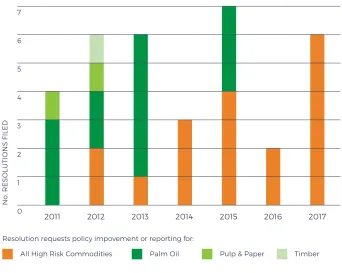
Proposals increasingly address all forest risk supply chains rather than focus on individual commodities. Most effective resolutions will go beyond blanket statements around improved sustainability and ask for specific, time-bound, and measurable change in company behaviour. Examining the shareholder resolutions in the Ceres database filed with Forest 500 companies, we find proposals increasingly address all forest risk supply chains rather than focus on individual commodities. As shown in Figure 1, the majority of proposals between 2011 and 2015 focused solely on palm oil, but in following years proposals covering all high-risk forest commodities increased.
This trend is especially relevant for commitments on cattle, given they lag far behind the commitments for palm oil. In 2016, only 32% of US-headquartered Forest 500 companies had a forest policy in place for cattle products, in contrast to 94% of companies for palm oil. Shareholder resolutions filed in 2017 continue to address this gap, with all six filed with Forest 500 companies covering all forest risk commodities, including cattle.
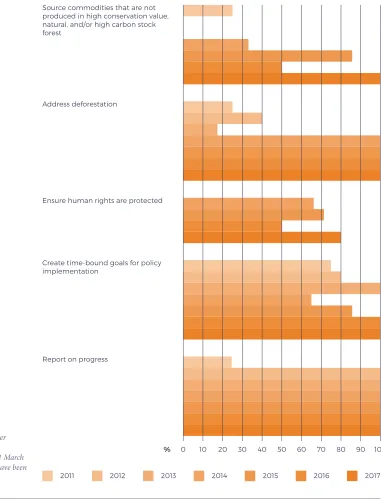
Shareholder resolutions are increasingly specific. This is both in terms of forest issues and the implementation of policies. Since 2015, proposals with Forest 500 companies have moved beyond asking companies to ‘address deforestation’ to specify particular land types that must be protected, using terminology such as high conservation value and natural or high carbon stock forest (Figure 2). In addition, around 90% of resolutions since 2011 ask that policies apply to all suppliers or are applied company-wide.
Proposals support better reporting. An increasing number of proposals request companies establish ‘time-bound’ goals along with public reporting (in contrast to reporting privately only to investors). With such requests, shareholder resolutions hold companies to account regarding their commitments and foster greater transparency around implementation. This is especially important as the Forest 500 finds that only 51% of US companies report for all existing policies.
Not all proposals include human rights protections. Companies may already protect human rights through overarching policies, yet there is potential for investors to file more resolutions which address social and environmental considerations together. While 87% of US-headquartered Forest 500 companies require their suppliers to respect workers’ rights, only 21% require free prior informed consent of indigenous and local communities as part of development planning for all the forest risk commodities they procure. Incorporating protections for human rights is viewed as best practice by many groups working on supply chain sustainability, such as the Consumer Goods Forum9.
9 For example, see: The Consumer Goods Forum. 2015. ‘Sustainable Palm Oil Sourcing Guidelines’. Available from: http://www.theconsumergoodsforum.com/files/ Publications/20150810-Sustainable-Plam-Oil-Sourcing-Guidelines-Final-Version-1.pdf
Regardless of the content of these resolutions, proposals only have the potential to drive change if companies respond. To what degree have shareholder resolutions led to the adoption or strengthening of company policies? This following sections analyse filings with Forest 500 companies, the powerbrokers of deforestation.
Many shareholder resolutions were withdrawn when companies agreed to make changes following preliminary engagement. Others were withdrawn for technical reasons. Of the 50 proposals initially filed, only 23 went on to a vote.
Around half (52%) of the 23 proposals successfully filed were followed by a company commitment to address the forest issue raised, according to the Ceres database10. However, beyond this initial commitment, it is difficult to
track the direct influence of shareholder resolutions on corporate policy, as company decisions occur within a broader context. Shareholder resolutions are often only one facet of an active ownership strategy and considerations such as an NGO campaign or competitor decision may spark shareholder dialogue in the first place.
There is some evidence that investor engagement causes company policy change. For example, Archer Daniels Midlands (ADM) is one of the largest soya traders in the world. A resolution filed in 2015 with ADM requested the company introduce time-bound policy goals to reduce deforestation. Prior to reaching a vote, ADM committed to address the issue and the proposal was withdrawn11. The resolution led the company to establish a no-deforestation policy for soybeans and palm oil with stronger, time-bound commitments12 and become the first major agricultural trader to expand its action plan for forest conservation beyond the Brazilian Amazon13,14.
However, in some cases the impact of shareholder resolutions is less clear. In 2014, shareholders of both Mondelez and PepsiCo requested these food and drink companies create company-wide policies on deforestation. The requests covered palm oil, soya, sugar and paper15,16. Although the shareholders withdrew the proposals after commitments to address the requests, significant progress is yet to be seen. PepsiCo took an incremental step by releasing an updated palm oil policy less than a year later17.
Nonetheless, as of 2016, the Forest 500 found both companies had yet to publish strong public policies for all of these commodities.
Company
responses
10 This analysis does not include the 11 shareholder resolutions listed as ‘filed’, or that were omitted or not voted on due to technical reasons. Calculations as of 9 May, 2017.
11 Ceres. 2015. ‘ADM Deforestation 2015’. Available from: https://www.ceres.org/investor-network/resolutions/adm-deforestation-2015
12 ADM. 2015. Our Commitment to No-Deforestation.
Available from: https://www.adm.com/sustainability/sustainability-progress-tracker/policies
13 Green Century Funds. 2015. ‘Will you join us in thanking ADM for protecting forests?’ Available from: http://greencentury.com/will-you-join-us-in-thanking-adm-for-protecting-forests/
14 Forest Heroes. 2015. ‘Soy, Palm Oil: End Deforestation’. Available from: http://www.forestheroes.org/adm-to-suppliers-of-soy-palm-oil-end-deforestation/
15 Ceres. 2014. ‘Mondelez Sustainable Forestry 2014’. Available from: http://tools.ceres.org/resources/tools/resolutions/mondelez-sustainable-forestry-2014/@@s3_view
16 Ceres. 2014. ‘Pepsi Deforestation 2014’. Available from: http://tools.ceres.org/resources/tools/resolutions/pepsi-deforestation-2014/@@s3_view
17 PepsiCo. 2015. ‘PepsiCo Palm Oil Specific Commitments.’ Available from: http://www.pepsico.com/docs/album/policies-doc/pwp/pepsico-palm-oil-commitment-3.pdf?sfvrsn=0
While proposals have the potential to drive significant change in company deforestation policies, very few shareholders are using this engagement method to express concerns. Shareholder resolution filing remains a marginal strategy for spurring company sustainability improvements.
The majority of proposals are filed by only a handful of investors. Just three investors – Domini Impact Investments LLC, Green Century Capital Management, and the New York State Comptroller – filed 59% of all resolutions with Forest 500 companies. Among the 13 investors that filed forest-related resolutions, many follow a socially responsible or religious investment mandate, suggesting that shareholder resolutions are not commonly used by conventional investors.
The investors filing forest-focused resolutions do not hold the largest investments in companies operating in commodity supply chains. Of the investors listed in the Ceres database, only one - the New York State Comptroller – makes it into the Forest 500 as one of the 150 financial institutions holding the largest investments in publicly listed powerbroker companies. This is through the New York State Comptroller’s role as the sole trustee of the New York State Pension Fund.
Support for proposals by shareholders averages around 20%. This support is an important factor in prompting change, as it demonstrates to a company’s management that resolutions reflect mainstream investor concerns. Votes in support of resolutions with Forest 500 companies are generally at similar levels to other climate-focused proposals. As investors become increasingly aware of supply chain risks, it is hoped that support for forest resolutions will increase, as has been the case for climate concerns with key oil and gas companies. For example, in May 2017, a surprising 62% of shareholders voted for Exxon Mobil to begin annually reporting its climate impacts, an increase from 38% for a similar proposal in 201618,19.
Shareholder
resolutions:
powerful but
marginal
18 Exxon Mobil. 2017. ‘Summary of 2017 Proxy Voting Results’. Available from: http://cdn.exxonmobil.com/~/media/global/files/investor-reports/2017/summary-of-proxy-votes-2017.pdf
Analysis suggests that shareholder resolutions are increasingly common and have potential to drive company action on deforestation, especially given their focus on companies with the most influence over forests. The filings from the Ceres Investor Network are encouraging as they show requests have expanded over time to cover more key forest issues as well as all high priority supply chains.
Regardless of the content, resolutions only stand to drive systemic improvements in sustainability if they are used by a greater number and wider variety of investors or, at a minimum, investors show high levels of support for company action. As the data on filings in the past seven years suggests, proposals have a fairly high success rate in sparking company engagement on deforestation issues. At the very least, such resolutions are supportive of policy improvements. However, the fact that only one Forest 500 investor is using shareholder resolutions to drive change underscores that proposals on forest issues remain a niche engagement method for the time being.
Overall, this research points to a possible strategy for action.
While different engagement strategies suit differing purposes,
investors wishing to drive positive change should take note of
the reasonably high degree to which shareholder resolutions are
successful in prompting company engagement on forest issues.
This table documents the 50 forest focused filings by the Ceres Investor Network as of 5th June 2017.
Annex:
Shareholder Resolutions
Company Year Forest 500
company Sector
Resolution
Summary Filer Status
Dominion
Resources, Inc. 2017 No Electric Power
Evaluating the net greenhouse gas impact from each of the company’s current
and planned biomass facilities
As You Sow
Withdrawn; Ongoing dialogue
Domino’s Pizza,
Inc. 2017 Yes
Food and Beverage
Develop policy and plan to eliminate deforestation from
supply chain
New York State
Comptroller Vote: 23.1%
Kraft Heinz Co. 2017 Yes Food and
Beverage
Report on supply chain impact on deforestation
Domini Impact
Investments LLC Vote: 13.1%
Kroger Co. 2017 Yes Retail
Report on supply chain impacts of
deforestation
Green Century Capital
Plan to eliminate deforestation and human rights violations
from supply chain
Seventh Generation Interfaith Coalition
for Responsible Investment
Withdrawn; Company will address
Target Corp. 2017 Yes Retail
Issue annual reports on supply chain impact on
deforestation
Green Century Capital Management
Filed
Yum! Brands,
Inc. 2017 Yes Retail
Adopt deforestation-free policy
Sisters of St. Francis of Assisi
No Vote For Technical
Reasons
Church &
Dwight Co. Inc. 2016 No
Consumer Goods
Palm oil implementation report
Seventh Generation Interfaith Coalition
for Responsible Investment
Withdrawn; Company will address
DuPont 2016 Yes Chemicals
Issue a report on reducing deforestation associated with supply
chain
Clean Yield Asset
Management Vote: 23%
Restaurant
Set goals to reduce impacts on forests and
human rights
Province of St. Joseph, Capuchin
Order
2016 No Food and Beverage Report on deforestation impacts Trillium Asset Management
Company Year Forest 500
company Sector
Resolution
Summary Filer Status
Whole Foods
Market, Inc. 2016 No
Food and Beverage
Report on palm oil sourcing policy
Clean Yield Asset Management
Withdrawn; Company will address
Archer Daniels Midland Company
2015 Yes Agriculture Adopt goals to reduce
deforestation
New York State Comptroller
Withdrawn; Company will address
Bunge Limited 2015 Yes Agriculture
Time-bound goals for reducing impacts on
deforestation
Green Century Capital Management
Vote: 29.3%
Dominion
Resources, Inc. 2015 No Electric Power
Report on bioenergy
risks Marion Edey Vote: 22%
DuPont 2015 Yes Chemicals Sustainable forestry
report
Clean Yield Asset Management
Holdings Inc. 2015 No
Consumer Goods
Adopt sustainable palm oil sourcing policy
Sisters of the Presentation of the Blessed Virgin
Mary
Vote: 29%
Kraft Foods Inc. 2015 Yes Food and
Beverage
Assess supply chain impacts on
deforestation
Domini Impact
Investments LLC Vote: 30.3%
McDonald’s
Corp. 2015 Yes
Food and Beverage
Report on curtailing deforestation from
palm oil
Green Century Capital Management
Vote: 7%
Target Corp. 2015 Yes Retail
Report on metrics for sourcing sustainable
palm oil
New York State Comptroller
Withdrawn; Company will address
Tyson Foods
Inc. 2015 Yes
Food and Beverage
Tyson sustainable palm oil implementation
reporting
New York State
Comptroller Vote: 9.7%
Walgreen Co. 2015 No Retail
Include sustainability metrics in executive
compensation
Clean Yield Asset
Management Vote: 5.7%
J. M. Smucker
Company 2014 No
Consumer Goods
Report on deforestation impacts in supply chain
Clean Yield Asset Management
Withdrawn; Company will address
J. M. Smucker
Company 2014 No
Consumer Goods
Assess supply chain impacts on
deforestation
Clean Yield Asset Management
Withdrawn; Company will address
Kraft Foods Inc. 2014 Yes Food and
Beverage
Sustainable forestry report
Domini Impact Investments LLC
Sustainable forestry report
Domini Impact Investments LLC
Withdrawn; Company will address
Panera Bread
Company 2014 Yes
Food and Beverage
Palm oil sourcing policy implementation
Franciscan Sisters of Perpetual
Adoration
No Vote For Technical
Company Year Forest 500
company Sector
Resolution
Summary Filer Status
PepsiCo, Inc. 2014 No Food and
Beverage
Report on deforestation impacts in supply chain
Domini Impact Investments LLC
Withdrawn; Company will address
Sysco Corp. 2014 No Food and
Beverage
Disclose impact of palm oil sourcing on forests
and human rights
Sisters of St. Dominic of Racine,
Wisconsin
Filed
Church &
Dwight Co. Inc. 2013 No
Consumer
Goods Palm oil policy
Province of St. Joseph, Capuchin
Order
2013 No Food and Beverage
Adopt and implement a comprehensive sustainable palm oil
policy
Sisters of the Presentation of the Blessed Virgin
Mary
Filed
Dean Foods
Company 2013 No
Food and Beverage
Adopt and implement a comprehensive sustainable palm oil
policy
Sisters of St. Francis of Dubuque, Iowa
Withdrawn; Company will address
Dunkin’ Brands 2013 Yes Food and
Beverage Palm oil sourcing
New York State Comptroller
Withdrawn; Company will address
Estee Lauder
Companies Inc. 2013 Yes
Consumer
Goods Palm oil policy
Sisters of St.
Francis of Assisi Filed
Kroger Co. 2013 Yes Food and
Beverage
Adopt and implement a comprehensive sustainable palm oil
policy
Sisters of the Presentation of the Blessed Virgin
Mary
Deforestation impact and risk mitigation
report
Domini Impact
Investments LLC Omitted
Starbucks
Corporation 2013 Yes
Food and
Beverage Palm oil policy
Green Century Capital Management
Withdrawn; Company will address
Sysco Corp. 2013 No Food and
Beverage
Adopt a palm oil sourcing policy
New York State Comptroller
Withdrawn; Company will address
Yum! Brands,
Inc. 2012 Yes
Food and Beverage
Comprehensive sustainable palm oil
policy
Trillium Asset Management
Withdrawn; Ongoing dialogue
Colgate-Palmolive Co. 2012 Yes
Consumer
Goods Palm oil sourcing
Calvert Research & Management
Withdrawn; Company will address
H. J. Heinz
Company 2012 Yes
Food and Beverage
Sustainable forestry report
Benedictine Sisters of Virginia
Withdrawn; Company will address
J. M. Smucker
Company 2012 No
Food and
Beverage Palm oil sourcing
New York State Comptroller
Withdrawn; Company will address
Kraft Foods Inc. 2012 Yes Food and
Beverage
Sustainable forestry report
Domini Impact
Company Year Forest 500
company Sector
Resolution
Summary Filer Status
Lowe’s
Companies Inc. 2012 Yes Big Box/Retail
Sustainable forestry report
Domini Impact Investments LLC
Withdrawn; Company will address
R.R. Donnelley & Sons Company
2012 Yes Business
Services
Sustainable paper sourcing
Domini Impact
Investments LLC Vote: 26.7%
Yum! Brands,
Inc. 2012 Yes
Food and Beverage
Comprehensive sustainable palm oil
policy
Trillium Asset
Management Vote: 37%
Archer Daniels Midland Company
2011 Yes Agriculture Palm oil sourcing
The Nathan Cummings Foundation
Vote: 4.2%
Avon Products
Inc. 2011 Yes
Consumer
Goods Palm oil sourcing
The Nathan Cummings
Company 2011 Yes
Food and
Beverage Palm oil sourcing
Adrian Dominican Sisters
Withdrawn; Company will address
R.R. Donnelley & Sons Company
2011 Yes Business
Services
Sustainable paper sourcing
Domini Impact