FACULTY OF ENGINEERING YOGYAKARTA STATE UNIVERSITY
SYLLABI OF BUILDING PLANNING 1
No. SIL/TSP/TSP 224/50 Revision: 00 Date : 01 April 2008 Page 1 of 4
Editor : Retna H,PhD It is prohibited to reproduce part or all of the contents without the written permission of the Faculty of Engineering, Yogyakarta
State University
Approved by : Drs Agus Santosa, MPd
SUBJECT : BUILDING PLANNING 1
SUBJECT CODE : TSP 224
SEMESTER : GASAL
STUDY PROGRAM : CIVIL ENGINEERING AND PLANNING EDUCATION (S1)
LECTURER : TEAM
I. SUBJECT DESCRIPTION
Building Planning 1 introduce about procedures, steps, analysis processes should be conducted in building planning. These processes covered of:
1. Spatial Programming and Building Analysis.
This process discusses the technique to do analysing processes: space requirement, space dimension, zoning system, space organization and relation, design module determination, and building performance.
2. Site Analysis.
This process discusses working technique in site to do site selection and to determine: site gridline, structural module, building composition and arrangement. In this subject the student should carry out the planning process of public function of a single building in a defined site as a final project which consists of two documents; those are:
1. Design concept of spatial, building, and site composition and arrangement.
2. Architectural design drawings (site plan, floor plan, elevation, section); structural design (roof, foundation, column-beam); and building utility.
II. ACHIEVEMENT OF COMPETENCY
1. Introduce the technique to list space need for a public building function.
2. Introduce the technique to decide space dimension of a public building by applying both space requirement standard and anthropometric standard.
3. Establish spatial grouping according to a defined requirement
4. Calculate total spatial need and requirement according to local BCR regulation 5. Analyze site selection according to a defined function criteria
6. Analyze the site to perform appropriate composition and arrangement for a public function.
7. Establish design concept for a public function 8. Prepare architectural and structural drawing.
FACULTY OF ENGINEERING YOGYAKARTA STATE UNIVERSITY
SYLLABI OF BUILDING PLANNING 1
No. SIL/TSP/TSP 224/50 Revision: 00 Date : 01 April 2008 Page 1 of 4
Editor : Retna H,PhD It is prohibited to reproduce part or all of the contents without the written permission of the Faculty of Engineering, Yogyakarta
State University
Approved by : Drs Agus Santosa, MPd
III. INDICATORS OF COMPETENCY ACHIEVEMENT
A. Cognitive aspects
1. Able to describe the technique to list space need for a public building function 2. Able to explain the technique to decide space dimension of a public building by
applying both space requirement standard and anthropometric standard. 3. Able to establish spatial grouping according to a defined requirement
4. Able to calculate total spatial need and requirement according to local BCR regulation
5. Able to carry out site selection according to a defined function criteria
6. Able to carry out site analyse to perform appropriate composition and arrangement for a defined function.
7. Able to establish design concept for a defined function 8. Able to prepare architectural and structural drawing.
B. Psychomotor aspect
Able to prepare architectural and structural drawing of a public function by both hand- drawing and computerized drawing.
C. Affective, social and personal aspects
1. Able to accurately interpret the procedure of planning
2. Able to logically carry out the planning and design processes in a certain time.
3. To have responsibility and discipline in carry out the assignment
4. Able to cooperatively work in a team and able to express the opinions in discussion/presentation forum
5. To have open-minded and responsibility attitude concerning information of new technology
IV. REFERENCES
1. Sumardjito, Pokok-pokok Materi Kuliah Perencanaan Bangunan 1, 2005 2. Fakultas Teknik UI, Perancangan Yang Sistematis,
3. Christoper Jones, Design Method 4. Ernest Neufert, Architect’s Data 5. Edward T. White, Site Analysys 6. Panero, Human & Interior Space
V. ASSESMENT PROVISION
Assessment aspects for this subject consist of: 1. Presence and Participation in Class
FACULTY OF ENGINEERING YOGYAKARTA STATE UNIVERSITY
SYLLABI OF BUILDING PLANNING 1
No. SIL/TSP/TSP 224/50 Revision: 00 Date : 01 April 2008 Page 1 of 4
Editor : Retna H,PhD It is prohibited to reproduce part or all of the contents without the written permission of the Faculty of Engineering, Yogyakarta
State University
Approved by : Drs Agus Santosa, MPd
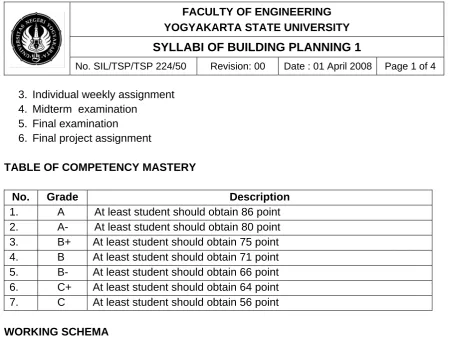
3. Individual weekly assignment 4. Midterm examination
5. Final examination 6. Final project assignment
TABLE OF COMPETENCY MASTERY
No. Grade Description
1. A At least student should obtain 86 point
Week Basic competence Basic Learning Learning
strategy
Reference
1-2 Introduce the technique to analyze spatial need and dimension
1. Spatial need and require-ment standard
2. Anthropometric Standard 3. The ways to calculate
spatial dimension
1. Lecture 2. Discussion
IV 1-6
3-4 Introduce the technique
to analyze spatial organi-zation and zoning
1. Spatial need, requirement, and characteristic of a public function
2. Spatial need, requirement, and characteristic of a defined zone
3. Spatial organization
analysis and zone process in a public function
Analyze spatial need, organization and zoning
6-8 Explain the mechanism
/analysis process to decide structural and building utility systems .
1. Building structural system and requirement
2. Building utility system and requirement
3. Building structural and utility analysis
FACULTY OF ENGINEERING YOGYAKARTA STATE UNIVERSITY
SYLLABI OF BUILDING PLANNING 1
No. SIL/TSP/TSP 224/50 Revision: 00 Date : 01 April 2008 Page 1 of 4
Editor : Retna H,PhD It is prohibited to reproduce part or all of the contents without the written permission of the Faculty of Engineering, Yogyakarta
State University
Approved by : Drs Agus Santosa, MPd
do site selection and analysis for a public function
teristic of location for a public function
2. Characteristic of site 3. Site selection criteria
2. Assignment 3. Exercise 4. Discussion
11-16 Working process to
prepare design concept and to do architectural design drawing for a public function
Implementation of the theory into a final project
1. Lecture 2. Consultation 3. study case 4. Discussion