27 Vol. 17, No. 1 TEACHER BURNOUT AND ORGANIZATIONAL CITIZENSHIP BEHAVIOR IN
TURKISH ELEMENTARY SCHOOLS Cemil Yucel
ABSTRACT
Today’s organizations demand people who have the habit of working voluntarily without any need for supervision and control, who tolerate limited resources and negative circumstances, who refrain from being negative, who share expertise with others, and who quest for new developments for the wellbeing of the organization. Being a hard working, patient, altruistic, punctual, collaborative employee mostly depends on not developing a syndrome called burnout. Employee behaviors such as helping others (e.g.
supportive actions to assist others and going beyond the job requirements), sportsmanship (e.g. tolerating
the work conditions, refraining from complaining), civic virtue (e.g. active engagement in organizational development and improvement) are called Organizational Citizenship Behaviors (OCB) (Mackenzie, Podsakoff, & Praine, 1999). Such behaviors are critical for organizational effectiveness (George & Brief, 1992; Karambayya, 1990; Podsakoff and MacKenzie, 1997; Podsakoff, MacKenzie, and Aherne, 1997). Employees who exhibit these behaviors are those who have the dispositional personality characteristics such as agreeableness and conscientiousness (George & Brief, 1992; Konovsky & Organ, 1996). This study investigates whether there is a relationship between teacher burnout and OCB.
INTRODUCTION
The study investigates whether there is a relationship between teacher burnout and organizational citizenship behavior. Burnout is a phenomenon of physical, emotional, and mental exhaustion (Freudenberg, 1974). It manifests itself by decreasing job-involvement, depersonalization (isolation), and feeling of reduced personal accomplishment. The feelings of physical, emotional, and mental exhaustion are considered to be the results of work stress (Golembiewski, Munzenrider, & Carter; 1983). Burnout can be observed among individuals who work with people (Maslach, 1982), and it can be common among people who work in communication intensive professions. Stressful conditions resulting from lack of appreciation and recognition, limited self-development opportunities, isolation from coworkers, limited career advancement opportunities, lack of professional autonomy, low salaries, unmotivated students, heavy work-load, time consuming administrative procedures, low social status of teaching and like are all well-known reasons for teacher burnout (Briggs & Richardson, 1993). The level of burnout can explain why some teachers demonstrate OCB and others not. To make sure that any relation between OCB and burnout is a unique one, other contaminating effects must be ruled out. Therefore; in the present study, an attempt is necessary to rule out some possible effects of other variables. Otherwise any result showing a relation between OCB and burnout can be misleading. Organizational justice, life satisfaction, and self esteem variables were introduced to this study as control variables. OCB may be the result of these variables. Any variance explained by these variables needs to be partialed out. Furthermore, to ind unique contribution of burnout, some dispositional characteristics that may have impact on organizational citizenship behaviors need to be considered. Personal values related to work may somehow produce or increase the likelihood of exhibiting OCB. Without partialing the effect of such work values from OCB, any relationship found between burnout and OCB will be misleading. Some of the variance in OCB can be due to these values rather than burnout. These statistical controls are carried out by regression procedures.
ORGANIZATIONAL CITIZENSHIP BEHAVIOR
effective functioning of the organization.” According to Organ (1988), the operational deinition has two types of behaviors: (a) active positive contributions, such as punctuality and attendance beyond what is strictly enforced, as well (b) avoidance from harm to colleagues or organization (sportsmanship), such as refraining from complaints, appeals, and accusations. Organ (1988) suggested that sportsmanship is less appreciated than other behaviors. According to Organ (1988), OCB has 5 dimensions: conscientiousness (e.g. punctuality), sportsmanship (e.g. avoiding unnecessary reactions), courtesy (e.g. giving advance notice), altruism (e.g. helping new comers), and civic virtue (e.g. learning and sharing for the good of organization). Constructs studied in relation to OCB as antecedents are job satisfaction, organizational commitment, interpersonal trust (Podsakoff, MacKenzie, Moorman, & Fetter, 1990), and mood of the employee and organizational justice (Konovsky & Pugh, 1994). The construct of OCB is widely studied in relation to other constructs such as job satisfaction, dyadic relationship quality, demographic variables, task characteristics, pay systems, and group characteristics; however, these variables account for approximately 10% of variance in OCB (Barr & Pawar, 1995). Thus, there is a continued need for more studies.
BURNOUT
There are three kinds of burnout (Pierce & Molloy, 1990). The irst is the feelings of emotional exhaustion and fatigue. Second is the negative, cynical attitude toward their students. The third is the negative self-evaluation due to feelings of lack of personal accomplishment. Burnout has been considered to be resulting from prolonged exposure to intense emotional stress. Pines et al (1981) add that feelings of helplessness and hopelessness and development of negative attitudes towards work, life and other people are all characteristics of the phenomenon. Teacher burnout also leads to a decrease in the quality of teaching, absenteeism, and premature turnover from the profession (Cherniss, 1980). The phenomenon is a strong predictor of thought of quitting the job (Jackson et al, 1986). Because of limited employment opportunities outside, the majority of the teachers intending to quit the job are “lucked-in” (Garcia, 1981). This fact creates a high level of prolonged stress fed by inordinate time demands, large class size, lack of resources, and limited involvement in decision making (Brissie, Hoover-Dempsey, & Bassler, 1988; Cunningham, 1983; Friedman, 1991). Teachers become less lexible towards students, lower expectations from students, and display low commitment to teaching (Cherniss, 1980; Farber & Miller, 1981; Maslach, 1976).
Burnout starts with energy exhaustion. A person feels worn out and unable to ind the power to continue daily life. The exhausted person thinks that things will not end as they should . Such person may even quit trying. The employee becomes horriied in the face of going to work one more day. Alienation from other people, insensitivity towards other people’s feelings and depersonalization are also common among burnout. Lastly, burnout individuals begin to believe that they are incompetent persons (Cordes & Dougherty, 1992).
If the expectations of teachers are not met in the work environment, it may trigger symptoms of burnout. Such organizational conditions as a reward system, advancement opportunities, friendly climate, and decision making processes are important determinants of burnout (Cordes & Dougherty, 1992). When expectations and organizational conditions are not met, work stress is inevitable (Iwanicki, 2001). People working in the same organization, however, may experience different levels of burnout. Differences in expectations and personality traits (Cordes & Dougherty, 1993), such as degree of locus of control (Schwab, 2001), are not the same for each person. For instance, people with external locus of control may experience higher levels of burnout than people with internal locus of control (Schwab, 2001). It is important to understand personal and environmental factors that may result in burnout because curing this illness is possible only by isolating and ixing these factors (Schwab, 2001).
CONTRIBUTION OF THE STUDY
29 Vol. 17, No. 1 METHOD
Population and Sample
The population of the study consisted of 1,069 elementary (grades 1-5) school teachers working in the public school system of Usak Province, Turkey. Instruments were distributed to a random sample of 450 teachers in 42 elementary schools over the course of 5 days. The number of instruments returned was 367. Table 1 shows the distribution of male and female teachers in the population and sample.
Table 1:
Distributions of Male and Female Teachers
Male % Female % Total
Population 657 61% 412 39% 1069
Sample 211 58% 156 42% 367
Dependent Variable
The study utilized OCB as the dependent variable. Behaviors such as helping others (e.g. supportive actions to assist others and going beyond the job requirements), sportsmanship (e.g. tolerating the work conditions, refraining him/herself from complaining), civic virtue (e.g. active engagement in organizational development and improvement) are considered as outcome variables that are more likely to be inluenced by the feelings of teachers such as emotional exhaustion, fatigue, the negative, cynical attitude toward others, and the negative self-evaluation due to feelings of lack of personal accomplishment. OCB also may be inluenced by personally held work values and perceived work conditions.
Instruments
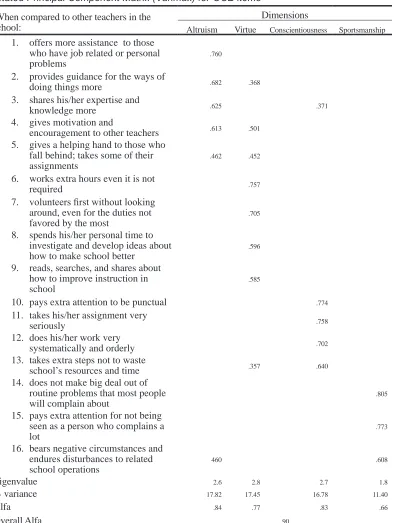
To measure burnout and OCB, a set of item pools were generated. Previously, more than seven studies used different versions of the OCB instrument (Unal, 2003; Keskin, 2005; Atalay, 2005; Mercan, 2006; Donder, 2006; Samanci, 2006; Kaynak, 2007; & Samanci, 2007) . Item development started in 2002. Reliabilities and validity improved over the time. The instrument properties were better than most of the instruments available in the literature. The pool of items generated over the years was examined and the best functioning were chosen for a new pilot test.
A pilot study was carried out for item analyses. The items that survive the item analyses, conducted using the pilot data, were subjected to a principal component analysis, conducted using the research sample data. A varimax rotation was used to extract factors. The factor structure resulting from the pilot sample data and in the research sample data were compared. A score on each dimension was calculated for each respondent by adding the teachers’ responses to items grouped under each factor. This score was divided by the number of items in the dimension. The procedure yielded a score on each dimension for each teacher.
Likert type scaling was used in each item. For OCB items, teachers were asked to rate themselves for each item. Instructions were as follows: “if we ask your colleagues in your school, how would they describe you?” For OCB items, responses were: My coworkers would say (a) Never behaves like this, (b) Seldom behaves like this, (c) Time to time behaves like this, (d) Most of the time behaves like this, and (e) Always behaves like this. OCB items were grouped under four dimensions. Content and meaning of items in each dimension were examined and named accordingly. Dimensions were named as follows: the irst dimension as altruism; the second as civic virtue; the third as conscientiousness; and, the forth as sportsmanship. Overall reliability and reliability for each dimension were found acceptable.
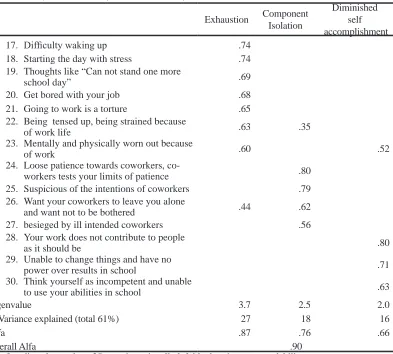
(depersonalization); the third as diminishing self-accomplishment. Overall reliability and reliability for each dimension were found acceptable.
Table 2:
Rotated Principal Component Matrix (Varimax) for OCB items
When compared to other teachers in the school:
Dimensions
Altruism Virtue Conscientiousness Sportsmanship
1. offers more assistance to those who have job related or personal problems
.760
2. provides guidance for the ways of
doing things more .682 .368
3. shares his/her expertise and
knowledge more .625 .371
4. gives motivation and
encouragement to other teachers .613 .501
5. gives a helping hand to those who fall behind; takes some of their assignments
.462 .452
6. works extra hours even it is not
required .757
7. volunteers irst without looking around, even for the duties not favored by the most
.705
8. spends his/her personal time to investigate and develop ideas about how to make school better
.596
9. reads, searches, and shares about how to improve instruction in school
.585
10. pays extra attention to be punctual .774
11. takes his/her assignment very
seriously .758
12. does his/her work very
systematically and orderly .702
13. takes extra steps not to waste
school’s resources and time .357 .640
14. does not make big deal out of routine problems that most people will complain about
.805
15. pays extra attention for not being seen as a person who complains a lot
.773
16. bears negative circumstances and endures disturbances to related school operations
460 .608
Eigenvalue 2.6 2.8 2.7 1.8
% variance 17.82 17.45 16.78 11.40
Alfa .84 .77 .83 .66
Overall Alfa .90
31 Vol. 17, No. 1 Table 3:
Rotated Component Matrix (Varimax Rotation) for Burnout Items
Exhaustion Component Isolation
Diminished self accomplishment
17. Dificulty waking up .74
18. Starting the day with stress .74
19. Thoughts like “Can not stand one more
school day” .69
20. Get bored with your job .68
21. Going to work is a torture .65
22. Being tensed up, being strained because
of work life .63 .35
23. Mentally and physically worn out because
of work .60 .52
24. Loose patience towards coworkers,
co-workers tests your limits of patience .80
25. Suspicious of the intentions of coworkers .79
26. Want your coworkers to leave you alone
and want not to be bothered .44 .62
27. besieged by ill intended coworkers .56
28. Your work does not contribute to people
as it should be .80
29. Unable to change things and have no
power over results in school .71
30. Think yourself as incompetent and unable
to use your abilities in school .63
Eigenvalue 3.7 2.5 2.0
% Variance explained (total 61%) 27 18 16
Alfa .87 .76 .66
Overall Alfa .90
Note: Loadings lower than .35 were intentionally left blank to improve readability.
Table 4:
Rotated Component Matrix (Varimax Rotation) for Justice, Life satisfaction,
and Self-esteem
31. Our administration is fair running the school .9432. In assignments, schedules, and like, fair- ness is
always meticulously followed .93
33. All procedures are fair and just in this school .89
34. I get satisfaction from life .91
35. May days pass with full of joy .87
36. I could not be happier than this .86
37. I wish I could have more self-esteem .80
39. I do not have control over what is happening
around me .74
40. I give up easily when confronted with
disagreement from other side .72
Eigenvalue 2.6 2.4 2.4
Alfa .91 .86 .76
Note: Loadings lower than .35 were intentionally left blank to improve readability. İtems in self esteem dimensions were negatively worded.
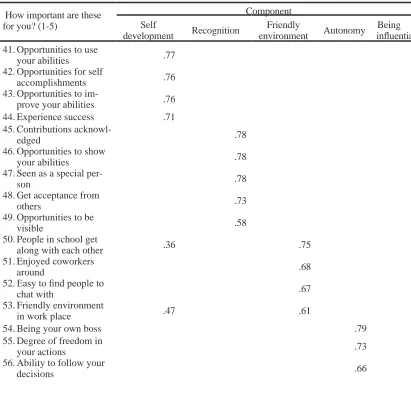
A pool of items related to personal work values was tested by utilizing principal component analy-sis. During the item writing process, each item was written intentionally to fall under a speciic value category. The result of the principal component analysis revealed that each item had a high loading on its own dimension as intended. Table 5 shows the items and dimensions. Reliabilities and loadings are acceptable. Teachers were asked to rank the importance of each statement. Responses were ranging from have no importance (1) to have a great importance (5).
Table 5:
Rotated Component Matrix (Varimax Rotation) for Work Values Items
How important are these for you? (1-5)
47. Seen as a special
per-son .78
48. Get acceptance from
others .73
49. Opportunities to be
visible .58
50. People in school get
along with each other .36 .75
51. Enjoyed coworkers
54. Being your own boss .79
55. Degree of freedom in
your actions .73
56. Ability to follow your
33 Vol. 17, No. 1 57. Flexibility in work
schedule .56 0
58. Have authority over
things .83
59. People listen to what
you say .74
60. Have a say in decisions .40 .35 .48
Eigenvalue 3.2 3.1 2.1 2.1 1.9
% Variance explained (total
62%) 16.2 16 11 11 9
Alfa .83 .84 .70 .70 .74
Overall Alfa .86
Note: Loadings lower than .35 were intentionally left blank to improve readability
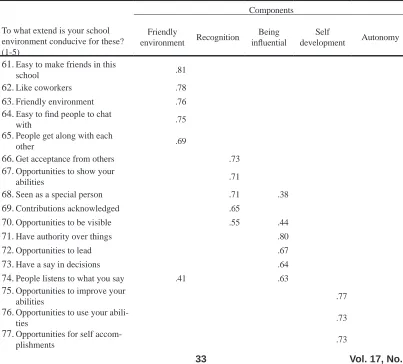
For each work value item, an item representing organizational conduciveness for the corresponding item is generated during item writing process. These items were subjected to a principal component analysis. For example: while in work values section, teachers were asked “How important for you to have a say in decision making process in your school,” in organizational environment section, teachers were asked “to what extend your school is conducive for you to have a say in decision making process.”
Table 6:
Rotated Component Matrix (Varimax Rotation) for Environmental İtems
Components
To what extend is your school environment conducive for these?
65. People get along with each
other .69
66. Get acceptance from others .73
67. Opportunities to show your
abilities .71
68. Seen as a special person .71 .38
69. Contributions acknowledged .65
70. Opportunities to be visible .55 .44
71. Have authority over things .80
72. Opportunities to lead .67
73. Have a say in decisions .64
74. People listens to what you say .41 .63
75. Opportunities to improve your
abilities .77
76. Opportunities to use your
abili-ties .73
77. Opportunities for self
78. Experience success .36 .52
79. Degree of freedom in your
actions .77
80. Ability to act on your own .71
81. Ability to follow your
deci-sions .68
82. Being your own boss .60
83. Flexibility in work schedule .39 .49
Eigenvalue 3.7 3.0 2.8 2.6 2.5
% Variance explained (total 63%) 16 13 12 11 11
Alfa .87 .83 .83 .83 .68
Overall Alfa .92
Note: Loadings lower than .35 were intentionally left blank to improve readability
The Unit of Analysis
For the present study, the unit of analysis is the individual teacher. All variables in this study are concerned with behavior, feeling, or attitudes of teachers. The interest is on how teachers react to feel-ings of burnout. The study does not utilize school as the unit because it will be very dificult to interpret relationships between aggregate school burnout scores and other variables. Similarly, it is not very use-ful to aggregate school scores for such variables as personal values, self-esteem and life satisfaction. Finally, using school as the unit would result in a sample size of 42 (number of schools), which would create a problem of getting reliable results from regression procedures due to decreasing n/k ratio.
Research Questions
The following main research question is formulated for this study:
Is there a relationship between organizational citizenship behavior and the level of teacher burnout? The following sub-research questions are formulated for the study:
1. Is there a relationship between civic virtue and dimensions of teacher burnout? 2. Is there a relationship between altruism and dimensions of teacher burnout? 3. Is there a relationship between conscientiousness dimensions of teacher burnout? 4. Is there a relationship between sportsmanship dimensions of teacher burnout?
RESULTS
35
V
ol. 17, No. 1
1 2 3 4 5 6 7 8 9 10 11 12 13 14 15 16 17 18 19 20 21 22 23
1. OCB 1.00 .86 .89 .84 .65 .20 .19 -.25 .24 .33 .33 .14 .18 .15 .32 .16 .32 .48 .40 -.22 -.21 -.17 -.25
2. Civic Virtue .86 1.00 .73 .65 .38 .20 .14 -.19 .22 .26 .22 .09 .09 .06 .26 .15 .34 .44 .38 -.20 -.18 -.18 -.23
3. Altruism .89 .73 1.00 .66 .42 .17 .13 -.26 .16 .29 .30 .13 .16 .14 .34 .12 .26 .49 .38 -.18 -.16 -.09 -.18
4. Conscientiousness .84 .65 .66 1.00 .42 .15 .16 -.21 .19 .34 .30 .15 .17 .15 .22 .15 .25 .37 .32 -.22 -.21 -.23 -.26
5. Sportsmanship .65 .38 .42 .42 1.00 .12 .20 -.12 .21 .17 .24 .09 .15 .13 .21 .08 .20 .21 .21 -.10 -.16 -.08 -.14
6. Years in teaching .20 .20 .17 .15 .12 1.00 -.03 .11 .00 -.04 -.16 -.13 -.12 -.10 .12 .08 .21 .24 .17 -.09 -.05 -.10 -.10
7. Life satisfaction .19 .14 .13 .16 .20 -.03 1.00 -.05 .26 .04 .08 .02 .12 -.01 .23 .19 .25 .22 .22 -.22 -.20 -.19 -.24
8. (lack of) Self-esteem -.25 -.19 -.26 -.21 -.12 .11 -.05 1.00 .06 -.06 -.29 -.20 -.10 -.08 -.14 .04 -.02 -.14 -.16 .34 .39 .24 .38
9. Organizational justice .24 .22 .16 .19 .21 .00 .26 .06 1.00 .10 -.02 -.01 -.09 -.09 .25 .31 .29 .29 .28 -.24 -.21 -.23 -.27
10. Valuing recognition .33 .26 .29 .34 .17 -.04 .04 -.06 .10 1.00 .34 .31 .38 .34 .26 .19 .17 .30 .39 -.09 -.12 -.11 -.12
11. Valuing self development .33 .22 .30 .30 .24 -.16 .08 -.29 -.02 .34 1.00 .35 .48 .44 .21 -.02 .07 .13 .05 -.21 -.22 -.16 -.23
12. Valuing autonomy .14 .09 .13 .15 .09 -.13 .02 -.20 -.01 .31 .35 1.00 .29 .28 .09 .18 .00 .04 .07 .00 -.04 -.02 -.02
13. Valuing friendly relations .18 .09 .16 .17 .15 -.12 .12 -.10 -.09 .38 .48 .29 1.00 .36 .36 .06 .09 .17 .05 -.04 -.11 -.08 -.08
14. Valuing being inluential .15 .06 .14 .15 .13 -.10 -.01 -.08 -.09 .34 .44 .28 .36 1.00 .08 -.01 -.06 .09 .06 .00 -.07 -.07 -.04 15. Friendly environment in
school .32 .26 .34 .22 .21 .12 .23 -.14 .25 .26 .21 .09 .36 .08 1.00 .30 .49 .55 .47 -.20 -.29 -.26 -.28
16. Autonomy in workplace .16 .15 .12 .15 .08 .08 .19 .04 .31 .19 -.02 .18 .06 -.01 .30 1.00 .46 .35 .39 -.21 -.13 -.24 -.22
17. Opportunities for self
development .32 .34 .26 .25 .20 .21 .25 -.02 .29 .17 .07 .00 .09 -.06 .49 .46 1.00 .53 .61 -.22 -.14 -.33 -.25
18. Opportunities for being
inluential .48 .44 .49 .37 .21 .24 .22 -.14 .29 .30 .13 .04 .17 .09 .55 .35 .53 1.00 .64 -.18 -.17 -.25 -.22
19. Degree of recognition for
contributions made .40 .38 .38 .32 .21 .17 .22 -.16 .28 .39 .05 .07 .05 .06 .47 .39 .61 .64 1.00 -.15 -.15 -.30 -.21
20. Emotional exhaustion -.22 -.20 -.18 -.22 -.10 -.09 -.22 .34 -.24 -.09 -.21 .00 -.04 .00 -.20 -.21 -.22 -.18 -.15 1.00 .62 .58 .93
21. İsolation -.21 -.18 -.16 -.21 -.16 -.05 -.20 .39 -.21 -.12 -.22 -.04 -.11 -.07 -.29 -.13 -.14 -.17 -.15 .62 1.00 .51 .82 22. Diminished self
accomplishment -.17 -.18 -.09 -.23 -.08 -.10 -.19 .24 -.23 -.11 -.16 -.02 -.08 -.07 -.26 -.24 -.33 -.25 -.30 .58 .51 1.00 .76
23. Burnout overall -.25 -.23 -.18 -.26 -.14 -.10 -.24 .38 -.27 -.12 -.23 -.02 -.08 -.04 -.28 -.22 -.25 -.22 -.21 .93 .82 .76 1.00
Table 8:
Correlations among Variables (n = 367
Table 7:
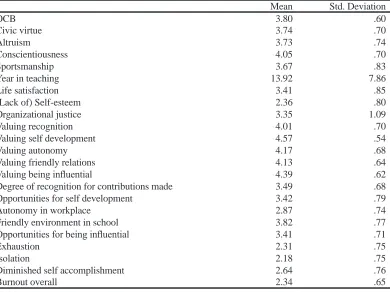
Descriptive Statistics (n=367)
Mean Std. Deviation
OCB 3.80 .60
Civic virtue 3.74 .70
Altruism 3.73 .74
Conscientiousness 4.05 .70
Sportsmanship 3.67 .83
Year in teaching 13.92 7.86
Life satisfaction 3.41 .85
(Lack of) Self-esteem 2.36 .80
Organizational justice 3.35 1.09
Valuing recognition 4.01 .70
Valuing self development 4.57 .54
Valuing autonomy 4.17 .68
Valuing friendly relations 4.13 .64
Valuing being inluential 4.39 .62
Degree of recognition for contributions made 3.49 .68
Opportunities for self development 3.42 .79
Autonomy in workplace 2.87 .74
Friendly environment in school 3.82 .77
Opportunities for being inluential 3.41 .71
Exhaustion 2.31 .75
İsolation 2.18 .75
Diminished self accomplishment 2.64 .76
Burnout overall 2.34 .65
Correlations revealed that OCB is more likely to be related to the opportunities given to the teachers to inluence others and have a say in decision making. İt seems that a teacher is more likely to exhibit OCB if he/she sees an opportunity to be visible and have a say in decisions. Also a teacher is more likely to show OCB when he/she see his/her contributions are acknowledged. İt is also evident that teachers valuing friendly environment and self improvement are more likely to exhibit OCB.
Stepwise regression procedures were used to examine the contribution of burnout to OCB behav-iors over and above work values of teachers and organizational conditions. It was found that burnout did not account for a signiicant change in explaining the variance in OCB over and above organizational factors and work values.
37 Vol. 17, No. 1 Table 9:
Stepwise Regression for Prediction of Overall OCB
β Std. Error
Std.
β t p
(Constant) .713 .329 2.169 .031
Opportunities for being inluential .179 .049 .213 3.645 .000
Valuing self development .277 .055 .246 5.007 .000
Degree of recognition for contributions made .123 .053 .138 2.316 .021
Years in teaching .012 .003 .161 3.508 .001
Organizational justice .076 .025 .137 3.019 .003
(Lack of) Self-esteem -.106 .034 -.144 -3.093 .002
Valuing recognition .104 .043 .120 2.396 .017
Gender .116 .052 .098 2.229 .026
R2 =, 39; Adj. R2 = 37; F = 25.74 p < .000001
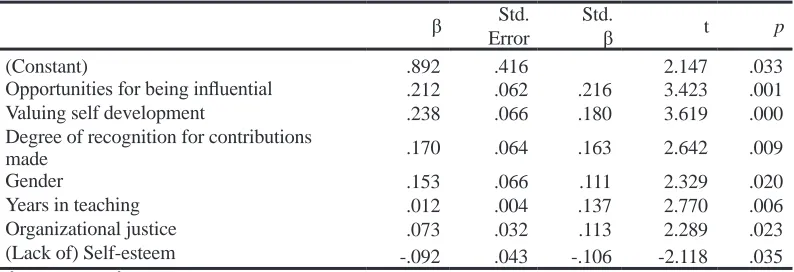
The same things can be said for the Table 10 where civic virtue is explained. The difference is the lack of value attached to recognition in the model. In this model, 27% of variance in civic virtue is accounted for by the linear combination of the opportunities for being inluential, valuing self develop -ment, the degree of recognition for contributions made, gender, years in teaching, organizational justice, and self esteem. Burnout, again, did not add any explanation to the variance of OCB over and above what already has been explained by these variables. This may mean that, even if the teacher is burned out, when she or he feels that things are fair, is recognized for his/her contributions, values self development, is given opportunities to exert inluence on things etc., he/she will continue to work extra hours. Even if it is not required, the teachers will volunteer irst without looking around for the duties not favored by others, spend personal time to investigate and develop ideas about how to make the school better, and read, search, and share about how to improve the instruction in school.
Table 10:
Stepwise Regression for Prediction of Civic Virtue
β Std.
Error
Std.
β t p
(Constant) .892 .416 2.147 .033
Opportunities for being inluential .212 .062 .216 3.423 .001
Valuing self development .238 .066 .180 3.619 .000
Degree of recognition for contributions
made .170 .064 .163 2.642 .009
Gender .153 .066 .111 2.329 .020
Years in teaching .012 .004 .137 2.770 .006
Organizational justice .073 .032 .113 2.289 .023
(Lack of) Self-esteem -.092 .043 -.106 -2.118 .035
R2=, 27; Adj. R2 = 26; F = 18.74 p < .000001
Table 11:
Stepwise Regression for Prediction of Altruism
β ErrorStd. Std.β t p
(Constant) -.071 .443 -.160 .873
Opportunities for being inluential .326 .060 .315 5.419 .000
Valuing self development .362 .065 .261 5.571 .000
(Lack of) Self-esteem -.143 .043 -.157 -3.334 .001
Gender .196 .065 .135 3.027 .003
Degree of recognition for contributions made .186 .063 .170 2.939 .004
Years in teaching .010 .004 .105 2.258 .025
Diminished self accomplishment .104 .046 .105 2.256 .025
R2 =, 37; Adj. R2 = 35; F = 27.71 p < .000001
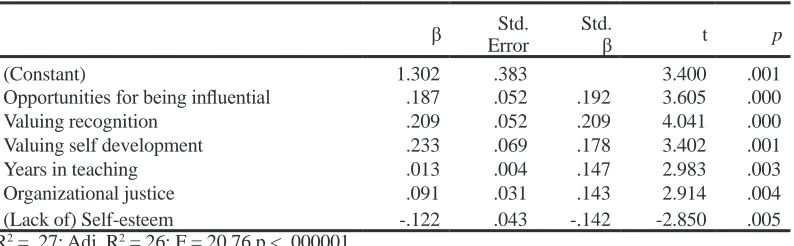
In the model, shown in Table 12, 27% of variance in conscientiousness is accounted for by the linear combination of the opportunities for being inluential, valuing recognition, valuing self develop -ment, years in teaching, organizational justice, and self-esteem. This may mean that even when a teacher is burned out he/she can still feel that things are fair and values self development. Given opportunities to exert inluence on things, he/she will still continue to pay extra attention to be punctual and on time, take his/her assignments very seriously, do his/her work very systematically and orderly, and take extra steps not to waste the school’s resources and time.
Table 12:
Stepwise Regression for Prediction of Conscientiousness
β ErrorStd. Std.β t p
(Constant) 1.302 .383 3.400 .001
Opportunities for being inluential .187 .052 .192 3.605 .000
Valuing recognition .209 .052 .209 4.041 .000
Valuing self development .233 .069 .178 3.402 .001
Years in teaching .013 .004 .147 2.983 .003
Organizational justice .091 .031 .143 2.914 .004
(Lack of) Self-esteem -.122 .043 -.142 -2.850 .005
R2 =, 27; Adj. R2 = 26; F = 20.76 p < .000001
39 Vol. 17, No. 1 Table 13:
Stepwise Regression for Prediction of Sportsmanship
β ErrorStd.
Std.
β t p
(Constant) .423 .447 .945 .345
Valuing self development .382 .080 .244 4.762 .000
Organizational justice .110 .041 .143 2.713 .007
Opportunities for being inluential .140 .066 .113 2.117 .035
Years in teaching .015 .005 .140 2.704 .007
Life satisfaction .124 .051 .129 2.447 .015
R2 =, 15; Adj. R2 = 14; F = 11.91 p < .000001
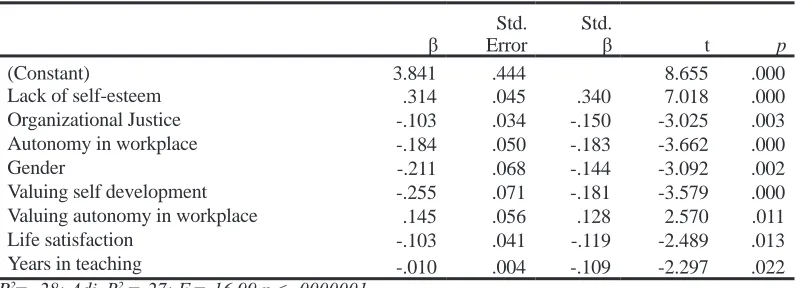
From a post hoc perspective, Table 14 shows that 28% of variance in exhaustion is explained by self-esteem, organizational justice, autonomy in the workplace, gender, valuing self development, valu-ing autonomy in workplace, life satisfaction, and years in teachvalu-ing. An interestvalu-ing indvalu-ing in this model is that as a teacher, who attaches more value to autonomy in working space, he/she is more likely to be exhausted than others who do not see autonomy very important. Those who see autonomy as an impor-tant issue are likely to be more prone to emotional and physical exhaustion. In the same model, however, when a teacher perceives that the school fosters autonomy, he/she is not likely to feel exhaustion.
Table 14:
Stepwise Regression for Prediction of Exhaustion
β ErrorStd.
Std.
β t p
(Constant) 3.841 .444 8.655 .000
Lack of self-esteem .314 .045 .340 7.018 .000
Organizational Justice -.103 .034 -.150 -3.025 .003
Autonomy in workplace -.184 .050 -.183 -3.662 .000
Gender -.211 .068 -.144 -3.092 .002
Valuing self development -.255 .071 -.181 -3.579 .000
Valuing autonomy in workplace .145 .056 .128 2.570 .011
Life satisfaction -.103 .041 -.119 -2.489 .013
Years in teaching -.010 .004 -.109 -2.297 .022
R2=, 28; Adj. R2 = 27; F = 16.99 p < .0000001
Table 15 shows that 24% of variance in isolation is explained by self-esteem, organizational justice, and friendly environment in the school. Table 16 shows that 17% of variance in diminished self accomplishment is explained by self-esteem, organizational justice, and opportunities in school for self development.
Table 15:
Stepwise Regression for Prediction of Isolation
β ErrorStd.
Std.
β t p
(Constant) 2.510 .227 11.066 .000
Lack of self-esteem .352 .044 .377 7.963 .000
Friendly environment in school -.192 .048 -.195 -4.023 .000
Organizational Justice -.126 .033 -.183 -3.794 .000
Table 16.
Stepwise Regression for Prediction of Diminished Self Accomplishment Std. Std.
. β Error β t p
(Constant) 3.360 .206 16.294 .000
Opportunities for self development -.262 .049 -.275 -5.398 .000
(Lack of) Self-esteem .222 .046 .237 4.848 .000
Organizational justice -.101 .036 -.145 -2.847 .005
R2=, 17; Adj. R2= 17; F = 24.37 p < .0000001
On overall, 32% of the variance in burnout is accounted for by the linear combinations of self-esteem, organizational justice, and autonomy in workplace, life satisfaction, and years in teaching, valuing self development, and valuing autonomy in workplace. Again, attaching too much importance to autonomy in school may result in quick burnout. More logically, those who feel burned out may want more autonomy in the work place.
Table 17:
Stepwise Regression for Prediction of Overall Burnout
Std. Std.
. β Error β t p
(Constant) 3.447 .363 9.497 .000
Lack of self-esteem .305 .038 .382 8.094 .000
Organizational Justice -.114 .029 -.193 -4.004 .000
Autonomy in workplace -.156 .042 -.179 -3.700 .000
Life satisfaction -.096 .035 -.128 -2.753 .006
Years in teaching -.011 .004 -.140 -3.064 .002
Valuing self development -.220 .060 -.180 -3.670 .000
Valuing autonomy in workplace .121 .048 .124 2.553 .011
R2=, 32; Adj. R2= 31; F = 23.10 p < .0000001
41 Vol. 17, No. 1 Table 18.
Effects of sets of variables on overall OCB
Set of variables tested against the full modelb
P
Life satisfaction, (Lack of) Self-esteem, Valuing recognition, Valuing self development, Valuing autonomy, Valuing friendly relations, Valuing being inluential, Gender, Years in teaching
.000 .12a
Environmental or organizational variables
Organizational justice, Degree of recognition in school for contributions made, Opportunities in school for self development, Autonomy in workplace, Friendly environment in school, Opportunities in school for being inluential
.000 .10 a
Burnout dimensions
Emotional Exhaustion, Isolation, Diminished self accomplishment .689 .003 a R2
full = .39, Adj. R 2
full = 36, Ffull= 11.52, p < .00001 a Tested against the full model.
b Predictors in the Full Model: (Constant), yearsofexp, justice, recogvalue, lackselfesteem, gender, lifesatis, autonvalue, lackslfaccomp, enluenvalue, autoevnrmnt, frienenv, slfdevvalue, isolation, frendvalue, slfdevenv, enioppu, emotionalexhust, recegoppur.
DISCUSSION
The purpose in the present study was to examine whether the degree of burnout would explain organizational citizenship behaviors beyond the inluence of selected work related values and conduciveness of organizational conditions for these values. Although burnout and its dimensions were related to OCB behaviors, in the presence of other personal variables and organizational variables, burnout dimensions did not explain what was already explained.
Individual characteristics as well as organizational related variables should be taken into consideration when studying the OCB and burnout phenomenon. Researchers need to focus more attention on the mediating role of characteristics of organizational context and personality characteristics on burnout to explain OCB. The indings suggested that job and person variables are important factors to consider for burnout prevention and improve teacher outcome behaviors. The study premised that teachers’ feelings and perception of organizational conditions are important factors preventing burnout and reducing the negative results of burnout. Burnout can be by-passed by improving organizational settings by aligning them to teachers’ work values. The study suggested that perceptions of conduciveness of school environment to values can help reduce the stress workers experience from the work demands. Teachers who perceived their organizations as supportive may feel a sense of greater control over their work.It may thus be posited that extra-role behaviors such as OCB is undertaken by individuals when they see a valued meaningful outcome, when they believe their contributions are valued and encouraged and when the organizational procedures are fair.
Further attempts focusing on individual characteristics to understand the OCB is needed. Studies examining outside work conditions of teachers may be fruitful to explain extra role behaviors. Furthermore, research may look at the effects of groups on OCB.
In so far as planning practices are concerned, planners and implementers should consider creating such an organizational climate that individuals feel at home even on-the-job. Training administrators on understanding teacher behavior may assist with implementation of plans. For plans to succeed, such behaviors as OCBs are invaluable.
context. Sample size compared to the number of variables examined was a limitation of this study as well. The use of only self-reported and cross sectional data could be another concern. Such use could generate social desirability as well. Researchers can use interviews and anecdotal materials to investigate the issue. İt is also possible that the construct OCB may mean two things at the same time. İt may have positive qualities as literature cites. OCB also may be contaminated by other behaviors, such as showing off and substituting some weaknesses in self-eficacy or self esteem.
REFERENCES
Atalay, I. (2005). Organizational citizenship behavior and organizational justice. Unpublished master theses. Afyon Kocatepe University, Afyon.
Barr, S. H., & Pawar, B. S. (1995). Organizational citizenship behavior: Domain speciication for three middle range theories. Academy of Management Journal, 82, 106-112.
Briggs, L., & Richardson, W. (1992). Causes and effects of low morale among secondary teachers. Journal of Instructional Psychology, 19(2), 87–92.
Brissie, J. S., Hoover-Dempsey, K. V., & Bassler, O. C. (1988). Individual, situational contributors to teacher burnout. The Journal of Educational Research, 82, 433-445.
Cherniss, C. (1980). Staff Burnout: Job Stress in Human Service. CA: Sage.
Cherniss. C. (1980). Professional burnout in human service organizations. NY: Praeger.
Cordes, C., & Dougherty, T. (1993). A review and an integration of research on job burnout. Academy of Management Review, 18(4), 621-656
Cunningham, W. G. (1983). Teacher burnout-solutions for the 1980s: A review of the literature. The Urban Review, 15, 37-51.
Donder, D. (2006). Organizational citizenship behavior and organizational bureaucracy. Unpublished master theses. Afyon Kocatepe University, Afyon.
Farber, B. A., & Miller, J. (1981). Teacher burnout: A psycho-educational perspective. Teacher College Record, 83, 235-244.
Freudenberger, H. J. (1974). Staff burnout. The Journal of Social Issues, 30, 159-164.
Friedman, I (1995). Student behavior patterns contributing to teacher burnout. The Journal of Educational Research, 88, 281-289.
Garcia, A. S. (1981). Predictors of job satisfaction and worker burnout among child welfare workers. Ann Arbor, Mİ: University Microilms International.
George, J. M., & Brief, A. P. (1992). Feeling good-doing good: A conceptual analysis of the mood at work-organizational spontaneity relationship. Psychological Bulletin, 112, 310-329.
Golembiewski, R. T., Munzenrider, R. F., & Carter, D. (1983). Phases of progressive burnout and their worksite covariant. Journal of Applied Behavioral Science, 19, 461-481.
Iwanicki, F. (2001). Toward understanding and alleviating teacher burnout” Theory into Practice, 22(1) 27-32
Jackson, S. E., Schwab, R. L., & Schuler, R. S. (1986). Toward an understanding of the burnout phenomenon. Journal of Applied Psychology, 71, 630-640.
Karambayya, R. (1990). Contextual predictors of organizational citizenship behavior”. In Proceedings, Academy of Management Annual Meeting, San Francisco, CA, 221–25.
Kaynak, S. (2007). Teachers’ personal characteristics and organizational citizenship behavior. Unpublished master theses. Afyon Kocatepe University, Afyon.
Keskin, S. (2005). Teachers’ work values and organizational citizenship behavior. Unpublished master theses. Afyon Kocatepe University, Afyon.
Konovsky, M. A., & Organ, D. W. (1996). Dispositional and contextual determinants of organizational citizenship behavior. Journal of Organizational Behavior, 17, 253-266.
MacKensie, S. B., Podsakoff, P., & Praine, J. B. (1999). Do citizenship behaviors matter more for managers than salespeople. Journal of the Academy of Marketing Science, 27, 396-410.
43 Vol. 17, No. 1 Mercan, M. (2006). Teachers’ work commitment, organizational alienation and organizational citizenship
behavior. Unpublished master theses. Afyon Kocatepe University, Afyon.
Organ, D. W. (1988). Organizational Citizenship Behavior: The Good Soldier Syndrome. Lexington, MA: Lexington Books.
Pierce, C. M. B., & Molloy, G. N. (1990). Psychological and biographical differences between secondary school teachers experiencing high and low levels of burnout. British Journal of Educational Psychology, 60, 37- 51.
Pines, A. M., Aronson, E., & Kafrey, D. (1981) Burnout: From tedium to personal growth. NY: Free Press.
Podsakoff, P. M., & MacKenzie, S. B. (1997). Impact of organizational citizenship behavior on organizational performance: A review and suggestions for future research. Human Performance, 10, 133–51. Podsakoff, P. M., MacKenzie, S. B., & Ahearne, M. (1997). Moderating effects of goal acceptance on
the relationship between group cohesiveness and productivity. Journal of Applied Psychology, 82, 974–83.
Podsakoff, P. M., MacKenzie, S. B., Moorman, R. H., & Fetter, R. (1990). Transformational leader behaviors and their effects on followers’ trust in leader, satisfaction, and organizational citizenship behaviors. Leadership Quarterly, 1(2) 107–42.
Samanci, S. (2006). Organizational climate and organizational citizenship behavior. Unpublished master theses. Afyon Kocatepe University, Afyon
Samanci, G. (2007). Organizational trust and organizational citizenship behavior. Unpublished master theses. Afyon Kocatepe University, Afyon.
Schwab, L. (2001). Teacher burnout moving beyond “Psychobabble.” Theory into Practice, 22(1) 21-26. Unal, Z. (2003). Teachers’ job satisfaction and organizational citizenship behavior. Unpublished master