Geomorphology study on the Bandar Lampung Capital City
for recommendation of development area
Rahmi Mulyasari1*, Hari Wiki Utama2 and Nandi Haerudin1 1
Geophysics Engineering, Lampung University, Lampung, Indonesia 2
Geological Engineering, Jambi University, Jambi, Indonesia
Email: [email protected], [email protected]
Abstract. Bandar Lampung area is a capital of Lampung Province, that located on the south of Lampung Province. It has highly populated urban area consisting of land and waters with several highlands and mountains lied in Bandar Lampung. Population density supported by high infrastructure development makes Bandar Lampung City become a city with rapid growth. Consequently, spatial planning concept by considering all aspects needed to support sustainable development in a city, one of them is geomorphology aspect. Geomorphology has an important role to give the information and overview on the existing landscape in an area. The aim of this paper is to know geomorphology characteristics of this area that could provide an information to land use, disaster mitigation, and references for infrastructure development area. Analysis of geomorphology aspect was employed in this study, which are morphology aspect (morphography and morphometry), morphogenetics aspect (morphostructure active, passive and dynamic), morphochronology aspect and also consider the morphoconservation aspect. Remote sensing is a method which is carried out to know characteristic of geomorphology aspect become a map. The geomorphologic map is resulted based on analysis of geomorphology aspect. This area could be divided to four geomophologic units, there are fluviatil unit, structural unit, volcanic unit, and denudational unit. In addition, based on analysis of geology and geomorphology, the area composed of two degree of geohazard, which are secure zone and dangerous zone. In addition, geomorphology map could be used to designed and development for recommendation area in Bandar Lampung.
Keywords: Bandar Lampung, geomorphology map, recommendation area.
1. Introduction
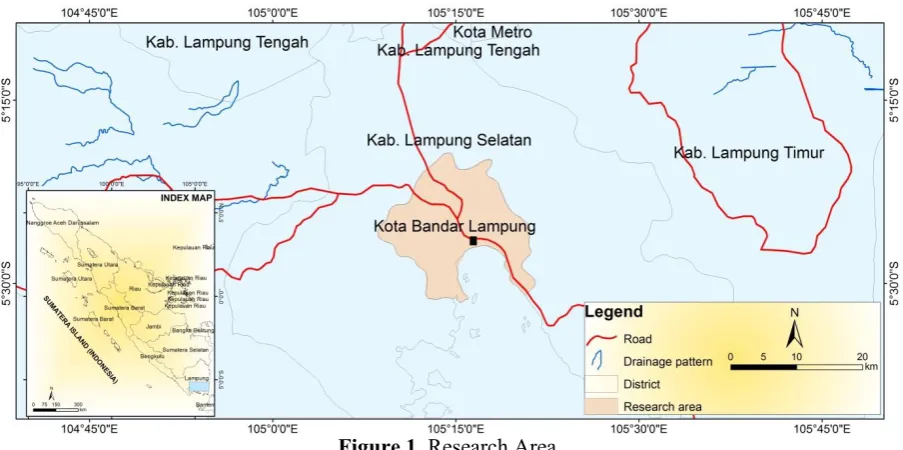
Bandar Lampung area is a capital of Lampung Province, that located on the south of Lampung Province (Figure 1). It has highly populated urban area consisting of land and waters with several highlands and mountains lied in Bandar Lampung [1]. Population density supported by high infrastructure development makes Bandar Lampung City become a city with rapid growth. Consequently, spatial planning concept by considering all aspects needed to support sustainable development in a city, one of them is geomorphology aspect.
young volcanic activity from Lampung Formation which is generally consist of tuff rock. This geological condition causes geological hazard in this area.
Geomorphology has an important role to give information and overview on the existing landscape in an area. Geomorphological map can be considered as graphical inventories of a landscape depicting landforms and surface as well as subsurface materials. This map can act as a preliminary tool for land management, geomorphological and geological risk management, as well as providing baseline data for other applied sectors of environmental research [3].
The aim of this paper is to know geomorphology characteristics of this area that could provide information to land use, disaster mitigation, and references for infrastructure development area. The geomorphologic aspects would be analyzed using remote sensing analysis.
Figure 1. Research Area.
2. Regional Geology
Sumatera Island was resulted from subduction of Indian Ocean plate boundary beneath the Eurasian Continent plate in the Cenozoic Period which is thought to cause a clockwise rotation of Sumatera Island [4, 5, 6]. This subduction made changing position of Sumatera Island, which initially directed
west – east to northwest – southeast [7]. Deformation changes in Sumatra Island occurred in Oligo –
Miocene Period [8]. This deformation caused movement of Sumatran fault which became active at that time. According to [8] the geological structure formed on the island of Sumatra is generally in the form of a horizontal fault which forms a fault segment.
2.1 Physiography
Physiography of Sumatra Island is divided into several physiographic zones: Bukit Barisan Zone, Semangko Fault Zone (Sumatera Fault Zone), Highland and Hills Zone, Bukit Tiga Puluh Zone, Outer Arc Zone, and Sunda Exposure Zone [9]. Bandar Lampung area is part of Bukit Barisan Zone. This physiographic condition has similarities to Barisan Magmatic Arc in Physiography and Mandala Geology [10] (Figure 2).
Bukit Barisan Zone is a hilly zone with a southeast-northwest orientation and has a longitudinal
Figure 2. Physiography and mandala geology [10].
2.2 Stratigraphy
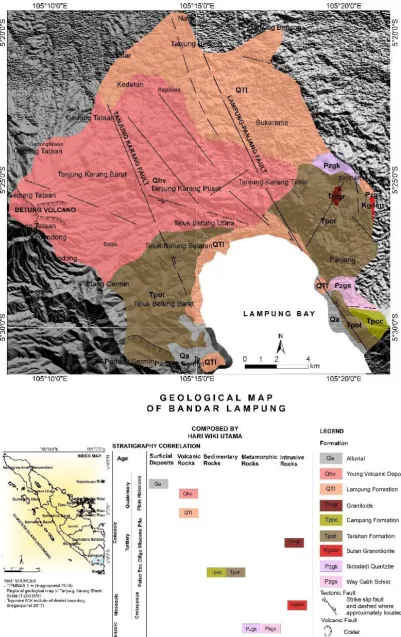
Based on regional geology map of Tanjungkarang sheet [2], stratigraphy of Bandar Lampung is divided into three parts: Pre-Tertiary, Tertiary, and Quaternary. Quaternary rocks are composed of sedimentary rocks, volcanic products and surface deposits. Tertiary rocks are composed of volcanic and intrusive rock products. Pre-Tertiary Rocks are composed of bedrock of metamorphic rocks.
2.3 Structural Geology
Research area was crossed by Lampung-Panjang fault. Lampung-Panjang fault in NE-SW direction was identified in the Tanjungkarang Sheet Geological Map [2] (Figure 4).
3. Data and Method
This research was conducted using some data, Digital Elevation Model National (DEMNAS) image, which has 5 m resolution [11] and regional geological map which scale of 1:250.000 on Tanjungkarang sheet of regional geology [2]. All of data were used to analyze and specify geomorphological aspects.
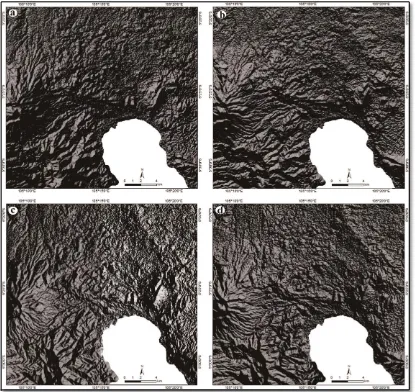
Research started with literature study to initiate previous publication article and interpretation on remote sensing imagery to detail analysis on digital elevation model of DEMNAS. Second stages than have done processing hill-shade analysis from topo to raster (Figure 3). Hill-shade analysis was conducted to attain an exact figure of relief from DEMNAS, particularly for a steep slope which probably indicated major lineament. Determination lineament and interpreted fault structure geology have been using combined of four azimuth directions. The systematics for to obtained of tentative geologic map. Geologic map to shown of rocks formation to composed of research area, formation boundary, stratigraphy contact, kinds of structure geology.
In the field were required of data collected, consist of characteristic lithology, confirmed of structural geology, geomorphic shape such as degree of undulation-valley, volcanic controlled, fluviatil processes, and degree of weathering. Specific data taken point to geohazard consist of mass movement related to active structural geology tectonics and volcanic structures. Collecting data have been give factual geologic map and geomorphology map.
Integration of geological map, geomorphology map, and point located of geohazard have done identification related to structural geology active/approximately and understanding tectonic development to control of fault segment in Sumatera, which Semangko fault (western of research area) and Lampung-Panjang fault segment similarly orientation to Semangko fault. Therefore, this step is divided in two group of geohazard zone, consists of secure zone and dangerous zone.
Figure 3. Four azimuth directions from the hill-shade analyze, a) N 315°E, b) N 0°E, c) N 45°E, and d) N 90°E. Four azimuth direction have done combine for produce hill-shale exactly is representative real geological condition surface.
4. Result and Discussion 4.1. Result
4.1.1. Stratigraphy
a. Paleozoic Group
This group is compiled of Schist Way Galih and Quartzite Sidodadi. These formation is depend on orogenesis processes product and related to reverse fault. The existence of rocks formation is basement rock of Bandar Lampung and Sumatra region. This group is distributed of eastern and southeastern of Tanjung Karang (center of research area).
b. Mesozoic Group
Granodiorite is intrusive igneous rock as feature of magmatisme in Bandar Lampung and distributed to eastern of research area. The existence of granodiorite intruded Paleozoic Sidodadi Quartzite.
c. Tertiary Group
Tarahan Formation and Campang Formation are sedimentary rock formation composed of research area. Campang Formation in the southeastern part of research area. This formation associated straight of Lampung-Panjang fault, which segmentation fault similarly to Semangko fault (one of big segment fault in Sumatra), whereas Tarahan Formation have width distribution, which is in the southeastern-northeastern and western-southwestern part of research area.
Tertiary group is also composed of magmatic intrusive igneous rock, which is Miocene Granitoid. This intrusive associated to secondary segment of Lampung-Panjang fault and the existence in the western part of research area.
d. Quaternary Group
This group can be divide two cluster, which are Alluvium as product Recent geological processes and Quaternary volcanic product. This group is focused to volcanic product. Lampung Formation distributed in the part of northern and southern research area, meanwhile Young Volcanic Deposits (Betung Volcano) distributed in the part of central to western research area. Young Volcanic Deposits of Betung Volcano product is occupied more half than research area extensive.
4.1.2.Geomorphology
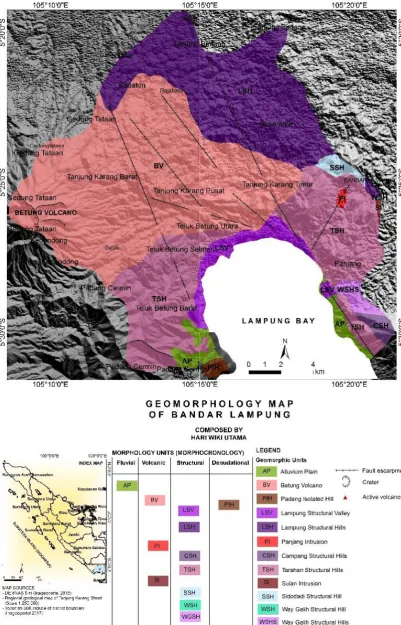
In the research area is four geomorphic units that could be identified. Classified of geomorphic unit divided become landscape. There is composed of fluviatil unit, structural unit, volcanic unit, and denudational unit. The geomorphic unit is too the determination based on morphochronology of landforms (Figure 5).
Drainage pattern in the research area compiled of radial, subdendritic, and dendritic. Radial is occupy in Betung Volcano geomorphic unit, subdendritic is covered of structural and denudational geomorphic units, whereas dendritic is only fluvial/alluvial plain unit.
a. Structural Geomorphic
This landscape have influenced by structural, which was active fault and approximately fault. There were occupied in the central-north-east-southeastern-west-southwestern part of research area. This landscape associated Lampung-Panjang fault with similarly Sumatra Fault System which Semangko fault segmented. This landscape is composed by Way Galih Structural Hills (WGSH), Way Galih Structural Hill (WSH), Sidodadi Structural Hill (SSH), Tarahan Structural Hills (TSH), Campang Structural Hills (CSH), Lampung Structural Hills (LSH), and Lampung Structural Valley (LSV).the existence of fault segment is primary element to formed of landscape.
b. Volcanic Geomorphic
This landscape controlled by Recent volcanic activity of Betung Volcano and magmatism in Granodiorite Cretaceous and Granitoid Miocene. The existence of active volcano is counted of Barisan Range, meanwhile presence of intrusion magmatism indicated tectonic-magmatism-volcanism the associated with Sumatra Fault Zone. This units geomorphic are composed of Sulan Intrusion (SI) Cretaceous, Panjang Intrusion (PI) Miocene, and active volcano product of Lampung Formation Plio-Plistocene, and Betung Volcano unit (BV) Quaternary.
c. Denudational Geomorphic
d. Fluvial Geomorphic
This landscape is product of Recent geological processes. This geomorphic have characteristics as unlitification, sedimentary material and distributed in plain/flat relief, such as Alluvial Plain (AP). Identified of fault segmented Lampung Panjang was dotted where concealed.
4.2. Discussion
4.2.1. Structural Geology and Geohazard
Structural geology is almost covered full in the research area. The existence of research area in between Barisan Range-Magmatic Arc associated Sumatra Fault Zone. Fault segment Lampung-Panjang fault is half Sumatra fault segmented. Lampung-Lampung-Panjang fault is fault range, it have similarly characteristic which Semangko fault, where fault segments interpreted to be active.
Structural geology development of the research area is resulted of interaction between those two segment Lampung Panjang fault and Tanjung Karang fault (west beside part of Lampung Panjang fault). There is orientation south-southeastern - north-northwestern direction and following orientation the primary fault structure segments of Sumatra Fault System.
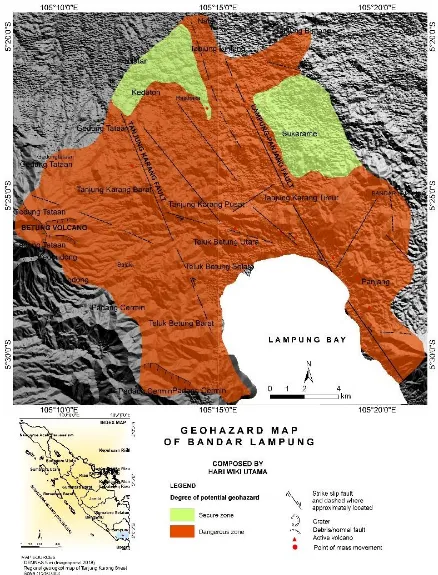
Along of segment fault system “tectonic fault” and volcanic fault is indicated to geohazard. Point of mass movement have occurred in fault zone and surrounding (Figure 6). In addition to tectonic compression of Sumatra regional, weight load exerted volcanic edifices. There is also plays important role in creating structural geology controlled. A relatively north-northeastern - south-southwestern compressional stress was generated by dextral fault movement of those fault, there are producing of extensional faults that the distributed of research area.
4.2.2. Geomorphology Study for Recommendation Development area
Geomorphology study could be standard operation procedure for recommendation development area. Integration data and considerately study have made geohazard potential zone which based on degree of geohazard, so that the result could be standard operational procedure. Based on analyzed of DEMNAS image, field datas, geomorphology map, geological map, and previous study, that divided become to 2 zonations (Figure 6).
Base principle of degree geohazard zonation is counted of several aspect geology, between of morphology (morphography), morphogenesis (characteristic lithology, structural geology, volcanism, eroded, fluviatil, and weathering), morphochronology. Characteristic lithology and structural geology is primary factor in determination of degree of geohazard. Active fault system in the research area have conducted change of geomorphic condition. In the research area is also of residence or located capital population, government building, and public transportation.
a. Secure Zone
This zone is category low potential geohazard. This zone occupied of Lampung Structural Hill (LSH) with Lampung Formation is volcanic product, and volcanic-sediment product. This zone secure relatively, meanwhile this zone across fault segment, but approximately segment. Therefore, this zone is very recommendation for development area, such as residence, government building, public transportation, and capital office complex.
b. Dangerous Zone
C
5. Conclusions
Based on structural geology, stratigraphy and geomorphic analysis are control geological setting in research area. Geomorphology map is resulted based on analysis morphology, morphogenesis, and morphochronology aspects. This area could be divided into several geomorphologic units, there are volcanic, structural, denudational, and fluvial morphology. The exist two degree of geohazard, which are secure zone and dangerous zone. In addition, based on geomorphology map, it could be designed and development for recommendation for area in Bandar Lampung.
6. References
[1] Pemerintah Kota Bandar Lampung 2017 Sekilas Kota, https://bandarlampungkota.go.id/sekilas-kota/ [accesed on 16 May 2018]
[2] Mangga S A, Amirudin T, Suwarti S, Gafoer and Sidarto 1993 Geological Map of Indonesia
Quadrangle: Tanjungkarang, Sumatra Scale 1: 250.000 (Bandung: Geological Research and Development Centre)
[3] Otto J C andSmith M J 2013 Geomorphological mapping Geomorphological Techniques, Chap. 2,
Sec. 6
[4] Hall R 1997 Cenozoic Plate Tectonic Reconstruction of SE Asia, Geological Society of London, Special Publication 126 pp 11-23
[5] Hall R 2002 Cenozoic Geological and Plate tectonic Evolution of SE Asia and the SW Pasific:
Computer Based Reconstruction, Model and Animation Journal of Asian Earth Sciences 20 pp
353-356
[6] Hall R 2014 Indonesia Tectonics: Subduction, Extention, Provenance, and More, Indonesian
Petroleum Association Proceedings 38th Annual Exhibition and Convention, Jakarta, Indonesia
IPA 14 G p 360
[7] Hamilton W B 1979 Tectonic of the Indonesian Region Professional Paper 1078 US Geological
Survey Washington DC p 345
[8] Barber A J Crow M J Milsom J S 2005 Geology, Resources and Tectonics Evolution (London: Geological Society Memoir) p 290
[9] van Bemmelen R W 1949The Geology of Indonesia Volume 1A (The Hague, Netherlands:
Government Printing Office) p 732
[10] Kusnama Pardede R, Mangga S A and Sidarto 1992 Geological Map of Indonesia Quadrangle:
Sungai Penuh and Ketahun Scale 1: 250.000 (Bandung: Geological Research and Development Centre)
[11] Geospatial Information Agency 2018 Digital Elevation Model National (DEMNAS) image
![Figure 2. Physiography and mandala geology [10].](https://thumb-ap.123doks.com/thumbv2/123dok/3994284.1937704/3.595.156.441.96.375/figure-physiography-and-mandala-geology.webp)