Improving Cognitive Engagement in Introducing International Financial
Reporting Standards through Open-Ended Experiential Learning Cases
Ismani
Faculty of Economics, Yogyakarta State University, Karangmalang, Yogyakarta, Indonesia
Andian Ari Istiningrum
Faculty of Economics, Yogyakarta State University, Karangmalang, Yogyakarta, Indonesia [email protected]
Annisa Ratna Sari1
Faculty of Economics, Yogyakarta State University, Karangmalang, Yogyakarta, Indonesia [email protected]
Adeng Pustikaningsih
Faculty of Economics, Yogyakarta State University, Karangmalang, Yogyakarta, Indonesia
Abstract
The aim of this research is to improve Cognitive Engagement in introducing International Financial Reporting Standards (IFRS) for accounting students at Yogyakarta State University through the implementation of Open-Ended Experiential Learning Cases. To achieve this aim, an action research was conducted in the first intermediate financial accounting course. Research used Kemmis and Mc Taggart model that consisted of two cycles. The first cycle was conducted to achieve students’ Cognitive Engagement in measuring inventory cost, while the second cycle was to value inventory. The data were collected by using test and questionnaire and analyzed by
using descriptive statistics to find the information of the level of Cognitive Engagement. The
result shows that there is an improvement in students’ Cognitive Engagement for the indicators students’ persistence, focus, full absorption, and mastering knowledge. However, the students’ effort that is also one indicator of Cognitive Engagement is still difficult to be improved in this research.
1
Corresponding author
Department of Accounting Education, Faculty of Economics, Yogyakarta State University Gang Guru, Karangmalang, Yogyakarta, Indonesia, 55281
Keywords: Cognitive Engagement, Open Ended Experiential Learning Case
Acknowledgments
1. Introduction
International Financial Reporting Standards (IFRS) are the accounting standards set by the International Accounting Standard Boards (IASB) and used internationally by most countries in
the business world. The IASB set this standard with the purpose to overcome problems related to comparability of financial statement. Indonesia has also faced the same problems; therefore Indonesia government decided to converge its accounting standard that was previously based on US Generally Accepted Accounting Principles (US GAAP) to IFRS.
Convergence to IFRS has raised many problems in setting the accounting learning model at higher education in Indonesia. The first problem is related to the change of mainstream from US GAAP to IFRS. US GAAP is a rule base standard, while IFRS is a principle base standard (Derstine & Bremser, 2010; Thomas, 2009). The implementation of principle standard requires students to be able to use their professional judgment to decide the accounting policies that must be followed by companies and to make several estimations that are appropriate with the conditions and environments of the companies. This creates a serious problem for higher education since professional judgment is rarely exercised in the implementation of rule base standard. The students have not yet been prepared to master knowledge of providing professional judgment.
Another problem of convergence to IFRS is the need to use the work of other profession. It is necessary for students to increase knowledge of other profession so that the students have reasonable capabilities to provide professional judgments. This will be a problem for higher education to provide the ways for students to integrate accounting with other subjects. The role
of lecturers to encourage students to be more persistence to find information that could not be learned in the class therefore should be improved.
The third problem is the availability of IFRS accounting text books. Lack of IFRS text books creates difficulties for students to use the books that are relevant with the condition in Indonesia. Students have no effort to find the information from many sources since they only used one mandatory text book that was asked by their lecturer in the previous learning.
model then creates students to have less focus in the learning process because there is no other creative model that can be used by students to understand and apply the accounting standards.
This will imply in the more serious effect that students feel it is hard to make a connection between what they get in the class and what they must do in the real business world.
All those problems will have negative effects in the level of students’ cognitive engagement. Rotgans and Schmidt (2011) define cognitive engagement as the extent to which students are willing and able to take on the learning task at hand. To reach high level of cognitive engagement, students must be able to show that they have efforts (Corno & Mandinach, 1983; Rotgans & Schmidt, 2011), persistence (Walker, Greene, & Mansell, 2006; Rotgans & Schmidt, 2011), full absorption (Rotgans & Smith, 2011), focus (Valentine, Milton, & Lipnevich, 2006), and mastering knowledge (Newmann, Wehlage, & Lamborn, 1992).
The unsatisfactory level of cognitive engagement then must be solved by implementing learning model that emphasizes more on students’ activity. Several studies (Archer & Wong, 2010; Ernst, 2013; Fay, Brozovsky, & Lobingier, 2011; Fitch & Steinke, 2013; Fuglister, Stegmoyer, & Castigrano, 2010, Penny, Frankel, & Mothersill, 2012) suggest that experiential learning is able to improve cognitive engagement since this model can build a link from theories to practical world.
Based on those backgrounds, this study was conducted to improve cognitive engagement in learning IFRS for accounting students in Yogyakarta State University by implementing one type of experiential learning-called open ended experiential learning cases.
2. Literature Review and Action Research Hypothesis
2.1 Cognitive Engagement
cognitive engagement in this study because each process in working on the task is measured. Students have a high level of cognitive engagement if they take a high effort, persistence and
absorption to do the task. This can be shown by the willingness of students to find information from many sources (Smiley & Anderson, 2011) and the willingness of students to make
connection with other subjects to find solution (Walker et al., 2006). In addition, it is also necessary to give value to students who are fully emerged in the learning activity. The students who are being fully absorbed by the task will be forgetting everything which is not related with the task, so it is reasonable to consider their involvement in working on the task as a part of cognitive engagement.
The students’ focus on learning activities is also another important aspect that should be
recognized in measuring cognitive engagement. This aspect is derived from Valentine et al. (2006) who defines that cognitive engagement is the mental efforts that individuals actively use to focus on tasks that lead to learning. Focus on tasks is used as one indicator to measure cognitive engagement in this study since it is important to measure whether students keep their attention while working on the task. It is necessary to appreciate students who are not disturbed by every obstacles they face in the process to finish the work.
All the above aspects are considered to be important to measure cognitive engagement. However, they are not sufficient to measure cognitive engagement. There is always a probability that students take a lot of effort, persistence, absorption and focus while they are working on the task, but they are not able to master the knowledge. As a result, the final output of learning process-mastering knowledge-should be used as another factor to measure cognitive engagement. This point of view is supported by several studies conducted by Ernst (2013) and Fitch &
Steinke (2013) and the definition of cognitive engagement given by Newmann et al. (1992) who state that cognitive engagement is the student’s psychological investment in and effort directed toward learning, understanding, or mastering the knowledge, skills, or crafts that academic work is intended to promote.
2.2 Experiential Learning
Penny et al. (2012) suggest that experiential learning is one type of learning model that will
result in the high level of student’s cognitive engagement. Experiential learning is a learning
Kolb, 1984; Silberman, 2007). This definition, according to Kolb (1984), implies that learning process should be able to translate the ideas from academicians to the practice world. Therefore,
Kolb (1984) emphasizes that the lecturer should design a learning model which makes students have a real experience to apply the theories they get in the class to the real world.
Kolb (1984) develops the experiential learning model that consists of four steps: (i) concrete experience: students encounter a new situation or experience, or students reinterpret existing experience, (ii) reflective observation: students conduct observation of the new experience to gain the information whether there are any inconsistencies between experience and understanding, (iii) abstract conceptualization: students gain a new idea or a modification on an existing abstract concept, and (iv) active experimentation: students apply this idea to the world around them to see the result.
Beaudin and Quick (1995) suggest that experiential learning could be conducted in the class. This is known as experiential classroom-based learning. Here, lecturer should be able to design a learning model that provides opportunities to students to have formal experience to apply the theoretical ideas they get in the class. The techniques that can be used under this category are case study and simulation. If the case study is used as the technique in experiential classroom-based learning, it must stress on the ability of students to solve and investigate problems (Rossman, 1993) and to provide critical thinking (Archer and Wong, 2010). To fulfill those requirements and to provide the experience of students in giving professional judgments, open-ended cases should be used in this study. According to Fuglister et al. (2010), an open-open-ended case is a case that does not have any specific answer but it really asks the students to provide their critical thinking to solve the problems.
2.3 Action Research Hypothesis
Rotgans and Schmidt (2011) states that different activity in the learning process reflects different extent of student’s autonomy; therefore it also results in the different level of cognitive engagement. Each step in the experiential learning also demands different level of cognitive engagement.
The reflective observation step demands students to be independently find information from many sources. Students deeply conduct observation to convince that their understanding and
experience is consistent. The level of students’ autonomy would be relatively higher and they
would be more cognitively engaged.
In the abstract conceptualization, students take the conclusion of what they get in the previous steps. This step demands higher students’ autonomy than concrete experience and reflective observation since students will try to construct a new concept or adjust an existing theoretical idea. Consequently, the level of students’ cognitive engagement would increase.
The highest students’ autonomy and therefore the highest level of cognitive engagement are shown in the active experimentation step. During this step students applied the idea they generated from abstract conceptualization step to see whether their idea could be worked in other companies.
Based on those frameworks, the action research hypothesis is set as follows: the implementation of open-ended experiential learning cases is able to improve cognitive
engagement in introducing IFRS.
3. Research Method
This study was an action research that applied Kemmis and Mc Taggart model. There were two cycles that were conducted during the study whereby each cycle consisted of planning, action, observation, and reflection (Kemmis & Mc. Taggart, 1988).
The class action research was conducted to 42 students enrolling the first intermediate financial accounting course. This course was chosen because several studies (Fay et al., 2011;
Jones, 2009) suggested that IFRS should be integrated in the accounting curriculum at higher education, particularly in the intermediate financial accounting course. The first cycle of study measured the level of students’ cognitive engagement in measuring inventory cost, and the second cycle was in determining the value of inventory.
was prepared in accordance with bloom taxonomy from the lowest level (memorizing) to the highest level (creating).
The data then were analyzed by using descriptive statistics. The data about students’ effort, persistence, absorption, and focus were divided into five categories as shown below:
Very High : X ≥ Mi + 1,5 DSi
High : Mi + 0,5 DSi ≤ X < Mi + 1,5 DSi Moderate : Mi –0,5 DSi ≤ X < Mi + 0,5 DSi Low : Mi –1,5 DSi ≤ X < Mi – 0,5 DSi Very Low : X < Mi – 1,5 DSi
while
Mi = ideal mean
DSi = ideal deviation standard
The data regarding mastering knowledge was divided into two categories: success and fail. Student is success in mastering knowledge if they achieve score at least 56 in the test (Academic
Regulation, 2011).
The criterion that was used in this study is drawn from Heikkinen, Huttuner, and Syrjala (2007). Based on their study, the implementation of open-ended experiential learning cases will improve cognitive engagement if there is useful movement of the indicators of cognitive engagement in the learning process.
4. Research Results and Discussions
4.1 The First Cycle of Action Research
Planning
The initiation of the action research is the identification of several problems related to the
low level of accounting students’ cognitive engagement that occurs because of the process
Action
In order to answer the research question, the experiential learning model was chosen and the
open-ended cases were set. The first cycle was conducted for three weeks. There were several steps that were conducted in taking action of the first cycle:
A. Concrete Experience
Students entered new experience by working on the open-ended case studies. The case studies were taken from Kieso, Weygandt, and Warfield (2011) whereby students tried to solve the problems faced by Supervalu Company and Englehart Company. Students tried to understand the condition and environment of those companies so that they gained the initial information about company characteristics. In this step, students were trained to provide their professional judgment to decide whether companies should apply First In First Out (FIFO) or Weighted Average (WA) to determine the inventory cost.
B. Reflective Observation
Students have worked independently to find information from many sources for one week. They tried to make a connection between the information they got from International Accounting Standard (IAS) 2 about regulating inventory and the condition of the companies. The students then decided the appropriate method that should be followed by companies.
C. Abstract Conceptualization
Students constructed new ideas during this step. The new ideas were drawn from the experience they got in working at open-ended cases. At first, students were successful to create the idea that the company should consider the effect of each inventory cost flow model to financial statement and tax expense during the inflation or deflation period. The second idea that
Students in this step were given other open-ended cases. Students again were trained to provide their professional judgment to decide the appropriate inventory cost flow model based on
the ideas they generated from abstract conceptualization step.
Observation
The observation in this study was conducted through questionnaire to measure the extent of
students’ effort, persistence, absorption, and focus. Another method of observation was test that was used to gain information whether students were able to master knowledge. Finally, field notes were used in the class observation to determine students’ ability to generate new ideas. The results are presented in the following tables:
Table 1 The level of Students’ Effort, Persistence, Absorption, and Focus in The 1st Cycle Indicators Very High
Table 2 The Level of Mastering Knowledge in the 1st Cycle
Indicator Success (%) Fail (%)
Mastering Knowledge 80 20
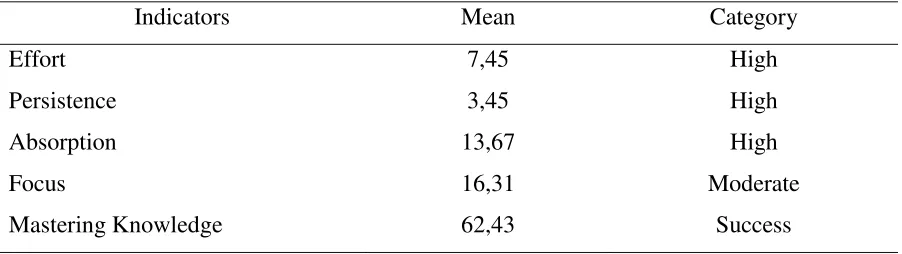
Table 3 The Mean Value of Cognitive Engagement in the 1st Cycle
Reflection
As can been seen in the table 1 and table 2, approximately a half proportion of students have
high level of cognitive engagement. However, the others are still in the moderate category and a few students are still less cognitively engaged while working on the cases. Based on this result,
reflection must be conducted to find the appropriate solution. The reflection is conducted through investigating the questionnaire that has lowest score in each indicator. This result in the several problems that must be considered: (i) Lack of effort is caused by low awareness and passive behavior to find the appropriate answers, (ii) Lack of persistence is caused by language problem, students are not accustomed to reading references written in English, (iii) Lack of absorption is caused by low commitment to study, this can be shown from the statement that students prefer doing anything that is not related to case studies to working on task, (iv) Lack of focus is caused by inability to relate the cases with previous concept in the Introduction of Accounting course, students are burdened with this obstacle and they only guess the solution without proper reference, (v) the low level of mastering knowledge is primarily caused by inability to create a new idea that must be generated from other previous courses.
4.2 The Second Cycle of Action Research
Planning
Solutions to overcome problems in the first cycle were developed during the planning phase. These consisted of: (i) Students must submit written report and there was a punishment for students who just copied their friends’ answers, (ii) Students were provided a reference that was written in Indonesian Language, (iii) Lecturer must emphasize students to pay more attention to the previous course that provided the basic principle of financial accounting, (iv) Lecturer provides a reward for students who were actively engaged in the discussion, this would encourage students to spare more time in working on the cases.
Action
The second cycle was conducted for three weeks to measure students’ cognitive engagement in determining the value of inventory. Several steps in this phase include:
Students had new case studies. Students experienced how to provide professional judgment to estimate net realizable value (NRV) of inventory. In addition, students also experienced to
provide professional judgment to apply lower cost or net realizable value (LCNRV) to determine the value of inventory. To achieve those purposes, students were provided with two open-ended
cases that were taken from Kieso et al. (2011).
The first case was the problem faced by Anonymous Company. There was different perspective between the accountant and the financial director to journalize decreasing value of inventory. The accountants suggested that they must use loss method to record decreasing value of inventory. On the other hand, the financial director preferred to choose cost of goods sold method since this method concealed the decrease value of inventory under cost of goods sold. This case provided a meaningful learning for students since they had experience in resolving business ethics problem.
The second case was about Englehart Company. In this case, students had experience to estimate the NRV of inventory and to determine the value of inventory that must be presented in the financial position statement.
B. Reflective Observation
Students independently found references related to methods to record decreasing value of inventory, NRV, and LCNRV. However, there was a serious drawback as a result of providing reference written in Indonesian. Students only used this reference as single reference to provide
solutions to the cases. Consequently, students’ horizon was limited to one author perspective. C. Abstract Conceptualization
Although there was a deficiency in finding reference, students were still able to construct
Students were also able to create the idea that can be used by companies to determine whether the companies will apply LCNRV to each item or total item. The idea is that the level of
product heterogeneity must be considered to apply LCNRV. D. Active Experimentation
Students work on other cases to apply the ideas they generate in the abstract conceptualization phase. This increases knowledge and skills of students since they get more experience in exercising professional judgment.
Observation
The result of second cycle can be seen in the tables below:
Table 4 The level of Students’ Effort, Persistence, Absorption, and Focus in the 2nd Cycle Indicators Very High
Table 5 The Level of Mastering Knowledge in the 2nd Cycle
Indicator Success (%) Fail (%)
Mastering Knowledge 100 0,00
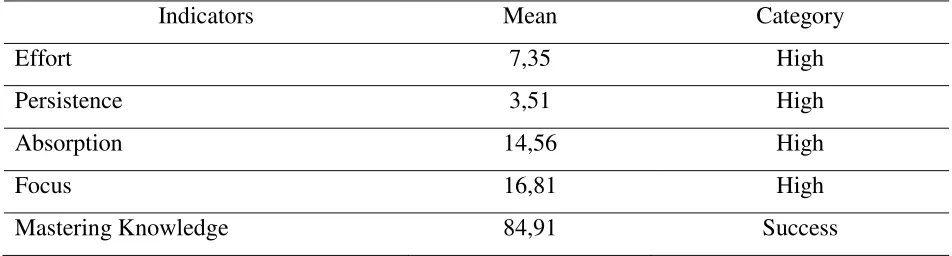
Table 6 The Mean Value of Cognitive Engagement in the 2nd cycle
Reflection
Table 6 shows that all indicators of cognitive engagement are in the high categories.
However, the serious deficiency in finding references must be solved. The lecturer should reinforce students to be eager to find the information from many resources since this will enrich
their knowledge. The primary reference suggested by the lecturer is not sufficient to broaden
students’ horizons.
Several basic problems that were occurred in the first cycle have been successfully solved. Students prepared materials well before they came to the class and spared more time to work on the cases. Students were also able to make correlation between the topics they worked with the topic at the previous course.
4.3 Discussions
The table below shows the change of cognitive engagement from the 1st cycle to the 2nd cycle:
Table 7 Cognitive Engagement in the Very High and High Level Categories and Success Category
Indicators 1st Cycle 2nd Cycle Increase (Decrease)
Effort 88.09% 79.07% (9.02%)
Persistence 50.00% 58.14% 8.14%
Absorption 54.76% 67.44% 12.68%
Focus 42.85% 53.48% 10.63%
Mastering Knowledge 80.00% 100.00% 20.00%
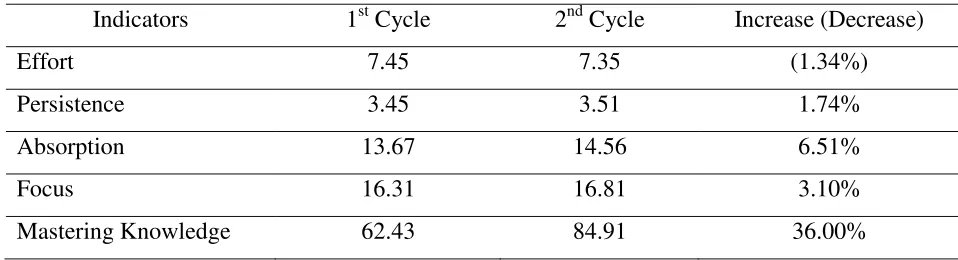
Table 8 Mean Value of Cognitive Engagement
Indicators 1st Cycle 2nd Cycle Increase (Decrease)
Effort 7.45 7.35 (1.34%)
Persistence 3.45 3.51 1.74%
Absorption 13.67 14.56 6.51%
Focus 16.31 16.81 3.10%
The first indicator of cognitive engagement is students’ effort. The extent of students’ effort
while working the open-ended cases decreases 9.02% from the 1st cycle to the 2nd cycle. This
result is not in accordance with the study from Rotgans and Schmidt (2011) who state that the level of autonomy increases when students find information to solve problems. It will result in
the higher level of cognitive engagement. However, the lecturer makes a mistake when trying to help students who have problems in understanding references written in English. The lecturer provides the Indonesian text book with the expectation that students also try to search other information from other sources. Therefore, it is important to always allow students to work independently in finding information they need to solve the problems. The guideline about primary reference could be provided, but the lecturer must emphasize that the primary reference is not sufficient to enrich knowledge.
The second indicator of cognitive engagement is students’ persistence. In this study, students who have satisfactory level of persistence increase 8.14% and the mean value increases 1.74%. This result is in accordance with several studies from Rotgans and Schmidt, (2011) and Walker et al. (2006). According to Rotgans and Schmidt (2011), persistence means preparing everything before coming to the class. During the concrete experience phase, students exercise to decide what accounting policies related to inventory that is appropriate to the company. Students already prepare themselves by searching and reading many references, such as text books and journal articles. Students also find information about condition faced by the company. In the next phase – reflective observation- students discuss the information they gain as a foundation to provide solutions. All preparations that students do individually and in a team lead them to be able to generate ideas in the abstract conceptualization phase. Students then prepare themselves to apply
the new idea to other companies. Therefore, all the phases in experiential learning are proven to improve the level of students’ persistence.
The third indicator of cognitive engagement is full absorption. The satisfactory level of
students’ absorption also increases 12.68% and the mean value increases 6.51%. The result is in a
line with the studies from Rotgans and Schmidt (2011) and Valentine et al. (2006). Their studies
suggest that students’ absorption is measured by fully emerged in working the task at hand (Rotgans and Schmidt, 2011) and students’ interest to the learning topic. The open-ended
experiential learning cases are proven to be able to improve the level of students’ absorption.
successful to encourage curiosity of students. They spare more time and forget anything else to fulfill their curiosity. When students are able to provide solutions, they try to form a group to
discuss the solution they gain. The debate in the discussion at the reflective observation phase raises a lot of questions and their interest to the topic increase. They really want to convince
themselves that their professional judgment is permitted under IFRS. Their high level of interest makes them involve in the class discussion. They do not feel bored when they try to generate new concepts in the abstract conceptualization phase. Afterward, their interest leads them to see whether the concepts can be used in other companies.
The fourth level of cognitive engagement is focus on the learning process. Students who are in very high and high levels of focus increase 10.63% and the mean value increases 3.10%. This means that the implementation of open-ended experiential learning cases is able to improve the
level of students’ focus. The result is in a line with the study from Valentine et al. (2006).
Valentine et al (2006) explain that students who have high level of focus show high attention in the learning process and provide solutions based on scientific research. Students feel that are able to keep high attention when they are working on the cases at concrete experience phase, finding the information and discussing the results in a study group at reflective observation phase. Their reason to keep high attention is that they feel the cases are difficult to solve since this is the first time for them to do the real cases in the business world. This high attention is still kept when students enter the class discussion at abstract conceptualization phase to produce the new concepts. In this phase, students are able to provide professional judgments that are appropriate with the environment of the companies and the regulation under IFRS.
The last indicator of cognitive engagement is mastering knowledge. Research shows that
5. Conclusions
The implementation of open-ended experiential learning cases is proven to be able to improve
cognitive engagement since there are useful movements to the level of persistence, full absorption, focus, and mastering knowledge. Open-ended experiential learning cases can
encourage students to be more persistent to prepare the materials that will be learned in the class meeting. Students feel interested in the cases and this leads them to be fully involved in the tasks.
The result is that the level of students’ absorption increases during learning process. In addition,
students also keep their attention when working at the cases and this leads their focus on learning process rise. At last, the ability of students to master knowledge increases due to the professional judgment that they can offer to solve the problems. The ability to provide professional judgment means that students can apply the theoretical ideas to the practical business word.
However, open-ended experiential learning cases in this study cannot improve the extent of
students’ effort. The primary textbook provided by the lecturer causes students’ willingness to search other information decrease. Therefore, it is necessary for the next study to lengthen the cycle of action research to get the actual information whether the open-ended experiential
learning can improve students’ effort.
Appendix A. Items to measure Cognitive Engagement
Indicators Item
Effort 1.I work hard to get the best answer for the cases.
2.I exert maximum efforts in order to master the material.
3.I try to find another way to learn the material when I do not understand about that material.
4.When I make a mistake, I try to find the correct answer by my own way.
Persistence 1.I hope that I can still continue with the work for a while. 2.I prepare the material before coming to the class.
Focus 1. I can keep my focus when doing the cases.
2. I can keep my focus when having a discussion in the class.
4. I prefer to talk with other students when the discussion is hold in the class,
5. I have a trouble to be able to focus in following learning activities. Full absorption 1. I am actively involved with the cases so I forget anything else.
2. The learning materials in the class are very interesting for me.
3. I apply the learning materials I get in the class to solve the problems of other companies.
4. I feel bored in the class.
5. I am so excited to get an understanding of learning materials.
Appendix B. Indicators for the 1st Cycle Test
Test Number Indicators Cognitive Level
1 Mention the methods for measuring the cost of inventory that are permitted under IFRS
C1
d. Evaluate management performance to handle the inventory.
C5
Appendix C. Indicators for the 2nd Cycle Test
Test Number Indicators Cognitive Level
1 a. Mention the definition of net realizable value. b. Explain how to estimate net realizable value
C1 C2 2 a. Calculate the value of inventory based on LCNRV
b. Analyze how the company uses LCNRV per item and LCNRV per total.
c. Decide the appropriate LCNRV for the company whether using LCNRV per item or LCNRV per total
C3 C4
C5
3 a. Record the decrease value of inventory based on cost of goods sold method and loss method. education: service learning and prior learning assessment and recognition. Unpublished paper presented at the international conference on enhancing learning experience in higher
education, Hongkong.
Beaudin, B.P., & Quick, D. (1995). Experiential learning: theoretical underpinning. Colorado:
HI-CAHS
Corno, L., & Mandinach, E. (1983). The role of cognitive engagement in classroom learning and motivation. Educational Psychologist, 18 (2), 88-108.
Derstine, R., & Bremser, W. (2010). The journey toward IFRS in the United States. The CPA Journal, 80 (7), 8-13.
Ernst, J.V. (2013). Impact of experiential learning in cognitive outcome in technology and engineering teacher preparation. Journal of Technology Education, 24 (2), 31-40.
Fay, R., Brozovsky, J., & Lobingier, P. (2010). Ruckman, Inc: converting from US GAAP to IFRS. Issues in Accounting Education, 26 (2), 341-360.
Fitch, P., & Steinke, P. (2013). Tools for assessing cognitive outcomes of experiential learning, Unpublished paper presented at the annual conference on quality in higher education,USA. Fuglister, J., Stegmoyer, M., & Castigrano, R. (2010). Two open-ended experiential learning
cases in accounting. American Journal of Business Education, 3 (11), 23-30.
Hartono, J. (2006). Filosofi, pendekatan, dan penerapan pembelajaran metode kasus untuk dosen dan mahasiswa. Yogyakarta: Andi Offset
Heikkinen, H.L.T., Huttuner, R., & Syrjala, L. (2007). Action research as narrative: five principles for validation. Educational Action Research, 15 (1), 5-19.
International Accounting Standard Board. (2001). International accounting standard 2: inventories. London: International Accounting Standard Committee Foundation.
Jones, C., Vedd, R., & Yoon, S.W. (2009). Employer expectations of accounting undergraduates’ entry-level knowledge and skills in global financial reporting. American Journal of Business Education, 2 (8), 85-101.
Kemmis, S., & Mc. Taggart, R. (1988). The Action Research Planner (3rd ed.). Geelong: Deakin University Press.
Kieso, D.E., Weygandt, J.J., & Warfield, T.D. (2011). Intermediate Accounting (IFRS ed.). New Jersey: John Wiley & Sons.
Kolb, D.A. (1984). Experiential learning: experience as the source of learning and development.
Engleewood Cliffs: Prentice Hall.
Newmann, F.M., Wehlage, G.G., & Lamborn, S.D. (1992). The significance and sources of student engagement: student engagement and achievement in American secondary schools. New York: Teacher College Press.
Penny, K., Frankel, E.B., & Mothersill, G. (2012). Curriculum, climate, and community: a model
for experiential learning in higher education.
http://www.ryerson.ca/content/dam/experiential/Penny,%20Frankel,%20Mothersill_IATED/ paper_2012.pdf
Rotgans, J.I., & Schmidt, H.G. (2011). Cognitive Engagement in the problem-based learning classroom. Advance in Health Science Education, 16, 465-479.
Silberman, M. (2007). The handbook of experiential learning. New York: John Wiley & Sons.
Smiley, W., & Anderson, R. (2011). Measuring students’ cognitive engagement on assessment
tests: a confirmatory factor analysis of the short form of the cognitive engagement scale. Research and Practice Assessment. 6, 17-28.
Thomas, J. (2009). Convergence: businesses and business schools prepare for IFRS. Issues in Accounting Education, 24 (3), 369-376
Universitas Negeri Yogyakarta. (2011). Academic Regulation 2011. Yogyakarta: UNY Press. Valentine, T., Milton, J., & Lipnevich, A. (2006). Mapping cognitive engagement in adult
literacy classrooms, Unpublished paper presented at forum for adult educators, USA.
Walker, C.O., Greene, B.A., & Mansell, R.A. (2006). Identification with academics, intrinsic/extrinsic motivation and self efficacy as predictors of cognitive engagement. Learning and Individual Differences, 16 (1), 1-12.