Full Terms & Conditions of access and use can be found at
http://www.tandfonline.com/action/journalInformation?journalCode=vjeb20
Download by: [Universitas Maritim Raja Ali Haji] Date: 11 January 2016, At: 20:26
Journal of Education for Business
ISSN: 0883-2323 (Print) 1940-3356 (Online) Journal homepage: http://www.tandfonline.com/loi/vjeb20
Student Perceptions and Experiences Using Jing
and Skype in an Accounting Information Systems
Class
Kimberly Charron & Robyn Raschke
To cite this article: Kimberly Charron & Robyn Raschke (2014) Student Perceptions and Experiences Using Jing and Skype in an Accounting Information Systems Class, Journal of Education for Business, 89:1, 1-6, DOI: 10.1080/08832323.2012.733740
To link to this article: http://dx.doi.org/10.1080/08832323.2012.733740
Published online: 13 Dec 2013.
Submit your article to this journal
Article views: 237
View related articles
CopyrightC Taylor & Francis Group, LLC ISSN: 0883-2323 print / 1940-3356 online DOI: 10.1080/08832323.2012.733740
Student Perceptions and Experiences Using Jing and
Skype in an Accounting Information Systems Class
Kimberly Charron and Robyn Raschke
University of Nevada, Las Vegas, Las Vegas, Nevada, USA
The authors examine the use of technology to support students in their learning of practical accounting software applications while taking a traditional on-campus class. Specifically, they look at how Jing and Skype are used to facilitate successful completion of a series of simulations using Netsuite (NetSuite, Inc., San Mateo, CA) accounting software. The authors find that students using the technology support tools experienced higher levels of perceived satisfaction than those who did not, while earning equivalent grades. They conclude that virtual instructor support is equally as effective as in-person support, allowing both the instructor and student more flexibility in how their time is spent.
Keywords: equivalency theory, hybrid courses, technology support tools
Today’s students are used to a digital world, with a recent Ithaka S+R report (Bacow, 2012) stating that “faculty will need to catch up with their students” (p. 27). This means that faculty will need to use and embrace new technologies to “increase productivity and lower instructional costs without sacrificing learning outcomes” (Bowen, Chingos, Lack, & Nygren, 2012, p. 28). The purpose of this article is to intro-duce two new supportive technologies that faculty can use to incorporate into their course delivery that involve little to no startup costs, which allow instructors to control the time spent in class for more meaningful discussion.
Within accounting there are two main streams of research related to pedagogy and technology. The first research stream is focused on distance education where an entire class is conducted virtually or in the area of the blended or hybrid class where face-to-face instruction is supplemented with online instruction (for a review of the literature, see Bryant, Kahle, & Schafer, 2005). The second stream examines the use of specific support technology within a traditional classroom setting (i.e., clickers or blogs) as a means to increase student learning and satisfaction (e.g., Carnaghan & Webb 2007; Edmonds & Edmonds 2008; Jones & Wright 2010).
This article contributes to the literature regarding the use of specific support technologies within a traditional
class-Correspondence should be addressed to Kimberly Charron, Univer-sity of Nevada, Las Vegas, Department of Accounting, 4505 S. Maryland Parkway, Box 456003, Las Vegas, NV 89154-6003, USA. E-mail: [email protected]
room setting with a focus toward the student experience us-ing practice related technology and a nod toward redirectus-ing scarce faculty time. We examine how the use of certain sup-porting technologies, namely Jing (a screen capture software; Techsmith Corp., Okemos, MI) and Skype (an internet-based phone service; Microsoft, Inc., Redmond, WA), provide a means of facilitating successful student completion of a se-ries of practical small business accounting software (Net-suite; NetSuite, Inc., San Mateo, CA) computer simulations in an accounting information systems (AIS) class. In this study we specifically examined how students perceive their experiences doing graded Netsuite homework assignments with and without the assistance of these supporting technolo-gies. We tested an equivalency theory model in which we in-vestigated whether students have a similar experience doing assignments using the support technology as students who get assistance through one-on-one or group visits with the instructor during office hours or formal lab sessions. Equiv-alency theory recognizes that the method of attaining the knowledge may be different (i.e., using technology versus traditional instruction), but the learning outcomes should be equivalent (Keegan, 1996; Simonson, Schlosser, & Hansen, 1999). While equivalency theory has largely been discussed in the context of distance education as compared to traditional classroom, we expand its concept to test whether it applies to virtual instructor support versus the in-person instructor support related to a specific aspect of a course.
In addition to outcome (i.e., grades) we also explore the experiences of accounting students with regard to their per-ceptions, usage and attitudes toward instructional features
2 K. CHARRON AND R. RASCHKE
and tools in a web-based, interactive learning environment. The remainder of the article is organized as follows. In the next section we provide a literature review of technology in the classrooms with a specific discussion of the support tech-nologies used in this study. Following that is a discussion of the data collection and results of our study. In the final section we conclude the article and elaborate on the contributions of our results and limitations of our study.
LITERATURE REVIEW
The use of technology in a typical 21st century university class is fairly common. The use of technology can range from basic to elaborate use of multiple complex technologies. Ba-sic technologies such as email and PowerPoint generally are so common that that they do not result in fundamental dif-ferences in courses. More complex technologies that expand the face-to-face paradigm by enhancing the course experi-ence and allow unique delivery options can have a significant impact on class delivery.
Research generally concludes that technology-enriched learning environments can enhance student learning and mo-tivation, thus contributing to students becoming more active participants in their own learning (Dabbagh & Kitsantas, 2009). Students who have 24/7 access to a course are more motivated, are sensitive to meeting deadlines, and keep up with course requirements (Becker & Haugen, 2004). How-ever, there are barriers to acceptance by faculty that include a lack of awareness of technology based opportunities, as well as perceptions that using web-based tools is of inferior quality compared to face-to-face instruction (Flowers, 2001). While course content and the role of the instructor are important and strong predictors of teaching effectiveness, the quality of the technology and the instructor’s ability to control the technology may also impact learning outcomes (Drago, Peltier, & Sorensen, 2002; Webster & Hackley, 1997). Certainly the drivers for successful course delivery are no longer limited to the course schedule and office hours (Becker & Haugen, 2004).
Moreover, faculty often struggle with large class sizes of diverse learners who often need individual instruction and find it difficult to find enough time to research and do other service (Becker & Haugen, 2004). In the wake of the great re-cession many universities have found their budgets cut while enrollments have either remained consistent or increased. According to the Center on Budget and Policy Priorities, at least 43 states have cut assistance to public colleges and universities (Johnson et al., 2010). For many educators, one of the results of budget cuts means an increase in class size as course sections are consolidated or instructors laid off. Thus, the continued efforts of educators to provide adequate support in the classroom is further complicated with the in-crease in class size and allocating the scarce resources of faculty time.
Student Satisfaction
When class sizes increase, students may also experience in-creased feelings of frustration because they receive less time from the instructor. The instructor’s allocation of time per student is diminished regardless of the content delivery envi-ronment (online or traditional classroom). Given the instruc-tor’s limited time, there is an opportunity to leverage the hybrid instruction environment. Indeed, research in the area of distance education comparing satisfaction with online vs. traditional courses has mixed results (Bryant et al., 2005). Some researchers suggest the convenience of online courses has led to acceptance and demand by students rather than a desire to learn virtually (Simonson, 1997). However, research has shown that a hybrid environment where some parts of the course are done virtually while other parts are done tradi-tionally may in fact increase satisfaction (Ponzurick, France, & Logar, 2000). Moreover, the flexibility of being able to learn when and where the student likes is an important de-terminant of satisfaction (Kearsley, 1996; Muirhead, 2002). Indeed, online learning tools, such as those used to support individual learning, provide an environment that is time and place independent (Deal, 2002). Therefore, increased virtual instructional support that focuses on helping learners will help students experience less frustration in the completion of the course (Land & Green, 2000).
Web-Based Technology
Using web-based technologies in courses, whether the course is taught entirely online or some type of blended environment can be difficult. Most instructors use the web to facilitate their classes through a learning management system such as Blackboard or WebCT (Blackboard, Inc., Washington, DC). These systems facilitate the posting of syllabi, notes, or other materials as well as allowing for online testing and monitor-ing and trackmonitor-ing of participation and progress. There are a variety of other web-based options available and discerning which will be most beneficial to the student, yet not overly onerous to the professor, can be challenging.
In this study we specifically look at Jing, a free screen capture software tool that allows the preparation of 5-min demonstration videos. In this instance, these videos demon-strate how to use computer programs to complete class projects. For example, in learning the practical application of the revenue cycle transaction with an accounting software application, a short video can demonstrate how to add a new customer. Then with an associated Screencast account (also free, albeit with limited bandwidth) the links from Jing are made available on a website that students can view when and where they want as well as accessing the assistance as often as they need. This provides a learn anytime and anywhere environment for the student with individual instruction on the practical application of an accounting software package. In addition, an online support tool Skype is used to provide
off campus support to the student during a mutually con-venient time for both student and instructor (or during the instructor’s office hours). Skype is useful because it allows an opportunity for the instructor to support the student when the student is unable to bring their laptop to the instructor’s office.
DATA COLLECTION
We collected survey data from students in six sections of the AIS classes. The content of these courses are coordinated covering the same subject materials and the same required as-signments. Students were required to complete three graded assignments using the Netsuite program. These assignments asked students to simulate accounting transactions in the rev-enue and expenditure cycles. The primary difference across the courses relates to how the students were assisted with the graded Netsuite homework assignments (use of support technology vs. no support technology). In two sections (test group), the instructor created screen capture videos using Jing to demonstrate to students how to use the software and provide hints on how to set up the solutions. These videos were intended to provide the students with basic how-to guid-ance similar to the experience of students working in a com-puter lab classroom environment. There were also dedicated virtual office hours where students could call in from off cam-pus using Skype on their home computer and the professor could chat with the student online. In addition, Skype allows the student to screen share, allowing the instructor to actually see any error messages and provide support to the student. Students randomly self-selected into sections without prior knowledge of whether the use of the learning technologies would be employed. This helps prevent any selection bias in assigning students to the test group which employed the technologies or control group, which did not.
The videos were available 24/7 for students to access at their convenience; however virtual office hours were limited in scope similar to regular office hours or by appointment. As a control, the other four sections (control group) did not use technology support tools while the instructor provided in-class demonstrations only and setup workshops during class periods where students could bring their laptop com-puter to the class period workshop and work on the project and ask questions of the instructor during that time. Stu-dents could also attend regularly scheduled office hours for assistance.
At the end of the course students were asked to com-plete a questionnaire regarding their experience with the graded assignments as well as general questions about their experience in the class, how they interacted with the in-structor and experience in using the technology. Students were also asked how often they used various resources (videos, office hours, in-class demonstrations) to complete the graded assignments and how frustrated they were, how
confident they felt, and how accessible they thought help was with regard to the completion of the homework assign-ments. In addition, the survey also collected demographic information.
RESULTS
Surveys were collected from 209 students out of 261 total students enrolled in the course, of which 81 were in the test group who used the technology to support the completion of the Netsuite assignments. The level of participation is 73% for the control group and 94% for the test group. Fifty percent of the participants were male. The average age of participants was 25 years in the control group and 27.2 years in the test group and the hours worked were 18.23 hr for the control group and 25.98 hr for the test group. The differences are significant which likely reflects the fact that the test groups classes were both offered in the evening, attracting a greater proportion of nontraditional students.1 In both groups the
majority of students identified themselves as seniors who attended school full time.
Learning Outcomes
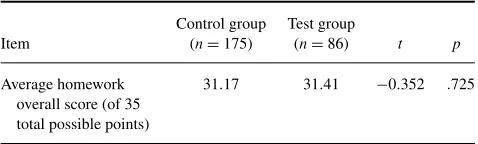
An analysis was done on the grades distributions for the test and control groups. Overall the grades between groups were not significantly different. The similar outcomes, despite dif-ferences in teaching support methods, provide support for the equivalency theory proposition. Table 1 provides details of the overall homework grades between the test and control groups.
Satisfaction, Frustration, and Confidence
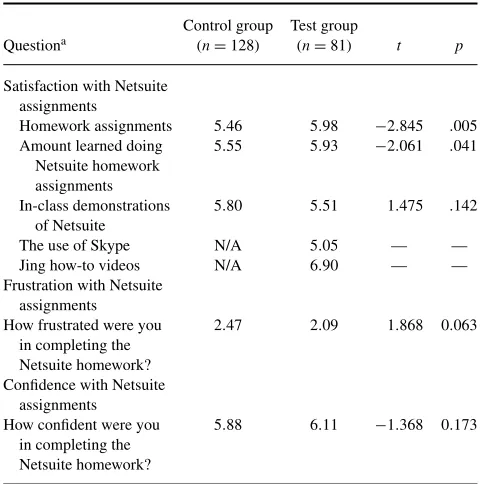
Students were asked to rate their satisfaction with the Netsuite homework and the amount learned. Students were also asked to rate their satisfaction with the in-class demonstrations of Netsuite. The test group was asked about their satisfaction with Jing and Skype. As shown in Panel A of Table 2, student satisfaction was fairly high among the test and control groups in all categories (average scores ranged from 5.05 to 6.90 on a 7-point Likert-type scale ranging from 1 [very dissatisfied] to 7 [very satisfied]). Students in the test group were signifi-cantly more satisfied with the homework assignments and the amount learned doing the Netsuite homework assignments.
TABLE 1
4 K. CHARRON AND R. RASCHKE
TABLE 2
Satisfaction, Frustration, and Confidence Panel A
Questiona
aMeasured on a 7-point Likert-type scale ranging from 1 (very dissatis-fied) to 7 (very satisdissatis-fied).
bMeasured on a 7-point Likert-type scale ranging from 1 (not at all frus-trated) to 7 (very frusfrus-trated).
cMeasured on a 7-point Likert-type scale ranging from 1 (not very con-fident) to 7 (very concon-fident).
There was no significant difference in student satisfaction with in-class demonstrations of Netsuite. Of interest is the fact that the two technology tools were ranked both the high-est (Jing how-to videos) and lowhigh-est (Skype) by the thigh-est group in terms of satisfaction. As seen in Table 3, Skype was used infrequently yet Jing was used very frequently by the test group, which is likely influencing this result.
While students in the test group were more satisfied with what they learned and the Netsuite homework overall, it is also relevant to note that students in the test and control
TABLE 3
Resource Usage for the Completion of Netsuite Assignments
aMeasured on a 7-point scale Likert-type ranging from 1 (not at all) to 7 (very often).
TABLE 4
Importance of Factors in Determining Satisfaction With Netsuite Assignments
aMeasured on a 7-point Likert-type scale ranging from 1 (not at all important) to 7 (very important).
groups experienced very little frustration in completing the Netsuite homework (scores of 2.09 and 2.47, respectively, on a 7-point Likert-type scale ranging from 1 [not at all
frus-trated] to 7 [very frustrated]). The test and control groups
were also equally fairly confident in their ability to complete the Netsuite homework (scores of 6.11 and 5.88, respectively, on a 7-point Likert-type scale ranging from 1 [not very
con-fident] to 7 [very confident]). As shown in Table 2, neither of
these differences is significant.
To achieve a more complete picture, we also examined the elements that influence student satisfaction with the Netsuite homework. The results are shown in Table 4. Students in both groups rated the availability of the instructor and course ma-terials with roughly the same level of importance. However, students in the test group rated the availability of technology to support the completion of the assignments significantly higher than the control group. The “How to” videos made using the Jing technology were rated by the test group on average as having an importance rating of 6.79 on a 7-point Likert-type scale ranging from 1 (not at all important) to 7
(very important). In addition, Table 3 shows that students in
the test group used the Jing how-to videos more frequently than other resources.
DISCUSSION
Based on the results and the previous discussion, students in the test group, who had virtual instructor support through the use of Jing videos and virtual office hours, had a higher level of perceived satisfaction with the practice based technology (Netsuite). Grades on the assignments were equivalent as well as perceived levels of confidence in completing the as-signments, and frustration in completing the assignments. This suggests that with the use of technology, virtual instruc-tor support is at least equally as effective as in-person support in a traditional on-campus class. The use of these technolo-gies offers more opportunities for the professor to connect
with students in a manner today’s technology savvy students are more comfortable with, while simultaneously using their class time more effectively, increasing their productivity and lowering instructional costs. These technologies also allow both the instructor and student flexibility in how their time is spent. For faculty this can free up time for research or other commitments by minimizing the number of students that come for one-on-one assistance with projects As class sizes get larger in light of higher demand for accounting classes or reduced resources available instructors often see several different students with the exact same issue. By creat-ing videos for common issues the instructor can free up that time spent going over the same problem without worrying that they are somehow short-changing students because the results show that students are actually are more satisfied with this assistance than if they had to come to campus for help. For students this increase in satisfaction is likely to be derived from the fact that they are able to get help with assignments anytime and anywhere.
There are several advantages to using Jing- and Skype-based student support as a component of a traditional on-campus class. First, students may not have a laptop to bring to class to work in a workshop environment during class time nor be able to bring their laptop directly to the instructor’s office during office hours to receive support. The use of Jing and Skype allows students who only have access to a desktop computer to receive support off campus. The second advan-tage is that it allows the student to work on or off campus at a time convenient to them. Many campuses have large facilities or a variety of options for students to access computers in a number of computer labs, but many do not have the ability to accommodate a large class size as a designated computer lab classroom.
Thirdly and probably most important, the use of the Jing and Skype as student support tools allows the instructor to control how they plan to use and manage their class time. This advantage particularly addresses the technology versus theory teaching dialectic. The control over an individual’s time allows for more theoretical discussion during class time lecture instead of answering questions regarding the mechanics of working with the practical software to com-plete the homework. While it does not preclude the student from coming to the instructor’s office, the students can re-ceive the majority of the support they need to work through these difficulties watching the videos and listening to their instructor walk them through the topic. This quasiperson-alized interaction can also foster connections between the student and instructor. Although the Jing software is sim-ple to use, the planning of what videos to make and how many to make is an upfront investment in the course, the advantage however is time use throughout the semester as the instructor no longer is answering the same question a multiple of times for various students and can therefore re-deploy their time toward more meaningful student-supported efforts.
The results of this study are consistent with the stream of research that suggests that the use of specific support tech-nologies within a traditional classroom setting (i.e., clickers) can increase student satisfaction (e.g., Carnaghan & Webb, 2007; Edmonds & Edmonds, 2008; Jones & Wright, 2010). In particular the use of Jing allows student time and location flexibility, which has been shown in previous research to in-crease student satisfaction as well (Kearsley, 1996; Muirhead, 2002). Although our results provide convincing evidence that the technology support tools Jing and Skype are useful and increase student satisfaction, our results must be considered within our research limitations. The sample is collected from two separate instructors, one who uses Jing and Skype in the classroom and one who does not. Future researchers should collect additional data from a variety of instructors who ei-ther use or do not use these tools in the classroom to eliminate any specific preferences the students may have had toward one particular professor. In addition it would be fruitful to examine other types of support technology (i.e., Livescribe; Livescribe, Inc., Oakland, CA) as well as the use of these par-ticular support technologies in other contexts or with other types of class assignments.
NOTE
1. Additional analyses were run on all outcomes to test the impact of age and hours worked on the reported results. No significant differences were noted.
REFERENCES
Bacow, L. S., Bowen, W. G., Guthrie, K. M., Lack, K. A., & Long, M. P. (2012).Barriers to adoption of online learning systems in U.S. higher ed-ucation.Retrieved from http://www.sr.ithaka.org/research-publications/ barriers-adoption-online-learning-systems-us-higher-education Becker, D., & Haugen, S. (2004). Wireless instruction: A new dimension in
course delivery.Management Accounting Quarterly,6, 41–46. Bowen, W. G., Chingos, M. M., Lack, K. A., & Nygren, T.
I. (2012). Interactive learning online at public universities: Evi-dence from randomized trials.Retrieved from http://mitcet.mit.edu/wp-content/uploads/2012/05/BowenReport-2012.pdf
Bryant, S. M., Kahle, J. B., & Schafer, B. A. (2005). Distance education: A review of the contemporary literature.Issues in Accounting Education, 20, 255–272.
Carnaghan, C., & Webb, A. (2007). Investigating the effects of group re-sponse systems on student satisfaction, learning and engagement in ac-counting education.Issues in Accounting Education,22, 391–409. Dabbagh, N., & Kitsantas, A. (2009). Exploring how experienced online
instructors report using integrative technologies to support self-regulated learning.International Journal of Technology in Teaching and Learning, 5, 154–168.
Deal, W. F. (2002). Distance learning: Teaching technology online. Tech-nology Teacher,6, 21–27.
Drago, W., Peltier, J., & Sorensen, D. (2002). Course content or the instruc-tor: Which is more important in online teaching?Management Research News,25, 69–83.
6 K. CHARRON AND R. RASCHKE
Edmonds, C. T., & Edmonds, T. P. (2008). An empirical investigation of the effects of SRS technology on introductory managerial accounting students.Issues in Accounting Education,23, 421–434.
Flowers, J. (2001). Online learning needs in technology education.Journal of Technology Education,13, 17–30.
Johnson, N., Oliff, P., & Williams, E. (2010).An update on state budget cuts. Washington, DC: Center on Budget and Policy Priorities. Retrieved from http://www.cbpp.org/cms/index.cfm?fa=view&id=1214 Jones, S. H., & Wright, M. E. (2010). The effects of a hypertext learning
aid and cognitive style on performance in advanced financial accounting. Issues in Accounting Education,25, 35–58.
Kearsley, G. (1996). Structural issues in distance education. Journal of Education for Business,71, 191–195.
Keegan, D. (1996). Definition of distance education. In D. Keegan (Ed.), Foundations of distance education(3rd ed., pp. 33–55). New York, NY: RoutledgeFalmer.
Land, S. M., & Green, B. A. (2000). Project based learning with the world wide web: A qualitative study of resource integration.Educational Tech-nology Research and Development,48, 45–68.
Muirhead, B. (2002). Promoting online interaction in today’s colleges and universities.USDLA Journal,16, 43–47.
Ponzurick, T., France, K., & Logar, C. (2000). Delivering graduate mar-keting education: An analysis of face-to-face versus distance education. Journal of Marketing Education,22, 180–187.
Simonson, M. (1997). Distance education: Does anyone really want to learn at a distance?Contemporary Education,68, 105–107.
Simonson, M., Schlosser, C., & Hansen, D. (1999). Theory and distance education: A new discussion.American Journal of Distance Education, 13, 60–75.
Webster, J., & Hackley, P. (1997). Teaching effectiveness in technology-mediated distance learning. Academy of Management Journal, 40, 1282–1309.