Chlamydial Infecion Prevalence in Human Immunodeiciency Virus Paients
Correspondence:
Feilicia Henrica Teja, Faculty of Medicine, Universitas Padjadjaran-Dr. Hasan Sadikin General Hospital Jl. Pasteur No. 38, Bandung, Indonesia e-mail: [email protected]
Feilicia Henrica Teja,1 Rasmia Rowawi,2 Asmaja Soedarwoto,2 Diah Puspitosari,1 Rini Rasiani,1
Rahmatdinata,2 Tony Djajakusumah2
1Faculty of Medicine, Universitas Padjdajaran-Dr. Hasan Sadikin General Hospital
2Department of Dermatology and Venereology, Faculty of Medicine, Universitas Padjajaran-Dr. Hasan Sadikin
General Hospital
Abstract Objecive: To determine the prevalence of chlamydial infecion in male urethra and female cervix of HIV-posiive paients based on PCR assay in Teratai Clinic, Dr. Hasan Sadikin General Hospital Bandung.
Methods: A cross secional observaional study with consecuive sampling method, which was conducted in Teratai Clinic during the month of July 2012. All paricipants underwent history taking, physical examinaion, and PCR assay for C. trachomais. Swab samples were obtained from male urethra and female endocervix.
Results: Eighty one HIV-posiive paients, consisted of 48 males and 33 females were included in this study. The PCR examinaion for C. trachomais was posiive in 14 of 81 subjects (17.3%), with 10 (20.8%) urethral chlamydial infecion in 48 males and four (12.1%) cervical chlamydial infecion in 33 females.
Conclusions: The study concluded that the prevalence of chlamydial infecion in male urethra and female cervix of HIV-posiive paients were 20.8% and 12.1%, respecively. Idenifying chlamydial infecion based on PCR tesing should be considered for rouine screening test in HIV-posiive paients.
Keywords:Chlamydia trachomais, HIV, prevalence, PCR
IJIHS. 2013;1(1):42–8
Introducion
Worldwide, Chlamydia trachomais is one of the most common eiologies for sexually transmited infecion.1 In 2009, 92 million new cases of chlamydial infecion were reported by World Health Organizaion, including 43 million cases in South and South-East Asia.2 Most of chlamydial infecions are asymptomaic (70% in female and 20–30% in male),3 making it diicult to diagnose clinically.1 Nowadays, polymerase chain reacion (PCR) method has been approved by the Food and Drug Administraion (FDA) as the new gold standard for the diagnosis of chlamydial infecion.4 In comparison with culture, the PCR method has higher sensiivity in detecing chlamydial infecion (90.4% vs 70.8%) which makes it the best method for screening.5
Acquired immunodeiciency syndrome (AIDS) caused by human immunodeiciency virus (HIV) has become a great public health concern.6 In 2009, the United Naions joint program on HIV/ AIDS (UNAIDS) esimated 33.3 million cases of HIV infecion with 4.1 million cases in South and South East Asia.7 Unil September 2012, Indonesian Ministry of Health reported 92,251 cases of HIV infecions with most of them (50.8%) are heterosexually transmited.8
The available epidemiological data showed that there is “epidemiological synergy” between sexually transmited infecions (STI) and HIV transmission.9 HIV transmission will increase 10 fold in STI and HIV co-infected paient10 and HIV-posiive paient has higher risk of being infected with other STIs. High risk sexual behaviors and drug abuse are the two main factors causing STI and HIV co-infecion.11 Both ulcerated and non-ulcerated STIs may increase the risk of acquiring and transmiing HIV.12 Ulcerated STIs increase the risk of acquiring HIV 5 to 10 folds, while non-ulcerated STIs increase the risk 2 to 5 folds.13 Received:
Although the impact of non-ulcerated STIs is smaller than ulcerated STIs, non-ulcerated STIs are more commonly found and, therefore, could also increase the HIV epidemic.14
In 2008, it was reported in a study that the prevalence of STI in HIV paients in Washington was 8% with 19.4% of them were infected by C. trachomais.15 Meanwhile, in India, the prevalence of chlamydial infecion in HIV paients in 2011 was 7%.16
Sexually transmited infecions among HIV-posiive paients usually suggest high risk sexual behaviors and HIV transmission to uninfected populaion.17 High-risk sexual behavior seems to be coninually praciced among HIV-posiive populaion.12 To decrease associated morbidity and prevent the secondary spread of HIV and STIs, prevenion eforts should focus on HIV-posiive paients who coninue to be engaged in high-risk sexual pracices.
Correcions of high-risk behavior and STI management could decrease the risk of HIV transmission as it is reported that .viral shedding in HIV-posiive paients decreased signiicantly ater the STIs were treated.18–20 A study on STI intervenion with syndromic management in several populaions in Mwanza has shown a successful reducion of HIV incidence by 38%.21
Unil currently, there has been no study conducted on the prevalence of chlamydial infecion in HIV-posiive paients in Indonesia. Therefore, this study will be the irst one that aims to determine the prevalence of chlamydial infecion in male urethra and female cervix of HIV-posiive paients in Indonesia.
Methods
Study populaionThis study was conducted at Teratai Clinic in Dr. Hasan Sadikin General Hospital, Bandung during the month of July 2012. Sexually acive HIV-posiive paients atending Teratai Clinic were ofered to paricipate in this study. Eighty one HIV-posiive paricipants (48 males and 33 females) were enrolled ater writen informed consent was obtained. Women having her menstrual period were excluded from the study. The HIV serostatus of the study populaion was determined and conirmed before this study according to the Naional Guideline for HIV/ AIDS. Comprehensive data on characterisics and sexual history of the paients were collected through history taking and medical records. History taking, clinical examinaion, and specimen collecions were conducted in Teratai Clinic, while the specimen processing was conducted
in Biology Molecular Laboratory, Microbiology Department of Health Research Unit, Faculty of Medicine, Universitas Padjadjaran.
The study was approved by the Ethical Commitee of Faculty of Medicine, Universitas Padjadjaran-Dr. Hasan Sadikin General Hospital Bandung.
Specimen collecion method
Urethral swab of male paients and endocervical swab of female paients were collected using specimen collecion kit (Roche) and transported to the laboratory in Chlamydia transport tubes (Roche), on the day of collecion. At the laboratory, urethral and endocervical swab specimens for PCR assay were prepared immediately according to the instrucion, frozen at -20 °C, and analyzed within 14 days of sampling.
Specimen processing method
The Roche Amplicor PCR Assay was used (the PCR was accomplished with thermocycler). Ater the ampliicaion, the ampliied nucleoide sequences were detected by an enzyme immunoassay and the opical density at wave length 450 nm was measured using a spectrophotometer. A posiive result was deined as a reading above 0.5 while the result was considered equivocal when the reading is between 0.2 to 0.5. A negaive result was assigned for a reading below 0.2. Staisical analysis was performed using SPSS 17.0
Results
During the study, 81 HIV-posiive paricipants were screened for chlamydial infecion. Among the 81 paients tested, 14 chlamydial infecions were ideniied with 10 in male urethra and 4 in cervix. The prevalence of chlamydial infecion in this study was 17.4%. Meanwhile, the prevalence of urethral chlamydial infecion in male was 20.8% and cervical chlamydial infecion in female was 12.1%.
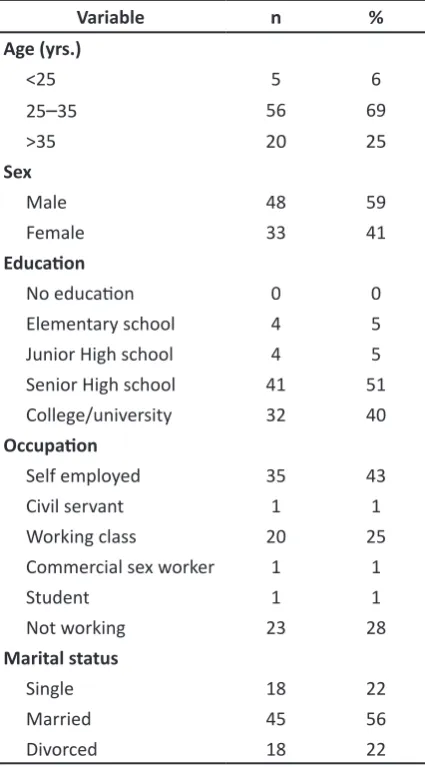
A list of the 81 HIV-posiive paricipants in this study is presented in Table 1. Male paricipants comprised 59.3% of the total paricipants and 69.1% paricipants were in 25–35 years old group. Half of the paricipants were high-school graduates, 43.2% were self employed, and 55.6% were married.
Most of paricipants who were infected with Chlamydia was in the age group of 25–35 years old, with 17.9% of them were Chlamydia posiive (Table 2). C. trachomais was detected in 20.8% males and 12.1% females. Both single and divorced groups were infected with C.
much higher compared to only 8.9% of married group that were infected by C. trachomais.
Table 1 Baseline Characterisics of Paricipants
Variable n %
Age (yrs.)
<25 5 6
25–35 56 69
>35 20 25
Sex
Male 48 59
Female 33 41
Educaion
No educaion 0 0
Elementary school 4 5
Junior High school 4 5
Senior High school 41 51 College/university 32 40
Occupaion
Self employed 35 43
Civil servant 1 1
Working class 20 25
Commercial sex worker 1 1
Student 1 1
Not working 23 28
Marital status
Single 18 22
Married 45 56
Divorced 18 22
Table 3 shows that 17.9% paricipants with the age of sexual debut of less than 20 years old were infected with Chlamydia. This percentage is not signiicantly diferent from that of the paricipants with the age of sexual debut of more than 20 years old. There were 33.3% paricipants with 6 or more lifeime sexual partners were Chlamydia posiive, which is higher when it is compared to only 14.3% paricipants with 1 lifeime sexual partners. Condom use behavior was also asked to the paricipants. Almost half of the paricipants included in the study admited that they always use condom. Despite this statement, there were sill 17.5% of the paricipants who were infected with Chlamydia. This means that we have to consider the paricipants’ statement regarding condom use
more carefully to understand the real condom use behavior.
Table 2 Characterisics of Paricipants with Posiive C. trachomais
Variable C. trachomais Total (+) (-) n
Age (yrs.)
<25 1 4 5
25–35 10 46 56
>35 3 17 20
Sex
Male 10 38 48
Female 4 29 33
Marital status
Single 5 13 18
Married 4 41 45
Divorced 5 13 18
Discussion
The overall prevalence of chlamydial infecion in this study was 17.3%, which was higher than any of the previous studies. This is probably due to the fact that STI screening is not rouinely performed for HIV-posiive paients in Teratai Clinic. Since most of chlamydial infecions are asymptomaic, most paients did not receive appropriate treatment and this could result in persistent chlamydial infecion.
Several studies on prevalence of chlamydial infecion using nucleic acid ampliicaion test in HIV-posiive paients have been conducted with varied results. A literature review of 37 clinical studies reported that chlamydia was the most common STI ideniied in HIV-posiive paients, with 5% median prevalence, ranging from 3 to 10,9%.22
An evaluaion on sexually acive Inuit women living in remote villages in Alaska found that 114 (23%) of 493 women had cervical infecion with C.
trachomais.23 As shown in this study, it has been repeatedly demonstrated that in sexually acive populaions in which litle diagnosic tesing and/ or speciic treatment is used, the prevalence of infecion may reach surprisingly high levels. This relects the asymptomaic nature of chlamydial infecion and the ability of the infecion, when untreated, to persist for months or years.23
HIV-posiive paients was 8.3%,24 whereas Iwuji reported that the prevalence of chlamydial infecion was 2.7% in asymptomaic paients and 19% in symptomaic paients.25
The prevalence of urethral chlamydial infecions in male paricipants in this study was 20.8%. The prevalence was higher than previous studies. Several authors reported varying result of C. trachomais prevalence in HIV-posiive men. The prevalence of chlamydial infecion in HIV-posiive men was 7% in India16 and America,15 9% in England,25 and 6% in US army.26
In this study the prevalence was higher in men than women. This is probably due to the fact that most of the paients who came to Teratai Clinic are male, and compared to women, men have higher tendencies to engage in high risk sexual behavior. The risk for chlamydial infecion was twice higher in men than women.26 This is probably due to higher risk sexual pracices in men. Twenty nine point two percent of men admited having more than 15 sexual partners, compared to 11.4% in women.27
A research in 11 ciies in Indonesia showed that 33% of men had sex with female sex worker in the previous year and 20% with non-marital female partners.This study also showed consistent condom use was low in both sex workers (17%) and other non-marital partners (13%).28 The prevalence of cervical chlamydial infecions in female paricipants in this study was 12.1%.
Previous studies have reported diferent results of chlamydial prevalence in HIV-posiive women.18,29,30 The cervical chlamydial infecion prevalence in women with HIV in 12 European countries was 11.8%.29 Research in Thailand found that the prevalence of chlamydial infecion was 9.7% in HIV-posiive woman.30 In an American study, it was reported that the prevalence of chlamydial infecion was 3.6% in HIV-posiive women.18
Chlamydial infecion in HIV-posiive paients were found as more common in female, but not staisically signiicant12 which was airmed by another studyshowing a correlaion between female sex and chlamydial infecion in HIV-posiive paients.31 Women have twice the risk of infected with C. trachomais than men. This is probably because women are anatomically more vulnerable to STIs. Anatomic consideraions make the transmission of STIs to women during sexual intercourse a biologically “more eficient” process. During intercourse, semen tends to pool in the vaginal vault causing prolonged contact with cervix epithelium. Another factor is cervical ectopy, which is commonly found in prepubertal women caused by hormonal changes.27
Norms regarding appropriate sexual behavior are usually more restricive for women than for men in most socieies. These norms not only limit women’s sexual freedom but also restrict their access to informaion about sexuality. In addiion, lack of economic independence may prevent women from leaving a relaionship that puts them at risk for acquiring STIs. In many countries, wives have litle control over marital sexuality and women’s ability to negoiate safer sexual pracices, paricularly condom use, is pracically none.32
In this study, the average age of paricipants infected with C. trachomais was 33.6 (34) years old, with a range of 23 to 71 years old. Most paricipants were in the age of 25–35 years old.
Most authors conirmed young age as a risk factor for chlamydial infecion.11,18,31 Young age was signiicantly related to the risk for acquiring STI in HIV-posiive paients.11 While another studies showed that an age of <35 years old with HIV posiive were at risk of being infected with chlamydia.18,31 One study stated that the prevalence of chlamydial infecion in <25, 25– 35, and >35 years old were 6.3%, 4.8%, 1.9%, consecuively.18
Several factors that contributed to young age as a risk factor for acquiring chlamydial infecion include higher number of sexual partners15 and less concerns about the risk of contracing HIV which lead to inadequate use of protecive measures despite knowledge of HIV-posiive status.26 Onen reported that recent sexual aciviies decreased with increasing age which may be due to a number of factors, including partner availability, relaionship saisfactory, social isolaion, bereavement plus perceived ageism, and sigmaizaion. The presence of physical and medical illness can also impact sexual funcion and was a factor independently and negaively associated with recent sexual acivity.15 Contrary to other studies, Iwuji found that age is not related with chlamydial infecions in HIV-posiive men.25
Most authors discovered that chlamydial infecion is related with sexual behavior. It is also reported that high risk sexual behavior increased the risk for acquiring chlamydial infecion signiicantly.33
Contrary to other studies, Lee found no signiicant relaion between sexual behavior and STI incident in HIV-posiive paients.11 This is probably due to bias. Many studies that observed sexual behavior frequently gave inaccurate result, because of recall and social desirability bias.34
condom use, and STI history. In this study, the average age of sexual debut in chlamydial infected paricipants is 19 years old, with 7 of 14 paricipants infected with C. trachomais having sexual debut at the age of <20 years old. This result is in accordance with the results from a study by Ghoshwho found the risk for acquiring chlamydial infecion in HIV-posiive paients increased in paients with age of sexual debut <20 years old.16
Young sexual debut, paricularly in men is correlated with increased number of sexual partners, while in women this correlates with early marriage and sexual coercion. Sexual coercion is related to big age diference, infrequent condom use, and high STI risk.32 In this study, 6/27 of paricipants claimed not having sexual intercourse in the last month and 4/20 in the last three months infected with C.
trachomais.
Fity percent of homosexual and 22% women who admited not having sexual intercourse in the last three months were infected with STI.34 This may be due to several reasons, including
recall and social desirability bias in reporing34 and persistent chlamydial infecion transmited through sexual encounters >3 months before.15 Most of chlamydial infecions are asymptomaic. Therefore, if rouine screening was not done, most of infecions would not be treated and could persist months or even years.23 Most of chlamydial infected paricipants in this study had ≥6 lifeime sexual partners.
Several authors found that the number of sexual partners correlated with chlamydial infecion.35,36 Findings show that increased number of sexual partners would increase the risk for acquiring chlamydial infecion35 and ≥6 sexual partners would increased the risk for acquiring chlamydial infecion 13.5 imes in women and 5.3 imes in men.36
Most of paricipants in this study claimed always using condom in every sexual intercourse. Seventeen point ive percent (7/40) of the paricipants who claimed that they always use condom were infected by C. trachomais. Several authors reported conlicing results about condom use in chlamydial infecion.11,34 One Table 3 Sexual History of Paricipants with Posiive C. trachomais
Variable C. trachomais Total
(+) (-) n
Age of sexual debut (yrs.)
<20 7 32 39
≥20 7 35 42
Number of sexual partner in the last month
0 person 6 21 27
1 person 6 42 48
≥2 persons 2 4 6
Number of sexual partner in the last 3 months
0 person 4 16 20
1 person 7 39 46
≥2 persons 3 12 15
Number of lifeime sexual partner
1 person 3 18 21
2–5 persons 4 35 39
≥6 persons 7 14 21
Condom use
Never 4 16 20
Seldom 3 18 21
study found no correlaion between condom use and incident of chlamydial infecion11 while another study found that 20% of paients who always use condom were infected with STI.34 Most paients infected with Chlamydia claimed that they always use condom in the previous week.35 This inding may be inluenced by several factors, including recall and reporing bias, inconsistent and inappropriate condom use,33 or latent chlamydial infecion.23
Contrary to other studies discussed above, van Benthem found that inconsistent condom use with casual sex partners increased the risk for acquiring chlamydial infecion in HIV-posiive paients.HIV-posiive women who used condoms
in less than 50% of their sexual contacts with casual partners had almost eight-fold higher risk and those who used condoms in 50–99% of the contacts had two-fold higher risk than women who did not have a casual partner.29
Based on the discussion in this paper, It is concluded that the prevalence of chlamydial infecion in male urethra and female cervix of HIV-posiive paients in Teratai Clinic, Dr. Hasan Sadikin General Hospital Bandung were 20.8% and 12.1%, consecuively, based on the PCR results. Idenifying chlamydial infecion using PCR assay should be considered for rouine screening test in HIV-posiive paients.
References
1. Stamm WE. Chlamydia trachomais infecions In: Holmes KK, Sparling PF, Stamm WE, Piot P, Wasserheit JN, Corey L, et al., editors. Sexually transmited diseases. 4th ed. New York: McGraw-Hill; 2008. p. 575–94.
2. Global prevalence and incidence of selected curable sexually transmited infecions. Geneva: World Health Organizaion; 2001.
3. Young H, Moyes A, Horn K, Scot GR, Patrizio C, Sutherland S. PCR tesing of genital and urine specimens compared with culture for the diagnosis of chlamydial infecion in men and women. Int J STD AIDS. 1998;9(11):661–5. 4. Jespersen DJ, Flaten KS, Jones MF, Smith TF.
Prospecive comparison of cell culture and nucleic acid ampliicaion tests for laboratory diagnosis of Chlamydia trachomais infecions J Clin Microbiol. 2005;45(10):5324–6.
5. Johnson RE, Green TA, Schachter J, Jones RB, Hook EW, Black C, et al. Evaluaion of nucleic acid ampliicaion tests as reference tests for Chlamydia trachomais infecions in asymptomaic men. J Clin Microbiol. 2000;38(12):4382–6.
6. Muhammad T, Ene C, Atanda G, Nwankwo A, Baba M. Seroprevalence of HIV infecion among paients atending STD clinic at Naional Hospital Abuja, Nigeria. Sci Res Essays. 2009;4(2):65–8. 7. Global report UNAIDS report on the global AIDS
epidemic. WHO; 2010.
8. Perkembangan HIV-AIDS di Indonesia triwulan III 2012 [Aricle on the Internet]. 2012 [cited 2013 Jan 25]. Available from: htp: htp://www. depkes.go.id/index.php/component/content/ aricle/43-newsslider/2186-perkembangan-hiv-aids-di-indonesia-triwulan-iii-tahun-2012.html.
9. Wasserheit J. Epidemiological synergy: interrelaionships between human immunodeiciancy virus infecion and other sexually transmited diseases. Sex Transm Dis. 1992;19(2):61–77.
10. Chan D. Fatal atracion: sex, sexually transmited infecions and HIV-1. Int J STD AIDS. 2006;17(10):643–50.
11. Lee HC, Ko NY, Lee NY, Chang CM, Liu SY, Ko W. Trends in sexually transmited diseases and risky behaviour among HIV-infected paients at an outpaient clinic in Southern Taiwan. Sex Transm Dis. 2010;37(2):86–93.
12. Manning SE, Pfeifer MR, Nash D, Blank S, Sackof J, Schillinger J. Incident sexually transmited infecions among persons living with diagnosed HIV/AIDS in New York city, 2001–2002: a populaion-based assessment. Sex Transm Dis. 2007;43(12):1008–15.
13. Lawson L, Katzenstein D, Vermund S. Emerging biomedical intervenions. In: Gibney L, DiClemente RJ, SH V, editors. Prevening HIV in developing countries. 1st ed. New York: Kluker Academic; 2002. p. 43–66.
14. Fleming DT, Wasserheit J. From epidemiological synergy to public health policy and pracice: the contribuion of other sexually transmited diseases to sexual transmission of HIV infecion. Sex Transm Inf. 1999;75(1):3–7.
15. Onen NF, Schacham W, Stamm KE, Overton ET. Comparison of sexual behaviour and STD prevalence among older and younger individuals with HIV infecions. AIDS Care. 2010;22(6):711–7. 16. Ghosh A, Dhawan B, Chaundry R, Vajpayee M,
trachomais infecions in treatment naive HIV-1 infected adults. Indian J Med Res. 2011;134(6):960–6.
17. Cohen M. Sexually transmited diseases enchance HIV transmission: no longer a hypothesis. Sex Transm Dis. 1998;351(Sppl 3):5–7.
18. Page KR, Moore RD, Wilgus B, Gindi BA, Erbelding E. Neisseria gonorrhea and Chlamydia trachomais among human immunodeiciency virus-infected women. Sex Transm Dis. 2008;35(10):859–61. 19. Cohen MS, Hofman IF, Royce RA, Kaembe P, Dyer
JR, Daly CC, et al. Reducion of consentraion of HIV-1 in semen ater treatment of uretriis: implicaions for prevenion of sexual transmission of HIV-1. Lancet. 1997;349(9069):1868–73. 20. Ghys PD, Fransen K, Diallo M. The associaion
between cervicovaginal HIV shedding, sexually transmited diseases, and immunodupression in female sex worker in Abidjan, Cote d’Ivoire. AIDS. 1997;11(12):F86–93.
21. Mayer KH, Venkatesan C. Interacions of HIV, other sexually transmited diseases, and genital tract inlammaion facilitaing local pathogen transmission and acquisiion. Am J Reprod Immunol. 2011;65(3):308–16.
22. Kalichman SC, Pellowski J, Turner C. Prevalence of sexually transmited co-infecions in people living with HIV/AIDS: systemaic review with implicaions for using HIV treatments for prevenion. Sex Transm Infect. 2011;87(3):183– 90.
23. Toomey KE, Raferty MP, Stamm WE. Unrecognized high prevalence of Chlamydia
trachomais cervical infecion in an isolated Alaskan Eskimo populaion. JAMA. 1987;258(1):53–6.
24. Phipps W, Stanley H, Kohn R, Stansell J, Klausner JD. Syphilis, Chlamydia and Gonorrhoea screening in HIV-infected paients in primary care, San Fransisco, California, 2003. AIDS Paient Care and STD. 2005;19(8):495–8.
25. Iwuji CC, Reeves I, Nambiar K, Richardson D. Diagnosic uility of urethral smear in predicing urethral chlamydia in HIV-infected men. Int J STD AIDS. 2008;19(11):741–3.
26. Spaulding AB, Lifson AR, Iverson ER, Ganesan A, Landrum ML, Weintrob AC, et al. Gonorrhoea or chlamydia in a US military HIV-posiive cohort. Sex Transm Infect. 2012;88(4):1–6.
27. Hook EW. Gender diference in risk for sexually transmited diseases. Am J Med Sci.
2012;343(1):10–1.
28. Musikawai DE, Morineau G, Nurhayai, Irmaningrum Y, Riono P, Prihutomo S, et al. Sexual risk taking, sexually transmited infecions and HIV prevalence among four “high-risk” occupaional froups of Indonesian men. Sex Transm Infect. 2009;85(5):391–6.
29. van Benthem BHB, Prins M, Larsen C, Delmas MC, Brunet JB, van den Hoek A. Sexually transmited infecions in european HIV-infected woman: incidence in relaion to ime from infecion. AIDS. 2000;14(5):595–603.
30. Srifeungfung S, Roongpisuthipong A, Asavapiriyanont S, Lolekha R, Trbuddharat C, Lockpichart S, et al. Prevalence of Chlamydia
trachomais and Neisseria gonorrhoeae in HIV-seroposiive paients and gonococcal animicrobial suscepibility: an update in Thailand. Jpn J Infect Dis. 2009;62(6):467–70. 31. Chkharishvili N, Dvali N, Khechiashvili G,
Sharvadze L, Tsertsvadze T. High seroprevalence of Chlamydia trachomais in newly diagnosed HIV paient in Georgia. Georgian Med News. 2010;2(189):12–5.
32. Buve A, Gourbin C, Laga M. Gender and sexually transmited diseases. In: Holmes KK, Sparling PF, Stamm WE, Piot P, Wasserheit JN, Corey L, et al., editors. Sexually transmited diseases. 4th ed. New York: Mcgraw Hill; 2008. p. 151–64.
33. Venkatesh KK, van der Straten A, Mayer KH, Blanchard K, Ranjee G, Lurie MN, et al. African women recently infected with HIV-1 and HSV-2 have increased risk of acquiring Neisseria
gonorrhoeae and Chlamydia trachomais in the
methods for improving reproducive health in Africa trial. Sex Transm Dis. 2011;38(6):562–70. 34. Hamlyn E, Welz T, Rebaudengo S, Simms H,
Poulton M. Sexual behaviour, condom use and rates od sexually transmited infecions in HIV clinic atendees in South East London. Int J STD AIDS. 2009;20(11):757–60.
35. Jin X, Chan S, Ding G, Wang H, Xu J, Wang G, et al. Prevalence and risk behaviour for Chlamydia
trachomais and Neisseria gonorrhoeae infecion among female sex worker in an HIV/AIDS high-risk area. Int J STD AIDS. 2011;22(2):80–4. 36. Götz HM, van Bergen JEAM, Veldhuijzen IK, Broer