A COMPACT TEA CO
2LASER FOR FIELD-BASED
SPECTROCHEMICAL ANALYSIS OF GEOLOGICAL SAMPLES
R. Wagini
1dan K. Kagawa
21Jurusan Fisika, FMIPA UGM, Sekip Utara Bulaksumur Yogyakarta 55281 2Department of Physics, Faculty nof Education, University of Fukui, Fuku i 910, Japan
ABSTRACT
A compact capacitor-transfer TEA CO2 laser of 180 mJ output energi and 50 ns pulse duration in half width has been designed and constructed for field use. This laser is suitable for laser microprobe spectrochemical analysis on geological and mining samples. Experiments show that the use of helium as a surrouding gas suppresses the continous emission spectrum of the plasma, thus increasing the S/N ratio. Using glass as standard samples, the minimum detectable concentrations are estimated with Zn neutral line and F ionic line to be 60 ppm and 500 ppm, respectively.
Keywords : lasers ( Compact TEA CO2 ), field-based analysis, laser microprobe analysis
Makalah diterima 3 Juni 2006
1. INTRODUCTION
The method of laser microprobe spectrochemical analysis (LMSA) was first introduced by Brench in 1962. Since than, many improvements have been made, mainly to increase the stability of the laser output and reproducibility of the sample removal process (Jida, 1990;Piepmeier and Osten, 1971, Scott and Strasheim, 1970). In addition to this, efforts have also been made to improve the detection system of the emission spectrum by employing photomultipliers or OMA (optical multichannel analyser) systems. In general, high-power solid-state laser, such as ruby and Nd laser, have been ased in LMSA, and almost all of the instruments employed in the LMSA were designed for application in the laboratory, but not for removal to the field.
Recently, an analytical method aof laser induced breakdown spectroscopy (LIBS) was presented by Cramers and his co-workers. This method offered the possibility of field-based rapid analysis. They used a Nd:YAG laser (45-475 ml, 15
ns) with the OMA as a detection system. We
belive that the TEA CO2 laser has great
potentia l for field-based rapid analysis on geological or mining samples for two reasons.
Firstly, a compact version of the TEA CO2
laser can be constructed, and secondly, geological samples show high absorbance at
the wavelength of the CO2 laser radiatioan
(10,6 µm). This leads to highly effective plasma generation. The emission spectrochemical analysis using the laser plasma indu7ced by the bombardment of the
TEA CO2 laser which was first attemted by
Gibson et al (1971) on Ge samples. They used
a CO2 laser pulse with 280 mJ output energy
and 350 ns pulse duration. The bombardment was made at a reducted pressure in order to decrease the continuous emission spectrum. Coversely, Kagawa et al have shown that Laser-inducted Shock Wave Plasma is produced by the bumbardment of a
high-power TEA CO2 laser with short pulse
duration (500 mJ, 100 ns) provided that the pressure of the surrounding gas is reduced to around 1 torr. In their experiments, they used
a commercial TEA CO2 laser which is
proved that the shock wave plasma has characteristics favourable to spectrochemical analysis. In particular, it has been noted that the background emission intensity of the plasma is relatively low, and there is a good linear relationship between the atomic line emission intensity and the concentration of the elements.
This paper presents a compact
TEA Co2 laser which was designed for
field-based spectrochemical analysis on the geological samples. The small size, low cost, and narrow pulse duration are advantages when that are compared with
the ordinary TEA CO2 laser. In this
experiment, emission spectrochemical analysis was made under 1 atmospheric pressure in order to accommodate the laser application to field-based rapid analysis. The methode of time-resolved emission spectroscopy was employed in order to reduce the signal generated by the continuous emission spectrum of the plasma.
2. LASER SYSTEM
Figure 1 shows the cross-section of the compact TEA CO2 laser. It basically
consists of a capacitor-transfer discharge circuit. The dimensions of the laser system are 400mm x 250mm x 200mm. The length and the separation of the main electrodes are 150mm and 20mm,
respectively. The optical cavity is
composed of a concave gold mirror with a curvature of 10m and a coated ZnSe reflecting flat mirror (70% reflection). The pre-ionization is made just before the main discharge, thus making the main discharge uniform. Six ceramic capacitors (Murata, 2 nF, 40 kV) are used as energy-storing elements and 25 kV is supplied through a compact high voltage power source, in which a neon-transformer is used with a double rectification circuit. The laser was
obtained from the compact TEA CO2 laser is
18mm x 7mm.
Figure 2 shows the pressure dependence
of the laser energy of the compact TEA CO2
laser. It can be seen that the maximum energy of 180 mJ can be extracted at 1020 torr was used through this experiment.
Figure 3 shows the pulse form of the
laser radiation. This signal was detected using a photondrag detector (Rofin 7410). It is seen that the half-width of the laser pulse is approximately 50 ns, and the rise time of the laser pulse is as short as only a few nanoseconds. Menyuk and Moulton (1980)
reported a high repitition rate mini TEA CO2
laser wiyh an output energy of 60 mJ and a pulse duration of 100 ns in half width. It is believed that the short duration in our compact
TEA CO2 laser is due to the low overall
inductance in the discharge circuit, and also due to resonator geometry (Baker et al, 1981).
It was proved experimentally that this
laser is very effective in producing the laser-induced Shock Wave Plasma. In fact, this laser generates a large plasma as compared with the plasma that was produced using a
commerical TEA CO2 laser under the same
pulse energy and the same pressure of the surrounding gas.
3. SPECTROCHEMICAL
APPLICATION
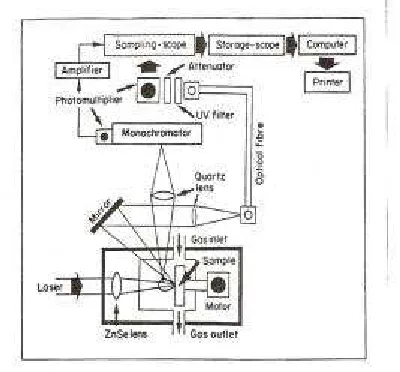
Figure 4 shows the set-up in this experiment. The laser radiation was focused by a Ge lens (f = 100mm) through a ZnSe window onto the surface of the sample in the chamber.
The flow of the surrouding gas in the chamber was regulated at a pressure of 1 atm. The radistion of the laser-induced plasma was observed at a right angle to the laser beam using an imaging quartz lens (f = 150mm).
The electrical signal from the photomultiplier (Hamamatsu R-1104, load resistance of 500 ohm) attached to a monochromator (Nikon P - 250, f - 250 mm), was fed into a 100 GHz sampling oscilloscope (Iwatsu SAS 601B). The trigger signal of the sampling oscilloscope was generated using another photomultiplier (Hamamatsu R-331) in combination with a UV filter. The plasma light emitting from 3 mm above the surface of the sample was sent into the monochromator. When the time-resolved emission spectrum was taken, the time axis of the sampling scope was fixed at a desired time and the wavelength of the monochromator was scanned with a scanning speed of 45 nm min'. The signal from the sampling scope was memorized by a digital storage scope (Kikusui, DSS 6522) and sent to a personal computer (NEC. PC-9801F). It was observed that the emission intensity of the plasma remained almost constant for about 2 minutes after the initiation of the bombardment when the sample is homogeneous.
Figure 5 shows the plasma observed
when the laser light was focused on a CaCO3
sample with air as the surrounding gas at a pressure of 1 atm.
Figure 2. Pressure dependence of the laser output energy.
Figure 3. Pulse form of the compact TEA CO2 laser
Figure 6 shows the time-resolved emission spectrum at different time delays after the laser pulse bombardment on
CaCo3: (a) using air as the surrounding
gas; (b) argon; (c) helium. In the case of air as the surrounding gas, it is observed that at the early time delay (1 µs) a high background continuum dominates the spectrum. At 3 µ s, the background becomes low and definity atomic line spectra appear. At 7 µs, the background emission becomes very low and the neutral calcium line (Ca I 4226 A°) could be plainly observed (Kurniawan, et. al, 1992). This is probably due to the difference in the excitation process of the plasma. In the case of argon surrounding gas, many argon ionic line dominate the spectra in the early time dela y, making the spectrum unsuitable for elemental analysis.
Figure 6.c shows the spectra in the helium surrounding gas. It is evident that even in the early time delay of 1µs, the background emission intensity level is low. Therefore, it is concluded that helium gas is most suitable as the surrouding gas. Furthermore, it should be noted that the strong emission line due to He I 3888 A° is observed in the early stage of the plasma formation, and decreases with time.
Figure 7 shows the comparison of the time-integrated emission spectrum on three kinds of surrounding gas air, argon and helium. It is seen that also provides a low bacground signal, even in this detection method. This results gives rise to the possibility that this sample means of emission spectrochemical analysis can be used without employing the time-resolved detection method.
Figure 8 shows the results of semiquantitative analysis using a standart glass sample. In this case, helium was used as the surrounding gas and the time axis of the sampling scope was set at 5 µs. Glass sample no 1 contains 3,36% calcium, 0,07% magnesium, 1,07% fluorine and other elements
. Whereas glass sample no 2 contains 9,51% calcium, 4,08% magnesium and no
Figure 5. Photograph of the laser plasma using air as a surrounding gas, the sample is C aCO3
usually very difficult to detect because of the high-lying electronic energy levels. The appearance of the fluorine ionic line proves that helium atmospheric plasma has a temperature high enough to ionized the fluorine atoms.
Another interesting fact that supports the high temperature plasma in the helium surrounding gas is obtained by observing the crater form. In the case of the helium surrounding gas, no molten material was observed around the crater, thus proving that effective vaporization takes place due to high temperature plasma. In contrst to this, in argon and air, a wall of molten material was observed around the crater, indicating that the plasma temperature is relatively low and a considerable part of the sample has been ejected as liquid, or in a recondensed form.
Using these standard glass sample, the minimum detectable concentrations of Zn I 4810 A° and F II 3850 A° were estimated to be about 60 ppm and 500 ppm, respectively.
4. CONCLUSION
Using a compact TEA CO2 laser
(180 mL, 50 ns), it has been demonstrated that a rapid semiquantitative analysis can be successfully made when helium gas is
used as a surounding gas. This analytical method holds great potential for using in the fiel-based analysis of geological and mining samples. On the basis of our experiments, it is expected that if the OMA system for detecting the emission spectrum is employed, the time needed for analysis will be drastically reduced.
ACKNOWLEDGEMENT
This work was partly supported by a Grant5-in-Aid for scientific research priority areas, Shock Wave Research, from the Ministry of Education, Science and Culture of Japan.
REFERENCE
Baker, C., Dye, P.E., and Tait, B.L., 1981.
Design of compact high prf TEA CO2
laser and performance under multimode
and single mode conditions, J Phys E.
Sci Instrum, 14, 1167-1170.
Breeh, F., 1962. Optical Microemission
stimulated by a ruby laser”, Appl
Spectrsc, 16, 59.
Cremers, D. A., 1987. The analysis of metal at a distance using laser-induced
breakdown spectroscopy, Appl
Spectrosc, 41, 572-579.
Cremes, D. A., and radziemski, L.J., 1983. Detection of chlorine and fluorine in air by laser-induced
breakdown-spectroscopy, Anal Chem, 55,
1252-1256.
Gibson, A.F., Hughes, T.P., and Ireland, C.L.M., 1971. CO2 laser generation of
plasma for spectroscopy and spectrochemical analysis”, J Phys D, 4, 1527-1534.
Jida, Y., 1990. Effects of atomosphere on laser vaporization and excila tion processes of solid samples, Spectrochim Acta, 45B, 1353-1367.
Kagawa, K., and Kurniawan, H., 1991.Blast wave generation by the bombardment of
TEA CO2 laset at low density,
Proceeding of the international Shosk Wave Workshop, Chiba, Japan.
Kagawa, K., Manda, T., Ueda, M., and li,
Zhaozhi, 1991. Balst wave
generation by the bombardment of TEA CO2 laser at low pressures, J Spectroscopy Soc Japan, 40, 150-154.
Kurniawan, H., Kobayashi, T., Nakajima,
S., and Kagawa, K., 1992.
Correlation between front speed and initial explosion energy of the blast
wave induced by a TEA CO2 laser,
Japan J Appl Phys.
Menyuk, N., and Moulton, P.F., 1980. Development of a high-repetition rate mini-TEA CO2 laser, Rev Sci Instrum,
51, 216-220.
Piepmeier, E.H., and osten, D.E., 1971. Atmospheric influences on Q-switched laser sampling and resulting plumes, Appl Spectrosc, 25, 642-652.