
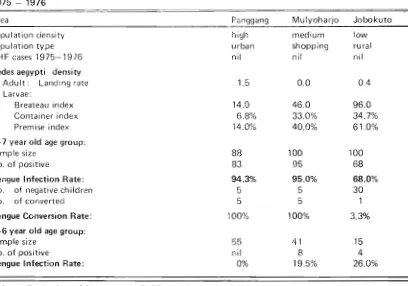
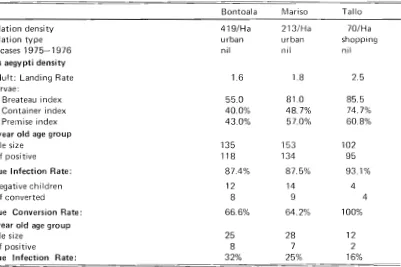
EPIDEMIOLOGICAL STUDIES OF DENGUE HEMORRHAGIC FEVER IN IEDONESIA, 1975-1976
Bebas
5
0
0
Teks penuh
Gambar
Dokumen terkait
The results of Table 1 showed that the average knowledge, attitudes and practices of respondents regarding dengue prevention were good.. Knowledge is the result of
fever using meteorological data such as rainfall, rainy days, air temperature, humidity, and dengue hemorrhagic fever surveillance data by month in Northern
and an area with high rainfall that need special attention in the dengue control program, because Karawang District is still an endemic area of dengue in Indonesia.. Aspects
Based on the results of GWLR analysis, the number of rainy days and the number of health workers partially significantly influence the status of dengue fever events in each
Copyright ©2023 Public Health Study Program School of Health and Life Sciences 24 RESULT Distribution Pattern of Dengue Fever The pattern of distribution of dengue fever in the
Here, we look at the estimates of the dengue fever rate in the year 2012, to 2017, area, poverty percen- tage, precipitation, number of rainy days for predicting the dengue fever
The study define DENV infection as a secondary infection based on the positivity of IgG anti Dengue on the convalescence sera on day 7 of DENV.. The study found primary DENV infection
