An IT Strategy Course: Why and How
David M. Woods
[email protected]
Computer & Information Technology Department
Miami University Regionals
Hamilton, OH 45011, USA
Elizabeth V. Howard
[email protected]
Computer & Information Technology Department
Miami University Regionals
Middletown, OH 45042, USA
Abstract
With continuing changes in all aspects of the technology field, especially the emergence of cloud and “as a service” offerings, developing skills for strategic thinking about technology is of increasing importance to our students. However, the presence of formal IS/IT strategy courses in programs of study trails that of more traditional courses. In addition, there is limited discussion on the teaching of strategy in the academic literature. This work offers reasons for the continued importance of teaching strategy and provides examples of how strategy is covered in a course on Global and Strategic Issues in IT.
Keywords: IT Strategy, Active Learning, Experiential Learning, IS Curriculum, Pedagogy
1. INTRODUCTION
The topic of strategy is explicitly included in the IS 2010 curriculum (IS 2010) through the IS 2010.7 IS Strategy, Management, and Acquisition course that is recommended for all IS Majors and Minors. Core elements of strategy are also related to several of the pervasive themes of “user centeredness and advocacy,” “professionalism (life-long learning, professional development, ethics, responsibility),” and “interpersonal skills” mentioned in the IT 2008 curriculum (Information Technology 2008).
Despite this, several recent reviews IS programs have found a limited presence of strategy courses in these programs. Additionally, a review of the published literature found few
examples discussing how strategy is being taught in IS and IT programs.
The emergence of technologies such as, Software as a Service, Infrastructure as a Service, Platform as a Service, and big data allows IS/IT departments new opportunities for growth. Effectively using these new technologies requires a focus on strategic thinking. We will share an overview of the design of our course, Global and Strategic Issues in IT, as well as specific activities and assignments intended to encourage strategic thinking.
2. STRATEGY IN THE CURRICULUM
of seven suggested core courses. The high level course description provided for IS 2010.7 mentions several topics related to strategy including “IS strategic alignment,” “strategic use of information,” “IS Planning,” and “Using IS/IT governance frameworks.” IS 2010.7 is one of three courses recommended for all IS majors and minors.
While the IT 2008 curriculum does not include a specific strategy course, strategy would fit in the IT Capstone courses described in the Integration-First Approach or the Social and Professional Issues in IT course from the Pillars-First Approach (Information Technology 2008).
The IS2010 curriculum was the first major revision in almost 10 years and included significant changes. Given the competing demands on faculty time, it would not be surprising if it took some time for major additions like the IS2010.7 course to make their way into programs of study.
A review (Apigan & Gambill, 2010) of programs at 240 colleges and universities assessed these programs in view of the IS 2009 working model curriculum. This review found the IS2009.7, IS Strategy, Management, and Acquisition course in only 35.4% of the programs reviewed. Of the seven core courses in the curriculum, the only course found in fewer programs was IS 2009.3, Enterprise Architecture, which was present in 20.6% of the programs. For comparison, the IS2009.4 IS Project Management course was found in 53.8% of the programs studied, and the remaining IS2009 core courses were found in at least 83% of programs.
Studies of the final IS 2010 curriculum find similar results. A study of 127 AACSB accredited undergraduate programs (Bell, Mills, & Fadel, 2013) found the core IS 2010.7, IS Strategy, Management, and Acquisition course in only 29 % of programs. Again, only IS 2010.3, Enterprise Architecture, was found in fewer programs (17 %). On the other hand, four of the core courses were found in at least 70 % of the programs.
A study reviewing the presence of IT 2010 curriculum elements in 37 ABET accredited programs (Feinstein, Longenecker, & Shrestha, 2013) found the IS 2010.7 and IS 2010.3 courses were found in only 10 of the 37 programs reviewed.
While the data shows a limited presence of courses matching the IS 2010.7 IS Strategy, Management and Acquisition course, this doesn’t exclude that potential that topics related to IS strategy may be covered in other courses.
3. WHY TEACH STRATEGY?
To frame this discussion, a definition of strategy is useful. For our purposes, we define strategy as the efforts related to developing a high level plan to achieve goals in an uncertain environment. For the IS/IT field, strategy must be discussed in terms of supporting the overall strategy of a business or other organization.
This definition of strategy is in agreement with several of the guiding assumptions of the IS 2010 curriculum, which include that “students must therefore understand that:
Information systems in organizations have increasing strategic significance ...” (IS 2010, p. 8)
and
“Focus on the application of information technology in helping individuals, groups, and organizations achieve their goals within a competitive global environment. ” (IS 2010, p. 8) integrator” along with other observations that indicate an increasing need for strategic skills.
compliance; and the other parts that direct another type of light (information technology) into new places to address the disruption and enable the transformation.” (Voss, 2014a)
Clear risks are seen in fragmenting the CIO role, reinforcing the need for IS/IT professionals to be able to think and act strategically.
Another consideration in developing skills related to strategy is that students can apply the same skills to career planning, lifelong learning, and professional development since all of these involve planning for achieving a goal in an uncertain environment.
4. AN OVERVIEW OF THE COURSE
In the Computer and Information Technology Department at Miami University, students have the opportunity to learn about strategy in a 400 level course addressing Global and Strategic Issues in IT (see appendix for an outline of the course). In this course, students learn how to identify and adapt to the cultural differences found in today’s world. There is specific emphasis on understanding how technology is used in different parts of the world, and developing the skills needed to understand, assess, and make informed decisions about global technology issues. The course satisfies a Miami University Liberal Education requirement in the Global Perspectives category, which requires that courses be designed “to have a global perspective and help students develop the ability to communicate and act respectfully across linguistic and cultural differences.” (Miami Global Perspectives, n.d.)
As previously described in more detail (Howard et al., 2012; Howard & Petrone, 2010), we designed the course around Bloom’s learning domains: Cognitive through lectures and reading; Affective through reflections and discussions, and Psychomotor through simulations, activities, and applications to the students’ own work (Bloom et al, 1956). Toward the end of the semester the activities and assignments encompass a synergy of all three domains. For the first third of the course, students research and participate in activities that facilitate learning about their own cultural orientation, the culture of specific USA-based technology corporations, the culture of the USA, USA demographics, and the IT Infrastructure of the USA. During the last two-thirds of the course, each team of students studies three
countries: one of the BRICI countries (Brazil, Russia, China, India, Indonesia) because of their importance as emerging world economies as well as two other countries. The teams begin by researching the culture and demographics, and then move on to the many aspects of the IT infrastructure covered in the course.
For strategy, the main skills that students develop are the collecting and analyzing of data to develop recommendations. An important part of this involves learning about useful sources of strategic information about technology. Fortunately, there are a number of strong resources, starting with strategy consultancies. Gartner (www.gartner.com) and McKinsey (www.mckinsey.com) both offer some information with a free registration. Additional information is available to clients – check with your school’s Information Technology group to see if they are clients of Gartner or McKinsey. Educause (www.educause.edu) provides information specific to technology use in higher education to members, which includes many higher education institutions. Local CIOs and senior IT leaders are also good sources for ideas on emerging technologies and strategic IT topics.
Additional discussion of strategic issues in information technology can be found in the information technology trade press, including Information Week (www.informationweek.com) and CIO (www.cio.com) magazine. More general business oriented publications such as the
Economist (www.economist.com) also offer
detailed analysis of the impact of technology on business. A good source of discussion topics are annual top-10 lists that can be found in several cover technologies with which students are more familiar.
about the use of technology in a specific industry.
Teams of students work together to apply the skills learned in class to collect and analyze data for presentations on a series of increasingly complex questions about the countries that they are studying. This leads to a final presentation where each team presents three ideas for potential IT projects to a hypothetical USA based technology company. Each of these IT projects are located in the countries that the teams have been studying. Each team also recommends one of their IT projects by building a business case to support their recommendation.
5. IT STRATEGY CLASSROOM ACTIVITIES
To help readers gain a better understanding of the strategy focused course activities, detailed descriptions for several activities are provided.
Hype Cycles (“Hype Cycle Research,” n.d.) are one of Gartner’s research methodologies related to the life cycle of a technology or technologies in a specific field. Figure 1 shows a generic Gartner hype cycle showing the expected changes in a technology’s visibility as the technology matures. In class, students review Gartner’s article explaining the Hype Cycle (Fenn & Raskino, 2013). Students then review recent hype cycle publications and select one for detailed review. While reviewing the selected hype cycle, each student generates one question or observation to be shared during small group discussions.
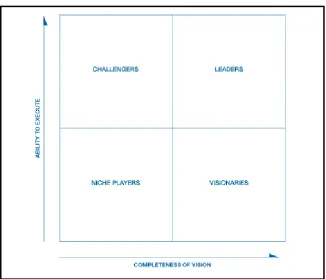
A similar activity is used for students to learn about the Gartner Magic Quadrant (“Magic Quadrant Research,” n.d.) methodology. Figure 2 shows a generic Gartner Magic Quadrant showing how technology providers within a specific area can be viewed in terms of their vision and ability to execute. Again, students review the details of Gartner’s methodology (Black & Thomas, 2013) and then select a specific MagicQuadrant for in depth review and discussion.
In addition to learning about tools, students are also introduced to new or emerging technologies and asked to think strategically about the impact of the technology. Guided class discussions are held around many technology topics. For example, for disaster recovery, students read an article about a fire at Notre Dame (Latimer, Teams are then merged and asked to take both lists of their top five and merge them into a identify examples of cloud computing, how cloud computing could help a business achieve strategic goals, and potential concerns from an IT perspective. The entire class then shares and discusses the items identified by the small groups. As part of this discussion, the university’s selection and implementation of Google Apps for Education was used to support a specific discussion of interesting points.
For big data, before class, students read an overview on big data (Cuiker, 2010) that is then discussed in class. Students are presented a brief overview of big data and watch and discuss short videos identifying strategic and technology considerations related to big data. Students also complete a hands on activity (adapted from Frydenberg, 2013) using Google’s BigQuery tool to get a feel for working with big data. This was followed by small group discussions with the same questions as the cloud computing exercise.
A final in-class activity focuses on gathering and analyzing information about high level strategic trends in the IT industry. For this exercise, effectiveness, breakdown of planned future IT spend, and anticipated talent needs) are used for small group discussion activities. Each group reviews the assigned section and responds to discussion questions. The small group discussions are then summarized for the entire class.
6. CONCLUSION
efficiency and effectiveness (Khan & Sikes, 2014). Our students not only need technology skills but they also need to understand how that technology can benefit their organization. Our course, Global and Strategic Issues in IT, combines intercultural, global, and technology topics that help foster strategic thinking.
Evidence of student achievement of strategy related learning outcomes can be found in reviewing the group presentations throughout the course. As the course progresses, these show steadily increasing to strategic aspects of the use of IT. For most groups, the final presentation offering three foreign expansion ideas for a USA technology company to consider show the expected consideration of intercultural, global, and strategic issues. the higher education environment. Students could use an education related Hype Cycle and assess the university’s current efforts on the technologies covered in the Hype Cycle. Similarly, a relevant MagicQuadrant could be identified and assessed in a local context. Both activities could also be extended to include a discussion with the university CIO.
To reinforce the point that IT strategic activities need to work in support of the larger business or organization, students could review the overall university strategic plan and IT specific strategic plan. Students could assess how well the IT plan is tied to higher level goals in the university plan. This would be another opportunity for a Journal of Information Systems Education, 21(4), 411-420.
Bell, C., Mills, R., & Fadel, K. (2013). An Analysis of Undergraduate Information Systems Curricula: Adoption of IS 2010 Curriculum Guidelines. Communications of
the Association for Information Systems, 32, 73-94.
Black, D. & Thomas, J. (July 2013). How Gartner Evaluates Vendors and Markets in magic Quadrants and MarketScopes. Subscription required for access on http://www.gartner.com
Bloom, B. S., Engelhart, M. D., Furst, E. J., Hill, W. H., & Krathwohl, D. R. (1956). Taxonomy of educational objectives: the classification of educational goals; Handbook I: Cognitive Domain New York, Longmans, Green, 1956.
Cukier, K. (2010). Data, data everywhere: A special report on managing information. Economist, Feb. 27, 2010. Retrieved on
May, 7, 2014 from
http://www.economist.com/node/15557443
Fenn, J. & Raskino, R (July 2013). Understanding Gartner’s Hype Cycles. Subscription required for access on http://www.gartner.com
Feinstein, D., Longenecker, H, & Shrestha, D. (2013) A Study of Information Systems Programs Accredited by ABET In Relation to IS 2010, Proceedings of the Information Systems Educators Conference, v30 n2757, San Antonio, TX.
Frydenberg, M. (2013). Drinking from the Fire Hose: Tools for Teaching Big Data Concepts in the Introductory IT Classroom. The Proceedings of the Information Systems Education Conference, V30 n. 2674, San Antonio, TX.
Gefen, D., et al. (2011). The Changing Role of the CIO in the World of Outsourcing: Lessons Learned from a CIO Roundtable. Communications of the Association for Information Systems, 28, 233-242.
Grajek, S., et al. (2014). Top 10 IT Issues, 2014: Be the Change You See. Educause Review, March/April 2014.
study.” Journal of Computing Sciences in Colleges, 28, 1 (October 2012), 66-73.
Howard, Elizabeth V. & Petrone Martha. (2010). Teaching global issues in IT: an intercultural communication approach. Journal of
Computing Sciences in Colleges, 26, 1
(October 2010), 67-74.
Hype Cycle Research Methodology (n.d.). Retrieved on May 6, 2014 from http://www.gartner.com/technology/researc h/methodologies/hype-cycle.jsp
Information Technology 2008: Curriculum Guidelines for Undergraduate Degree Programs in Information Technology. Retrieved on May 8, 2014 from http://www.acm.org//education/curricula/IT 2008%20Curriculum.pdf
IS 2010: Curriculum Guidelines for Undergraduate Degree Programs in Information Systems. Retrieved on May 8,
2014 from
http://www.acm.org/education/curricula/IS %202010%20ACM%20final.pdf
Johnson, L., Adams Becker, S., Estrada, V., Freeman, A. (2014). NMC Horizon Report: 2014 Higher Education Edition. Austin, Texas: The New Media Consortium.
Khan, N. & Sikes, J. (2014). IT Under pressure: McKinsey Global Survey results. March 2014. Retrieved on May 7, 2014 from http://www.mckinsey.com/insights/business _technology/it_under_pressure_mckinsey_gl obal_survey_results (free registration required).
Latimer, Dewitt. (2009). At Least It Wasn't a Football Weekend: The Notre Dame Tunnel Fire. (Research Bulletin, Issue 20). Boulder, CO: EDUCAUSE Center for Analysis and Research. Retrieved on May 20, 2014 from http://www.educause.edu/library/resources/
least-it-wasn%E2%80%99t-football-weekend-notre-dame-tunnel-fire.
Magic Quadrant Research Methodology (n.d.). Retrieved on May 6, 2014 from http://www.gartner.com/technology/researc h/methodologies/research_mq.jsp
Miami Global Perspectives (n.d.) retrieved on
May 21, 2014 from
http://www.miami.miamioh.edu/liberal- ed/current-students/foundation-three-gmp.html
Voss, B. & Wheeler, B. (2010). The CIO: Plumber or Strategist? Educause 2010 Annual Conference. Retrieved on May 1,
2014 from
http://www.educause.edu/annual-conference/2010/cio-plumber-or-strategist .
Voss, B. (2014a). The CIO Pipeline, Part 1: The Strategist vs. the Plumber Revisited. Retrieved on May 7, 2014 from http://www.educause.edu/blogs/bdvoss/cio- pipeline-part-1-strategist-vs-plumber-revisited
Appendices
Course Overview and Major Student Assignments
Week Class Activity Major Student Assignments
(listed when they are due) 1 Intro to Course and Global Perspectives
2 Exploring Culture
3 Working with Americans Cultural Assessments
4 Global IT Challenges Know your Company
5 Tracking Emerging Technologies
6 Intellectual Property Rights Know Your Country
7 Security and Privacy Country Profile #1
8 Technology Management and Disaster Recovery
9 e-Commerce Country Profile #2
10 IT Industry and Mobile Computing
11 IT Industry Country Profile #3
12 The Cloud and BIG Data
13 3D-printing and other technologies
14 Final Presentations Comfort Zone Assignment
Final Project
The course also includes a number of other smaller scale assignments to help students learn about and reflect on global cultural and technology topics.
Know Your Company – Students work in small groups to learn about a specific US technology
company. Students work to learn about the company from the perspective of a global IT professional. Groups explore their assigned company’s mission, values, global presence, approach to cultural
differences, etc. to form a perception of the company. Group findings are shared in a 15 minute in-class presentation.
Know Your Country – Students work in small groups to develop a reference handbook and
presentation for a non-US technology company that is looking to expand into the USA.
Country Profiles– Students work in small groups to develop and present a series of country profiles. 1. Provide an overall introduction to the group’s primary country (typically a BRICI country),
including demographics, government, cultural dimensions, economics, and assessing how well the group’s company (from the Know Your Company assignment) would fit in the country from a cultural perspective.
2. Provide an introduction to a secondary country assigned by the instructor and overview of IT infrastructure for the group’s primary country.
3. Provide an introduction to a third country (chosen by the group and approved by the instructor) and also profile the IT Industry, mobile computing and the Cloud in the group’s primary country.
Comfort Zone Assignment – Students reflect on their comfort zone and identify a culture about
which they know little. Each student identifies an activity that will take them out of their comfort zone and writes a 1 – 2 paragraph description for the instructor to review and approve. Students then complete the activity and use techniques learned in class to observe and reflect on the experience and write a 1 – 2 page paper about the activity and what they learned from stepping outside of their comfort zone.
countries the group has researched for the Country Profiles. On the last day of class, each group turns in a business case document discussing the three potential projects including technical and cultural challenges and making a final recommendation. The groups also make an executive level presentation on the projects and final recommendation.
Figure 1. The Gartner Hype Cycle methodology for viewing technology’s life cycle.