______________________________
Corresponding author: Dragana Ignjatović-Micić, Maize Research Institute „Zemun Polje“, S. Bajića 1, 11185 Belgrade, Serbia , Tel: 011/3756704, Fax: 011/3756707, e-mail: [email protected]
UDC 575: 633.15 DOI:10.2298/GENSR0803205I
Original scientific paper
QUALITY PROTEIN MAIZE – QPM
Dragana IGNJATOVIĆ-MICIĆ, Goran STANKOVIĆ, Ksenija MARKOVIĆ, Vesna LAZIĆ-JANČIĆ and Miloje DENIĆ
Maize Research Institute „Zemun Polje“, S. Bajića 1, 11185, Serbia
Micić-Ignjatović D., G. Stanković, K. Marković, V. Lazić-Jančić and M.Denić (2008): Quality protein maize – QPM.– Genetika, Vol. 40, No. 3, 205-214.
Quality protein maize (QPM) contains the opaque-2 gene along
with numerious modifiers for kernel hardness. Therefore, QPM is maize with high nutritive value of endosperm protein, with substantially higher content of two essential amino acids - lysine and tryptophan, and with good agronomical performances. Although QPM was developed primarly for utilization in the regions where, because of poverty, maize is the main staple food, it has many advantages for production and consumption in other parts of the world, too. QPM can be used for production of conventional and new animal feed, as well as for human nurture. As the rate of animal weight gain is doubled with QPM and portion avaibility is better, a part of normal maize production could be available for other purposes, such as, for example, ethanol production. Thus, breeding QPM is set as a
challenge to produce high quality protein maize with high yield and other important agronomical traits, especially with today’s food and feed demands and significance of energy crisis.
Key words: maize, opaque-2, QPM
INTRODUCTION AND HISTORY OF QPM DEVELOPMENT Agricultural scientists have long had an interest in improving the protein quality of plants. Maize, one of the most important staple foods worldwide, is relatively low in protein content (generally about 10%). Also, roughly half of that protein contains almost no lysine or tryptophan, two amino acids essential for building proteins in humans and monogastric animals.
Several natural maize mutants conferring higher lysine and tryptophan were identified in the 1960s and 1970s, i.e. opaque-2 (o2), floury-2 (fl2), opaque-7 (o7), opaque-6 (o6) and floury-3 (fl3). The o2 mutation was found to be the most suitable
for genetic manipulation in breeding programs aimed at developing maize high in lysine and tryptophan. Maize homozygous for the o2 (recessive) mutation was
shown to have substantially higher lysine and tryptophan content than maize that was either homozygous dominant (O2O2) or heterozygous (O2o2) for the opaque-2 locus
(CROW and KERMICLE, 2002). BRESSANI (1992) showed that increased concentrations of these two amino acids in the grain endosperm can double the biological value of maize protein. However, the amount of protein in such maize remains at about 10% or, in other words, the amount of common maize that needs to be consumed to achieve amino acid equilibrium is more than twice as much as the amount of
opaque-2 maize (FAO, 1992). Maize homozygous for the o2 also has protein quality
value equivalent to 90% that of milk.
The discovery of opaque-2 maize stimulated considerable research interest
and activity, with high hopes of substantially improving the nutritional status of maize consumers, especially in developing countries. But, this highly desirable trait turned out to be closely associated with several undesirable ones. The opaque-2
maize kernels were dull and chalky, had 15-20% less grain weight and were more susceptible to several diseases and insects. These obstacles made most research programs to stop their work on opaque-2.
Only a small number of crop research institutes continued this work, most notably the International Maize and Wheat Improvement Center (CIMMYT) in Mexico. Using conventional breeding methodologies, the CIMMYT interdisciplinary research team slowly overcame the original opaque-2 defects while maintaining
superior nutritional quality. They were able to convert the floury soft endosperm kernels into harder types, increase grain yield potential to the level of the best normal maize types, endow the opaque-2 maize with disease and insect resistance and with
utilization and storage qualities similar to those of superior normal maize materials. The new, normal-looking, normal-tasting opaque-2 types were renamed „Quality
UTILITY OF QPM
Maize with high lysine and tryptophan, has been used in feeding studies involving monogastric animals and humans. In one experiment it was shown that pigs raised on high lysine/tryptophan maize gained weight at roughly twice the rate of animals fed solely on normal maize with no additional protein supplements. An equal quantity of high lysine maize substituted for normal maize in pig feeds can maintain the amino acid balance and decrease the use of synthetic lysine (BURGOON et al., 1992).
Several human nutrition studies were conducted by AKUAMOA-BOATENG (2002) in Ghana, where maize is the main staple. It was shown that children fed with high lysine/tryptophan maize were healthier, had reduced stunting and better growth-enhancing capabilities, compared with children fed normal maize porridge. The conclusion was that high lysine/tryptophan maize holds the promise of improving the nutritional status of vulnerable groups whose main staple is maize and who cannot afford protein-rich foods to supplement the diet.
The biological value of protein is estimated on the average proportion of absorbed protein that is successfully retained by the body for maintenance and growth. Biological value is closely related to protein quality, which in the case of maize is limited mostly due to low concentrations of essential amino acids. Several studies on children and adults have found that subjects eating QPM had significantly higher nitrogen retention than those who ate normal maize (BRESSANI, 1991), indicating that QPM protein is more „bioavailable“. The biological value of normal maize is about 45% and of QPM about 80%, which is similar to the biological value of milk - 90% (FAO, 1992). Besides biological value, QPM has additional improved nutritional advantages over normal maize. As the consequence of increased concentration of tryptophan QPM has higher concentration of niacin (B3). Also, because of reduced leucine concentration absorption of potassium (GRAHAM et al.,
1980) and carotene (DE BOSQUE et al., 1988) are improved.
Although QPM was developed primarily for utilization in the regions where, because of poverty, maize is the main staple food (e.g., Africa, Asia), it has many advantages for production and consumption in other parts of the world, too. QPM can be used for production of conventional and new animal feed, as well as for human nurture. Utilization of QPM could discourage import of protein additives which are used in animal feed composites. As the rate of animal weight gain is doubled with QPM and portion avaibility is better, a part of normal maize production could be available for other purposes, such as, for example, ethanol production.
GENETICS OF QPM
The development of high lysine/tryptophan maize involves manipulating three distinct genetic systems: 1. the recessive allele of the opaque-2 gene (o2o2), 2.
modifiers/enhancers of the o2o2 – containing endosperm to confer higher lysine and
tryptophan and 3. genes that modify the opaque-2- induced soft endosperm to hard
The recessive allele of the opaque-2 gene is the central component of the
genetic system that confers high levels of lysine and tryptophan in maize endosperm protein. The o2 allele is inherited in a simple recessive manner. The presence of o2
in the homozygous recessive state (o2o2) is the pre-requisite for the entire process of
obtaining high lysine/tryptophan maize.
The presence of the o2 gene in different maize genotypes changes the
relative share of protein fractions and therefore alters quality (LAZIĆ-JANČIĆ, 1986). The most abundant proteins in the grain endosperm are zeins and, particularly, alpha-zein, which are poor in lysine and tryptophan. The homozygous o2 mutant causes a
decrease in the production of endosperm alpha-zein protein and a corresponding increase in the proportion of non-zein proteins that naturally contain higher levels of lysine and tryptophan (GIBBON and LARKINS, 2005). Therefore, in a given quantity of protein from o2o2 maize, the proportion of non-zeins is higher, which predisposes o2
maize to have higher lysine and tryptophan concentration. In order to confer higher levels of these amino acids, the presence of another set of genes, called enhancers, is required.
The enhancers consist of minor modifying loci that effect lysine and tryptophan levels in the endosperm. Lysine levels in normal and o2 maize average
2% and 4%, respectively, of total proteins in the whole grain flour. However, across diverse genetic backgrounds, the levels range from 1.5 - 2.8% in normal maize to 2.6 – 6.5% in their o2 converted counterparts (MORO et al., 1996). Therefore, if lysine or
tryptophan levels are not monitored while developing new cultivars, one could end up with a maize cultivar having the o2o2 genotype and lysine and tryptophan levels
equivalent to those in normal maize.
The o2 mutation and the enhancers are, by themselves, not sufficient to
develop agronomical acceptable maize high in lysine and tryptophan. Pleiotropic effects of the o2 allele make the maize endosperm soft and susceptible to cracking,
ear rots and weevils. Therefore, breeding maize for high lysine and tryptophan content requires selection based on a third, distinct genetic system, also comprised of minor modifying loci that convert the mutant endosperm of the soft phenotype to a hard phenotype, similar to normal maize.
It has been shown that an increased level of gamma zein likely contributes to the recovery of a hard endosperm phenotype, given that the o2- modified grains
(hard endosperm) have approximately double the amount of gamma zein in the endosperm as the o2-only mutants (WALLACE et al., 1990). In another words, while
the proportion of zeins generally decreases in o2 gerplasm, gamma zein increases
during the recovery of hard endosperm.
Several SSR markers, closely linked to more than ten gene modifiers, have been identified up to now. These genes influence 27kD gamma-zein content, elongation factor eEFI1A content and enzyme activities which control important metabolic steps in amino acid synthesis and lysine degradation. The identified markers are being introduced in breeding programs (WU et al., 2002; DANSON et al.,
BREEDING QPM
Research programs on breeding for high quality protein maize were stimulated during the 1960-ies, with discovery of o2o2 mutants. Almost a decade,
backcrossing was used for mass conversion of standard maize inbred lines into
opaque-2 variants, with parallel study of their combination abilities for yield and
other important agronomical traits. These research programs were intensive in the countries in which maize was an economically important crop. A very potent program in this field was also developed at Maize Research Institute „Zemun Polje“, where a significant number of commercial opaque-2 inbred lines and hybrids with
improved nutritional and biological value were developed (DUMANOVIĆet al., 1977; EGGUM et al., 1983; DENIĆ et al., 1984). Unfortunately, because of undesirable pleiotropic effects of the gene most of these programs were stopped and only a small number of crop research institutes continued this work. The goal – overcoming the original opaque-2 negative effects while maintaining superior nutritional quality -
was achieved in CIMMYT, were Quality Protein Maize was developed.
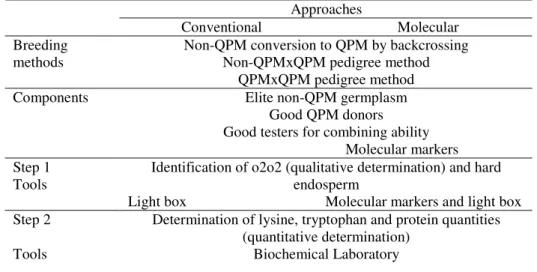
It is recommended that the breeding programs should start by converting their elite non-QPM inbred lines and open pollinate varieties (OPV) to QPM either through backcrossing or through pedigree crosses between elite non-QPM germplasm and elite QPM donors. Once a breeding program has some elite QPM germplasm, recycling elite-QPM germplasm with elite-QPM germplasm, available in the program or from other breeding programs, should be started (i.e., use elite QPM x elite QPM).
Table 1 QPM breeding approaches, methods, components, steps and tools
Approaches
Conventional Molecular Breeding
methods
Non-QPM conversion to QPM by backcrossing Non-QPMxQPM pedigree method
QPMxQPM pedigree method Components Elite non-QPM germplasm
Good QPM donors Good testers for combining ability Molecular markers Step 1
Tools
Identification of o2o2 (qualitative determination) and hard endosperm
Light box Molecular markers and light box Step 2
Tools
Determination of lysine, tryptophan and protein quantities (quantitative determination)
Biochemical Laboratory (Taken from VIVEK et al., 2008)
There are two possible approaches to QPM breeding, no matter which breeding method is used: the conventional approach and the molecular approach (use of molecular markers to assist in o2 selection). Regardless of the breeding method
and approach used, there are two unique and essential steps in the development of QPM germplasm. The first is to simultaneously identify segregants in a family or population having the o2 allele in the homozygous recessive (o2o2) condition with a
hard endosperm. The conventional approach for this task uses light table and the molecular approach involves the use of both molecular markers and light table. The second step is to identify and confirm QPM quality, i.e. percentage of tryptophan and protein in a sample, through laboratory analysis. The approaches, methods, components, steps and tools are described in Table 1, taken from VIVEK et al. (2008). Light table selection
Light table selection (selection of desired level of modification/opaqueness in the kernel) is done to pick out kernels with the o2o2 genotypes by using the
degree of opaqueness as an indirect measure or secondary trait. Due to segregation of genes for endosperm hardness varying degrees of softness/hardness are expressed in endosperm of segregating generation, i.e. varying levels of opaqueness are observed on a light table. A kernel with o2o2 genotype (soft endosperm) is seen as complete
opaqueness, while kernels with O2O2 or O2o2 genotypes (hard endosperm) are
translucent.
Gradation in the opaqueness is visually assessed on a 1 to 5 scoring scale. The scores are as follows:
Type (modification score) 1: not opaque Type (modification score) 2: 25% opaque Type (modification score) 3: 50% opaque Type (modification score) 4: 75% opaque Type (modification score) 5: 100% opaque
Less opaqueness implies higher/more action of modifiers. Types 1 to 3 would be considered QPM, provided their protein quality is verified. It is recommended to select only types 2 and 3 in a conventional breeding approach. Type 2 kernels should be selected only in advanced generations, because O2O2 or O2o2
genotypes may have a small degree of opaqueness and the presence of o2o2
genotypes in early generations is the priority. Type 3 is recommended for selection in early generations as it is a compromise between the guaranteed presence of o2o2 (high priority) and good modification (which can be improved in subsequent generations).
QPM quality (percentage of tryptophan and protein in a sample)
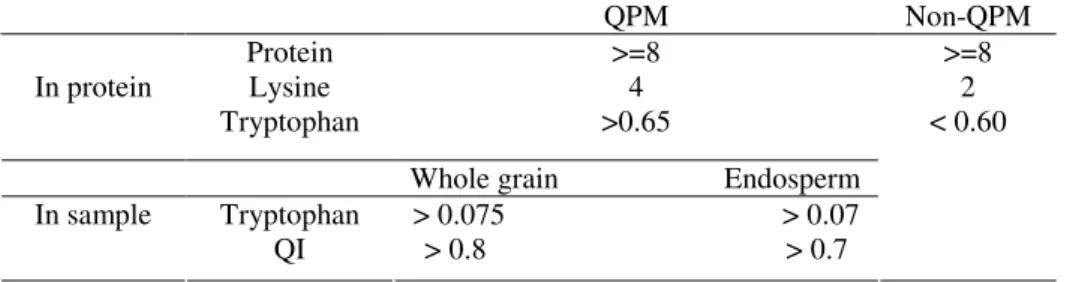
Samples are usually first sent to the laboratory for protein content and tryptophan analysis at the F3 or F4 stage (before the first test cross). Both lysine and tryptophan concentrations are increased in QPM, but only tryptophan is analyzed on routine basis. This is because lysine and tryptophan are highly correlated and, normally, the value of lysine is four times that of tryptophan. Due to the
well-established relationship between these amino acids in the protein of opaque-2 maize
endosperm (HERNANDEZ and BATES, 1969; VILLEGAS et al., 1992), tryptophan can be
used as a single parameter for evaluating the nutritional quality of the protein. When interpreting the results of laboratory analysis for making selections, the protein, tryptophan and quality index (QI - tryptophan to protein ratio in the sample) have to be above the acceptable limits described in Table 2 (VIVEK et al, 2008).
Table 2 Ready reckoner for interpreting laboratory results (all values in %)
QPM Non-QPM In protein Protein Lysine Tryptophan >=8 4 >0.65
Whole grain Endosperm In sample Tryptophan QI > 0.075 > 0.07 > 0.8 > 0.7 >=8 2 < 0.60
(Taken from Vivek et al., 2008)
Marker Assisted Selection (MAS)
Since the development of molecular marker techniques in the 1980-ies, genetic background of many agronomically important traits in maize has been dissected. Markers closely linked to gene(s) and/or QTLs (quantitative trait loci) for traits, such as drought tolerance (LEBRETON et al., 1995; QUARRIE et al., 1999),
kernel oil content (MIKKILINENI and ROCHEFORD, 2003; LAZIĆ et al., 2003; MARKOVIĆ et al., 2007) and many other have been identified. With the rapid advances in genome research and molecular technology, it becomes possible to use these markers in marker assisted selection. MAS is gaining considerable importance due to the efficiency and precise transfer of genomic regions of interest (foreground selection) and the recovery of the recurrent parent genome (background selection) (BABU et al., 2004).
It has recently become possible to use MAS to accelerate selection for the
opaque-2 allele in QPM breeding programs. There are publicly available SSR
(Simple Sequence Repeats) markers for this purpose – phi57, phi112 and umc1066
(DANSON et al., 2006). The three markers are located within the opaque-2 gene,
which means that there is a very high correlation between marker data and phenotypic expression. The phi112 marker is dominant and therefore identifies normal (O2O2) and heterozygous (O2o2) genotypes. The breeder can assume that all
other genotypes are of desired homozygous recessive type (o2o2). The other two
markers are co-dominant and can identify all three genotypes.
The advantages of MAS is that the leaf tissue from seedlings is used to extract DNA and conduct the PCR assay; therefore, selection of the desired genotypes can be completed prior to flowering and only the desired plants need to be pollinated. MAS for o2 allele has been reported in a study aimed at achieving faster
et al., 2005) and would appear to be an appropriate use of the technique. However, without concurrent selection for amino acid modifiers, protein quality can drop considerably. In the study by BABU et al. (2005), tryptophan content as a percentage
of total protein decreased from 1.05% in the QPM donor line to 0.78-0.85% in the BC2F2 families. In order for QPM MAS to be fully effective, a suit of markers linked to modifying loci of both amino acid levels and endosperm hardness need to be identified (KRIVANEK and VIVEK, 2006). Also, additional traits will likely need to be coupled with selection for QPM to become cost competitive with traditional methods.
ACKNOWLEDGEMENTS
These research was supported by the Ministry of Science and Technology, Republic of Serbia, through Project TR 20039.
.
Received September 24th, 2008 Accepted November 10th, 2008
REFERENCES
AKUAMOA-BOATENG, A. (2002): Quality protein maize infant feeding trials in Ghana. Ghana Health Service.Ashanti, Ghana.
BABU, R., S.K.NAIR, .M. PRASSANA, H.S. GUPTA (2004): Integrating marker assisted selection in crop breeding – prospects and challenges. Curr. Sci. 87(5): 607-619.
BABU, R., NAIR S.K., A. KUMAR, S. VENKATESH, J.C. SEKHAR, N.N. SINGH, G. SRINIVASAN, H.S. GUPTA (2005): Two-generation marker-aided backcrossing for rapid conversion of normel maize lines to quality protein maize (QPM). Theoretical and Applied Genetics 111:888-8897.
BRESSANI, R. (1991): Protein quality of high lysine maize for humans. Cereal Foods World 36:806-811. BRESSANI, R. (1992): Nutritional Value of high-lysine maize in humans. In E.T. Mertz (ed.). Quality
Protein Maize. American Association of Cereal Chemists, St. Paul, MN.
BURGOON, K.G., J.A. HANSEN, D.A. KNABE and A.J. BOCKHOLT (1992): Nutritional value of quality protein maize for starter and finisher swine. Journal of Animal Science 70:811-817.
CROW, J.F. and J. KERMICLE (2002): Oliver Nelson and quality protein maize. Genetics 160:819.
DANSON, J.W., M.MBOGARI, M.KIMANI, M.LAGAT, A. KURIA, A.DIALLO (2006): Marker assisted introgression of opaque-2 gene into herbicide resistant elite maize inbred lines. African Journal of Biotechnology 5(24): 2417-2422.
DE BOSQUE, C., E. J.CASTELLANOS, R. BRESSANI. (1988): In ICAP Report Annual, INCAP, Guetamala. DENIĆ, M., J. DUMANOVIĆ, D.MIŠEVIĆ, Ž.STOJANOVIĆ, K. KONSTANTINOV, D. FIDLER (1984): Use of wheat
and maize protein mutants in breeding for improved protein quantity and quality. Cereal Grain Protein Improvement. International Atomic Enargy Agency, Vienna.
DUMANOVIĆ, J., M. MIŠOVIĆ, Č. JOVANOVIĆ, M. DENIĆ (1977): Changes in protein content and quality in modified opaque-2 endosperm types of maize. Proc. IX Meeting EUCARPIA, Maize and Sorghum Section, Krasnodar.
EGGUM, B. O., DUMANOVIĆ J., D.MIŠEVIĆ, M. DENIĆ (1983): Grain yield and nutritive value of high oil, opaque and waxy maize hybrids. J. Cereal Sci. 1:139-145.
GIBBON, B.C. and B.A. LARKINS (2005): Molecular genetic approaches to developing quality protein maize. Trends in Genetics 21:227-233.
GRAHAM G, G., R.P.PLACKO, W.C. MACLEAN (1980): J. Nutr, 110:1070-1074.
HERNANDEZ, H.H. and L.S BATES (1969): A modified method for rapid tryptophan analysis in maize. CIMMYT Research Bulletin no. 13. Mexico, D.F.: CIMMYT.
FAO (1992): Maize in human nutrition. FAO, Rome.
KRIVANEK, A. and B. VIVEK (2006): Science behind breeding QPM. Mexico D.F.:CIMMYT.
LAZIĆ-JANČIĆ, V. (1986): Study of biochemical basis of genetic control of maize endosperm storage proteins. Ph.D. thesis, PMF, University of Belgrade.
LAZIĆ-JANČIĆ, V, D IGNJATOVIĆ-MICIĆ, K MARKOVIĆ, T ĆORIĆ, D KOVAČEVIĆ, G SARTALIĆ, SA QUARRIE (2003). Changes in RFLP allele frequencies during recurrent selection for high oil content in maize. Maize Genetics Cooperation Newsletter, 774-5
LEBRETON, C., V. LAZIĆ-JANČIĆ, A. STEED, S.PEKIĆ, S.A. QUARRIE (1995): Identification of QTL for drought responses in maize and their use in testing causal relationships between traits. Journal of Experimental Botany 46, 853-865.
MARKOVIĆ, K., D.IGNJATOVIĆ-MICIĆ, G. SARATLIĆ, V.LAZIĆ-JANČIĆ (2007): Identification of chromosome regions determining kernel high oil content in maize (Zea mays L.) synthetic populations. Genetika 39(2): 197-206.
MIKKILINENI, V. and T.R. ROCHEFORD (2003): Sequence variation and genomic organization of fatty acid desturase-2 (fad2) and fatty acid desturase-6 (fad6) cDNAs in maize. Theor. Appl. Gen.
106(7):1326-1332.
QUARRIE, SA,V LAZIC-JANCIC,D KOVACEVIC, A STEED, S PEKIC (1999):Bulk segregant analysis with molecular markers and its use to help improve drought resistance in maize. Journal of Experimental Botany50: 1299-1306.
VILLEGAS, E., S.K. VASAL, M. BJARNASON (1992): Quality protein maize – What is it and how it was developed?. In E.T. Mertz, ed. Quality Protein Maize, American Association of Cereal Chemists, St. Paul, Minnesota. p.27-48.
VIVEK, B.S., A.F., KRIVANEK, N. PALACIOS-ROJAS, S. TWUMASI-AFRIYIE and A.O. DIALLO (2008): Breeding Quality Protein Maize (QPM): Protocols for Developing QPM Cultivars. Mexico, D.F.: CIMMYT.
WALLACE, J.C., M.A. LOPES, E. PAIVA, B.A. LARKINS (1990): New methods for extraction and quantitation of zeins reveal a high content of gamma-zeins in modified opaque-2 maize. Plant Physiology
92:191-196.
WU, R., X.Y. LOU, C.X. MA, X. WANG, B.A. LARKINS, G. CASELLA (2002): An improved genetic model generates high resolution mapping of QTL for potein quality in maize endosperm. PNAS
KUKURUZ VISOKOG KVALITETA PROTEINA
Dragana IGNJATOVIĆ-MICIĆ, Goran STANKOVIĆ, Ksenija MARKOVIĆ, Vesna LAZIĆ-JANČIĆ i Miloje DENIĆ
Institut za kukuruz „Zemun Polje“, S. Bajića 1, 11185 Beograd, Srbija I z v o d
Kukuruz visokog kvaliteta proteina (QPM – Quality Protein Maize) sadrži opaque-2
gen, kao i mnogobrojne modifikatore za tvrdoću zrna. QPM se može definisati kao kukuruz sa visokom nutritivnom vrednošću proteina endosperma, odnosno značajno većim sadržajem dve esencijalne aminokiseline – lizinom i triptofanom, i istovremeno dobrim agronomskim perfomansama. Mada je QPM stvoren prvenstveno za korišćenje u regionima u kojima je, zbog siromaštva, kukuruz glavna hrana, postoje mnoge prednosti za proizvodnju i korišćenje ovog kukuruza i u ostalim regionima sveta. QPM se može koristiti za proizvodnju konvencionalne i nove hrane za životinje, kao i za ishranu ljudi. Zbog dvostruko bržeg prirasta telesne težine životinja i boljeg iskorišćavanja pripremljenog obroka QPM kukuruza, deo proizvedenog standardnog kukuruza bi se mogao preusmeriti za druge potrebe, kao na primer za proizvodnju etanola. Selekcija kukuruza za poboljšanje kvaliteta proteina, zajedno sa visokim prinosom i dobrim perfomansama drugih značjnih agronomskih svojstava, predstavlja izazov za selekcionere, pogotovo imajući u vidu današnje potrebe za hranom, kao i značaj energetske krize.
Primljeno 24. IX 2008.