A JOURNAL ON TAXONOMIC BOTANY,
PLANT SOCIOLOGY AND ECOLOGY
Vol. 13(3): 221 —315, April 11, 2012
Chief Editor
KARTINI KRAMADIBRATA
Editors
DEDYDARNAEDI (INDONESIA)
TUKTRIN PARTOMIHARDJO (INDONESIA) JOENI SETIJO RAHAJOE (INDONESIA) TEGUHTRIONO (INDONESIA)
MARLINAARDIYANI (INDONESIA) EIZI SUZUKI (JAPAN)
JUN WEN (UNITED STATE OF AMERICA)
Managing editor
HIMMAH RUSTIAMISecretary
ENDANG TRI UTAMI
Lay out
DEDEN SUMIRATHIDAYAT
Illustrators
SUBARIWAHYUDI SANTOSO ANNE KUSUMAWAIY
Reviewers
BRYAN SIMON (AUSTRALIA), EVE J. LUCAS (UNITED KINGDOM), J.F.VELDKAMP (NETHERLANDS), LAUR-ENCE SKOG (USA), PIETER BAAS (NETHERLANDS), RUTH KIEW (MALAYSIA), ROBERT J. SORENG (USA), HE-LENA DUISTERMAAT (NETHERLANDS), LYN A. CRAVEN (AUSTRALIA), RUGAYAH (INDONESIA), MARK HUGHES (UNITED KINGDOM), MARTIN CALLMANDER (USA), PETER C. VAN WELZEN (NETHERLANDS), WAYNE TAKEUCHI (USA), NOBUYUKI FUKUOKA (JAPAN).
Correspondence on editorial matters and subscriptions for Reinwardtia should be addressed to:
HERBARIUM BOGORIENSE, BOTANY DIVISION,
RESEARCH CENTER FOR BIOLOGY-LIPI,
CIBINONG 16911, INDONESIA
Vol 13, No 3, pp: 271 − 297
271
THE PANDAN FLORA OF FOJA-MAMBERAMO GAME RESERVE AND
BALIEM VALLEY, PAPUA-INDONESIA
Received May 14, 2010; accepted December 27, 2011
ARY PRIHARDHYANTO KEIM
Herbarium Bogoriense, Botany Division, Research Center for Biology-LIPI, Cibinong Science Center, Jl. Raya Bogor−Jakarta Km. 46, Cibinong 16911, Bogor, Indonesia. E-mail: [email protected].
ABSTRACT
KEIM, A. P. 2012. The Pandan flora of Foja-Mamberamo Game Reserve and Baliem Valley, Papua–Indonesia. Reinwardtia 13 (3): 271–297. –– Seven species of Pandanus and seven species of Freycinetia are observed in Kwerba and adjacent areas within the Foja-Mamberamo Game Reserve, Papua-Indonesia. Two species are proposed as new: Freycinetia kwerbaensis A.P. Keim and Pandanus korwae A.P. Keim. This recent study also acknowledges a new record for F. mariannensis and a possibly new record for F. vidalii. The rest are extension of distribution areas in mainland New Guinea. The discovery of a long searched almost mythical wild type of widely cultivated P. conoideus is also accomplished. A new species from Baliem Valley nearby Wamena in the Jayawijaya Mountains, Papua-Indonesia namely F. wamenaensis A.P. Keim is described
Keywords: Foja, Freycinetia, Jayawijaya, Mamberamo, New Guinea, Pandanaceae, Pandanus, Papua, Wamena.
ABSTRAK
KEIM, A. P. 2012. Flora pandan di Suaka Margasatwa Foja-Mamberamo dan Lembah Baliem, Papua-Indonesia dengan jenis dan rekaman baru serta penemuan hidupan liar dari Pandanus conoideus Lam. Reinwardtia 13 (3): 271–297. –– Tujuh jenis marga Pandanus dan tujuh jenis Freycinetia teramati di kawasan Kwerba dan sekitarnya di wilayah Suaka Margasatwa Foja-Mamberamo, Papua-Indonesia. Dua jenis dipertelakan di sini sebagai jenis baru: Freycinetia kwerbaensis A.P. Keim dan Pandanus korwae A.P. Keim. Penelitian ini juga mencatat rekaman baru Freycinetia mariannensis dan kemungkinan rekaman baru F. vidalii. Selebihnya adalah perluasan persebaran di daratan New Guinea. Tumbuhan liar P. conoideus yang lama dicari dan hampir melegenda juga berhasil ditemukan dalam penelitian ini. Satu jenis baru dari wilayah Lembah Baliem dekat dengan Wamena di Pegunungan Jayawijaya, Papua-Indonesia, yaitu F. wamenaensis A.P. Keim, juga dipertelakan sebagai jenis baru.
Kata kunci: Foja, Freycinetia, Jayawijaya, Mamberamo, New Guinea, Pandanaceae, Pandanus, Papua, Wamena.
INTRODUCTION largest part of the basin.
The Foja Mountains is located north of the Mamberamo river basin and covers an area of 9,712 km2, in which more than 3,000 km2 are composed of lavish tropical rainforests. The highest point is Mount Foja (hence the name of the mountains) with altitude of approximately 2,193 meters and located
at latitude of 3°5’49‖S and longitude of 138° 44’16‖ E.
The combination of difficult accessibility and low density of human population make the forests in the Foja Mountains are relatively untouched, and
thus make them as the largest undisturbed tropical rainforest in the Asia Pacific region. Based on this exceptional nature circumstance on October 21st
1982 (Anonymous, 2004) the Indonesian government established the mountains and the neighbouring Mamberamo Basin as a protected area in the form of Game Reserve formally the Foja-Mamberamo Game Reserve.
Prior to this current study, the only information on the pandan flora of the Mamberamo Basin was by Brass based on collections made through the 3rd Archbold Expedition to New Guinea (Merrill & Perry, 1939; 1940). However, this expedition did not penetrate further north into the Foja-Mamberamo area.
Indonesia Administration (UNTEA Administration,
ca. 1969). Since then the Kwerbas had moved
down to the present location, Kwerba (2°38’32.2‖S, 138°24’38.2‖E) at much lower altitude (90 to 100
m) and Bringnyawa was deserted, but it is still regarded a sacred place though.
The result of this current study indicates that areas in mainland New Guinea. The discovery of a long searched almost mythical wild type of widely cultivated P. conoideus is also attained.
Baliem Valley
South of the Mamberamo river basin stand the mighty Jayawijaya Mountains with the great Baliem Valley rest within. Wamena, located at 1600 to 1700 meter altitude, is the most important city in the valley and being the centre of administration, Wamena is the capital of the mountainous District of Jayawijaya, and cultural activities it is undoubt-edly the most populated area in the valley.
Prior to this current study the pandan flora of the Baliem Valley was studied by Brass (Merrill & Perry 1940), but the area understudy was restricted to around Lake Habema. Keim (Keim et al. 2006) incorporated wider areas covering Wamena up to Trans Kurulu-Pass Valley, excluding Lake Habema. Interestingly there has been no report of any species of Freycinetia in the two publications. The result of this current study reveals both the first record of
Freycinetia in the valley and the existence of a spe-cies new to science from the Wamena Biological Garden namely F. wamenaensis.
Wamena Biological Garden is a 150 hectares garden located in the Gunung Susu area about 8 km Northwest of Wamena. The garden was established by the Indonesian Institute of Sciences (LIPI) on 12 June 1995. It aim is to serve as an ex-situ conservation area for the indigenous biota of the central highlands of Papua and adjacent areas including the Lorentz National Park.
There are two creeks of importance flow in the garden, the Gur and Dupuk. These creeks serve as the source of running water and are of biologically most diverse areas in the garden. Freycinetia
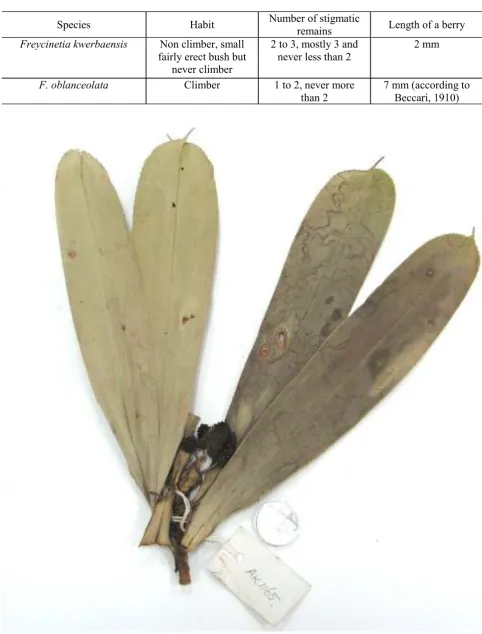
Gracilis fruticosa, non scandens; infructescentiae ter-nate vel quaternatae; cephalium ellipsoideus; stigmata 2 vel 3, plerumque 3. –– Type: A.P. Keim 1165 (BO!), Indonesia, Papua, Mamberamo Raya, Kwerba, Tace-waram, Kuikarawar, 21 Nov. 2008.
Slender non climbing pandan, up to 1 m high.
Stem 0.5–0.6 cm diameter; internodes 0.8 cm. Leaf
oblanceolate (spathoideous), 20–28 cm long, 3.5–5 cm wide, acuminate apex, spines on terminal and basal parts only; adaxial surface green, glabrous; abaxial surface light green, glabrous; auricle tapered, glabrous, brown. Infructescence terminal, consists of 3 or 4 cephalia (ternate or quaternate – in
quaternate infructescence one cephalia undeveloped), each 4–6 cm long; peduncle 1–1.5
cm long; pedicel 1.5– 1.8 cm long, bright yellowish green, glabrous. Cephalium ellipsoidal, 2.5–3.5 cm long, 1–1.5 cm circumference, green when young turns to orange when mature. Berry 0.2 cm long, 0.1 cm wide; number of stigmatic remains 2–3, mostly 3, deep brown.
Etymology. After the village Kwerba, where the type was collected.
Distribution. Known only from type locality.
Habitat. Lowland, hill slope, commonly found close to a path at about 75 m altitude.
Vernacular name. Not recorded.
Uses. Cephalium said to be consumed by birds.
Notes. Despite sharing the possession of oblanceolate or spathoideous leaves, F. kwerbaensis
differs from F. oblanceolata in 3 morphological
arboreous) habit. The number of stigmatic remains in F. kwerbaensis is almost always 3. Berries with the number of stigmatic remains 2 are rarely seen and they are only observed in the undeveloped cephalium in the quaternate infructescence.
Table 1. Morphological comparison on habit, number of stigmatic remains, and the length of berries between Freycinetia kwerbaensis and F. oblanceolata.
Species Habit Number of stigmatic
remains Length of a berry
Freycinetia kwerbaensis Non climber, small fairly erect bush but
never climber
2 to 3, mostly 3 and never less than 2
2 mm
F. oblanceolata Climber 1 to 2, never more than 2
7 mm (according to Beccari, 1910)
2. FREYCINETIA LAETA Merr. & L.M. Perry. ––
Type: L. J. Brass 7031 (A; iso. BO!), Papua New Guinea, Palmer River, 2 miles below Black River sec-tion, June 1936.
Distribution. Mainland New Guinea
Habitat. Lowland tropical rainforest at about 100 m altitude. In Kwerba it is found at about 85 m altitude. Although abundantly found, mostly were not in flowering or fruiting.
Vernacular name. Not recorded.
Uses. Not recorded. obvious reddish orange colouration on bracts and basal part of leaf, the tapered auricle, the non needle -like berries with 3 to 4 stigmas. In the field F. laeta
looks exceedingly similar to F. marginata; how-ever, the two species differ mainly in three morpho-logical characters (Table 2). Even if the individuals are sterile, F. laeta can still be distinguished from F. marginata through the colour of the terminal leaves. The terminal leaves in F. laeta are green with bright orange tints. In F. marginata the terminal leaves are green with reddish orange to red tints on terminal parts.
Specimen collected. Indonesia, Papua, Mamberamo Raya, Mamberamo Tengah, Kwerba, Tacewaram, Kwerep, 02 Nov. 2008, A.P. Keim
1078(BO!).
3. FREYCINETIA MARGINATA Blume. –– Type:
Zippelius 219-a (L), Indonesia, Papua, Triton Bay, Kaimana, Dobo, June-July 1828. –– Fig. 3.
Freycinetia reineckei Warb. (1898) 578. –– Syntypes: Reinecke 255 (B†), Reinecke 255a (B†), Reinecke 255b (B†), Reinecke353a (B†), Reinecke362 (B†; isosyntype
Table 2. Morphological comparison on the colours of bracts and anthers, and the shapes of berries between Freycinetia laeta and F. marginata.
Species Colour of bracts Colour of anthers Shape of berries Freycinetia laeta Orange Orange to deep red Prismatic
F. marginata White or white with red-dish orange to bright red
tints on apical parts
Pink to deep pink Needle-like (filiform)
BO!), Samoa, Savaii, NW of Savaii, Le Pacga, November 1894, syn. nov.
Freycinetia minahassae Koord. (1898) 267. –– Type: S.H. Koorders 18465β (BO!), Indonesia, North Sulawesi, Minahassa, Upper Tondano Lake, 12 March 1895, syn. nov.
Freycinetia australiensis Warb. (1900) 32. –– Type: Peutzkes.n. (B†), Australia,Queensland, Daintrie River.
Freycinetia latispina Warb. (1900) 33. –– Type: Sarasin669 (B†), Indonesia, North Sulawesi, Minahassa, 1893-1894, syn. nov.
Freycinetia maxima Merr. (1908) 310. –– Syntypes: CurranFB 10754 (PNH†), Philippines, Luzon, Tayabas, 22 July 1908; Curran FB 12381 (PNH†), Albay, Sorsogon, Adumoy Hills, June 1908, syn. nov.
Freycinetia mariannensis Merr. (1914) 48. –– Type:
Costenoble s.n. (US), USA, Marianas Islands, Guam Island, 1914, syn. nov.
Freycinetia ponapensis Martelli in Kaneh. (1934) 129. –– Type: Lederman 13245 (B†), Micronesia, Po-nape, Patapat, November 1913, syn. nov.
Freycinetia carolinensis Kanehira (1935) 185, f. 17. –– Type: R. Kanehira 2359 (TI), Micronesia, Palau, Aimiriik, 01 Aug. 1933, syn. nov.
Freycinetia mariannensis var. microsyncarpia Hosok. (1937) 191. –– Type: Koidzumi s.n. (TI), Micronesia, Ponape, July 1915, syn. nov.
Freycinetia tesselata Merr. & Perry (1939) 149. –– Type: Brass 3384 (A), Solomon, Ysabel, Maruto, 25 December 1932, syn. nov.
Freycinetia parviaculeata B.C. Stone (1970) 220. ––
(Queensland).
Habitat. Lowland tropical rainforest. In Kwerba it is found from 75 to 125 m altitude, but it is abundantly seen occupying hill slope at about 85 m altitude.
Vernacular name. Érorit (Kwerba).
Uses. Local people mentioned that cephalium is quaternate infructescence, elongate-ellipsoidal cephalium, and the distinctive needle-like (filiform) berries. Even when sterile, the habit and colouration of bracts and terminal leaves are sufficient for identification.
Blume (1835) did not mention the exact location of the type; however, Zippelius was known to visit and collect botanical specimens at Dobo in Triton Bay, Kaimana on June to July 1828 (van Steenis, 1950). Thus it is assumed here that the type was collected in that area and around that time. The presence of F. marginata in Mamberamo Basin extends the species distribution in mainland New Guinea.
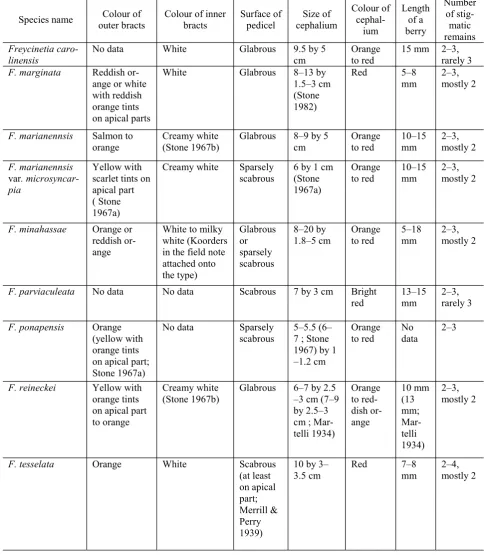
The result of this current study regards the species listed above as synonyms of F. marginata. Apart from the slight differences in the surface of pedicels and sizes of cephalia (Table 3), there is no distinctive morphological character that can be used
to distinguish any of those species from
F. marginata. In fact all the species share one obvious morphological character that is considered unique in the genus, the needle-like (i.e. filiform) berries. Stone (1968) based on the common posses-sion of this character grouped twelve species into a section of their own, Filiformicarpae, but with a note that the section is noticeably homogenous and the species included were rather poorly defined.
Among the species listed above possess glabrous pedicels except three species, F. parviaculeata, F. ponapensis, and F. tesselata (Table 3). This raises a question concerning the inclusion of the three species into the synonyms of F. marginata. Yet, despite having scabrous pedicels in this present study the three species are treated as a synonym of
F. marginata based on the fact that scabrous and glabrous pedicels can be found in the same
individual as can be seen in the then F. minahassae, where the fairly scabrous and glabrous pedicels can be found in different infructescences but of the same individual (Keim & Wahjuningsih, in prep.). Thus, the result of this current study indicates that at least in the section Filiformicarpae the scabrous or glabrous pedicels are considered less important in defining a species. Consequently, F. parviaculeata,
F. ponapensis, and F. tesselata perish into synonymy.
This result is not in accordance with Stone (1967a) that regarded the pedicel covering (scabrous versus glabrous) as an important character and was employed as the most distinctive character to differ F. mariannensis from F. ponapensis despite thought that F. ponapensis was morphologically very similar to F. mariannensis.
As in this study the pedicel surface has been regarded as less important in determining a species the boundary between F. mariannensis and
F. ponapensis subsequently disappears. The two species thus are placed here as synonyms of
F. marginata.
Indeed, apart from the differences in the surface of the pedicels, there is no distinctive morphological character that can be used to set any of the two species apart from F. marginata. Apparently Stone failed to spot the presence of both scabrous and glabrous pedicels in the same species as in the case of F. minahassae. Nevertheless, it is assumed here that by the time Stone studied the section
Filiformicarpae there was not enough material of
F. minahassae in his disposal. Indeed then
F. minahassae was known only from the type kept at BO; thus there was insufficient variations within the species could be observed. The situation was worsened by the fact that Stone was never known to conduct any collecting activities in Sulawesi. It is not surprise to know that F. minahassae was neither mention nor included in the first publication of the section Filiformicarpae (Stone, 1968).
Species name Colour of
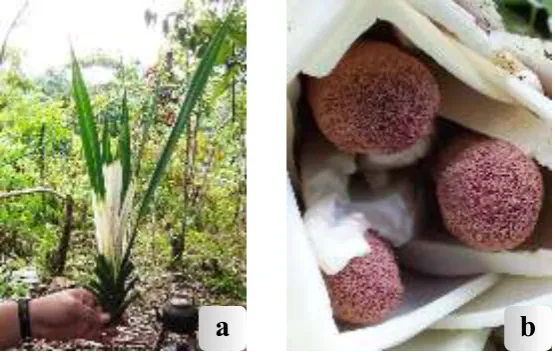
Fig. 3. Freycinetia marginata Blume. a. Conspicuous white outer bracts enclosing young male inflorescence; b. Young terminal staminate inflorescence consists of 3 flowering parts (ternate) enclosed by layers of bright white thick-fleshy inner bracts, in which each flowering part consists of numerous pink to deep pink anthers. Photos: A.P. Keim.
a
b
pedicels (peduncles of syncarps, according to Merrill & Perry, 1939). In this current study the ponapensis into the world of synonymies.
Despite mentioned F. carolinensis that was published previously by Kanehira (1935), Merrill & Perry (1939) regarded F. carolinensis as a synonym of F. ponapensis; thus disregarding Kanehira that mentioned F. carolinensis as morphologically near to F. mariannensis and distinguished by the posses-sion of prominently tessellate leaves (Kanehira, 1935; Merrill & Perry cited the publication year of
Kanehira’s protologue of F. carolinensis as 1937). In this current study it is assumed that Merrill & Perry (1939) failed to spot the tessellate leaves and glabrous pedicels possessed by F. carolinensis. As the consequence they placed the glabrous pedicels possessing F. carolinensis as the synonym of the scabrous F. ponapensis. Furthermore, the tessellate leaves, which is the prominent distinctive character of F. carolinensis (Kanehira, 1935) was used as the important character to distinct their proposed new species F. tesselata from F. ponapensis (Merrill & Perry, 1939). The reason for this sloppy work was unknown.
Although there is a difference in the sizes of berries (Table 3), it is continuous; thus cannot be used as a strong distinctive character to define
F. minahassae. In other word, in this current study
F. minahassae is regarded as the synonym of
F. marginata. The placement of the eastern
Malesian widespread species of F. minahassae and
F. parviaculeata, the only member of the section
Filiformicarpae occurs in western Malesia have a consequence that F. marginata is now recognised as the most widely distributed species in the genus, extending from Borneo in the west to Samoa in the east (encompassing both western and eastern Malesia and beyond), and surpassing the previously known F. scandens.
Freycinetia reineckei has smaller cephalia but fairly larger berries than F. marginata (Table 3). However, these differences are regarded in this current study as less important compared to more obvious similarities between the two species, such as the colour of both bracts and the shape of berries. Thus, F. reineckei is lowered to the rank of
Pristophyllae), and F. scandens (§ Oligostigma; see Poppendieck, 1987; Cox, 1990). In other word, the tendency is wide spread within the genus. On the contrary, the needle-like (filiform) berries are exclusively possessed by the members of the section Filiformicarpae, in which F. reineckei and
berries.
Specimens collected. Indonesia, Papua, Mamberamo Raya, Mamberamo Tengah, Kwerba, Tacewaram, Kwerep, 03 Nov. 2008, A.P. Keim
1100 (BO!); Itanem, Karenepu Hill, 19 Nov. 2008,
A.P. Keim 1159 (BO!); Kuikarawar, 21 Nov. 2008,
A.P. Keim 1166 (BO!).
4. FREYCINETIA OBLANCEOLATA Martelli.
— Syntypes: Beccari 545 (FI), Indonesia, Papua Barat, Manokwari, Andai, 19 July 1872; Beccari
s.n. (FI); De Albertis s.n. (FI); Dorei, J.E. Teijsmann 6762 (BO!).
Distribution. Sulawesi (Keim & Rustiami, 2007) and mainland New Guinea (including the Raja Ampat Islands, Keim et al., 2007).
Habitat. Lowland tropical rainforest. In Kwerba it is commonly found from 85 to 250 m altitude. Although it was found abundant during exploration
most were found without flowers or fruits. Apparently both the flowering and fruiting times were over by the time the research proceeded.
Vernacular names. Daidoté (Papasena), kakacir (Kwerba).
Uses. Not recorded.
Notes. The presence of F. oblanceolata in the Mamberamo Basin extends the species distribution area in the mainland New Guinea. In the field F. oblanceolata looks exceedingly similar with F. kwerbaensis; however the two species differ in three morphological characters described in Table 1 (see above).
Specimens collected. Indonesia, Papua, Mamberamo Raya, Kwerba, Tacewaram, 02 Nov. 2008, A.P. Keim 1084 (BO!); Hehetem, Pumpunom Hill, close to Lake Hehetem, 12 Nov. 2008, A.P. Keim 1127 (BO!).
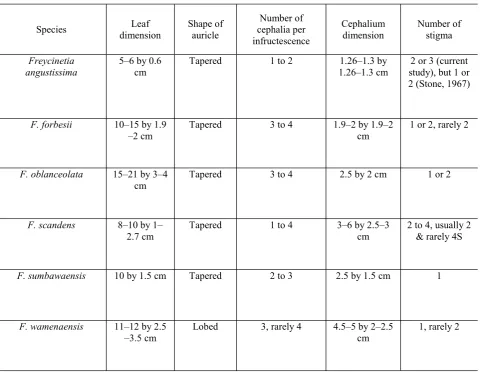
Table 4. Morphological comparison on leaf and cephalium dimensions, shape of auricle, number of cephalia per
infructescence, and number of stigma between F. angustissima, F. forbesii, F. oblanceolata, F. scandens, F. sumbawaensis, and F. wamenaensis.
Fig. 7. a. Lanceolate-elongate immature cephalium of F. wamenaensis A.P. Keim (× 2) clearly showing the number of stigma almost always one. b. The number persists through maturity (× 1.5). Photo: A.P. Keim.
a
5. FREYCINETIA SCANDENS Gaudich. — Type: Gaudichauds.n. ―crescit in Insula Timor‖ (P), Indonesia, Nusa Tenggara Timur (Eastern Lesser Sunda Islands), Timor (presumably from West Timor).
Freycinetia gaudichaudii R. Br. & Benn. in Horsfield (1838) 31, t. 9. – Type: Horsfield s.n. (BM), Indonesia, Java, West Java.
Freycinetia muelleri Martelli (1910) 311, 313.
– Type: Mueller s.n.(possibly at BM or K), Austra-lia, Queensland.
Freycinetia propinqua Domin (1915) 150. – Type: Domin s.n.(possibly at PR).
Freycinetia gonocarpa Moore in Gibbs (1917) 309 – Type: Gibbs 6348 (BM), Australia, Queensland.
Distribution. Sumatra, Java, Borneo, Sulawesi (including the Sangir and Talaud Islands), Timor, New Guinea (including the islands of Waigeo and Yapen), and northern part of mainland Australia (Queensland).
Habitat. Lowland tropical rainforest to lower montane forests from coastal to about 1000 m alti-tude. In Kwerba it is found growing close to a creek
from 75 to 250 m altitude.
Vernacular names. Not recorded.
Uses. Not recorded.
Notes. Freycinetia scandens has previously never been reported from Mamberamo Basin, thus the species distribution extends further into the interior of New Guinea. Following the placement of several species into the synonyms of F. marginata (see above) that increases the distribution area of
F. marginata, in this current study F. scandens is regarded as the second most widely distributed species in the genus. As in F. marginata, such a wide distribution reflects also in the vast morphological variations. Several other species found in New Guinea, such as F. beccarii Solms, F. ellipsoidalis Merr. & L.M. Perry, F. elliptica Merr. & L.M. Perry, F. globiceps Warb., F. nervosa Merr. & L.M. Perry, and F. streptopifolia Warb. are suggested in this study would eventually fall into synonymies. Further study is being proceeded.
Specimen collected. Indonesia, Papua,
Mamberamo Raya, Kwerba, Tacewaram, 04 Nov.
Mediocris scandens, auricula lobatus. Infructescencia terminalis, ternate. Cephalium elongatus-ellipsoideus, stigmata plerumque una, rariore duo. –– Typus: A.P. Keim 1280 (BO!), Indonesia, Papua, Jayawijaya, Wamena, Gunung Susu, Wamena Biological Garden, 8 Km NW of Wamena, 03 Aug. 2010.
Medium size climbing pandan, climbing up to 15 m high. Stem green, glabrous, 0.5–0.7 cm diameter, internodes 1–1.5 cm. Leaf elongate-oblong to spathoideous, 11–12 cm long, 2.5–3.5 cm wide, acute to acuminate apex, minute spines on apical part, rest of leaf margin glabrous; adaxial surface green, glabrous; abaxial surface light green, slightly glaucous; auricle lobed, persistent already disintegrated into fibres, light brown. Male inflorescence ternate, persistent, already dried, ca. 5 cm long; pedicel ca. 2 cm long, scabrous, flowering part 2 cm long. Female inflorescence not observed but it seems in a different branch with male inflorescence. Infructescence terminal, ternate or rarely quaternate, 6.5–8 cm long; peduncle short, 1– 1.5 cm long; pedicel 1–1.5 cm long, light green, fairly scabrous; bracts persistent, ca. 9 cm long, ca. 15 cm wide, already disintegrated. Cephalium elongate-ellipsoidal, 4.5–5 cm long, ca. 2–3cm wide, green when young turns to reddish orange to deep red when mature; number of stigmatic remains almost always one, very rarely two, deep blackish brown.
Etymology. After Wamena, the city where the type was collected.
Distribution. Known only from type locality.
Habitat. Montane forest at about 1700 to 1750 m
Vernacular name. Wuluhélé (Wamena).
Uses. Local people mentioned that cephalium is consumed by Cuscus (Spilocuscus maculatus). Stem
is used for strings.
Notes. The result of this present study indicates that now there are five species of the genus Freycinetia
known to possess a berry with single stigmatic re-main: F. angustissima, F. forbesii, F. oblanceolata,
F. sumbawaensis, and F. wamenaensis (Table 4). Nevertheless, F. wamenaensis can be easily distin-guished by its distinctive lobed auricle. In fact F. wamenaensis is the only species bearing lobed auri-cles and berries with single stigmatic remain, thus it is proposed here as a new species. Prior to this pre-sent study Ridley (1886) suggested F. forbesii and
F. scandens as closely ally. Keim & Rahayu (2010) expanded the alliance with the inclusion of F. sum-bawaensis. The result of this current study in-creases the number of species in the alliance with the addition of F. wamenaensis.
Specimens collected. Indonesia, Papua, Jayawijaya, Wamena, Gunung Susu, Wamena Biological Gar-den, 8 Km NW of Wamena, 13 July 2009, A.P. Keim 1231 (BO! DNA material only); 25 July 2009,
A.P. Keim 1233 (BO!); 03 Aug. 2010, A.P. Keim
1280 (holotype BO!); 30 June 2011, A.P. Keim
1342 (BO!), A.P. Keim 1343 (BO!), A.P. Keim 1344 (BO! sterile collection).
7. FREYCINETIA CF. ANGUSTISSIMA Ridl.
Distribution. New Guinea.
Habitat. Lowland tropical rainforests.
Vernacular name. Not recorded.
Uses. Not recorded.
Notes. The specimen A.P. Keim 1149 is sterile, thus identification is based on the vegetative character, especially lanceolate-elongate leaf (9 × 1.2 cm). Thus, this taxon is regarded here a possibly belong-ing to F. angustissima.
Specimen collected. Indonesia, Papua, Mamberamo Raya, Mamberamo Tengah, Kwerba, 17 Nov. 2008, A.P. Keim 1149 (BO!).
8. FREYCINETIA AFF. VIDALII Hemsl.
Distribution. Prior to this publication F. vidalii was known only from the Philippines. It is strongly suggested here that the distribution area may ex-pands to New Guinea.
Vernacular names. Araripaja (Papasena), kamaha-kurau (Kwerba).
Uses. Not recorded.
Notes. This taxon is also identified based on sterile collection. Nevertheless the possession of lobed auricle indicates that this taxon belongs to the section Auriculifoliae (Stone, 1968). Except
F. vidalii (a species previously known as endemic to the Philippines), all members of this section are robust climbers; thus the result of this current study suggests that this taxon (A.P. Keim 1128) possibly belonging to F. vidalii. The strong floristic link between the Philippines and Eastern Malesia is not something new as it has been suggested previously by Lam (1945a; 1945b). It seems that the result of this study supports the existence of such link.
Specimen collected. Indonesia, Papua, Mamberamo Raya, Mamberamo Tengah, Kwerba, Hehetem, 12 Nov. 2008, A.P. Keim 1128 (BO!). 9. PANDANUS ATROPURPUREUS Merr. & L.M.
— Type: Brass 13648 (A; iso. BO!), Indonesia,
Papua, 4 km SW of Bernhard Camp, Idenburg (now Taritatu) River, March 1939.
Pandanus columbiformis B.C. Stone (1974) 8. – Type: B.C. Stone 10131 (LAE), Papua New Guinea, Central, Vailala.
Distribution. Mainland New Guinea.
Habitat. Lowland and swampy forests at 200 to 800 m altitude. In Kwerba it is found in the low-land or hill slope rather open area at altitude 80 to 90 m. Not a common species, very rarely seen.
Vernacular name. Tatacir (Kwerba).
Uses. Local people report that the cephalium and drupes are eaten by birds.
Notes. Prior to this recent study P. atropurpureus
was known only from the type locality (Merrill & Perry, 1940; Stone, 1982; Jebb, 1992). Thus, the result of this study extends the species distribution further north in the Mamberamo Basin. The result of this study also suggests that P. columbiformis fall
b
a
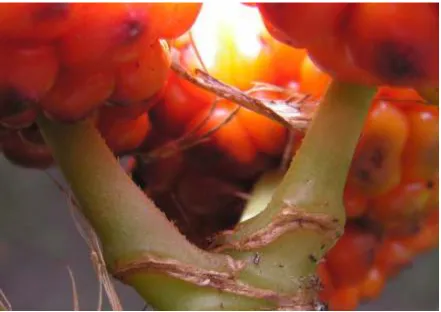
Fig. 9. Pandanus conoideus Lam. a. Cephalium from the cultivated form at Kwerba, b. The yellow variety, c. The cephalium being prepared showing the much longer size, d. Cephalium of the wild form showing the shorter and smaller size compare to the cultivated one, e & f. Cephalia collected from wild individuals showing colour variation from orange to red. Photos: Hari Sutrisno & Suparno (MZB, used here with permission).
Fig. 10. Pandanus conoideus Lam. Lateral section (l-s) of a cephalium showing the massive insect invasion (arrows) into pedicel through the pericarps, where the vegetable fat is produced and usually extracted. The invasion is mainly at the basal parts. The invasive insect is still not yet identified. The correct identification of this inva-sive insect is essential to protect the highly valued cultivated forms (cultivars) from possibly imminent danger. Photo: Suparno (MZB, used here with permission).
into synonymy with P. atropurpureus. Apart from the small difference in the shape of drupe, there is no significant morphological difference between the two species. Pandanus columbiformis is
character-ised by the shape of its drupes that are like ―small
pigeons” (hence the name, see Stone, 1974), but molecular study became available P. columbiformis
is considered here as a synonym of
P. atropurpureus.
Specimen collected. INDONESIA, Papua,
Mam-beramo Raya, Kwerba, Tacewaram, Karenepu Hill, Itanem, 19 Nov. 2008, A.P. Keim 1158 (BO!).
Bryantia butyrophora Webb ex Gaudich. (1843) t. 20, f. 1–15. – Pandanus butyrophorus
(Webb) Kurz (1869) 150. – Lectotype: the plate, designated here.
Pandanus subumbellatus Becc. ex Solms (1883) 96. – Type: Beccari s.n. (FI), Indonesia, Moluccas, Aru Archipelago, Wokam Island, Giabu-Lenga (Jabulenga).
Pandanus macgregorii F. Muell. ex Solms (1889) 511. – Type: Mac Gregor s.n. (B†), Papua
New Guinea, D’ Entrecasteaux Islands, Fergusson Island, nom. prov., inval.(―beschreibe ich vorläufig‖).
Pandanus cominsii Hemsl. in Hook. (1900) t. 2654. – Type: Comins 363 (K), Papua New Guinea, Solomon Islands, Florida Group, Siota Island, Rev.
Pandanus hollrungii Warb. (1900-a) 161, nom. nud.; (1900-b) 71. – Type: Hollrung s.n. (B†),
Papua New Guinea, northern part of mainland Papua New Guinea (then Kaiserwilhelmsland).
Pandanus hollrungii Warb. forma caroliniana
Martelli (1912) 66. – Type: Kraemer s.n. (B†),
Micronesia, Caroline Islands, Truck Island, Tol Uman.
Pandanus englerianus Martelli (1912) 65. – Syntypes: Penloup 5 (FI), Papua New Guinea, New Ireland (then Neu Mecklenburg), 1908; Peekel 91
Table 5. Morphological and ecological comparison on habitat preferences, stem height, dimensions of leaf and drupe between Pandanus carrii and P. korwae.
Species name Habitat
preferences Stem height Leaf dimension Drupe dimension Pandanus carrii Savanna
Fig. 12. Pandanus korwae A.P. Keim. a. Ellipsoidal drupe, long-elongated conical pileus. b. Blunt-flattened stigmatic remain (arrow) indicates that this species is a member of the subgenus Lophostigma and section Karuka. Pho-tos: A.P. Keim.
b
Fig. 13. Pandanus korwae A.P. Keim. a. The presence of minute adaxial ventral pleats (arrow). b. The absence of re-curved spines. Photos: A.P. Keim.
Central, Bella Vista.
Pandanus cominsii Hemsl. var. micronesicus
B.C. Stone (1965) 5. – Type: B.C. Stone 5340 (PH), Micronesia, Caroline Islands, Truk Islands, Tol, 7°
25’ N 151° 47’ E, cultivation, 30 Jan. 1965.
Pandanus latericius B.C. Stone (1965) 2. – Type: B.C. Stone 2637 (BISH), Papua New Guinea, New Ireland, Kavieng.
Pandanus minusculus B.C. Stone (1965) 3. – Type: B.C. Stone 2627 (BISH), Papua New Guinea, New Ireland, Kavieng.
Pandanus rubrispicatus St. John (1968) 519. – Type: Not designated. nom. nud, anglice,
―Northeast New Guinea‖.
Pandanus cominsii Hemsl. var. augustus B.C. Stone (1972) 109. – Type: B.C. Stone 2570 (fem.) (BISH), Solomon Islands, Santa Isabel Isl., Vulavu to Thathaje trail, along south-west coast, 17 October 1957.
Distribution. Moluccas, New Guinea and adjacent islands, Bismarck Archipelago, Solomon Islands and the islands of Micronesia (i.e. Caroline Islands).
Habitat. Mostly cultivated from sea level up to 2000 m altitude. In Kwerba village three cultivars are observed; the individuals with red, yellow, and brown long-trigonal (triangular) shaped cephalium with the red cultivar being the most widely planted. In Hehetem-Kwerba the wild individuals are mostly found growing close to a creek at about 200 m altitude.
Vernacular names. Kutéri péri, péri (Papasena), éhéna (Kwerba, for the yellow cultivar), Piri (Kwerba, for the red and brown cultivars).
Uses. Leaves are used for mats and cigarette papers. Vegetable fat extracted from the pericarp is used as sauce, medicine, and tonic. The use of vegetable fat is only recorded from the cultivated individuals.
Notes. Both the people of Kwerba and Papasena recognised the wild individuals as belonging to the same taxon with the red cultivar indicated by the done by Keim (2009; see also 2006a). Prior to this current study, P. conoideus was known only as cultivated plants (Stone 1982; French 1986; Jebb 1992; Walter & Sam 2002). Although large efforts had been done to find the wild form of this species
–including by the author of this paper in the neighbouring Wamena area (i.e. Baliem valley, see Keim, 2006b), the wild form had never been successfully found. Therefore, the result of this study is significant for the study of this highly praised (both culturally and economically) and widely cultivated species of Pandanus in New Guinea.
Cephalium of the wild form is observed greenish orange then turns to orange and finally deep red and it is noticeably smaller than the cultivated ones (Figure 9). The difference in the size as seen in the cultivated forms is apparently related with the domestication effect. The morphological features observed in the wild form of P. conoideus, most particularly the size and colour of cephalia, support the placement of several closely related species mentioned above into synonymies proposed by Keim (2009).
Unlike the cultivated form (i.e. cultivar), the cephalia of the wild form of P. conoideus are almost always found being invested by insect (Figure 10). Bogoriense (MZB) at Cibinong, West Java.
Specimens collected. Indonesia, Papua, Mam-beramo Raya, MamMam-beramo Tengah, Kwerba, He-hetem, 09 Nov. 2008, A.P. Keim 1116 (BO!); 14 stigma obtusus, complanatus. –– Typus: A.P. Keim 1144 (BO!), Indonesia, New Guinea, Papua, Mamberamo Raya, Mamberamo Tengah, Kwerba, Tacewaram, Mancin, Kuwamuk Creek, 17 Nov. 2008.
Fig. 14. Pandanus pseudosyncarpus Kanehira. a. Mature cephalium. It looks like the cephalium is a compound fruit constructed of numerous single compactly arranged simple fruits (drupes), thus a syncarp. b. Lateral section of cephalium, which clearly explaining the structure of the cephalium that it is actually constructed of complex fruits (phalanges); thus the cephalium look as if it is a syncarp hence the epithet ―pseudosyncarpus‖. Photos: Suparno (MZB, used here with permission).
rosette, tristichously arranged; each 300–450 cm long, 10 cm wide, spines throughout length; adaxial surface deep green, glabrous, adaxial ventral pleats present; abaxial surface light green, glabrous, recurved spines absent. Infructescence terminal, solitary, pendulous, 90 cm long, massive, heavy; peduncle 51 cm long, light green, glabrous.
Cephalium globose-slightly elongate, 39 cm long, 62 cm circumference, deep green, consisting of nu-merous drupes. Drupe ellipsoidal, 5.5–6 cm long, 0.8 cm wide; pileus 4.2–4.5 cm long, orange to reddish orange; style elongate, conical, deep purplish green, 1.3–1.5 cm long; stigmatic remains blunt, flattened, deep brown.
Etymology. After Michael Korwa, a member of the team involved in this RAP 2 and community developer for the Conservation International sta-tioned at Kwerba.
Distribution. Known only from type locality.
Habitat. Lowland tropical rainforest growing close to a creek.
Vernacular name. Técéni (Kwerba).
Uses. Cephalium is said to be consumed by Cassowaries.
Notes. The ellipsoidal drupe, long-elongated conical pileus, and blunt-flattened stigma (Figure 12) indicate that this taxon is a member of the sub-genus Lophostigma and section Karuka. The section
Karuka includes three edible and economically important highland species of New Guinea:
Pandanus brosimos Merrill & Perry (1940),
P. iwen B.C. Stone (1984), and P. jiulianettii Martelli (1912; 1913). Prior to this current study the members of the section Karuka are massive tree pandans with stems height more than 10 m. The only member of this section to have stem height less than 10 m was the imperfectly known P. carrii St. John (1968). However, P. carrii is known to have a stem of 5 m tall and grows in savanna grassland at much lower altitude that is about 450 m altitude. Furthermore, P. korwae differs from P. carrii in two other morphological characters: The dimen-sions of leaves and drupes (Table 5).
Specimen collected. Only known from the type. 12. PANDANUS KRAUELIANUS K. Schum. — Type: Hollrung 164 (B†), Papua New Guinea (then German New Guinea), Morobe (then Kaiserwil-helmsland), Kollua near Finschhafen.
Pandanus silvestris Rumph. (1743) 145, t. 77
(―Keker wassi‖), nom. inval. – Pandanus rumphii
Warb. (1900-b) 84, non Gaudich., 1846. –
Pandanus ceramicus Kunth (var.) sylvestris Kunth (1841) 98. – Type: Rumph., Herb. Amboin. 4: t. 77. 1743. Warburg (1900-b) erroneously used
―montanus‖ as the name for this plate. Rumphius had two ―species‖, ―silvestris‖ and ―montanus‖. The plate is of ―silvestris‖, Rumphius wrote. – Epitype: Indonesia, Moluccas, Amboina, Lateri, Sept. 9, 1913, Robinson Pl. Rumph. Amboin. 31 (US; iso:
A, BM, BO!, F, K, L!, MO, NSW, NY), designated here.
Pandanus montanus Rumph. (1743) 145
(―Keker ewan‖), nom. inval. –Pandanus montanus
Miq. (1855) 161, non Bory, 1804. – Pandanus terrestris Warb. (1900-b) 84.– Type: Not indicated.
– Merrill (1917) erroneously identified the Rumphian plate with this.
Pandanus amboinensis Warb. (1900-b) 83. – Type: De Vriese s.n. (L), Indonesia, Moluccas, Ambon.
Pandanus flabellistigma Martelli (1905) 366. – Type: Kurz s.n. (CAL), Cult. in Hort. Bot.Buitenzorg.
Pandanus tabbersianus Rendle ex Gibbs (1917) 198. – Type: Gibbs 6213 (BM), Indonesia, Papua Barat, Manokwari track to Ambani (Amban), Jan. 1914.
Pandanus kivi Martelli (1929) 140. – Type:
Brass 1557 (A), Territory of Papua, Eastern Div., Lower Mori River, 28 May 1926.
Pandanus microdontus Merr. & L.M. Perry (1939) 177, t. 1, f. 18. – Type: Brass 7695(A; iso. L), Papua New Guinea, Western, Lake Daviumbu, Middle Fly River, Sept. 1936.
Pandanus xanthocarpus Merr. & L.M. Perry Type: Brass 19293 (BRI; iso. L), Australia, Queen-sland, Cape York Peninsula, Iron Range, 22 June 1948.
Pandanus flavicarpus B.C. Stone (1965) 2. – Type: B.C. Stone 2478(holotype LAE), Papua New Guinea, Solomon Islands, Santa Ysabel.
Pandanus nakanaiensis B.C. Stone (1965) 2. – Type: NGF 6440 (Floyd) (LAE), Papua New
Pandanus biciliatus St. John (1973) 64, t. 311.
– Type: Brass 28746 (K, iso. L, US), Papua New Guinea, Woodlark Island, Kulumadau rain forest, 14 November 1956.
Pandanus biformatus St. John (1973) 67, t. 312. – Type: Brass 23765 (K; iso. A, L, LAE), Papua New Guinea, Milne Bay, Gwariu River, Biniguni Camp, 2 August 1953.
Pandanus luteus St. John (1973) 77, t. 318, 319. – Type: Brass 24732(K, iso LAE), Papua New Guinea, Goodenough Island, eastern slope, mossy oak forest, 8–15 October 1953.
Pandanus croceus B.C. Stone (1974) 23, t. 9– 11. – Type: B.C. Stone 10290 = LAE 53590 (Stone & Streimann) (LAE; iso. A, BISH, BRI, CANB, K, L, US), Papua New Guinea, Admiralty Islands, Manus Island, hills above Lorengau, 18 June 1971.
Pandanus auritus St. John ex Huynh (1976) 93, gallice, nom. nud. – Voucher: Brass 27272 (L, incl. Carpol. 13298), Papua New Guinea, Fergusson Isl., Agamoia, 22 June1956. (LAE), Papua New Guinea, Morobe.
Pandanus imbrialis St. John ex Huynh (1976) 93, gallice, nom. nud. – Voucher: Brass 5655 (FI), Papua New Guinea.
Pandanus maneauensis St. John ex Huynh (1976) 93, gallice, nom. nud. – Voucher: Brass
23461 (LAE), Papua New Guinea, Milne Bay.
Pandanus reconditus St. John ex Huynh (1976) 93, gallice, nom. nud. – Voucher: Brass
29252 (LAE), Papua New Guinea, Morobe.
Pandanus wauensis St. John ex Huynh (1976) 93, gallice, nom. nud. – Voucher: NGF 24963 (Womersley) (L), Papua New Guinea, Morobe.
Pandanus kosteri B.C. Stone (1987) 435, t. 5.
– Type: BW 6852(Koster) (holotype L), Indonesia, Papua Barat, Kebar, Sanopi, 17 February 1958.
Pandanus beccarii auct. non Solms: K. Schum. (1887) 192.
Distribution. Moluccas, New Guinea and adjacent islands including Yapen Island, Raja Ampat
Archipelago, Bismarck Archipelago, D’
Entre-casteaux Islands, Solomon Islands and northern part of Australia (Queensland).
Vernacular name. Kacir (Kwerba). substrate extracted from the pericarp similar to that of P. conoideus Lam. Indeed, in the other areas in new information on the species distribution.
Specimen collected. Indonesia, Papua, Mam-beramo Raya, Kwerba, Tacewaram, 03 Nov. 2008,
A.P. Keim 1092 (BO!).
13. PANDANUS LAUTERBACHII K. Schum. & Warb. – Type: Lauterbach 863 (B†), Papua New Guinea, northern part of mainland Papua New Guinea (then Kaiz-erwilhelmsland).
Distribution. Moluccas (Keim et al. 2008) and New Guinea including the adjacent islands.
Habitat. Swamp and lowland tropical rainforests, along riverbanks from coastal to 100 m altitude. In Kwerba found in lowland and close to a creek (riverbank) close to plantation at about 75 m alti-tude. Rare.
Vernacular name. Hamicah (Kwerba).
Uses. Leaves used for mats. Cephalium is said to be consumed by birds.
Specimen collected. Indonesia, Papua, Mam-beramo Raya, Kwerba, Tacewaram, Aruh Creek, 19 Nov. 2008, A.P. Keim 1157 (BO!).
14. PANDANUS PSEUDOSYNCARPUS Kanehira. — Type: Inokumae 636 (FU), Indonesia, Papua, Nabire, 1940. –– Fig. 14.
Distribution. New Guinea, including the island of Yapen (Keim 2009).
Habitat. Lowland tropical rainforest. In Kwerba it is found at 75 to 80 m altitude.
Vernacular name. Kawani (Kwerba).
Uses. Leaf used for mats, young leaf for cigarette paper. Cephalium is not consumed.
Notes. The taxonomical study of this species has been published by Keim (2009). Prior to this present study the presence of this species in mainland New Guinea was known only from the type locality, thus its occurrence in Mamberamo Basin extends its distribution area.
Specimen collected. Indonesia, Papua, Mamberamo Raya, Kwerba, Tacewaram, Kwerep, 01 Nov. 2008, A.P. Keim 1074 (BO!).
(B †), Papua New Guinea, Morobe, Finschhafen.
Pandanus erinaceus B.C. Stone (1965) 1. – Type: B.C. Stone 2578 (BISH), Papua New Guinea, Northern Solomons, Bougainville, Buka.
Pandanus lictor B.C. Stone (1965) 2. – Type:
B.C. Stone 2614 (BISH), Papua New Guinea, New Britain, East New Britain, Gazelle Peninsula, Warangoi.
K, PNH †), Indonesia, Moluccas, North Moluccas,
Halmahera, Poeloe Rao, Galeo, 12 Oct. 1921.
Pandanus jacobsii B.C. Stone (1983) 210. – Type: M. Jacobs 9281 (L), Papua New Guinea, Southern Highlands, limestone country near Waro
airstrip 20 km SSW of Kutubu, 6° 31’S, 143° 10’E,
Jayapura.
St. John 26102 (LAE), Indonesia, Papua Barat, So-rong, Sele Strait. Milne Bay, Louisiade Islands, Missima Island.
Pandanus rugulosus St. John, nom. nud. –
Voucher: St. John 26188 (LAE), Papua New Guinea, East Sepik, Angoram.
Pandanus echinatus St. John, nom. nud. Pandanus noviberiensis St. John, nom. nud. Pandanus rererivalis St. John, nom. nud. Pandanus rudis St. John, nom. nud.
Distribution. Moluccas, New Guinea and adjacent islands including Raja Ampat, Bismarck, and Solomon Islands.
Habitat. This species is reported to be found from coastal up to 1300 m altitude (Stone, 1982; Jebb, 1992). In Kwerba it is found in humid lowland tropical forest below 100 m altitude (about 65 to 90 m).
Vernacular name. Kamani (Kwerba)
Uses. Leaf is used for mats, young leaf for cigarette paper. Cephalium has never been eaten.
Notes. Pandanus stenocarpus is a wide spread species. Both species lack visible prop roots possess long and similar beaked styles. This current study also places the Moluccan (Halmahera Island precisely) species P. verruculosus C. Backer & B.C. Stone into synonymy. Apart from slight difference in the size of cephalia and dotted surface of the pileus, there has been no decisive character that can be used to distinguish P. verruculosus from P.
stenocarpus. On the other hand, there are several important morphological features that support the placement of P. verruculosus into synonymy, such as the lack of visible prop roots, drupe with long and beaked style, and the distinctive colour of the mature drupe, which is bright red. The same argument can also be implemented when placing P. jacobsii B.C. Stone (1983) into synonymy. Further study for a proper paper regarding this matter is still being undertaken.
Specimen collected. Indonesia, Papua, Mam-beramo Raya, Kwerba, Tacewaram, Kwerep, 02 Nov. 2008, A.P. Keim 1077 (BO!); A.P. Keim 1089 (BO!); Mancin, 17 Nov. 2008, A.P. Keim 1152 (BO!).
ACKNOWLEDGEMENTS
The author would like to express his deepest gratitude to the Conservation International, Papua for their gener-osity. This present study is a part of the 2nd Rapid As-sessment Project (RAP) funded by the Conservation In-ternational Indonesia in the form of a join research incor-porating scientists from the Research Center for Biology-LIPI, Conservation International Indonesia & the Smith-sonian Institution, USA proceeded in the Foja-Mamberamo Game Reserve in 2008. Sincere apprecia-tions are also sent to Dr. Wayne Takeuchi (LAE) and Prof. Nobuyuki Fukuoka (JICA) for precious discussions and suggestions to the manuscript. Genuine thanks are amazing mountainous garden of the mighty Jayawijaya.
REFERENCES
ANONYMOUS. 1938. Atlas van tropisch Nederland. Uitg.Kon.Ned. Aardrijkskundig Genootschap i.s.m. den Topografische Dienst in Nederlandsch-Indië, Batavia. (Djakarta).
ANONYMOUS. 2004. Data & informasi kehutanan Propinsi Irian Jaya. Pusat Inventarisasi & Statistik Kehutanan, Badan Planologi Kehutanan, Departemen Kehutanan, Jakarta.
BAILEY, F. M. 1902. Queensland flora. A. J. Cumming, Government Printer, Brisbane.
BLUME, C. L. 1835. Rumphia: Commentationes botani-cae imprimis de plantis indiae orientalis. Vol. 1. COX, P. A. 1981. Bisexuality in the Pandanaceae: New
findings in the genus Freycinetia. Biotropica 13 (3): 195-198.
COX, P. A. 1982. Vertebrate pollination and the mainte-nance of diocism in Freycinetia. Amer. Nat. 120 (1): 65-80.
breed-ing system in Pandanaceae. Ann. Miss. Bot. Gard. 77 (4): 816-840.
COX, P. A., Wallace, B. & Baker, I. 1984. Monoecism in the genus Freycinetia (Pandanaceae). Biotropica 16 (4): 313-314.
DOMIN, K. 1915. Beiträge zur Flora und Pflan-zengeographie Australien. Bibliotheca Botanica 85: 150.
GAUDICHAUD-BEAUPRÉ, C. 1843. Voyage autour du monde la Bonite. Botanique: t. 13, f.1-8; t. 20, f. 1-15. t. 22, f. 17; t. 25, f. 1-7.
GIBBS, L. S. 1917. Dutch North West New Guinea: A contribution to the phytography and flora of the Arfak Mountains. Tayor & Francis, London.
HOOKER, J. D. 1894. The flora of British India. 6: 487. L. Reeve & Co., London.
HUYNH, K-L. 1976. La morphologie microscopique de la feuille et la taxonomie du genre Pandanus I: Aperçu général sur les charactères micromor-phologiques de la feuille du genre Pandanus et leur valeur taxonomique. Bot. Jahrb. Syst. 97: 92-93. JEBB, M. 1992. A field guide to Pandanus in New
Guinea, the Bismarck Archipelago & the Solomon Islands. Christensen Research Institute, Madang. KANEHIRA, R. 1935. New or noteworthy trees from
Micronesia XI. Bot. Mag. 49: 185-195.
KANEHIRA, R. 1940. A summary of our knowledge of Papuan Pandanus. Bot. Mag. 54: 258.
KEIM, A. P. 2009. Pandanaceae of the island of Yapen, Papua (West New Guinea), Indonesia, with their no-menclature and notes on the rediscovery of Sara-ranga sinuosa, and several new species and records. Blumea 54: 255-266.
KEIM, A. P., PURWANTO, Y. & ROVIHANDONO, R. 2006. Beberapa rekaman baru (new records) dan kemungkinan jenis baru dari suku Pandanaceae di Pulau Yapen, Papua:1-37. Herbarium Bogoriense, Bogor [mimeograph].
KEIM, A. P, KOMARA, D., LATUPAPUA, H., SU-LISTYO, J. & SUBANDI, A. 2006. Flora pandan Wamena & sebagian Lembah Baliem berdasarkan eksplorasi di Kabupaten Wamena, Papua 15-21 Ma-ret 2006. Herbarium Bogoriense, Bogor. [mimeograph].
KEIM, A. P. & RUSTIAMI, H. 2007. Keanekaragaman suku Pandanaceae di pegunungan sekitar desa Sedoa, kawasan Taman Nasional Lore Lindu Kabupaten Poso-Propinsi Sulawesi Tengah. Berita Biologi 8 (5): 375-389.
KEIM, A. P., PURWANTO, Y. & DARNAEDI, D. 2007. Keanekaragaman flora pandan (Pandanaceae) di Pulau Waigeo, Kepulauan Raja Ampat Propinsi Papua Barat. Herbarium Bogoriense, Bogor. [mimeograph].
KEIM, A. P., SUSIARTI, S. & AMIR, M. 2008. Taksonomi Pandanaceae Pulau Seram. Laporan Tek-nik Pusat Penelitian Biologi-LIPI: 1281-1326. KEIM, A. P. & RAHAYU, M. 2010. Pandanaceae of
Sumbawa, West Nusa Tenggara, Indonesia. Rein-wardtia 13 (2): 151-158.
KUNTH, C. S. 1841. Enumeratio plantarum 3: 98.
Col-lae, Stuttgart, Tübingen. Kurz, S. 1869. Revision of the Indian screwpines & their allies. J. Asiat. Soc. Bengal 38, 2: 148, 150.
LAMARCK, J. B. 1785. Encyclopédie Méthodique Botanique. Vol. 1. Panckocke, Paris.
MARTELLI, U. 1905. Pandanus, nuova specie descritte. Webbia 1: 363, 366.
MARTELLI, U. 1910. Enumerazione delle Pandanaceae I. Freycinetia. Webbia 3: 307-327.
MARTELLI, U. 1912. Neu Pandanaceae Papuasiens. In C. Lauterbach (ed.). 1912. Beiträge zur Flora von Papuasien I. Bot. Jahrb. Syst. 49: 65.
MARTELLI, U. 1913. Enumerazione delle Pandanaceae II. Pandanus. Webbia 4: 5-105. Arnold. Arbor. 20: 139-186.
MERRILL, E. D. & PERRY, L. M. 1940. Plantae papua-nae archboldiapapua-nae, II. J. Arnold. Arbor. 21: 163-175. MERRILL, E. D. 1941. Micronesian Pandanaceae.
Philipp. J. Sci. 9: 48.
MUELLER, F. V. 1887. Australian plants. Austral. J. Pharm. 2: 126.
POPPENDIECK, H. H. 1987. Monoecy and sex changes in Freycinetia (Pandanaceae). Ann. Miss. Bot. Gard. 74 (2): 314-320.
RIDLEY, H. 1886. On the monocotyledoneous plants of New Guinea. Journal of Botany 24: 859.
RUMPHIUS, G. E. 1743. Herbarium amboinense 4: 143-151, t. 76, 79, 80. Franciscus Changuion, Amster-dam, etc.
SCHUMANN, K. 1887. Die flora des Deutschen Ost-Asiatischen Schutzgebietes. Bot. Jahrb. Syst. 9: 192. SCHUMANN, K. & HOLLRUNG, M. 1889. Die flora
von Kaiser Wilhelmsland: 17. Asher & Co., Berlin. SOLMS, H. 1883. Über die von Beccari auf seiner Reise
nach Celebes und Neu Guinea gesammelten Pan-Stickman. Part 35. Additional Pandanus species from New Guinea. Pacific Sci. 27: 64, 67, t. 311, 312, 318, 319.
Micronesian supplement. University of Malaya, Kuala Lumpur.
STONE, B. C. 1966. Pandanus Stickm. in the Malayan Peninsula, Singapore, and Lower Thailand. Malay. Nat. J. 19 (5): 291-301.
STONE, B. C. 1967a. Materials for a monograph of Freycinetia (Pandanaceae) I. Gard. Bull. Sing. 22: 129-152.
STONE, B. C. 1967b. The master key to Freycinetia. Herbarium Bogoriense, Bogor [mimeograph].
STONE, B. C. 1968. Materials for a monograph of Frey-cinetia Gaud. IV. Subdivision of the genus with fif-teen new sections. Blumea 16 (2): 361-372.
STONE, B. C. 1972. The genus Pandanus in the Solo-mon Islands with notes on adjacent regions. Part 1. Malaysian J. Sci. 1 (A): 109.
STONE, B. C. 1974. Studies in Malesian Pandanaceae XIII. New & noteworthy Pandanaceae from Papua-sia. Contr. Herb. Austr. 4: 7-40.
STONE, B. C. 1974. Towards an improved infrageneric classification in Pandanus (Pandanaceae). Bot. Jahrb. Syst. 94: 459-540.
STONE, B. C. 1978. Studies on Malesian Pandanaceae: A revision of Acrostigma. Fed. Mus. J. 23: 1-74. STONE, B. C. 1982. New Guinea Pandanaceae: First
approach to ecology and biogeography. In Gressitt, J.
L. (ed.). 1982. Biogeography and ecology of New Guinea. Vol. 1. Monographiae Biologicae 42. Dr. W. Junk Publ., The Hague.
STONE, B. C. 1983. A guide to collecting Pandanaceae (Pandanus, Freycinetia and Sararanga). Ann. Mis-souri Bot. Gard. 70: 137-145.
STONE, B. C. 1984. Pandanus from Ok Tedi Region, Papua New Guinea, collected by Debra Donoghue. Economic Botany 38: 304-313.
STONE, B. C. 1987. New taxa of Pandanus (Pandanaceae) from Malesia and Papuasia. Blumea 32: 435, f. 5. 1987.
STONE, B. C. 1992. The New Guinea species of Panda-nus section Maysops St. John (Pandanaceae). Blumea 37: 31-61.
VAN STEENIS, C. G. G. J. 1950. Flora Malesiana. Vol. 1. Ser. 1: Spermatophyta. Noordhoff- Kolff, Jakarta. WALTER, A. & SAM, C. 2002. Fruits of Oceania.
Aus-tral. Centre Intern. Agric. Res. (ACIAR) Monogr. 85: Canberra.
WARBURG, O. 1900-a. ( 1 Oct.) Pandanaceae, in K. Schumann & K. Lauterbach, Fl. Schutzgeb. Südsee: 159, 161. Gebrüder Borntraeger, Leipzig.
ERRATUM
REINWARDTIA Vol. 13, Part 2, 2010
1. Please change the existing word in p. 213, LINE 7 on ABSTRAK (written in Bahasa Indonesia version) with the following:
Keberadaan dua jenis terakhir melampaui distribusi yang sebelumnya hanya diketahui di barat garis Wallace.
2. Please change the existing epithet name in p, 214, COLUMN 1, LINE 40 on Key to the species of
Reinwardtia is a scientific journal on plant taxonomy, plant ecology, and ethnobotany. Manuscript intended for a publication should be written in English represent an article which has not been published in any other journal or proceedings. Every manuscript will be sent to two blind reviewers.
Two printed copies (on A4 paper) of the manuscript of not more than 200 pages together with an electronic copy prepared on Word Processor computer program using Time New Romance letter type and saved in Rich Text File must be submitted.
For the style of presentation, authors should follow the latest issue of Reinwardtia very closely. Title of the article should be followed by authors name and mailing address in one-paragraphed English abstract of not more than 250 words. Keywords should be given below each abstract. On a separated paper, author(s) should send the preferred running title of the article submitted.
using the aligned couplet type.
Strict adherence to the International Code of Botanical Nomenclature is observed, so that taxonomic and nomenclatural novelties should be clearly shown. Latin description for new taxon proposed should be provided and the herbaria where the type specimens area deposited should be presented in the long form that is name of taxon, authors name, year of publication, abbreviated journal or book title, volume, number and page.
Map, line drawing illustration, or photograph preferably should be prepared in landscape presentation to occupy two columns. Illustration must be submitted as original art accompanying, but separated from the manuscript. On electronic copy, the illustration should be saved in jpg or gif format at least 350 pixels. Legends or illustration must be submitted separately at the end of the manuscript.
Vol. 13. No. 3. 2012 CONTENTS Page
W.J.J.O. DE WILDE & BRIGITTA E.E. DUYFJES. Trichosanthes (Cucurbitaceae) in Malesia: additions and corrections, including a new species and a new variety 221
DEDEN GIRMANSYAH. Two new species of Begonia (Begoniaceae) from Bukit Tiga-puluh National Park, Riau, Sumatra 229
PUDJI WIDODO. New nomenclature in Syzygium (Myrtaceae) from Indonesia and its vicinities 235
ALEX SUMADIJAYA & JAN FRITS VELDKAMP. Non-Bambusoid Grasses (Gramineae) from Raja Ampat Archipelago, Papua Barat Province, Indonesia 241
ARY PRIHARDYANTO KEIM. New variety, records & discoveries of some species of Pandanus
(Pandanaceae) in Sumatra and Kalimantan, Indonesia 255
HARRY WIRIADINATA. A new species of Begonia (Begoniaceae) from Sagea Lagoon, Weda Bay, Halmahera Island, North Moluccas, Indonesia 263
ARY PRIHARDYANTO KEIM. The Pandan flora of Foja-Mamberamo Game Reserve and Baliem Valley, Papua-Indonesia 271
JAN FRITS VELDKAMP. Koordersiochloa Merr. (Gramineae), the correct name for Streblochaete Hochst. exPilg. 299
SRI ENDARTI RAHAYU, KUSWATA KARTAWINATA, TATIEK CHIKMAWATI & ALEX HARTANA. Leaf anatomy of Pandanus species (Pandanaceae) from Java 305
Reinwardtia is a LIPI acredited Journal (258/AU 1/P2MBI/05/2010)
Herbarium Bogoriense Botany Division