Journal of Chemical and Pharmaceutical Research, 2015, 7(9S):54-58
Research Article
CODEN(USA) : JCPRC5
ISSN : 0975-7384
The effect of increasing blood glucose level on several atherogenic factors with
biomolecular in diabetes mellitus type II patients
Eti Yerizel
a*and Asman Manaf
baBiochemistry of Faculty of Medicine, Andalas University, Padang, Indonesia bDepartment of Internal Medicine, General Hospital Centre Dr. M. Djamil, Padang, Indonesia
_____________________________________________________________________________________________
ABSTRACT
Hyperglycemia in type 2 diabetes results in excessive production of superoxide in mitochondria damage, poly ADP ribose polymerase activity and inhibition of glyceraldehide-3 Phosphate Dehidrogenase. These give raise to complicated reaction in the form of polyol pathway. Protein Kinase C (PKC) activation, increasing hexosamine Advanced Glycation End Products (AGES). Expression of several molecules intracellular Adhesive Moleculs-1 leads to endothelial dysfunction. This study aims analyzing several atherogenic factors arising from the increase of blood glucose level in people with diabetes mellitus of type 2. Observational research with comparative sectional study in patient with diabtes mellitus of type 2 aged 30 – 60 years has been conducted. Sample of the research were conducted at 70 participants. Examination of PARP and ICAM-1 were conducted by Linked Immunosorbent Assay (ELISA) technique. Data were analyzed statistically by using t-test and chi-square. The mean of PARP activity in the type 2 DM group was 457 ± 81.34 Unit/µl, in non DM group it was 214 ± 75.54 Unit/µl. Mean of ICAM-1 concentration in DM group of type 2 was 670,.93 ± 192.44 ng/ml and in non DM group it was 360.01 ± 137.56 ng/ml. concentration in DM group of type 2. There was a significant correlation between the increasing of PARP activity and the increasing of ICAM-1 concentration. In addition, there was also a significant correlation between PARP activity. ICAM-1 is atherogenic factors.
Keywords: type 2DM, hyperglycemia, endothel, PARP, ICAM-1.
_____________________________________________________________________________________________
INTRODUCTION
that cause damage to tissue increase [9,10]. Expression of Intrtraceluller Adhesive Moleculers-1 (ICAM-1), inactivates NO. In the end it induced endothelial dysfunction [11,12].
These changes affect the polyol pathway, activate protein kinase C, increase flux through the hexosamine pathway and formation of advanced glycation end product, expression of intracellular adhesive molecule -1 and nitrit oxide. The end result is endhothelial dysfunction [13,14,15]. The aim of this study was to observe several antherogenic factors that are affected by the increased blood glucose levels in diabetes mellitus type 2 patients. Atherogenic factors is ICAM-1 concentration.
EXPERIMENTAL SECTION
Observational research was conducted using a cross sectional study comparative on patients with type 2 DM aged 30 – 60 years old, 19 males and 16 females. The study group comprised 35 patients with type 2 DM who haspostprandial bloodglucose ≥ 200 mg/dl, and HbA1c level ≥ 7%, either the patients on hospitalized at the polyclinics Internal medicine RSUP. M Djamil Padang. The control group was 35 non-DM volunteers.
Sample was taken with random block on patients type 2 DM who were hospitalized in general medicine Dr. M. Djamil hospital, Padang. Type 2 DM patients consist of 19 males and 16 females. Each patient is undergoing conducting anamnesis involving interview, smoking habit, gender, blood glucose checkup, weight, height, hip and wise circumference. Hereafter, blood glucose and HbA1c checkup were conducted. People without DM function as a comparator who got the same treatment as the patients with blood glucose level post prandial ≤ 200 mg/dl and HbA1c ≤ 7%. Each sample and comparator underwent vena blood taken procedure for 10 ml to measure the HbA1c level with variant hemoglobin testing system technique. In order to check up blood glucose checkup, PARP, ICAM-1 were given the form of serum.
The blood glucose of each patient was examined using an enzyme method and HbA1c level with variant hemoglobin testing system technique. PARP activation, ICAM-1 and NO level are checked with Enzyme Linked Imunosorbent Assay (ELISA) technique. Statistical analysis used t-test and chi-square.
RESULTS AND DISCUSSION
Table 1. The Characteristic of Research’s Subject
Characteristic of research’s subject type 2 DM Mean ± SD
Table 2. The Average of PARP Activities on Patient with DM of type 2 and Non DM
Group n PARP activity (Unit/µl) Mean ± SD p
Type 2 DM 35 457 ± 81,34
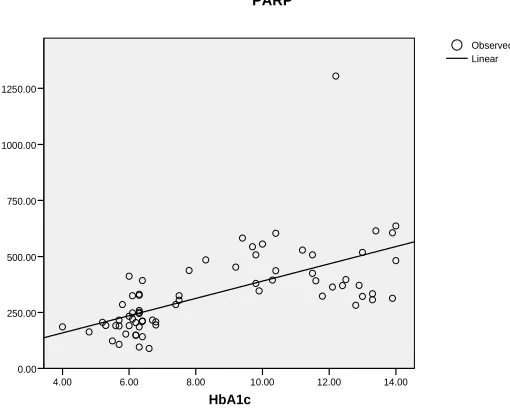
Figure 1. Correlation HbA1c with PARP activity
Table 3. The Average of ICAM-1 Level on Patients with Type 2 DM and Non DM
Group n Cocentration ICAM-1 (ng/ml) Mean ± SD p
Type 2 DM 35 670,93 ± 192,44
< 0,001 Non DM 35 360, 01 ± 37,56
There was a significant difference in NO level between patients with DM type 2 and the control non DM group (p ≤
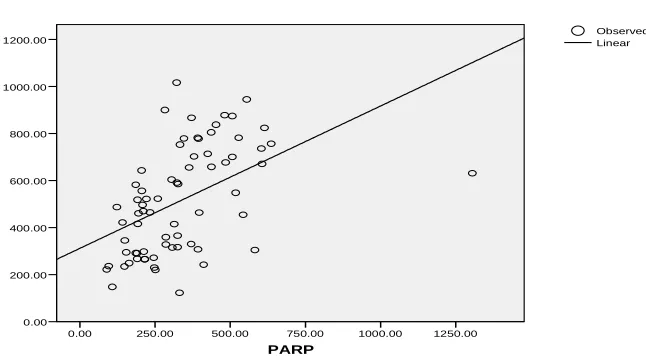
0,001). A significant correlation between the increasing in PARP activity and ICAM_1 level were shown in figure 2 and 3 respectively.
The advanced of PARP level due to the increasing of Intracellular glucose levels that causes superoxide on mitochondria increase (Reusch, 2003., Brownlee, 2005). This condition leads to the destruction of DNA mitochondria and DNA nucleus [12,13]. PARP is a marker of DNA damage by catalyzing the poly-ADP-ribosylation on several core proteins as histon. The result of other researches (Reusch, 2003., Monnier et al, 2006) show that the increase of ICAM-1 level on patients with DM of type 2 DM occured due to the vascular destruction as a result of excessive superoxide. The excessive superoxide in mitochondria damages the DNA, which in turn activates the PARP. The activation of PARP inhibits GAPDH that lead to PKC activation. The increase of PKC activity increases the ICAM-1 level. Glucose level in blood and in related to the damage to the corpus system as a result of repeatedly elevated glucose leads that follow food consumption.
HbA1c
14.00 12.00 10.00 8.00
6.00 4.00 1250.00
1000.00
750.00
500.00
250.00
0.00
PARP
Figure 2. Correlation between HbA1c with ICAM-1 concentration
Figure 3. Correlation between PARP activity with ICAM-1 concentration
CONCLUSION
Increasing blood glucose caused increasing PARP activity, where atherogenic factor was ICAM-1 concentration.
HbA1c
14.00 12.00
10.00 8.00
6.00 4.00
1200.00
1000.00
800.00
600.00
400.00
200.00
0.00
ICAM1rev
Linear Observed
PARP
1250.00 1000.00
750.00 500.00
250.00 0.00
1200.00
1000.00
800.00
600.00
400.00
200.00
0.00
ICAM1rev
REFERENCES
[1]Giugliano D, Antoni C, Khaterine E,. Am J Clin Nur. 2008, 217 S- 221 S
[2]PERKENI,. Konsensus pengelolaan dan Pencegahan diabetes melitus tipe 2 di Indonesia. 2006, 1 ed; PB PERKENI
[3]Antonio C, Enrico U,. Diabetes and Cardiovascular Disease J., 2004
[4]Adam JMF,. Klasifikasi dan kritera diagnosis diabetes melitus yang baru. 2000, Cermin Dunia Kedokteran : 127; 37 – 40
[5]Barbara A, Gilschrest & Vilhelm A.Bohr (editor),. The Role of DNA Damage and Repair in Cell Aging. Series editor: Mark P.Mattson, National Institute on Aging, Baltimore, USA, 2001,113-129
[6]Bouchard V.J, Michele R, Michele R, Guy G P,. PARP-1,. Experimental Hematology, 31, 446-454. [7]Casas J P, Cavalleri G L, Bautista L E et al., A Huge Revieu. 2006
[8]Boyle. P.J, MD., The American J of medicine, 2007, 120(98), 512-517
[9]Halliwell B, Gutterridge, Free radicals in Biology and Medicine. Department of Biochemistry , Osaka University Medical School, Osaka, Thrird ed; oxford University Press, 2004, 36-95; 267-276; 640-645.
[10] Kalaivanam. K.N, Mala. D, Sera. R.M., Int..Diab J., 2006, 26(1), 30-32 [11] Casas J P, Cavalleri G L, Bautista L E et al., A Huge Revieu., 2006
[12] Gilchrest B A, Wilhelm A B, The Role of DNA Damage and Repair in Cell Aging, Advand in Cell Aging and Gerontology, Series editor; Mark P, Mattson, National Institute on Aging, Baltimore, USA, 2001, 51-65; 73-129 [13] Brownlee M, Diabetes J., 2005, 54, 1615-1625