CONFIRMATION REL{ABILTTY
AS
AT]DIT EVTDENCE
D
o
s
e
n r u
ra
s ahiik*f-*,f,
efi,
t,, t.r
o, o
n o
* o
ABSTRACT. As we have already known together &at one of the audit er.idence
is audit confirrnation. In several audit firm, audit confinnation is used as the main
audit evidence, in the contrtrjr, there are many academician said that it couldn't
fulfill any of audit goals. In our aountry situation, in the middle of huge crisis,
there are not much investor want to investing their money unless we prepare a
very reliable aadit reporting. To achieve that, we must r-rse
reliable audit
evidence-of course.
To knowing which argument is true, we are trying to stud.y some
literature related with audit evidenc€ and audit confirmation. we compare those
literalures, and make a conclusion tlrough analyzingand logical thi*G. And, as
we concluded
at the end of this Fper, we stated that.s$dit evidence couldn't.be
used to fulfill the audit goalg completeness
and valuation.
INTRODUCTION
In some literatureg we found that confirmation can be used to fulfilt the audit
goals, compleleness
and vaftretion. B$t, we found in several researches
that both
audit goals could not be fulfilled fu confirmation. There is argument from paul
caster, R. K. Mautz" E. H. Sauls, and a tot more that discussing iudit widence and
audit confirmation So, in this paper, we are trying to make air explanation about
audit risk and audit evidence - in this case audit confirmation - and previous
research
denving
the ability of confirmation
to fulfill those
audit soals
AUDIT EVTI}ENCE
Evidence
The rvord 'elidence' describes
the whole range of 'things', such as documents,
reports,
guesses,
inferelces, and calculations,
upon rvhich the auditor exercises
his
eryert
-iudgment in evaluating whether or not the accounts show a true and fair
vierv. More formally, evidence
is 'the facts presenfed
to the mind of a person fcr
the purpose
of enabling him to decide a disputed
question' (Mautz l9-5g).
Tan Ming Kurng; Confirmdioa Relbbility l'7
of the persuasiveness of evidenc€ afe relevance, mmp€ten€, sufi.ciency. and timeliness. Notice that fhe sffind and thkd determinants are taken directly from the third standard of field
works-Relevance Evidence mv$ pertain to or be relevant to the audit objective that the auditor is testing befo:e it can be persuasive. For example, assum€ that the auditor is concemed that am ctient is failing to bill customers for shipment (completeness objectives). If the auditor selected a sample of duplicate sales invoices and traced each to related shippmg documeuts, the evidenc€ would not be relevant for the completeness objective. A relevant procedure would be to trace a sample of shipping documerfs to related duplicate sales irwcices tc determine if each had been billed.
Relevance can be mnsidered only in terms of specific audit objectives-Evidence may be relevant to one audit objective but not to a different one. In the prwious ex:lmple, when the auditor traced from the duplicate sales invoices to related shipping documents, the evidence was relevant to tle existence objective. Most evidence is relevant to more than one, but not all, audit objectives.
Competence- Competerrce refers to the degree to which widence can be considered believable or worthy of trust. If evidenc€ is considered highly compet€nt, it is a great help in persuading the auditor that financial statemeat are fairly stated. For examplg if an auditor c' ounted the inventory, that widence would be more cofitpetent ttun if managem€nt gave the auditor its own figures. Most auditors use ttre term reliability of evidence as being sltonyrnous with comp€tence.
Competence of evidence deals only rvith the audit procedures selected. Competence cannot be improved by selecting a larger sample size or different population items. It can only be improved by selecting audit procedures that contain a higher quality of one or more of the following five characteristic of competent
evidence-l- Independence ofprovider.
Evidence obtained from a sourtr outside the entity is more reliable than that obtained within, For example, exlemal evidence such as commrurications from bankg attorneys, or customers is generally regarded as more reliable than answers obtained from inquiries of *re client. Similarly, documents that originate within the company and have never left the client's organization. An example of the former is an insurance policy and the latter a purchase requisition.
2. Effectiveness of client's internal control.
When a client's internal control are effective. evidence obtained is more reliable than when they are weak. For example, if intemal controls over sales and billing are effective, the auditor could obtain more competent evidence frorn sales invoices and shipping documents than if the controls rvere inadequate.
18 Jurnal trlmiah Akuntanri, November2003, yol. 3 No-l
Evidence obtaired directty by the auditar through physical examinafion
obsen'ation, computatiorq and inspectio:r is m*re competent than information
obtained directly. For exarryle, if the auditor calculates the gross margin as a
percentage
of sales and compares
it with previous periods, G evidence would
be tnore rcliable than if the auditor relied cn{lre calculations of &e confroller.
.{.
Qualifications of individcals pcviding the inforrnation.
Although the solrce of infcnnation is irdependenl the evidenoe wilt not be
reliable unless the individual poviding it is quameo to do so.'For this
reason-comrnunication from attsrasys and bank confirmations are tlpically more
highly regarded tlun accoants receivable,ccsfirmations from persons not
familiar with the business
worlds. AIso, evidence obtained dircaly by the
auditor may not be reliable if he or she lacks the qualifications to evaluate the
evidence. For examplq examination of an inventoly or diamonds by an
audiror not trained to distinguish tretween diamonds and glass wouk! nor
provide reliable evidence afthe existence af diamonds.
5.
Degree of Objectivif.
Objective evidence is more reliable than evidenc€ that rquires considerable
-iudgment to determine whether it is correct. Examples of lbjective evidence
include confirmation of acccunt receivable and bank balaraes, the physical
count of securities and cash and adding {footing) a list ofaccounts payable to
determine if it agrees rvith the balance in the general ledger. Examples of
subjective evidence include a letter wrifien by a clieni observation of
obsolescence
of inventcry during plrysieal examination, ana aq*ries or tl,e
credit manager about the collectibility of non+urrent acccunts receivable. In
evaluating the reliability of subjective widence, the qualifications if the
people providing the evidence are important
sufficiency- Ttrc quantifu of evidsnce obtained determines its sufficienc1...
Quantify is measured
n"nn,aray_uyttre-sample
size tlre auditor selects.
For a given
audit procedure. the evidence obtained from a sample of 200 would ordrleri'iir be
rnore suf{'icient tlun from a sample of loo. There are several factors that
determine the appropriate sample size in audits. The two most important ones a'e
the auditor's expectations of misstatement and the effectiveness of the client,s
mternal control. To illustrate, assune in the audit of Jones computer parts co. that
the auditor concludes tlrat there is a high likelihood of obsotel inventory due ro
the nature of the client's industry. The auditor would sample more inventory items
for obsolescence
in an audit such as this tlun ot
"
*h"." the likelihood of
obsolescence
rvas low. similady, if the auditcr concludes that a client has
effective rather than ineffective internal controls over recording fixed assets. a
smalier sarnple
sizr in the audit of acquisitions
of fixed assets
is wLanted.
Tan Ming Kuang Confirmation R.eli;ability..- 19
usually consider samples insufficient that contain only the largest dollar items from -the population -unless these items make up a large portion of the total amounL
Tirneliness. The timeiiness of audit evidenc€ ann refer either to when it is accumdded or to the p€rid covered by &e audit. Evidence is usually more persuasive for balasce sheet accounts when it is obtained- as clos€ to the balance sheet date would be morp persnasiYe than a count two months earlier. For income statemenl accounts, evidence is more persuasive if there is a sample from the entire period under audit ratherthan frcm only a part of the period. For example, a random sample of sales tmnsactions for the entire year would be more persuasive thaa a sample from only the first six months.
Quatity of evidenc€ is determined by {a) the closeness of the evidenc€ to the thing being evidence4 &) the directness of the cotrespondenc€ between the evidence and the thing being evidence4 and (c) &e reliability of tie source of the evidence. The first of these was considered by Mautz and sharaf (1961). They identifiedtlreebroad classes ofevidence: natural widence, created evidence, and rational argumentalion. Keenan (1979) discussed the'directness'of evidence- He considered &e classes of evidence to be found in law and identified these as: primary evidence, secondary evidence $oth are forms of 'direct widence') and indirect or circumstantial widence. The final element in the quality of the evidence relates to the reliability of lhe source of the widence. This issue was addressed ir some detail by Hatherley (i980). Hatherley identified three sources of evidence: processes largely under the control of the auditor, processes largely under the control ofthe directors and prccesses largely under the control ofthird parties.
Taken together the three classifications provide a fair$ detailed description of the qualitative characteristic of any evidence that the auditor has colleAed. By pref€r€nce, the auditor will always ernploy natural primary evidence from sources under his control. Such very best evidence is rarely to hand. The Cornmittee on Basic Auditing Concepts (AAA 1973) emphasized this problem:
The auditor can and does perceive the physical e o n se que n c e s af ev e n is - Th e se physi c a I co nse que nce s include the existence of cash, secttrities, inventory and plant. On the other hand, onlv afew operating events
(e.g., pryrott distribulion and transactions in the cut of, period) are directlY obsen'etJ.
... Operoting events are fts,' t?lore signifcant in the accounting model than the physical consequences of such events. T-hus the auclitor must depend on the perception of others (particularlv the client's
20 Jumal trmiah Akuntansi, Novernber2003, Vol. 3 No-l
Thus much cf the atdit Winion will be basd on cr€irted evidencr, from sources
under the control of &e directars, &rt. will ftquently involve an important degree
of inference.
These qualihtire characteristics
are surrunarized
in Figure 1.
igtue 1. The QualifdiVe
TffE TYPES OF'Amtff
:EYIDENCf, .
There are seven brsrd'catoltiriix of evidence from which the auditor can chaose.
These categories,
refened tq*s fpes af evidence,are listed below.
'/
Physical e
ion
'/
Confirmation '
,/ Documentation
,/ Obsenation
/
lnquiries of the client
,/ Re-performanoe
,/ Analytical
A the most que$ion to be asking is "how reliable the audit evidence is?" To
this questi
Clsseness -(Mautz and Stura0
Directness {Keenan} Source {tatherly)
Natural
::
Created
Rational areumeni;tion
f*iury
kordary
Circu{nstantial
Auditorcontrol
Director control
Third Frty control
Finue 1. Tbe
ofEvidence
answ'er
we use a table as s@n at
2
Criteria to determine reliabilitv
Effetivenes
s cf Clienfs
iaternal
Control
Auditor's
Direct
Knowledge
Qualiflcations of ProviderObjectir.ity
nf
Evidence
Physical
examination
High ,
{auditordoes)
Varies
HighNormally
high (auditor
does)
High
Confirmation High Not
aoolicable
Low
Varies
-usually hieh
HighDocumentatiolr
Varies
-external more
independent
than internal
Varies
LowVaries
HighObservation High
(auditor does)
Varies
HighNormally
high (auditor
does)
Medium
Tan MingKuang ConfirmationRdiabili$r-.--.-.-. 21
CONFIRMATION AS AUDIT EVII}ENCE
One of the most important audit procedures is the canfirmation of account receivable. The primary purpcse of accounts receivable confinnation is to satisf-v the existence, accuracy, and cdoffobjectives.
Confirmation describes the receipt of a written or oral response fron a1 independent third panry veri$ing the accuracy of information that was requested by th" auditor- Because confirmatiors come from sourc€s independent of the client, they are highly regarded and often used type of evidence. However. confirmations are relatively costly to obtain and may c:luse som€ inconvenience 10 those asked to supply them. Therefore, lhey are not used in every insfance in which they are applicable. Because of the high reliabilily of confirmations" auditors tpicatly obtain wri$en respons€s rather than oral ones whene'r'er it is practical. Written confirmation are easier for supewisors to review, and t|ey provide better support if it is necessary to demonstrate that a confirmation w'as received.
Whether or not confirmation should be used depends on the reliabiliry needs of the sifuation as rvell as the alternative evidence available. Traditionalll'-confirmations are seldom used in the audit of fixed assets additions because these can b€ verifred adequately by documentation and physical examination, Similarly. confirmations are ordinarily not used to verify individual transactions betrveen organizations, Such as sales transaCtions, bec.luse the auditor can use documents for that purpose. Naturatly, there are exceptions, Assulne the auditor detennines tlut there ar€ two transactions recorded tfuee days before year-end. Confinnation of these two lransactions may be
appropriate-In performing confirmation procedures. tlre auditor must decide the type of confinnation to use. Trvo common types of confirrnafions are used to confirnring accounts receivables: positive and negatile. A psilive confirmation is a communicalion addressed to the debtor requesting him or her to confirm directlv rvhether the balance as stated on the confirmaticn requesl is correct or incorrecl. A second rype of positive confinnation, often called a blank con{imration forrn- does not state the amount on the con-firmation but requests the recipients to ltll in the balance or funish other infonnation. Because blank forms require the recipierrt to deternrine the infonnation requested before signrng and returning thc
client
(client
provides)
applicable
lo'wto hieh
Re-performance
High(auditor does)
Varies
High High{auditor does)
High
Anatytical
procedures
High/low (auditor does / client
responds)
Varies
Low Norrnailyhigh {audilor does / client responds)
22 Jurnal Ilmiah Akuntansi, Novemba2003, Vol. 3 No. 1
confirrnation- they are consider€d more reliable than confirmations that include &e information- Research show, however, tttat response rales usualir. lower for blank conErrnation forms- A positive confirmation is more reliable evidence because the auditor can perfomr follow-up procedures if a response is not received from the debtor. With a negatirre confirmatiorL failure to reply must be regarded as a correct r€spons€, even though the debtor may have ignored the conf,rmation request
A negative confirmation is also addressed to the debtor, but requests a response only when the debtor disagrees wi& the stated amourl offsetiing the reliability disadvantage, negative confirmations are less erpensive to send &an positi'r.e confirrnations, and thus more c:rr be distributed f,or the s:me total cost. Negative confirmations cost less because l}lere are no secoad requests and no fol lorv-up of nonresponses.
The determination of which type of confirmation to use is an auditor's decision, and it strould be based on the facts in the audit. sAS 6? states that it is acceptable to use negative mnfirmations only when all of the following circumstarces ar€ presefit:
'/ Accounts receivable is made up of a large number of sma1l accounts. ./ Combined assessed
confiol risk and inherent risk is !orv. The combined risk is unlikely to be low if ei&er internal control are ineffective or there is a high expectation of misstatement. For example" if prior years' audits indicate that there are often disputed or inaccurate accounts receivable, negative confi rmations would be inappropriate.
'/ There is no reason to believe tlrat the recipients of the confirmations are uilikely to give them consideration. For example, if tlrc response rate to positive confirmations in prior years was extremely high or if there are high response rates on audits of similar clients, it is likel-v that recipients will give confi rmations reasonable consideration.
Typicall-v. rvhen negalive confirmations are used, the auditors puts considerable enrphasis on &e effectiveness of intemal controls, substantive tests of transactions. and analytical procedures as evidence of the faimess of accounts receivable. and assulne that the large majority of the recipients will provide a conscientious reading and response to tlrc confirmation request. Negative confinnations are often used for audits of hospitals, retail stores, banks and other industries in which tle receivables are due from the general public.
It is also comnron to us€ a combination of negative ald positive confinnations by sending the latter to accounts wi& large balances and the former to those q'ith small balances.
Tan Ming Kuang Confirmation Reliability- ' ' ' ' -
23
risk,inherentrisk.tlreeffectivenessofconfirmationsasauditevidence.andthe availabiliq of other audit evidence'
AICPA RPQUIREIVIENT
TwomajorauditproceduresareformaltyrequiredbytheAiCPA:theconfinnation o1 o"*u*" reieivable and the physical examination of inventory' These ,fo,rir"*"rrt, are a direct result of tire 1933 landmark legal case' McKesson and nittinr, in which a rnassive fraud invclving fictitious accolnts receivable and inventorywasnotuncoveredintheaudit.Therewasarrrytesrrpporttod€monstrate tlat &e confirmation of receivables and the physical observation of inventory *orm have brought the fraud to ligh! but at that time neitlrer of these procedures was normally perfonned- Because of a strong reactron in tlre financial statemenl tft" *"*U".iftip of the AICPA votd in 1939 to require these two procedures whenever an rmqualified report is iszued'
tater, the standatd for confirmations was modified by SAS 67 (AU 330) to the present requirement that permits an unqualified report even when account receivable are not confirmed in any of three circurnstances: (1) accounts receivable are immaterial, (2) the auditor consider confirmations ineffective evidence because ,".po.r"'*i", will likely be inadequate or unreliable, or (3) the combined level of inherent risk and contrcl risk is low and other substantive evidence can be accumulated to provide sufficient evidence. If the auditor decides not to confirm arcounts receivable, the justification for doing so must be documented in the working papers. This change in requirements., especially the third consideration, is likelyio^reduce the use of ccnfirmations in practice' If a client has effiective intemal conlrots and low inherent risk for the sales and collection cycle. the auditor should often be able to satiss the evidence requirements by tests of controls. substantive tests of transactions' and analytical procedures.
ANALYSIS
As noted earlier- auditors have considered that accounts receivable confirmation evidence a strong form of evidence because it involves direct communication with independent source outside of the entif being audrtld {AICPA' 1989)' Nevertheless. defects in the reiiabitity of confirmation evidence, however, have been reported in research, which is conducted. by Sauls (1969), warren {19?3)' Sorkin itslll. and AICPA (1939). Unfortunately. these studies of confirmation evidence were limrted in scope due to the population sampled (primarily customers of banks and credit unions)'
24 Jurral trmiah A.kuntansi, Novenba2003, Voi. 3 No.l
overstatement
errors intrduces by the experiments mav have been confused with
interest earned in the accounts.
Anofftercomrnol limiqtion ir previous study was the failure to examrne
tie
confirmatio* process
To*
n9 perspective of thi connrtoatio* ieJpierq which
resulted in ornission of variables onty sa'ls (1969) gave some consideration
to
&e recipients in terms of the types of actions ,lrat euri b" .uk;; ii .*rpon
"
,o u
confirmation
requesc
The rast 'research focused on &e delbct in the retiabflity of confirmation
evidence
was the research
by paul caster (1990). He aeueiop;i ri*pr,n"a *oo"r
of positive confirmation processing, *hidi;;r.r"nted
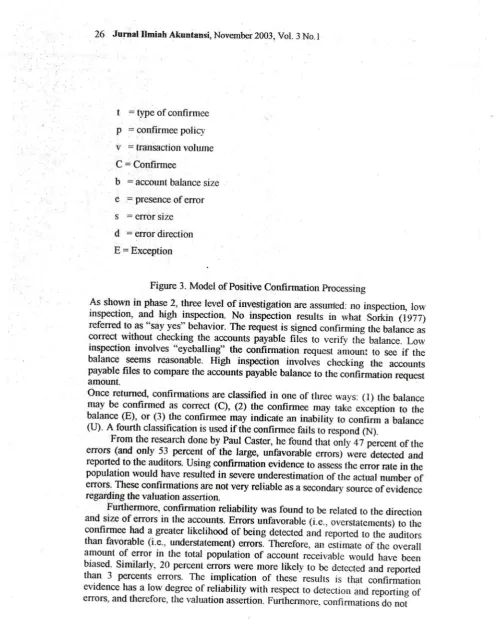
in figure 3.
The model represents
the squentiar deisio,, prr*r, ir* ihe perspectrve or
tie recipient (confirmee) of a posriive confirmauon request. The positive
form of
confirmation was chosen beca-use
it is the Jong*ut
11d most widery used form,
and it is familiar to confirmees. ttre mnnJ,ee-decides *t"trre. iJprocess
the
request
further in phase r. kr phase z, frecs;;ee
decides *t
Mail from Supphef s Auditor
TanMingKuang Confirrndio'rrReliability.---'.- 25
Function Variable Key
a : account balance age
26 Jurnal trmiah Akuntansi, Novernber2003, Vol. 3 No.1
t : type of confirmee
p : confirmee polic1
v = @irsactionvolume
C = Confirmee
[image:11.590.33.530.27.663.2]b = account balance size
e = presencg
oferror
s : error size
d = errordireclion
E = Exception
Figure 3. Model of positive Confirmation processing
As shown h pS:
?, Pt*
rever
of investigation
are assunred:
no inspection,
row
mspection, and high
-insqeaion.
No inspection results in what sorkin (1977)
refened tg
F
'"sa{ yes" behavior. The request is sigrred *"fi;;;
the balance as
coffect without checking the accounts payable files to r,.eri!, thi tlalance. Low
inspection involves "eyeballing" the confirmation request amount to see if the
balance seems r€asonable. High inspection involves checking the accounts
payable files to compar€ the accorrnts payable balance to the confi?mation requesr
amount.
once retumd confinrutions are classified in one of three ways: (l) the balance
may be confirmed as correct (c), (2) the confirmee may take exception to rhe
balance (E), or (3) the confirmee may indicate an inabiliry to confirm a balance
(rt). A fourth classification is used if the confirmee fails ro iespond (N).
From the research
done by paul caster, he found tlut o;ly 4ipercent of the
errors (and only 53 p€rcent of the large, unfavorable errors)'were'detected and
reported to the auditors. Using confirmation evidenc€ to assess
the error rate in the
population would have rezulted in sever€ underestimation of the actual number of
enors,.The.se
confirmations
are not very reliable u. u .""ondu.y ;;;
of evidence
regarding the valuation assertion
Tan Mirg Kueng, Conftndiod'Rdiability.. . : .
-CONCLUSION
provide very strong evidence regarding the srryle' enessrassertion
-.less'thn 42
percent of the large understatemtnt errors 'w€re det€ctd'ard"reporbd
by
confirmer.
. . A mnnber of questions rise, because in &at *rdy less tbai whlf.of,,the'
se€ded
errors were detected and rcported to the auditor, ma*ing ee reliability of
ccinfifmation evidence'questiomble. 'What is the apreprideistanfud to us .to
€nalual€.onfirmation reliabitity? Does the confirr6tion p**Sue
@
tobe,l0o
peicent rdiirble'to bd,us€firl to.tfte fmditors?:Ilow,:ri:liiderfu,it'ooryakd to
att€rnative forms of evidene regrrding valudion'and oomplAeness
assrtions?
2t
' ',: "'l
Froih:tlre liteiature revitrws and sbvenil',rresearches
ad trurmCbnilr.we conclude
thag ifi fed &C contrfitrrrtio'n,'can't
be uised,to
ftIfin,&€ audifgOqlE owhpteteness
and valuation. This conclusiqr is consistcnt with Paul Cast€tr119.901:Iindings
rtw
in using confinnation evidence to ass€ss
the error ratb,in the population would
have rcsulted in severe underestim*ion'of;the actudl nfibctr of,
'fhese'
confirmations ar€ no-t very reliable as a seoondary
surroe'sf evidenoe regalding
the valuaion hisrirtioa'B*ides Paul Caster,'there'ai€ sErriral'igtti*rcbers *1o
ag€e\$ith.'ouranalysis. They,arb.Sauls
('1%9), W,dwn (19'?"$!'ldi.Soi*inif gZZ).
Bliq th*e.'itudies of 'cciirliniation'evidenoe were lirnited ih soope-due to the
poprilatiiiii.iiarnpled (primaritytustomeG of banks ard credit mtons). ;. ;.; , ,1r;1;
I ; ,1
.
''Wce formd tlnt confirnation-as an audit evidence mfst:tletdiffiderthe most.
effeetive coirfinnhtioa forni whichis'usefirl to obtaiiiaetiatE'iiiftrnia
froU
debtor and the s0andard
that regulaterhe use of enfinmtion ac s*lit,evidence.
We suggest for further rcsearch
to consider several vAriarbleq
like how large
tlre auditbrs''trust in rising conliir*&ion m :iudit evidence;and,so
ittu'
succEsrroNs
' ';;:', :'.:.
' ,
.4\ftef-all our explanations and conclusions abov€, we arQ'siggesing,folthe:
auditing piocess using confinf,ntioa as audit oridenre; tftat: ' :::
ir ',
l.
To ensure the reliability of the confirmation pdob€Bs,
therdudtrirs sttould
carefutly design the confinmtion rcquests
to seek the apprqriate information
and make it easy for tlre recipient to respond 'The aiidtor3'als6 Sftrufd
consider whether it is necessary to specifically address the confirmation
request to an individual in the outside oiganization that has easy access
to the
information being confirmed" As an example, information about the terms of
a debt agreement at a financial institution migltr best be sem to the clieril's
loan officer.
28 Junal trmiah Akuntansi, Noverrber20O3, Vot. 3 No.l
:lt
. : :
:t;'l
ia
;,i
I
rcsponses,
the auditor has lo* control and wift it in&petrfue;,thus fire
rcliabilit_v
of the evidence
is reduced.
In fact, the weakness
of today's confirmation
is there's no control and itseems,to
be done
as'a routines
procedures,
so it losses
it's 'evidenoet**i.A;;;ffi
T ryT
to.chang-e.or
replace
the confirrnatioq
becatrse
af-tmrrgl;t,is en9:of.t&e
most expensiv€
audit evidene, jt was very best audit svide@: foeLeyis"mnt or
from the auditom: If ye really control: n9 frory ad eale&dly @gn:tlre
proguresL
we're
sueftd itwiilherpmucfi
fdnaking;"fr.
i*,
., :;, .,
: ]
REFERENCES
A.A.A. (American
Accounting
Association)
(t973)A-statement
of Biic,.Auditine
Concepts The C.ommiree on liasic i,rOl iog *r*;''
Studies,
iq
Accounting
Research
No. 6.
Arens,
{ A., *
i.
S
Loebbecke,l
\djting: An Integrated
ipp*ii,
W"nU
.Caster,
PauL *An E.py?1 Snd1 ol_Accounts
.ryceiwbjq,Coqf,r. i,oar,,a!
Audit Evidence;-
A Jaurnal qf pmctiee od Iheoty g$i.L-,g90),,,.
,,, , . .
Cor,**:
P:,!:nf:n.
xadsucat
*iptis,
&tited by D. Kenr, M, Shcrer,
and
tt.'feddy,
*cun€nt
Issues
in Auditing" Flarper&
now prrurcne^,
i6sr-Hatherly,
D.J. (19s0) The
Audiit Evidence
p'-cess.
Andersol reenaaruuu-snirig.
5fnttu_Dr_(19?9J
E-viderrce
and Oe auAitor Accoantancy,a
SJ9'.9C2.
MauE,
15:^jlr,l_tT1.\TT.and leliabitity
Arcountanc)l,llt:iley
1959. Reprinted
of axrit efia"r*. toi^h oy
in Brasseaux,
J.H. and Edwards=,
- ;
j.o..teart
{re73\Rgiltngs
inAuiu,irs.South-w;;;,n
ryi1ir,e,,,
Mautz,
R.R, aM sqeryq
,In:$ trnl
rheVhibsophy:.;tAiailirina*
Accouatlng
essociahon.'
Sauls, F. H
1,::_t!:^p*bt?ry-?{.N*yspo!!"
and Improper Response
to
Lonrtrmatton
Requests
gfisg."
state^university
ph.D. tresis, isel;.
Sorkiq tLL-,An Enpirical Stugt of Ihree Confirmation
fiiiGp"rirotttity
g[FleandinS the rcspon&ntb Decisibn rretd (Univerffty."f
W"
f6
.-,,
Ph.D.
&esis,
1977),
::i.: