P
a
g
e
1
1
---
---
Research Article ISSN 2320-2912
---
---LIMING EFFECT ON CHANGES OF SOIL PROPERTIES OF WHEAT FIELD: A CASE OF BARIND AREA IN BANGLADESH
MD. KAMARUZZAMAN1, MD.NURUL ISLAM2, *MD. NOOR-E-ALAM SIDDIQUE, BIKASH
CHANDRA SARKER3, MD. JAHIDUL ISLAM4 and SIKDAR MOHAMMAD MARNES RASEL5
1Principal Scientific Officer, Soil Resource Development Institute, Regional Office, Rajshahi. 2Senior Scientific Officer, Soil Resource Development Institute, Regional Office, Rajshahi. *Md. Noor-E-Alam Siddique, Senior Scientific Officer, Soil Resources Development Institute (SRDI), Ministry of Agriculture, District Office, Pabna-6600, Bangladesh.
3,4Professor, Department of Agricultural Chemistry, Hajee Mohhammad Danesh Science and Technology University, Dinajpur.
5Sikdar Mohammad Marnes Rasel, Senior Scientific Officer, Soil Resources Development Institute, Dhaka, Bangladesh.
ABSTRACT
The initial soil was silty loam having pH 4.90, Organic matter 1.92%, total N 0.12%,
available P 4.00 µg g-1, K 0.040 meq 100 g-1, available Ca 1.50 meq 100 g-1, Mg 0.98 meq
100 g-1 and S 12.00 µg g-1. There were six lime treatments viz.T1: Control, T2 : 0.5 t lime
ha-1 , T3 : 1.0 t lime ha-1, T4 : 1.5 t lime ha-1, T5 : 2.0 t lime ha-1, and T6 : 2.5 t lime ha-1.
Dolochun was used as the liming material. The design of the experiment was Randomized Complete Block Design (RCBD )with three replications. Every plot received
140.0 kg N, 25.0 kg P, 106.0 kg K, 3.06 kg S, 3.6 kg Zn and 0.6 kg B ha-1 from urea, TSP,
MoP, gypsum, zinc sulphate (monohydrate) and boric acid, respectively. The post harvest soils were analyzed for pH, OM, available P, Ca, Mg and K. The application of different rates of lime to soil progressively increased pH, OM and availability of P and gradually decreased K, Ca and Mg in soils at 30 DAL. Liming significantly increased at 30 DAL pH, OM but K, P, Ca, Mg decreased from 60 DAL up to 120 DAL. Available K, P, Ca and Mg were significantly increased due to application of lime which was mainly associated with increased wheat yields.
Key Words: Soil, Barind Tract, Wheat, Lime, Plant Nutrients Availability, Grain Yield
P
Nutrient availability in soil
depends on the pH value of soils. On the basis of pH, soil are classified as alkaline, neutral and acidic having pH range 6.6 to 7.4. (Hausenbuiller, 1972). Most of the and strongly acidic to moderately acidic in nature, pH ranges from 4.5 to 5.5 (FRG, 2005). The status of available P, Ca and Mg of these soils are low. The sandy soil has low cation exchange capacity. These soils have high content of aluminum, iron and manganese and deficiencies of nitrogen,
calcium, magnesium, potassium,
phosphors and boron are common. Aluminum toxicity is responsible for the poor yield of crops in acid soils.
Among the cereal crops, wheat is next to rice in Bangladesh. Although, rice is the staple food of Bangladesh but its total
production is not sufficient enough to feed her population. Wheat can be a good
supplementary irrigation while a boro rice crop needs about 15-20 irrigation during the growth period. It is a future challenge for Bangladesh to better exploit the potential of the production of wheat crop
to meet the country’s grain food
requirement without endangering the environment.
P 1992; Islam et al., 1999) are responsible for lower productivity of wheat in the tropics and sub-tropics. Among these factors, the most dominating factor that is a vital barrier for crop productivity is problem soil like acidic soil, saline soil etc. There are different types of problem soils in Bangladesh. These soils restrict the growth of plants and make crop production difficult and sometimes impossible.
Special management practices need to be applied in such soils for economic crop production. Acid soil in Bangladesh is one of the problematic soils. The potential of acid soil for crop production is limited due to less availability of phosphorus and 2005). The status of available P, Ca and Mg of these soils are low. The sandy soil has low cation exchange capacity. These soils have high content of aluminum, iron, and manganese, and deficiencies of nitrogen,
calcium, magnesium, potassium,
phosphorus and boron are common. Aluminum toxicity is responsible for poor yields in acid soils. There are some reclamation processes for acid soils, for
instance liming that increases the
availability of P, Ca, Mg and Mo and renders iron, and manganese insoluble
and harmless, increases fertilizer
effectiveness and decreases plant diseases (Sahai, 1990). Thus, the crop plants may have a better nutrition and the crop may produce a good yield. Farmers in the Northern part of Bangladesh are applying a large amount of fertilizers for wheat production but they do not get good yields. Unless the soil pH is raised to around neutrality, the availability of nutrient elements will limit the growth of plants.
Liming also promotes the decomposition of organic matter by making condition more favorable for the growth of microorganisms. The bacteria that fixed
nitrogen from the air both
P
upon lime that satisfactory biological activities cannot be expected if calcium and magnesium levels are low. Infertility of acid soil is a major limitation to crop production on highly weathered and leached soil throughout the world and
research project deal with soil
management practices to sustain high yield through fertilization and liming to improve soil quality at a high level to meet plant requirements. The specific objective is to investigate the changes of chemical properties of soil under different
levels of lime in wheat field.
MATERIALS AND METHODS
Study area
The experimental field is located at
25o 09' 58.0" N latitude and 88o 28' 32.6" E
longitude at a height of 28.0 m above the mean sea level. The experiment was conducted at Mouza Tiloni, Village Boikanthapur under Sapahar Upazila in Naogaon District during the period from October 2011 to April 2012.
Soil
Within total land surfaces of Bangladesh, terrace constitutes about 8% namely The
Barind tract and The Madhupur Tract. The Barind tract has mainly level, poorly drained highland though it has a small area of dissected hilly lands at the western fringe and a small well drained highland
area at the eastern fringe. The
experimental field belongs to the AEZ No. 26, Barind Tract Soil. Amnura (Soil series of Bangladesh) soils are developed in deeply weathered Madhupur clay. The soils are mixed yellowish brown and grey to light grey silt loams to silty clay loams grading into grey, mottled yellowish brown, weathered Madhupur clay below about 2 feet, a member of hyperthermic Aeric Haplaquept under the order Inceptisol having only few horizons, developed under aquic moisture regime and variable temperature conditions, Agro
ecological Appraisal of Bangladesh,
(UNDP and FAO, 1988). According to
BARC ‘Fertilizer Recommendation Guide
P
Table 1: Morphological and physical characteristics of the soil
Parent material Madhupur clay
Drainage Imperfectly drained
Topography High land
Flood level Above flood level
Table 2: Physical characteristics of soil
Sand (%) 42
Research Centre, BARI, Shampur,
Rajshahi. The variety used was Prodip.
Treatments
There were six different rates of lime application in wheat as follows,
T1 : Control 10% Mg. The liming material was applied to the soil on 07 November 2011.
Land preparation
P
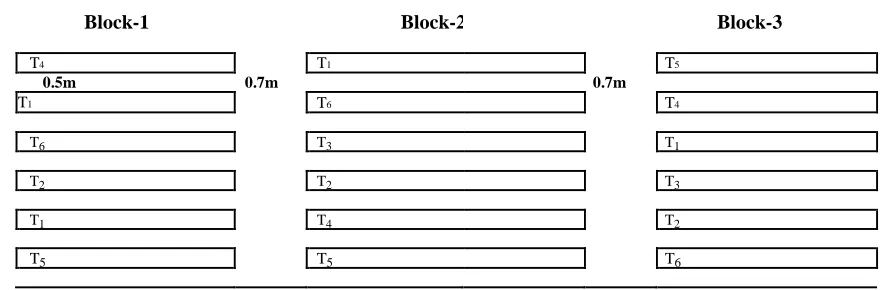
Figure 1. Layout of the experimental plot.
Treatment during final land preparation. Nitrogen
was applied @ 140 kg ha-1 from urea, P @ 5
kg ha- 1 from TSP, K @ 106 kg ha -1 from
MOP, S @ 3.06 kg ha -1 from gypsum, Zn @
3.6 kg ha-1 from zinc sulphate
(monohydrate) and B @ 0.6 kg ha-1 from
boric acid . Urea was applied in two splits, 2/3 was applied during final land preparation and rest 1/3 was applied 20 days after sowing. The fertilizers were
incorporated to soil by spading one day apart lines covered by soil manually.
Intercultural operations
Intercultural operations were done to ensure normal growth of the crop. The following intercultural operations were followed:
Irrigation
Three irrigations were applied, the first irrigation after 18 days of sowing , second irrigation after 29 days of sowing at crown root initiation stage and the third after 62 days of sowing at heading stage.
P the whole growing period, the one after 19 days of sowing and the other after 38 days.
Insect and pest control
During maturation, four plots were slightly infested by field rat and the pest
was controlled instantly by using
mechanical control measures and
application of zinc phosfide.
Harvesting
The crop was harvested at maturity after about four months of sowing (March 25, 2012). For data collection, ten plants from each plot were sampled randomly. The crop was cut at the ground level. Threshing, cleaning and drying of grain were done separately for every plot. Then plot- wise weights of grain and straw were recorded.
Data collection
Data were collected on the following yield and yield components.
Plant height
The plant height was measured from the ground level to top of the spike. From each plot, height of 10 plants were measured and averaged.
Number of tillers plant-1
Ten plants were selected from each plot randomly. The number of effective
and non-effective tillers plant-1 was
counted and averaged.
Spike length
Length of spike of ten plants per plot was recorded and averaged.
Grains spike-1
Ten spikes were selected and the filled and
unfilled grains spike-1 were recorded and
averaged.
Thousand grain weight
P
I. About 15 percent moisture in grain. II. Grains in hard dough stage.
III. Yellowing of spikelets.
SOIL ANALYSIS
The initial soil sample was analyzed for both physical and chemical properties such as soil texture, pH, organic matter, total N and available P, K, S, B, Zn, Ca, Mg contents. The post harvest soils were analyzed for soil pH, available P, Ca and Mg.
Collection and preparation of soil
samples
Before land preparation, soil samples were collected randomly from 9 different spots of the field from a depth of 0-15 cm. A mesh) sieve. The sieved soil was stored in a clean plastic container for subsequent mechanical and chemical analysis
Analysis of soil samples:
Mechanical analysis: Mechanical analysis
was done by hydrometer method
(Buoyoucos, 1927). The textural class was
determined following Marshall’s
triangular coordinate using USDA system.
Soil pH: Soil pH was measured with the help of a glass electrode pH meter, the soil-water ratio being 1:2.5 as described by (Jackson, 1962).
Organic matter content: Organic carbon content of soil was determined following wet oxidation method (Page et al., 1982). The amount of organic matter was calculated by multiplying the percent organic carbon with the van Bemmelen factor, 1.73 (Piper, 1950).
P
Available phosphorus: Available P content was extracted from soil with 0.03
M NH4F – 0.025 M HCl (Bray and Kurtz
method). The P in the extract was then determined by developing blue colour
with SnCl2 reduction of
phosphomolybdate complex and
measuring the colour by
spectrophotometer at 660 nm wavelength (Page et al, 1982).
Available sulphur: Available S of soil content was determined by extracting soil sample with CaCl2 (0.15%) solution as described by (Page et al, 1982). The S content in the extract was determined turbidimetrically and the turbid was measured by spectrophotometer at 420 nm wavelength.
Exchangeable potassium: Exchangeable K content of soil was determined by extraction with 1M NH4OAc, pH 7.0 solution followed by measurement of extractable K by flame photometer (Jackson, 1962).
Exchangeable calcium and magnesium:
Exchangeable Ca and Mg content of soil comparisons of the treatments were evaluated by DMRT (Ducan's Multiple Range Test). The analysis of variance (ANOVA) for different parameters was done by a computer package programme
"MSTATC”.
Results and Discussion
Soil pH
P
a
g
e
2
0
Chemical properties of post harvest soil
Table 1: Effects of liming on changes in soil properties of post harvest soils of wheat field
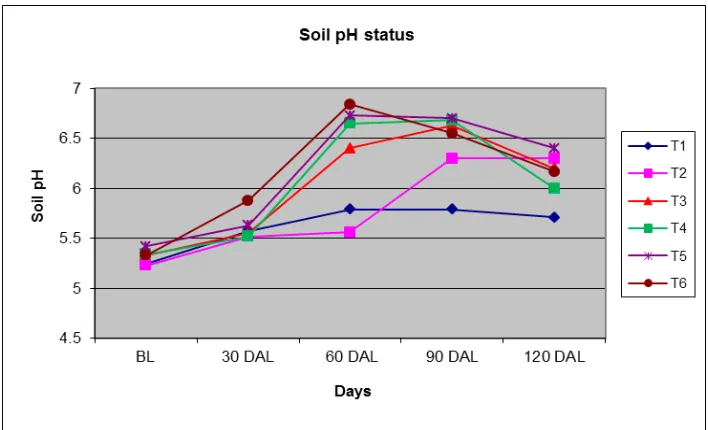
These finding was also in agreement with the observation of (Rao et al., 1982). A significant increase in pH was obtained with lime application and the better pH ranges were observed with treatment T4 and T5. Similar observations were also reported by (Basak, 2010; Halim, 2012) that pH of soil steeply increased during the first 30 days after liming, then slightly increased and finally slightly decreased with time until the end of 120 days of experimentation.
P
a
g
e
2
1
Soil Organic Matter
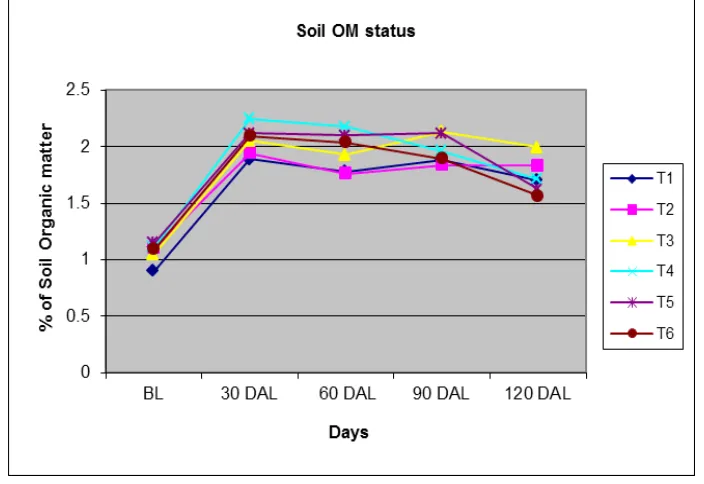
The average soil organic matter content in initial soil and before liming was slightly lower than soils collected after adding organic matter in the experimental field as per as necessary on the basis of crop requirement (Table 1 and figure 2). After adding organic matter to experiment field the status of OM was found to change significantly and increased up to 60 days, but at 90th, day it was decreased due to application of liming. The status of OM was increased with the advancement of the time, where the highest value of OM 2.25 and 1.89 at 30 DAL in respectively T4 and T1 treatments, but at 120 DAL the status was found identical. This was possibly due to the liming affect which increased pH of the initial acidic soil, as a result the microbial activities of the soil increased. Possibly due to increased microbial activities soil organic matter was decreased. But the effect of liming may vary with time and environment condition such as soil temperature and moisture as reported by Kreutzer (1995). Similar observations were also reported by (Basak, 2010; Halim, 2012).
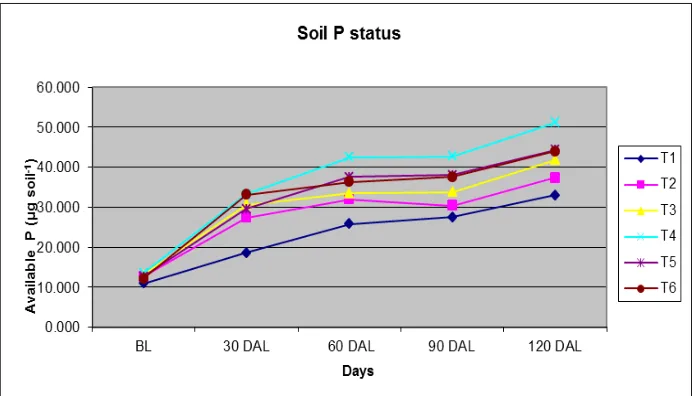
P after liming up to harvest of wheat (Figure
4). The initial value of available
phosphorus in the soil was 4.0 μg g-1 soil
and days after lime up to the post harvest soils had the values of 120th DAL 32.97,
37.40, 51.20, 44.33 and 43.97μg g-1 soils in
T1, T2, T3, T4, T5 and T6 respectively. A significant effect was found to the change of available P. The status of available P on soils was positively correlated with the rates of lime application. Lime application increased the soil pH which helped the release of fixed P from the oxides and hydroxides of Fe and Al thus increased the P availability in soil.
In general soil pH should be maintained 6.0 to 7.5 to maximize plant available
phosphorus. Possibly the higher
concentration of P was due to the application of phosphate fertilizer in acidic soil over time because P is not mobile. This result agreed with the report of (Samia, 2007).
They found that phosphours is not mobile in the soil and can result in high concentrations over time. Samia (2007) observed that the status of available P on liming were higher than 6.01, Where Bray
and Kurtz’ method was used for P
determination, with ammonium fluoride
(NH4F) as extracting solution.
The pH of soils that were collected after
liming was greater than 6.0 where Olsen’s
method were used for P determination with sodium hydrogen carbonate solution
as extracting solution. Ammonium
P
a
g
e
2
3
Figure 4: Soil P status before liming and at different days after liming.
Available Calcium
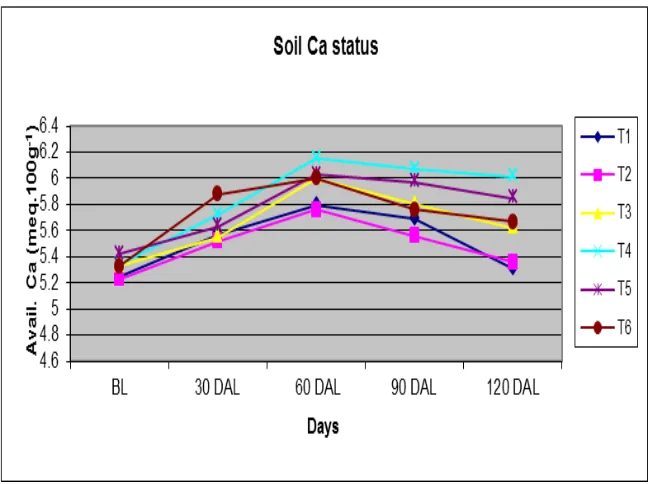
Available calcium in the sample that was collected days after liming increased steadily with increase rates of lime application, but it decreased in treatment T5 and T6. The available Ca of the soil before liming was 2.22, 2.72, 2.6, 2.34 and 2.47 meq 100g soil-1 respectively. After 30th DAL that became 1.78, 2.05, 2.26, 2.46, 2.21 and 2.05 with T1, T2, T3, T4, T5 and T6 treatments respectively. The result was found that the decreasing trend after 30th DAL was found upto 120DAL (Table 1 and Figure 6). The liming material used as
Dolochun [Dolomite, CaMg(CO3)2], which
on dissolution released a large amount of Ca and thus the available Ca increased in
soil after liming. The status of available Ca on soils was positively correlated with the
rate of lime application, because
application of lime increased the soil pH, which increased available Ca in soil. The co-efficient of variation was 6.37% and that of LSD was 0.019 at 1% level of significant. Which means a significant
increased of Ca (2.46 meq 100g soil-1) was
obtained with lime application and the better concentration of Ca was observed 2.46 in respect of treatment T4. This result agreed to report of (Garica, 1975) that the pH of acid soils increases due to liming, and adsorption is higher with higher rate
of lime application and calcium
P
a
g
e
2
4
Figure 5: Soil Ca status before liming and at different days after liming
Available Magnesium
Magnesium availability in soil samples collected during experiment was increased just after liming at 30th DAL, but it was gradually decreased with different rate of lime application up to 120th DAL. The content of available Mg in soil of sample collected before liming was 0.52, 0.56, 0.55, 0.69, 0.59 and 0.56 meq 100g soil-1 which changed after 30th DAL to 0.09, 1.24, 1.54, 1.56, 1.61 and 1.55 meq 100g soil-1 in T1, T2, T3, T4, T5 and T6 treatment respectively (Table 1 and Figure
7). The liming material used as Dolochun
[Dolomite, CaMg(CO3)2], which on
P
a
g
e
2
5
Figure 6: Soil Mg status before liming and at different days after liming
Available Potassium
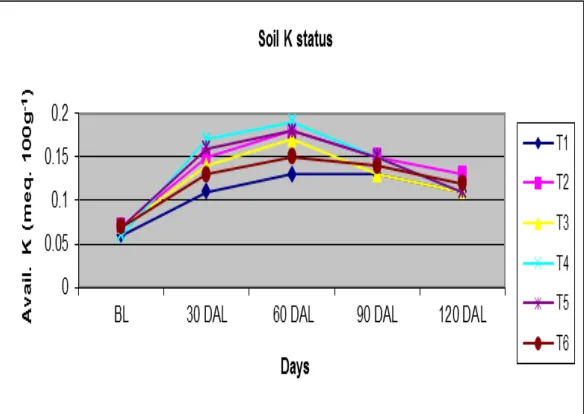
The application of different rate of lime increased the K availability of soils at after 30th days after liming, but it decreased gradually up to the 120th days after liming. The result showed that numerical different but level of lettering were identical. The CV was 15.35 and that of LSD was 0.0818 which was not significant (Table 1 and Figure 8). But better concentration of available K was obtained
with treatment T4 (1.5 t ha-1). Similar
observations were also reported by (Jackson, 1962) and (Basak, 2010) that the supply of exchangeable potassium in the soil is often low in acid soils, due to the formation of soluble K salt by soil acids and their loss by leaching from the soil. The availability of K begins to fall below a pH of 6.0. This finding was also in consonance with the finding of (Basak, 2010) found that liming acid soils
promotes and demotes potassium
P
a
g
e
2
6
Figure 7: Soil K status before liming and at different days after liming
Summary and conclusion
The experiment was laid out in a randomized complete block design with three replications. The size of the unit plot was 2.5m x 4m. Soil of the experimental field was sandy loam having initial pH 4.9, organic matter 1.92%, total N 0.12%,
available P 4.0 µg g-1, K 0.04 meq 100 g-1,
available Ca 3.5 meq 100 g-1, Mg 0.98 meq
100 g-1 and S 12.00 µg g-1. Post harvest soil
samples (120th DAL) were analyzed for pH, OM, available P, K, Ca and Mg.
Soil pH of the post harvest soils in different treatments of wheat increased steadily with increase in rates of lime application. The pH of the initial soil was
4.9 which increased to more than 6.0 due to the application of more than 1.5 t lime ha-1. The application of different rates of lime increased the P, Ca and Mg availability of the soils of different lime treatments after harvest of wheat. The available Mg of the initial soil was 0.98
meq 100 g-1 soil which increased to 1.61
meq 100 g-1 due to application of 2.0 t lime
ha-1 at 30 DAL. Similarly, the available Ca
of the initial soil was 1.5 meq 100 g-1 soil
which rose to 2.46 meq 100 g-1 soil due to application of 1.5 t lime ha-1 at 30 DAL.
P
a
g
e
2
7
Sapahar Upazila of Naogaon District. The application of lime to soil increased soil pH, available P, Ca and Mg in soils which had positive impact on yield components resulted in higher yield of wheat. The application of 1.5 t lime ha-1 appears to be optimum for wheat cultivation in the study area. However, further research may be carried out on the effects of lime on yield bearing characteristics of wheat for a sustainable food production.
Conflict of Interest:
P
a
g
e
2
8
REFERENCES
Adams, F. 1980. Soil acidity and Liming. Crop response to lime in the western United States, Madison, Wisconsin USA.
BARC (Bangladesh Agricultural Research Council), 2005. Fertilizer Recommendation Guide-2005. Soil Pub. No. 45. Farmgate, Dhaka.
Basak,V, 2010. Nutrient Dynamics and Chemical Properties of Acid soil under different liming conditions in Mungbean field followed by Transplanted aman. MS Thesis Student No. 0905046, HSTU, Dinajpur.
BBS (Bangladesh Bureau of Statistics), 2012. Statistical Yearbook of Bangladesh. Bangladesh Bur. Stat. Ministry of Planning. Govt. of the People's Republic of Bangladesh. Dhaka.
Buoyoucos, G. J. 1927. Hydrometer method improved for making particle size analysis of soils. Agron. J. 54: 4661-4665.
FRG (Fertilizer Recommendation Guide, 2005), Bangladesh Agricultural Research Council, Bangladesh.
Garica, F.V. 1975. Depth of liming on very acid soils. M. Sc. Thesis No. 842 AIT, Bangkok, Thailand.
P
a
g
e
2
9
Hausenbuiller, R. L. 1972. Soil Science: Principle and Practices. W.M.C. Brown Company, Pub. USA.
Haynes, R. J. 1984. Lime and phosphorus in the soil plant system. Adv. Agron. 37: 249-315.
Hossain, I., Yahia, G. and Jahiruddin, M. 1995. Effects of copper, boron and molybdenum on leaf spot disease and grain set of wheat. Bangladesh J. Train. Dev. 8: 77-81.
Islam M. R., Islam, M. S., Jahiruddin, M. and Hoque, M. S. 1999. Effects of sulphur, zinc and boron on yield, yield components and nutrient uptake of wheat. Pakistan J. Sci. Ind. Res. 42: (8), 137-140.
Jahiruddin, M. Hoque, M. S., Haque, A. K. M. M. and Roy, P. K. 1992. Influence of boron, copper and molybdenum on grain formation on wheat. Crop Res. 5: 35-42.
Kreutzer, K. 1995. Effects of forest liming on soil processes. Plant and Soil, v.-168-169, p.447-470.
Jackson, M.L. 1962. Soil Chemical Analysis. Prentice Hall of India Pvt. Ltd. New Delhi. pp. 10-14.
Miller, P.R. 2000. Effect of varying seeding date on crop development, yield and yield components in canaryseed. Canadian J. Plant Sci. 80(1): 83-86.
P
a
g
e
3
0
Rao, B. K. Panchaksharjah, S; Patil, B. N., Narayana, A. and. Raiker, D. I. S. 1982. Chemical composition of irrigation waters, from selected parts of Bijaypur district, Kamataka. Mysore Journal of agricultural Science 16(4): 426-432.
Sahai, V. N. 1990. Fundamental of Soil Science. Kalyani Publishers, Ludhiana, New Delhi. P 76-84.
Samia, B.S. 2007. Effect of liming on soil properties and yield of wheat. MS Soil Sci. Thesis student no. 0605015,HSTU, Dinajpur.