1 Study on Employee Motivation in Indonesia: Does culture really matter?
Suharnomo-Diponegoro University-Indonesia [email protected]
Abstract
The objective of the study is to investigate and analyze the influence of culture on motivation. The research is expected to answer the importance question: Are motivations influenced by national culture? It is generally accepted that motivation is considered to be universal until Hofstede (1980:42) published the seminal work: Culture’s Consequences: International Differences in Work Related Value in 1980. Hofstede’s work is the most popular in cross culture management studies so that his framework in national culture will be used in this research.
The study is completed by using survey method. The respondents are 108 managers of HRM from the listed companies of Indonesia Stock Exchange (IDX) 2008/2009. Modified Value Survey Module (VSM) 1994 developed by Hofstede is used to analyze the new scores of culture’ dimension comparing the scores done by Hofstede almost 30 years ago.
The results indicate that the national culture dimensions tend higher for masculinity (74), lower for power distance (66), lower for collectivism (27) and low on uncertainty avoidance. When the results are compared to Hofstede’s findings in 1983, they indicate those two dimensions i.e. collectivism and power distance is relatively unchanged (stable). However, masculinity-feminity and uncertainty avoidance dimension tend to change toward higher score.
By using the new scores of dimension of national culture, some proposition on motivation is developed.
2 Introduction
Management as said is one of the most important product of modern human culture despite of technologies. Management (both science and practice) has been giving the most valuable contribution for human being. Major projects are well accomplished thus the organization (company) are well developed because of management. Management in particular is always associated with company (organization). It happens because the progress of management science is related to the company’s development and growth in the future. Recently, management has been applied in various organization’s type, small and big, profit oriented and non-profit oriented ones.
The study is expected to find Indonesian Model of Management which is different from American or Japanese model. The basic study of Indonesian management is the cultural diversity. Indonesia has different culture characteristics with the United States, Japan and other countries so that this part will makes this study very original, and worth to do. The cultural differences in this study will be conducted by using Hofstede framework (1981, 1997, 2005).
Background Theory & Hyphoteses
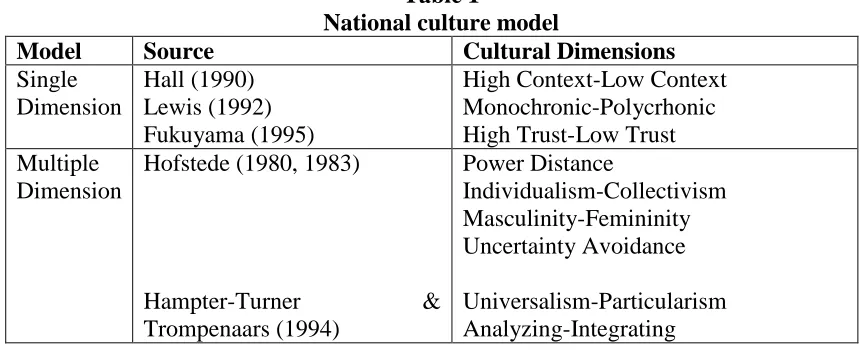
Morden (1998) identifies that there are three categories of National Culture, they are single dimension, multiple dimension and historical-social model as listed in the table below.
Table 1
National culture model
Model Source Cultural Dimensions
3
Among those studies, Hofstede (1980) is the most comprehensive in explaining the National Culture dimensions as said by Shackleton & Ali (1990:109), Triandis (1982:86), and Schuler & Ragovsky (1998:159). Hofstede culture dimension (1980) is also the most popular study among the study of national culture influence in management (Myers & Tan, 2002).
The study uses Hofstede’s national culture dimension (1993) which has been acknowledged world wide as an important cultural framework in explaining the national cultural diversity (Triandis, 1982:86). The Hofstede study is the only study on national cultural dimension, which provides complete expalanation from the conseptual side up to the research indicators measurement.
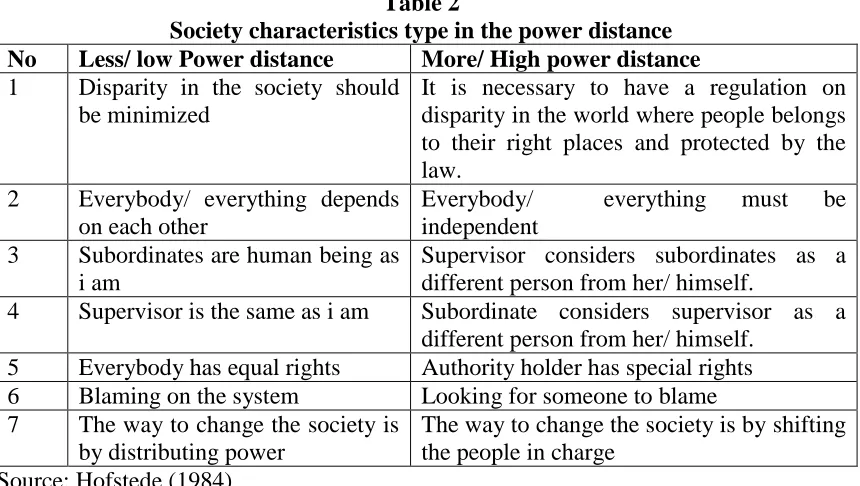
Further details of Hofstede’s national culture are : 1. Power Distance
4 Table 2
Society characteristics type in the power distance No Less/ low Power distance More/ High power distance 1 Disparity in the society should
be minimized
It is necessary to have a regulation on disparity in the world where people belongs to their right places and protected by the law.
2 Everybody/ everything depends on each other
Everybody/ everything must be independent
3 Subordinates are human being as i am
Supervisor considers subordinates as a different person from her/ himself.
4 Supervisor is the same as i am Subordinate considers supervisor as a different person from her/ himself.
5 Everybody has equal rights Authority holder has special rights 6 Blaming on the system Looking for someone to blame 7 The way to change the society is
by distributing power
The way to change the society is by shifting the people in charge
Source: Hofstede (1984)
2. Uncertainty Avoidance
Uncertainty avoidance is how people feels being threatened under uncertain circumstances and creating faith along the institution to avoid those uncertainties. Several different charactheristics among nation with lower and higher uncertainty avoidance described in the table below.
Table 3
Society diversity under uncertainty avoidance
No Lower uncertainty avoidance Higher uncertainty avoidance 1 Always moving arround Always staying in a workplace 2 Loyalty to company (owner) is no
longer considered as a priority
Loyalty to company (owner) is considered as a priority
3 Manager must be selected based on competency
Manager must be selected by seniority and competency
4 Considering internal conflict as a common conflict
Dislike internal organization conflict 5 Employee competitions are acceptable Employee competitions are not
preferable
6 Wider working manual are preferrable Detail working manual are preferrable
7 Risk avoider Risk taker
5 3. Individualism versus Collectivism
Individualism is people tendency to focus only to themselves or their closest family. Hofstede measures the gaps of individualism dimensions into two poles of continum, so that the smaller of society individualism the more it become collectivism. Collectivism is the opposite of individualism, people tendency to join a group or a collective and care each other as a symbol of loyalty among them. Some differences of individualist and colletivist society charactheristics are illustrated as follows in table 4.
Table 4
Characteristics differences between Individualist and collectivist society No Lower individualism (collective) Higher individualism
1 Awareness on “us” Awareness on “me”
2 Collective orientation Individual orientation 3 Identity based on social system Identity based on individual 4 Personal life interfered by
organization (personal)
Personal life is separeted from the organization (impersonal)
5 Different standard of values for the group member and the outsider
Similar standard of values for both group member and outsider. 6 Emotional dependency of individual
due to organization.
Emotional Individual independency from the organization or institution
7 Extended family Nucleus family
Source: Hofstede (1984) 3) Masculinity versus Femininity
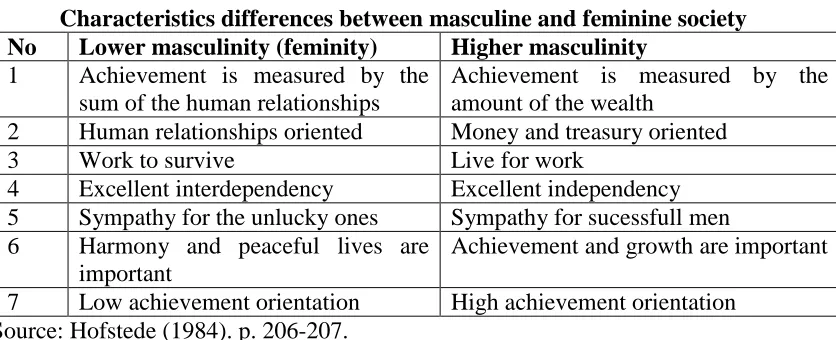
6 Table 5
Characteristics differences between masculine and feminine society No Lower masculinity (feminity) Higher masculinity
1 Achievement is measured by the sum of the human relationships
Achievement is measured by the amount of the wealth
2 Human relationships oriented Money and treasury oriented
3 Work to survive Live for work
4 Excellent interdependency Excellent independency 5 Sympathy for the unlucky ones Sympathy for sucessfull men 6 Harmony and peaceful lives are
important
Achievement and growth are important 7 Low achievement orientation High achievement orientation
Source: Hofstede (1984). p. 206-207. Cultural aspects on motivation
USA has been the center of production concept and modern management theory since 1960’s. Some efforts have been done by experts to understand the correlation of national culture or society culture to management practice. The increasing growth of multi national company from advanced country particularly USA, the need to understand the national culture where the multi national company operated is increasingly in distinct.
7 possible to motivate them in the different ways or processes. The whole motivation theory as mentioned before, from both content and process must consider society cultural aspects in this study.
Several efforts have been conducted by management experts to link the national culture with the organization or management business activities (Ouchi 1982, Cooney, 1989, Adler, 1991). One of the aspect that acknowledges as the core of management is motivation. Motivation to work is built by both individual factor and environmental factor (i.e culture). In other words, motivation is influenced by the society culture. What drives certain society might not work in other society, but the implications may vary. In other words, there is no best way to manage the employee, so that employment management in organization also depends on its national culture.
National culture variable is crucial in order to have good understanding on the implementation of motivation theory in the workplace. Robbins (1991) defines motivation as a willingness to spend maximum efforts to achieve the organization objectives, conditioned by capability in order to satisfy the level of individual needs. The important part of the definition tends to individual needs. According to national culture dimensions, Hofstede (1994) states that motivational needs is very close to the culture, which is origined from certain national culture. For example, most of Indonesian people will visit their hometown to meet their parents and extended family during Muslim festival. It is their top urgent need while for other people it is not necessary. Urgent needs can be the wish to accomplish challenging tasks.
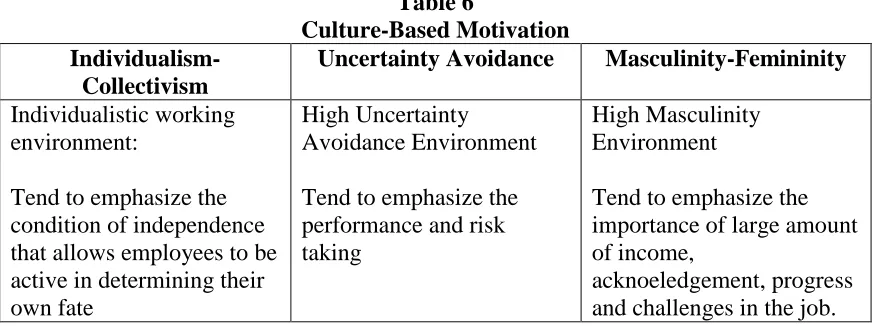
8 Collective working
environment
Tend to emphasize the mutual dependence (interdependence) to cooperate in the organization
Low Uncertainty
Avoidance Environment Tend to emphasizes on security, continuity, acknowledgement of groups and group progress
Low Masculinity Environment
Tend to emphasize the importance of relationships with leaders, colleagues, cooperation, and job security.
Source: Hofstede (1994)
Research Methods
Population of the study is the listed companies in Indonesia Stock Exchange in 2007/2008. The firms are selected based on the notion that these companies are quite appealing to the applicants from all over the country to supervise and thus join as employees. The company is expected to be a proxy for diverse ethnic and cultural representation in Indonesia that reflecting the national culture characteristics compared to the local culture (sub-culture).
9 Score calculation technique is based on the International Questionnaire (VSM 1994) as enclosed in this study. The calculation formula is:
Respondent Profile
The total sample obtained was 108, which consisted of 64 managers / director of Human Resources (HR) (59.3%), middle manager / assistant director of human resources amount are 41 persons (37.9%) and the rests are supervisors (2.8%). The total cumulative percentage of managers and middle managers is 97.2%, at that position respondents are certainly familiar with the HR practices characteristics thus will minimize bias response (common method bias).
Score Calculation Results of the National Cultural Dimensions (Hofstede Formulation, VSM 1994) and Discussion
Power Distance
Power Distance (PD) = -35m(03) + 35m(06) + 25m(14) – 20m(17) - 20
Power Distance (PD) = -35 (3,185185) + 35 (4,287037) + 25 (3,962963) -20 (2,592593) Power Distance (PD) = 65,78704
Power Distance (PD) = -35m(03) + 35m(06) + 25m(14) – 20m(17) - 20
Individualism (IDV) = -50m(01) + 35m(02) + 20m(04) – 25m(08) + 130
Masculinity (MAS) = 60m(05) - 20m(07) + 20m(15) – 70m(20) + 100
10 Individualism
Individualism (IDV) = -50m(01) + 35m(02) + 20m(04) – 25m(08) + 130 Individualism (IDV) = -50 (3,981481) + 35 (3,88889) + 20 (4,018519) – 25 (4,037037)
Individualism (IDV) = 27,03708 Masculinity
Masculinity (MAS) = 60m(05) - 20m(07) + 20m(15) – 70m(20) + 100
Masculinity (MAS) = 60 (3,962963) – 20 (3,972222) + 20(4,194444) – 70 (3,83333) + 100
Masculinity (MAS) = 73,89118 Uncertainty Avoidance
Uncertainty A (UAI) = 20m(13) + 20m(16) - 50m(18) – 15m(19) + 120
Uncertainty A (UAI) = 20 (3,861111) + 20 (4,11111) – 50 (4,148148)-15 (4,055556) + 120
Uncertainty A (UAI) = 29,81445
Analysis on the Power Distance Score Results
Power distance dimension based on Heuer, M., Cummings, L. J., Hutabarat, W. study (1999) have some special characteristics. First, there is no evidence of convergence on this dimension directed to small power distance or smaller differences in power distance. Second, strong roots in this dimension (deep roots) makes the value of power distance as national culture dimension will last longer. Third, power distance dimension is considered as the Southeast Asia characteristic of nations including Indonesia. According to Hofstede, Indonesia has a very high value of power distance score (78). It is a remarkable number compared to other countries.
11 the supervisor-subordinate relationship model. Third, information and technology lead in building society by reducing physical contact to other human being.
However, according to the power distance value in this study which scores 66, Indonesia is categorized as a country with high power distance. The model of the Indonesian society in cultural perspective in Hofstede, high power distance is a hierarchical where people who is in high or low position status feels comfortable with the condition and take it for granted for that kind of relationship. Leaders get a proper right as superiors and subordinates accept these conditions without questioned. However, the superiors and subordinates relationship is not a transaction-oriented model but more to “brotherhood” relationship.
Proposition 1
In Indonesia, with high power distance in cultural environment, employees are more motivated to work by seeing more examples / emulate the leader’s behavior and the leader with warm fatherly nature (paternalistic), which gives attention to the employee.
Analysis of Individualism Score Results
Individualism score in this study was 27.037 or rounded to 27, is in contrast to Hofstede research that puts Indonesia’s to score 14. There is an increasing point of Individualism up to 13 points, despite that it will not change Indonesia's position of low individualism (high collectivism) category. The main reasons that might explain the increase point of individualism scores in Indonesia is the level of natural competition and the working demands that lead to asocial nature because of the narrowness of space and time to meet and interact to each other.
12 mostly have similar opinions with other group. being persistant in defending the opinion is unusual and called cultureless.
In the workplace, creating good relationships between superiors and subordinates personally and colleagues is also important before engaging an occupation. Employee’s tasks are not only focus on the job it self but also need to consider non-technical issues outside the work such as: maintaining the harmony of the group, low profile and trying to integrate themselves in the larger part of the group.
A discussion of the collectivist-individualist in Indonesia is inseparable from the concept of “gotong-royong” (mutual cooperation) which is still a strong hold in Indonesia. In this concept, human beings are perceived intrinsically dependent. Man needs help from others especially from the relatives. The way of that kind of thinking will carry a deep and steady secure to the conscience of the people, because there will always be a positive reflection of life, for better (happiness) or worst (under sad condition) . There will always be other people in the collectivity of human being because one person problems are also problems for others.
As the negative impact, the mutual concept of cooperation also creates a responsibility for someone to constantly maintain a good relationships, aware on their needs and encourage to have a spirit of sharing, especially to their own family members (Koentjaraningrat, 2002:41). The “brotherhood” systems which are brought into the workplace will be unavailable for people who do not have many affiliates, although they have superior achievement.
Proposition 2
In Indonesia, with a low individualism culture environment, employees are more motivated to work collectively.
Analysis of Masculinity Score Results
13 rounded to 74. The perception level of the cultural dimensions of this high Masculinity level showed a friction process of cultural dimensions due to the masculine characteristics: assertiveness, money, material and success. The score changing in masculinity dimension is probably caused by the stronger of the material culture driven by the need of money and physical appearence appreciation.
Proposition 3
In Indonesia with a high masculinity cultural environment, employees are more motivated to work for income, recognition, progress and challenges in the job.
Analysis on uncertainty avoidance Score Results
The substance of the uncertainty is a subjective experience, a feeling. The roots of uncertainty charactheristics are irrational. Uncertainty avoidance is different from risk avoidance. Both fear and risk are associated with an object. Risk is the probability of an up-coming event. Uncertainty avoidance is closely related to anxiety. Anxiety is an anxious feeling about something that might happen. While uncertainty is acknowledged as a risk thus it will be anxiety’s source. In general, uncertainty avoidance defined as a condition in which people in society feel threatened by uncertainty or unknown situation thus how much is the efforts to avoid the situation.
Society is the countries with strong uncertainty avoidance are characterized as: a busy, restless, emotional, aggressive and active, while the society in the countries with weak uncertainty avoidance is categorized as: passive, easy-going, slow, controlled and lazy. In strong uncertainty avoidance society, time is a very important determinant, so that keeping the time will be more important than to take care of the life itself.
14 How about the conditions in Indonesia that reflects the uncertainty avoidance scores by Hofstede? Referring to Data related to the depression which then leads to suicide, unfortunately it is not much published in the Indonesian data. Trust Magazine, quoted a Suicidology journal published by the University of Oslo of Norwegia, provides data: the suicide rate in Moslem countries is almost 0, only 0.1 per 100,000 of population. In the countries with Christian population there are more than 11, while 13in India which is Hindus, in Japan the number is up to 25 and the atheist country like China, the suicide rate is 40 per 100.000 populations. In Indonesia, which is the biggest population of Moslem country, suicide is a behavior that is strictly prohibited and considered as unforgivable sin by Allah.
Religion may also have significant influence to cope with the uncertain condition. In Western countries, they generally assume that people are the masters of destiny which able to determine their own fate. By this concept, the failure or success solely because of their own effort. While in common lesson of Moslem subjects in Indonesia, people must believe in God destiny’s as one of the faith pillars. In this concept, both success and failure is not only because of human effort but also the will of God. Believing in God’s destiny is probably an important factor in dealing with the uncertainty situation that is a relieving attitude due to happines or sadness. Indonesian uncertainty avoidance is relatively low (48).
In this study, uncertainty avoidance score is 29.81 or rounded to 30. The crisis that striked Indonesia since 1998, the election conflicts in some areas, floods and disasters that frequently striked Indonesia apparently did not much effect the anxiety in life. This score puts Indonesia a the low rank in the uncertainty avoidance through out the world.
Proposition 4
15 Conclusion
From the analysis in above, it can be concluded that:
1. Based on the calculating scores framework of the national culture developed by Hofstede (1981, 1984) the results are: power distance dimension (66) , individualism dimension (27), masculinity dimension (74) and uncertainty avoidance (30). It is a different result from the scores of Hofstedes research (1981, 1984) in Indonesia where the dimension scores are: power distance (78), individualism (14), masculinity (46) and uncertainty avoidance (48).
2. No significant difference in results compare to Hofstede (1981, 984) i.e: Indonesia is in a position as a country with high power distance, low individualism and low uncertainty avoidance as well. According to Hofstede study (1981, 1984) Indonesia has a mid-low masculinity score while in this study Indonesia posessed high masculinity score.
3. In low individualism, the top priority needs according to the employee is establishing a good relationship with family and co-workers. Thus, if you want to motivate the employees in order to perform their best achievement, you must always connect the job to the family aspect. It will attract the employees attention and results a good relationship with the closest people.
4. Unlike the Hofstede research (1981, 1984), Indonesia national culture dimension included in the masculine culture while many researches stated that in general, Indonesian employees are lacked of motivation to perform high achievement and only pursue the peace. However, this study shows different results. Nowadays, with high score of masculinity, Indonesian employees are motivated to work for the reasons of income, recognition, progress and challenges in the job.
16 with high uncertainty avoidance such as USA and Japan, employees look busy, restless, emotional, aggressive and active. In Indonesia with low uncertainty avoidance, employee should be someone who loves the risks and challenges in work. In fact, what often happens is a negative trait such a comfortable feeling when lazy and hard-working only when it is needed. Mochtar Lubis (2001) accused that the Indonesian people tend to be passive, easy-going, slow, controlled and lazy. This paradox requires a more adequate explanation from other sufficience sciences such as sociology or anthropology.
References
Aziz, Anwar., & Naim, Chaker. 2003. Globalization of Corporate America and Its Implications for Management Styles in An Arabian Cultural Context. International Journal of Management. Vol.20 No.1 March.
Black, Boyd. 1999. National Culture and High Commitment Management. Employee Relation. Vol. 21. No. 4. p. 389-404
Daft, L. (2000). Management. New York: McGraw-Hill.
Drucker, Peter. (1977). an Introductory View of Management. New York: Harper & Row.
Drucker, Peter F. (1998). The New Management Paradigm. Forbes, July.
Fuad Mas’ud. 2002. 40 Mitos Manajemen Sumber Daya Manusia. BP Undip Semarang Fuad Mad’ud, 2008. Menggugat Manajemen Barat. BP UNDIP Semarang
Geringer, M. J., Frayne, A. C., Milliman, F. J. 2002. In Search of “Best Practices” in International Human Resource Management: Research Design and Methodology.Human Resource Management, spring; 41, 1: 5 – 30
Gomez-Mejia, L & Welbourne, T. 1993. Compensation Strategis in a Global Context. Human Resource Planning, Volume 14, Number 1, 29-41
17 Heuer, M., Cummings, L. J., Hutabarat, W. 1999. Cultural Stability or Change among Managers in Indonesia? Journal of International Business Studies, 30, 3.Third Quarter: 599 - 610
Hofstede, G. 1980. Culture’s Consequences. International Differences in Work-Related Values. A Bridged Edition. Sage Publication. Newbury park.
Hofstede, G. 1980. Motivation, Leadership, and Organization: Do American Theories Apply Abroad? Organizational Dynamics, summer, AMACOM, A Division of American Management Association
Hofstede, G. 1983. National Culture in Four Dimensions: A Research-Based Theory of Cultural Differences among Nations. International Studies of Management & Organization. Vol XIII, No.1-2: 46 - 74
Hofstede, G. 1990. A Reply & Comment on Joginder P Singh: Managerial Culture and Work-related Values in India. Organization Studies, 11/1:103-106, p: 1-5 Hofstede, G. 1993. “Cultural Constrains in Management Theories”. Academy of
Management Executive. Vol 7. No.1: 81 – 94
Hofstede, G. 1994. Management Scientists are Human. Management Science. Vol.40, No1, January, p 4-13
Hofstede, G. 1997. Cultures and Organizations, Software of the Mind. Intercultural Cooperation and its Importance for Survival. McGraw Hill. New York.
Kim, Ken., Park Hun Joon, Suzuki, Nori. 1990. Reward Allocation in the United States, Japan & Korea: A Comparison of Individualistic and Collectivistic Cultures. Academy of Management Journal.Vol 33 Iss 1 p, 188-199
Koentjaraningrat.2004. Manusia dan Kebudayaan di Indonesia. . Penerbit Djambatan.Jakarta
Laurent A. 1983. The Cultural Diversity of Western Conceptions of Management. International Studies of Management & Organization, Vol. XIII, No. : 75-96
Lee, Sang. (1982). Japanese Management: Culture and Environment. New York: Praeger Publishing.
Lloyd, S & Hartel, C. 2004. Predicting HRM Strategy and Practice Decision: Development of the HRM Orientation Typology. Cross-Cultural Management. Vol 11 Number 4, 2004
18 Trust Magazine. 2003 (4), p 43
Mellahi, K & Frynas, G., J. 2003. An Exploratory Study into the Applicability of Western HRM Practices in Developing Countries: An Algerian Case Study. International Journal of Commerce & Management, 13, 1:61 – 80
Morden, Tony. 1999. Models of National Culture- A Management Review. Cross Cultural Management. Volume 6 Number 1:19-44
Newman, L.K & Nollen, D.S. 1996. Culture and Congruence: The Fit Between Management Practice and National Culture. Journal of International Business Studies. Fourth Quarter, 27, 4: 753 – 779
Newman, William H. (1969). Cultural Assumptions Underlying U.S. Management Concepts. In Management In International Context.
Schuler, R. S & Rogovsky, N. 1998. Understanding Compensation Practice Variations across Firms: The Impact of National Culture. Journal of International Business Studies; First Quarter; 29, 1: 159 – 177
Shackleton, V & Ali, A. H. 1990. Work-Related Values of Managers: A Test of the Hofstede Model. Journal of Cross-Cultural Psychology. 21:109-118
Singh, P Joginder. 1990. Managerial Culture and Work-Related Values in India. Organization Studies.11/1:075-101, p76-101
Sondergaard, M. 1994. Hofstede’s Consequences: A Study of Reviews, Citations and Replications. Organization Studies, Vol 15 Iss: 3: 447 - 456
Stenning, B.W. & Ngan.E.F. 1997. The Cultural Context of Human Resource Management in East Asia. Asia Pacific Journal of Human Resources. 35 (2): 3-15
Stoner, James F. (1998). Management. New York: Prentice -Hall.
Sridharab, Uma V., Dicken, Lorry,, dan Caines, W Royce (2002). The Social Impact of Business Failure: Enron. Mid-American Journal of Business, Vol. 17. No. 2. pp. 11- 21.
Terry, George. (1978). Principles of Management. New York: Mc-Graw-Hill.