SPEAKING MATERIALS ADOPTING INFORMATION GATHERING TECHNIQUE FOR THE TENTH GRADE STUDENTS OF SMA BOPKRI 2
YOGYAKARTA
A SARJANA PENDIDIKAN THESIS
Presented as Partial Fulfillment of the Requirements to Obtain the Sarjana Pendidikan Degree
in English Language Education
By
Monika Nur Indah Sari
Student Number: 091214059
ENGLISH LANGUAGE EDUCATION STUDY PROGRAM DEPARTMENT OF LANGUAGE AND ARTS EDUCATION FACULTY OF TEACHERS TRAINING AND EDUCATION
SANATA DHARMA UNIVERSITY YOGYAKARTA
i
SPEAKING MATERIALS ADOPTING INFORMATION GATHERING TECHNIQUE FOR THE TENTH GRADE STUDENTS OF SMA BOPKRI 2
YOGYAKARTA
A SARJANA PENDIDIKAN THESIS
Presented as Partial Fulfillment of the Requirements to Obtain the Sarjana Pendidikan Degree
in English Language Education
By
Monika Nur Indah Sari
Student Number: 091214059
ENGLISH LANGUAGE EDUCATION STUDY PROGRAM DEPARTMENT OF LANGUAGE AND ARTS EDUCATION FACULTY OF TEACHERS TRAINING AND EDUCATION
SANATA DHARMA UNIVERSITY YOGYAKARTA
iv
STATEMENT OF WORK’S ORIGINALITY
I honestly declare that this thesis, which I have written, does not contain the work
or parts of other people, except those cited in the quotations and the references, as
a scientific paper should.
Yogyakarta, 11 December 2013
The Writer
Monika Nur Indah Sari
v
LEMBAR PERNYATAAN PERSETUJUAN PUBLIKASI KARYA ILMIAH UNTUK KEPENTINGAN AKADEMIS
Yang bertanda tangan di bawah ini, saya mahasiswa Universitas Sanata Dharma:
Nama : Monika Nur Indah Sari
Nomor Mahasiswa : 091214059
Demi pengembangan ilmu pengetahuan, saya memberikan kepada Perpustakaan Universitas Sanata Dharma karya ilmiah saya yang berjudul:
SPEAKING MATERIALS ADOPTING INFORMATION GATHERING TECHNIQUE FOR THE TENTH GRADE STUDENTS OF SMA BOPKRI 2
YOGYAKARTA
Dengan demikian saya memberikan kepada Universitas Sanata Dharma hak untuk menyimpan, mengalihkan dalam bentuk media lain, mengelolanya dalam bentuk pangkalan data, mendistribusikan secara terbatas, dan mempublikasikannya di Internet atau media lain untuk kepentingan akademis tanpa perlu meminta ijin dari saya maupun memberikan royalti kepada saya selama tetap mencantumkan nama saya sebagai penulis.
Demikian pernyataan ini yang saya buat dengan sebenarnya.
Dibuat di Yogyakarta
Pada tanggal: 11 December 2013
Yang menyatakan
vi
ABSTRACT
Sari, Monika Nur Indah. 2013. Speaking Materials Adopting Information Gathering Technique for the Tenth Grade Students of SMA BOPKRI 2 Yogyakarta. Yogyakarta: English Language Education Study Program, Sanata Dharma University.
This study aims to design a set of English speaking materials for the tenth grade students of SMA BOPKRI 2 Yogyakarta by adopting information gathering technique. Information gathering technique was used to encourage the students in building meaningful interaction and maintaining comprehensible ongoing communication. This technique assists the students to conduct survey, research, and interview to gather information. This study addressed two problems: 1) How are speaking materials adopting information gathering technique for the tenth grade students of SMA BOPKRI 2 Yogyakarta designed? 2) What do the speaking materials look like?
There were three research instruments used to answer the first research problem: questionnaires, observation checklist, and interview. The respondents were the tenth grade students and the English teacher of SMA BOPKRI 2 Yogyakarta. The researcher applied six Research and Development (R&D) procedures, (1) Conducting Research and information collecting, (2) Planning, (3) Developing preliminary form of product, (4) Conducting preliminary field testing, (5) Conducting main product revision, and (6) Reporting the final product.
In order to design the materials, the researcher applied six steps adapted from Kemp’s and Yalden’s instructional design models. They were (1) Need survey, (2) Considering the goal, listing the topic, and stating the general purposes, (3) Selecting syllabus type, (4) Conducting pre-assessment, (5) Evaluating the materials, and (6) Revising. The researcher consulted and evaluated the materials to the four evaluators. Based on the data analysis results, the materials were acceptable, appropriate and ready to be used.
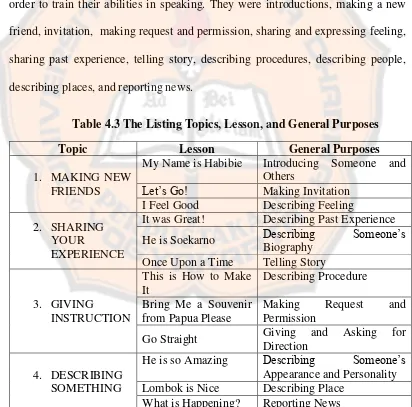
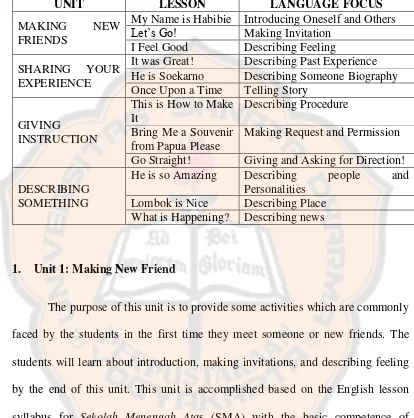
To answer the second problem, the researcher presented the final result of the materials that had been designed using information gathering technique, which consisted of four units. The first unit is Making New Friends which consists of introducing someone and others, making invitations, and describing feeling. The second unit is Sharing Your Experience which consists of describing experiences, describing someone’s biography, and telling a story. The third unit is Giving Instruction which consists of describing procedure, making request and permission and giving and asking for direction. The last unit is Describing Something which consists of describing someone’s appearance and personality,
describing place, and reporting news. Each unit contained three lessons and three main parts: Pre-activity, Main-activity, Post-activity.
vii
ABSTRAK
Sari, Monika Nur Indah. 2013. Speaking Materials Adopting Information Gathering Technique for The Tenth Grade Students of SMA BOPKRI 2 Yogyakarta. Yogyakarta: English Language Education Study Program, Sanata Dharma University.
Penelitian ini dilakukan untuk mendisain materi berbicara untuk siswa kelas sepuluh SMA BOPKRI 2 Yogyakarta dengan mengadopsi teknik pengumpulan informasi. Teknik pengumpulan informasi digunakan untuk mendorong para siswa untuk membangun interaksi penuh arti dan proses komunikasi yang berkelanjutan. Teknik ini membantu para siswa untuk melakukan survei, penelitian, dan interview untuk mengumpulkan informasi dalam pembelajaran. Penelitian ini ditujukan pada dua permasalahan: 1) Bagaimana materi berbicara yang mengadopsi teknik pengumpulan informasi untuk kelas sepuluh SMA BOPKRI 2 Yogyakarta didesain? 2) Seperti apa bentuk materi berbicara?
Terdapat tiga instrument penelitian untuk menjawab permasalahan pertama: panduan observasi, kuisioner, dan panduan interview. Responden dari penelitian ini adalah siswa kelas sepuluh dan guru Bahasa Inggris SMA BOPKRI 2 Yogyakarta. Peneliti mengaplikasikan enam Research and Development (R&D) prosedur, (1) Pengumpulan data awal, (2) Perencanaan, (3) Pengembangan produk awal, (4) Pengetesan awal, (5) Perbaikan produk utama, dan (6) Pelaporan produk akhir.
Dalam mendesain materi, peneliti mengaplikasikan sepuluh langkah yang diadaptasi dari model Kemp dan Yalden. Langkah-langkah tersebut adalah: (1) Survei kebutuhan, (2) Penentuan sasaran, menyusun topik, dan menyebutkan tujuan umum, (3) Pemilihan silabus, (4) Penafsiran awal, (5) Pengevaluasian materi, (6) Perbaikan. Peneliti mengkonsultasikan dan mengevalusikan materi kepada empat evaluator. Berdasarkan hasil dari analisis data, materi telah sesuai dan siap untuk digunakan.
Untuk menjawab permasalahan kedua, peneliti mempresentasikanmateri yang telah didesain kedalam empat unit. Unit pertama adalah Making New Friends yang terdiri dari memperkenalkan seseorang dan orang lain, membuat undangan, mendeskripsikan perasaan. Unit yang kedua adalah Sharing Your Experience yang terdiri dari mendeskripsikan pengalaman, mendeskripsikan biografi seseorang, dan menceritakan cerita. Unit yang ketiga adalah Giving Instruction yang terdiri dari mendeskripsikan prosedur, membuat permintaan, dan menunjukan arah. Unit yang terakhir adalah Describing Something yang terdiri dari mendeskripsikan penampilan dan karakter seseorang, mendeskripsikan tempat, dan melaporkan berita. Setiap unit terdiri dari tiga pelajaran dan tiga bagian: Pre-activity, Main-activity, “Post-activity”.
viii
ACKNOWLEDGEMENTS
I would like to express my best gratitude to My Great Father in heaven,
Jesus Christ, Holy Spirit, Saint Mary, and Saint Monica, who have granted me a
great deal of knowledge and abilities in my entire life. Through Their blessings, I
am finally able to finish this thesis entitled Speaking Materials Adopting
Information Gathering Technique for the Tenth Grade Students of SMA BOPKRI
2 Yogyakarta as a partial fulfillment of the requirements to obtain the Sarjana
Pendidikan Degree in English Language Education Study Program.
I would like to express my gratefulness to my thesis advisor, Carla Sih
Prabandari S.Pd., M.Hum., who has guided and given me critical ideas and useful advice along the process of composing this thesis. I greatly thank Samuel
Sunu Nugraha, S.Pd., S.H., M.Hum., as the tenth grade teacher of SMA BOPKRI 2 Yogyakarta for the opportunities and kindness to allow me doing
research in his class. I also send my gratitude to my great evaluators J. Sri Murwani, S.Pd., M.Pd., Adesti Komalasari, S.Pd.,M.A., and Gregorius Punto Aji, S.Pd., M.Pd., I also thank all of PBI lecturers for the knowledge they shared for the last four years.
My best gratitude and love go to my parents, Bapak Supono and Ibu Sri
Winarsih who have given me spiritual and financial supports along the process of composing this thesis. I thank them for love, care, understanding, and the sincere
ix
prayers, love, understanding, spiritual and financial supports along my prosess of
study.
Special thanks go to all of my friends in English Language Education
Study Program, especially FLAME (Evi, Agnes, Alice Kandy, Titus, & Sony). I
thank them for the togetherness, laughter, and tears we had. I also thank my close
friends Elok, Tyas and Lai for the everlasting friendship we had so far.
Last but not least, I would like to invite the readers’ suggestions and
criticism upon the presence of this thesis. The readers’ responses would be
beneficial for the improvement of this thesis. Finally, the writer hopes that this
thesis will give many advantages to those concerning on Educational Research
and Developing (R & D) field.
The Writer
x
TABLE OF CONTENTS
Page
TITLE PAGE ... i
APPROVAL PAGE ... ii
STATEMENT OF WORK’S ORIGINALITY ... iv
PERNYATAAN PERSETUJUAN PUBLIKASI ... v
ABSTRACT ... vi
ABTSRAK ... vii
ACKNOWLEDGEMENTS ... viii
TABLE OF CONTENTS ... x
LIST OF FIGURES ………... xiii
LIST OF TABLES ………... xiv
LIST OF APPENDICES ... xv
CHAPTER I: INTRODUCTION ... 1
A. Research Background ... 1
B. Research Problem ... 3
C. Problem Limitation... 3
D. Research Objectives ... 4
E. Research Benefits ... 5
F. Definition of Terms ... 7
CHAPTER II: REVIEW OF RELATED LITERATURE ... 10
A. Theoretical Description ... 10
1. Instructional Design Models ... 10
a. Kemp’s Model of Instructional Design ... 11
b. Yalden’s Model of Instructional Design ... 15
2. Teaching and Learning of Speaking Skill ... 18
a. The Nature Of Speaking ... 18
b. Learning Speaking ... 18
xi
3. Information Gathering Technique (IGT) in Communicative
Language Teaching (CLT) ... 20
4. The Characteristic of Information Gathering Technique in CLT Classroom ……….. 23 5. The Role of Teacher in Information Gathering Technique in CLT ………... 24
6. The Role of Students in Information Gathering Technique in CLT ……… 25
7. The Role of Instructional Materials……… 25
8. Kompetensi Tingkat Satuan Pendidikan (Education Unit Level Competency’s Curricullum) for The Tenth Grade of Senior High School ... 26
xii
3. Develop Preliminary Form of Product ………. 44
4. Preliminary Field Testing ………. 45
5. Main Product Revision ………. 45
6. Reporting the Final Product ………... 45
CHAPTER IV: RESEARCH RESULTS AND FINDINGS ... 47
A. The Steps in Designing English Instructional Speaking Materials for The Tenth Grade Students of SMA BOPKRI 2 Yogyakarta ... 47
B. The Final Version of the Materials Designed ... 61
CHAPTER V: CONCLUSIONS AND SUGGESTIONS ... 69
A. Conclusions ... 69
B. Suggestions ... 71
REFERENCES
xiii
LIST OF FIGURES
1. Figure 2.1. Kemp’s Model (Kemp,1977) ... 14
2. Figure 2.2. Yalden’s Model (Yalden, 1987) ... 17
3. Figure 2.3. The Theoretical Framework of This Research ... 31
4. Figure 3.1. The Correlation of Theoretical Framework and The
xiv
LIST OF TABLES
1. Table 3.1. The Four Options of Agreements ... 42
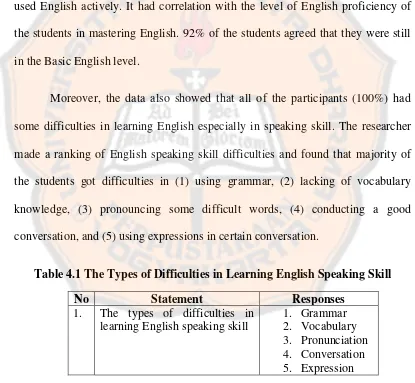
2. Table 4.1. The Types of Difficulies in Learning English Speaking Skill ... 49
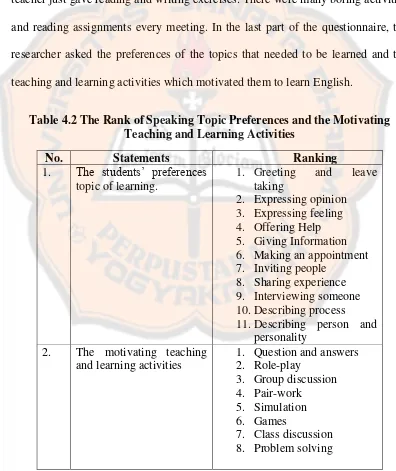
3. Table 4.2. The Rank of Speaking Topic Preferences and the Motivating Teaching and Learning Activities ... 50
4. Table 4.3 The Listing Topics, Lesson, and General Purposes ... 54
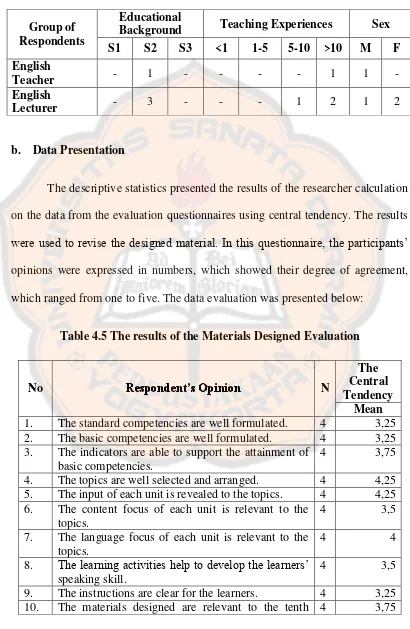
5. Table 4.4. The Description of the Respondents ... 57
6. Table 4.5. The Result of Materials Designed Evaluation ... 57
xv
LIST OF APPENDICES
1. The Materials Design ... 75
2. The Permission Letters ... 76
3. The Observation Checklist ... 81
4. The Questionnaire of the Designed Materials Evaluation ... 83
5. The Questionnaire and Information Collecting ... 89
1 CHAPTER I INTRODUCTION
This chapter will be divided into six parts, namely research background,
research problems, problem limitations, research objectives, research benefits, and
definition of terms.
A. Research Background
Nowdays, the ability in speaking English especially for communication is
needed. The worldwide demands for English have created an enormous demand in
communication system. It requires people to speak in high level of accuracy and
fluency. In this case, the quality of language teaching, language materials, and
resources have to be improved. It is obvious that the needs of speaking materials
guideline in school are very essential.
In teaching and learning process, there will be always an interaction
between the teacher and the students. The ability to speak in the term of class
communication system is very important. Richards (2006) states that people learn
a language best when they are using it to do things rather than through studying
how language works and practicing rules. Learners have to be familiar with the
use of English in daily activities. Therefore, in education background, mastering
English speaking skill becomes very crucial for the learners to comprehend
However, based on the observation in SMA BOPKRI 2 Yogyakarta, the
tenth grade students have many problems in speaking English and expressing their
ideas in the class discussions. The students cannot present their works in front of
the class using English fluently. They still get difficulties in gathering information
and practicing their conversations in English. Moreover, the teacher and the
students do not have English speaking modul and they rarely use English as their
classroom language although in English class. Reflecting to those facts, the
researcher realizes that the students need to learn speaking English actively since
at the beginner level of Senior High School. Therefore, the tenth grade students
are the focus of this study.
The speaking materials were going to be designed based on
Communicative Language Teaching by using the information gathering
techniques. Information gathering technique is a strategy to assist the students in
searching and gathering many information through communication. The students
will be accustomed to do survey, research, and interview to complete their
knowledge in learning English. They need to do some class disscussions and
presentations. This kind of technique is very beneficial to be applied in speaking
class since the teacher and the students can communicate actively by using
English through the teaching and learning process. The reason of using this
technique is that the students need such technique to encourage their performances
in gathering data, sharing information, and expressing their opinion in critical
ways. The students need to use their communicative knowledge to gain their
and the students to improve their speaking skills. The researcher expects this
research and the materials design can help improving students’ speaking
competence.
B. Research Problems
In conducting this research, the researcher composes two research
problems. They are stated as follows.
1. How are speaking materials adopting information gathering technique for the
tenth grade students of SMA BOPKRI 2 Yogyakarta designed?
2. What do the speaking materials look like?
C. Problem Limitations
Since this research is going to design speaking materials for the tenth
grade students of SMA BOPKRI 2 Yogyakarta, the research will be focused on:
1. The speaking materials’ design, which is based on information gathering
techniques for tenth grade of SMA BOPKRI 2 Yogyakarta. To answer the first
research problem, the researcher is going to conduct some steps of Research
and Development (R & D) to design English speaking materials. The
materials are going to be designed based on information gathering technique
since this strategy can assist the students to do some surveis, researches, and
interviews to gather information surrounding them. The information collected
English. This process will help the students to construct their personal and
interpersonal skill of communication.
2. The contents and the appearances of speaking materials design are based on
information gathering technique for tenth grade of SMA BOPKRI 2
Yogyakarta. To answer the second research problem, the researcher will focus
on the presentation of the the designed materials. The researcher is going to
develop the topics, goals, contents, and some learning activities which will
facilitate the students to learn English better. The presentation will be
designed interestingly to motivate the students in learning speaking.
D. Research Objectives
In this study, the researcher has two research objectives. They are stated as
follows.
1. Designing the best speaking materials design for the tenth grade students
based on Communicative Language Teaching. The objective of this study is
to design interesting and meaningful English speaking materials based on the
needs of the tenth grade students of SMA BOPKRI 2 Yogyakarta. The
materials are going to be designed by using Communicative Language
Teaching since the researcher is going to create communicative speaking
atmospher. As we know, in Comunicative Language Teaching the students
will often do some learning activities in group so they will be accustomed to
speak English with others. It will encourage the students to use their
2. Designing the contents and the appearances of speaking materials design
based on information gathering technique. Another objective of this research
is to compose a set of speaking material for the tenth grade students of SMA
BOPKRI 2 Yogyakarta. The materials are going to be designed interestingly
so it will not look boring and monotonous. There will be various activities
which support the teaching and learning process such as how to make a good
conversation, conduct some surveis, conduct some mini researches, and
interview someone to find some information.
E. Research Benefits
Since this research is qualitative and quantitative research, those research
approaches are going to examine and describe the students’ problems and needs in
speaking class. The speaking materials can assist the students in performing their
speaking skills. Moreover, since the speaking materials are based on
Communicative Language Teaching which is specific on the information
gathering technique, the teacher and the students can discuss about certain topic
actively.
1. The Benefits for the Teacher
From this study, the researcher provides three benefits for the teacher.
First, the designed materials can help the teachers in teaching English especially
in speaking. The materials can be used as the teacher’s speaking modul in
the students to conduct some speaking activities in the class such as mini
conversations, dialogues, and presentations. Third, the materials will facilitate the
teacher to gain interesting and meaningful communication atmosphere to support
the teaching and learning process. The speaking materials will give the teacher
opportunities to communicate English actively in speaking class.
2. The Benefits for the Students
From this study, the researcher provides some benefits for the students.
The students will have systematic speaking materials as their handbook in daily
activities. The contents in the materials design contain some topics which are
related to their daily life activities. It will help them to communicate in English
better. Moreover, in class discussion, the students will have opportunities to learn
how to express and present their idea toward some topics. The opportunities will
make the students more confident in speaking English.
3. The Benefits for the Future Researcher
From this study, the researcher provides a benefit for the future researcher.
The future researcher can use this research as the guideline and references for the
next speaking materials design. The future researcher can study this research and
gain more information for background knowledge especially in designing
F. Definition of Terms
This research has several dominant terms, namely speaking activities,
materials design, information gathering technique, and SMA BOPKRI 2
Yogyakarta. These terms have correlation each other.
1. Speaking Activities
Porter and Johnson (1983) state that in communicative language teaching,
the ability to speak is important. The educators and the learners need to show off
their communication skills through speaking competence. Richards (2006) also
implies that speaking is an activity to produce words and voice through oral
communication. Widdowson (1978) defines speaking as a kind of active and
productive characteristic that makes using aural media. It is a part of reciprocal
exchange in which the reception and production play apart. In this research,
speaking is defined as the process when the participant or the students do the
self-interaction or social self-interaction by conducting dialogue, discussion, presentation,
and others oral communication to vary certain meaning. The students share and
collect the information as his or her knowledge.
2. Instructional Design
Nunan (1989) states that materials are information, which is used to learn
something. Materials are such instruments or tools that is used to master the
competence required. Based on Kemp (1977), instructional design plan is a design
to support and answer three basic questions, the objective, activities and
of an overall plan incorporating the interrelated parts of an instructional process in
systematic steps. In this research, instructional design means systematic steps
which are composed to create speaking materials design for the tenth grade
students of SMA BOPKRI 2 Yogyakarta. The design is created by considering the learners’ needs and learning goals in speaking class.
3. Information Gathering Technique
Richards (2006) states that information gathering technique is an activity
in which the students are conducting surveys, interviewing someone, and
searching something. The students are required to use their linguistic resources to
collect information. In this case, the students tried to speak and communicate to
their partners or others to gather much information. When they are searching the
information, they are directly practicing speaking. In this research, information
gathering technique is teaching and learning technique which will be used in the
speaking class in order to create communicative teaching and learning
atmosphere. The technique will encourage the students to be active in learning
speaking.
4. SMA BOPKRI 2 Yogyakarta
SMA BOPKRI 2 Yogyakarta is a private high school which is located in
Sudirman Street number 87, Yogyakarta. In this research, the researcher takes
SMA BOPKRI 2 Yogyakarta as the target school and tries to design speaking
the research in X-E class. The researcher finds that the teacher and the students
10 CHAPTER II
REVIEW OF RELATED LITERATURE
In this chapter, the research presents detailed discussion about the theories
related to the study as the basic in designing speaking materials for the tenth grade
students of SMA BOPKRI 2 Yogyakarta using information-gathering technique.
This chapter is divided into two parts, namely theoretical description and
theoretical framework.
In the first part, the theoretical description, the researcher presents some
theories dealing with the design of the materials. This part aims to explain the
background theories in designing the materials by reviewing the theories of
instructional design models, the information gathering technique in
Communicative Language Teaching (CLT), the speaking skills, and the
Kompetensi Tingkat Satuan Pendidikan (KTSP) for tenth grade students of Senior
High School program. The second part discusses about theoretical framework
which presents information about the framework in designing speaking materials
for the tenth grade students of SMA BOPKRI 2 Yogyakarta using information
gathering activities.
A. Theoretical Description 1. Instructional Design Models
In designing materials, the researcher must know the learners’ needs and
the best way to design appropriate product in certain competence. It should be
Instructional design is the entire process of analysis of learning needs and goal and the development of delivery system to meet the needs; also includes development of instructional materials and activities, try out, and revision of all instruction and learners assessment activities (p. 89).
In addition, Borg and Gall (1983) state that designing materials product means
developing and evaluating the product to be more effective. Therefore, in this
study, there are two models of instructional design used by the researcher.
a. Kemp’s Model of Instructional Design
Based on Kemp (1977), the instructional design plan is a design to support
and answer three basic questions, the objective, activities and resources, and
evaluation. Instructional design involves the development of an overall plan
incorporating the interrelated parts of an instructional process in systematic steps.
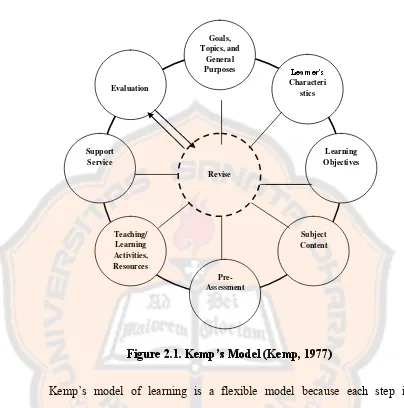
In addition, Kemp (1977) suggests eight interdependence elements in designing
process. They are as follows.
1) Considering goals, listing the topics, stating the general purposes for teaching
each topic.
In this step, the researcher tries to design the contents of the materials
design. The researcher uses the first background data to compose the learning
topics, goals, and objectives. Those elements have correlations each other to carry
a meaningful materials design.
2) Enumerating the important characteristics of the learners for whom the
The researcher considers the learner characteristics in designing the
materials. The researcher uses the need analysis to decide which materials are
going to be discussed and designed. The researcher enumerate the needs of the
subject briefly.
3) Specifying the learning objectives to be achieved in terms of measurable
student behavioral outcomes.
Before designing the materials, the researcher needs to compose and
decide the measurements used to measure the students’ outcomes. The researcher
needs to have a clear measurement and grading system to clarify whether the
learning objectives are achieved or not. The researcher has to corelate the
measurement with the learning goals and objective.
4) Listing the subjects content that supports each objective.
The next step is to list the subject requirements of the content. The
researcher needs to list the subjects based on the leraners’ needs. The subjects
need to be clearly arranged and staged.
5) Developing pre-assessment to determine the students’ backgrounds and
present level of knowledge about the topics.
The researcher needs to do pre-assessment to know the students level of
simulation. The materials are tested to the students to know whether it fulfills the
students’ needs or not.
6) Selecting teaching and learning activities and instructional resources that will
treat the subject content so students will accomplish the objectives.
In this step, the researcher selects and composes some teaching and
learning activities which are accomplished with the learning objectives. The
teaching and learning activities should help the students to improve their
performances in speaking skill.
7) Coordinating such support services as budget, personnel, facilities,
equipment, and schedules to carry out the instructional plan.
Budget, personel, facilities, equipment, and schedules should be
considered well. The researcher needs to make a good plan dealing with those
elements of teaching. The instructional plan will run effectively if those elements
support each other.
8) Evaluating students’ learning in terms of their accomplishment of objectives,
with view to revising and reevaluating any phases of the plan that need
improvement.
In this step, the researcher evaluates the materials and revise the incorrect
part. The researcher revaluates the final revisions of the materials and some parts
Figure 2.1. Kemp’s Model (Kemp, 1977)
Kemp’s model of learning is a flexible model because each step is
independent step. Therefore, the researcher can start the research from any step.
The researcher can repeat the previous stage when the researcher finds problems
or dissatisfaction in the certain stage. However, since the researcher can go back
to the previous stage, the research seems invalid because the researcher has
opportunities to control and manipulate the data or result in the previous stage.
The weakness is the researcher gets lack of information about the background
information of the students. It is because the researcher focuses on the content of
the design rather than the data collecting process. In addition, it is time-consuming
if the researcher repeats the stage before. In order to decide and make clear Revise
Teaching/ Learning Activities, Resources
Subject Content
Learner’s
Characteri stics
Pre-Assessment Support
Service
Learning Objectives Goals,
Topics, and General Purposes
justification about the model of learning, the researcher needs to examine another
model of instructional design. It is Yalden’s model of instructional design.
b. Yalden’s Model of Instructional Design
Yalden (1987) states that designing instructional materials is conducting a
survey of communication needs of the learners for whom the program is being
prepared as well as survey of the physical resources at hand. Therefore, based on
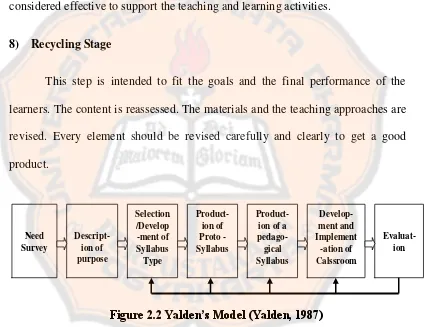
Yalden, there are eight steps in conducting materials designed. They are stated as
follows.
1) Need Survey
Survey is conducted to know the learners’ needs and analyze it. The
instructional design will fulfill the right needs of the learners. It has to include the
identification of the communication requirements, personal needs, motivations,
relevant characteristics and resources of the learners. The need survey is the step
to collect the first data of the research.
2) Description of Purpose
The researcher has to decide and clarify the purpose of the course based on
the information gathered in the previous step. According to Yalden (1987), in
certain situation, the researcher might be constrained to add other elements (such
as study of the culture associated with the target language) which might not come
out of the needs survey quite directly. Therefore, the researcher tries to decide the
3) Selection and Development The Syllabus Type
The researcher needs to select an appropriate syllabus for the next
materials product. It should be based on the learners’ needs and characteristics in
order to support the teaching and learning activities effectively. The syllabus has
to base on the method and technique which are applied.
4) Production of Proto-Syllabus
In this step, the researcher produces a syllabus which describes the
language itself. It should cover certain program that is developed maximally. The
researcher uses the correlation of the method and technique to design the syllabus.
5) Production of a Pedagogical Syllabus
Pedagogical syllabus refers to a plan in implementing the content of the
language teaching and learning in the classroom level. The researcher needs to
produce the syllabus in the form of teaching-learning materials and testing
approach. This process is the long syllabus selecting process.
6) Development and Implementation of Classroom Procedures
In this step, the researcher tries to organize the learning activities within
the lesson plan. Yalden (1987) suggests that the researcher must deal with the
teaching techniques and realize the syllabus in the form of teaching materials. The
7) Evaluating
All elements in teaching-learning activities of language (teachers, students,
instructional program, and teaching materials) have to be evaluated in this step. It
aims to get the correction for those elements in order to gain better supporting
elements of classroom teaching and learning process. Every element needs to be
considered effective to support the teaching and learning activities.
8) Recycling Stage
This step is intended to fit the goals and the final performance of the
learners. The content is reassessed. The materials and the teaching approaches are
revised. Every element should be revised carefully and clearly to get a good
product.
Figure 2.2 Yalden’s Model (Yalden, 1987)
In this model, there are two strengths can be stated. The first is that
Yalden’s model contains a needs analysis to know the needs of the students in
learning English. Based on Yalden (1987), another strength is the recycling
process in the evaluation stage. The researcher can adjust the goals of the products
2. Teaching and Learning of Speaking Skill
Porter and Johnson (1983) state that in communicative language teaching,
the ability to speak is important. The teachers and the students need to show off
their communication skills through speaking competence. Richards (2006) also
implies that speaking is an activity to produce words and voice through oral
communication. From those two statements, we can see that speaking is a
continuous process which deals with oral production in communication ways.
a. The Nature of Speaking
Widdowson (1978) defines speaking as a kind of active and productive
characteristic that use aural medians. It is a part of reciprocal exchange in which
the reception and production play apart. Nunan (2003) states that speaking is the
productive aural or oral skill. It consists of producing systematic verbal utterances
to convey meaning. In the speaking process the participant do the self-interaction
or social interaction by conducting dialogue, discussion, presentation, and others
oral communication to vary certain meaning.
b. Learning Speaking
Paulston and Bruder (1976) define that speaking is the way to learn
language actively. It means when we practice speaking, we learn to communicate
the language. To clarify the meaning of the speaking activities, the participants
have to know how to manage the arguments and manage the confidence in stating
Moreover, Nunan (2003) states that people do not learn the pieces of
language and then put them together to make conversation. Instead, they are
acquiring their first language and learning the second language by interacting with
other people. This realization has several interesting implications. If people learn
the language by interacting and practicing, the students need to use the language
in their class interactions regularly so that they will be accustomed to use English
in their daily life. It will make the language taught efficiently.
c. Teaching Speaking
Paulston and Bruder (1976) discuss that teaching speaking cannot be
separated from the idea of teaching communicative ability. It requires the learners
to vary information in communication ways. The learner can deliver and inform
certain information and send it to another learner who will gather the information
as the new knowledge.
It is obvious that the learners need a model of communicative speaker.
Therefore, Rivers (1968) examines that teaching speaking skill is more demanding
on teacher in the classroom. The classroom teacher should have the ability in
speaking and facilitate the students with activities and materials, which can
encourage them to communicate and collect much information to be applied in the
real life. “Good speaking activities can and should be extremely engaging for the
students” (Hamer, 2007). It means that if the students are participating fully and if
the teacher has set up the activity properly, it will gain sympathetic and useful
3. Information Gathering Technique (IGT) in Communicative Language Teaching (CLT)
Richards (2006) defines that Communicative Language Teaching (CLT) as
a set of principles about goals of language teaching, how learners learn a
language, the kinds of activities that best facilitate learning and the roles of
teachers and learners in the classroom that all of them set the goals to
communicative competence. Then, Marton (1988) states it as an approach for the
second and foreign language teaching that involves more than simply learning
grammatical pattern and rules. It gives the students chances improving their
abilities to communicate in target language.
In this case, according to Richards (2006), information gathering technique
is a techniques in CLT which requires the learners to conduct surveys, interviews,
and researches in the classroom activities. This teachnique can be applied in any
skill. However, the technique will be more effective used in speaking skill. It is
because the students are required using their linguistic resources to collect the
information. The students are able to think creatively and critically in performing
their communicative competences to collect information from others to construct
their knowledge in studying English.
There are several teaching and learning ways to conduct information
a. Conducting One-on-One Interviews
The most common technique for gathering requirements is to interview
someone and ask about some information. The discussion should be planned
based on the information that are going to be known. There are many good ways
to plan an interview, but generally the students can use open-ended questions to
get much information from their interviewees.
b. Group Interviews
Group interviews are similar to the one-on-one interview, except that more
than one person is being interviewed. These interviews work well when everyone
is at the same level or has the same role. Group interviews require more
preparation and more formality to get the information.
c. Facilitated Sessions
In a facilitated session, the teacher brings a larger group (five or more)
together for a common purpose. In this case, the teacher are trying to gather a set
of common requirements from the group. The students are asked to present their
result of interviews and share it to others.
d. Using Some Cases
Using some cases are basically a stories that describe how discrete
processes work. The stories include people (actors) and describe how the solution
articulate, although using some cases may need to be distilled later into the more
specific detailed requirements.
e. Conducting Question and Answer
This technique is especially helpful when gathering information on current
processes. The teacher can give some questions as the guideline and the students
anwer those questions based on their knowledge. The students can share their
knowledge to their friends.
f. Brainstorming
On some projects, the requirements are not "uncovered" as much as the
students are "discovered." In other words, the solution is brand new and needs to
be created as a set of ideas that people can agree to. In this activity, simple
brainstorming may be the starting point. The students can do brainstorming in
class disscussion and try to get appropriate solutions from a problem.
g. Survey
In this activity, the students can do some surveis toward some problems or
phenomena in their daily life. They can collect information to construct their new
paradigms in learning such topic. This technique help the students to be sensitive
h. Conducting Mini Research
In gathering the data, the students have a role as a researcher. They need to
search some solutions toward some problems. This action will lead them to use
their communication skill to be more critical in facing some problems. They can
get information and solve some teaching and learning problems.
In the extension, the CLT activities are usually conducted in pair or group
discussion. Malton (1988) says that class situation is formed as real
communication world. The students can encourage theirselves to be active in the
class discussion and get many benefits from others. .
4. The Characteristic of Information Gathering Technique in CLT Classroom
Richards (2006) states that information gathering technique is an activity
when the students conducted surveys, interviews and searches in which students
were required to use their linguistic resources to collect information. In this case,
the students tried to speak and communicate to their partners or others to gather
much information. When they search the information, they directly practice their
speaking ability.
Marton (1988) defines six students’ characteristics of this technique such
as:
a. Speaking actively in the class.
b. Using the target language in all of class activities.
d. Focusing the activities on negotiation of meaning and exchange information.
e. Learning grammar explicitly through speaking activities.
f. Performing communicative task in class
Marton (1988) defines four teacher characteristics of this technique such
as:
a. Teaching grammar explicitly through speaking activities
b. Correcting the learners’ error.
c. Observing and providing feedback for the learners.
d. Performing communicative task in class.
5. The Role of Teacher in Information Gathering Technique in CLT
In CLT, the teacher must be creative and active in giving and conducting
learning activities in the class. Breen and Candlin (as cited in Richards &
Rodgers, 1986) state that teacher has three main roles. The teacher should
facilitate the communication process between the participants. The teacher needs
to control and check the process whether it runs effectively or not. However, in
the process, the teacher needs to put hisself or herself as the facilitator not as the
main commander of the learning process.
The second role of the teacher is as the independent participant within
learning-teaching group. The teacher does not allowed to take a side into certain
group. He or she has to be fair in giving the instruction and evaluation. The
teacher should have the internal skill in reinforcing his or her students in every
activity.
The third roles are to be a researcher. To be a researcher means to be
actively search the needs of his or her students in teaching and learning process.
Teacher needs to be an active person in preparing the communicative materials for
the students. Moreover, the teacher is also a learner. It means that the teacher also
learns how to be a good facilitator for his or her students.
6. The Role of Student in Information Gathering Technique in CLT
Based on Breen and Cadlin (1982) as cited in Richards and Rodgers
(1986), CLT class, the learners are the member of communication. It means that
the learners are the targets of the communications. The learners need to participate
actively in the class to encourage their communicative performances better. The
learners have to gather much information and do the procedures in the teaching
and learning enthusiastically. They must contribute their ideas and plans in the
class activities. Therefore, the learners can acquire the process of communication
better.
7. The Role of Instructional Materials
According to Richards and Rodgers (1986), there are three kinds of
materials currently used in information gathering activities. The first one is
text-based materials which refers to the supporting textbook materials. The second is
task-based materials which refers to the activities such as games, role play,
materials. Based on Richards and Rodgers (1986), there are two roles of
instructional materials. The first role is as media for teaching and learning
activities. In this case, the materials can be a task-based book of speaking
materials, instruction of the discussion activities, etc. The second is as the
supporting guidelines of speaking activities. It means the instructional materials
can be used as the framework of the classroom activities.
Those materials have beneficial roles in teaching speaking in CLT class.
The materials can help the students to focus on the topic of the teaching-learning
activities. The authentic materials support the communicative skill since the
students can apply their knowledge they have got in class into the real knowledge.
8. Kompetensi Tingkat Satuan Pendidikan (Educational Unit Level Competency’s Curricullum) for The Tenth Grade of Senior High School
Every country definitely has its own curriculum system in education.
Curriculum is a set of intentions about opportunities for engagement of person to
be educated with other persons and with things in certain arrangements of time
and space. It means that curriculum is a set of educational ways to educate the
person.
Recently, Indonesia emphazies the latest curriculum system which is
called Kompetensi Tingkat Satuan Pendidikan (KTSP). Kunandar (2008) defines
KTSP as a curriculum which the result of implementation and the development of
educational unit under coordination and supervision of educational department
and school. Every school has right to implement and compose its own standard in
every educational standard has to be based on the standard from Departement
Pendidikan Nasional (The Department of National Education) as the supervision.
Reflecting to the KTSP curriculum, the tenth grade students of SMA
BOPKRI 2 Yogyakarta use it as the basic standard in teaching and learning
English. The teacher designs the materials based on the competencies that are
considered beneficial for the teaching and learning performances.
B. Theoretical Framework
In conducting the research, the researcher tries to adopt and combine two
models of instructional design, Kemp’s and Yalden’s model. It is because the
researcher considers that every model has its own strengths and weaknesses. In
Kemp’s model, the steps are flexible and independent. It emphasizes three major
of problems in the designing process which are objectives, activities and
resources, and evaluation. In this model, there is lack step of information
gathering activities. The researcher needs to gain complete information about the
students and the teachers in order to get supporting background data before
starting the process. Therefore, the researcher uses Yalden’s model which
conducts need survey in the beginning of the materials designed process.
Moreover, in Yalden’s model, there is a step of selecting syllabus as the basic of
the materials designed. It is essential to create the framework of the teaching and
learning activities at the starting point. As the extension, Yalden’s model also
provides recycling process in the evaluation step. It aims to see whether the all
or not. The combination of the two models can be beneficial since every strength
can cover the weakness of another model.
Moreover, the researcher also realizes about the importance of
information gathering technique in CLT when design the materials. This
technique can encourage the students to be active in developing their speaking
abilities. Since they are accustomed to be familiar with any speaking materials
which force them to be critical in the class discussion, they will be easier in
sharing their opinions, doing any researches, and having good speaking
confidence in this recent communicative world. The function of this technique is
merely to establish students communicative performance especially in learning
and using the language effectively.
Moreover, the researcher considers KTSP and SMA BOPKRI 2
Yogyakarta’s curriculum principles in composing the speaking materials. The
curriculum and the principles are used as the foundation of the teaching and
learning activities in the classroom.
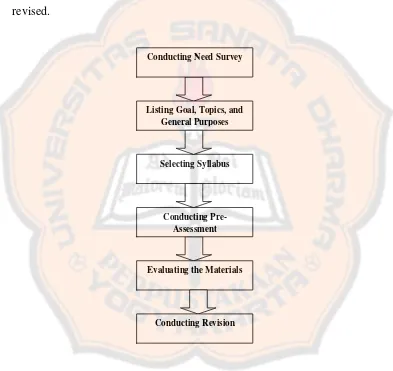
In designing the speaking materials, the researcher conducts six steps
which are the result of Kemp’s and Yalden’s model collaboration. They are stated
as follows.
a. Need survey
The first step belongs to Yalden’s model. In this step the researcher does
the research and information collecting procedures. The researcher gains more
speaking. The effective need survey can be analyze if the researcher knows what
is the wants and the expectations of the teacher and the students well.
b. Considering the goal, listing the topic, and stating the general purposes for teaching each topic.
This step belongs to Kemp’s model. The process begins with recognition
of the broad goals of the school system or institution. It is obvious that every
school has its own goal in teaching and learning process. After knowing the goal,
the researcher also decides the teaching and learning goals based on the need
survey before. It is essential as the framework of designing process. The data
collection can be used as the sources to compose learning objective. It has to
reflect the characteristics, interests, needs, and the competences of the subject
designed. The learning objectives must be specific and compatible. It has to fulfill
the goal of the teaching-learning procedures. The researcher does the planning
procedure in this step. The researcher plans and designs the objectives of the
materials which are put in the certain topics to be discussed.
c. Selecting syllabus type
This step belongs to Yalden’s model. The syllabus must be suitable for the
target designed. It has to cover the goal and objective as the basic of materials
designed. It clarifies the contents and the topic which is needed by the teacher and
the students to improve their communicative competences. The step aims to
develop preliminary form of product. When the syllabus is done, the researcher
d. Conducting Pre-Assessment
After designing the syllabus, the researcher applies Kemp’s model to
determine the students’ background of knowledge about the topic in the term of
pre-assessment. The researcher will create such a diagnostic test to detect the
students’ abilities in the speaking topic. The test can be taken from the speaking
materials design which is prepared by the researcher before. The diagnostic test
will be used as the consideration in the speaking materials product. Therefore, in
the pre-assessment, the researcher has developed the speaking materials product
designed.
e. Evaluating the Materials
This step belongs to Kemp’s model. The evaluation process aims to
provide feedback. It can be gathered from respondents’ opinions, comments,
criticisms, and suggestions. Moreover, it is intended to evaluate all components in
teaching and learning program. This step includes to the main product revision
procedure.
In this step, the researcher does the evaluation enganging the teacher and
lecturers. The first step, the researcher consults the materials to the classroom
teacher to gain comments and suggestions. After that the reseacher revises it then
continues to consult it to the lecturers. The lecturers check the materials and give
f. Revising
This step belongs to Yalden’s model. It has a deep correlation with the
evaluation process, the objective, goal, and materials designed. In this step, the
content is reassessed. Moreover, the materials and the teaching approaches are
revised.
Figure 2.3. The Theoretical Framework of This Research
Legend Explanation:
The line of the process Selecting Syllabus Conducting Need Survey
Listing Goal, Topics, and General Purposes
Conducting Pre-Assessment
Evaluating the Materials
32 CHAPTER III METHODOLOGY
This chapter is divided into six parts, namely research method, research
participants, research instruments, data gathering technique, data analysis
technique, and research procedure.
A. Research Method
This research was done by qualitative and quantitative approaches since it
provides a narrative description and some calculations to gain information about
the data. According to Ary, Jacobs, and Razavieh (2002), the result of the research
was a phenomenological study which was a narrative report so comprehensive
that the researcher could understand the social reality experienced by the
participants. Moreover, this research belonged to Educational Research and
Development (R&D), study since the researcher designed English-speaking
materials for the tenth grade students of SMA BOPKRI 2 Yogyakarta. Borg and
Gall (1983) stated that research and development study was the most promising
strategy for improving education. By conducting this research, the researcher
could analyze, develop and validate the educational product.
In addition, the researcher and the evaluators also used content base or
document analysis research in analyzing the content of the materials design. Ary
et.al. (2002) explained that in conducting document analysis research, the
researcher had to establish the authenticity of the document itself, as well as the
and determine the clarity, readability, and the validity of the product later.
According to Borg and Gall (1983), there were ten steps in conducting R & D
research. They were research and information gathering, planning, developing
preliminary form of product, conducting preliminary field testing, conducting
main product revision, conducting main field testing, conducting operational
product revision, conducting operational field testing, conducting final product
revision, and conducting dissemination and implementation. Since there was
limitation of time, the researcher did six steps as the research procedures. They
were stated as follows.
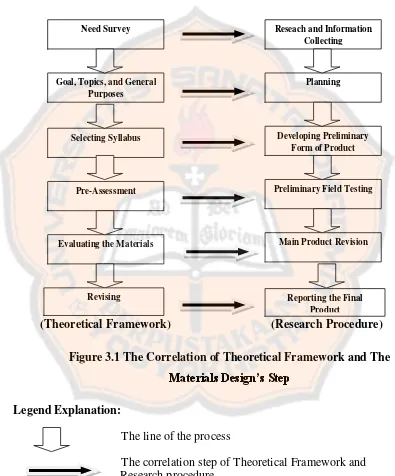
1. Research and Information Collecting
The first step was research and information collecting which included
review of literature, classroom observation, and preparation of report of state of
the art. The researcher tried to collect the framework information about the
teacher and students as the participants in this research. The data were essential to
be used as the basic knowledge about the need analysis.
2. Planning
The next step was planning which included defining skills, stating
objectives, determining course sequence, and conducting small scale feasibility
testing. The researcher determined learning objectives and the goals of the study.
3. Develop Preliminary Form of Product
It is included preparation of instructional materials, handbooks, and
evaluation devices. In this stage, the researcher had prepared the product and
developed it into a set of material which was ready to be tested. It was the first
product of the materials designed.
4. Preliminary Field Testing
It was conducted in the school. The researcher did it to the small subjects
of research. It aimed to diagnose the appropriateness of the topic. Moreover, it is
useful to determine the learners’ background knowledge about the topic.
5. Main Product Revision
It was the revision of the product as suggested by the preliminary
field-testing. In this stage, the researcher did the correction to the part which became
the weakness of the product. It was the first revision of the designing process.
6. Reporting the Final Product
The revision was conducted by considering the result of operational
field-testing. It was obvious to compose final product which was suitable with the
learners’ needs. The materials were expected useful for improving the students
competence in learning.
Those steps had covered the process in conducting the research. The
researcher would make the correlation of the research procedure and the
develop, and validate a new educational product as seen in English speaking
materials for the tenth grade students of SMA BOPKRI 2 Yogyakarta
B. Research Participants
There were three participants in conducting research. They were stated as
follows.
1. Tenth Grade Students of SMA BOPKRI 2 Yogyakarta
The researcher chose the tenth grade students because the researcher found
that the speaking ability of the students of SMA BOPKRI 2 Yogyakarta was still
low. Therefore, the researcher designed appropriate English speaking materials to
enrich and fulfill students’ needs since at the beginning of level in Senior High
School.
2. The Tenth Grade Teacher of SMA BOPKRI 2 Yogyakarta
The researcher chose the teacher as the evaluator because he was the
participant who used the product in teaching and learning activity. He was the
English teacher who taught the students with the materials. He was the participant
who checked the validity, readability, content and the appropriateness of the
product.
3. Three Lecturers of English Language Education Study Programme (ELESP) of Sanata Dharma University and The Classroom Teacher
The researcher chose three lecturers of ELESP of Sanata Dharma
product. It is important to choose an expert to validate the product because it is the
way to check whether the content and the face validity were appropriate or not for
the students. According to Borg and Gall (1983) there were three characteristic as
the product’s evaluator.
a. The evaluator must be master in education.
b. The evaluator must have teaching experience in speaking class.
c. The evaluator must have teaching experiences more than a year.
Since the evaluating results were the tools to revise the product, those
characteristics were used to determine the success of the evaluating process.
C. Research Instruments
This research used four instruments such as observation, interview,
questionnaire, and document. However, the use of instruments were divided into
two steps as follows.
1. Pre-Design Instruments
In this part, the researcher used observations, interviews, and
questionnaires as the instruments. At the first step, observation checklist was
chosen since the researcher was going to observe the teachers and students when
they were learning about speaking. The used of observation form could be helpful
in diagnosing the effectiveness of speaking materials that were used by the teacher
The researcher distributed questionnaires to collect background data.
There were two types of questionnaires namely the close form and the open form.
The first was close form questionnaires. Closed questions asked the respondent to
choose among a possible set of answers. The response represented his/her
viewpoint. The second was open form questionnaire. Open-ended or free-response
questions were not followed by any choices and the respondent must answer by
supplying a response, usually by entering a number, a word, or a short text.
Then, the researcher held the interviews to the teacher and the students.
The researcher chose the students randomly to set the data validation. Interview
was chosen in order to get more and specific data about the kinds of the speaking
materials which was used in the speaking class and whether it was effective or
not. The type of questions in the interview was open-ended questions. Therefore,
the respondents could answer the questions freely.
2. Post-Design Instrument
In this stage, the researcher had designed the speaking materials. The
researcher consulted it to the evaluators who were classroom teacher and three
lecturers. The evaluators did document analysis of the materials designed. They
evaluated and gave some comments to the materials. In addition, the evaluators
also filled the questionnaires provided to gain some opinions, comments,
suggestions, and criticisms. The questionnaires were in the form of close ended
and open ended questions. Closed questions asked the respondent to choose