All sources 98 Internet sources 52
[17]
iopscience.iop.org/issue/1757-899X/223/1 2.4% 15 matches[18]
https://www.researchgate.net/publication...tion_and_Application 2.5% 12 matches[21]
www.aensiweb.net/AENSIWEB/aejsa/aejsa/2014/99-103.pdf 2.0% 11 matches[22]
www.sciencedirect.com/science/article/pii/S0142941814002694 2.1% 11 matches[23]
https://www.science.gov/topicpages/a/addition cured silicone.html 1.8% 10 matches[25]
www.science.gov/topicpages/c/curing agents compounds.html 1.3% 7 matches[30]
https://www.researchgate.net/publication...LICA_-_COMING_OF_AGE 1.2% 2 matches[31]
https://link.springer.com/article/10.1007/s10853-015-9188-5 1.2% 4 matches[37]
https://www.researchgate.net/publication...tire_tread_compounds 0.9% 4 matches[39]
https://www.researchgate.net/publication...iller_Coupling_Bonds 0.8% 2 matches[45]
https://rd.springer.com/content/pdf/10.1007/s13233-015-3040-2.pdf 0.7% 3 matches[46]
https://bioresources.cnr.ncsu.edu/BioRes..._Composites_5003.pdf 0.7% 5 matches[47]
https://www.sciencedirect.com/science/article/pii/S0142941800000738 0.6% 3 matches[48]
https://www.researchgate.net/publication...s_of_EPDM_composites 0.6% 2 matches[51]
www.sciencedirect.com/science/article/pii/B9780081004098000085 0.5% 3 matches[52]
https://pdfs.semanticscholar.org/4e22/60070b887ed88d2fd5c6911509d7a82c32c4.pdf 0.5% 3 matches[53]
https://www.researchgate.net/publication...ilane_coupling_agent 0.5% 2 matches[55]
https://www.hindawi.com/journals/ijps/2017/3920524/ 0.4% 3 matches[57]
www.sciencedirect.com/science/article/pii/S0142941816301891 0.4% 2 matches[59]
www.ijacskros.com/artcles/IJACS-MSP73.pdf 0.4% 3 matches[60]
www.tandfonline.com/doi/citedby/10.1080/00397917308062031?scroll=top&needAccess=true 0.4% 1 matches[62]
https://www.sciencedirect.com/science/article/pii/S0142941898000609 0.3% 2 matches15.4%
Results of plagiarism analysis from 2017-12-06 08:37 UTCAlkanolamide as an accelerator, filler-dispersant and a plasticizer in silica-filled natural rubber compounds.pdf
[65]
https://www.researchgate.net/profile/Moh...n=publication_detail 0.4% 2 matches[66]
https://www.sciencedirect.com/science/article/pii/S001430570400240X 0.4% 1 matches[67]
ijetsr.com/images/short_pdf/1423665400_reshmivc_ijetsr.pdf 0.3% 3 matches[68]
https://www.researchgate.net/publication..._in_Polar_Elastomers 0.3% 1 matches[69]
https://www.sciencedirect.com/science/article/pii/S0008622307005751 0.3% 2 matches[70]
www.tandfonline.com/doi/pdf/10.1080/00222348.2012.701560?needAccess=true 0.2% 2 matches[71]
www.tandfonline.com/doi/full/10.1080/00222340701388854 0.3% 1 matches[72]
https://link.springer.com/content/pdf/10.1007/s40090-016-0107-7.pdf 0.3% 2 matches[73]
https://www.researchgate.net/profile/Sey...yethylene-blends.pdf 0.3% 2 matches[74]
https://www.scribd.com/document/34803060...SING-OF-SS409M-SHEET 0.3% 2 matches[75]
www.sciencedirect.com/science/article/pii/S000862231731014X 0.3% 2 matches[76]
www.academia.edu/4474528/Effects_of_epox...oclay_nanocomposites 0.3% 1 matches[77]
https://link.springer.com/chapter/10.1007/978-3-642-15787-5_8/fulltext.html 0.3% 1 matches[78]
https://link.springer.com/article/10.1007/s10853-011-5832-x 0.3% 2 matches[81]
https://www.researchgate.net/publication...ve_NRSBRrNBRg_Blends 0.2% 1 matches[82]
https://www.sciencedirect.com/science/article/pii/S0142941800000489 0.2% 1 matches[84]
schizophrenia.com/glycine.htm 0.1% 1 matches[85]
https://www.sciencedirect.com/science/article/pii/S2351978915005600 0.2% 1 matches[88]
https://en.wikipedia.org/wiki/ANCAP_(commodity_standard) 0.1% 1 matches[89]
https://www.sciencedirect.com/science/article/pii/S0014305714000809 0.2% 1 matches[90]
https://www.researchgate.net/profile/Yon...oscopic-Analysis.pdf 0.2% 1 matches[94]
https://www.sciencedirect.com/science/article/pii/S0378775315306881 0.1% 1 matches[95]
https://www.sciencedirect.com/science/article/pii/S0263822317301046 0.1% 1 matches[96]
https://link.springer.com/article/10.1007/s10973-012-2673-z 0.1% 1 matches0.1% 1 matches
[98]
www.rubberchemtechnol.org/doi/pdf/10.5254/1.3538156 0.1% 1 matches[99]
https://www.scribd.com/document/354830512/NR-chitosan-SBR 0.1% 1 matches[101]
https://www.sciencedirect.com/science/article/pii/S0378874106001280 0.1% 1 matches[102]
https://www.sciencedirect.com/science/article/pii/101113449380169A 0.1% 1 matches[103]
file.scirp.org/Html/3-1310115_62787.htm 0.1% 1 matches9 pages, 5499 words
PlagLevel: selected / overall
327 matches from 104 sources, of which 80 are online sources. Settings
Data policy: Compare with web sources, Check against my documents, Check against my documents in the organization repository, Check against organization repository, Check against the Plagiarism Prevention Pool
Sensitivity: Medium Bibliography: Consider text
--Material properties
Alkanolamide as an accelerator,
fi
ller-dispersant and a
plasticizer in silica- lled natural rubber compounds
fi
Indra Surya
a, H. Ismail
b,*, A.R. Azura
baOn study leave from Department of Chemical Engineering, Engineering Faculty, University of Sumatera Utara, Medan 20155, Sumatera
Utara, Indonesia
bSchool of Materials and Mineral Resources Engineering, Universiti Sains Malaysia, Engineering Campus, Nibong Tebal 14300, Penang,
Malaysia
a
i
r
n
t
f
i
o
c
l
e
Article history: Received 21 May 2013 Accepted 25 July 2013
Keywords:
A feasibility study was carried out on the utilization of Alkanolamide (ALK) on silica reinforcement of natural rubber (NR) by using a semi-ef cient cure system. The ALK wasfi incorporated into the NR compound at 1.0, 3.0, 5.0, 7.0 and 9.0 phr. An investigation was carried out to examine the effect of ALK on the cure characteristics and properties of NR
[17]
compounds.It was found that ALKgaveshorter scorch and cure timesfor silica- lled NRfi
[17]
compounds. ALK also exhibited higher torque differences, tensile modulus, tensile strength, ha rdness and crosslink densityof up to 5.0[17]phr of ALK loading, and then decreased with further increasesof ALK loading.The resilience increased with increased
[17]
ALK loading.Scanning electron microscopy (SEM) micrographs proved that 5.[37]0 phr of ALK in thesilica- lledfi NR compound exhibited the greatest matrix tearing line and surface roughness due to higher reinforcement level of the silica, as well as better dispersion and cure enhancement.
Ó2013 Elsevier Ltd. All rights reserved.
1. Introduction
Carbon blacks and silicas of varying forms and particle-sizes are very popular and have been widely utilized as reinforcingfillers in the rubber industry. In general, the properties of silica-reinforced rubber vulcanisates are usually inferior to those of carbon blacks, even when they are of comparable size[1]. This is attributed to the apparent dissimilarity in the surface chemistry of the two materials. Carbon black will react with sulphur during vulcanization
[30]
and form sulphur bonds that link the rubber chains, and also tie the carbon black to the rubber.This is known as
filler-rubber crosslinking, another type of crosslink to the
rubber system, and is de ned as coupling bondsfi [2,3].[In 3 0 ]
marked contrast to the hydrocarbon functionality of carbon
black, silica does not react with sulphur, and coupling bonds will not be formed due to its hydrophilic silanol groups that are relatively incompatible with hydrocarbon rubbers, such as natural rubber[2].
For many applications, silicas are not satisfactory alter-natives to carbon blacks because of their relatively lower reinforcement levels. The fundamental problem is their surface chemistry, which is more polar and hydrated than carbon blacks, and which cause them to be dif cult to wet,fi
disperse and interact with hydrocarbon rubbers. Numerous methods have been carried out to improve the reactivity of
[39]
silicas with the rubber phases. One such method is the utilization of a silane-coupling agent to modify the surface
[39]
of the silica. The modi edfi silica provide chemically active surfaces that can participate in vulcanization, providing coupling bonds between the silane and both the silica and the rubber phases[4,5]. Those products show signi cantfi
improvement in performance compared to their base materials.
*Corresponding author.
E-mail address:hana @eng.usm.myfi (H. Ismail).
Contents lists available at ScienceDirect
Polymer Testing
j o uh ro nm awe l pw awv g.ic eeeo :lrms. /e l o c a t e / p o l y t e s t
0142-9418/$–see front matterÓ2013 Elsevier Ltd. All rights reserved. http://dx.doi.org/10.1016/j.polymertesting.2013.07.015
Another alternative method to overcome the de ciencyfi
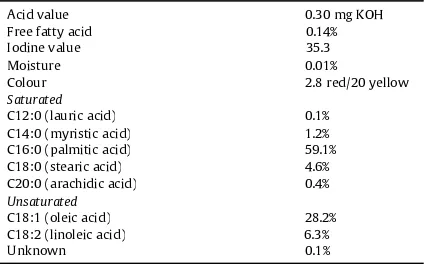
of silica is the utilization of Alkanolamide. The ingredient is synthesized from Re ned Bleached Deodorized Palmfi
Stearin (RBDPS), a product of crude palm oil fractionation. This article describes the preparation and utilization of the new rubber ingredient as an additive in order to improve the reinforcement level of silica to natural rubber.
2. Experimental
2.1. Laboratory preparation of Alkanolamide
The reaction was carried out at atmospheric pressure in a 1000 ml reaction vesselfitted with a stirrer. Typically, 1.0 mol of RBDPS and 3.0 mol each of diethanolamine, so-dium methoxide and methanol (as catalysts) were placed in the reactionflask. The speci cations of the RBDPS arefi
[59]
given in Table 1.Themixture was stirred and heated;the reaction temperature was kept constant at 70 C for about five hours. The resultant mixture was extracted with diethyl ether, and washed with saturated sodium chloride solution. The crude Alkanolamide was puri ed withfi
anhydrous sodium sulphate, and then concentrated by a rotary evaporator. The final product, a cream-coloured, waxy, solid material, namely Alkanolamide, was used as an additive in silica- lled natural rubber compounds. Thefi
reaction procedure was as shown in Fig. 1.
2.2. Materials
Natural rubber grade SMR L obtained from Guthrie (M) Sdn. Bhd., Seremban, Malaysia was used. Other com-pounding ingredients such as sulphur, zinc oxide, stearic acid, N-isopropyl-N0-phenyl-p-phenylenediamine (IPPD),
benzothiazolil disul de (MBTS), and precipitated silicafi
(grade Vulcasil–S) were supplied by Bayer Co. (M) Sdn. Bhd., Petaling Jaya, Selangor, Malaysia.
2.3. Compounding
A semi-ef cient vulcanization system was used for thefi
compounding. The recipes for the preparation of the nat-ural rubber compounds are given in Table 2. The com-pounding was done on a two-roll mill (Model XK-160).
Table 3 shows the designation and composition of the
[94]
NR-based recipes used in this study.
[62]
2.4. Cure characteristics
The cure characteristics of the silica- lled NR com-fi
pounds were obtained using a Monsanto Moving Die
Rheometer (MDR 2000), whichwas used to determine the
scorch time (ts2) cure time (t90), and torque difference
(MHdML) according to ISO 3417. Samples[62] of the respective
compounds were tested at 150 C.The compounds were subsequently compression moulded using a stainless steel mould at 150 C with a pressure of 10 MPa using a
labo-ratory hot-press based on the respective curing times.
2.5. Tensile, hardness and resilience properties
Dumbbell-shaped samples were cut from the moulded sheets. Tensile tests were performed at a cross-head speed of 500 mm/min using an Instron 3366 universal tensile
[45]
machine according to ISO 37.The tensile strength andstress
at 100% elongation (M100), 300% elongation (M300),and
[22]
elongation at break wereinvestigated. The hardness
mea-surementsof the samples were performed according to ISO
[21]
7691-I using a Shore A type manual durometer. The
resil-ience was studied using a Wallace Dunlop Tripsometer
[21]
according toBS 903 Part A8. The reboundresilience was calculated according to the following equation:
% Resilience¼ ð1cos ½ [21]
q
2Þ=ð 1 cosq
1Þ 100 (1)where,
q
1is the initial angleof displacement (45), andq
2isthe maximum rebound angle.
2.6. Scanning electron microscopy (SEM)
The tensile fractured surfaces of the compounds were examined by using a Zeiss Supra-35VP scanning electron microscope (SEM) to obtain information regarding the llerfi
dispersion and to detect the possible presence of
micro-[70]
defects.The fractured pieces were coatedwith a layer of gold to eliminate electrostatic charge build-up during examination.
2.7. Fourier transform infra-red (FTIR) spectroscopy
The FTIR spectra were obtained using a Perkin-Elmer 2000 series instrument. The spectrum resolution was 4 m1and the scanning range was from 550 to 4000 cmc 1.
2.8. Measurement of crosslink density
Swelling tests on the rubber vulcanisates were
per-[21]
formed in toluene in accordance with ISO 1817.The cured
test pieces (30 mm5 m2 mm) were weighed usingm
an electrical balance andswollen in toluene until equilib-[21]
rium, which took 72 h at room temperature.The samples
weretaken out of the liquid, thetoluene was removed from
thesample surfaces and the weight was determined.The
samples were then dried in the oven at 60 C until constant
weight was obtained. The swelling results were used to
Table 1
Speci cation of RBDPS.fi
Acid value 0.30 mg KOH
Free fatty acid 0.14%
Iodine value 35.3
Moisture 0.01%
Colour 2.8 red/20 yellow
Saturated
C12:0 (lauric acid) 0.1%
C14:0 (myristic acid) 1.2%
C16:0 (palmitic acid) 59.1%
C18:0 (stearic acid) 4.6%
C20:0 (arachidic acid) 0.4%
Unsaturated
C18:1 (oleic acid) 28.2%
C18:2 (linoleic acid) 6.3%
calculate the molecular weight between two crosslinks the volume fraction of the polymer in the swollen
spec-imen,Qmis the weight increase of the blends in toluene and
c
is the interaction parameter of the rubbernetwork-solvent (
c
[21]of NR¼ 0.393).The degree of the crosslink density is given by;
Vc ¼ 1
2Mc
a (4)
3. Results and discussion
3.1. Characterization of Alkanolamide
Fig. 2 shows the typical infrared spectrum of the Alka-nolamide (ALK) obtained, andTable 4shows the wave-number of the functional groups in the ALK molecule. The strong broadband at 3370 cm1is an O H stretch of the–
ethanol. The C H stretches above and below 3000 cm– 1
indicate saturated and unsaturated portions exist in the molecule[7]. The umbrella mode at 1364 cm 1con rmsfi
the presence of a methyl group (CH3) which is attached to
the carbon atom. The (CH2) rocking band at 719 cm1
means that there are more than 4 methylene atoms in a row in the molecule. The C]O stretch is at 1615 cm 1, and
the amide C N stretch is at 1248 cm– 1. The spectrum
clearly shows the presence of wavenumbers of the func-tional groups of ALK.
3.2. Cure characteristics and crosslink density
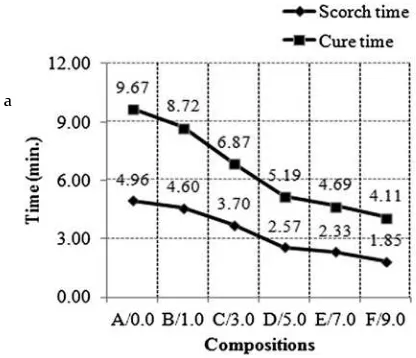
The effects of ALK on the cure characteristics of the silica- lled NR compound can be seen infi Fig. 3andTable 5. Fig. 3 shows that the scorch and the cure times decreased with increased ALK loading. It was observed that there was an enhancement in the cure characteristics, indicating that ALK could act as a co-curing agent or secondary accelerator in the curing process of the silica- lled NR compounds. Thefi
cure enhancement can be attributed to the amine content
[18]
of the ALK.Amine is an alkaline substance which will
in-crease the pH ofthe rubber compoundand, in most
in-[18]
stances,enhance the cure rate.Any material thatmakesthe
rubber compound more basicwillenhance the cure rate since acidic materials tend to retard the effect of the
[84]
accelerator[8].Increasing the ALK loadinghas the same effect as increasing the amount ofamine in the silica- lledfi
[17]
NR compound. Hence, it can be saidthat the higher the ALK
loading, thegreater the amount of amine andthe shorter
thecure rate.
According to Bateman[9], and Ismail & Ng[10][18], a certain organic substance containing nitrogen atoms promotes the
curing process of ole nic rubber, comprising sulphur andfi
primary accelerators, throughthe formation of complexes
whichare responsible for thefission of the sulphur
mole-cules to form crosslinksbetween the linear rubber chains.It
is expected that the amine-content of the ALK would accelerate the cure and is responsible for enhancing the cure rate and the cure state of the silica- lled NRfi
compound.
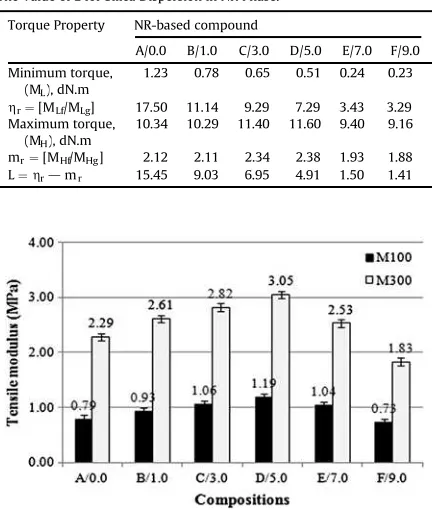
As presented in Table 5, the incorporation of up to
5.[18]0 phr of ALK into the silica- lled rubber compoundfi
increased the torque difference (MHdML), i.e. the
maximum torque minus the minimum torque. Further
Fig. 1.Chemical reaction of the preparation of Alkanolamide.
Table 2
[17]
Compositionof the rubber compounds.
Ingredients Content (phr)a
Natural rubber (SMR L) 100.0
Alkanolamide 0.0; 1.0; 3.0; 5.0; 7.0; 9.0 Precipitated silica (Vulcasil - S) 30.0
Sulphur 1.5
Zinc oxide 5.0
IPPD 2.0[72]
Stearic acid 2.0
MBTS 1.5
a parts per hundred parts of rubber.
Table 3
Designation and Composition of the NR-based recipes.
Designation Composition NR/Silica/Alkanolamide (phr)
increases in the ALK loading decreased the torque
differ-[53]
ence. It is also evident that the minimum torque (ML)
decreased withincreases in the ALK loading.It has been reported that ML corresponds to the filler- ller interfi
[67]
agglomeration [11]andis a measure of thestock viscosity [12]. The incorporation of ALK into the silica- lled NRfi
compound reduced the viscosity of the compound and facilitated a relatively strong interaction between the ALK and the silica ller, while the silica particles had a weakerfi
tendency to interact with each other and form a ller- llerfi fi [18]
agglomeration.Consequently, the processability of the sil-ica dispersion in the rubber phase became easier and increased the degree of silica dispersion.
Theoretically, the torque difference (M
[18]
HdML)
repre-sents the shear dynamic modulus, which is indirectly
related to the total crosslink density of a rubbercompound [18]
[10,13–51 ].The total crosslink density is contributed by the
sulphide crosslinks and physical crosslinks [16,17]. The addition of up to 5.0 phr of ALK into the silica- lled NRfi
compounds increased the torque difference (MHdML) f o [51]
the silica- lled NR vulcanisates.fi This is clearly attributed to the action of theALK, not only as a secondary accelerator,
but also as fi ller dispersant. The ALK accelerated the
sulphur reaction and enhanced the state of the sulphide
[51]
crosslink.The ALKincreased the degree of silica dispersion and formed the additional physicalcrosslinks by silica NR–
attachments (which will be seen in FTIR result).
The reduction of the torque difference (MHdML) fter a
the 5.0 phr loading, i.e. the E/7.0 NR compound, is most probably due to the softening or lubricating effect of the
[46]
excessive ALK, which caused a lower crosslink density.This
can be attributed to thephenomenon of dissolving a part of the elemental sulphur and silica particles into the excessive ALK and, as a consequence, less sulphur and silica were
attached to the NR chains.The ALK is a unique molecule
which is structured by a non-polar hydrocarbon chain and polar terminal groups. The non-polar hydrocarbon chain dissolved in the non-polar NR, forming a monolayer and lubricating the NR; whereas the polar terminal groups together with other curatives and silica formed interme-diate complexes that remained insoluble. The excessive amount of ALK caused a more pronounced lubricating ef-fect, and produced boundary layers which coated and absorbed not only the curatives but also the silicafiller inside the layers. Through this mechanism, the ability of sulphur to form a sulphide crosslink and silica to form a
[46]
physical crosslink would be less.This explanation could be
supported by amorphological study of the tensile fractured
surface of the E/7.0 NR compound. The fractured surface
seemed smoother than that of the D/5.0 NR compound due to excessive ALK loading. ALK was synthesized from the
Fig. 2.The infrared spectrum of Alkanolamide.
Table 4
The Wavenumbers of Functional Groups of Alkanolamide Molecule.
Vibration Wavenumber (cm1
)
O H stretch– 3370
Unsaturated (C]C) 3006
Saturated (CH3) 2852
C]O stretch 1615
CH3Umbrella mode 1364
C N stretch– 1248
CH2rocking 719
[17]
Fig. 3.Scorch time ( )t2and cure time (t90) of thesilica- lled NR compoundsfi
at various ALK loadings. I. Surya et al. / Polymer Testing 32 (2013) 1313–3 211
RBDPS, a palm oil fraction. Palm oil has the effect of plas-ticizing or lubricating rubbers [18].
The crosslink density of the silica- lled NR vulcanisatesfi
was determined by the FlorydRehner approach [Eq.(2)]. Fig. 4 shows the crosslink density of the vulcanisates at room temperature. The addition of up to 5.[17]0phr of ALKinto
the silica- lled rubber compound increased the crosslinkfi
density, andfurther increases in the ALK loadingdecreased
[18]
the crosslink density. This observation is in line with that of
the torque difference (MHdML), which is an indirect
measure of thecrosslink density ofthe rubber vulcanisates.
3.3. Silica dispersion
The degree of silica dispersion in the NR phase can be determined quantitatively by equation [19,20],
L¼
h
rmrin which:
h
r¼[MLf/MLg], mr¼[MHf/MHg], where MLfandMHf are the minimum and the maximum torques of the filled vulcanisates; MLgand MHgare the minimum and the
maximum torques of the gum NR vulcanisates. Based on the previous study [21] (for NR gum compound vulcanized with the same semi-ef cient formulation), Mfi Lg ¼ 0.04;
MHg ¼4.81.[18]The lower the value of L at a particular silica
loading, the better is the silica dispersion in the rubber
[18]
phase. The value of L forthe silica dispersion in theNR phase is presented in Table 6.
From the data shown in Table 6, it can be seen that ALK
[17]
caused a lowering in the value of L.The higher the ALK loading, thelower isthe value ofL.The lower value of L indicates better silica dispersion, which provides a greater available surface area for the silica-NR interaction. The
greater the available surface area for the interaction, the higher is the total crosslink density [16,17]. However, as presented inFig. 4, the total crosslink densities of the E/7.0 and F/9.0 silica- lled NR vulcanisates were lower thanfi
those of the B/1.0, C/3.0 and D/5.0 silica- lled NR vulcani-fi
sates, and even the former vulcanisates had lower values of L. This phenomenon can be attributed to the dominant plasticizing effect of ALK. As discussed before, the excessive amount of ALK trapped the silica inside its layers, thus causing less formation of physical crosslinks.
3.4. Mechanical properties
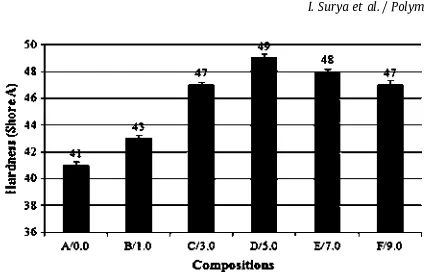
Figs. 5 8– show the effect of ALK on the tensile, hardness
and resilience of the silica- lled NR vulcanisates. It can befi Table 5
The Effect of Alkanolamide Loading on Torque Difference of Silica- lled NRfi Compounds.
Torques NR-based compound
A/0.0 B/1.0 C/3.0 D/5.0 E/7.0 F/9.0 Maximum
torque, (MH), dN.m
10.34 10.29 11.40 11.60 9.40 9.16 Minimum
torque, (ML), dN.m
1.23 0.78 0.65 0.51 0.24 0.23 Tork diff.,
(MHdML), dN.m
9.11 9.51 10.75 11.09 9.16 8.93
Fig. 4.Crosslink density of the silica- lled NR vulcanizates at various ALKfi loadings.
Table 6
The Value of L for Silica Dispersion in NR Phase. Torque Property NR-based compound
A/0.0 B/1.0 C/3.0 D/5.0 E/7.0 F/9.0 Minimum torque,
(ML), dN.m
1.23 0.78 0.65 0.51 0.24 0.23
hr¼[MLf/MLg] 17.50 11.14 9.29 7.29 3.43 3.29
Maximum torque, (MH), dN.m
10.34 10.29 11.40 11.60 9.40 9.16 mr¼[MHf/MHg] 2.12 2.11 2.34 2.38 1.93 1.88
L¼hrdmr 15.45 9.03 6.95 4.91 1.50 1.41
Fig. 5.Modulus at 100% and 300% elongations of the silica- lled NR vul-fi canizates at various ALK loadings.
Fig. 6.Tensile strength of the silica- lled NR vulcanizates at various ALKfi loadings.
seen that M100 and M300 increased up to the maximum level (5.[17]0 phr)and then decreased with further increases in
[17]
the ALK loading.The results of the tensile strength and
hardness also exhibited a similar trend.According to Hertz
[22], and Ismail & Chia [23], the modulus or stiffness/ hardness and tensile properties are dependent only on the degree of crosslinking. According to Ignatz-Hoover & To [24], as the crosslink density of a rubber vulcanisates in-creases, the elastic properties, such as tensile modulus, hardness and tensile strength increase, whereas viscous loss properties, such as hysteresis, decrease. Further in-creases in the crosslink density will produce a vulcanisate that tends towards brittle behaviour. Thus, at a higher crosslink density, such elastic properties as mentioned earlier begin to decrease.
The enhancement in tensile modulus, tensile strength and hardness with up to 5.0 phr ALK loading is attributed to a higher reinforcement level of silica to natural rubber due to a better degree of silica dispersion or wetting in the NR phase, as well as the cure rate and cure state enhancements phenomenon of the silica- lled NR compound. Thisfi
explanation is in line with the data in Table 6, and the SEM micrographs of the silica- lled NR vulcanisates. Thefi
micrograph of D/5.[22]0 exhibits a homogeneous micro dispersion ofsilicaas a result of the incorporation of ALK.
According to Hamed[25], in order for a ller to give sig-fi
ni cant reinforcement, the size of its particles must befi
small ( 1
m
m) and well dispersed in the rubber matrix. The deterioration of those properties after 5.0 phr can be attributed to the lower degree of crosslink density and the more pronounced softening effect of the excessive ALK.As presented in Fig. 7, the addition of 1.0 phr ALK into the silica- lled NR compound resulted in the vulcanisatedfi
B/1.0 NR compound having a higher elongation at break. Increasing the ALK loading caused a further increase in the percentage of elongation at break. This can be attributed to the function of the ALK as an internal plasticizer to the silica- lled NR system. According to Moneypenny et al.fi
[24], a plasticizer is a compounding material that is used not only to improve the rubber compound processing but also to modify the physical properties such as hardness,
flexibility or distensibility of the rubber vulcanisates, and one of the sources from which it is made is natural oil/fat [18]. However, ALK is a waxy, solid material, and is derived from RBDPS-Crude Palm Oil, a type of natural oil. Although ALK has a smaller molecular size compared to NR, that additive could provide a monolayer in the rubber com-pound which provides free volume, thus allowing more mobility/ exibility for the rubber chains. Increasing thefl
ALK loading has the same effect as an increase in free vol-ume that will enhance the exibility or the extensibility offl
the silica- lled NR vulcanisates.fi
Fig. 9 shows the effect of ALK on the resilience of the
[47]
silica- lled NR vulcanisates.fi Resilienceis the ratio of energy
released by therecovery from deformation tothatrequired
to produce the deformation[26]. According to Hofmann [27], and Ignatz-Hoover & To[24][90], the rebound resilience is enhanced to some extent as the crosslink density rises, and
the resilience isrelated to theflexibility of the molecular
chains;the moreflexible the molecular chains, the better the resilience. The incorporation of ALK into the silica- lledfi
NR compound enhanced the resilience of the silica- lled NRfi
vulcanisates. Again, this can be attributed to the functions of the ALK as an accelerator andfiller dispersant which en-hances the total crosslink density, and as a plasticizer which improves the exibility of the lled rubber chains.fl fi
[17]
3.5. Scanning electron microscopy (SEM) study
Scanning electron microscopy (SEM) was used to
[46]
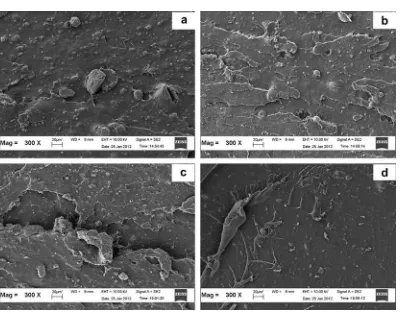
determine thesilica dispersion in the NR matrix.Fig.10
provides the SEM micrographs of the tensile fractured
surfaces of the silica- lled NR vulcanisates with andfi
withoutthe addition ofALK:(A) A/0.0; (B) C/3.0; (C) D/5.0;
and (D) E/7.0 at 300magni cation.fi
From the micrographs, it can clearlybe observed that
[55]
the presence of ALK improved the silica dispersion.The
Fig. 7.Hardness of the silica- lled NR vulcanizates at various ALK loadings.fi
Fig. 8.Elongation at break of the silica- lled NR vulcanizates at various ALKfi
loadings. Fig. 9.Resilience of the silica- lled NR vulcanizates at various ALK loadings.fi I. Surya et al. / Polymer Testing 32 (2013) 1313–3 211
dispersion of the ller is the least homogeneous in A/0.0,fi
where large silica agglomerates can be observed. The SEM micrograph of A/0.0 also seemed relatively smooth compared to those of the others, which indicates that A/0.0 is less ductile than the others. However, the SEM micro-graph for D/5.[17]0 exhibitsthe greatest matrix tearing line and
[18]
surface roughness. Better silica dispersion in the D/5.0
altered the crack path, which led to increased resistance to crack propagation, and thus caused an increase in elastic properties, such as tensile modulus, tensile strength, and
[73]
hardness.The micrographs of the tensile fractured surfaces
werein good agreement with the results obtained by Ismail
[22]
and Mathialagan[28]as well as Nabil et al.[29]which
re-portedthat an increase in energy was responsible for the
Fig.10.SEM micrographs of the failure fracture surface of silica- lled compound at a magni cation of 300 , (a) A/0.0, (b) C/3.0, (c) D/5.0, and (d) E/7.0.fi fi
Fig. 11.FTIR spectrums of (a) A/0.0; (b) D/5.0.
[22]
roughness and the matrix tearing line of the fractured
[22]
surface. However, the matrix tearing line and surface roughnessof E/7.0 was smoother than those of D/5.0, which indicated the more pronounced plasticizing or lubricating effect of the excessive ALK.
3.6. Infrared spectroscopic study
Fig. 11 shows the results of the FTIR spectroscopic study on the vulcanisates of A/0.0 and D/5.0, the control and the control with 5.0 phr. of ALK. All the gures show that the Cfi –
H stretches above and below 3000 cm1, indicating that the
vulcanisates has saturated and unsaturated portions [7]. The strong bands occurred around 2954-2956 cm1,
2916 cm1 and 2848 cm1, which are attributed to the
symmetric and asymmetric stretching vibration of the C H–
bonds based on CH2and CH3[96].Also, the bands at 1538 cm1
and 1456 cm1are relatedto the bending vibration of the
methylene(CH2) and methyl (CH3) groups, respectively. The spectra clearly show the characteristic wavenumbers of the NR vulcanisates. These characteristic wavenumbers of the NR were also reported by Wang et al.[30]for starch/NR composites, and Ooi et al. [31] for oil palm ashfilled NR vulcanisates.
[52]
Fig.11(a) shows thatthe presence of theO H group–
peak at 3380 cm1is relatedto the presence ofsilanol Si
–
OH.In addition, two peaks are observed, i.e. at 890 cm 1
and 1096 cm1, which can be related to the Si O Si sym-– –
metric stretch, and Si O Si asymmetric stretch, respec-– –
tively. The spectrum clearly shows the presence of silica in the NR vulcanisates.
The IR spectrum of D/5.0 (Fig. 11b) showed similar
[102]
characteristic bands to that of A/0.0.In addition, new bands are observed, i.e. at 3830 cm1(O H stretch), 1398 cm
– 1
(NO2 symmetric stretch), 1279 cm1 (C N stretch), and–
666 cm1(NO
2bend), the occurrence of which are due to
the effect of ALK on the silica lled-NR vulcanisates. It isfi
also observed that the Si O Si asymmetric stretching peak– –
has shifted towards a lower frequency (1095 cm1). This
spectral feature indicates that there are strong interactions, not only between ALK and silica, but also between ALK and NR.
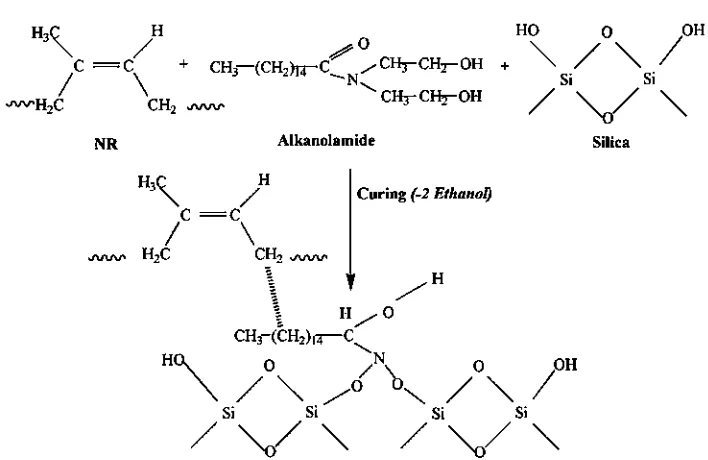
According to Limper[32], due to its low boiling point, alcohol, which is attached to the TESPT coupling agent, can be classi ed as a Volatile Organic Compound (VOC). Duringfi
curing, the ethanol in the ALK is released, and the amine group becomes reactive and forms coupling bonds with the silanol Si O group of silicas, instead of the non-polar hy-–
drocarbon of ALK interacting physically through moment dipole interaction with the long chains of NR. By this mechanism, the silica-ALK-NR bonding/interaction is formed, and the probable mechanism for such an interac-tion is presented inFig. 12.
4. Conclusions
Alkanolamide was synthesized from RBDPS-palm oil and diethanolamine. Alkanolamide can be utilized as a new ad-ditive in silica- lled natural rubber compounds. The incor-fi
poration of Alkanolamide enhanced the cure rate, and reduced the scorch time of silica- lled natural rubber com-fi
pounds. The results also indicated that Alkanolamide can be utilized as a plasticizer to increase the elongation at break and resilience. The incorporation of Alkanolamide also improved the reinforcement level of silica to natural rubber compounds. The tensile modulus, hardness, tensile strength and crosslink density of the silica-filled natural rubber vul-canisates were enhanced, especially up to 5.0 phr loading.
Acknowledgements
The authors would like to thank Universiti Sains Malaysia for providing the research facilities for carrying out the experiment and for making this research work
Fig. 12.The probable mechanism of coupling bond between NR and silica in the presence of Alkanolamide. I. Surya et al. / Polymer Testing 32 (2013) 1313–3 211
possible, and the Division of Oleochemicals, PT. Bakri Sumatera Plantation Tbk., Medan, 20362, Sumatera Utara,
[85]
Indonesia, for supplying the RBDPS. One of the authors
(Indra Surya) is grateful to the Directorate General of
Higher Education (DIKTI), Ministry of Education and
Cul-ture (Kemdikbud) of the Republic of Indonesia, for the
award of a scholarship under the fth batch of the Overseasfi
Postgraduate Scholarship Program.
References
[1] P.E. Pinter, C.R. Mc. Gill, Comparing rubber fillers in an energy conscious economy, Rubber World International 177 (1978) 30 37– . [2] M.Q. Fetterman, The unique properties of precipitated silica in the design of high performance rubber, Elastomerics 116 (1984) 18 31– . [3] M. Fetterman, Precipitated silica coming of age, Rubber World 194–
(1986) 38 40– .
[4] M. Ranney, C. Pagano, Silane coupling agent effects in ethylene propylene diene terpolymers, Rubber Chemistry and Technology 44 (1971) 1080 1092– .
[5] M. Wagner, Heat generation and rubber- ller coupling bonds,fi Rubber Chemistry and Technology 47 (1974) 697 716– .
[6] P.J. Flory, J. Rehner Jr., Statistical mechanics of crosslinked polymer networks II. Swelling, Journal of Chemical Physics 11 (1943) 521. [7] B.C. Smith, Infrared Spectral Interpretation: A Systematic Approach,
CRC, 1998.
[8] H.L. Stephens, in: M. Morton (Ed.), The Compounding and Vulcani-zation of Rubber, Rubber Technology, Van Nostrand Reinhold, New York, 1987, pp. 20 58– .
[9] L. Bateman, P. Allen, N.R.P. Re, The Chemistry and Physics of Rubber like Substances, 1963.
[10] H. Ismail, C. Ng, Palm oil fatty acid additives (POFA s): preparation and'
application, Journal of Elastomers and Plastics 30 (1998) 308 327– . [60]
[11] A.K. Manna, P. De, D. Tripathy, S. De, D.G.Peiffer,Bonding between precipitated silica and epoxidized natural rubber in the presence of silane coupling agent,Journal of Applied Polymer Science 74(1999) 389 398– .
[21]
[12] H. Ismail, R. Nordin, A.Noor,Cure characteristics, tensile properties and swelling behaviour ofrecycled rubber powder- lledfi natural rubber compounds,Polymer Testing 21(2002) 565 569– . [13] B. Boonstra, H. Cochrane, E. Dannenberg, Reinforcement of silicone
rubber by particulate silica, Rubber Chemistry and Technology 48 (1975) 558 576– .
[14] H. Cochrane, C. Lin, The in uence of fumed silica properties on thefl processing, curing, and reinforcement properties of silicone rubber, Rubber Chemistry and Technology 66 (1993) 48 60– .
[66]
[15] P. Teh, Z. Mohd Ishak, A. Hashim, J. Karger-Kocsis, U.Ishiaku,Effects of epoxidized natural rubber as a compatibilizer in melt com-pounded natural rubber organoclay nanocomposites– , European Polymer Journal40 (2004) 2513–2521.
[16] G. Kraus, Reinforcement of Elastomers, John Wiley & Sons Inc, 1965. [89]
[17] K. Polmanteer, C. Lentz, Reinforcement studies-effect of silica structure on properties and crosslink density, Rubber Chemistry and Technology 48 (1975) 795 809– .
[18] F.W. Barlow, Rubber Compounding: Principles, Materials, and, 1993. [22]
[19] B.Lee, Reinforcement of uncured and curedrubber composites and its relationship to dispersivemixing–aninterpretation of cure meter rheographs of carbon black loaded SBR and cis-polybutadiene compounds, Rubber Chemistry and Technology 52 (1979) 1019– 1029.
[20] P. Pal, S. De, Effect of reinforcing silica on vulcanization, network structure, and technical properties of natural rubber, Rubber Chemistry and Technology 55 (1982) 1370 1388– .
[21] I. Surya, Reinforcement of Natural Rubber and Epoxidized Natural Rubbers with Amine-treated Silica, Universiti Sains Malaysia, Malaysia, 2002.
[22] D.L. Hertz Jr., S.E. INC, Theory & practice of vulcanization, Elasto-merics (November 1984).
[23] H. Ismail, H. Chia, The effects of multifunctional additive and epoxidation in silica filled natural rubber compounds, Polymer Testing 17 (1998) 199 210– .
[24] B. Rodgers, Rubber Compounding: Chemistry and Applications, CRC, 2004.
[25] G. Hamed, Engineering with Rubber How to Design Rubber Com-ponents, by AN Gent, 1992.
[37]
[26] P.T. Hao, H. Ismail, A.S.Hashim,Study of two types of styrene butadiene rubber in tire tread compounds, Polymer Testing 20 (2001) 539 544– .
[27] W. Hofmann, Vulcanization and Vulcanizing Agents, Mac Laren and Sons, 1967.
[31]
[28] H. Ismail, M.Mathialagan,Comparative study on the effect of partial replacement of silica or calcium carbonate by bentonite on the properties of EPDM composites, Polymer Testing (2011).
[31]
[29] H. Nabil, H. Ismail, A. Azura, Compounding, mechanical and morphological properties of carbon-black- lledfi natural rubber/ recycledethylene-propylene-diene-monomer (NR/R-EPDM) blends, Polymer Testing (2012).
[30] Z.-F. Wang, Z. Peng, S.-D. Li, H. Lin, K.-X. Zhang, X.-D. She, X. Fu, The impact of esteri cation on the properties of starch/natural rubberfi composite, Composites Science and Technology 69 (2009) 1797– 1803.
[31] Z.X. Ooi, H. Ismail, A.A. Bakar, Synergistic effect of oil palm ash lledfi natural rubber compound at lowfiller loading, Polymer Testing (2012).
[32] A. Limper, Mixing of Rubber Compounds, Carl Hanser Verlag, Munchen, 2012.