SOILS, SEC 2•GLOBAL CHANGE, ENVIRON RISK ASSESS, SUSTAINABLE LAND USE•SHORT ORIGINAL COMMUNICATION
Effects of fire-derived charcoal on soil properties
and seedling regeneration in a recently burned
Larix
gmelinii/Pinus sylvestris
forest
Kobayashi Makoto&Muneto Hirobe& Thomas H. DeLuca&Semyon V. Bryanin& Valentina F. Procopchuk&Takayoshi Koike
Received: 10 May 2011 / Accepted: 27 August 2011
#Springer-Verlag 2011
Abstract
Purpose Fire is a primary form of disturbance in boreal
ecosystems. Charcoal is an important by-product of forest fire and has been reported to have the potential to influence the plant community establishing after fire. To date, however, no study has effectively tested the relationship between charcoal and plant regeneration in the actual post-fire forests. To determine the contribution of charcoal to soil
properties and plant regeneration after forest fires, we conducted in situ investigations concerning the relationship between charcoal and the plant–soil system.
Materials and methods We conducted a field investigation
in a recently burnt Gmelin larch (Larix gmelinii)/Scots pine
(Pinus sylvestris) forest in the Russian Far East to
investigate charcoal contents, pH, water contents, and nutrient availability in soil together with the regeneration of larch and pine seedlings.
Results and discussion Positive correlations were found
between charcoal contents and soil pH, water contents, and available P contents. Additionally, charcoal contents and the number of pine seedlings were positively correlated. There was, however, no significant relationship between charcoal content and extractable NH4+ content or the number of
larch seedlings. These results suggest that while charcoal influences are somewhat obscure in the field, charcoal significantly contributes to the amelioration of water and nutrient availability together with the success of regenera-tion of pine seedling.
Conclusions Charcoal produced during fire events in
Gmelin larch and Scots pine forests of eastern Russia has a modest influence on soil properties, but has the potential to improve regeneration in these fire-prone ecosystems.
Keywords Charcoal . Forest fire . Phosphate . Regeneration . Russian Far East
1 Introduction
Fire is a natural disturbance that directly and indirectly influences the soil–plant system in boreal ecosystems
Responsible editor: Hailong Wang K. Makoto
:
T. Koike (*)Laboratory Silviculture and Forest Ecological Studies, Hokkaido University,
Sapporo 060-8589, Japan
e-mail: [email protected] M. Hirobe
Lab. Forest Ecology, Graduate School of Environmental Science, Okayama University,
Okayama 700-8530, Japan T. H. DeLuca
SENRGY, Environment Centre Wales, Bangor University, Bangor, Gwynedd LL57 2UW, UK
S. V. Bryanin
:
V. F. ProcopchukLab. Agrochemistry and Soil Science, Far Eastern Agricultural University, Blagoveshchensk 675009, Russia K. Makoto
Climate Impact Research Center, Department of Ecology and Environmental Science, Umeå University,
Abisko 981-07, Sweden S. V. Bryanin
Lab. Geoeology, Institute of Geoecology and Nature Management, Far East Branch of Russian Academy of Science,
(Kozlowski et al.1991; Goldammer and Furyaev1996). In mixed conifer, broad-leaved forests of the Russian Far East, fire greatly affects plant regeneration (Goldammer and Furyaev 1996; Makoto et al. 2007). Fire consumes the organic matter and releases CO and CO2 and generates
charcoal as a result of the incomplete combustion of biomass. Charcoal has been reported to have effects on plant and soil systems (DeLuca et al.2009and references therein). The physical structure of charcoal is highly porous (Preston and Schmidt 2006), providing a great deal of specific surface and the capacity to adsorb water, organic compounds, and nutrients in soil (Glaser et al.2002). As a result, the presence of charcoal in the rhizosphere often increases the plant productivity mainly through the increased availability of soluble and insoluble nutrients (e.g., Tryon 1948; Glaser et al. 2002; Lehmann et al. 2003; DeLuca and Sala2006; Makoto et al.2010). Based on these studies, it is thought that charcoal may be a major determinant of tree regeneration success in the post-fire forest ecosystem.
While the mechanisms mentioned above have often been investigated employing model experiments (e.g., Wardle et al.
1998; MacKenzie and DeLuca 2006; Makoto et al. 2010,
2011), few studies have been conducted to provide field evidence for the relationship between the presence of charcoal and its effects on soil properties and processes in the post-fire forest (Bach et al.2008; MacKenzie et al.2008; Wardle et al.
2008). Furthermore, no study has been conducted to assess the relationship between charcoal and tree regeneration in the natural setting of forest ecosystem where various factors confound plant behavior and charcoal effects. To determine the contribution of charcoal to soil properties and plant regeneration after a forest fire, we conducted an in situ investigation concerning the relationship between charcoal and the plant–soil system response. This study provides an enhanced understanding of how charcoal can influence ecosystem processes in fire-prone boreal forests.
2 Materials and methods
2.1 Site description
The field research was conducted in a forest, 40 km south of Zeya City, in the northern part of Amur region, Far
Eastern Russia (53°32′02″N, 126°39′27″E). The dominant woody species in this forest are Gmelin larch (Larix
gmelinii (Rupr.) Rupr.) mixed with Scots pine (Pinus
sylvestris L.), white birch (Betula platyphylla Sukaczev),
and Dahurian birch (Betula davurica Pall; Table 1). From disks taken from larch stems, the stand age was estimated about 120 years old. Following the Russian system of soil classification, the soil type is brown taiga soil, and the soil texture is sandy loam formed from tertiary sedimentary rocks. This area is the sporadic permafrost soil region, with a mean annual temperature of about −2.1°C and a mean annual precipitation of about 520 mm. The study area is relatively flat at approx. 300 ma.s.l. The fire season in this region extends from the end of April to the beginning of July and from the end of September to the end of October. The main type of forest fire in this region is surface fire. The study site experienced a surface fire in the fall of 2007. The intensity of the surface fire was such that it can kill the mature birch trees, but not kill the mature larch and pine trees.
2.2 Study design and method of sampling and chemical analysis
We established a 1×25-m belt transect in the study site in the beginning of June 2009. Continuous microplots (measuring 50×50 cm, giving four plots per square meter) were established along the belt, resulting in a total of 100 plots. In each microplot, we counted the number of larch and pine seedlings that were established since the 2007 fire. The relative light intensity in the center of each plot, as determined using diazo-sensitized paper (Opt leaf R3D, TAISEI E&L, Japan) and sampling the substrate of forest floor beneath the litter layer (totaling 100 samples), was about 20% of the open field, which is a farmland without any standing crops and close to the study site. After removing the litter layer, cores of 12.7-cm diameter and 5-cm depth (volume is 200 ml) were taken at each point, all 100 sample points were sampled in 1 day. Due to the variability in the depth of the F-H horizon, the relative contents of organic and mineral matter varied by samples. The depth of sampling was chosen so as to target the collection of substrate where the root systems of the seedlings are primarily located, as determined in prelimi-nary studies. The samples were brought to the laboratory
Table 1 Overview of the stand structure in the study site. Mature trees with diameter at breast height (DBH) >2 cm were investigated
Average DBH (cm) 18.7 19.7 20.6 23.9 20.7 Basal area (m2ha−1) 28.9 1.0 8.1 1.4 39.4
and immediately placed in cold storage at 4°C until processed for analysis in the Far Eastern Agricultural University, in Blagoveshchensk, Amur region.
Samples from each microplot were carefully mixed, and all gravel, roots, twigs, and litter >5-mm diameter were removed by sieving and hand sorting. Fresh soil samples were then extracted by shaking 10 g of soil with 100 ml of 2 M KCl for 1 h before filtering through Whatman no. 2 filter paper. Extracts were then analyzed for NH4+ by a
spectrophotometer using the indophenol blue absorptiometry method (KFH-2-UHL-4.2 ZAGORSKY, Russia), and NO3−
in the extract was determined using an ion-selective electrode (ELISS-121, SCI PRIDCUTION ASSOC MEASUR TECH, Russia). Unfortunately, all NO3−analyses
were below the detection limits of the electrodes; therefore, in this study, we do not present these results. Soil samples were also analyzed for available P content using the Bray II method (Kuo 1996). The contents of all nutrients were converted to a dry mass basis by taking the water content of the fresh samples into account. Water content was deter-mined by weighing about 20 g of fresh soil, drying for 3 days at 70°C in a drying oven, and then reweighing the sample after it had cooled. Soil acidity was determined by measuring the pH of a suspension of 10 g of fresh sample suspended in 100 ml of deionized water (sample/H2O, 1:10).
The suspension was shaken for 1 h before measurement on a compact pH meter (B-212, Horiba, Japan). During the measurement for the suspension, the pH was stable.
2.3 Analysis of charcoal content
Oven-dried samples were used for the analysis of charcoal contents in organic layer and mineral soil. Charcoal content was determined using a modified version of the CT0375 method (Gustafsson et al.1997). The quantity of charcoal in soils was estimated as the difference in sample weight between the thermal treatment at 375°C and then at 450°C. This method is based on the assumption that more than 99.85% of all organic carbon, except for charcoal and soot, is volatilized at 375°C and that <10% of black carbon remains after combustion at 450°C (Gustafsson et al.1997). These two temperatures are those used in the
chemo-thermal method, “CTO375 method,” which analyzes the charcoal contents as the carbon contents reduced between the two temperatures by an elemental analyzer.
The direct estimation of the charcoal amount in the sample based on the decreased weight can include the amount of black carbon other than charcoal and confuse interpretation of the data. However, from the view point of that study site, which is 5 km from the road and the industrial area producing the black carbon as soot and aerosol, we believe that most of the amount of black carbon identified in this method represents the amount of charcoal produced by forest fire. Although this method tends to underestimate the quantity of charcoal in soil (Schmidt et al. 2001), we believe that the method provided a reasonable estimation of charcoal added to the soil in recent fire events. The benefit of this method is that it could be conducted conveniently in our remote field location with only a balance, drying oven, and muffle furnace, thus allowing for the rapid processing of many samples with decent reliability.
Briefly, samples were ground with a mortar and pestle and sieved under 500μm. A 0.5-g oven-dried soil sample was then placed in a thin layer in a 5×10-cm aluminum tray. The sieving and the thin placement of the sample were conducted to facilitate oxygenation and, thus, combustion of the organic matter in the soil samples and avoid the production of charcoal during the analysis (Gustafsson et al.
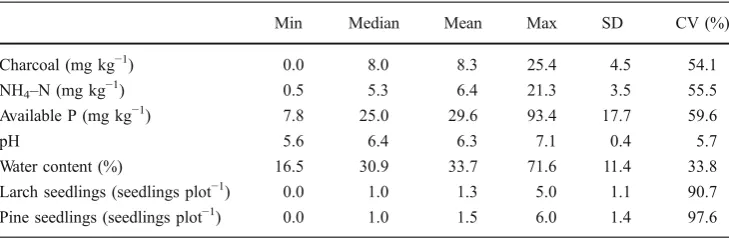
2001; Schmidt et al. 2001). During the combustion in a muffle furnace, an excess amount of oxygen was directed into the muffle furnace (Gustafsson et al.1997,2001). The content of charcoal in the sample is then determined by the difference between the mass of the 375°C sample and the 450°C sample after drying at 60°C for 18 h. The summary of the charcoal content and other analyzed parameters were shown in Table2.
2.4 Statistical analysis
Correlations between charcoal contents and all soil proper-ties and the number of seedling for each species were analyzed by the generalized linear model (GLM). All soil properties were estimated to follow the Gaussian distribu-tion. The numbers of seedlings for both species were
Table 2 Summary of the parameters investigated in the present study
Min Median Mean Max SD CV (%) Charcoal (mg kg−1) 0.0 8.0 8.3 25.4 4.5 54.1
NH4–N (mg kg−1) 0.5 5.3 6.4 21.3 3.5 55.5
Available P (mg kg−1) 7.8 25.0 29.6 93.4 17.7 59.6
pH 5.6 6.4 6.3 7.1 0.4 5.7
Water content (%) 16.5 30.9 33.7 71.6 11.4 33.8 Larch seedlings (seedlings plot−1) 0.0 1.0 1.3 5.0 1.1 90.7
estimated to follow a Poisson distribution. The correlation between two parameters was evaluated to be significant at
p<0.05. All statistical analyses were conducted using R software 2.9.0 (R Developing Core Team2009).
3 Results
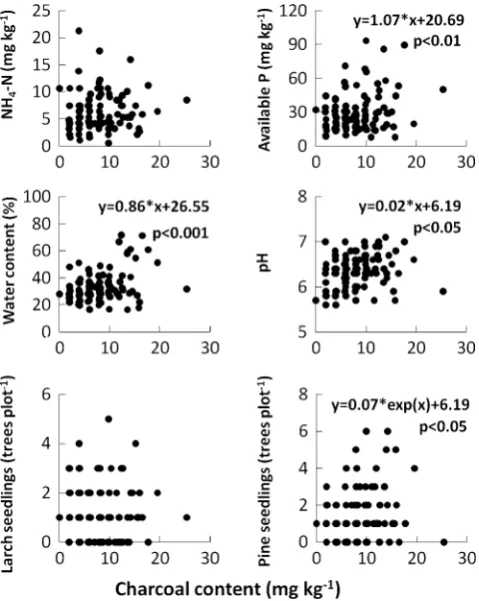
We found significant positive correlations between charcoal content and soil pH, soil water contents, and available P contents (Fig. 1). Furthermore, charcoal content and the number of pine seedlings regenerated in a plot also have a significantly positive correlation (see Fig. 1). Interestingly, there was no significant correlation between charcoal content and the extractable NH4+ content or the number of larch
seedlings (see Fig.1,p=0.664 and 0.5135, respectively).
4 Discussion
We provide, for the first time, field evidence for a positive relationship between charcoal content and the number of
pine seedlings, and the chemical properties of soil and forest floor (see Fig. 1). There were, however, several parameters which were not influenced by charcoal, even though previous laboratory experiments would have pre-dicted otherwise.
The positive correlation between charcoal contents and soil pH is likely due to the fact that fire oxidizes organic material concentrating alkaline oxides along with charcoal (Tryon 1948; Glaser et al.2002). The positive relationship between charcoal contents and soil water content is likely due to the porous nature of charcoal and its ability to hold water (Keech et al. 2005). Charcoal is known to retain an enormous micro- and macroporosity, resulting in a great water-holding capacity per unit mass of charcoal, thereby enhancing the retention of water in the forest floor and mineral soil (Glaser et al. 2002). Higher available P contents in the presence of charcoal may be due to the concentration of P in a low-temperature generation of charcoal (Gundale and DeLuca2006), as might be expected in a low-severity surface fire. Alternatively, P might combine with Ca and Mg in the macropores (Glaser et al.
2002), temporarily forming stable phosphate precipitates. Soil phosphate has low mobility (Certini2005) and is likely to remain in the macropores of charcoal until organic acids slowly liberate soluble P. Thus, available P should have a positive correlation between charcoal contents, assuming low charcoal generation temperature and minimal fire-induced volatilization of P. It is likely that Ca– and Mg–P precipitates can be extracted by Bray II method (Bray and Kurts1945). This would also suggest that this source of P would be available for plants through the acidification of phosphate with organic acids exuded from roots, mycorrhiza, or P-solubilizing bacteria (Allen1991; Finlay2008).
There was no positive relationship between extractable soil NH4+and charcoal presence. In previous studies, NH4+
absorption to man-made charcoal amendment to tropical soils has been implicated to result in the reduced occurrence of N leaching from soil (Lehmann et al.2003). However, it is likely that the direct adsorption of NH4+ to charcoal
would be specific to the type of charcoal in question. In fact, it is implicated that NH4+might be weakly adsorbed to
charcoal (Berglund et al. 2004). The lack of detection of NO3−using the ion-selective electrode precluded testing of
the reported effect of charcoal on net nitrification in boreal and temperate coniferous forests (DeLuca et al. 2006). Further studies might be conducted, in the field, to elucidate how charcoal influences the biological process of nitrification or net immobilization (DeLuca et al.
2006,2009), both serving as pathways that might decrease the extractable soil NH4+.
There was a positive relationship between charcoal contents and the number of pine seedlings. However, no other single factor (pH, NH4, available P, and water
Fig. 1 Relationships between charcoal content and soil parameters, and the number of seedlings. NH4–N, available P, water content, and
contents of soil) which can be related with the seedling emergence had any significant effects on the numbers of pine (data not shown). Charcoal can affect plant emergence through the improvement of growth and seed germination (Choi et al.2009; Makoto et al.2010,2011). Although we did not attain any conclusive data, this knowledge suggests that charcoal increased P availability and water contents, and these two factors increased seedling emergence not independently but cooperatively. In northeastern China, which is close to our site,P. sylvestrisforests were observed to be P- and water-limited for tree growth (Zhao et al.
2009). As a further study, by checking the seedling growth together with its ecophysiological parameters, we can attain indicators of how charcoal affects the physiological condition of a seedling to attain a higher occurrence in microhabitats characterized by a large amount of charcoal. Meanwhile, there was no relationship between soil charcoal content and the number of larch seedlings. From our field observation, one plausible explanation for such species-specific effects might be the pine seedlings showing faster growth and developing their root system more rapidly than larch seedlings. Qu et al. (2003) reported that with more dense root development, the more the positive effect of soil nutrients attained exponentially is observed. The positive effect of charcoal on the root system and the growth of plants (e.g., amelioration of nutrient availability and moisture condition and sorption of phenolics as toxic matter) might be a result of greater root development and increased contact with charcoal in the forest floor. To verify this explanation, it would be necessary to investigate the mechanisms causing such species-specific effects of char-coal on tree seedlings in intensive microplots or greenhouse studies. On the other hand, while we observed some significant relationships between charcoal and various parameters, there was a great deal of variation in the data (see Fig.1). This implicates that, in the field, fire-derived charcoal affects soil properties and seedling growth signif-icantly as a factor among various ones which also affect them coincidentally. Charcoal can be relatively old in forest soils (Ohlson et al.2009) and is known to lose its adsorbing capacity after the long-time burial within soil after fire (Zackrisson et al.1996). In our study, we mainly focused on the role of charcoal which distributes surface soil and was recently produced by fire. The observed positive correla-tions between charcoal contents and other parameters were attained probably because the charcoal was just recently formed.
These results reveal the in situ ecological significance of charcoal in boreal forest ecosystems in terms of both plant and soil response. Importantly, the spatial distribution of charcoal has been reported to influence the distribution of nutrient contents in the forest floor (MacKenzie et al. 2008). To effectively assess the role of charcoal in the heterogeneous
environment of the boreal ecosystem, ultimately, we would need to evaluate the spatial relationship between charcoal distribution, soil condition, and regeneration of seedlings, taking their spatial heterogeneities into consideration.
Acknowledgments We thank Dr. F. Satoh, Dr. M. Shibuya, and Dr. H. Saito for their valuable comments for this study. Thanks are also due to Dr. Y. P. Nemilostiv for his help throughout the research in the Russian Far East. This study is supported in part by the Grant-in-Aid of JSPS to Y. Hashidoko (type A 2025500208), that to K. Makoto (No. 192105), and that to T. Koike (type B 20380083).
References
Allen MF (1991) The ecology of mycorrhizae. Cambridge University Press, Cambridge
Bach LH, Frostegård Å, Ohlson M (2008) Variation in soil microbial communities across a boreal spruce forest landscape. Can J For Res 38:1504–1516
Berglund LM, DeLuca TH, Zackrisson O (2004) Activated carbon amendments of soil alters nitrification rates in Scots pine forests. Soil Biol Biochem 36:2067–2073
Bray RH, Kurts LT (1945) Determination of total, organic and available forms of phosphorus in soils. Soil Sci 59:39–45 Certini G (2005) Effects of fire on properties of forest soil: a review.
Oecologia 143:1–10
Choi DS, Makoto K, Quoreshi A, Qu L (2009) Seed germination and seedling physiology ofLarix kaempferiandPinus densiflora in seedbeds with charcoal and elevated CO2. Landsc Ecol Eng
5:107–113
DeLuca TH, Sala A (2006) Frequent fire alters nitrogen trans-formations in ponderosa pine stands of the inland northwest. Ecology 87:2511–2522
DeLuca TH, MacKenzie MD, Gundale MJ, Holben WE (2006) Wildfire-produced charcoal directly influences nitrogen cycling in ponderosa pine forests. Soil Sci Soc Am J 70:448–453 DeLuca TH, MacKenzie MD, Gundale MJ (2009) Biochar effects on
soil nutrient transformation. In: Lehmann J, Joseph S (eds) Biochar for environmental management: science and technology. Earthscan, London, pp 251–270
Finlay RD (2008) Ecological aspects of mycorrhizal symbiosis: with special emphasis on the functional diversity of interactions involving the extraradical mycelium. J Exp Bot 59:1115–1126 Glaser B, Lehmann J, Zesh W (2002) Ameliorating physical and
chemical properties of highly weathered soils in the tropics with charcoal—a review. Biol Fertil Soils 35:219–230
Goldammer JG, Furyaev VV (1996) Fire in ecosystem of boreal Eurasia. Kluwer, London
Gundale MJ, DeLuca TH (2006) Temperature and source material influence the chemical properties of charcoal in the ponderosa pine/Douglas-fir ecosystem. Forest Ecol Manag 231:86–93 Gustafsson O, Haghseta F, Chan C, Macfarlane J, Gschwend PM
(1997) Quantification of dilute sedimentary soot phase: implica-tion for PAH speciaimplica-tion and bioavailability. Environ Sci Technol 31:203–209
Gustafsson O, Bucheli T, Kukulska Z, Andersson M, Claude L, Rouzaud JN, Reddy CM, Eglinton TI (2001) Evaluation of a protocol for the quantification of black carbon in sediments. Global Biogeochem Cy 15:881–890
Kozlowski TT, Kramer PJ, Pallardy SG (1991) The physiological ecology of woody plants. Academic, San Diego
Kuo S (1996) Phosphorus. Methods of soil analysis. Part 3, 3rd end. SSSSA Book Series 5. SSSSA, Madison
Lehmann J, da Silva JP Jr, Steiner C, Nehls T, Zech W, Glaser B (2003) Nutrient availability and leaching in an archaeological Anthrosol and a Ferralsol of the Central Amazon Basin: fertilizer, manure and charcoal amendments. Plant Soil 249:343–357 MacKenzie MD, DeLuca TH (2006) Charcoal and shrubs modify soil
processes in ponderosa pine forests of western Montana. Plant Soil 287:257–266
MacKenzie MD, McIntire EJB, Quideau SA, Graham RC (2008) Charcoal distribution affects carbon and nitrogen contents in forest soils of California. Soil Sci Soc Am J 72:1774–1785 Makoto K, Nemilostiv YP, Zyryanova OA, Kajimoto T, Matsuura Y,
Yoshida T, Satoh F, Sasa K, Koike T (2007) Regeneration after forest fires in mixed conifer broad-leaved forests of the Amur region of Far Eastern Russia: the relationship between species specific traits against fire and recent fire regimes. Eurasian J For Res 10:51–58 Makoto K, Tamai Y, Kim YS, Koike T (2010) Buried charcoal layer
and ectomycorrhizae cooperatively promote the growth ofLarix gmeliniiseedlings. Plant Soil 327:143–152
Makoto K, Choi DS, Hashidoko Y, Koike T (2011) The growth of
Larix gmeliniiseedlings as affected by charcoal produced at two different temperatures. Biol Fertil Soils 47:467–472
Ohlson M, Hahlberg B, Økland T, Brown K, Halvorsen R (2009) The charcoal carbon pool in boreal forest soils. Nat Geosci 2:692–695
Preston CM, Schmidt MWI (2006) Black (pyrogenic) carbon: a synthesis of current knowledge and uncertainties with special consideration of boreal zone. Biogeosciences 3:397–420 Qu L, Quoreshim AM, Koike T (2003) Root growth characteristics,
biomass and nutrient dynamics of seedlings of two larch species raised under different fertilization regimes. Plant Soil 255:293–
302
R Development Core Team (2009) R: A Language and Environment for Statistical Computing, Vienna, Austria. ISBN 3-900051-07-0. Available via DIALOG. http://www.Rproject.org. Accessed 1 Sept 2009
Schmidt MWI, Skjemstad JO, Czimczik CI, Glaser B, Prentice KM, Gelinas Y, Kuhlbusch AJ (2001) Comparative analysis of black carbon in soils. Global Biogeochem Cy 15:163–167
Tryon EH (1948) Effect of charcoal on certain physical, chemical, and biological properties of forest soils. Ecol Monogr 18:82–115 Wardle DA, Zackrisson O, Nilson MC (1998) The charcoal effect in
boreal forests: mechanisms and ecological consequences. Oecologia 115:419–426
Wardle DA, Nilsson MC, Zackrisson O (2008) Fire-derived charcoal causes loss of forest humus. Science 320:629
Zackrisson O, Nilsson MC, Wardle DA (1996) Key ecological function of charcoal from wildfire in the boreal forest. Oikos 77:10–19
Zhao Q, Liu X, Zeng D, Liu J, Hu Y (2009) Relationship between foliar phosphorus fractions ofPinus sylvestrisvar.mongolicaand soil available phosphorus. Front Forest China 4:85–89