Full Terms & Conditions of access and use can be found at
http://www.tandfonline.com/action/journalInformation?journalCode=vjeb20
Download by: [Universitas Maritim Raja Ali Haji] Date: 11 January 2016, At: 20:54
Journal of Education for Business
ISSN: 0883-2323 (Print) 1940-3356 (Online) Journal homepage: http://www.tandfonline.com/loi/vjeb20
Operations Management: Is There a Disconnect
Between College Textbook Content and Employer
Needs?
Cliff Alan Welborn & Marc G. Singer
To cite this article: Cliff Alan Welborn & Marc G. Singer (2013) Operations Management: Is There a Disconnect Between College Textbook Content and Employer Needs?, Journal of Education for Business, 88:1, 1-7, DOI: 10.1080/08832323.2011.629237
To link to this article: http://dx.doi.org/10.1080/08832323.2011.629237
Published online: 19 Nov 2012.
Submit your article to this journal
Article views: 142
CopyrightC Taylor & Francis Group, LLC ISSN: 0883-2323 print / 1940-3356 online DOI: 10.1080/08832323.2011.629237
Operations Management: Is There
a Disconnect Between College Textbook Content
and Employer Needs?
Cliff Alan Welborn and Marc G. Singer
Middle Tennessee State University, Murfreesboro, Tennessee, USA
The authors sought to determine the knowledge, skills, and abilities (KSAs) employers seek when recruiting operations management personnel and whether sufficient emphasis is be-ing afforded to these areas in introductory operations management courses. Eighty-three job postings were obtained from online employment sites and analyzed to determine the relevant KSAs sought by employers. Ten textbooks, with publication dates ranging from 2004 to 2010, were randomly selected and examined to determine if a uniform body of knowledge existed. Eight knowledge areas common to all the textbooks emerged. Additionally, topics not afforded similar textbook coverage occurred more frequently in the advertisements.
Keywords: curriculum content, operations management, textbooks
There is little, if any, doubt among students, employers, and collegiate accrediting bodies that a key reason for obtaining a college education is to maximize employment opportuni-ties upon graduation. In a nationwide survey of high school seniors by WiseChoice, an online college guidance site, 80% of the respondents identified better job opportunities as the reason for attending college (De Vise, 2010). Additionally, industry practitioners view colleges as suppliers of manage-ment talent and place heavy importance on a program’s cur-riculum (Rutner & Fawcett, 2005). Realistically, however, the purpose of a college education is multidimensional. Not only is the ultimate effectiveness of an educational institution defined by the initial employment rate of its graduates, but also by the eventual success of its students in their chosen careers. In fact, recognizing this factor, the preamble of the standards for the Association to Advance Collegiate Schools of Business (AACSB; 2010), the accrediting agency for busi-ness colleges and universities internationally, states that “In this environment, management education must prepare stu-dents to contribute to their organizations” (p. 3).
Despite this recognition of career importance, the suc-cess of business schools in preparing their graduates for professional employment has been questioned. Much of the
Correspondence should be addressed to Cliff Alan Welborn, Middle Tennessee State University, Department of Management & Marketing, Box 75, MTSU, Murfreesboro, TN 37132, USA. E-mail: [email protected]
criticism relates to the relevance of business programs to the practice of management (Bruce, 2010). Business schools have been criticized for failing to impart useful skills, fail-ing to prepare leaders, and failfail-ing to lead graduates to good jobs (Bennis & O’Toole, 2005). Behavioral competencies, indicated by managers as those most critical for job success, appear to be the competencies least represented in required MBA curricula (Rubin & Dierdorff, 2009). Instead of being learning institutions, where participants develop their man-agerial skills, these programs are being viewed primarily as a selection mechanism whereby motivated and talented stu-dents are identified (Pfeffer & Fong, 2004).
Identifying the root cause for the disparity between that which is conveyed in the classroom and that which is neces-sary for successful performance on the job is not easy. There is scant documentation in the prevailing literature of empir-ical studies investigating a uniform set of knowledge, skills, and abilities (KSAs) that potential employers seek to iden-tify in job applicants. Consequently, there is a great deal of uncertainty about what students should be taught and what they should learn (Birnik & Billsberry, 2008).
The foregoing criticisms leveled are not unique to business schools. Educators throughout academia have long wrestled with the dilemma of what is the best method for passing on theoretical and practical information to students. The tradi-tional textbook, once composed primarily of written material, is being supplemented by elaborate pictorial displays and masses of ancillary materials. Lectures, one of the oldest
2 C. A. WELBORN AND M. G. SINGER
methods for imparting knowledge, are being enhanced through audiovisual techniques. Guest speakers and class-room cases are commonplace. Despite these efforts, prac-titioners still complain that many business students are ill prepared for the realities that influence decision-making in the real world of everyday business. Although it is proba-bly safe to assume that most instructors adequately impart a wide array of historically sound theoretical knowledge to their students, what appears to be sorely missing is an under-standing of how to develop course content that will foster the successful positive transfer of this learned theory into real world application.
Historically, researchers have employed a variety of ap-proaches in an effort to identify relevant course topics. For ex-ample, Sincoff and Owen (2004) sampled 98 human resource managers in an attempt to discover the importance of various human resource management areas for first-job human re-sources professionals. Based on their findings, course topics were prioritized and used to design human resource man-agement curriculums. Similarly, Rutledge, Tillery, Kethley, and Desai (2004) compared the content coverage of quality topics in textbooks to the training offerings found in a popu-lar quality practitioner’s journal. Their assumption was that the frequency of practitioner training offerings for a given quality topic was a proxy for practitioner relevance. Using the training offerings as a benchmark they determined if text-books overrepresented, underrepresented, or accurately rep-resented various quality management topics. Their research resulted in recommendations for topics to be included in quality course curricula and guidelines by which textbooks should be chosen.
There appears to be little doubt that academicians who teach quality management courses remain perplexed about the appropriate methodology to use in determining the most relevant topics for inclusion into their classroom curricula (Rutledge et al., 2004). This dilemma may have resulted in academicians relying on vacant job postings as an indicator of topical areas around which curricula should be designed. Clearly, the intent of a job posting is to attract applicants that have the relevant KSAs necessary for successful job completion. It plays a significant role in whether or not a potential applicant will ultimately pursue the job (Barber & Roehling, 1993). Therefore, it is logical to hypothesize that because job postings provide a significant measure of the relevancy and importance of the KSAs within a given field, faculty might refer to these postings to determine relevant topical areas for inclusion in their curricula.
The purpose of the present research was to identify what KSAs are frequently indicated as necessary by potential em-ployers when hiring operations management personnel and whether these required KSAs are given sufficient empha-sis in introductory operations management course textbooks. Rather than employing traditional survey techniques to sam-ple faculty or practitioners’ opinions regarding the necessary KSAs for job success, the present research was specifically
designed to determine what KSAs hiring employers actually seek from potential employees and whether or not operations management textbooks focus on these criteria.
METHOD
Phase 1 of the study involved the collection of Internet job listings by inserting the key words operations management
into the search engines of the online recruiting sites Mon-ster.com and CareerBuilder.com. This method for selecting the sample of job postings was chosen because the text for the job postings in these advertisements are unedited and ap-pear as composed by the hiring organization. After culling the listings so as to include only relevant operations man-agement positions within the United States, a total of 83 relevant job postings (39 from Monster.com and 44 from CareerBuilder.com) remained.
Next, the texts from the job advertisements selected were imported into a database and a histogram for each word in the posting was developed. Ultimately, 3,531 unique words and a total word count of 27,766 emerged from which those job advertisements that referenced specific operations manage-ment KSAs were determined. Each time a posting contained a reference to a required or desired operations management KSA, that particular KSA was indexed by one. Subsequently, the frequency count was converted to a percentage of post-ings referencing the KSA. For example, if every job posting contained a reference to a particular KSA, that specific KSA was assigned a score of 100%.
The second phase of the study necessitated the selec-tion of a sample of textbooks used in introductory college and university operations management classes. College text-books were chosen as an indicator of course content because most professors adopt textbooks for their courses and tend to structure their syllabi, lectures, and assignments around the chapter outlines. Furthermore, when sampled, students have indicated that as much as 55% of the knowledge that they garner from their courses is obtained from their assigned textbooks (Lichtenberg, 1992).
Principles of operations management classes were cho-sen because this core class is a standard requirement for all AACSB U.S. business students and is a prerequisite for many other operations management elective courses (Rut-ledge et al., 2004). As with the job listings, an Internet search was utilized as the selection technique and 10 of the most commonly used textbooks in principles of operation man-agement were randomly chosen.
Next, the chapter outlines, as listed in the table of con-tents within each of the 10 selected textbooks, were scruti-nized in an effort to determine the commonality of operations management subject matter that exists within the volumes. Although minor discussion or reference was afforded to a variety of different operations management KSAs through-out the text, only the topics identified in the table of contents
were chosen, because it was apparent that those were the areas the textbook authors viewed as most significant. If an entire chapter for a textbook was devoted to a topic, the fre-quency count for that topic was indexed by one. If all 10 textbooks contained a chapter for a given topic, that topic received a frequency count of 10, and that topic was deemed to be a universal operations management KSA.
Next, we obtained the course syllabi from 30 various col-lege and university undergraduate sections of principles of production and operations management classes to ascertain whether there was a match between (a) the topics listed on the syllabi and the titles of the textbook chapters and (b) the amount of chapters in the textbooks and the total number of weeks that the classes met.
Last, a comparison was made between the KSAs identified in the job postings and the topical chapter outlines of the 10 textbooks to determine the frequency that each of the eight universal topics appeared in the job postings.
RESULTS
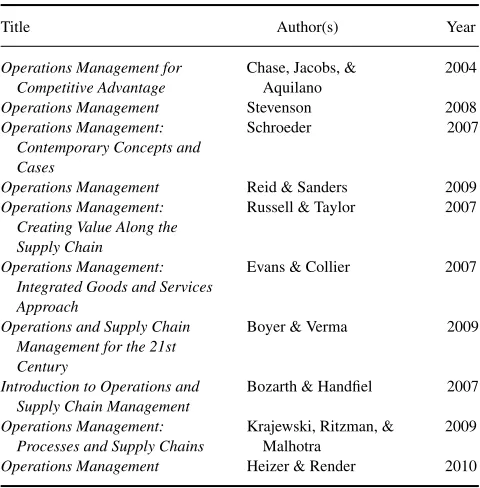
Each of the 10 textbooks analyzed (see Table 1) contained between 14 and 18 chapters, which correlated with the ap-proximate length of the typical college semester (usually 14–16 weeks, depending on the institution). Furthermore, an examination of the 30 course syllabi collected from the class sections indicated that the stated course objectives and most of the topics that were listed for discussion on the syllabi
TABLE 1
Operations Management Textbooks Chosen for Analysis
Operations Management Reid & Sanders 2009
Operations Management:
Operations Management Heizer & Render 2010
TABLE 2
Percentage of Job Postings Requiring Operations Management KSAs and Percentage of Textbook
Chapters Devoted to the KSA Topical Area
Operations Posting Book chapter
management KSA percentage percentage
Budgeting 61 0
Safety 37 0
Supply chain management 36 100
Project management 31 100
Lean or just in time 14 100
Forecasting 13 100
Product–service design–analysis Undetermined 100
Note.KSAs=knowledge, skills, and abilities.
mirrored the textbook chapters. Clearly, all the textbooks, despite being authored by different individuals, were strik-ingly similar in content and appeared to strongly influence the format of the course.
The percentage that each of the eight universal chapter topics is mentioned as a critical operations management KSA in the job postings is detailed in Table 2. Supply chain man-agement at 36% and project manman-agement at 31% were the only universal topics appearing in greater than 30% of the job listings. Five of the other topics were listed in the ad-vertisements less than 30% of the time. These were, in order of frequency of appearance in the job postings, aggregate and capacity planning (29%), quality (24%), inventory man-agement (17%), lean or just in time (14%), and forecasting (13%). The percentage of postings requiring the textbook topic product–service design–analysis could not be deter-mined due to the ambiguity of the term.
Additionally, four other operation management topics that were not categorized as universal operations management KSAs are enumerated in Table 2 because of the frequency for which they appeared in the sampled job postings. These were budgeting, safety, productivity and scheduling, appear-ing 61%, 31%, 28%, and 24%, respectively.
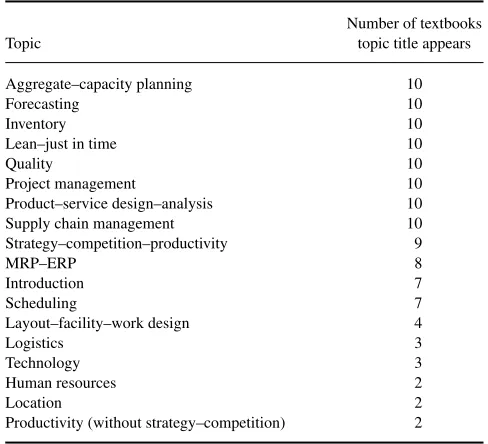
None of the operations management textbooks analyzed had a chapter devoted to budgeting, and few even mentioned the budgeting process in their content. Similarly, safety, or safety management, did not appear as a chapter in any of the sampled textbooks. Productivity, appeared as a chapter in two textbooks (when differentiated from strategy–competition), and scheduling appeared in seven of the sampled textbooks (see Table 3).
4 C. A. WELBORN AND M. G. SINGER
TABLE 3
Chapter Topic Titles Extracted From the Sampled Production and Operation Textbooks
Note. MRP=Material requirements planning; ERP=Enterprise re-source planning.
DISCUSSION
The results of the present investigation indicated that the ma-jority of textbooks chosen for use in teaching the principles of operations management course at academic institutions contained basically the same core content areas and many in-structors designed their course outline to mirror the format of the adopted textbook. Furthermore, when comparisons were made between the textbook chapter topics and the KSAs that employers sought through job postings, a distinct hier-archical frequency of demand between the topics emerged. These topical areas, in order of their frequency of demand by employers included chapters on supply chain management (36%), project management (31%), aggregate and capacity planning (29%; mostly worded in terms of developing labor or machine schedules, not necessarily in the analytical capacity planning computations found in most textbooks), quality (24%), inventory management (17%), lean or just in time (14%), forecasting (13%), and product–service design–analysis (undetermined percentage; see Table 2).
The fact that supply chain management and project man-agement emerged as the most frequent KSAs listed in the job postings of the eight universal topics listed by employers was not surprising. Even though the job postings were for oper-ations management positions, supply chain management has become a fundamental part of the operations management responsibilities for many organizations. The Association for Operations Management (APICS) now emphasizes resource management as part of a broader supply chain management focus. Similarly, the nature of the operations management
function in many organizations dictates that much of the work conducted will be project based. Although not nec-essarily hiring project managers per se, organizations have indicated that they prefer operations managers who posses project management skills.
Following closely behind supply chain management and project management, aggregate or capacity planning capabil-ities were listed as desired KSAs in 29% of the job postings. Interestingly, as Table 3 illustrates, several textbooks either focused on material requirements planning in their chapters on aggregate or capacity planning, or contained a chapter devoted solely to material requirements planning (MRP), but only one of the sampled job postings referred to MRP as a necessary KSA. Likewise, whereas the textbooks often associated linear programming with the aggregate planning function, no references to linear programming were found in any of the job listings.
Quality management was referenced in 24% of the job descriptions. Responsibility for quality assurance has been a crucial component of the operations management function for several years. As quality improvement has evolved into process improvement and with the growing popularity of Six Sigma techniques, this field has become integral with the operations management function.
The last of the universal textbook chapters to be cited by employers in their job postings were inventory management, lean or just in time, and forecasting. Although inventory management was individually specified in 17% of the job advertisements, it is conceivable that for many practitioners this topic may be associated, or even thought of as syn-onymous, with supply chain management. However, for this study it was treated separately because all the textbooks sam-pled devoted individual chapters to each topic, and different subtopics are associated with each field.
Lean or just in time was referenced in 14% of the job ads. Forecasting was identified in 13% of the job postings. Often, the reference to forecasting in these listings referred to an operations manager’s ability to predict the amount of employees or labor hours that will be needed in the future. However, textbooks often associate forecasting with quantitative time series methods, such as weighted moving averages and exponential smoothing techniques. Last, the textbook topic product–service design–analysis could not be accurately identified in the job postings. This finding may be attributable to the fact that the vocabulary used to describe this topic was ambiguous resulting in the inability to systematically identify it in the job postings.
There are two questions that emerge from the present investigation. First, why are the most frequently included chapter topics in textbooks on operations management only listed in job advertisements between 13% and 36%? Sec-ond, why are topics such as budgeting, safety, productivity, and scheduling (appearing in 61%, 37%, 28%, and 24%, re-spectively, of job listings) that practitioners appear to value most highly in selecting potential operations management
personnel conspicuously absent from many of the most com-monly used operations management textbooks or not widely considered significant enough topics to warrant individual chapters?
It appears that the causes for the disparity in the topics chosen for classroom dissemination and those desired by em-ployers may be attributable to academicians and practition-ers. Professors and authors may contribute to the dilemma by failing to use appropriate methods to select the content to in-clude in the textbooks that they write and in the materials that they choose to disseminate in the classrooms. Likewise, prac-titioners may be guilty of either failing to adequately identify the job duties and responsibilities necessary for ultimate job satisfaction, or in effectively communicating these needs to the professionals who teach their potential employees.
Ideally, the determination of appropriate material for in-clusion in textbooks for use in practically oriented disciplines such as operations management should occur after a compre-hensive needs assessment of the industry is undertaken. In fact, AACSB recommends that when developing curricula institutions should confer with a variety of constituents, in-cluding alumni and the business communities served by the school. Based on the results of these consultations, chapter outlines would be developed that are reflective of the con-tent areas determined to be most needed by practitioners for ultimate success on the job. Subsequently, ongoing research would be conducted to monitor any significant changes oc-curring in the field and textbooks would be updated to reflect the new emphases.
Realistically, this process rarely occurs. Although AACSB (2010) recommends a list of general and management-specific knowledge and skills areas for inclusion in business programs, they do not mandate specific courses or content. Rather, they leave it up to the discretion of each institution to determine the appropriate topics to be included within their individual curricula. Institutions seeking initial AACSB ac-creditation tend to be weary of straying from the norm. Rather than developing curriculum specific to their schools, they are inclined to mirror the curriculum of their peer institutions that have already succeeded in the accreditation process. Simi-larly, colleges and universities involved in the maintenance of accreditation process may be loath to continually tinker with their course contents because doing so may impact neg-atively on their assessment of learning results. Rather than having to defend a unique curriculum it seems more prudent to remain with the established tried and true widely used textbook topics.
Although formidable, the pressure of obtaining and main-taining AACSB accreditation is not the only external force impacting on textbook authors. Arguably, the publication process itself appears to be dictated more by publisher needs rather than academic criteria. Prior to the issuance of book contracts, publishers typically require prospective authors to submit a proposal for review. This prospectus usually re-quires, at a minimum, that the prospective author submit a
proposed table of contents and sample chapters for scrutiny. These materials are then sent out for review to academicians who are currently teaching the courses and are most likely to adopt the textbooks for their classes. Because it is logical to assume that the content in the currently used course text-book and syllabi reflects the professors conception of what material is appropriate for the course, proposals that deviate significantly from these materials are likely to be critiqued. Consequently, aspiring authors desiring to obtain publishing contracts tend to rely on existing textbook topics instead of needs surveys when determining their chapter layouts.
Even if textbooks ultimately chosen for publication con-tain chapters that reflect the existing state of the discipline, there is no guarantee that further editions will remain current. In an effort to circumvent the used book market, many pub-lishers have opted to establish textbook revision cycles that facilitate the publication of a new edition every 2–3 years. This periodic schedule leaves little, if any, time for authors to actually conduct research to ascertain employer needs and still meet their publishing timelines. As a result, revisions usually entail only a tweaking of current material rather than a comprehensive overhaul, unless the discipline experiences a widespread change in theory or practice.
Effective recruitment and selection of competent employ-ees depends largely on an organization’s ability to identify potential employees who have the necessary KSAs to sat-isfactorily perform the required job duties. This process is typically accomplished by conducting job analyses that iden-tify the essential features of positions. Because the essential duties of similarly titled jobs at different organizations vary, it is quite understandable that the same job title (e.g., op-erations manager) does not require the same skills in every organization. For example, one company’s job may require an emphasis on supply chain management skills, while an-other organization might be seeking operations management employees with stronger forecasting abilities. This is not to imply that a set of universal skills applicable across orga-nizations does not exist, but rather that these skills would be weighted or valued differently depending on the organi-zation. Therefore, the study’s finding that indicated that the most any single universal KSA was listed in a job posting was only 36% is not necessarily surprising.
Although the differences in weighting across organiza-tions may explain the finding that the leading universal KSA only appeared in 36% of job postings, it does not answer the question of why employers listed budgeting, and safety, two topical areas given minimal coverage, at best, in the sampled textbooks, as the KSAs most desired in potential employees. Similarly, topics such as productivity, and scheduling, were found to exceed, or were equal to, the frequency of job listings for five universal KSAs, yet were not afford the same em-phasis by textbook authors. A plausible explanation to this enigma may be that these topics are addressed in conjunc-tion with other topical areas within textbooks, or are given extensive coverage in either advanced elective courses or
6 C. A. WELBORN AND M. G. SINGER
other core courses required of all business majors. For ex-ample, budgeting may be found in core accounting courses, productivity tends to be listed by most authors together with strategy and competition, and scheduling is usually closely aligned or viewed synonymously with aggregate–capacity planning. Consequently, authors of introductory textbooks may choose to address these topics minimally, as part of other chapters, rather than singling them out for extensive coverage.
Unfortunately, whereas budgeting skills may be covered in other business courses, academic exposure to the area of safety management is not so evident. In today’s business environment many operations managers are responsible for the safety and well-being of their employees and for ensur-ing the delivery of employee trainensur-ing related to workplace safety. In fact, many engineering and engineering technol-ogy programs have courses specifically focused on safety. Yet, our findings appear to indicate that few, if any, opera-tions management students are being adequately prepared to meet the safety responsibilities associated with their potential jobs.
Last, we would certainly be remiss if we didn’t consider the fact that the apparent disconnect between the material be-ing included in textbooks and taught in college classrooms, and the information needed for successful job performance may be a function of the lack of industry experience on the part of textbook authors and/or classroom instructors (in many instances they are one and the same). Although some operations management instructors began their careers as practitioners prior to embarking on a teaching career, others entered academia without any industry experience whatso-ever. Lacking practical knowledge of the industry these new faculty members would naturally tend to draw on their past academic training, the textbooks that they are already famil-iar with, and the academic research that they have studied and personally conducted, in developing their course outlines. If the knowledge they have gleaned is dated and unrelated to the real world they may be unintentionally engaging in a form of academic inbreeding by continuing to propagate this information.
CONCLUSION
The results of the present investigation indicated that the topical chapters of operations management textbooks differ from those KSAs listed by potential employers in job postings. This finding appears to support the contention es-poused by past researchers that a disconnect exists between the subject matter taught in the college classroom and the relevance of the material for ultimate job success (Bennis & O’Toole, 2005; Bruce, 2010; Rubin & Dierdorff, 2009). Historically, attempts to improve the practical applicability of college course content has centered on using varying experiential techniques within the classroom environment.
Although these methods certainly have merit, they are only useful if the materials being imparted are actually relevant to the work place. If the subject matter conveyed is dated or erroneous, then it is conceivable that negative transfer rather than positive transfer may occur, hampering job performance.
Tantamount to any other product, to be successful in pro-viding business education, requires that academicians con-tinually monitor the marketplace and enhance the product when necessary to meet the rapidly changing needs of cus-tomers (Moore, 2007). Accomplishing this goal requires that faculty foster ongoing relationships with their corporate part-ners. Consulting activities, active membership and participa-tion in professional societies (as differentiated from their professional academic organizations), research activities in-volving samples from the business environment (in addition to student samples), and placing and monitoring students in practicum and internship environments are some of the activ-ities that will assist in keeping faculty abreast of the present state of affairs in their respective disciplines. Most impor-tantly, faculty should periodically and systematically review their textbooks for currency and relevance.
Realistically, although the findings of the present inves-tigation have indicated an apparent mismatch between the content of operations management textbook chapters and employment job postings, they fail to definitively identify the reasons for this mismatch. We have hypothesized that part of the rationale for this phenomenon may be attributable to the variance in job duties and responsibilities of similar titled jobs in different organizations, and in the manner that faculty choose their course content. To test this hypothesis, further research in these areas need to be conducted by ac-tually obtaining and comparing the completed job analyses of organizations who have posted job openings for oper-ations management employees to determine the degree that the required job duties are indeed alike. Subsequently, the job postings of those organizations with similar required KSAs would be compared to the content matter found in oper-ations management textbook chapters. Similarly, research should be conducted on how academicians choose the top-ics to include in their introductory operations management course syllabi and in the textbooks that they adopt for these courses.
REFERENCES
Association to Advance Collegiate Schools of Business International. (2010). Eligibility procedures and accreditation standards for busi-ness accreditation. Retrieved from http://www.aacsb.edu/accreditation/ business standards.pdf
Barber, A., & Roehling, M. V. (1993). Job postings and the decision to interview: A verbal protoc. Journal of Applied Psychology, 78, 845–856.
Bennis, W., & O’Toole, J. (2005). How business schools lose their way.
Harvard Business Review,83(5), 96–104.
Birnik, A., & Billsberry, J. (2008). Reorienting the business school agenda: The case for relevance, rigor, and righteousness. Journal of Business Ethics,82, 985–999.
Boyer, K., & Verma, R. (2009).Operations and supply chain management for the 21st century. Mason, OH: Cengage Learning.
Bozarth, C. C., & Handfield, R. B. (2007).Introduction to operations and supply chain management(2nd ed.). Upper Saddle River, NJ: Pearson Prentice-Hall.
Bruce, G. (2010). Students’ experiences in full-time, part-time, and execu-tive MBA programs.Journal of Education for Business,85, 38–44. Chase, R. B., Jacobs, F. R., & Aquilano, N. J. (2004).Operations
man-agement for competitive advantage(10th ed.). New York, NY: McGraw-Hill/Irwin.
De Vise, D. (2010, April 29). Survey: College applicants want to earn, not learn.The Washington Post. Retrieved from http://voices.washingtonpost. com/college-inc/2010/04/survey college applicants want.html Evans, J. R., & Collier, D. (2007).Operations management: Integrated
goods and services approach. Mason, OH: Cengage Learning. Heizer, J. H., & Render, B. (2010).Operations management(10th ed.).
Upper Saddle River, NJ: Prentice-Hall.
Krajewski, L. J., Ritzman, L. P., & Malhotra, M. K. (2009). Operations management: Processes and supply chains(9th ed.). Upper Saddle River, NJ: Prentice-Hall.
Lichtenberg, J. (1992). The new paradox of the college textbook.Change,
24, 10–18.
Moore, T. E. (2007, July/August). Repositioning the MBA. BizEd, 50–56.
Pfeffer, J., & Fong, C. T. (2004). The business school ‘business’: Some lessons from the U.S. experience.Journal of Management Studies,41, 1501–1520.
Reid, R. D., & Sanders, N. R. (2009).Operations management(4th ed.). Hoboken, NJ: Wiley.
Rubin, R. S., & Dierdorff, E. C. (2009). How relevant is the MBA? As-sessing the alignment of required curricula and required managerial competencies.Academy of Management Learning & Education,8, 208– 224.
Russell, R. R., & Taylor, B. W. (2007).Operations management: Creating value along the supply chain. Hoboken, NJ: Wiley.
Rutledge, A. L., Tillery, K. R., Kethley, B., & Desai, K. J. (2004). The treat-ment of quality in U.S. production and operations managetreat-ment textbooks.
The International Journal of Quality & Reliability,21, 479–496. Rutner, S. M., & Fawcett, S. E. (2005). The state of supply chain.Supply
Chain Management Review,9(6), 55–60.
Schroeder, R. G. (2007).Operations management: Contemporary concepts and cases(4th ed.). New York, NY: Irwin Professional.
Sincoff, M., & Owen, C. L. (2004). Content guidelines for an undergraduate human resources curriculum: Recommendations from human resource professionals.Journal of Education for Business,80, 80–85.
Stevenson, W. J. (2008).Operations management(10th ed.). New York, NY: McGraw-Hill/Irwin.