1 CRITIQUE ON GIVING FEEDBACK FOR STUDENTS’ WRITING
BY
ESTI JUNINING*
A Lecturer at University of Brawijaya
ABSTRACT
Giving feedback has still become a controversial issue in language pedagogy. Some experts regard it as a useful practice in language learning and the others claim it as a useless one when it is not delivered correctly and effectively. On the basis of this controversial issue, this paper is intended to review some current findings on giving feedback, that is reviewing the issue of formative feedback, formative online feedback system and peer feedback. The current practice of giving feedback in Indonesian context is drawn and three recommendations for changes are proposed as well. These three recommendation are proposed to overcome the problems of the teachers (working too much on giving feedback) as well as the students ( to build communication mechanism, reduce frustration, and confusion) to create less threatening and meaningful learning.
Keywords: formative feedback, formative online feedback system, peer feedback
2 THE CURRENT PRACTICES OF GIVING FEEDBACK
The current practice of giving feedback in writing classes tends to be still conventional such as correcting grammar, spelling, and editing instead of giving more emphasis on the purpose, audience and text type. While writing teachers realize that the most important aspect in writing is beyond grammar and spelling like identifying purpose, audience and text type, they still tend to give feedback on grammar and spelling mistakes which do not really help the students develop their ability in writing (Lee, 2011). The worst thing happened to the effect of the feedback given in which the learners rarely edit or proof read their tasks resulting in the repeated mistakes made during the writing process. This negative effect surely does not pay the time consumed and burden of the teachers in correcting their student‟s writing.
Another type of feedback that occurred in the current practice is marking or giving
grades for the students‟ writing as an assessment for learning. Giving grades in the formative
assessment does not surely help learners to develop. The learners tend to pay more attention to the mark given rather than editing or revising their work. The time given to revise their work will be used only for comparing marks, whispering and reacting in various ways such as giggling and cooling aggrieved. Moreover, the worst situation could occur when the learners try to persuade the teacher to make the marks higher (Lewis, 2002). Thus, giving grades is more necessarily applied for summative assessment as part of information delivered to schools and parents.
3 (2008), the other from Hatziapostolou and Paraskakis (2010) and one finding regarding peer feedback by Rolinson (2005).
FORMATIVE FEEDBACK BY SHUTE (2008).
Shute (2008)‟s finding on formative feedback proposed a non evaluative, supportive, timely and specific feedback given to the students. Non evaluative feedback means that the feedback given to the students should not be given mark or grade unless it is for summative assessment. It is supported by William (2007) who summarized that students receiving just grades showed no learning gains. Students getting just comments showed large gains, and those with grades and comments showed no gains. In addition, effective feedback should relate to content of the comments. Thus, besides giving no grades, it is suggested to focus on content rather than form meaning that teachers should provide more attention to the purpose, audience and text type of the writing rather than to the grammatical or spelling mistakes made by the students.
In terms of giving supportive feedback, teachers should give more constructive and encouraging feedback to the students. The example of this feedback is like giving more focus on the task rather than on the learner. The feedback given should address specific features of
the students‟ work in relation to the tasks with suggestions on how to improve it. It is not
recommended to present feedback that discourages the learner that is giving feedback which is too controlling or critical to the learners. These too controlling and too critical feedbacks may cause the students‟ discouragement, frustration and confusion which will result in no learning at all.
4 relatively simple and transfer of learning task, she suggested to apply delayed feedback for transfer task performance. Immediate and delayed feedbacks are defined as direct and indirect feedbacks by Ellis (2009) who emphasized that indirect feedback or delayed feedback (a term defined by Shute, 2008) caters to “guided learning and problem solving” and encourages students to reflect about linguistics forms that could lead to long-term learning.
The last aspect of giving formative feedback proposed by Shute (2008) was giving specific feedback. Giving specific feedback means giving a clear feedback with clear message and meaning that could be linked clearly and specifically to goals and performance. If feedback is not specific or clear, it can impede learning and can frustrate learners. Ellis (2009) defined specific feedback in this regard as a focus corrective feedback. Focused corrective feedback in this regard is proven to be more effective because the learner is able to examine multiple correction of a single error.
The four aspects of conducting formative feedback proposed by Shute (2008) seem to have both strengths and weaknesses. One of the advantages of this finding is that these are able to accommodate detailed aspects of giving feedback such as timely, motivational, individual, manageable and directly. However, the implementation of these formative
feedback still affect on teachers‟ performance in terms of time, energy, competence and
readability. This formative feedback is still time consuming and energy taking. Teachers‟ competence and readiness toward the changing are necessarily to be prepared as well. One of the ways to overcome this shortcoming is by integrating formative feedback with online system such as what is being discussed in the following section.
FORMATIVE FEEDBACK THROUGH ONLINE FEEDBACK SYSTEM
5 the provision of formative feedback. This online feedback system is arranged to enhance feedback reception and to strengthen the quality of feedback through the way feedback is communicated to the students. They strongly recommend integrating effective communication mechanism with a student online learning system to motivate the students to engage with feedback. In this OFES, Hatziapostolou and Paraskakis (2010) introduced three common feedback techniques and communication methods namely word-processed feedback forms, emailing comments or feedback forms and electronic annotations on students‟ work. Three of these types attempt to reduce teachers‟ burden such as time consuming and less effective result. Besides, this type of feedback has some advantages such as maintaining
students‟ personalization, motivation, manageability and timeliness. However, this also
carries some disadvantages in maintaining interpersonal relationship between teacher and students because the students prefer to discuss face to face or through intermediary to save their face in front of the tutor. And this, of course, will result in a failure in building more interpersonal relationship between the tutor and the student (Towndrow, 2004). Yet, if we compare the benefits and the shortcomings, still this online system feedback has more advantages in terms of time consumed by the teachers and students‟ personalization.
The other type of feedback that fosters time saving, reduces teacher‟s burden and learning effectiveness is conducting peer feedback like what is described in the following section.
PEER FEEDBACK
6 communicative purposes in terms of revising their work such as formulating their writing in line with the characteristics and demands of the readers. Thus, this activity could establish more meaningful, more informal, more encouraging and motivating collaborative dialogues compared with one way interaction between teacher and student. Despite its benefits, the negative side of this peer feedback is lack of trust in the accuracy, sincerity and specificity of their peer comments. This may result in more time consumed in giving feedback. Thus, not only the teachers need professional development, but also the students deserve training in giving feedback as well. One of the ways to compromise this problem is by setting up the group of the learners, and providing adequate training that is coaching students in the principles and practice of effective peer group interaction and responses.
CURRENT STATE OF GIVING FEEDBACK IN INDONESIAN CONTEXT
7 the effort of building their communicative mechanism between teacher and students. Secondly, teachers are recommended to build peer feedback suggested by Rollinson (2005) to
reduce teacher‟s burden in correcting students‟ writing. The last recommendation is
conducting formative feedback correctly and efficiently as suggested by Shute (2008) to improve the way writing teachers give feedback in the class.
SOME RECOMMENDATIONS FOR CHANGES OF GIVING FEEDBACK IN EFL
CONTEXT
IMPLEMENTING ONLINE FEEDBACK SYSTEM (OFES)
To stimulate students‟ motivation in responding feedback it is suggested to set up
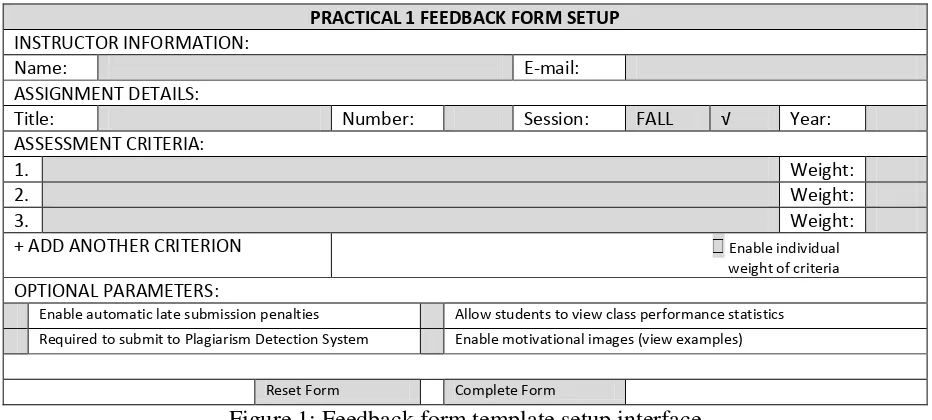
OFES as a part of assessment process. In setting up OFES, first of all teachers need to consult Informational Technology (IT) assistant who is capable of providing the OFES software. After the software is installed, teacher should be given some training on how to operate OFES as a part of formative assessment. The software introduced by Hatziapostolou and Paraskakis (2010) seem easy and not too complicated to operate. The interface is illustrated in the following figure:
PRACTICAL 1 FEEDBACK FORM SETUP
INSTRUCTOR INFORMATION:
Name: E-mail:
ASSIGNMENT DETAILS:
Title: Number: Session: FALL √ Year:
ASSESSMENT CRITERIA:
1. Weight:
2. Weight:
3. Weight:
+ ADD ANOTHER CRITERION Enable individual weight of criteria OPTIONAL PARAMETERS:
Enable automatic late submission penalties Allow students to view class performance statistics Required to submit to Plagiarism Detection System Enable motivational images (view examples)
[image:7.595.65.531.484.694.2]Reset Form Complete Form
8 As seen in figure 1, the interface for setting up a feedback form comprises four parts namely basic information about the tutor (name and e-mail), details of formative assessment including assignment title, number and academic session, assessment criteria with percentage of option criteria, optional parameters of measuring the penalties of late submission, plagiarism detection, class performance statistics and motivational images and two buttons of reset or complete form. The second part is Practical 1 Assessment in which teacher could
proceed to fill out feedback form for each individual student. It mentions students‟ name, identification number as well as the assessment status whether completed or pending for each student.
By implementing this OFES student could engage in formative assessments and more motivational and stimulating feedback environment to reduce their anxiety, lack of confidence, confusion and discouragement.
IMPLEMENTING PEER FEEDBACK
The second recommendation is conducting peer editing. In spite of the benefits and
shortcomings of peer feedback, this strategy could reduce the teacher‟s burden in correcting
the students‟ composition. The practical implementation of peer feedback suggested by
Rollinson (2005) consists of four steps. Firstly, teacher should set up a group of 3 or 4 students, secondly, determine the number of drafts to be written, then decide the kind of evaluation (giving codes, or suggestions) and develop response activity whether using oral or written responses. The benefit of this peer editing is that it is easier to teach student editing procedure than to teach student to write correctly. Giving more practice to be critical readers is able to help them to be more self-reliant writer.
IMPLEMENTING FORMATIVE FEEDBACK CORRECTLY AND EFFICIENTLY
9 what Shute (2008) suggested in focusing on formative feedback. Teachers should follow the guidelines of conducting formative feedback which comprises things to do, things to avoid, timing and learners characteristics. By implementing the guideline correctly and appropriately, the effective formative feedbacks could be built so that time of giving feedback will be spent wisely and purposefully. All of the language teachers in my country should be given training, coaching and disseminating of these guidelines to gain more meaningful giving feedback strategies and equip EFL teachers with sufficient knowledge and competence in giving feedback.
CONCLUSION
10 REFERENCES
Ellis, R. 2009. A Typology of Written Corrective Feedback Types. ELT Journal Volume 63/2 April 2009; doi:10.1093/elt/ccn023. The Author 2008. Published by Oxford niversity Press; all rights reserved. Advance Access publication May 20, 2008. Downloaded from eltj.oxfordjournals.org at SEAMEO Regional Language Centre on December 30, 2010.
Hatziapostolou, T & Paraskakis, I. 2010. Enhancing the Impact of Formative Feedback on Student Learning through an Online Feedback System. Electronic Journal of e-Learning Volume 8 Issue 2 2010 (pp111-122) available online at www.ejel.org
Lee, I. 2011. Feedback Revolution: What Gets in the Way? ELT Journal Volume 65/1 January 2011; doi:10.1093/elt/ccp028 1. The Author 2009. Published by Oxford University Press; all rights reserved. Advance Access publication April 17, 2009 Downloaded from eltj.oxfordjournals.org at SEAMEO Regional Language Centre
onDecember 19, 2010.
Lewis, M. (2002). Giving Feedback in Language Classes. RELC Portfolio Series 1. SEAMEO Regional Language Center.
Nurmukhamedov, U, & Kim, S.H. 2010. „Would you perhaps consider . . .‟: hedged comments in ESL writing. ELT Journal Volume 64/3 July 2010;
doi:10.1093/elt/ccp063. The Author 2009. Published by Oxford University Press; all rights reserved. Advance Access publication August 28, 2009. Downloaded from
eltj.oxfordjournals.org at SEAMEO Regional Language Centre on October 14, 2010 Rollinson, P. 2005. Using Peer Feedback in the ESL Writing Class. ELT Journal Vol. 59/1
January 2005. Oxford University Press.
Shute,Valerie J. 2008. Focus on Formative feedback. Review of Educational Research. March 2008, Vol. 78. No. 1, pp153.
Sugita, Y, 2006. The Impact of Teacher‟s Comment Types on Students‟ Revision. ELT
Journal Vol. 60/1 January 2006. Oxford University Press.