A THESIS
Presented in Partial Fulfillment of the Requirements for the Attainment of a Sarjana Sastra Degree in English Language and Literature
By
Aan Mulyana
11211141001
ENGLISH LANGUAGE AND LITERATURE STUDY PROGRAM
ENGLISH LANGUAGE EDUCATION DEPARTEMENT
FACULTY OF LANGUAGES AND ARTS
YOGYAKARTA STATE UNIVERSITY
i
A THESIS
Presented in Partial Fulfillment of the Requirements for the Attainment of a Sarjana Sastra Degree in English Language and Literature
By
Aan Mulyana
11211141001
ENGLISH LANGUAGE AND LITERATURE STUDY PROGRAM
ENGLISH LANGUAGE EDUCATION DEPARTEMENT
FACULTY OF LANGUAGES AND ARTS
YOGYAKARTA STATE UNIVERSITY
iv
Nama : Aan Mulyana
NIM : 11211141001
Program Studi : Bahasa dan Sastra Inggris Jurusan : Pendidikan Bahasa Inggris Fakultas : Fakultas Bahasa dan Seni Universitas : Universitas Negeri Yogyakarta
menyatakan bahwa karya ilmiah ini adalah hasil pekerjaan saya sendiri. Sepanjang pengetahuan saya, karya ilmiah ini tidak berisi materi yang ditulis oleh orang lain, kecuali bagian-bagian tertentu yang saya ambil sebagai acuan dengan mengikuti tata cara dan etika penulisan karya ilmiah yang lazim.
Apabila ternyata terbukti bahwa pernyataan ini tidak benar, sepenuhnya akan menjadi tanggung jawab saya.
Yogyakarta, 17 Juni 2016. Penulis,
v
“
If I had no sense of humor,
I would long ago have committed suicide.
”
Mahatma Gandhi.
“
We have one life,
it soon will be past,
vi
vii
foremost I would like to express my highest gratitude and praise to Allah
Subhanahu Wa Ta’alaa, the Most Beneficent and the Most Merciful, for His
blessing, love, care, opportunity, health, and mercy. Secondly, my humblest
gratitude to the Holy Prophet Muhammad (peace be upon him) whose way of life has been a continuous guidance for me.
This thesis appears in its current form due to the assistance and guidance
of several people. It gives me a great pleasure to express my gratitude to all those
who supported me and have contributed to make this thesis possible. I owe my
deepest gratitude to:
1. my first and second supervisors (Bapak Drs. Asruddin B. Tou, M.A., Ph.D. and
Bapak Andy Bayu Nugroho, S.S., M.Hum.) who have patiently given helps, advices, guidance, corrections in the process of accomplishing this thesis;
2. my academic adviser (Ibu Titik Sudartinah, S.S., M.A.) who has always given me advice regarding my academic plan and support me to complete this thesis
as soon as possible;
3. the examiners (Bapak Drs. Suhaini M. Saleh, M.A., Bapak Drs. Asruddin B. Tou, M.A., Ph.D., Bapak Andy Bayu Nugroho, S.S., M.Hum., and Ibu Niken Anggraeni, S.S., M.A.) for their valuable input and feedback;
viii
Education Department - Faculty of Languages and Arts - Yogyakarta State
University) who have transferred lot of knowledge;
6. my big family in Kesatuan Bangsa School Yogyakarta for being my second
home and giving me tremendous experience in undertaking remarkable
journey;
7. all my friends in the English Language and Literature Study Program (2011),
especially my classmates in A class and in Translation Studies concentration;
8. all the three respondents (Aniendya Prasetyaningtyas, Oktaviani Primasari, and
Difara Uswatun Khasanah) for their valuable comments and suggestions
regarding my questionnaire;
9. all the three triangulators; Karimzoda Fazliddin, Ika Wahyu Maylani, and
Wahyu Kurniasari for their assistance with the proofreading of the final
versions.
Finally, I tried to do my best in finishing this thesis. As I realize that it is
still far from being perfect, suggestions and opinions are welcomed and expected
from the readers. Yet, I hope this thesis will be beneficial to those who are
interested in the study of translation phenomena.
Yogyakarta, June 2016.
ix
APPROVAL SHEET ... ii
RATIFICATION SHEET ... iii
PERNYATAAN ... iv
MOTTOS ... v
DEDICATIONS ... vi
ACKNOWLEDGEMENTS ... vii
TABLE OF CONTENTS ... ix
LIST OF TABLES ... xiii
LIST OF FIGURES ... xix
LIST OF ABBREVIATIONS... xx
LIST OF APPENDICES ... xxi
ABSTRACT ... xxii
CHAPTER I INTRODUCTION ... 1
A.Background of the Problem ... 1
B.Focus and Formulation of the Problem ... 6
C.Objectives of the Research ... 8
D.Significance of the Research ... 9
1. Theoretical Significance ... 9
x
b. Processes of Translation ... 12
c. Types of Translation ... 14
1) Intralingual Translation or Rewording ... 16
2) Intersemiotic Translation or Transmutation ... 16
3) Interlingual Translation or Translation Proper ... 16
a) Dubbing ... 18
b) Voice-over ... 19
c) Subtitling ... 20
2. Subtitling Strategies ... 21
a. Expansion ... 21
b. Paraphrase ... 22
c. Transfer ... 23
d. Imitation ... 23
e. Transcription ... 24
f. Dislocation ... 25
g. Condensation ... 25
h. Decimation ... 26
i. Deletion ... 26
j. Resignation ... 26
3. Verbal Humor ... 27
a. Notions of Verbal Humor ... 27
b. Types of Verbal Humor ... 28
1) Wordplay ... 28
a) Homonymy ... 29
b) Homophony ... 30
c) Homograph ... 31
xi
3) Verbal Irony ... 36
a) Hyperbolic Expressions ... 37
b) Tag Question ... 38
c) Hyperformality ... 39
d) Intensifier ... 40
e) Interjection ... 40
f) Ironic Repetition ... 41
4. Translation Verbal Humor ... 43
5. Translation Quality Assessment ... 44
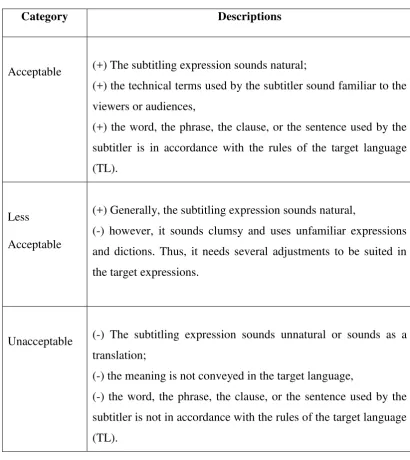
6. Acceptability in Verbal Humor Translation ... 45
a. Acceptable ... 49
b. Less Acceptable ... 50
c. Unacceptable ... 50
7. Summary of the Film ... 52
8. Related Studies ... 53
B.Conceptual Framework ... 56
1. Verbal Humor ... 57
2. Subtitling Strategy ... 61
3. Acceptability ... 63
C.Analytical Construct ... 65
CHAPTER III RESEARCH METHOD ... 66
A.Research Type ... 66
B.Data and Data Sources ... 66
C.Research Instruments ... 67
1. The Researcher ... 67
xii
CHAPTER IV FINDINGS AND DISCUSSION... 74
A.Research Findings ... 74
1. Description of the Types of the Verbal Humor in Rio 2 Film ... 74
2. Description of the Subtitling Strategies Used in Translating Rio 2 Film ... 76
3. Explanation of the Acceptability of the Verbal Humor Translation In Rio 2 Film ... 78
B.Discussion ... 79
1. The Types of the Verbal Humor ... 79
a. Allusion ... 79
b. Verbal Irony ... 86
c. Wordplay ... 99
2. Subtitling Strategies ... 108
3. Acceptability ... 150
CHAPTER V CONCLUSIONS AND SUGGESTIONS... 166
A.Conclusions ... 166
B.Suggestions ... 169
References ... 171
Appendices ... 175
A.The Data Analysis ... 176
xiii
Nababan, Nuraeni, and Sumardiono (2012) ... 48
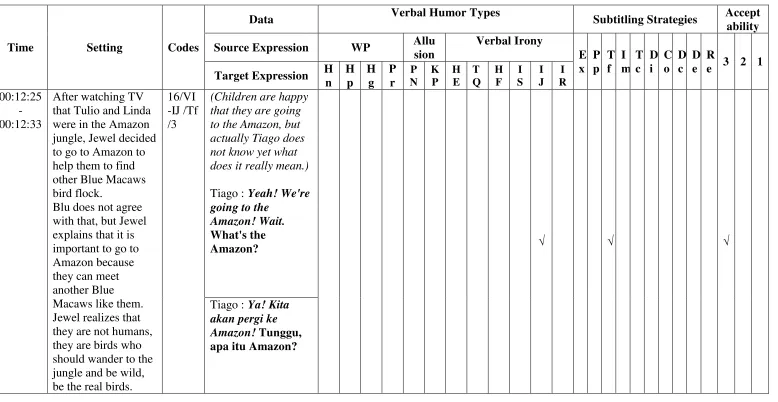
Table 2 : Example of Data Analysis of Dialogues Containing Verbal Humor and Their Indonesian Translation ... 71
Table 3 : Table of the Data Analysis of Acceptability Level in Translating Dialogues Containing Verbal Humor ... 72
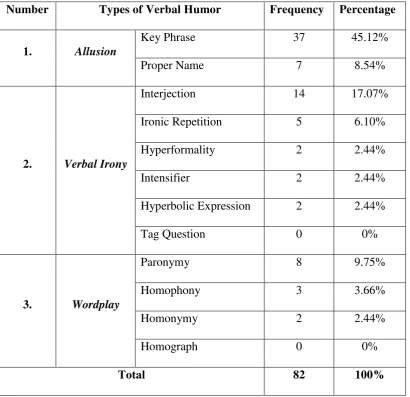
Table 4 : The Types of Verbal Humor Expressed by the Characters In Rio 2 Film ... 75
Table 5 : The Subtitling Strategies Applied in Translating the Verbal Humor in Rio 2 Film ... 76
Table 6 : The Acceptability Level in Bahasa Indonesia Subtitling Expression of the Verbal Humor in Rio 2 Film ... 78
Table 7 : Example of Allusion-Key Phrase (1) ... 80
Table 8 : Example of Allusion-Key Phrase (2) ... 81
Table 9 : Example of Allusion-Key Phrase (3) ... 82
Table 10 : Example of Allusion-Proper Name (1) ... 83
Table 11 : Example of Allusion-Proper Name (2) ... 84
Table 12 : Example of Allusion-Proper Name (3) ... 85
Table 13 : Example of Verbal Irony-Interjection (1) ... 87
Table 14 : Example of Verbal Irony-Interjection (2) ... 88
Table 15 : Example of Verbal Irony-Interjection (3) ... 89
Table 16 : Example of Verbal Irony-Ironic Repetition (1) ... 90
xiv
Table 21 : Example of Verbal Irony-Intensifier (1) ... 95
Table 22 : Example of Verbal Irony-Intensifier (2) ... 96
Table 23 : Example of Verbal Irony-Hyperbolic Expression (1) ... 98
Table 24 : Example of Verbal Irony-Hyperbolic Expression (2) ... 98
Table 25 : Example of Wordplay-Paronymy (1) ... 100
Table 26 : Example of Wordplay-Paronymy (2) ... 101
Table 27 : Example of Wordplay-Paronymy (3) ... 102
Table 28 : Example of Wordplay-Homophony (1) ... 104
Table 29 : Example of Wordplay-Homophony (2) ... 104
Table 30 : Example of Wordplay-Homonymy (1) ... 106
Table 31 : Example of Wordplay-Homonymy (2) ... 107
Table 32 : Example of Transfer Strategy Applied in Wordplay- Homonymy ... 109
Table 33 : Example of Transfer Strategy Applied in Wordplay- Homophony ... 110
Table 34 : Example of Transfer Strategy Applied in Wordplay- Paronymy (1) ... 111
Table 35 : Example of Transfer Strategy Applied in Wordplay- Paronymy (2) ... 112
xv
Phrase (1) ... 115
Table 39 : Example of Transfer Strategy Applied in Verbal Irony-
Hyperbolic Expression ... 115
Table 40 : Example of Transfer Strategy Applied in Verbal Irony-
Hyperformality ... 116
Table 41 : Example of Transfer Strategy Applied in Verbal Irony-
Intensifier ... 117
Table 42 : Example of Transfer Strategy Applied in Verbal Irony-
Interjection (1) ... 119
Table 43 : Example of Transfer Strategy Applied in Verbal Irony-
Interjection (2) ... 120
Table 44 : Example of Transfer Strategy Applied in Verbal Irony-
Interjection (3) ... 121
Table 45 : Example of Transfer Strategy Applied in Verbal Irony-
Ironic Repetition (1) ... 122
Table 46 : Example of Transfer Strategy Applied in Verbal Irony-
Ironic Repetition (2) ... 123
Table 47 : Example of Paraphrase Strategy Applied in Wordplay-
Homonymy ... 124
Table 48 : Example of Paraphrase Strategy Applied in Wordplay-
xvi
Phrase (2) ... 127
Table 51 : Example of Paraphrase Strategy Applied in Allusion-Key
Phrase (3) ... 128
Table 52 : Example of Paraphrase Strategy Applied in Verbal Irony-
Intensifier ... 129
Table 53 : Example of Paraphrase Strategy Applied in Verbal Irony-
Interjection (1) ... 130
Table 54 : Example of Paraphrase Strategy Applied in Verbal Irony-
Interjection (2) ... 131
Table 55 : Example of Imitation Strategy Applied in Wordplay-
Paronymy (1) ... 132
Table 56 : Example of Imitation Strategy Applied in Wordplay-
Paronymy (2) ... 133
Table 57 : Example of Imitation Strategy Applied in Allusion-Proper
Noun (1) ... 134
Table 58 : Example of Imitation Strategy Applied in Allusion-Proper
Noun (2) ... 135
Table 59 : Example of Imitation Strategy Applied in Allusion-Proper
Noun (3) ... 136
Table 60 : Example of Imitation Strategy Applied in Allusion-Key
xvii
Phrase (1) ... 139
Table 63 : Example of Resignation Strategy Applied in Allusion-Key
Phrase (2) ... 140
Table 64 : Example of Resignation Strategy Applied in Verbal Irony-
Interjection ... 141
Table 65 : Example of Condensation Strategy Applied in Allusion-Key
Phrase (1) ... 142
Table 66 : Example of Condensation Strategy Applied in Allusion-Key
Phrase (2) ... 143
Table 67 : Example of Condensation Strategy Applied in Verbal Irony-
Hyperbolic Expression ... 144
Table 68 : Example of Condensation Strategy Applied in Verbal Irony-
Interjection ... 145
Table 69 : Example of Expansion Strategy Applied in Wordplay-
Homophony ... 146
Table 70 : Example of Expansion Strategy Applied in Verbal Irony-
Interjection ... 147
Table 71 : Example of Deletion Strategy Applied in Allusion-Key
Phrase ... 148
Table 72 : Example of Transcription Strategy Applied in Allusion-Key
Phrase ... 149
xviii
Table 77 : Example of Acceptable Translation of Verbal Irony (1) .... 155
Table 78 : Example of Acceptable Translation of Verbal Irony (2) .... 156
Table 79 : Example of Less Acceptable Translation of Wordplay ... 157
Table 80 : Example of Less Acceptable Translation of Allusion ... 158
Table 81 : Example of Less Acceptable Translation of Verbal irony .. 159
Table 82 : Example of Unacceptable Translation of Allusion ... 160
Table 83 : Unacceptable Translation of Verbal Irony ... 161
Table 84 : Table Data Classifying Analysis ... 162
Table 85 : The Data Analysis ... 176
Table 86 : Table of Acceptability ... 218
xix
Figure 2 : Translation Process Proposed by Bell (1991) ... 13
xx
AVT : Audiovisual Translation SLT : Source Language Text
Co : Condensation ST : Source Text
Dc : Decimation Tc : Transcription
De : Deletion TE : Target Expression
Di : Dislocation Tf : Transfer
DVD : Digital Versatile Disc TL : Target Language
Ex : Expansion TLT : Target Language Text
HE : Hyperbolic Expression TT : Source Text
HF : Hyperformality TQA : Translation Quality
Hg : Homograph Assesment
Hn : Homonymy TQ : Tag Question
Hp : Homophony TQ : Tag Question
IJ : Interjection VEH : Verbal Expressed Humor
Im : Imitation VH : Verbal Humor
IR : Ironic Repetition VI : Verbal Irony
IS : Intensifier VCD : Video Compact Disc
KP : Key Phrase WP : Wordplay
PN : Proper Noun
Pp : Paraphrase
Pr : Paronymy
Re : Resignation
xxi
Appendix 2 : Questionnaire to Determine Acceptability in Verbal Humor
Translation of Rio 2 Film ... 218 Appendix 3 : The Representative of Data Questionnaire to Determine the
Acceptability ... 222
xxii
11211141001
ABSTRACT
Verbal humor is humorous expression in which inherently concerns with the verbal matters. This research attempts to analyze how the verbal humor expressions in Rio 2 film are translated into Bahasa Indonesia subtitling expressions. In doing this research, three objectives are formulated: 1) to describe the types of the verbal humor, 2) to describe the subtitling strategies used by the translator to translate the verbal humor, and 3) to explain the acceptability level of the verbal humor in the English Rio 2 film expressions used in Bahasa Indonesia subtitling expressions.
This research employed a qualitative method since it provided descriptions of translation phenomena in Rio 2 film. The form of the data of this research were words, phrase, and sentences containing verbal humor that were collected manually from the DVD of Rio 2 film. The main instrument of this research is the researcher himself and the second instrument is the data sheets. The data are categorized based on some theories; verbal humor theory proposed by Spanakaki (2007), and subtitling strategies theory proposed by Gottlieb in Taylor (2000). To achieve data trustworthiness, the data sheets are repeatedly examined by the researcher and some peers and the results are discussed with the supervisors and the respondents.
The results of this research show the three important findings. First, the types of verbal humor found in Rio 2 film are allusion (key phrase and proper noun), verbal irony (interjection, ironic repetition, hyperformality, intensifier, and
hyperbolic expression), and wordplay (paronymy, homophony, and homonymy). Among them, allusion (key phrase) is in the highest occurred number. Second, there are eight subtitling strategies applied by the translator to translate the verbal humor; transfer, paraphrase, imitation, resignation, condensation, expansion, deletion, and transcription in which transfer becomes the most commonly used strategy. Third, from 82 data, there are 66 data (80,49%) belong to acceptable level, 13 data (15,85%) belong to less acceptable level, and 3 data (3,66%) belong to unacceptable level. This finding indicates that the translation of the verbal humor dialogues in Rio 2 film is considered as acceptable translation.
1 A. Background of the Problem
Laughter naturally exists in human beings even in infants a few months
old. Trigger of laughter can be caused by various things, such as being tickled,
reading funny stories, watching comedies, or listening to ridiculous sound. How
such things can cause laughter apparently has been a subject of research for
scientists to investigate further about humor, especially linguists, cognitive
experts, and psychologists. Humor not only gives positive benefits to the human
body, but also has an important role in the social life of the community.
Therefore, humor is an important component of human communication. It makes
people friendlier that can be used for resolving the problem of communication. It
is necessary to note that the ability to produce and appreciate humorous activities
is important to human’s culture and social interaction.
In addition, humor also continuously grows as it follows what is
happening in the society. It is one of the essential parts of intercultural
communication and mass entertainment such as literary works and films. Various
kinds of things in human life could potentially be used as material to make a thing
to be funny, such as social inequality, a strange phenomenon, the latest trends, or
political satire. Humor can also be used as a medium to convey the message
properly because it is relaxing and entertaining. The works of humor can spread
Afterwards, media are the device in human interaction; its form can be
either printed or electronic. Thus, this modern era of technology makes
audiovisual product to become the most popular and easiest way to distribute any
information. The world is greatly influenced by them as well. More specifically, it
could be in the form of films, television programs, musics, operas, web pages,
video games, etc. Meanwhile, those features are just some examples of the vast
array of available audiovisual products.
In line with this progress, translation is exactly needed for these features of
media which represents a significant amount of translation performed recently. It
has made its own discipline that now is known as audiovisual translation (AVT). It is the term which is used for transfering the translation of the verbal
components containing audiovisual works and products. Moreover, audiovisual
products require to be both heard (audio) and seen (visual) equally but they are
mostly to be seen, especially in films or television programs.
Since the materials of audiovisual are meant to be seen and heard
simultaneously, the technique which is applied to translate them is different from
written text. On one hand, written works are mainly used to be read such as books,
newspapers, journals and magazines which are enhanced and illustrated with
photographs, diagrams or graphs as the verbal content. On other hand, translating
audiovisual product needs another form of technique which is called subtitling. It is translation that enables the source expression (SE) and the target expression
In this regard, the function of subtitles is to facilitate the audience to get
information, and occasionally entertainment, for both the source expression and
the target expression simultaneously. The job of subtitlers is influenced by the
time and space hindrance since there is only a room for a limited amount of
characters in subtitles that also can only be seen for a limited period of time
depending on the speed delivery in the source expression. That is why reduction is
necessary to overcome this matter because the audiences absorb speech quicker
than they can read. Thus, it must have time to register and understand the subtitles
well. To sum up, it can be understood that subtitle is a reduced form of the source
expression. Most of subtitlers use reduction to employ the message throughout the
subtitle. However, although some words are disappeared on the screen, it does not
mean that the message of the source expression is lost. Therefore, the competence
of the translator is very influential in translating through the subtitle. He or she
should select the most appropriate word to convey the message of the source
expression to the target expression.
In spite of all translators have been trained to deal with some difficulties in
translating, what makes translation even more complicated is when it encounters
with the sense of humor. In this respect, humor has various levels of applicability
that are partly universal, cultural and linguistic, or individual which makes it
becomes a real problem for a translator to translate the works of art in general.
However, it depends on the skills of the translators such as whether they are able
When trying to translate humor, cultural elements and language-specific
devices make the process of translating more difficult. What sounds funny in one
language or culture can be regarded as unfunny in another language or culture. In
addition, there are some terms related to the sense of humor, such as anecdote,
comedy, comic, jokes, pun etc. Those terms will be explained as the following
statements.
According to Oxford Dictionary, 8th edition, (Hornby, 2010) anecdote is a
short, interesting or amusing story about a real person or event. Comedy is a play,
or film that is intended to be funny, usually with a happy ending; plays and films
of this type. Comic is entertainment that amusing and makes people laugh. Joke is
something that somebody says or does to make people laugh. Pun is the clever or
humorous use of a word that has more than one meaning, or of words that have
different meanings but sound the same. Meanwhile, humor itself means the
quality in something that makes it funny or amusing; the ability to laugh at things
that are amusing. Since the text to be studied is only humor expression in which
inherently concerns with the verbal matters, the term verbally expressed humor
(VEH) or can be called simply here as verbal humor (VH) is used in this thesis.
Verbal humor is different from humor accompanied by action that the characters
do in the film. It means that verbal humor is rather pure verbal expression of
humor than the humor added by any action to arise the audiences’ laughter. Thus,
this research will be more examined verbal humor than the character’s physical
In addition, it is called as humor-action or situational humor if the viewers laugh by simply watching the action of what the characters do or show funny
expressions on the screen without much understanding of what they are talking
about. Afterwards, translating verbal humor is not as easy as translating the humor
which accompanied by figure’s actions. Therefore, it is definitely different. This
problem yet includes the challenge for translators to search a resolution.
Nevertheless, film is a form of media that most people in the world are
interested in. Since films from foreign language need to be translated, it is a job
for translator to render the most significant and appropriate meaning of the source
expression as good as possible. When doing the translation, the translator should
be able to think like the minds of people in the source language, then transferring
it into the target expression as natural as possible in which suitable with the
culture norm in the target language.
In addition, it is necessary to note that the researcher takes Rio 2 film as the object of analysis. It is a 2014 American 3D computer-animated musical
adventure-comedy film produced by Blue Sky Studios and directed by Carlos Saldanha. More specifically, it is the sequel to the 2011 computer-animated film
Therefore, the translator has to pay highly attention to the basic theories of
translation which can be applied to the translation targeted for children especially
in subtitle discipline. Since the film performs many comedies in its verbal
language of the characters, verbal humor in this film is important to be observed.
B.Focus and Formulation of the Problem
Humor can be defined as anything that causes amusement, mirth,
spontaneous laughter and smile. However, humor differs from culture to culture
which makes verbal humor as the most difficult text to translate. There are also
distinctions between purely verbal humor and humor which is accompanied with
the action of the characters. Some aspects that are found in Rio 2 film can be explained as follows; language, culture, subtitle and humor.
In terms of language, sometimes the translator makes complicated sentences in subtitling which causes humor failed to be rendered. There were
many idiomatic expressions that were intentionally expressed to evoke the
laughter of the audiences from the source expression but it did not represent the
real meaning of what the characters said in the target expression. Therefore, the
selection of using words is highly recomended to translate the humor senses.
Moreover, the translator’s skill to build creative resolution in word choice is the
key of good quality in humor translation. The second aspect is cultural aspect. It is also difficult because it requires to negotiate not only between the two
languages, but also both cultures. Before selecting a strategy in translating cultural
matters, the translators must consider the norms of the target culture and the
Thus, there must be a complete comprehension about keeping the meaning
and the sense in order to obtain culturally acceptable translation to the target
audiences especially for children, because the children’s background knowledge
and understanding depend on their awareness in intercultural differences. In
addition, children from a certain continent might not fully understand the culture
from another continent. Hence, the translator’s capability to employ adaptation
theory is suggested in order to give the children viewers such understanding about
the connection between the story in the film and its culture. Since children still do
not fully understand other culture like how adults do, the translation must be
considered carefully.
The third aspect is subtitling aspect. Since subtitle is different from written translation as books; it does not have much freedom when translating an
audiovisual product. Although it is not easy to convey the full semantic meaning
of the source text, subtitlers constantly have to follow the norms of written
language and they must condense the original. Obviously, this aspect affects the
translation whether the translator has to reform or retain the meaning in order to
adjust to the limitation of the subtitling rules. Moreover, humor differs from
culture to culture. Thus, the subtitlers need to create long and complicated
explanations when they deals with translating humor in order to convey the humor
as natural as possible. Finally, it is important to note that translators have to
consider to use what kinds of subtitle strategies to translate the verbal humor in
the source expression to the target expression because the sense of verbal humor
The last aspect, on which the researcher tends to keep much attention in
this research, is humor. There are some problems in translating verbal humor in
Rio 2 film which need to be analyzed. Before finally making a decision in considering language to translate the humor, subtitlers must recognize the humor,
then considerably think about negotiating the meaning between the source
language and the target language. The subtitlers should aim at recreating the same
viewing experience by adapting the humor to the target audiences.
Based on the problems identified above, the problems of the study are
formulated as follows.
1. What types of verbal humor are found in the English Rio 2 film expressions? 2. What are the subtitling strategies used by the subtitler in translating the verbal
humor in the English Rio 2 film expressions into Bahasa Indonesia subtitling expressions?
3. How acceptable is the translation of the verbal humor in the English Rio 2 film expressions used in the Bahasa Indonesia subtitling expressions?
C. Objectives of the Research
The expected objectives of this research are:
1. to describe the types of verbal humor found in the English Rio 2 film expressions and their Bahasa Indonesia subtitling expressions,
2. to describe the subtitling strategies used by the subtitler in translating the
3. to explain how acceptable is the translation of the verbal humor in the English
Rio 2 film expressions used in the Bahasa Indonesia subtitling expressions.
D. Significance of the Research
This research has two benefits, those are explained as follows.
1. Theoretical Significance
This reseach study can be used as additional reference for lecturers in
teaching and students in learning translation subject. It also can give useful insight
to the field of translation, especially concerning with verbal humor and the
strategies to translate it.
2. Practical Significance
This research study can give better understanding for the viewers of the
film, especially in understanding the verbal humor that employed by the
10 CHAPTER II
LITERATURE REVIEW
A. Theoretical Review
This part investigates the theories of translation, its processes, and types of
the translation. This research analyzes verbal humor and subtitiling matters, in
which audiovisual translation that contains subtitling strategies will be examined
further. In addition, since the data of analysis are taken from the subtitle of Rio 2
film, the summary of the film will also be presented later. The previous study
which is connected to this research is going to be explained with some similarities
and differences toward this investigation as the latest research.
1. Translation
When it comes to the word translation, most of people will think about the process of changing something that is written or spoken into another language. In
order to discover more about it, this section will further discuss the notions of
translation, the processes of translation, and the types of translation. Those three
sections are studied according to some experts of translation studies.
a. Notions of Translation
Traditionally, translation can be understood as a process of transferring
meaning, idea or message of a text from one language to other languages.
Afterwards, it can be transpired in the same or different languages but more
familiar in the different languages. Therefore, it will be clarified in some
Benhaddou (1991: 2) states that translation, in the real sense of the word,
is not a mere transfer of syntactic structure of one language into another language.
There are some other aspects of language that should be considered in any
operation of this kind. Thus, it is important to consider that the readers or
audiences of the target language accept the same information as well as the
readers or audiences of the source language. This consideration includes the
clarity, accuracy, and naturalness of the meaning or messages of the translation.
Nevertheless, according to Hatim and Munday (2004: 6), translation is a
process of transferring a written text from source language (SL) to the target
language (TL). In this definition, they emphasize that the object being transferred
in translation is a process. Besides, Meetham and Hudson in Bell (1991: 6) define
translation as the replacement of a representation of a text in one language by
representation of an equivalent text in a second language. This definition stresses
in exchanging of the representation of meaning equivalence from the source
language to the target language.
Meanwhile, translation is also mentioned by Nida and Taber (1982: 12).
They state that translating consists in reproducing in the receptor language the
closest natural equivalent of the source language message. This definition is more
comprehensive than the previous ones. They clearly state that translation is
closely connected to the matters of recreating the meaning as natural equivalence
From the several definitions mentioned above, translation as a process of
transferring according to Hatim and Munday is more appropriate to be used. It can
be said that translation is a process which is obligated to find the meaning
equivalence and preserved features of the original text in the target text. In brief,
the process of translation is emphasized here as the main problem in translating to
find the equivalent meaning of translation, in this regard, in translating the verbal
humor matters.
b. Processes of Translation
Translation process is the complete activity which is done by the
translators to transfer a message, meaning, or idea from source language into
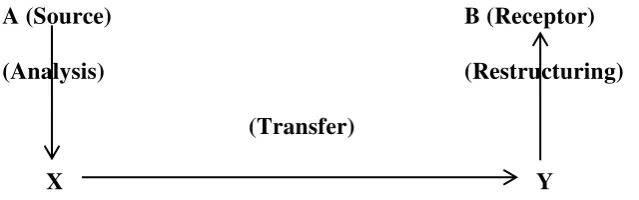
target language. According to Nida and Taber in Munday (2001: 39-40), they state
that translation process consists of three stages which can be illustrated as follows.
A (Source) B (Receptor)
(Analysis) (Restructuring)
(Transfer)
[image:35.595.169.489.490.590.2]X Y
Figure 1. Translation Process by Nida and Taber in Munday (2001)
In the first stage, which is the beginning of the structure that the meaning
is given in source language A, analysis can be defined as analyzing in terms of the grammatical relationship and the meaning of the words or the combination of the
In the second stage, transfer can be defined as analyzing material which is transferred in the translator’s mind from the source language A to the target
language B. In the last stage, restructuring can be defined as transferring material which is restructured in order to make the final message fully acceptable
translation in the receptor of the target language. Relating to this research,
translating verbal humor expression does not only need transfer process, but also
another process in which connected to the semantic (meaning) and style (form) of
the verbal humor in order to make the translation acceptable in the target
language’s culture as natural as possible. In this respect, the researcher then takes
into consideration of another concept of the translation process which is proposed
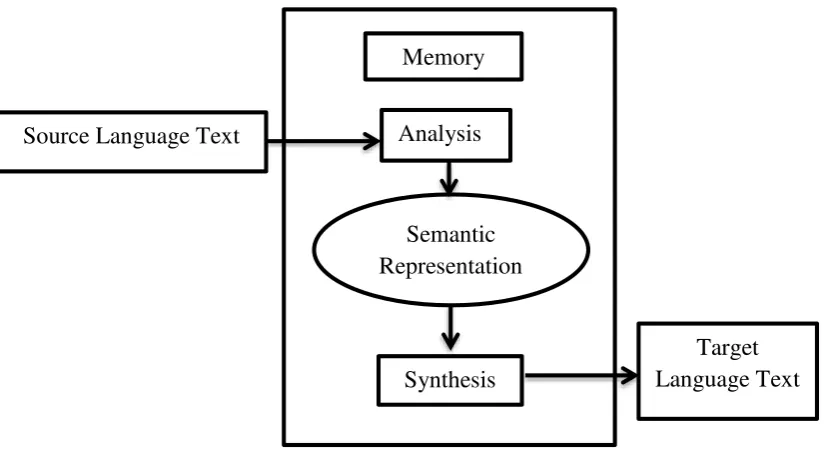
by Bell (1991: 20). He states that translation process is the transformation of a
source language text into a target language text by means of processes which
takes place within memory of human beings. Further, it can be seen more
[image:36.595.106.526.493.719.2]specifically in the following figure.
Figure 2. Translation Process Proposed by Bell (1991)
Source Language Text
Memory
Analysis
Synthesis Semantic Representation
The above figure shows the analysis of one language-specific text (the
source language text, the SLT) into a universal (non-language-specific) semantic
representation and the synthesis of that semantic representation into a second
language-specific text (the target language text, the TLT). Those stages show that
translation is not an easy process because the translator should take into
consideration to transfer the representation of the meaning equivalence in the
target language. Both theories describe that the translators must pay highly
attention towards the stage of analysis to discover the equivalent meaning before
they transfer and re-express the meaning. Besides, they also have to mind about
the stage of restructuring of synthesis in order to get the meaning as natural as
possible in the target language culture.
Since this research is mostly related to the analysis of not only semantic
representation (meaning), but also the synthesis (form or style) of the verbal
humor from the source expression to the target expression, the process of
translation proposed by Bell (1991) is more appropriate to be used. Therefore, by
using this process, the translated expression of the verbal humor which consists of
Wordplay, Allusion and Verbal Irony hopefully can be excellently delivered as an acceptable translation in the target language as well.
c. Types of Translation
There have been many observations and proposals regarding the types of
translation. This segment will explain further about the types of translation
Newmark (1992) divides two basic types of translation, namely
communicative and semantic. These two approaches differ in terms of method, means, as well as the texts which are translated. Semantic translation is trying to
maintain the structure of semantic, syntactic, and the contextual meaning of the
source language text. Thus, the cultural elements of the source language should be
maintained even though it is presented in the text of the target language
translation. More specifically, some textssuch as a poem and a song lyric require
semantic approach, others, like advertising texts, or journalistic prose, must be
translated in a communicative fashion.
Further, in communicative translation, the translator can improve the logic
of the sentences of the source language, such as replacing words and rigid
structures with a more flexible, eliminating part of the unclear sentence,
eliminating repetition, and modifying the use of jargon (Newmark, 1981: 42). In
addition, this approach aims at creating the effect of the audience in the target
language as well as the experience of the audience in the source language do.
Since this research is aimed to analyze the film which includes the sense of
humor, the best method to be applied is communicative approach. Thus, the
translation will not sound clumsy or awkward in order to create an acceptable
1) Intralingual Translation or Rewording
Intralingual translation or rewording is an interpretation of verbal signs by means of other signs of the same language. This type of translation would occur
when the translators rephrase the messages, expressions, or texts in the same
language to explain or clarify something that might be spoken or written. In this
case, the translator uses synonyms to be translated using another expression
although the message in the source text (ST) remains the same.
2) Intersemiotic Translation or Transmutation
Intersemiotic translation or transmutation is an interpretation of verbal signs by means of non-verbal sign systems or vice versa. This type of translation
would occur when a written text were translated, for instance, into music, film, or
painting. The message is transferred from one symbol system or sign system into
a language or another form.
3) Interlingual Translation or Translation Proper
Interlingual translation or translation proper is an interpretation of verbal signs by means of some other languages. This type is more familiar in translation
field which is involved two or more languages. In addition, this research is using
this type of translation that the source expression is in English and the target
expression is in Bahasa Indonesia.
Afterwards, there are some divisions concerning with this type of
In the academic field of Translation Studies, an endeavor has been made to
provide more specific criteria for defining the translation activities; it can be
written, spoken, and audiovisual translation. Kade in Schaffner (2004: 1) stated
that for a translator (written translation), the source text is available in some fixed form; for example, printed on paper, until the target text has been produced. This
allows the translators to refer back to the source text in order to correct and revise
the target text. In contrast, an interpreter’s job is to translate what somebody is
saying into another language directly. He or she gets only one attempt in
producing the target text from the source text which is presented to the interpreter
orally and only once whereas the target text has to be produced immediately.
Meanwhile, audiovisual product (audiovisual translation / AVT) is in different type of translation. It is a process of translation from “spoken” as the source
language (SL) to a “written” as the target text (TT). Since the source expression
and the target expression are in different language, this research is regarded into
the interlingual translation.
In general, audiovisual translation is included to a new field of research
studies. Audiovisual product involves both sound and picture in order to get
whole understanding of the work product. Since its development is not only in the
local area but also throughout the international area which conveys diferrent
language and culture, the translation is demanded to transfer the message as well
as the style of the source expressions to the target expressions. Therefore, this part
will explain more about its theories and types based on the thoughts from several
The basic understanding of audiovisual translation mode known as
subtitling is that, in the beginning, it is intended primarily for cinema, and television use, by the help of a visual component in the form of (video) recording
and the final script of the original live subtitles. Audiovisual product is made to be
both heard (audio) and seen (visual) simultaneously but they are primarily meant
to be seen. Moreover, Chiaro (2013: 1) defines audiovisual translation as the term
used to refer to the transfer from one language to another of the verbal
components contained in audiovisual works and products. This definition shows
that audiovisual products contain a series of verbal messages that will be
perceived both acoustically and visually.
However, audiovisual translation is different from translating printed texts
because audiovisual materials are meant to be seen and heard simultaneously.
Written works are primarily meant to be read, while the verbal and visual contents
of audiovisual products are meant to be watched inseparably to create a whole
meaning. In addition, there are three types of Audiovisual Translation; namely
dubbing, voice-over, and subtitling. These three types will be explained as
follows.
a) Dubbing
The intention of dubbing is to make the translated dialogue appear as if
being spoken by the actors in the target language. It means that the displacement
of the original speech by a voice track has to follow of the timing, phrasing, and
Ivarsson in Alkadi (2010: 48) claims that dubbing started in 1927 when the
audience could hear the actors. By 1929 dubbing studios had spread all over
Europe. Dries in Alkadi (2010: 48) also maintains that dubbing was introduced at
about the same time as the introduction of the original sound to the moving
picture. At the same time the problem of exporting films to countries with
different languages needed a solution, similarly to dubbing. Nonetheless, Maluf in
Alkadi (2010: 48) puts this differently. He suggests that when the articulation,
intonation, accent, or dialect of the stars of the silent silver screen were
inappropriate for the new films, studios resorted to dubbing over the dialogue by
adjusting the mouth movements of the original actors in the film to the voice of
other actors. Therefore, the harmony between the performing characters and the
dubbing voices of the characters in terms of temper, reaction, body movement and
language must be synchronous.
b)Voice-over
According to Oxford Dictionary, 8th edition, (Hornby 2010) voice-over is information or comments in a film or movie, television programme etc., given by
a person who is not seen on the screen. In addition, voice-over is commonly used
in a radio, television production, filmmaking, theater, or other presentations. It is
read from script and spoken by a specialist voice actor. Furthermore, voice-over
translation is an audiovisual translation technique in which the actor’s voices are
recorded over the original audio track which can be heard in the background. This
method of translation differs from dubbing and is often used in documentaries or
c) Subtitling
According to Gottlieb in Chiaro (2013: 4), subtitle consists of the
rendering in a different language of verbal messages in filmic media in the shape
of one or more lines of written text presented on the screen in sync with the
original message. Subtitle is an abbreviated written translation (compressed,
shorter written expression, etc) of what can be heard on the screen. Subtitles also
significantly reduce the original dialogue simply because viewers need the time to
read them without running the risk of missing any action scene on the screen.
Furthermore, Antonini in Chiaro (2013: 4) statesthat the subtitling process
involves three basic steps: elimination, rendering, and condensation. Elimination
consists in reducing elements that do not change the meaning of the source
dialogue such as false starts, repetitions, and hesitations. Rendering refers to the elimination of taboo items, slang, and dialect. Condensation involves the simplification of original syntax in order to render the subs more easily readable.
In addition, Gottlieb in Chiaro (2013: 4) also mentions about the rules that
subtitles were restricted to thirty (30) to forty (40) characters including spaces that
were displayed at the center bottom of the picture, or else left-aligned. Therefore,
it can be concluded that subtitling is words that translate what is said in a film into a different language and usually appears at the center bottom of the screen. Since
the researcher uses a film as the object of analysis, there will be subtitle as the part
of investigation in conducting this research. He needs to explore more about
2. Subtitling Strategies
There have been many scholars developed the theories of subtitling
strategies. Choosing an appropriate strategy is the basic task for the subtitler to
translate the audiovisual product—in this regard the verbal humor expressions.
Afterwards, if it is compared to dubbing, subtitling is simpler and cheaper. One
prominent scholar in the translation field who has proposed subtitling strategies is
Henrik Gottlieb. As stated by Taylor (2000), Gottlieb’s translation strategies for subtitling of film are as follows.
a. Expansion
Expansion is used when the original requires an explanation because some
cultural nuance is not retrievable in the target language. For example:
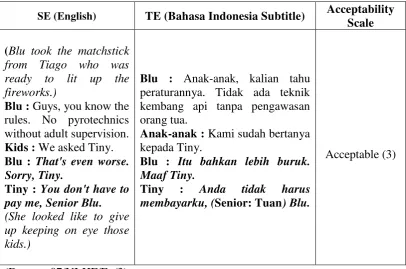
(Setting: Blu and Jewel find their children playing fireworks. They worry about their children to play it because it is dangerous for them. In the scene, Blu takes the matchstick from Tiago who is ready to lit up the fireworks.)
SE : Blu : Guys, you know the rules. No pyrotechnics without adult supervision.
Kids : We asked Tiny.
Blu : That’s even worse. Sorry, Tiny.
Tiny : You don’t have to pay me, Senior Blu. (She seems to give up in keeping on eye those kids).
TE : Blu : Anak-anak, kalian tahu peraturannya. Tidak ada kembang api tanpa pengawasan orangtua.
Anak-anak : Kami sudah bilang ke Tiny. Blu : Itu bahkan lebih buruk. Maaf, Tiny.
Tiny : Anda tak harus membayarku, (Senior : Tuan) Blu.
In this example, expansion strategy is applied in translating the utterance
of the character (Tiny). The word “Senior” which comes from Spanish is
translated into the target language becomes “Tuan” which employs the same
Further, the word “Senior” in English has different meaning if it is
translated literally to the target language which means a person who is older than somebody else. Therefore, it needs more explanation in the target language.
b. Paraphrase
Paraphrase is resorted to in cases where the phraseology of the original
cannot be reconstructed in the same syntactic way in the target language. For
example:
(Setting : People in Rio de Jeneiro city are in the party to celebrate the new years eve. They are dancing and singing “What Good is Love” together. They look so happy at the moment. Beside, all birds in bird sanctuary are also dancing and singing together as the same rhytm with humans.)
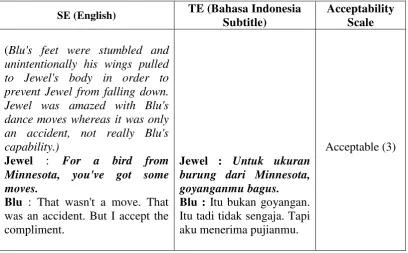
SE : Jewel : From a bird from Minessota, you’ve got some moves.
Blu : That wasn’t a move. That was an accident. But I accept the compliment.
TE : Jewel : Untuk ukuran burung dari Minnesota, goyanganmu bagus.
Blu : Itu bukan goyangan, itu tadi tidak sengaja. Tapi aku terima pujianmu.
In the example above, the translator uses paraphrase to translate this
utterance in order to make the audiences easier to understand. Although the
translator using another word, he did not lose the meaning and the style of the
humor expression from the source language. This is the function of using
paraphrase strategy that the translator has to creatively find another different
words to express the humorous effects to be accepted by the target audiences as
c. Transfer
Transfer refers to the strategy of translating the source text completely and
accurately. For example:
(Setting : Blu is going to the Amazon with his family as a request from Jewel, his wife, to find another flock of Blue Macaws. Blu seems extremely worry about it but Rafael tries to persuade him to go for the sake of his wife.)
SE : Rafael : If this is important to Jewel, just do it! Happy wife, happy life.
Remember that!
TE : Rafael : Kalau ini penting bagi Jewel, lakukan saja! Istri bahagia, hidup bahagia. Ingat itu!
This translation is translated completely and accurately without any missed
or added message from the source expression to the target expression. The
translator can successfully maintain the style and meaning of idiomatic verbal
humor expression in the source expression to the target expression using transfer
strategy.
d. Imitation
Imitation maintains the same forms, typically with names of people and
places. For example:
(Setting : Nigel succeds to run away from the market where he is being imprisoned. He rides Charlie, a tapir, as his vehicle. Gabi, who falls in love with Nigel, joins them too.)
SE : Nigel : The croaking cockatoo doth bellow for revenge. That’s
Shakespeare, by the way.
Gabi : Without your performance, it’s nothing.
TE : Nigel : Kakaktua yang bernyanyi ini akan membalaskan dendamnya. Sebenarnya itu syair Shakespeare.
In the example above, the expression “the croaking cockatoo doth bellow
for revenge” may cause the audience confused about the statement because they know nothing about this expression except if there is an addition phrase further
that this expression is originated from the words of famous playwright. It is
adapted from the popular idiom “the croacking Raven doth bellow for revenge” in
Hamlet which is written by Shakespeare. In the scene, Nigel has a revenge to Blu
who has given the misery in his life. Nigel makes allusion on his utterances. It
brings fun to the expressions. In the target expression, the translator imitates the
name of the greatest author in 16th century, Shakespeare. The translator creatively
delivers this verbal humor expression by using imitation strategy so that the verbal
humor expression in the target language can be easily understood by the
audiences.
e. Transcription
Transcription is used in those cases where a term is unusual, even in the
source text, such as the use of third language or nonsense language. For example:
SE : Monkey : At first sight of trouble, I’ll give you a signal; Ka-kaw! Kee-kee!
TE : Monyet : Bila terlihat bahaya, aku akan beri aba-aba; Ka-kaw! Kee-kee!
“Ka-kaw! Kee-kee!” is the term used when Monkey says to Po (Panda)
in Kung Fu Panda 2 film to give a signal if Wolfs as the guard of the jail, their enemy, are coming. This term is only used in this film which becomes nonsense
for anybody who does not watch the film because they do not understand the
meaning or the function of that signal. The translator uses transcription strategy to
f. Dislocation
Dislocation is adopted when the original employs some sort of special
effect, e.g. a silly song in a cartoon film, where the translation of the effect is
more important than the content. For example:
SE : Po Panda : My fist hungers for justice. (Then something is growling from his stomach). That was my... fist.
TE : Po Panda : Tinjuku lapar akan keadilan. (Perutnya berbunyi). Itu tadi... tinjuku.
This is the effect of what characters do in the film. In the scene, there is a
sound growling from the character’s stomach (Po) when he starts to fight the
bandits who attack the village. Since his belly is so fat and always be hungry and
then it sounds growling in the middle of fighting, it brings fun to the conversation.
That sound is an important factor of the scene to arouse the viewer’s laughter.
g. Condensation
Condensation would seem to be the typical strategy used, that is the
shortening of the text in the least obtrusive way possible, but it is not necessarily
the case. For example:
SE : Po Panda : Nothing is unstoppable except for me when I'm stopping you from telling me something is unstoppable!
TE : Po Panda : Tiada yang tak terkalahkan kecuali saat aku bilang, berhenti bilang begitu!
This uses condensation strategy to shorten the translation of the target
h. Decimation
Decimation is an extreme form of condensation where, perhaps for reasons
of discourse speed, the potentially important elements are omitted. For example:
SE : Po Panda : Danger! Tell those musicians to start playing some action music because it is ON. Don't worry Master Shifu, I'll master inner peace
as soon as I get back.
TE : Po Panda : Bahaya! Minta para pemusik memainkan music aksi, sebab kita akan bertempur. Tenang Shifu, aku akan belajar kedamaian jiwa.
There is omission part of the expression “as soon as I get back” in the target expression, but this function is to shorten the expression due to reasons of
reduction of the content and discourse speed.
i. Deletion
Deletion refers to the total elimination of parts of a text. For example:
SE : Po Panda : Hahaha! Snack stops,pffft. Wait, are you serious? TE : Po Panda : Kudapan. Tunggu, kau serius?
The above translation loses the important element of the dialogue. The
word “stop” is ommited in which it influences the meaning in the target expression. Thus, the translation changes and makes the important element failed
to be conveyed to the target expression.
j. Resignation
Resignation describes the strategy adopted when no translation solution
can be found and the meaning is inevitably lost. This often occurs with
SE : Po Panda : Y-you, w-woo, kung fu is, de-eaad? Fine! You stay in your prison of fear, with bars made of hopelessness... And all you get are three square meals a day of... shame!
Master Croc : With despair for desert.
TE : Po Panda : Aku, kalian, kung fu sudah mati? Baiklah! Kalian tinggal di penjara ketakutan dengan jeruji keputusasaan. Hanya dengan tiga kali santapan memalukan sehari!
Guru Buaya : Dengan pencuci mulut tanpa harapan.
In this strategy the translator is unable to render the source expression
adequately. It has to use different expression in order to render the meaning and
humor accurately in the target language.
3. Verbal Humor
There have been numerous observations and proposals regarding the
nature of humor. This segment will explain further about verbal humor theories
and types according to some experts of translation studies.
a. Notions of Verbal Humor
Humor is multi-disciplinary field of research. People have been working
on humor in many fields of research especially in linguistic, sociology, and
literature. Humor also affects the social phenomenon and serves various types of
social or interpersonal purposes. It is exceedingly related to the culture sense
because humor differs from culture to culture. What is humorous in one culture is
not always humorous in another culture. Furthermore, Hassaine (2014: 2) states
that the innovative and artful use of language can be detected in human beings’
aptitude to produce verbal humor. Being a universal trait of human language
For instances, it pervades in many types of interaction and discourse, and
insinuates a lot of forms of entertainments. Nevertheless, Jensen (2009: 2) stated
that humor is a quite social thing, but at the same time it is also highly individual
and very much a matter of personal tastes and preferences. It means that humor
may change over time. It depends on one’s mood, the context of the situation, and
the capacity of individual for appreciating something as being humorous or funny.
In addition, there is a distinction between conceptual humor and verbal
humor. According to Jensen (2009: 2), conceptual humor involves concepts or ideas that are thought as humorous without using aspects of language for other
purposes conveying the humorous message, while verbal humor occurs when an aspect of language is exploited in order to achieve a humorous effect. Since the
data taken from this research is the matter of verbal humor, this research only
analyzes about the verbal humor which is available in the object of analysis.
b. Types of Verbal Humor
There are three kinds of verbal verbal humor based on Spanakaki (2007),
those are wordplay, allusion, and verbal irony. Each categorization of verbal
humor will be explained as follows.
1) Wordplay
Wordplay is one kind of verbal humor that usually used to created a joke.
It is literary technique and a form of wit in which the words that are used become
the main subject of the work, primarily for the purpose of intended effect or
According to Delabastita in Spanakaki (2007), wordplay is the general
name for the various textual phenomena in which structural features of the
language(s) are used are exploited in order to bring about a communicatively
significant confrontation of two (or more) linguistic structures with more or less
similar forms and more or less different meanings. For example:
SE : We need something that can make us winggle. Something that make us jiggle.
TE : Kita membutuhkan sesuatu yang bisa membuat kita bergoyang. Sesuatu yang bisa mengguncang.
The word “winggle” is originated from the word “wiggle” which means to move from side to side or up and down in short quick movements; to move
something in this way. Since they are birds which have wings, the character said
“winggle” as the result of association between the word “wing” and “wiggle”. In
addition, the last word at the end of the sentence he said “jiggle” to make a
perfect rhyme.
Furthermore, According to the type and degree of similarity, wordplay can
be divided into the following categories (Delabastita, 1996: 128 in Spanakaki,
2007).
a) Homonymy
Homonymy is a type of wordplay which has identical spelling and sounds
but different meaning. For example, the word can in English meaning ‘be able’
and also can meaning ‘put something in a container’. In the context of verbal
SE : Eduardo : Brazil nut trees. These trees are the key to our way of life. The trees feed us. The sustain us.
Blu : (Sleep)
Eduardo : Hey, wake up! (Waking Blu up).
Blu : I'm up! Nutty Brazil... Brazil nut trees, something. Yeah, got it.
TE : Eduardo : Pohon kacang Brazil. Pohon-pohon ini adalah kunci untuk menjalankan hidup kita. Pohon-pohon yang memberi makan kita. Mereka menyokong kehidupan kita.
Blu : (Tidur) Eduardo : Bangunlah!
Blu : Aku bangun. Brazil Gila... Kacang Brazil, semacam itu. Iya, aku mengerti.
In the dialogue above, Blu said “Nutty Brazil” and “Brazil Nut” which have same spelling but different meaning. First nut means a strange or crazy
person, while the second nut means a small hard fruit with a very hard shell that
grows on some trees.
b)Homophony
Homophony is a type of wordplay which is pronounced like another word
but has a different spelling or meaning. For example, the word some, and sum
/s∆m/. In the context of verbal humor, it can be seen as the following example.
SE : Carla : Here's the plan. Auditions today... And we preview the show tomorrow.
Pedro : "Oui"? What are you talking about, "oui"? You speak French?
Carla : Come on, chop-chop. Let's get started! Rafi : Wow, kid's been working.
TE : Carla : Ini rencananya. Audisi hari ini. Dan kita akan mempersembahkan pertunjukkannya besok.
Pedro : Kita? Apa yang kau maksudkan dengan "kita"? Kau berbicara bahasa Perancis?
In the dialogue above, Pedro misundertood about the word “we” in English
and “oui” in French which are pronounced like one another but have different
meaning as well. “We” in English is used as the subject of a verb, meaning that
the representation of the speaker and another person or other people when she or
he says. Meanwhile, “Oui”in French means “yes” in English.
c) Homograph
Homograph is a type of wordplay which is spelt like another word but has
a different meaning from it, and may have a different pronunciation. For example,
the word bow /baʊ/ , and bow /bəʊ/ - /boʊ/. In the context of verbal humor, it can
be seen as the following example.
SE : A : What he did?
B : He decided to desert his dessert in the desert.
TE : A : Apa yang dia lakukan?
B: Dia membuang manisannya ke gurun pasir.
In the dialogue above, B said “desert” as a verb means to leave something or somebody without help or support (abandon), and “desert” as a noun means a large area of land that has very little water and very few plants growing on it.
Most of deserts are covered by sand. Meanwhile, “dessert” means sweet food
eaten at the end of meal. Those three words are spelt like another but they have
d)Paronymy
Paronymy is a type of wordplay in which there are slightly differences in
both spelling and sounds. For example, the word naughty and the word knotty in
English. In the context of verbal humor, it can be seen as the following example.
SE : Rafael : If this is important to Jewel,