STUDENT LEARNING MATERIALS ON THE MULTIPLICATION AND
DIVISION OF FRACTIONS FOR GRADE FIVE WITH REALISTIC
MATHEMATICS EDUCATION
Hongki Julie
Sanata Dharma University [email protected]
Abstract
There are 2 questions that will answer in this paper, namely (1) what the contexts that can be used to introduce the meaning of the multiplication and division of two fractions, and (2) how to use these contexts to construct the student’s understanding about the meaning of the multiplication and division of two fractions. Learning approaches used in designing the teaching-learning process was realistic mathematics education (RME). Student materials were developed by the researcher for fifth grade elementary school students. The type of research is used by researcher in this study is the design research developed by Gravemeijer and Cobb. According to Gravemeijer and Cobb (in Akker, Gravemeijer, McKeney, & Nieveen, 2006), there are three phases in the design research, namely (1) the preparation of the trial design, (2) the trial design, and (3) a retrospective analysis. The results which were presented in this paper were limited to the first phase of three phases of the design research. There were several contexts that could be developed in this study to introduce the meaning of multiplication and division of two fractions, namely (1) dividing bread for two groups of students, (2) comparing three pieces of bread, and (3) analyzing student answers.
Keywords: multiplication of fractions, division of fractions, realistic mathematics education (RME), design research.
INTRODUCTION
In 2012, the researcher had the opportunity to accompany a fifth grade elementary school teacher to implement the realistic mathematics approach. In a discussion conducted between the lessons, the teacher said that one of the topics in grade five that was difficult to be understood by fifth grade students was fractions, especially on the meaning of multiplication and division of two fractions.
According to Lamon (2001, in Ayunika, 2012), the development of understanding of the meaning of fractions in the teaching-learning process was a complex process because the concept of fraction had a number of interpretations, namely (1) fraction as a part of the whole, (2) fraction as the result of a measurement, (3) fraction as an operator, (4) fraction as a quotient, and (5) fraction as a ratio.
how to use these contexts to construct the student’s understanding about the meaning of the multiplication and division of two fractions.
THEORETICAL FRAMEWORK
The philosophy of RME was mathematics as a human activity, which means that the learning process of mathematics first of all should not be connected with mathematics as a deductive system that was well organized and formal, but it should be connected with mathematics as a human activity (Freudenthal in Gravemeijer, 1994). If the mathematics which was learned by the student was connected with a formal deductive system, then the student will view that mathematics was resulted by the human thingking; it was an abstract and was not related to real-life. So, they will think that they could not find mathematics and using mathematics in their life. Learning mathematics should be able to make the students thought that there was mathematics in human activities, and it was be used by them in real life.
The philosophy of RME had an impact on a fundamental change in the teaching-learning process of mathematics in the classroom. The teacher in the teaching-learning process was not to transfer the knowledge directly to students, but they provided problems which were interacted and designed activities that could be done by students to build their formal mathematics knowledge. In other words, the teacher should be able to play a role as a facilitator for their students. According Widjaja, Fauzan, and Dolk (2010) to be able to act as a facilitator, the teacher facilitating students by using the rich contextual problems, asking questions that lead to develop students' thinking processes, and leading the class discussion.
There are four main principles in the RME (Gravemeijer, 1991 and 1994, and Treffers, 1991), namely:
1. Guided reinvention;
According to this principle, students were given the opportunity to be able to reinvention both concepts and procedures in mathematics, "like" the mathematicians to find it. In the reinvention process was done by the students, in addition there was the teacher guidance, there needs to be a student communication, and there was a negotiation process between one student and other students. The communication and negotiation process between one student and other students were intended to develop students' findings gradually until the students can achieve the mathematics formal knowledge.
2. The progressive mathematizing;
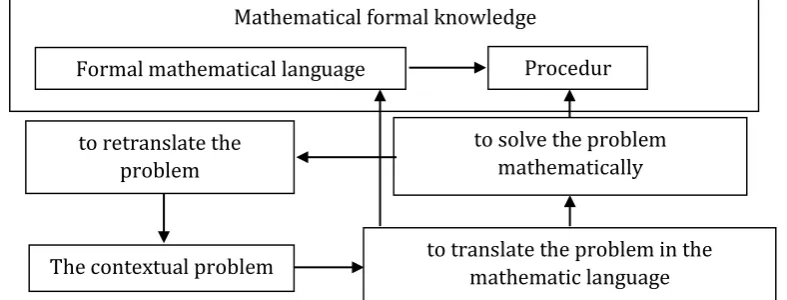
procedure on the similar problem can be simplified further and formalized through the problem series, so that at the end, a formal procedure can be found by students. Through this learning process, a formal mathematical knowledge can be reconstructed themselves. This process is illustrated in figure 1. In the RME, this process is called a progressive mathematization.
Figure 1: The reinvention process through the progressive mathematization process
3. Didactical phenomenology;
The students were given the opportunity to explore phenomena or situation series that can make students experience the process of establishing a formal mathematical knowledge in a sustainable manner. The purposes of the investigation of the phenomenon by students were to investigate the circumstances that approach to the particular phenomenon, and the results of the investigation can be generalized to generate solution procedures, so it would develop the formal mathematical knowledge.
4. Self-developed models.
In RME, models were interpreted as a representation of translating problems into the mathematics language and problem solving in the problem solving stages. A model in RME may involve a model of a situation, schematics, descriptions, or a way to express an idea or ideas. The modeling process by students played the role as a bridge between the informal and formal mathematical knowledge. In RME, the models must be built by themselves as a result of the exploration of the phenomenon by the students and the basis for forming a formal mathematical knowledge. It means that students should be given the opportunity to build models when the problem solving process was occured.
When teacher seek to build the formal mathematical knowledge of students, teacher need to do with the bottom-up approach. First, a model was related to real life activities. After that, a model was a model of the specific context, and the model obtained in this way is termed model of. Then, the model was generalized to many similar situations, and the model was constructed in this way is termed the model for. At the end, the model becomes something truly lies within students, and can be used as a basis to achieve a formal knowledge of mathematics.
Mathematical formal knowledge
Procedur Formal mathematical language
The contextual problem to translate the problem in the mathematic language to solve the problem
mathematically to retranslate the
RESEARCH METHODOLOGY
The approach used to develop the students' learning materials and the teacher giude in this research activity was RME. This type of research that was used by the researcher in this study was the design research with three cycles. The data analysis was conducted by video data and the student's work, but the data analysis was not presented in this paper. The steps undertaken by the researcher followed the phases in the development research were developed by Gravemeijer and Cobb.
RESULTS
The research results presented in this paper were limited by the researcher on the first phase of the design research. The aims of the design that was made by the researcher were that students could know about the meaning of multiplication and division of two fractions. Before students experienced learning process designed by the researcher, students have learned about fractions in grade four, namely (1) the meaning of fractions, (2) the ordering of fractions, (3) the simplfying of fractions, and (4) the additing and subtracting of fractions. Most of the problems were given to students inspired by the problems that exist in the book that written by Fosnot and Dolk (2002).
Student and teacher activities for three meetings in this study were as follows:
1. The first meeting
Activities to construct social norms in the classroom
The teacher explained the social norms that will be formed in the class, namely: a. If students want to ask, express opinions, answer questions, or provide feedback for
other student opinions, then students need to raise his/her hand first, and students began to talk when the teacher has given students the chance to speak.
b. If there was a student who is talking, the other students would listen.
c. If the teacher asks the students about their answers, then it does not mean the answer is not correct, but the teacher wants to know the student thinking process.
Exploration a problem
a. The teacher made the following image on the board:
Group 1 Group 2
b. The teacher told the following story: yesterday afternoon during the school break, I saw there were two groups of students who were sharing bread. The first group consisted of two students who were sharing a piece of bread. The second group consisted of four students who were sharing two pieces of bread. Which students in group one or two will obtain a part of bread more than other students?
Classroom discussions
a. The teacher told the students, if there were students who already had an idea how to solve the problem, they have expressed their ideas.
b. The teacher asked the students to express their ideas. There were two possible answers expressed by students, namely:
Possibility 1:
For the first group, the students divided the bread into two equal parts, so that each student got half. For the second group, the students divided the first and second bread into two equal parts, so that each student got half. Thus, students in both groups get the same part of bread.
Possibility 2:
For the first group, the students divided the bread into two equal parts, so that each student got half. For the second group, the students divided the first and second bread into four equal parts, so that each student got two parts of quater or mathematically, the students could write + = × , or in order to obtain one piece of half of bread. Thus, students in both groups get the same great bakery section.
c. The teacher led a class discussion to discuss the students' answers.
Teacher could ask some questions when the teacher led a class discussion, for example:
1) who could explain the idea was expressed by your friend with your own words? 2) do you have another idea to solve the problem? Try to explain your ideas!
3)were there differences between the first and second ideas (if there were two ideas put forward by the students to solve the problem)?
4) if the student could not give another idea to solve the problem, the teacher has asked the students, how did you think about this idea (the teacher wrote another idea of the solution of the problem).
5) if there were students who raised the idea of such a second possibility, the teacher has asked the students to discuss how the process of add + or multiply × and why = in the group discussion consisting of 2 - 3 students. After that, the teacher asked one the groups to explain the results of their discussion. Then the teacher led a class discussion.
Exploration of other problems
a. The teacher made the following image on the board:
b. The teacher told the following story: yesterday afternoon during school breaks, I also saw two other groups of students who were sharing bread. The first group consisted of two students who were sharing a piece of bread. The second group consisted of three students who were sharing two pieces of bread. Which students in group one or two will obtain a part of bread more than other students?
c. The students were given time to understand the problem and were given the opportunity to ask if students have difficulty understanding the problem.
Classroom discussions
a. The teacher told the students, if there were students who already had an idea how to solve the problem, they have expressed their ideas.
b. The teacher asked the students to express their ideas. There were three possible answers expressed by students, namely:
Possibility 1:
For the first group, the students divided the bread into two equal parts, so that each student got a half of bread. For the second group, students gave to each student half of the bread. After that, the students divided the remaining bread into three equal parts, so that each student gets another : = piece of bread. Thus, students in the second group got more part of bread than the students in the first group, because students in the second group got + piece of bread, while students in the first group only got
piece of bread .
Possibility 2:
For the first group, the students divided the bread into two equal parts, so that each student got a half of bread. For the second group, students gave to each student half of the bread. After that, the students divided the remaining bread into three equal parts, so that each student gets another part of piece of bread = piece of bread. Thus, students in the second group got more bread than the students in the first group. Because students in the second group got part + piece of bread, while students in the first group only got piece of bread .
c. The teacher led a class discussion to discuss the students' answers.
The teacher could ask some questions when the teacher led a class discussion, for example:
1) if there were students who raised the idea of such a second possibility, the teacher has asked the students to discuss what it means : and why : = in a group discussion consisting of 2-3 students. After that, the teacher asked one of the groups to explain the results of their discussion. Then the teacher led a class discussion. 2) if there were students who raised the idea of such a third possibility, the teacher
After that, the teacher asked one of the groups to explain the results of their discussion. Then the teacher led a class discussion. Furthermore, the teacher led the class discussion and stated that part of piece in mathematics can be written as × . Then, the teacher discusses how the process of multiplying two fractions was. 3) if there were students who raised the idea of such second and third possibilities, the teacher has discussed with the students so that the students can deduce the relationship between multiplication and division of fractions as follows: : =
part of piece of bread = × = .
4) if there were students who raised the idea of such fourth possibility, the teacher has asked the students to discuss what it means to divided a piece of bread to two students the same with divided the two pieces of bread to four students in a group discussion consisted of 2-3 students. After that, the teacher asked one of the groups to explain the results of their discussion. Then the teacher led a class discussion.
Exploration of other problem
a. The teacher put up posters which contained questions that will be discussed and solved by the students.
b. Questions that need to be discussed and solved by the students were as follows: The first condition: in the first group there were 2 bread and 3 students, while in the second group there were 3 bread and 4 students.
The second condition: in the first group there were 1 bread and 4 students, while in the second group there were 2 bread and 5 students.
The question for each condition was which students in group one or two will obtain a part of bread more than other students.
c. The students were given time to understand the problem and the opportunity to ask if the students do not understand the problem.
d. The teacher asked a student to explain a matter to be discussed and solved by the students. If the explanation of the student was not quite clear, then the teacher could explain the intent of the question.
Group Discussion
a. The teacher asked the students to form a group discussion consisting of 2-3 students. The teacher share the student worksheet about dividing a cake, as described previously.
The teacher asked each group to discuss and solve the problems that exist in the student worksheet.
c. The teacher asked the students to create a poster that contained an explanation about the group strategy in solving such question.
Classroom discussions
a. The teacher asked one of the groups to present the results of their discussion.
b. The teacher led the class discussion. Navigate the discussion so that students were aware of (1) if there were two fractions that have the same numerator, the fraction which had big denominator was smaller than other fractions, (2) equivalence of fractions, (3) division of fractions, and (4) multiplication of fractions.
2. The second meeting
Activities to construct social norms in the classroom
The teacher reminded the students about the social norms that will be constructed in the classroom as described in the previous meeting.
Exploration problems
a. The teacher distribute the student worksheet which contains the question that to be discussed and solved by the students in a group. Question that needs to be answered by students was as follows: in between pieces A, B, and C, which one of the biggest pieces?
b. The students were given time to understand the problem and were given the opportunity to ask if students have difficulty understanding the problem.
c. The teacher asked a student to explain a matter to be discussed and solved by the students. If the explanation of the student was not quite clear, then the teacher could explain the intent of the question.
Group Discussion
a. The teacher asked the students to form a group discussion consisting of 2-3 students. b. The teacher share the student worksheet about dividing a cake, as described
previously.
c. The teacher asked each group to discuss and solve the problems that exist in the student worksheet.
d. When the students discussed, the teacher went around to (1) guide students how to solve problem by using guiding questions, for example: could you tell me what were your idea to solve this problem? So, your idea were like it (the teacher repeats the student’s idea with a systematic way , and then what were the next steps to solve the problems that you mentioned it?, note student’s strategies emerge from the discussion, and (3) record the things that appear in the discussion that needs to be discussed in the classical discussion.
A
B
e. The teacher asked the students to create a poster that contained an explanation about the group strategy in solving such question.
f. The teacher displayed all posters in front of the class.
g. The students learned every poster, and wrote their comments and questions for each poster in the post-it and stick it on the poster that he/she had learned. When students were studying the poster, the teacher could note the comments and questions from students that were important to be presented in the class discussion, and prepare the order of presentation.
h. The teacher asked each group to return to their posters and to read comments and questions were embedded in their paper posters.
Class discussions
a. The teacher asked one of the groups to present the results of their discussion. The presentation should begin from the group that got a lot of comments or questions from the other students on thoer poster.
b. The teacher led the class discussion. Navigate the discussion so that students were aware of (1) the equivalent fractions, (2) two equivalent fractions should not always be represented by two congruent parts, and (3) the division and multiplication of fractions.
3. The third meeting
Activities to construct social norms in the classroom
The teacher reminded the students about the social norms that will be constructed in the classroom as described in the previous meeting.
Exploration the problem
a. The teacher presented the problem if it is not many different strategies emerge in the solution for the first problem. The second matter is as follows: Mrs. Niken provided the following questions to the students. Bulan in the group was composed of 5 people. Her group got three pieces of bread. How many parts of the bread were obtained by Bulan? Here were the answers from the four students of Bu Niken.
So, Bulan got: + + = . The smaller part was , the bigger part was . So, Bulan got: +
b. The students were given time to understand the problem and given the opportunity to ask if students have difficulty understanding the problem and to solve it.
c. When students solved the problems, the teacher got around and payed attention to how students solve the problem and help students who had difficulty to solve the problem.
Class Discussion
a. The teacher asked a student to explain his/her idea.
b. The teacher led the class discussion. Navigate the discussion so that students were aware of each Mrs. Niken student strategy to solve the problem, the Rudy’s strategy was not right, and inaccuracies in the Rudy’s strategy was considered the whole thing is one of the supposedly half.
c. The teacher asked the students to solve the first problem about the observation activity with the existing strategy in the second problem that were not appear when students solve the first problem for the first time.
d. Students form a group discussion consisting of 2-3 students to discuss how to resolve the problem.
e. When the students discussed, the teacher went around to (1) guide students how to solve problem by using guiding questions, for example: could you tell me what were your idea to solve this problem? So, your idea were like it (the teacher repeats the student’s idea with a systematic way , and then what were the next steps to solve the problems that you mentioned it, note student’s strategies emerge from the discussion, and (3) record the things that appear in the discussion that needs to be discussed in the classical discussion.
f. The teacher asked a group of student to expalin their idea.
g. The teacher let the class discussion. Navigate the discussion so that students were aware of (1) fair sharing, (2) fractions as a result of the division, (3) equivalent fractions, and (4) the division and multiplication of fractions.
CONCLUSIONS
There were several contexts that could be developed in this study to introduce the meaning of multiplication and division of two fractions, namely (1) dividing bread for two groups of students, (2) comparing three pieces of bread, and (3) analyzing student answers for the problem which were given by Mrs. Niken. These contexts were expected to be used to introduce to the students about the meaning of multiplication and division of two fractions.
To answer the second question of this study, the researcher must look at how students answer for each of these problems. Because according to the principle of progressive mathematization in RME, how did the teacher direct students to arrive at a formal knowledge of mathematics, it should follow the development of students' thinking. However, before the try out was done, the researcher have made the possibility of learning path that was be based on the possibilities of how students solve these problems so that students could come to the formal knowledge of the meaning of multiplication and division of fractions.
REFERENCES
Akker, J. v. D., Gravemeijer, K., McKenney, S., & Nieveen, N. (2006). Introduction educational design research. In J. v. D. Akker, K. Gravemeijer, S. McKenney, & N. Nieveen (Eds.), Educational Design Research. New York: Routledge Taylor and Francis Group.
Ayunika, El. P. S., Juniati, D., & Maesuri, S. P. (2012). Early fractions learning of 3rd grade
students in SD Laboratorium Unesa. Journal Mathematics Education, 3, 17-28. Fosnot, C. T. & Dolk, M. (2002). Young mathematicians at work: Constructing fractions,
decimal, and percents. Portsmouth: Heinemann.
Gravemeijer, K. P. E. (1994). Developing Realistic Mathematics Education. Utrecht: Freudenthal Institute.
Gravemeijer, K. P. E. (1991). An instruction-theoretical reflection on the use of manipulatives. In L. Steefland (Ed.), Realistic mathematics education in primary school (pp. 57-76). Utrecht: CD-β Press.
Treffers, A. (1991). Didactical background of a mathematics program for primary education. In L. Steefland (Ed.), Realistic mathematics education in primary school (pp. 21-56). Utrecht: CD-β Press.