UN I T E D ST A T E S A N D PE R U
S p e n c e r Sa l a s, Pa u l G . F i t c h e t t , a n d L e o n a rd o M e rc a d o
Talking to Learn across
Classrooms and Communities
A
s teachers, we value the role
of participatory and
explor-atory civil dialogue in our
classrooms for its pedagogical benefits
(Haneda and Wells 2008; Heyden
2003; McCann et al. 2006; O’Keefe
1995) and, even more, for what
dis-cussion profoundly represents for
democratic societies (Dewey 2009;
Fitchett and Salas 2010; Hoffman
2000; McCoy and Scully 2002).
Despite its many benefits, discussion
does not always come easily, especially
in language classrooms. Some
educa-tors dismiss dialogue as too advanced
for emerging English speakers. Others
believe in and want to include
thought-ful discussion in their curricular
reper-toire, but they hesitate, worried that
students are not yet ready.
Problemati-cally, when students approach the end
of their formal trajectories as language
learners, they and their teachers have
had little practice with the ins and outs
of talking with each other in
purpose-ful and thoughtpurpose-ful ways; thus, we are
all disappointed.
In our combined experiences, we
have seen the familiar sequence of a
teacher asking a question, a student
or students responding, and the same
teacher evaluating that response while
the rest of the students wait their
“turns.” In other instances, talking is
framed as a debate with two teams
committed to outtalking each other
and competing for the teacher’s
atten-tion. Yet discussion can be something
much more than a contest for the
teacher’s recognition or an argument
with a winner and a loser. Structured
and focused classroom discussion—
“talking to learn”—can move student
interactions with the target language
forward while simultaneously serving
as a catharsis whereby
competitive-ness and egocentrism are replaced
with respect, empathy, and
perspec-tive sharing (Fitchett and Salas 2010).
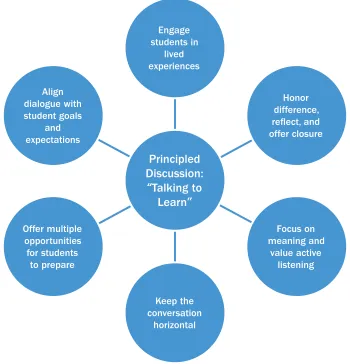
Engage students in
lived experiences
Align dialogue with student goals
and expectations
Honor difference, reflect, and offer closure
Principled
Discussion:
“
Talking to
Learn
”
Offer multiple opportunities for students
to prepare
Focus on meaning and
value active listening
Keep the conversation
horizontal
We begin by articulating a model for promot-ing principled discussion (see Figure 1). We conclude with a set of three specific but versa-tile formats for talking to learn in the English as a Foreign Language (EFL) classroom.
Engage participants in focused discussions drawing from their experiences
Although there are compelling reasons to engage students in critical discussions of current events, frequently learners may lack the background knowledge to engage in such discussions. Teachers who do opt for discus-sions of contemporary or historical events should make sure that students are given access to multiple information sources and ample content preparation in order to discuss the topic in an informed manner (Adler 2004; Hess 2009). Participants can access articles,
lectures, videos, and specialized websites on the Internet or other sources.
At the same time, students do come to classrooms with a multitude of lived experiences. We suggest focusing discus-sions around those “funds of knowledge” (Moll 2011) to stimulate purposeful and introspective talk. For example, a potential theme for discussion might focus critically on the gendered roles that define women and men in their homes and communities. Questions generated around such a theme might include, “What are the roles of fathers and mothers in raising children?” or “Should children be raised equally by both parents?” Other theme-based questions may include, “What is the difference between having only one working parent as opposed to two?”; “What can be done to stem crime in our neighborhoods?”; or “How is bullying a
ous problem and what should be done to address it in schools?”
Student involvement in the composition of the questions is a way of approaching the complexity or diversity of thought that a theme might generate. With a theme in hand, small groups of participants might then move to developing potential questions for discus-sion. The theme of friendship, for example, might generate questions such as “What are the qualities of a true friend?” or “What are the limits of friendship?” At this point, teachers can help students sculpt thoughtful, well-structured, and emotionally and develop-mentally appropriate questions for discussion.
Questions generate more questions. For example, thinking about the limits of friend-ship, participants might begin to critically examine their personal working definition of “friendship” with specific examples of how that relationship is or is not demonstrated. With some thoughtful facilitation on the part of the teacher, participants can choose what is personally most relevant to them while main-taining coherence with the curriculum.
Create multiple opportunities for participants to prepare
Teachers often reward students for spon-taneity. However, spontaneity can exclude students who prefer to think deeply before they speak. If teachers do opt for spontane-ity, questions should focus on topics that are exceedingly familiar to students, such as daily routines or personal preferences.
Thoughtful discussions depend on thoughtful preparation. Language learners benefit from structured opportunities to pre-pare and organize ideas before actually par-ticipating in discussion. We recommend that teachers encourage all participants to write their ideas on paper first and to bring that writing to the discussion—this way we can be certain that all participants have some-thing to say or, if necessary, to read. Pre-discussion preparation might engage students in well-known cooperative learning practices such as think-pair-share, three-step interview, or round-robin brainstorming (Kagan and Kagan 2009). We have also found it helpful for students to end these brief preliminary composition activities by writing down the questions that emerged in the course of
pre-discussion writing and small-group work. Writing questions about questions and about one’s own initial response creates a tentative stance, where one begins to explore ideas and adopt an opinion about a topic. Recursive questioning also sends the message that dia-logue is not merely a space to state one’s posi-tion, but also a means of questioning our own points of view.
Writing and talking in advance of a discus-sion widens the circle of participation. Prepar-ing for a discussion is not limited to helpPrepar-ing students gather and organize what they are going to say, but also lays the foundation for how they will interact with each other. In advance of the activity, teachers and students might outline their expectations of appropri-ate behaviors such as routines for turn-taking, protocols for disagreeing and agreeing, strate-gies for soliciting examples from peers, and challenging classmates to consider alternative viewpoints. In a series of mini-lessons before or after a discussion, teachers and students might examine specific structures and lan-guage that are indicative of and necessary for respectful dialogue.
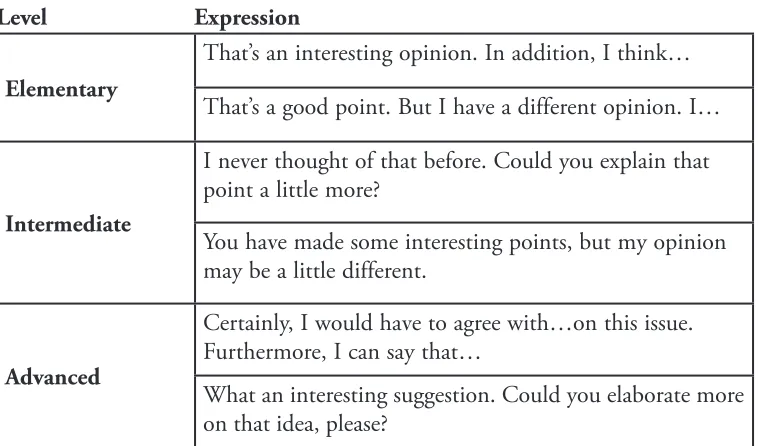
Participants might practice various ways of expressing agreement (“That’s an interest-ing point—I’ve thought about that too”) or disagreement with an idea or point of view (“I’m afraid I disagree”), or ways to indicate uncertainty or tentativeness in ways that pro-mote talk as opposed to silencing or shutting down others (“That’s an interesting way to think about it. I’m not sure what my opinion is”). With training and practice over time, language learners at different levels can use a variety of expressions naturally and confi-dently (see Figure 2).
Keep the conversation horizontal
Level Expression
Elementary
That’s an interesting opinion. In addition, I think…
That’s a good point. But I have a different opinion. I…
Intermediate
I never thought of that before. Could you explain that
point a little more?
You have made some interesting points, but my opinion
may be a little different.
Advanced
Certainly, I would have to agree with…on this issue.
Furthermore, I can say that…
What an interesting suggestion. Could you elaborate more
on that idea, please?
Figure 2. The language of discussion
revealing his or her point of view. Teachers might very well express their opinion or might hold off. (“I’m not completely sure of what I think. I’d like to hear what everybody else thinks first.”)
One simple strategy to decentralize discus-sions is for teachers to position themselves physically such that they become a participant among participants. A circle format is ideal. In classroom spaces that do not accommodate grouping and re-grouping, classmates might elect a peer to represent the range of their opinions in a panel format. After a series of opening statements from each of the panelists, the discussion might turn to questions and probing from the panelists and “audience.”
Discussion formats sometimes favor extro-verted students. Providing specific feedback about individuals’ frequency of participation at the close of a discussion and thinking together how we might all work to encourage each other to participate are strategies for raising awareness of group dynamics and individual levels of participation. For example, ask par-ticipants to identify a contribution they made to a discussion and contributions others made to the discussion. Articulate questions that the discussion generated and identify behaviors that encouraged or discouraged participation. Asking students questions such as “What did you do to encourage a classmate to share his
or her opinion?” or “What do you do when one of your classmates begins dominating the discussion?” or “How did your body language indicate that you were listening to your class-mates?” can elicit feedback about behaviors that enhance or detract from dialogue.
Recognize what specific students did at certain points of the discussion that moved the dialogue forward, e.g., “I liked the way Leo and Paul asked each other for specific examples of the limitations of friendship. I appreciate that Spencer invited Leo into the conversation by asking him what he thought.” Students can also provide feedback to their teachers, letting them know how they felt during the discussion because of their teachers’ interventions and observations regarding their performance.
Focus on meaning and value active listening
about, teachers should concentrate on under-standing and helping them clarify or elaborate their points of view and challenging them to consider alternative perspectives with empa-thy. What students are trying to say should be valued over form. As opposed to correcting student language, teacher-talk might sound something like, “Is there another way that we might think about friendships?” or “Can you think of any reasons why someone would want to put limits on friendship?”
During the discussion, the class might identify individual participants who can help out with students struggling to express their ideas. We also imagine that students talk-ing about somethtalk-ing that matters to them might have a tendency to shift into their first language (L1). Instead of penalizing students for attempting to express an idea or thought, consider students’ use of L1 as an indicator of their motivation.
Dialogue depends on both talking and good “listenership” (O’Keeffe, McCarthy, and Carter 2007; Rost 2006). We encourage teach-ers to think of ways to promote active and thoughtful listening by assigning certain stu-dents the role of observers. During a discussion or structured interchange, observers might take notes on content and participant strategies and behaviors that either stimulate or block the dialogue. After the discussion, observers might report out to the class, highlighting strands of the discussion that they found important or particularly thoughtful. Students might also reflect on individual or collective behaviors and strategies that encouraged or discouraged thoughtful participation. Students’ debriefing might include what individuals learned from their classmates and what new questions the discussion generated.
Align progressively more demanding dialogue with student goals and expectations
Teachers can carefully plan discussion activities that engage students in meaning-ful, participatory dialogue in ways that make the most of their potential at any particular point in time or language level. Curricular vetting or the practice of validating planned learning events in a course or program against well-established criteria or benchmarks, such as Bloom’s Taxonomy or international
pro-ficiency standards, can bolster that potential (Mercado 2012). Teachers can plan discus-sions over the course of a semester or year so that turn-taking, question formulation, and reflective discourse all gain complexity and richness as students move to higher levels of language development.
As they help students engage in evaluation and synthesis, teachers can cross-reference the competencies and skills that increasingly complex discussion activities require against the descriptors of well-known proficiency standards or guidelines, such as the American Council on the Teaching of Foreign Languages (ACTFL) or the Common European Frame-work of Reference for Languages (CEFR). To that end, discussions will advance the level of thought, elaboration, and complexity for successful participation and simultaneously contribute to the consolidation of skills and competencies that correspond to the level of proficiency students are seeking to develop.
Parker (2003) proposes two models for pro-gressive discussion: deliberation and seminar. Through deliberation, participants’ discussion centers on resolving a common dilemma or controversial issue such as “Should website providers be responsible for the quality and usage of material on the site?” or “Which of the main tenants of democracy is more impor-tant: freedom or equality?” Unlike debate, deliberation challenges learners to mediate their perspectives in order to find an alterna-tive middle ground.
Seminar, rather than resolving issues, attempts to expand understanding of an idea or concept. Frequently associated with inqui-ry and questioning strategies, seminar for-mats challenge students to question their own assumptions and understandings. For example, a seminar might entail an investigation of a single text, such as Hughes’s (1995) “I Too”—a free-verse poem that challenges the racial seg-regation of the early twentieth-century United States. Both deliberation and seminar provide students the opportunities to become critical consumers of their own language acquisition through advanced, engaged discourse.
Honor difference, reflect, and offer closure
some closure to the dialogue. Closure might include a synthesis or review of the various points of view that were expressed during the course of the conversation, the questions that the discussion generated, and the identifica-tion of behaviors that advanced the process. Discussions can generate strong emotions. Teachers should recognize these feelings but at the same time honor the diverse ways in which individuals might problem-solve or conceptualize a particular issue.
Ending a discussion does not involve identi-fying who was “more right.” Rather, closure as we understand it involves reflection on where the discussion took us in our individual and collective thinking and what additional ques-tions it generated. To emphasize the generative dimension of classroom discussion, teachers might finish the discussion with individual or small-group writing—a chance for participants to get down on paper what they did not say but wish they had and what they are now thinking. We also suggest that once teachers have mod-eled bringing closure to a discussion, students themselves might also take a more active role in facilitating that process.
Three formats for classroom dialogue
Teachers can approach discussion in various ways. We conclude here with three formats that we have found particularly generative and flexible in terms of age and language readiness.
1. Gallery Walk
The concept of a gallery walk comes from the world of art. Just as in an art gallery, par-ticipants move from one image to the next— responding at an immediate level to the images displayed. In the language classroom, images might be visual (a picture or graphic) or textual (a word, phrase, or short reading). Develop a set of written or visual images around a theme or concept and use chart paper to post the images or texts on tables or on the wall. A gallery walk structured around the theme of friendship might include pictures or artistic renderings of friendship; quotes about friendship such as “A friend to all is a friend to none”; or even simple words such as enemy or friend. Direct teams or groups to stations with a colored marker specif-ic to their team. Have them respond in writing to each visual or textual prompt. Debrief the class on responses and encourage individual or collaborative elaboration of ideas.
2. Rating agreement/disagreement
Rating activities are useful discussion scaf-folds (McCann et al. 2006). In designing a rating activity, teachers should choose a theme that allows for a variety of opinions— some potentially controversial. We suggest, for example, value-oriented topics that address the lived experiences of students and encour-age a wide range of responses, e.g., a ranking activity that elicits opinions about gendered roles in family and society; friendship; hones-ty, etc. We have structured ranking activities, for example, around the theme of love—tak-ing popular quotes about the emotion such as “All you need is love” or “Love is blind” and asking student groups to rate their level of agreement or disagreement using a numerical scale ranging from one to five. Afterwards, a representative from each group reports on two to three highlights of the small group’s discus-sion. Follow up by having students create a multilayered definition for whatever category the ranking activity is examining.
3. Scenarios for role play
Role plays stress the adoption of perspec-tive. They offer emerging English speakers a platform that emphasizes the complexity of the human condition by simulating conflict, resolution, and compromise (Au 2010; Cruz and Thornton 2009). Choose a short narra-tive to read and identify participants who will take on the perspectives of the various charac-ters. Thinking about the theme of friendship, teachers might select a short reading such as
The Giving Tree by Silverstein (1964)—the poignant tale of a tree who gives a little boy all she has until she is nothing but a stump for the boy-turned-old-man to sit on. Allow characters to prepare with the support of a small-group opening statement explaining their motivation and point of view: Why as “tree” did I give all of myself to the boy? Why as “boy” did I ask so much of the tree? Follow up with pre-prepared questions from the class to the “tree” and the “boy.”
From “What do I think?” to “How could we think differently together?”
and collective values informed by their lived experiences. However, such perspectives can evolve. Thoughtful classroom dialogue is a powerful medium through which students can gain fluency and confidence in the lan-guage while making substantial progress in developing their language proficiency. When discussion focuses on promoting empathetic, genuine interchange, talking to learn can transform traditional classrooms into com-munities of accomplished learners who inter-act and respect each other as equals. We believe that English language classrooms can and should mirror the sorts of communities that we are in the process of still becoming— ones committed to exploratory, civil, and participatory dialogue. Classroom practice that supports the notion of “cultural democ-racy” (Banks 2008; Parker 2003) honors students’ individual perceptions of content and concept as valid, educative, and fluid. What is more, instructional environments emphasizing openness of discourse embody the tolerance and civic understanding that we need more of in our communities (Avery 2002; Torney-Purta and Richardson 2003). However, far too often, in our classrooms and our communities, discussion is adversarial, polemic, and insular.
It does not have to be that way. Engaging students in discussion encourages perspective-taking and a dialogue of civility and tolerance grounded in mutual understanding, respect, and empathy (Avery 2002; Fitchett and Salas 2010). Constructive dialogue, as exempli-fied in the model presented here, empowers students and teachers to reach these goals while making a substantial contribution to their English language development. As Hess (2002) notes, teachers should teach both “for and with” discussion. That is to say, it is not enough to teach English learners the form and function of the language. Students must also be skilled in how to enact and sustain mutu-ally challenging but respectful discourse. As such, talking to learn across classrooms and communities can empower English learners of all levels with the skills and stances upon which our cultural and political democratic traditions are grounded and upon which our collective futures as open societies depend.
References
Adler, M. 2004. The paideia proposal. In The cur-riculum studies reader, ed. D. J. Flinders and S. J. Thornton, 159–62. New York: Routledge-Falmer.
Au, W. 2010. Not playing around: Teaching role-plays in social education. In Social studies and diversity education: What we do and why we do it, ed. E. E. Heilman, 292–95. New York: Routledge.
Avery, P. G. 2002. Teaching tolerance: What research tells us. Social Education 66 (5): 270– 75.
Banks, J. A. 2008. Diversity, group identity, and citizenship education in a global age. Educa-tional Researcher 37 (3): 129–39.
Cruz, B. C., and S. J. Thornton. 2009. Teaching social studies to English language learners. New York: Routledge.
Dewey, J. 2009. Democracy and education: An intro-duction to the philosophy of education. New York: WLC Books. (Orig. pub. 1916.)
Ellis, R. 2001. Introduction: Investigating form-focused instruction. Language Learning 51 (s1): 1–46.
Fitchett, P. G., and S. Salas. 2010. “You lie—That’s not true”: Immigration and preservice teacher education. Action in Teacher Education 32 (4): 96–104.
Freire, P. 2000. Pedagogy of the oppressed. New York: Continuum. (Orig. pub. 1970.)
Haneda, M., and G. Wells. 2008. Learning an additional language through dialogic inquiry. Language and Education 22 (2): 114–36. Harmer, J. 2007. The practice of English language
teaching. 4th ed. Harlow, UK: Pearson Long-man.
Hess, D. E. 2002. Discussing controversial public issues in secondary social studies classrooms: Learning from skilled teachers. Theory and Research in Social Education 30 (1): 10–41. ——. 2009. Controversy in the classroom: The
demo-cratic power of discussion. New York: Routledge. Heyden, R. 2003. Literature circles as a
differenti-ated instructional strategy for including ESL students in mainstream classrooms. Canadian Modern Language Review 59 (3): 463–75. Hoffman, M. L. 2000. Empathy and moral
develop-ment: Implications for caring and justice. Cam-bridge: Cambridge University Press.
Hughes, L. 1995. I, too. In The collected poems of Langston Hughes, ed. A. Rampersad and D. Roessel, 46. New York: Vintage.
Kagan, S., and M. Kagan. 2009. Kagan cooperative learning. San Clemente, CA: Kagan.
McCann, T. M., L. R. Johannessen, E. Kahn, and J. M. Flanagan. 2006. Talking in class: Using dis-cussion to enhance teaching and learning. Urbana, IL: National Council of Teachers of English. McCoy, M. L., and P. L. Scully. 2002. Deliberative
dialogue to expand civic engagement: What kind of talk does democracy need? National Civic Review 91 (2): 117–35.
In A handbook for language program administra-tors. 2nd ed. Ed. M. A. Christison and F. Stoller, 117–36. Miami, FL: Alta Book Center. Moll, L. C. 2011. Only life educates: Immigrant
families, the cultivation of biliteracy, and the mobility of knowledge. In Vygotsky in 21st cen-tury society: Advances in cultural historical theory and praxis with non-dominant communities, ed. P. R. Portes and S. Salas, 151–61. New York: Peter Lang.
Nation, P. 2007. The four strands. Innovation in Language Learning and Teaching 1 (1): 1–12. O’Keefe, V. 1995. Speaking to think, thinking to
speak: The importance of talk in the learning pro-cess. Portsmouth, NH: Boynton-Cook.
O’Keeffe, A., M. McCarthy, and R. Carter. 2007. From corpus to classroom: Language use and language teaching. Cambridge: Cambridge Uni-versity Press.
Oxfam. 2006. Teaching controversial issues. www. oxfam.org.uk/education/teachersupport/cpd/ controversial/files/teaching_controversial_ issues.pdf
Parker, W. C. 2003. Teaching democracy: Unity and diversity in public life. New York: Teachers Col-lege Press.
Rost, M. 2006. Areas of research that influence L2 listening instruction. In Current trends in the development and teaching of the four language skills, ed. E. Usó-Juan and A. Martinez-Flor, 47–74. Berlin: Mouton De Gruyter.
Shor, I. 1992. Empowering education: Critical teach-ing for social change. Chicago: University of Chicago Press.
Silverstein, S. 1964. The giving tree. New York: Harper and Row.
Torney-Purta, J., and W. K. Richardson. 2003. Teaching for the meaningful practice of demo-cratic citizenship: Learning from the IEA civic eduation study in 28 countries. In Civic learning in teacher education: International perspectives on education for democracy in the preparation of teachers, ed. J. J. Patrick, G. E. Hamot, and R. S. Leming, 25–44. Bloomington, IN: ERIC Clearinghouse for Social Studies/Social Science Education. Eric Digest ED 475824. www.eric. ed.gov/PDFS/ED475824.pdf
SPENCER SALAS is an Assistant Professor in
TESL Education in the Department of Middle, Secondary, and K–12 Education at the University of North Carolina at Charlotte.
PAUL G. FITCHETT is Assistant Professor of
Education in the Department of Middle, Secondary, and K–12 Education at the University of North Carolina at Charlotte. His research interests include the intersection of social studies education, teacher characteristics, and educational policy.
LEONARDO MERCADO, originally from Queens,