Journal of Home Affairs Governance p-ISSN: 2085-4323 | e-ISSN: 2503-3360 Jurnal Bina Praja
P : R D A
M H A R I Bina Praja Vol. 8 Iss. 2 pp. 175-340 p-ISSN: 2085-4323
e-ISSN: 2503-3360
Accredita 735/AU2/P2MI-LIPI/04/2016
Valid thru: 24 April 2019
Jakarta, November 2016 Jurnal Bina Praja 8 (2) (2016): 305-315
Jurnal Bina Praja
e-ISSN: 2503-3360 p-ISSN: 2085-4323
www.binaprajajournal.com
The Implementation of SWOT Analysis
of People Economic Empowerment Business Loan (KUPEM)
in Jambi Province
Susi Desmaryani
1, *1 Regional Research and Development Agency (Balitbangda) Jambi Province
Jl. R. M. Noor Admadibrata No. 1A
Received: 31 August 2016; Accepted: 6 October 2016; Published online: 30 November 2016
DOI: 10.21787/jbp.08.2016.305-315
Abstract
The problems of SMEs today are generally only able to survive but rarely oriented towards growth and capacity development of the company. One of the problems that hinder the growth of SMEs is financing problems. The government has tried to provide financing assistance in the form of soft loans, one of which is KUPEM, but SMEs do not have the commitment to running the business with loans that have been granted by the government. This study aims to determine the implementation strategy of People Economic Empowerment Business Loan (KUPEM) in the Province of Jambi. The research method used was a case study with descriptive research type. The sample consists of 125 respondents. Sampling is conducted in a nonprobability sampling and purposive sampling. Data were analyzed using SWOT analysis. The results showed that the implementation of KUPEM by the Provincial Government of Jambi through internal analysis indicates the value of the power factor is still below the weakness factor. External analysis of People Economic Empowerment Business Loan still has a big opportunity than a threat factor. Therefore, People Economic Empowerment Business Loan continues because it can help the growth of the community effort by making strategic changes. Result of the study recommend to strengthen internal factors which are the analytical skills of relevant agencies that are trusted to provide recommendations for KUPEM loans, (1) Relevant agencies create mentoring programs to enhance the ability of SMEs actors, (2) Through the relevant agencies forming a group of associations between groups of SMEs, (3) Increasing motivation to make MSMEs business through counseling activity, and improve the competence of field educators, (4) Conduct analysis of the suitability of business in accordance with local conditions (in this case the state of nature, the public taste and the target market).
Keywords: SWOT analysis, credit, SMEs.
I. Introduction
Government’s role as a motivator, catalyst, regulator and facilitator in developing the micro,
small and medium enterprises have not been
welcomed by the business actors, many businesses
found not able to utilize the credit support provided by the government. This is happening because SMEs
still have limitations in managing finances which are
limited knowledge about bookkeeping and lack of
separation between personal finances and business finances, thus making the credits earned cannot be used optimally. (Ministry of Trade, 2013).
Tight controlling on budget and financing is one of the weaknesses of SMEs, according to Saragih
and Surikayanti (2015) small businesses have a
small budget, as a result they often forced to divide the funds to finance various needs as efficiently as possible, and the impact on business operations
resulting in shortage of venture capital. Operational funding shortage that could not be prevented will usually lead to bankruptcy because SMEs do not have the capacity to pay the debt.
Meanwhile, economic growth in Indonesia is largely dominated by micro, small and medium enterprises (SMEs). Moreover, SMEs are the type
of business that can survive in the midst of the
economic crisis that hit Indonesia, because it has
developing countries are absorbed by the informal sector and the activities of the small and medium enterprises. The role of the SME sector is very
important because it can create the market, expand trade, manage natural resources, reduce poverty, create jobs, build communities and support their
families without adequate control and facilities from
the local government (ILO, 1991 and Reddy et.al., 2002). In Indonesia, the SME sector even becomes
the foundation of life since the economic crisis that
began in 1997 (Sarosa, 2000).
Many government aid programs are given to
the groups of SMEs, for example providing capital
assistance in the form of loans with a low-interest rate. Sabirin (2001) explains that in order to empower the economically disadvantaged or small business sector is to provide a source of business
financing or affordable credit. Increased credit
services aimed at addressing the shortage of capital
for households in developing a business (Diagne, et al., 2000 and Diagne, 2001) Capital is one of the
problems faced by SMEs in maintaining its presence.
But, there are other problems that arise which is the
limited knowledge of business actors in managing
the business, due to lack of knowledge causes most
small and medium enterprises can only survive and
rarely oriented towards growth, development in the capacity and the ability of the company (Gray, 2006).
Loans are given by the government, in fact,
has not been utilized to the maximum by SMEs to
develop the business, in addition to their limited ability to manage credits, loans given were being used for consumption rather than investment. Suji, Sutomo, and Mukti research results (2015) found that the misuse of the People’s Business Credit (KUR) which was originally for the production, in reality, is used for consumption and not for
investment that can provide a business advantage. If the use of credit were diverted for consumption it will cause the burden of unpaid debt. This is why loans become ineffective and have an impact on bad debts.
Other studies which support that the use of credits earned by SMEs has not been maximized to
financing the company’s operations, investigated by Purnamayanti, Suhendra, and Yulianthini (2015),
the study found that the revenue of SMEs declined after receiving credit assistance. This occurred due to the capital obtained from the loan is not fully utilized for business capital.
Government needs to create a strategy to make the SMEs that received loans can feel the benefits of the loans to help to boost the economy, as loans for
productive purposes provides an opportunity for households to start or expand a household business
(Feder et al., 1990), so as to increase household income (Zeller et al., 1997). Cashmere (2010) stated
that the credit can positively increase revenue
because the credit is given to increase business capital.
Capital Problem is also a problem for SMEs in the province of Jambi in maintaining its existence. Jambi province has natural potential that capable of providing welfare for the people if the natural
potential can be managed properly, it will have an impact on economic growth. Based on that condition, one of Jambi Provincial Government program is to help Micro, Small and Medium Enterprises in terms
of credit provision known as Community Economic
Empowerment Business Credit (KUPEM) as a way
to overcome the problem of capital for SMEs in the province of Jambi.
The granting pattern of Community Economic
Empowerment Business Credit (KUPEM) previously using executing patterns, and then switch to channeling, wherein the pattern of channeling
the process of assessment and credit provision
conducted by the Provincial Government of Jambi
directly through the relevant working unit related to the type of business of the SMEs. The role of Banking in channeling pattern is just as the administration of payment and does not have the legal authority to follow up violations of inability to repay loans that
had been granted by the Provincial Government
of Jambi. The pattern of channeling got a different interpretation from the business actors resulting in a credit crunch. The survey results found that there was credit aid that is not targeted and business empowerment program was not carried out intensively to develop the business of SMEs groups.
This is why businesses are difficult to survive and
even to grow and thrive.
The desired expectation is actually a credit assistance provided by the government can raise revenue of SMEs so that SMEs have the ability to pay
credit obligations. Therefore, the government’s role is not limited to providing funding, but more to the
empowerment of SMEs so that SMEs can grow and
develop. So far, the perceived role of government
is limited to providing credit but not oriented to
the empowerment of SMEs to the maximum, so
that the credit assistance can improve the SMEs business. This is in line with research conducted by
Ferdian (2004) of the Community Small Business Empowerment through People’s Economic
Empowerment Program (PER) in Sabang City. The results showed that the PER program through the provision of soft loans to people in Sabang has been running as expected by the local government. But the program had an image of only project funding loans with low-interest rate because the process that uses the concept of empowerment was still minimum. Community empowerment has not touched all aspects of the stages of the provision of soft loans to small entrepreneurs.
done by Kurniawan and Fauziah (2014) on the Empowerment of Micro, Small and Medium Enterprises (SMEs) in Poverty Reduction, the
research states that the empowerment process that has been done by the government was only to the extent of providing business capital and lack of
effort in developing the Micro, Small and Medium
Enterprises (SMEs).
Effort to improve the performance of SMEs, the
government not only help provide credit but more broadly to mention the role of the government in an attempt to empower SMEs as stipulated in Law
No 20 Year 2008, it is expected that the People Economic Empowerment Business Loan (KUPEM)
that granted to SMEs can increase revenues.
The study results of Murdy (2010) on the
Role KUPEM in Increasing Potato Production in Kerinci District of Jambi, has shown that KUPEM fund is beneficial to farmers. The capital assistance
that helps to increase potato production had
an impact also on increasing farmers’ income.
While studies of Setyari (2012) titled “Impact Evaluation of Microcredit on Household Welfare in Indonesia” This study has shown a strong result that
microcredit gave a positive significant impact on the
level of household welfare in Indonesia in terms of upgrading the amount of spending per capita and labor supply of households receiving the program.
However, it did not show a significant impact on
the level of education of children even it revealed the presence of adverse effects mechanism. Credit which was use for expansion mostly will utilize
household labor, so that the children could help
the family business and they were able to employ children in micro-enterprises. Based on the results
of both studies, it showed that the credit received by
the public can increase revenue.
In addition, both studies also showed that KUPEM can increase the ability of people in
managing the debt of credit to become a source of household income in order to improve the quality of life.
The phenomenon of People Economic
Empowerment Business Loan (KUPEM)
implementation, generally in the province of Jambi, currently not able to increase revenue, this is due
to the behavior of customers who have not been
consistent in running the business, the ability of the
customer is still limited to repay debt obligations after obtaining loans from government. The presence of loan funds provided by the government
has not targeted based on predefined rules. Government assistance and business guidance to groups of SMEs are not intensively managed, therefore KUPEM given by the government have not
been able to provide an opportunity for groups of SMEs to improve their business. Based on the issues
contained in the implementation of KUPEM, this
study will make the right strategy through a SWOT analysis regarding the implementation of People
Economic Empowerment Business Loan (KUPEM), the purpose of this study is to find out the SWOT analysis of the KUPEM implementation in Jambi
Province.
Business Loan Program for Community Economic Empowerment in Jambi Province is
earmarked for the SMEs group in the field of agriculture, fisheries, animal husbandry and
processing industry.
People Economic Empowerment Business
Loan (KUPEM) are loans granted to farmers in the group members of crops, Horticulture, Fisheries, Livestock and Industry in order to finance the farming, small industries and home industries, also
services and small trading in the city of Jambi and District in the province of Jambi.
Loans granted to the SME group using the
pattern of small business loans specifically regulated in the implementation guidelines of KUPEM in accordance with Jambi Governor’s decision No 369 of 2002 dated October 28, 2002. For the
technical implementation in the management and development as well as implementation guidelines
in the field, the first party QC. Relevant Department of each District/City respectively, in which the relevant agencies, among others, Agriculture, Fisheries, Animal Husbandry, Small Industry and Small Trade using KUPEM funds to develop
business in each sector either through the groups or individuals through the recommendations given by the relevant authorities.
Based on the agreement between the Governor
of Jambi and the Bank of Regional Development of
Jambi No 01/PERj/OHK/I/2004 and No 2:01 .KP/. DIR, KUPEM Awarding is based on the provision stating that KUPEM reserved for farmers and
entrepreneurs to the industry engaged in services and trade. The government gives requirements that
must be met by the receiver, those are must have savings on Jambi Bank, the loan must be used for business capital, repayment of credit in maximum of 2 years, the way of credit repayment is adapted to the business results cycle, and doing some feasibility
analysis before getting the loan. Conditions analysis of creditworthiness according to Munawir (2002)
among others, viewed from: (a) Character, reflect the nature and character of prospective borrowers, (b) Capacity, to see the client’s ability to manage its business, which is associated with the education,
the ability to understand the provisions of the government and the ability of customers to restore
their credit. (C) Capital, to see the effective use of capital, seen from the financial statements (balance
sheet and income statement) by performing the
given by customers both physical and
non-physical and (e) Condition of Economic, conduct an
assessment of the economic and political conditions.
KUPEM is a government program as an effort to reduce poverty. Through the credit, it is expected
that the economic level and quality of life is getting better. People can develop the business through capital loans and become a strong entrepreneur.
Therefore, business actors are expected to
grow to be entrepreneurs who have the attitude and behavior that can perform loan capital with the attitude and behavior of work achievement. According to Suryana (2003) Achiever is an entrepreneur who always ambitious and want to go forward (ambition driven) therefore an entrepreneur who wants to succeed in his business
must not sluggish, surrender, did not want to fight, but has to be passionate, striving, and having the
ambition to go forward with commitment to their work.
Suryana (2003) argues that attitudes and achiever working behavior can be characterized as follows: (1) Work with self-awareness in the
emotional sense, entrepreneurs are required to always be careful in conducting their business, (2) Work smart, entrepreneurial ability to think precisely in overcoming all conditions, (3) Work Hard, show the spirit and capabilities of entrepreneurs to achieve the results desired, (4) Work sincerely, works without any complaints, keep fighting despite making mistakes, (5) Work
completed is work that is capable of organizing part
in an integrated effort from start to finish so that it can produce a maximum effort to finish with.
II. Method
The method used in this research surveys, research sites in East Tanjung Jabung, Sarolangun, Merangin, Batanghari and the city of Jambi. The
study was a descriptive study.
The method of sampling in this study is a non-probability sampling which is a sampling where the probability or chance of a person to be elected as a
sample is unknown (Irawan Soehartono, 200: 59).
The sampling technique used in this study is
purposive sampling (samples intended), given the limited time and funds, the investigator directly
determines which SMEs group that can be reached directly.
The area selected as the sample in this study
consisted of four (4) districts and cities, namely East Tanjung Jabung, Sarolangun, Merangin, Batanghari,
and Jambi city. The basis for determining the sample
was based on the area’s which got many credit
assistance and have ease of access for researchers to reach them.
The sampling technique to the respondent is by purposive sampling. Purposive sampling
carried out due to consideration of the limitations
of time, effort and funds so could not take a large
sample and distant. Besides purposive sampling was done on purpose to note that the sample should represent the of the population to be studied. This sampling techniques aim is good enough because it
is in accordance with the researcher’s consideration
themselves so they can represent the population. The advantage lies in the accuracy of researchers in selecting data source according to the variables
studied (Sutrisno, 1993).
Based on Provisions of sample amount for
respondents by Roscoe quoted in Sekaran (2006),
it provide a common reference to determine the sample amount of more than 30 and less than 500
is appropriate for most research, therefore selected
sample of the population is divided into two (2)
categories, where the first category is customers
who smoothly run their credit obligations. The second sample category is customers who have a problem in paying credit obligations (loss). The purpose of the determination of this sample category is to determine whether the process of
conducting KUPEM by the government of Jambi
Province is in conformity with the rules that apply
to both categories of such customers. Thus, the
total sample of this research consisted of 125
customers, 55 customers’ with settled payment
and 70 customers with problematic payments. 125 respondents considered as representatives to answer about the loan process by the government and the ability of customers or respondents to use credit for business development.
Data were analyzed using SWOT analysis through quantitative approach (Pearce and
Robinson, 2008) and a qualitative approach through the matrix according to Kearns (in Salusu, 2003).
SWOT illustrates the strengths and weaknesses
as internal factors, opportunities and threats as
external factors. The grouping of the factors that
being included in the strengths, weaknesses,
opportunities and threats are according to the observations of researchers that have been
discussed through Focus Group Discussion (FGD).
SWOT with a quantitative approach using
three step calculations (Pearce and Robinson, 2008), the first step is to give a score from each of
the internal and external factors. Scores obtained
from the average of respondents’ answers, then
give weight to internal and external factors to the sequence of importance. The level of importance
starts from 1-4, (1) give meaning as not important, (2) give meaning as less important, (3) gives the meaning as quite important, and (4) give meaning as important. Furthermore, the total score is obtained
by multiplying the average scores and weights. The
second step to make cuts on internal factors, in
total amount of weakness (d = S - W), then make cuts on external factors, in which the total amount
of opportunity reduced by the total amount of
threats (e = O - T), scoring (d = x), then it becomes the point of the X-axis, then the scoring (e = y) to be a point of the Y-axis, the third step is searching for the axis point (X, Y) on SWOT quadrant as described
in Figure 1.
For SWOT with the qualitative approach is using internal factors and external factors. Internal factors that incorporated into the matrix are called IFAS (Internal Strategic Factor Analysis Summary). External factors that incorporated into the matrix are called EFAS (External Strategic Factor Analysis Summary). After the matrix of internal and
external factors completed, then the results were incorporated into the qualitative model, namely SWOT matrix to formulate the company’ competitive
strategy. The matrix factors for internal (IFAS) and external (EFAS) strategy.
Indicators for measuring internal factors is the provisions of People Economic Empowerment Business Loan implementation and external factors
assessed on the attitudes and behavior of creditors after receiving the business credit for community economic empowerment.
SWOT Analysis on the external environment assessed on the attitudes and behavior of borrowers after receiving the business credit for community
economic empowerment, to which extent is the
ability of borrowers to manage credit for developing
the business, and internal analysis to look at the
provisions of the People Economic Empowerment
Business Loan (KUPEM) implementation given by
the government is already in line with the criteria which has been determined. The analysis of external and internal environment is then being outlined in the form of SWOT strategy as shown in the framework picture in Figure 2.
III. Result and Discussion
A. Description of People Economic Empowerment Business Loan Implementation
Methods for Granting Business Loan for Community Empowerment (KUPEM) with
channeling pattern through the designated working
unit (SKPD) disbursing credit to the business actor of Micro, Small and Medium Enterprises measured
using indicators of the provisions set by the government.
Scheme of Distribution/Utilization/Repayment of KUPEM funds in Jambi province can be seen in
Figure 3.
KUPEM delivery mechanism is carried out in seven stages. First, the credit application is
done in groups/individuals to the Regent/Mayor
through related Technical Office, through the submission provided by the related Technical Office. Submissions must be accompanied with RDKK which
Quadrant III
Quadrant II Quadrant IV
Quadrant I (- , +)
Change Strategy
(+ , +) Progressive
(- , -) Survival Strategy
(+ , -) Diversification
Strategy Opportunity
Threat
Strength Weakness
W S
O
T
Figure 1. SWOT Quadrant
SWOT Analysis (Pearce and Robinson, 2008)
Internal Analysis External Analysis
Strength (Provisions of Loan Granting)
Weakness (Coaching and Mentoring Program
for SMEs)
Threat arising from the achiever attitude and behavior of SMEs
Opportunity arising from the achiever attitude and behavior of SMEs
Strategy for KUPEM Implementation to Increase the Revenue of SMEs
was approved by the related Technical Officers/
Department/Institution existing in its scouted region and known by the Village/District Head.
Second, examine thoroughly on the feasibility of their business in the field together with the technical team of the District/Municipal and officials/ officer of Local BPD Branch. Third, after checking/ researching, the related technical Department/
Institutions propose to the Regent/Mayor to get
a recommendation. Fourth, the Regent/Mayor
receives the request and promptly recommended and submitted to the local branch of the BPD with
a copy to Related Technical Office in Jambi Province. Fifth, BPD Jambi after receiving the application of KUPEM submitted by the Regent/Mayor as point 4 above are being processed immediately for the realization of the potential participants of KUPEM that has been recommended. Sixth, the technical
implementation of the operational management of
KUPEM distributions is governed by the Regent/
Mayor in accordance with the conditions and
the situation of each district/city. Seventh, with the altered pattern of KUPEM management from executing into channeling, causing the responsibility of KUPEM implementation (Distribution, Utilization,
and Development) becomes the responsibility of the Regent/Mayor.
Based on the answers of respondents, it
turned out that SMEs in Jambi Province which
received KUPEM assistance, gives no impact on the increase in revenue, they still not able to increase their income, but have an impact on the failure to
pay the debt. The strategy needs to be made for
the KUPEM implementation so that SMEs have
the ability to manage credit which will turn into
increasing revenue. Therefore, the strategy for the implementation KUPEM is measured through
external factors and internal factors. External factors illustrate the opportunities and threats. Internal factors illustrate the strengths and weaknesses.
Internal factors measured using indicators of KUPEM
provisions. External factors are measured through attitudes and behavior of the borrowers (SMEs group) in managing the Economic Empowerment Business Loans granted by the government. Based
on respondents’ answers then described as follows:
1. Internal factors describe the KUPEM provisions
that should be accepted by the SMEs groups, it
shows the strengths and weaknesses of lending system undertaken by the government through
working unit (SKPD) as described in Table 1.
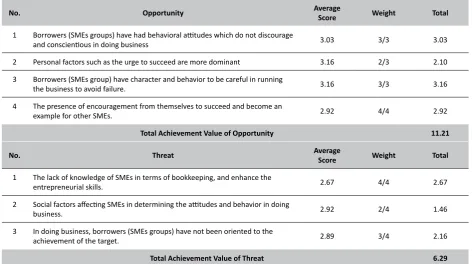
2. External factors describe the obligations of borrowers to repay the debt as measured by the behavior of borrowers in developing venture capital through the analysis of the achieving attitudes and behavior of people
after obtaining the KUPEM loan. Borrowers behavior is influenced by several external
factors that bring opportunities and threats for
KUPEM as described in Table 2.
B. SWOT Analysis in the Implementation of KUPEM in Jambi Province
Considering the credit given by the government is one of the government programs to
reduce poverty, to show care and concern of the government in improving the welfare of the people, based on those reasons, the loan programs continue
to be implemented. In order for the loan program from the government to run smoothly and can avoid
Jambi Governor
KUPEM Province Team
Regent/Mayor
Regent/Mayor
Technical Office of the District/City
District Manager
Village Chief/Lurah
BPD Jambi
BPD Jambi Branch of District/ City 1
2
2
2 3
Figure 3. Scheme of Distribution/Utilization/Repayment of KUPEM funds in Jambi Province
Sources: Bank Jambi (2014)
Explanation:
= Reporting Procedures
Table 1.
Strengths and Weaknesses of Lending System
No. Strengths Average
Score Weight Total
1 KUPEM destination is on the right target which is SMEs 3.46 2/4 1.73
2 Distribution of the amount of loans granted in accordance with the ability of borrowers to meet monthly obligations, as measured by the capacity on business results
3.31 3/4 2.48
3 SKPD/Working Unit ability to provide guidance so loans can develop the business, so that borrowers can meet debt obligations in accordance with the collective agreement.
3.18 4/4 3.18
4 Time Period, determination of maturity that has been agreed between
borrowers and SKPD (Working Unit) 3.16 2/4 1.58
Total Achievement Value of Strength 8.97
No. Weaknesses Average
Score Weight Total
1 Guidance to SMEs in managing the business. 2.27 4/4 2.27
2 Analysis of suitability between the business type and the potential of the area. 2.94 4/4 2.94
3 Disseminating information to potential borrowers regarding liability and
sanctions that should be run. 2.87 3/4 2.15
4 Analysis of the financial statements of potential borrowers had not been
effective. 2.30 4/4 2.30
Total Achievement Value of Weakness 9.66
Difference between the strengths and weaknesses S – W = 8.97 – 9.66 = -0.69
Table 2.
Opportunity and Threat of Lending System
No. Opportunity Average
Score Weight Total
1 Borrowers (SMEs groups) have had behavioral attitudes which do not discourage
and conscientious in doing business 3.03 3/3 3.03
2 Personal factors such as the urge to succeed are more dominant 3.16 2/3 2.10
3 Borrowers (SMEs group) have character and behavior to be careful in running
the business to avoid failure. 3.16 3/3 3.16
4 The presence of encouragement from themselves to succeed and become an
example for other SMEs. 2.92 4/4 2.92
Total Achievement Value of Opportunity 11.21
No. Threat Average
Score Weight Total
1 The lack of knowledge of SMEs in terms of bookkeeping, and enhance the
entrepreneurial skills. 2.67 4/4 2.67
2 Social factors affecting SMEs in determining the attitudes and behavior in doing
business. 2.92 2/4 1.46
3 In doing business, borrowers (SMEs groups) have not been oriented to the
achievement of the target. 2.89 3/4 2.16
Total Achievement Value of Threat 6.29
bad credit, there should be a strategy which is ideal for the implementation of KUPEM.
The inability of SMEs in the province of Jambi
to manage KUPEM funds into revenue, due to the
behavior of business actors have not oriented on
results of operations, the use of credit funds have
not been maximized to create products and services that can meet the needs of the market. Most of the products do not follow the development of consumer
tastes, moreover in doing business they do not
predict whether the effort carried out in accordance with the geographical conditions that would have a negative impact on production output. To overcome the unintended consequence from misapplication of
funds provided by the government, it is necessary
to have business guidance and coaching from the
related working unit (SKPD) so that the loan funds
which have been granted can be used appropriately and can help people to develop their business.
SWOT analysis is based on the analysis of internal factors which consists of strengths and
weaknesses, opportunities and threats from
external factors. The results of the internal analysis in Table 1 were measured through the provisions
of KUPEM implementation and coaching and
mentoring programs provided by the government. And external analysis as measured by the achieving nature and behavior of SMEs that give impact on the
opportunities and threats in the business, thus the
strategy that will be implemented can be illustrated in SWOT diagrams and matrix which can be seen in
Figure 4.
Based on Figure 4, the KUPEM is in quadrant III, which changes the strategy, it means KUPEM must make strategic changes in its future implementation,
in order to minimize the risk of unpaid debt (credit crunch) and improve the performance of SMEs groups. This change emphasizes that the loans granted to SMEs should be accompanied by the
empowerment of SMEs so that SMEs have the knowledge to manage debt and increase capacity for their business development.
On the channeling pattern, it is found that there is lending which is not on target, namely the loans that not for production, but used for consumption, which leads to the inability to repay the loan, this
is in line with the research results conducted by
Suji, Sutomo, and Mukti (2015) who found the misuse of the People’s Business Credit (KUR) which was originally for the production, the reality
on the way it is used for consumption rather than
investment that can benefit their business. This
study is also consistent with research conducted
by Purnamayanti, Suhendra, and Yulianthini (2014)
who found that SMEs income decreased after
receiving credit assistance. However, this research is on contrary to the opinion of Kashmir (2010)
who states that the credit can positively increase revenues because the loans can increase the business capital.
Channeling pattern also showed that the mistargeted is seen from the incompatibility between the type of business and local geographical
circumstances, means that the government in
giving credit does not analyze whether the type of business is in accordance with the geographical
conditions or not. It is proven, like in flood-prone areas, they attempt to make fish pond business, thus make the fish farmers do not succeed. And it will
affect the growth of the business. Not on target both credit used for consumption and incompatibility of business with its geographic condition is more prevalent in the group of jammed payment due most of the people in the group considers the funds provided by the government are grants that do not require having to be returned.
The behavior of customers on channeling patterns is still reluctant to perform the obligation because it still considered a government grant.
Therefore, the government through the related local government offices continue to perform continuous billing to customers which are classified as non-performing loans is able to repay its obligations,
then channeling pattern should return to the pattern
of executing, involving Jambi Bank as executor of lending implementation, doing credit analysis and
has the legal authority to follow up on violations of the inability to repay the loans granted by the
Provincial Government of Jambi.
By making a change in the implementation of
channeling pattern to executing patterns, where the
responsible party for assessing creditworthiness
is done by the Jambi Regional Development Bank,
as well as responsibility for collecting the debts
from the customers. Thus, the supervision and
implementation of the use of funds from the government can be done to the right target and in
5
-0.79 Change the Strategy
W S
O
T
Figure 4. SWOT Diagrams and KUPEM Strategy
accordance with the type of business. Furthermore, to enhance the performance of SMEs, the government should empower, to shape the ability
of SMEs in managing credit funds into a source of income to improve welfare.
Thereby, the loans given can really help and
can increase the income of economic actors (SMEs). This is in line with the results of research conducted
by Saad Murdy (2010) on the Role KUPEM in Increasing Potato Production in Kerinci District. The results showed that farmers earn benefit from KUPEM fund, where capital assistance is able to
increase the income of farmers through increased production of potatoes.
Research that supported the loans as an effort to improve the welfare is done by Setyari (2012) titled “Impact Evaluation of Microcredit on Household Welfare in Indonesia.” The results show that (1) after
receiving credit, the household spending is greater, it is showed improved earnings, the absence of domestic workers who are unemployed, even there is a reallocation of time, in which school children participated in doing business which is financed by
microcredit.
Another strategy that should be changed can be seen in Table 3.
Based on the SWOT analysis in Figure 4 which
is quantitative SWOT analysis and Table 1 which is
qualitative SWOT analysis, thus the ideal strategy for the implementation of KUPEM programs for the
people in Jambi Province are:
1) Strength-Opportunity Strategy (S – O)
Strategy that prioritize strengths and take
advantage of opportunities, this strategy is used to support aggressive growth policies, such as:
a. Provide further credit assistance program for the development of SME (meaning
KUPEM continued by changing the
channeling pattern into executing patterns).
2) Strength-Threat Strategy (S – T)
Strategy used to utilize the strength to overcome the threat by:
a. Strengthening the capacity of relevant agencies to create mentoring and coaching programs to enhance the ability of SME actors
b. Through the relevant agencies to form
Table 3.
SWOT Analysis on the Strategy of KUPEM Implementation for the People of Jambi
STRENGTHS WEAKNESSES
• KUPEM loan provisions already in accordance with the applicable rules • There is an assessment for credit
repayment
• KUPEM terms of payment have been based on mutual agreement in accordance with the income business cycle and the ability of the borrowers
• Lack of guidance to SMEs in managing their business
• The weakness of suitability analysis between business type and the area’ potential
• Lack of socialization to the prospective borrowers regarding the liability and sanctions that should be fulfilled • Analysis of the financial statements of
prospective borrowers had not been effective
OPPORTUNITIES S - O W - O
• IKM has had behavioral attitudes which are not discouraged and conscientious in doing business
• Personal factors such as the urge to succeed are more dominant • SMEs groups have the nature and
behavior of being careful in running the business to avoid failure.
• The encouragement from inner side to succeed and become an example of other SMEs
• Carry forward further credit assistance program for the development of SME • Realizing the SMEs that have innovative
and creative behavior
• The existence of guidance in the form of accompaniment in managing the business • Strengthening the analysis of business
suitability
• Disseminating information to all creditors of the obligations and sanctions that must be executed
• Financial statements as credit terms.
THREATS S - T W - T
• Lack of knowledge of SMEs in terms of bookkeeping, and enhancing the entrepreneurial skills
• Social factors affecting SMEs in determining business attitudes and behaviors
• In doing business not yet oriented to achieving the target
• Strengthen the ability of the relevant authorities, through the Human Resources ability to continue giving assistance to improve the ability of SME actors • Through the related department to make
associations among groups of SMEs • Increasing motivation to work through
counseling activities
• Optimization of SME actors capabilities through business mentoring
associations between groups of SMEs c. Increasing motivation to work through
counseling activities
3) Weakness Opportunity Strategy (W – O)
A strategy that minimizes internal weaknesses by taking advantage of opportunities to improve internal conditions became a source of new powers
for the ideal implementation KUPEM.
a. Guidance or assisting program for
businesses
b. Strengthen the analysis for the type of business compatibility
c. Socialization to all creditors regarding the
liabilities and sanctions of KUPEM
d. The financial statements as credit terms
4) Weakness Threat Strategy (W – T)
Strategy that leads to internal weaknesses in
order to survive (defensive) in the face of challenges,
they are:
a. Optimization of socialization and motivation towards SMEs
b. Improving the capacity of human resource educator
IV. Conclusion
The result of SWOT analysis quantitatively
and qualitatively through S-O strategy, the
government should continue to implement further credit assistance program for the development of
SMEs by making strategic changes, one of which
is the restoring the pattern from channeling back
to executing patterns. Through the S-T strategy,
the government has to develop mentoring or coaching programs for SME groups and forming
associations. Through a strategy of W-O, Jambi Provincial Government through relevant agencies associated with the group of SMEs, before giving
loans they should analyze the compatibility of
business with the potential of SMEs and the market,
to provide guidance on business management in the
form of financial reporting, and dissemination of
information to all creditors regarding the liability
and sanctions of KUPEM. Through W-T strategy,
there should be an improvement in educator agents in each agency associated with the group of SMEs.
Suggestion
KUPEM is a government program to improve the ability of businesses through financial assistance with low interest. So that businesses can thrive, it
needs government support to enhance the ability
of educator officers in every relevant working unit (SKPD) according to the type of SME, so mentoring
and coaching to improve the ability of SMEs can be done optimally. There is a need for cooperation
between SKPD and Bank of Jambi, before the credit
is disbursed there should be a recommendation
from relevant SKPD regarding the suitability of the
type of business with the local conditions (in this
case the state of nature, public taste, and the target
market) to avoid failure in the attempt. It is needed to do a study of the strategy to build the capacity of SMEs to enhance the creative and innovative behavior.
Acknowledgement
The author expressed her gratitude to the Research and Development Agency of Jambi Province that have provided funding for this study.
The greatest appreciation also goes to Jambi Bank,
Department of Economic and Development and the District Municipality in Jambi Province that have supported the implementation of research activities
so that this research could be finished well.
V. References
Diagne, A., & Zeller, M. (2001). Access to Credit and Its
Impact on Welfare in Malawi. Research Report
International Food Policy Research Institute.
Retrieved from http://search.ebscohost.com/
login.aspx?direct=true&db=eoh&AN=058524 4&site=ehost-live
Diagne, A., Zeller, M., & Sharma, M. (2000). Empirical Measuremnets of Households’ Access to
Credit and Credit Constraints in Developing Contires: Methodological Issues and Evidence.
Food Consumption and Nutrition Division.
International Food Policy Research Institute,
90(90), 1–73.
Feder, G., Lau, L. J., Lin, J. Y., & Luo, X. (1990). The
Relationship between Credit and Productivity in Chinese Agriculture: A Microeconomic Model of Disequilibrium. American Journal of
Agricultural Economics, 72(5), 1151–1157.
http://doi.org/10.2307/1242524
Ferdian, R. (2004). Pemberdayaan Usaha Kecil
Masyarakat melalui Program Pemberdayaan Ekonomi Rakyat (PER) di Kota Sabang: Studi Kasus Pemberian Kredit Lunak kepada Usaha
Kecil Masyarakat di Kota Sabang. Universitas
Indonesia.
Hadi, S. (1993). Statistik 2. Yogyakarta: Andi.
ILO. (1991). The Dilemma of the Informal Sector:
Report of the Director-General. In The 78th
Session of the International Labour Conference, Geneva. Geneva: ILO.
Kasmir. (2010). Manajemen Perbankan (9th ed.).
Jakarta: Raja Grafindo Persada.
Kementerian Perdagangan. (2013). Analisis Peran
Lembaga Pembiayaan dalam Pengembangan UMKM. Jakarta.
Kurniawan, F. D., & Fauziah, L. (2014). Pemberdayaan Usaha Kecil dan Menengah (UMKM) dalam
220.
Mukti, C. (2015). Evaluasi Dampak Program
Pemberdayaan Masyarakat Melalui Penyaluran Kredit Usaha Rakyat di Desa Sumber Lesung Kecamatan Ledokombo
Kabupaten Jember. Universitas Jember.
Retrieved from http://repository.unej.ac.id/
bitstream/handle/123456789/65672/Ainul Latifah-101810401034.pdf?sequence=1
Munawir. (2002). Analisis Informasi Keuangan.
Yogyakarta: Liberty.
Murdy, S. (2010). Peranan Kupem dalam Meningkatkan Produksi Kentang di Kabupaten
Kerinci. Jurnal Sosio Ekonomika Universitas
Jambi, 13(1), 1–13.
Pearce II, J. A., & Robinson, R. B. (2008). Manajemen
Strategis (Formulasi, Implementasi, dan
Pengendalian). Jakarta: Salemba Empat.
Purnamayanti, N. W. A., Suwendra, I. W., & Yulianthini, N. N. (2014). Pengaruh Pemberian Kredit dan
Modal terhadap Pendapatan UKM. E-Journal
Bisma Universitas Pendidikan Ganesha, 2.
Sabirin, S. (2001). Pemanfaatan Kredit Mikro untuk
Mendorong Pertumbuhan Ekonomi Rakyat di dalam Era Otonomi Daerah. In Orasi Ilmiah
Lustrum IX Universitas Andalas. Padang:
Universitas Andalas.
Salusu, J. (2003). Pengambilan Keputusan Stratejik
untuk Organisasi Publik dan Organisasi Non
Profit. Jakarta: Grasindo.
Saragih, F. (2015). Analisis Penerapan Akuntansi dan Kesesuaiannya dengan SAK ETAP pada
UKM Medan Perjuangan. In Seminar Nasional
Ekonomi Manajemen dan Akuntansi (SNEMA) Fakultas Ekonomi Universitas Negeri Padang
(pp. 452–461). Padang: Universitas Negeri
Padang.
Sarosa, W. (2000). Menyoroti Sektor Informal Perkotaan. Retrieved August 7, 2015, from
http://www.urdi.org/urdi/bulletin/volume-12a.php
Sekaran, U. (2006). Research Methods for Business:
A Skill-Building Approach (4th ed.). Toronto:
Wiley.
Setyari, N. P. W. (2012). Evaluasi Dampak Kredit Mikro terhadap Kesejahteraan Rumah Tangga
di Indonesia: Analisis Data Panel. Jurnal Ekonomi Kuantitatif Terapan, 5(2), 141–150.
Soehartono, I. (2001). Metode Penelitian Sosial.
Bandung: Rineka Cipta.
Suryana. (2003). Kewirausahaan: Pedoman Praktis
Kiat dan Proses Menuju Sukses. Bandung:
Salemba Empat.
Zeller, M., Ahmed, A., Babu, S., Broca, S., Diagne, A., & Sharma, M. (1996). FCND Discussion Papers
contain preliminary material and research
results, and are circulated prior to a full peer
review in order to stimulate discussion and critical comment. It is expected that most Discussion Papers will eventually be published in some. FCND Discussion Paper, (11).
Kesepakatan Kerjasama antara Gubernur Jambi
dengan Direksi Bank Pembangunan Daerah Jambi tentang Perubahan Program Executing
menjadi Channelling, Pub. L. No. 01/PERj/ OHK/I/2004 & 02.01.KP/DIR 2004 (2004).
Indonesia.