THE IMPLEMENTATION OF PICTURE SEQUENCE TECHNIQUE IN TEACHING NARRATIVE PARAGRAPH WRITING AT THE SECOND GRADE OF SMP NEGERI 2 ADILUWIH
PRINGSEWU
(CLASSROOM ACTION RESEARCH)
By
Ratna Gunawan
Submitted in a Partial Fulfillment of The Requirment for S-1 Degree
in
The Language and Arts Department of Teacher Training and Education Faculty
LAMPUNG UNIVERSITY BANDAR LAMPUNG
ABSTRACT
THE IMPLEMENTATION OF PICTURE SEQUENCE TECHNIQUE IN TEACHING NARRATIVE PARAGRAPH WRITING AT THE SECOND
GRADE OF SMP NEGERI 2 ADILUWIH PRINGSEWU
By
Ratna Gunawan
Writing is a skill in which we express the ideas, feelings, and thoughts arranged in words,
sentences, and paragraph using eyes, brain, and hand (Raimes, 1983:76). That’s why
writing becomes the most difficult language skill to learn. Referring to the phenomena above, it was found that the students could not express their ideas in written form, although they had been given the topic that relevant to their lives, it did not automatically lead them to write and students do not know how to organize their ideas and link sentences into coherent ideas in the target language.
The research was conducted at SMP Negeri 2 Adiluwih-Pringsewu at the second grade in the academic year 2012 - 2013. This Classroom Action Research was conducted in two cycles, each cycle consisted of: planning, action, observation and reflection. In cycle I, there were 17 students (42.5%) who gained score > 70, thus, she conducted cycle II, and there were 30 students (75%) who gained score > 70. It means the indicator is achieved.
LIST OF APPENDIX
Appendix
1. Preliminary Test ………... 2. Test 1………...
3. Test 2………... 4. ESL Composition Profile Criteria ………
5. Lesson Plan 1……… 6. Lesson Plan 2……… 7. Observation Sheet of Students’Activities Cycle I ………... 8. Observation Sheet of Students Activities Cycle II ………... 9. Teacher Observation Form Cycle I ………..
10. Teacher Observation Form Cycle II ……….
11. Result of Preliminary Test ………... 12. Result of Cycle I ………... 13. Result of Cycle II ………...
14. Surat Keterangan Mahasiswa ………... 15. Surat Keterangan Izin Penelitian ……….. 16. Surat Keterangan Telah Mengadakan Penelitian……….. 17. The Example of Students’ Writing Paragraph………
LIST OF TABLES
Table
1. Marking Composition………... 2. Specification of Writing Test... 3. Observation Format Result at Cycle I ………... 4. Students’ Writing Score at Cycle I ………... 5. Students’ Score in Each Component of Writing at Cycle I …………... 6. Observation format Result at Cycle I and Cycle II ………... 7. Students’ Writing Score at Cycle I and Cycle II………... 8. Students’ Score in Each Component of Writing at Cycle I and Cycle II……….... 9. Students’ Writing Component Achievement by Picture Sequence
Techniqueat Cycle I and Cycle II………... 10. The Aspect of Teachers’ Performance Developed by Picture
Sequence Techniqueat Cycle I and Cycle II ………... 11. The Students’ Activity Score at Cycle I and Cycle II ………... 12. Figure 1 The Example of Picture Sequence ………... 13. Figure 2 The Cycle of Classroom Action Research ………...
A. Background of the Problem
English has been used by many people all over the world to communicate with
each other, because it is an international language. As it is known language is a set
of communication tool so which is always used by many people in the
communication.
In accordance with the explanation above, it is understood why Indonesia has
declared English as the first foreign language which must be taught from
elementary school through university. Referring to this, this study would like to
discuss English teaching and learning at Junior High School. According to the
2006 English Curriculum, the goal of teaching learning at Junior High School is
that the students must be able to develop communicative competence in written as
well as in spoken languages to achieve functional literacy level. They are expected
to be able to communicate both in spoken and written form to solve problems in
their daily life. In this curriculum, English material is taught based on the text.
One of the texts that should be learnt by the eighth year students of Junior High
School is recount text. The students have to be able to understand and create a
recount text cohesively based on the social function and generic structure of the
text.
In learning English, there are four language skills that must be taught, namely:
2
skill. This is because among the four language skills, writing is considered the
most difficult subject for students especially for junior high school students. It is
shown by the fact that the students can not arrange sentences to become good
paragraph. It can be see that the students who graduate from junior high school
get difficult to communicate in the written form. And it can also be see from the
average score of final examination which is very low. For example in SMPN 2
Adiluwih Pringsewu, the average score of the final examination in 2010 was 4.5.
So it is the reason why the students are confused and do not understand if they are
asked to write a sentence or a simple paragraph. That is why the researcher would
like to do this classroom action research because little researcher has been done
using picture sequence technique in classroom activities. The writer found that
there were still many students could not express their ideas in written form. They
still could not understand or create a recount text, although the teacher had
explained it. The students know and have ideas of what they are going to write or
to express, but they do not know how to do it. When their teacher asks them to
make a composition, they will get confused about expressing themselves in
written form or this may also be caused by their lack of vocabulary; their
vocabularies is very poor or knowledge of structure for example they do not know
how to use tenses correctly. That is why the results of their writting are far from
satisfactory. Although they had been given a topic to write, they could not
automatically begin to do their writing tasks. Even they write several lines, they
mostly find difficulties on how to continue their writing. As the result, they tend
In relation to the problems above, study conducted by Sukendar (2012: 2) also
indicated that SMP students experience crucial difficulties in their writing. In
addition, this researcher will conduct classroom action research because in this
skill achievement of SMP students is not yet satisfactory. Looking more deeply
into the background aforementioned, it is believed that by writing ability the
students are able to express their ideas systematically. This skill, among others,
involves the new language, eyes, hands, and brains to communicate in written
form. In this case, writing can be also used to improve students’ vocabulary and
structure as well as comprehensive skills. It is true that the students feel difficult
to write if they are not trained to write something in their own ways. Therefore, a
good way of training or increasing students’ narrative paragraph writing skills is
through picture sequence technique. Ultimately this strategy will help students to
express their ideas in their writing.
Picture sequence technique is meant that the students have to make a paragraph
according to pictures that are distributed by the teacher. The researcher uses
classroom action research (CAR) because the results of the research are expected
to be used as references to improve the learning process. And the researcher uses
picture sequence technique because no researcher does picture sequence technique
in this class and also the researcher think that a good way of training or increasing
students’ narrative paragraph writing skills is through picture sequence technique.
Based on the background of the problem above, the researcher is interested in
4
B. Identification of the Problems
In accordance to the background of the problem above, the writer comes to the
identification of the problem:
1. Students lack writing practice.
2. Students’ motivation to learn writing is low.
3. The students’ strategies of learning to write are not appropriate.
4. The classroom atmosphere is not conducive.
5. The teacher who teaches English rarely uses interesting techniques.
6. The material for learning to write is less appropriate.
7. The teacher’s ways of teaching writing is not appealing.
C. Limitation of the Problem
In line with the identification of the problems, the researcher focuses his study on
writing technique that is the implementation of picture sequence technique in
teaching narrative paragraph.
D. Formulation of Research Question
In accordance with the limitation of the problems above, the research questions
are formulated as follow:
1. Can picture sequence technique be used to increase the students’ writing skill
at the second grade in SMP Negeri 2 Adiluwih Pringsewu?
2. Can the use of picture sequence technique be used to improve the students’
E. Objectives of the Classroom Action Research
Referring to the formulation of the problems, there are three objectives of the
study:
1. To investigate if picture sequence technique can be used to increase the
students’ writing skill at class VIII A in SMP Negeri 2 Adiluwih
Pringsewu.
2. To measure if picture sequence technique can be used to improve
students’ activities at class VIII A in SMP Negeri 2 Adiluwih Pringsewu.
F. Uses of Classroom Action Research
The researcher expects that the findings of this classroom action research can be
used:
1. The findings are expected to support the existing theories on teaching and
learning writing activity English as a foreign language.
2. As a reference for English teachers to improve his/her performance in
teaching activity.
3. As information for the English teacher that picture sequence technique can
be used to increase students writing skill.
G. Scope of the Classroom Action Research
This classroom action research will be conducted at SMP Negeri 2 Adiluwih
6
students. These students are taken as the subjects under consideration that they
have already studied grammar, vocabulary, structure in the previous semester.
Before doing this classroom action research, the researcher prepares the materials,
which are based on 2009 English curriculum for SMP. He will apply the material
about narrative text. Actually there are some ways in teaching narrative paragraph
writing, for example, completing appropriate vocabulary, and forming sentences,
but the researcher applies arranging sentences in to a good a paragraph based on
picture.
H. Definition of Terms
These terms are used below to provide clear ideas which make of the topic which
will be discussed.
Writing is a process of communication that uses conventional graphic
system to convey a message to readers. In addition, that writing is used for
communicating one’s idea in written form to readers, so that the readers
can understand the information appropriately.
Teaching Writing is the teaching process to help the students to express
and develop students’ idea into a paragraph or text and write the main idea
then develop it with good coherence.
Narrative Writing is kinds of text that have social function to amuse,
narrative deal with problematic event which lead to a crisis or turning
point of some kind which in turn find a resolution.
Picture Sequence is one of techniques used in teaching writing that
II. FRAME OF THEORIES
A. Concept of Teaching English as a Foreign Language
Teaching is an active process that involves an interaction between a teacher and
students. As Gardner (2002:3) says that interaction is a set of events that effect
learners in such way that learning is facilitated.
Referring to the description above, since English is a foreign language, Ried
(1993:15) states that teaching English as a foreign language is used in an
education situation where interaction in other subject is not normally given in
English. It means that teaching English as a foreign language must be taught in
education situation or in formal situation such as at school and university.
Besides that, communication should be emphasized. As Lindeman (1982:3) states
that the goals of teaching English as a second language or foreign language should
be for the learners to gain the ability to communicate in the target language. It is
known that in Indonesia, English is as the first foreign language, so it must be
taught at formal school mainly from Junior High School, Senior High School
through University. There are four skills that must be taught in teaching English
namely: listening, speaking, reading and writing. All these skills are very
important to be given for students, because without knowing or mastering learning
foreign language, the four skills above must be taught integrated. It means that all
In addition, in teaching English as a foreign language, I needed material which is
going to be used to make the teaching learning process successful. As Corder
(1986:137) says in teaching learning process the teacher must consider what to
teach and how to teach. It means that to achieve the teaching learning objectives,
the teacher should consider the materials and techniques. In this classroom action
research, picture sequence is taken as a technique to increase students’ narrative
paragraph writing ability.
B. Concept of Writing
Writing is an active process of expressing ideas, thought, feelings of the writer. A
researcher is hoped to be able to send his massages in right order to readers. If he
or she is able to share his or her right massages to the readers, it means that there
is communication between them. As Lindeman (1982:11) states that writing is a
process of communication which uses a conventional system to covey the
meaning to the receiver. It means that writing always involves information from
the writer to the reader to make the communication meaningful or understandable
to the reader.
As a matter a fact, the students need guidance in writing because they will be easy
to express their ideas. River (1984:245) says that to be able to write in foreign
language, the students must be trained systematically through five steps of
development that is: copying, reproduction, recommendation, guided writing and
composition. From this statement, a teacher certainly must have a system to train
10
teacher asks, they must be able to reproduce what the teacher says, and they must
be able to compose their ideas in good composition.
Writing is a means of communication similar to speaking. Communication is not
only through speaking but it can be also through writing because in writing a
writer can communicate with the reader. He will express his ideas in the written
form. In this case, the writer tries to make the reader know about his ideas or
opinions. It means that there is a communication between the writer and the
reader. According to Byrne (1988:4), there are three problems why writing is
difficult to be learnt, they are: psychological problem, linguistic problem, and
cognitive problem.
1. Psychological Problem
It means that writing is essentially a solitary activity and the fact that we are
required to write on our own, without possibility or interaction or benefit of
feedback.
2. Linguistic Problem
It means when one speaks, it is spontaneous, he or she has little time to pay
attention either to organize our sentence structure or to connect our sentences, but
in writing he or she has to compensate for the absence of these features, he/she
has to keep the channel of communication open through our choice of in sentence
structure and by the way my sentences are linked together and sequenced, that the
3. Cognitive Problem
It means that writing is learn through a process of interaction. We have to master
the written form of the language and to learn certain structure which are less used
in speech, or perhaps not used at all, but which are important for effective
communication in writing.
From the problem above, the researcher thinks that if every teacher understands
them and then he or she wants to try to solve the problem, it will be easy for him
to teach writing in the class, because he or she has known the problems which are
going to be faced by the students writing.
Furthermore, Byrne (1988:1) added that when we write, we use graphic symbols
that are a letter or combination of letters which relate to the sound we make when
we speak. It means that in writing, we arrange or combine letter that build the
sound when they are used. It can also be used to help the people who are difficult
to speak when they want to communicate with other people. To be clear, if the
students find difficult to communicate with others, they can write according to the
rules of English spelling, and grammar.
C. Concept of Narrative writing
Narrative text is the form of writing used to relate the story of acts or events. The
story can be fiction or it can be non-fiction. (Stahl: 1997). The purpose of
narrative text is to entertain or amuse the readers with actual and imaginary
12
focusing at character oriented. It is built by using descriptive familiar language
and dialogue.
In general, narrative text is organized by the story starting from beginning, middle
and the end of the story. To build this story basically narrative text needs plot.
This plot will determine the quality of the story. Plot is a series of episodes which
hold the reader’s attention while they are reading the story. Conflict is the main
important element of the plot. This conflict among the characters will drive the
story progress. In this conflict, readers will be shown how the characters face the
problem and how they have ability to handle that problem.
A narrative text generally consists of the following structures, namely:
1. Orientation is usually introducing the characters and informing the time
and place.
2. Complication is usually describing the rising crises which the participants
have to with.
3. Resolution is the phase where the participants solve the problem aroused
by the conflict. It doesn’t matter whether the participants succeed or fail.
The point is the conflict becomes end.
4. Re-orientation indicates optional point. This means that the story not
always uses this, and usually, it states the conclusions of the event based
Language features of narrative text are as follows:
Focus on the specific and individualized participants
The use of noun phrases (e.g. a beautiful princess, a huge gate)
The use of connectives (e.g. first, before that, then, finally)
The use of adverbial phrases of time and place (e.g. in the kitchen, yesterday)
The use of simple past tense (e.g. she ate the poisonous apple)
The use of action verbs (e.g. walk, sleep, run)
The use of saying verbs (e.g. say, tell, ask)
The use of thinking verbs, feeling verbs, verbs of senses (e.g. she felt hungry,
she thought that she was right)
D. Concept of Paragraph
According to Oshima and Hague (1983:3) a paragraph is a basic unit of
organization in writing in which a group of related sentences develops one main
idea. It means that in writing a paragraph we just develop one main idea by using
one up to ten sentences, because a paragraph can be as short as one sentence or as
long as ten sentences. In a paragraph there are three major part: the topic sentence,
the supporting sentence, and the concluding sentence.
1. Topic sentence
Topic sentence states the one topic or main idea of the paragraph. It limits the topic to one or two areas that can be discussed completely in the space of a
single paragraph. The specific area is called the controlling idea.
14
- Gold : the topic.
- Two important characteristics: controlling idea.
A topic sentence must be a complete sentence that contains a subject, a verb
and (usually) a complement. It must be specific enough so that it can be
adequately covered in the paragraph itself. The topic sentence usually found at
the beginning of the paragraph, but it can be located in the middle or at the end
of the paragraph.
2. Supporting sentences
Supporting sentences develop the topic sentence. They may develop the topic sentence by giving reasons, using facts or details, providing examples, statistic,
and quotation.
3. Concluding sentence
The concluding sentence signals the end of the paragraph and leaves the reader
with important point to remember, it is generally short and simply restated. The
aim of this paragraph is to let the reader to know that the writer is bringing the
writer’s idea to a close. The first part of paragraph is the topic sentence which
states the main idea of paragraph. It will limit the topic to one or two areas that
can be developed in the paragraph. The areas have to be specific and it is called
The second part of paragraph that should be considered is the supporting sentence.
It develops the topic sentence and explains the topic sentence by giving reason,
fact, statistic and quotation.
And the last part is the concluding sentence. It signals the end of paragraph and
leaves the reader with the important ideas to memorize. In concluding sentence,
the researcher tries to make the reader get to the main point in their mind. In
addition, Oshima and Hague (1983:4) added that a good paragraph that element of
unity and coherence. The unity means that there is only one main idea in a
paragraph that will be discussed. And then, the coherence means that the
paragraph is easy to read and understand because the supporting sentences are in
some kinds of logical order, and the ideas are connected and developed by using
transition signals.
E. Concept of Picture
Picture is a kind of visual aids that can help students in acquiring writing. Stevick
(1957:74) states that visual aid is anything visible to help the students to learn
language more quickly and more accurately. While, River (1951:1) says that the
use of visual aid is useful to language learners. How important picture are in
language learning. Finocchiaro and Bonomo (1973:140) defines picture as a
specific item or material, representation, made on material usually opaque. Picture
as important visual aids can be used as a tool of communication between the
teacher and students in teaching learning process. Thus, the writer will use
16
Teaching aids are useful in many subjects to encourage the students to learn and
make it easy in accepting the material. One of teaching aids is visual aid. Visual
aid is the tools that will aid in creating the proper image for the learners and that is
the true basis of learning. In this research the researcher will try to use picture
sequence technique to overcome the problem relates to narrative paragraph
writing and teacher’s performance in teaching writing.
F. Concept of Picture Sequence
According to Zainudin quoted by Rohimah (2001:14) picture is one of visual aids
that can raise the students’ motivation in learning. It is supported by Stevick
(1957:74) who states that picture is one visual aid as anything visible, which helps
our students to learn the language more clearly. It can be said that picture is able
to stimulate students’ idea to appear in more details. Gardner (2007) said that
“simply distributing or show a picture that tell a story and encourage students to
brain storm and ideas about the image before writing a story that’s tell a
background on the image or extend details on what happen, give the students
chance to think critically about their interpretation of the events in the image and
to write about that idea”
From the statement above, the writer can infer that a picture sequence can guide
the students to express what is in their mind. They can also interpret the picture in
written form specially, since they directly see the condition of what they want to
write in the picture. In addition, Heaton, (1991:142) states that a picture or series
composition but also stimulate their imaginative power. He also says, if the
stimulus in a situational composition is purely verbal, the testes often tend to
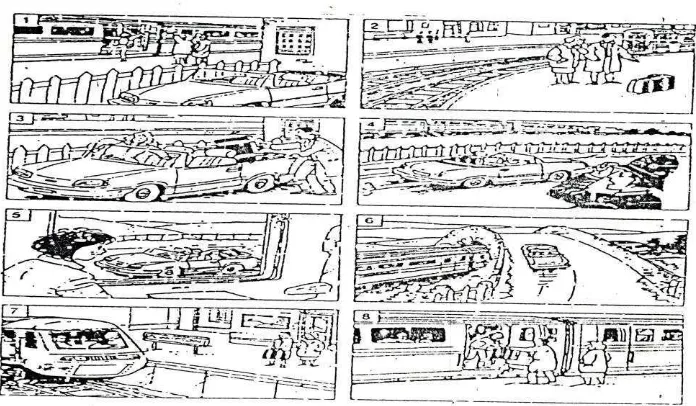
reproduce the phrases and sentences contained in it. The following is an example
of narrative paragraph writing through picture sequence.
Instruction: write paragraph of six to twelve sentences based on the following
[image:24.595.124.472.276.479.2]picture sequence
Figure 1: the example of picture sequence (taken from Heaton 1991:93)
Checking everything you have before going to somewhere is very important. This silly experience happened to me when to go to Palembang last year. My parent put me on the train station. But when my train had gone, my father saw one of my suitcase was left on the station. Fortunately, they brought a car. So my father drove the car as fast as possible to the next station where the train would stop. Firstly, I was surprised when I saw from the window of the train that their car was following the train. Luckily, they had arrived in the next station, before the train stopped there. When the train stopped, my parents directly gave the suitcase to me, and told me to be more careful. Then I continued to Palembang through the train. This occasion always make me remember to check everything I have before going somewhere.
From the explanation above, it clear that picture has many benefits, in order to
increase students’ skill especially to raise their own ideas in the form of writing.
18
imagination and pour out in the form of written form. Finally, it can be conclude
that picture sequence consist of series of picture that relate each other and creates
a story in this research. It uses a picture sequence technique in teaching writing in
order to increase students’ narrative paragraph writing skill.
G. Picture Sequence in Relation to the Study
Goodman (2006:1) states that picture stories are often used in a very predictable
way in classroom, usually as a starting point for narrative writing activity. The
statement above is supported by Rohimah (2001:30) who points out that picture
sequence is a copy of real object, which might be either larger or smaller than the
object that are represented aiming at making the students to producing their
message creatively about the content of picture sequence. It means that picture
sequence helps the students to find out and expand the topic writing (unity)
especially narrative paragraph. The students may make topic sentence behind the
message of picture sequence intended and generate the topic into a complete
narrative paragraph in term of organization (coherence) it is clear that picture
sequence can help the students arrangement of sentences in the paragraph. Since
in picture sequence, the first picture is relates to the next picture. These relate
picture can helps the students to form outline. This outline can make the students
easier to develop their paragraph more smoothly by writing transitional signal
Moreover, Rimes, Ann (1993:33-36) suggest to offer the use of picture sequence
in the class with the idea that words can be associated by a picture. From the
paragraph form. From the statement above, it can be inferred that in term of
vocabulary, picture sequence give guidance in focusing the appropriate words use
in writing. This can help the students to find appropriate vocabulary related to the
content of the picture. From the collection of certain words related to the picture
sequence, the students can create phrases. Then from those phrases, the students
will be able to construct clauses and even sentences easily in form of a good
paragraph.
Meanwhile, mechanic and language uses are not closely relates to picture
sequence, however having more writing practice by using picture sequence
technique can force the students to realize about how to use correct language and
mechanics, in this case, use of past tense.
From the statement above, it is clear that picture sequence is very beneficial to be
used as a technique in writing class since it helps the students to develop their
writing.
H. Teacher’s Role in Teaching Process
Teaching is providing someone with opportunity to learn. This can be done well,
and it can be done poorly but it is never done easily. As a good teacher someone
should always improve himself to give the best performance in teaching learning
process, since this can help the students to achieve teaching learning objective as
20
Actually, a teacher has an important role in teaching learning process. Wafiah
(2003:7) said that the function of the teacher in the process of teaching learning is
a director, facilitator, moderator and motivator. It means that every step that is
performed by the teacher in teaching learning process has specific function that is
mentioned to increase the quality of students’ learning activities.
In accordance with Medley and Shannon (1994), teacher’s performance is the way
in which a teacher behaves in the process of teaching. So the teacher’s
performance is any behavior done by the teacher when she/he teaches the
students.
It is necessary to observe teacher’s performance during the teaching and learning
process because according to Foster (1976:37), a teacher is a central force that
shapes the behavior of the individual child as well as those of children in groups.
The teacher’s performance covers the teacher’s behavior that can be described
according to specific roles that stem from the expectation of society, school,
peers, colleagues, and the children themselves.
Foster (1976:38) adds that, the qualified and competent teacher must have
mastered the knowledge and skills necessary for the performance of the
psychological roles and instructional roles.
In psychological roles, a teacher must be:
In performing this role, the teacher must be aware that children in certain
communities still expect the teacher to be a model for the social values
found therein. Thus the teacher is expected through the use of precept and
example, to inculcate those moral values, life styles, and career goals that
have high priority in the community. Thus, in teaching writing the teacher
should give good example in writing.
2. An evaluator
The way the teacher performs this role can frequently determine how
children view themselves. Because children are sensitive about all matters
concerning success or failure, the way in which the teacher performs the
evaluator role is often more critical than the evaluation itself. A teacher
must evaluate the students’ performance while they are writing.
3. A walking encyclopedia
It means that a teacher must be able to provide any information needed by
the students. Hence, a teacher must be knowledgeable. A teacher is place
for students to ask any problems they have during teaching and learning
process.
4. A moderator
The school teacher portrays the moderator role on many occasions.
22
objectively. A teacher must be able to be bridge among students when they
have complicated problem.
5. An investigator
This role can be performed in a constructive way an understanding
teacher, or it can result in devastating trauma for children if it is performed
in an insensitive manner. A teacher must find out and understand the
condition of the students.
6. An ombudsman
This role provides the support and encouragement that many children need
if they are to overcome difficulties in learning and personal matters. In
performing this role, a teacher usually respond by listening to the needs of
pupils in an understanding way. Thus, a teacher must be willing to listen
the students’ problems and try to solve them.
7. A morale builder
This role is important in the daily instructional program, especially where
cognitive learning tasks are concerned. A teacher should build the morale
of her students when they feel inadequate, or experience an early failure.
Thus, a teacher must educate the students well, so that they have good
8. A leader of the group
For a teacher, skills in group leadership lie in the area of classroom
management and planning for instruction. Suffice it to say at this point that
group leadership is a critical role for the teacher to perform. A teacher
must be able to lead the students.
9. A substitute parent
A teacher acts as a parent for many pupils. With very young children, the
teacher frequently must assist the pupils with personal attire, as well as to
perform a number of essentially psychomotor tasks. A teacher must
substitute the parent’s role at school.
Meanwhile, in instructional roles a teacher must be able to perform the following
roles:
1. A planner for learning and instruction
A teacher plans the lesson plan and the activities that will be applied in
teaching and learning process.
2. A facilitator of learning and instruction
A teacher must facilitate the learning media and anything which are useful
for teaching and learning process.
24
A teacher must evaluate the students’ performance and the students’ work
in teaching and learning process.
According to the descriptions above, the teacher’s performance is the way a
teacher behaves in the process of teaching. The behavior done by the teacher in
this process shows that she/he is doing her/his roles which cover psychological
roles and instructional roles.
Considering the important role of a teacher, the researcher intends to observe the
teacher’s performance when the teacher teaches writing by using imagination
activity. The main tools for assessing the teacher’s performance are observational
schedules and rating scales. In this action research, the researcher will use an
observation sheet in which there are some aspects that will be scored, the aspects
cover the teacher’s performance in pre activity, while activity, and also post
activity.
I. Procedure Teaching Narrative Paragraph through Picture Sequence Evison. (1988:11) state that there are three step of writing. These steps are used to
make the writing more effective, they are:
1. Pre-writing refers to selecting the general subject, restricting the
subject, generating the ideas and organizing the ideas.
2. Writing denotes to setting the paper the ideas in his/her mind in to
3. Re-writing concern with evaluating her or his writing, deals mainly
with:
a. Correcting the content and form.
b. Correcting the vocabularies, punctuation and grammar.
c. Correcting writing error, words duplication and omission.
Considering the statement above, finally the writer uses steps consisting of
pre-writing, writing and re-writing. The procedure of teaching narrative paragraph
through picture sequence will be presented as follows:
1. Pre-writing activities
a. Teacher greets the students.
b. Teacher motivates the students and asks them about narrative, e.g.
what do you know about narrative? Have you ever written a
narrative paragraph?
c. Teacher explains about the goals and the objectives of the
instruction and also aspect of writing within a good paragraph.
d. Teacher breaks the class up into group of five students.
e. Teacher distributes the picture to the students.
f. Teacher gives some guidance question relate to the picture, e. g:
1. What the first picture tell about?
2. According to you, who are the people in the picture? 3. What happened to them?
26
g. Teacher asks the students to discuss the picture given by the teacher.
2. Writing Activities
a. Teacher asks the students to write narrative paragraph that consist of
7-15 sentences based on the picture sequence given.
b. Teacher moves among the students to control their activities and
help them if necessary.
3. Rewriting Activities
a. Teacher asks the students to check their friends writing and correct
it if there are some mistakes.
b. Teacher asks the students to rewrite/revise their writing to get the
better result.
c. Teacher submits students work.
d. Teacher closes the class.
J. The Applicability of Picture Sequence Technique in Teaching Narrative Paragraph Writing
As one of visual aids and also technique in teaching writing, picture sequence can
be used to teach writing. Here is description of how to use this picture sequence.
The picture is taken from Heaton, 1991: 93.
1. Pre-writing activities
a. The teacher greeted the students in English, asked the students to pray
before starting the activity and then checked the students' attendance, for
examples:
Teacher : Good morning, students. How are you today?
Students : Good morning, Sir. We are fine, and how are you?
Teacher : I am fine too. Thank you.
b. After that the teacher told the learners that they were going to learn about
narrative text and asked some questions related to the topic that was going
to be learnt.
c. The teacher motivated the students by asking them about narrative text, for
examples:
Teacher : What do you know about narrative text?
Students : I do not know about it yet, Sir.
Teacher : Have you ever written narrative text?
Students : No. We have not written it yet.
It was used to activate their background knowledge of narrative text.
2. Writing Activities
a. Teacher breaks the class up into group of five students.
Teacher : Now I would like to divide you into five groups
with five members each.
Students : Yes, Sir. We follow your instruction.
28
Students : It is about travelling, Sir.
Teacher : According to you, who are the people in the
picture?
Students : They are the members of the family, Sir.
Teacher : What happened to them?
Students : His father put his son on the train station, Sir.
Teacher : Why did it happen to them?
Students : His father saw one of the suitcases was left on the
station, Sir.
Teacher : Where did it happen?
Students : It happened on the train station, Sir.
b. Teacher asks the students to discuss the picture given by the teacher.
c. Teacher asks the students to write narrative paragraph that consist of 7-15
sentences based on the picture sequence given, for instance:
This silly experience happen to me when to go to Palembang last year. My parent put me on the train station. But when my train gone, my father saw one of my suitcase was left on the station. Fortunately, they brought a car. So my father drove the car as fast as possible to the next station where the train would stop. Firstly, I was surprise when I saw from the window of the train that their car following the train. Luckily, they had arrive in the next station, before the train stop there. When the train stopped, my parents directly gave the suitcase to me, and told me to be more careful. Then I continued to Palembang through the train. This occasion always make me remember to check everything I have before going somewhere.
d. Teacher moves among the students to control their activities and help them
if necessary.
Teacher : Students, if you have difficulties in writing the narrative,
Students : Yes, Sir.
1. Rewriting Activity
a. Teacher asks the students to check their friends writing and correct it if
there are some mistakes and the right writings are as follows:
This silly experience happened to me when to go to Palembang last year. My parent put me on the train station. But when my train had gone, my father saw one of my suitcase was left on the station. Fortunately, they brought a car. So my father drove the car as fast as possible to the next station where the train would stop. Firstly, I was surprised when I saw from the window of the train that their car was following the train. Luckily, they had arrived in the next station, before the train stopped there. When the train stopped, my parents directly gave the suitcase to me, and told me to be more careful. Then I continued to Palembang through the train. This occasion always make me remember to check everything I have before going somewhere.
b. Teacher asks the students to rewrite/revise their writing to get the better
result.
c. Teacher submits students work.
d. Teacher closes the class.
Teacher : Alright students, time is up now. Please study hard at
home.
III. RESEARCH METHODS
A. Classroom Action Research Design
This Classroom Action Research was implemented to find out whether there is
increase on students’ narrative paragraph writing skill through picture sequence
technique. The subject of this research was students of class VIII. A at SMP
Negeri 2 Adiluwih Pringsewu, The researcher took a class after discussing with
the other English teacher. This was done because according to 2009 revised
curriculum for SMP/ Kurikulum Tingkat Satuan Pendidikan, this subject had
already studied grammar, vocabulary, preposition and transitional signal in their
previous level. Besides, the researcher took one class in which the students had
lower average score compare to the other class. He also observed a class in which
the students were not active when they are following English subject, especially in
writing class, having low motivation and look unenthusiastic in joining it and the
achievement is not satisfactory.
The researcher conducted the preliminary test, in order to see the problem face by
the students and teacher in writing class. After that, the researcher examined the
solution for the problem. The solution for the problem is teaching narrative
paragraph through picture sequence technique. Then the researcher asked the
other English teacher who will be previously train by the researcher, to teach
narrative paragraph through picture sequence technique. Next, the researcher
(the strength and the weaknesses which were done by the teacher and students
during teaching leaning process using picture sequence technique) and learning
result (narrative paragraph writing test). Learning process is analyze and base on
the result of this analysis and reflection, it is decide to conduct the next cycle by
focusing on the weakness of the previous cycle.
B. Research Procedures
Mettetal (2002:1) states that Classroom Action Research (CAR) is systematic
inquiry with the goal of improving practice in particular situation. In addition, he
states that classroom action research way for instructor to discover what works
best in their own classroom situation. Thus following informs decision about
teaching.
The researcher conducted the first cycle base on the problem face by the students
in writing narrative paragraph from result preliminary test. The teacher taught
narrative paragraph through picture sequence base on the lesson plan. After that,
the students were given writing test, and then the result was analyzed and
discussed both of writing and observation. She conducted the next cycle based on
the weaknesses happening in the previous cycle. Furthermore, if the result met the
indicator of learning achievement, she stopped in the second cycle only; but if the
result did not require the indicator of the research, she conducted for the next
cycle. It focused on the weaknesses of previous cycle and so on. Each cycle of
classroom action research consist of: 1. planning, 2. action, 3. observation and
30
Planning
CYCLE 1
Observing
Re-Planning
CYCLE 2
Re-Observing
Implementing Reflecting
Re-Implementing Re-Reflecting
?
The Cycle of Classroom Action Research (Arikunto, 2006: 16)
1. Planning
Based on the researcher observation when he did the preliminary test, the
researcher formulated the problems. After deciding the problems, he chose
appropriate technique to overcome the problems. In this phase, the researcher
also planned the type of test and teaching material while preparing teaching
aids and lesson plan.
2. Action
The researcher asked the other English teacher to teach her class by using
lesson plan. During the teaching learning process, the researcher observed
teacher’s performance and also observed students’ activities.
3. Observation and interpretation
Observation and interpretation toward the action in the class was done while
the teacher was teaching in the class by using picture sequence technique. In
other words, the observation was done at the same time with action that had
been mentioned before.
4. Analysis and Reflection
The analysis and reflection was done after teaching learning process. The
researcher and the rater checked the test and observation toward the teacher.
This stage was done to see the weakness and strengths in each cycle.
32
It is also necessary for the researcher to trains the teacher how to teach narrative
paragraph writing through picture sequence technique. This teacher’s training
procedure consists of three stages, they are:
1. Preparation
In teaching narrative paragraph writing the researcher asked the other English
teacher to teach the material based on the lesson plan. There are two picture
sequence present in this research. The topic is Riding bicycle and Sam’s Life.
Before the research was conducts, the researcher trained the teacher first. The
researcher demonstrated how to teach narrative paragraph through picture
sequence by using micro teaching technique.
2. Implementation
The training procedure was carrying out by the following steps:
Firstly, the teacher explained the goal and the objective of the teaching learning
process, so the students were aware of the learning target that should be
achieved. Then the teacher motivated the students and asked them about
narrative, for example,” What do you know about narrative paragraph?”
“Have you ever written narrative paragraph?” It functioned to activate their
background knowledge of narrative paragraph.
In prewriting process, teacher explained narrative, the parts and elements of a
good paragraph. In addition, the teacher explained the tense commonly used in
narrative paragraph, and the use of appropriate graphic convention. The teacher
explanation, the teacher checked whether the students have understood her
explanation or not. If there were some students who still do not understand the
explanation, the teacher explained more clearly. Afterwards, the teacher broke
the class up into group of four students. Then the teacher distributed the picture
sequence to the students. It aimed at making the students readier when they
wrote a narrative paragraph based on the picture sequence individually later on.
The teacher asked them to discuss about the picture sequence given. The
teacher may help them by giving some guidance questions, for instance:
a. What the first picture told about?
b. According to you, who are the people in the picture?
c. What happened to them?
d. Why did it happen?
e. Where did it happen?
f. What happened then?
g. Why did it happen?
h. How did the story end?
The question will help them to interpret the picture sequence technique into a
story and determine the vocabulary relates to the picture. The students were also
allowed to look up in the dictionary if it was necessary. During the writing
process, the teacher may help the students by giving them some keywords relates
34
The next step is writing process. Firstly, the teacher explained the instruction and
direction clearly. Then, the teacher asked the students to write a narrative
paragraph individually, based on the result of their discussion. During the writing
process, the teacher moved among the students in order to monitor and helped
them, if it was necessary.
The last step is rewriting. After the students finished their writing, the teacher
asked the students to check their friends writing using the guidance questions for
students editing that adapt from Spandel and Stiggins (1990:130). The students
can correct their friends’ works, if there are some mistakes. In this case, the
students shared ideas and even they gave comment and suggestion about their
friends work. Then teacher asked the students to consider their friend’s comment
and suggestion. It aimed at making the student aware on the mistake they made
and learnt from them. Then, the teacher allocated 10 minutes for the students to
rewrite their writing in order to get better result. Then the teacher asked all the
students to submit their works.
3. Evaluation
In this phase, the researcher will evaluate the teacher’s performance in the class
by using teacher’s observation form adapted from APKG/Alat Pengukur
Kemampuan Guru (Lampung University: 2006). The researcher classify each
aspect into five categories, they are:
VS : very satisfactory, the teacher achieves 95% result of the target
S : Satisfactory, the teacher achieves 80% result of the target
Su : Sufficient, the teacher achieves 70% result of the target
U : Unsatisfactory, the teacher achieves 50% result of the target
D. Indicator of the Research
In order to see whether guide question through picture sequence technique can
improve students’ narrative writing skill or not, the researcher determined the
indicator dealing with learning process and learning product.
a. Learning Process
For the learning process, observation was done toward the teacher by an
observer during the teaching learning process by observing the whole
teacher’s activities in the class and filling the observation form, and the
students’ activities. The indicator is if the teacher and the students gained 70%
from the result of the observation form.
b. Learning Product
The indicator is 70% of the students who get score at least 70 (seventy) or
higher in writing paragraph based on the criteria given. In giving the score, the
researcher used scoring criteria adapted from Jacob et al (1981:90).
There are five aspects evaluated by the researcher. They are:
1. Content refers to the substance of writing, the experiences of main idea
(unity). i.e., groups of related statements that a writer presents as unit in
developing a subject. Content paragraph do the work of conveying ideas
rather than fulfilling special function of transition, restatement, and
36
2. Grammar refers to the use of the correct grammatical and syntactic pattern
on separating, combining, and grouping ideas in words, phrases, clauses,
sentences to bring out logical relationship in paragraph writing.
3. Vocabulary refers to the selection of words those are suitable with the
content. It begins with the assumption that the writer wants to express the
ideas as clearly and directly as he can. As a general rule, clarity should be
his prime objective. Choosing words that express his meaning is precisely
rather than skew it or blur it.
4. Organization refers to logical organizations of the content (coherence). It
is scarily more than an attempt to piece together all collection of facts and
jumbles ideas. Even in early drafts it may still be searching for order,
trying to make out patterns in its material and working to bring the
particulars of his subject in line with what is still only a half-formed notion
of purpose.
5. Mechanic refers to the use graphics conventional of the language. i.e., the
steps of arranging letters, words, sentences, paragraph by using
knowledge of structure and some others related to one another.
The percentage of scoring form the writing components are decided as follows:
1. Content : 30%
3. Vocabulary : 20%
4. Language use : 25%
5. Mechanics : 5%
Bellow is the classification of scoring criteria adopted from Jacob et al (1981:90)
Classification Score Description
Content 20-17 Excellent to very good: excellent to very good treatment of the
subject, considerable variety of ideas or argument, independent
and thorough interpretation of the topic, content relevant to the
topic, accurate detail.
16-12 Good to average: adequate treatment of topic, some variety of
ideas or argument, some independent of interpretation of the
topic, most content relevant to the topic, reasonably accurate
detail.
11-8 Fair to poor: treatment of the topic is hardly adequate, little
variety of ideas or argument, content irrelevant, lacking detail.
4-0 Inadequate: fails to address the task with any effectiveness.
Organization 20-17 Excellent to very good: fluent expression, ideas clearly stated
and supported; appropriately organized paragraphs or sections;
logically sequenced (coherence); connectives appropriately used
(cohesion).
16-12 Good to average: uneven expression, but main ideas stand out;
paragraphing or sections organization evident; logically
sequenced (coherence); some connectives used (cohesion).
11-8 Fair to poor: very uneven expression, ideas difficult to follow;
38
Vocabulary 20-17 Excellent to very good: wide range of vocabulary; accurate
word/idiom choice and usage; appropriate selection to match
register.
16-12 Good to average: adequate range of vocabulary; occasional
mistakes in word/idiom choice and usage; register not always
appropriate.
11-8 Fair to poor: limited range of vocabulary; a noticeable number
of mistakes in word/idiom choice and usage; register not always
appropriate.
7-5 Very poor: no range of vocabulary; uncomfortable frequent
mistakes in word/idiom choice and usage; no apparent sense of
register.
4-0 Inadequate: fails to address this aspect of the task with any
effectiveness.
Language 30-24 Excellent to very good: Confident handling of appropriate
structures, hardly any errors of agreement, tense, number, word
order, articles, pronouns, prepositions, meaning never obscured.
23-18 Good to average: acceptable grammar-but problem with more
complex structures; mostly appropriate structures; some errors
of agreement, tense, word order, articles, pronouns, sequence difficult to follow (coherence); connectives largely
absent (cohesion).
7-5 Very poor: lacks fluent expression, ideas difficult to follow,
little sense of paragraphing/organization; no sense of logical
sequence (coherence); connectives not used (cohesion).
4-0 Inadequate: fails to address this aspect of the task with any
prepositions, meaning sometimes obscured.
17-10 Fair to poor: insufficient range of structures with control only
shown in simple constructions; frequent errors of agreement,
tense, number word order, articles, pronouns, prepositions,
meaning sometimes obscured.
9-6 Very poor: major problem with structures-even simple ones;
frequent errors of negation, agreement, tense, number word
order/function, articles, pronouns, prepositions, meaning
sometimes obscured.
5-0 Inadequate: fails to address this aspect of the task with any
effectiveness.
Mechanics 10-8 Excellent to very good: demonstrates full command of spelling,
punctuation, capitalization, lay out.
7-5 Good to average: occasional errors in spelling, punctuation,
capitalization, layout.
4-2 Fair to poor: frequent errors in spelling, punctuation,
capitalization, layout.
1-0 Very poor: fails to address this aspect of the task with any
effectiveness.
Based on the explanation above, the researcher measured the students’ ability in
writing paragraph. In addition, the researcher adapted marking composition taken
40
Table1. Marking composition
Meaning Marking Example
1. Wrong Form WF The best WF will be its achievement 2. Wrong Word WW Patient, funny and kindly WW
3. Wrong Tense
___________ In the last few weeks you didn’t has much fun
4. Something is missing You arrived in Brighton √ the first 5. Wrong Spelling Sp Confortable SP
6. Wrong word Order Wo You haven’t seen yetWO London 7. Wrong punctuation P Look outP
8. wrong verb form V The titanic sunk Vvery quickly 9. Not necessary John come in and be sat down
10.Incomplete sentence or I don’t understand what are you trying to say
?
While Ari was singing…?
E. Instrument of the Research
In gathering the data, the researcher used two kinds of instrument. The first
instrument is the main source of information and the second one supports the
analysis itself. The instrument used here is writing test and observation sheet. The
instrument is hopefully with the stated objectives.
1. Writing Test
The first instrument used in getting the data is writing test. Heaton (1991:137)
stated that writing can be useful testing tool since it provides the students with
an opportunity to demonstrate their ability to organize language material, using
their own words and ideas, and to communicate. In addition, he said that
composition test provided a degree of motivation which many objective type of
test fail to provide. In this research, the teacher asks the students to write
narrative paragraph writing base on the picture sequence technique given to
There are two topic of picture sequence technique given to them, they are:
Riding bicycle and Sam’s Family. It is hoped that the students can increase
their writing through picture sequence. The test is given by following details
instruction and direction including number of words, time allocation, and the
use of past tense, correct mechanics, appropriate transitional signal, etc.
Table2. Table of specification of writing test
80-100 Very good Good vocabulary and structure, above the simple sentence level.
Errors non-basic.
61-80 Good Simple but accurate relation of task. Sufficient naturalness, not
many errors.
0-60 Fair Reasonably correct if awkward or natural treatment of subject
with some serious errors.
2. Observation Sheet
In this research the researcher observed directly what was happening during
teaching learning process when the teacher implemented picture sequence
technique in teaching narrative paragraph writing. The aspect of students’
activities and teacher’s performance was observed. We adapted from APKG/
Alat Pengukur Kemampuan Guru (Lampung University: 2006) for observing
teacher’s performance. The researcher classified each aspect into five
categories: 1. very satisfactory, 2. satisfactory, 3. sufficient, 4. insufficient and
42
C. Data Analysis
Data analysis is the process of organizing the data in order to gain regularity of
the pattern and form of the research. The term interpretation can be defined as
procedure of giving meaning on the result of the analytic process (Setiyadi,
2006:255).
In this research, the researcher validated the data by using writing test and
observation. The researcher analyzed the data base on the limitation of the
problems and objectives of the research. Meanwhile, in order to measure the
reliability of the writing score, the researcher used interater reliability. Interater
reliability was used when the test independently estimated by two or more judges
or raters. In addition, it is important to ensure that both raters used the same
scoring criteria. That was product scoring criteria adapted from Jacob et al
(1981:90).
The data in the learning process is observation. The aspects of teacher’s
performance are classified into five criteria, they are: very satisfactory,
satisfactory, sufficient, insufficient and very insufficient. The researcher
determined the criteria achieve in each aspects of teacher’s performance after he
observed the teacher in teaching learning process. Meanwhile, the data in the
learning product is the score of students’ writing test. The last step was making
the report. After the researcher gained the data, she tried to interpret all collect
The schedule of the research consists of:
1. Cycle 1 is started from May 17th, 2012 up to May 21st, 2012 involves:
a. Planning. It contains of preparing lesson plan, explaining about picture
sequence technique, preparing teacher’s observation format and
students’ activities observation sheet.
b. Action. It deals with pre writing activities, while writing activities and
post writing activities.
c. Observation and Interpretation. They are: learning process concerning
with teacher’s performance and students’ activities and learning
product dealing with students’ writing scores.
d. Analysis and Reflection. They refer to learning process (students’
activities and teacher’s performance and learning product explaining
about students’ writing scores and teacher’s performance.
2. Cycle 1 is started from May 23rd, 2012 up to May 27th, 2012 involves:
a. Planning. It contains of preparing lesson plan 2 based on the problems
in cycle 1, preparing teacher’s observation format and students’
activities observation sheet.
b. Action. It deals with pre writing activities, while writing activities and
post writing activities.
c. Observation and Interpretation. They are: learning process concerning
with teacher’s performance and students’ activities and learning
44
d. Analysis and Reflection. They refer to learning process (students’
activities and teacher’s performance and learning product explaining
V. CONCLUSIONS AND SUGGESTIONS
A. Conclusions
Based on the result of the data analysis and discussion, the researcher draws the
following conclusions:
1. Picture sequence technique can be used to improve the students’ writing
achievement. It can be proved that there is an increase of students’ narrative
text writing achievement, they are:
a. Content.
In cycle I, there were 17 students (42.5%) who fulfilled the good criteria
up to very good criteria of content component. Meanwhile, in cycle II,
there were 30 students (75%) who fulfilled the good criteria up to very
good criteria. It proves that there is an increase of using picture sequence
technique in narrative text writing. It means that students can fulfill the
criteria for the content component of writing; good criteria up to very good
criteria. The increase is 13 students (32.5%) for the content component of
writing.
b. Language Use
In cycle I, there were 25 students (69.44%) who fulfilled the good criteria
up to very good criteria of language use component. Meanw