http://iaesjournal.com/online/index.php/TELKOMNIKA/index
hッイイゥセM :. _\lo_l QRL⦅セq@ .. 1.2 ... " ... AANセセMセセ@
Accelerating Computation of DNA Multiple Sequence Alignment in Distributed Environment
... .---- . ···-·-····-·-···-·-·-···· DOI: QPNQQUYQOエNャャォッュョゥォセNカQRゥQRNVUWR@
Abstract
t-li:ltFpl10 セ・アオセQカLセ@ «lignment U·l':'''i ゥセ@ ,, エセ」ィョゥアjGャ@ for findmq ,;uni!-ttnty 1n mJny セjアオ・ョLGNエセN@ Tni5 エ|G」ィョゥアオセ@ is very impo1tm\t hi セᄋjーーッイエ@
rMnf HQeMwャヲュᄋイイイョエゥ\Zセ@ エNNGャセォ@ MセjᄋZィ@ Vi 1dnnt:f;,r,;;i -;;,"_Jle nオイLャョ^エBゥセ@ J>olyrru)rphl%' ('SNI'") Md mH"'·;ierrnrrm ヲイセァュエャャエセ@ ィイイNョゥョセN@ "l'hn Dゥュセャオエ@
セャ」」ョエィイョ@ m MSA Qセ@ sエセQᄋ@ tdgoritnr.1, Th\' \ZッイゥMNーャ・セエケ@ oi DN•\ イエZオャエNーャセ@ BGGGQlャセイN」・@ jィセョュゥュャ@ オセQョァ@ d 1n,lmic ーイッQQ⦅イmセイョゥョGQ@ th<:hniq:'e-i;: vi;rr
ィQセィN@ n,1s イゥ[ウ・セイセィ@ airM lo セn・ャセイョエセ@ セ・イョーオエQQエ[ッョ@ of-sャZセイ@ mオセQーャ・@ sセᄋャGjセッ」K@ c\!1\!nment jセ[イLY@ h\AMセウQQY・@ Pernnr. jョエ・Qヲ。」・セ@ HmセャIN@ 1'he
;.•1rfQ11n11r.rr1 M the 」イッーイLセ・、@ ュセエャゥッ\ャ@ [ᄋLSセ@ GャセGjャオNQエ・」Q@ by cal.:ul.1tin9 セーm、QjーN@ セイゥッNョᄋQュセョエ@ セ。セ@ conduo:.ted usu19 \[ZNセ@ Sfl•Ncnc.H <it f.00 !,>p
gャ[」ゥョオMュセクᄋ」ィイッイョッセᄋ]GュᄋQM\[\ᄋャGャG[ャ@ f,·aQmonb: ¥iel·::!( d t·v ra'Jdcmlv CL1t fr or,) nヲッイッQQ」セ@ ;c11u•1n.;c cf cᄋャセ」ゥッ・MュセクM」ィイZBョッhᄋュヲャᄋ|ャᄋャGeゥャ@ エ。セᄋ」ョ@
from NC!H (!·J:,ttQnal <:entc•r for 61(>t•:donolo1n jイLヲッイュセエnョIN@ tQQセ@ LMセセBiエセ@ セィッセセセ、@ tli-1t エィセ@ ーイッーッセセ、@ エイNAュゥQQオセ@ (.'Quid obtain セーセ・、オイL@ th re fl
time:: UW'\I エQセ」@ c,;·rnp•jt¢rs v1hen 、ィ[ゥョゥイッセN@ M セAャqオᄋョサャ^@ oi Gitc•rrn·nM> M、ゥイnゥッ\セッQQ^・MvMsゥZGLャ@ ir<11llT>!tnl-; エNQPQᄋ・LLᄋセエイL@ |ゥLセ@ イイL」イmセュァ@ oi I.he
ヲBjュ「セイ@ rif NZNッイキオエ・イセ@ w•Juld セ[ッョゥヲQセmLエャQ@ 11m c[AセZ、@ セpAゥvセオー@ of エィセ@ :1rvpos!id
http://iaesjournal.com/online/index.php/TELKOMNIKA/about/editorialTeam
Editorial Team
Advisory Editors
1.
Prof. Hamid
AToliyat, Texas A&M University, United States
2. Prof. Patricia Melin, Tijuana Institute of Technology, Mexico
3. Prof. Neil Bergmann, The University of Queensland, Australia
4. Dr. Argyrios Zolotas, University of Lincoln, United Kingdom
5. Prof. Aurelio Piazzi, University of Parma, Italy
6. Prof. Daniel Thalmann, Nanyang Technological University, Singapore
7. Prof. Aiith Abraham, VSB Technical University ofOstrava, Czech Republic
Editor-in-Chief
Tole Sutikno, Universitas Ahmad Dahlan, Indonesia
3
Co-Editor-in-Chief
1. Prof. Dr. Leo P. Ligthart, Delft University of Technology, Netherlands
2. Prof. Dr. Omar Lengerke, Universidad Aut6noma de Bucaramanga, Colombia
3. Assoc. Prof. Dr. Wanguan Liu, Curtin University of Technology, Australia
4. Dr. Arianna Mencattini, University of Rome "Tor Vergata", Italy
5. Dr. Auzani Jidin, Universiti Teknikal Malaysia Melaka (UTeM), Malaysia
6. Mark S. Hooper, Analog/RF IC Design Engineer (Consultant) at Microsemi, United States
Editors
1. Prof. Dr. Faycal Djeffal, University ofBatna, Batna, Algeria
2. Prof. Dr. Luis Paulo Reis, University ofMinho, Portugal
3. Prof. Dr. Sanjay Kaul, Fitchburg State University, United States
4. Prof. Dr. Sotirios G. Ziavras, University Heights, United States
5. Prof. Dr. Srinivasan Alavandar, CK College of Engineering and Technology, India
6. Prof. Dr. Tarek Bouktir, Ferhat Abbes University, Setif, Algeria
7. Prof. dr.sc. Maj a Stula, University of Split, Croatia
8. Assoc. Prof. Dr. Nik Rumzi Nik Idris, Universiti Teknologi Malaysia, Malaysia
9. Assoc. Prof. Dr. Lunchakom Wuttisittikulkij, Chulalongkorn University, Thailand
10. Assoc. Prof. Dr. Jumril Yunas, Universiti Kebangsaan Malaysia, Malaysia
11. Assoc. Prof. Dr. Mochammad Facta, Universitas Diponogoro (UNDIP), Indonesia
12. Asst. Prof. Dr. Ahmet Teke, <;ukurova University, Turkey
13. Asst. Prof. Dr. Ehsan
0.
Sheybani, Virginia State University, United States
14. Asst. Prof. Dr. Supavadee Aramvith, Chulalongkorn University, Thailand
15. Dr. Ahmad Saudi Samosir, Universitas Lampung (UNILA), Indonesia
16. Dr. Ahmed Nabih Zaki Rashed, Menoufia University, Egypt
17. Dr. Deris Stiawan. CCNA, CIEH, CIHFI, Universitas Sriwijaya, Indonesia
18. Dr. Han Yang, University of Electronic Science and Technology of China, China
19. Dr. Jacek Stando, Technical University of Lodz, Poland
20. Dr. Munawar A Riyadi, Universiti Teknologi Malaysia, Malaysia
21. Dr. Nidhal Bouaynaya, University of Arkansas at Little Rock, Arkansas, United States
22. Dr. Peng Peng, Seagate Technology, Bloomington, MN, United States
23. Dr. Shahrin Md. Ayob, Universiti Teknologi Malaysia, Malaysia
24. Dr. Surinder Singh, SLIET Longowal, India
25. Dr. Tutut Herawan, Universiti Malaysia Pahang, Malaysia
26. Dr. Vassilis S. Kodogiannis, CEng, University of Westminster, United Kingdom
27. Dr. Yin Liu, Symantec Core Research Lab, United States
TELKOMNIKA Indonesian Journal of Electrical Engineering Vol. 12, No. 12, December 2014, pp. 8349 - 8356
DOI: 10.11591/telkomnika.v12i12.6842
Knowledge Management System for Zakat
• 8349
Aulia Rahman N*', lrman Hermadi2, Wisnu Ananta K3, lrfan Syauqi B4
'".3Departement of Computer Science, Faculty of Mathematics and Natural Science
4
Departement of Islamic Economics, Faculty of Economics, Bogor Agricultural University, Bogar 16680, Indonesia, Kampus IPB Dermaga, JI. Meranti, Wing 20 Level 5-6, Bogor 16680
Telp./Fax.: +62-251-8625584
*Corresponding author, e-mail: [email protected] ,
[email protected], [email protected], [email protected]
Abstract
Zakat is one of the Islamic pillars that has strategic contribution to the society. Zakat is one of the Muslim obligation.It is also a form of social solidarity. The collaboratill§J'..f!Search conducted by Badan Amil Zakat Nasional (BAZNas) and lnstitut Pertanian Bogar (/PB) estimated the potential of zakat collection in Indonesia could reach about Rp 217 trillion every year that has not been achieved yet. Researchers and practitioners have advised to implement a Knowledge Management System (KMS) to optimize the collection and BAZNas's objectives. The objective of this research is to develop web-based Zakat Knowledge Management System (ZKMS). The KMS development methodology is done with using Knowledge Management System Life Cycle (KMSLC). Knowledge has been captured from experts consisting of practitioners and scientists from BAZNas of Bogor City, muzakki, documents, books and journals. ZKMS was developed using ASP.NET framework, Ct_tprogramming language and MySQL database management system. The system has menu that are user, zakat knowledge, questions and answers with experts, interaction between members, about us, profiles and knowledge sources. This system is designed be user friendly to get, know, make, share, store and disseminate actual and contemporary of zakat knowledge.
Keywords: badan amil zakat nasional (BAZNas), knowledge management system life cycle (KMSLC), zakat knowledge management system (ZKMS)
Copyright© 2014 Institute of Advanced Engineering and Science. All rights reserved.
1. Introduction
One of Islamic pillars that has strategic contribution to society is the zakat. It is part of implementation of the Muslim obligation and also a form of social solidarity. Social solidarity in socio-economic realities of society is the problem of poverty that needs attention and solution [1 ]. According to Badan Pusat Statistik (BPS) [2] and World Bank (World Bank 2012), Indonesia is one offive poorest countries in the Muslim world. BPS stated in 2012, number of poor people in Indonesia reached 29.88 millions however World Bank stated much higher number that reached 102.45 millions.Concept of people economic empowerment through of implementing zakat in Islam is one alternative to overcome poverty problem. One of people economic empowerment institutions has been mandated by the Law of Indonesian Republic No. 23 of 2011 for national zakat management is Badan Amil Zakat Nasional (BAZNas). BAZNas (2011) has published zakat data, donation, and alms that collected from all zakat organizations only reached by Rp 1.73 trillion. Collaborative research conducted by BAZNasand lnstitut Pertanian Bogor (IPB) estimated potential of zakat collection in Indonesia could reach about Rp 217 trillion
every year. This potential needs to be extracted optimally in people life enhancement [3]. Many research suggested that not achieved zakat potential caused by low public awareness of zakat problems especially actual and contemporary [4]. In the end, the emphasis is awareness of people to give zakat, donation and alms that it must be cultivated and instilled in every Muslim [5].Knowledge Management System is a form of information combination, interpretation, reflection and experience of a person or an expert that could documented or knowledge that is still in minds of experts called implicit/tacit knowledge. It could be distributed in a container and could be accessed by all people.
8350 • ISSN: 2302-4046 KMS is to support the creation, transfer and application of knowledge within organization effectively and requires a lot of literature [7]. According to activity theory, KMS paradigm is to create, share, store and disseminate knowledge and collaborate with each other [8]. The expected result is to be a good learning system. In general, information is defined from terminology of data, knowledge is defined from terminology of information and cultural (wisdom) is defined from terminology of knowledge [9].Knowledge could lead gradually users to get the ultimate solution [1 OJ.Expression and representation model of knowledge is the most important stage to influence reasoning efficiency, enriching knowledge and affect the intelligence level of the entire knowledge [11 ].
Many systems have been built to support awareness of zakat that it aimed of getting information zakat related easily. One system has been built is a Web-Based Zakat Information System by Francisca Meisye Huseina (2006). The advantages of a system could display zakat information and could calculate zakat. The weakness of a system is only display information but not be a knowledge, only one-way interaction and not involve experts thoroughly.Zakat services and socialization activities are conducted using old patterns. It is necessary innovated by using the knowledge management system and utilize the current technology, so that any data, information and knowledge could be processed accurately and quickly accessible by public especially muzakki. The formulation of problem in this research is lack of awareness, satisfaction and muzakki trust. It is caused the lack of knowledge about zakat. Therefore, we have taken a concept of KMS that it would be cultivated and be instilled knowledge, paradigms and awareness in every a Muslim. The objective of this research is to develop web-based Zakat Knowledge Management System (ZKMS).
2. Research Method
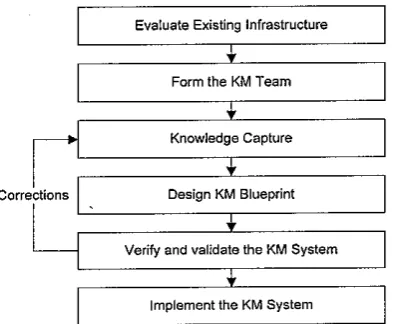
Development of ZKMS has used Knowledge Management System Life Cycle [12] that could be seen in Figure 1. The phases are: evaluate existing infrastructure, form the KM team, knowledge capture, design KMS blueprint, verify and validate the KM system, implement KM system and testing KM system.
Evaluate Existing Infrastructure
Form the KM Team
Knowledge Capture
Design KM Blueprint
Verify and validate the KM System
[image:4.595.188.394.437.599.2]Implement the KM System
Figure 1 . KMSLC Development Phase
TELKOMNIKA ISSN: 2302-4046 • 8351
repository of various media with study of literature, capturing of the tacit knowledge from experts with interview and knowledge representation. The research material has used the expert knowledge base that consists of practitioners and scientists from BAZNas of Bogar City, muzakki, documents, books, journals of zakat. Knowledge has been captured from experts in order to build a knowledge base. KMS blueprint has been designed using Unified Modeling Language (UML), Object Relational Mapping (ORM) and Entity Relationship Diagram (ERD).Experts has verified and validated knowledge with a blueprint design that has been made. KM System has been implemented with creating a database, writing program code, interface-pages in system and converts knowledge into explicit forms, including of errors reasoning, ambiguity, incompleteness and error representation and user training. KMS has been tested using black box where system is run on Google Chrome or Mozilla Firefox, MySQL local web server and Microsoft Visual Studio 201 O.
Knowledge Capture has done with: a) The study of literature
Explicit knowledge has been captured from books, documents, papers, proceedings and journals scientific research zakat related. Explicit knowledge has been extracted in form of files that has been stored in the database. The books and journals have been captured knowledge that are:
9
1. Al-qur'an an adist.
2. Fiqih 4 Ma - Syaikh Al-Allamah Muhammad Bin Abdulrrahmantahun 2013 3. 20 Fatwa Pilihan Seputar Zakat - Al-Imam 'Abdul 'Aziz bin 'Abdillah bin Baz
tahun2007.
4. Fiqih Zakat- Al-Qurdowi tahun 1997
5. Buku Panduan Zakat Dom pet Dhuafa - Ahmad Hadi Yasin tahun2011 6. Buku Tunaikan zakat -Achmad Muzammil tahun2003.
7. Kitab Zakat - Syaikh Abdul Aziz bin Baz tahun2009
8. Factors Affecting Zakat Payment Through Institution Of Amil: Muzaki's Perspectives Analysis (Case Study Of Badan Amil Zakat Nasional [BAZNas])ect.
b) Interview
The interview has been conducted to capture tacit knowledge that is in the experts minds. Experts are selected because they are intensively involved in research and they have an experience of the zakat service in Indonesia. Expert name is Ustadz Jejen Hermawan H, Spdl. Result of the interview that has been captured from their knowledge are the ones who could receive zakat is poor person's, the poor category have basic needs that must fulfilled every day or every month from Indonesian society is Rp. 900.000, - according to the number of eating 3 x Rp. 10.000, - x 30 days. Groups who could receive zakat are people who is owed, and ratio both the debt and income that makes them ・ャゥァゥ「ャ・セ・ゥカ・@ zakat is basic needs more than their daily income by Rp. 50.000, - and others that c U b e contained in this presentation.
3. Results and Discussion
BAZNas has technology infrastructure that be adequate for system implementation. There has a network of computers and internet has integrated, a server unit online 24-hour that could be used to manage knowledge. Servers have used Intel Core i5, 3 GB memory, 500 GB Hard Disk. It also has MySQL and XAMPP. Microsoft Visual Studio 2010 and Navicat Premium are installed to develop ZKMS. Software from Microsoft that has been used not all licensed or still trial. Finance for this project has received an allocation of funds from the financial center BAZ itself every year. Human resources also have been accommodated with the information technology division. Administrator and expert has been trained to run the system. Then the project has created a strategy that consists of a vision that emphasizes the application of zakat knowledge management, knowledge sources has been taken from experts. Culture is instilled into every administrator, and specifically for experts to always create, share, enhance and maintain zakat knowledge. KM team has been formed with the stakeholder, experts, administrators and researcher and developer a ZKMS.
8352 • ISSN: 2302-4046
Shafi'i, Hanafi, Hambali, Maliki book's, documents and journals zakat related. The Implicit knowledge and the knowledge sharing culture are gotten from practitioners and scientists from BAZNas and muzakki. The formulation could be seen as in Figure 2. Knowledge Map of ZKMS has eight subdivisions. The first of these is the intentions on payments. The second of these is the terms of obligation where there are six of terms among others is is lam, fully-owned (owned perfect), already reached one nishab and reached one year (Al-Hawl). The third of these is the right group accept where there are eight of group among others is fakir and miskin. The fourth is the distribution of zakat. The fifth is the haram group accept where there are four of group among others is kafir and atheis. The six is the promise of Allah for them that pay of zakat. The seven is the punishment of Allah for them that not pay of zakat.The last subdivision is the kinds of zakat that has two kinds are fitrah and maal. Fitrah has two subdivisions that are measure and time of payment. Maal has two subdivisions that are intention and kinds of maal. The kinds of maal zakat have seven subdivisions. The first is the animal husbandry that are camel, cow and buffalo I sheep. the next subdivision are mining and seafood, trade, gold, silver and saving, enterprise, income and the last subdivision is the agriculture that are rain water, irrigation and hybrid.
Camel
Intention on
Payments
Terms of Obligation
Animal
Husbandry
The Righi Group Accept
Mining and
seafood
Zakal
Distribution
Intention
Trade
The Haram The Promise of The Punishment
Group Accept Allah of Allah
Kinds
Gold, Sliver
and Savings
Fl!rah
Measure
Income
Cow Buffalo Sheep I Nishab and Hawl
Ad min
Figure8nowledge Map of ZKMS
(\,
Register
ead Knowledge Detall
Rain Water
Figur8se Case Diagram of ZKMS
Kinds
Hybrid
TELKOMNIKA ISSN: 2302-4046 • 8353
ZKMS is designed with using UML [14]. Use case diagram could be seen as in Figure 4, which has four user that are admin, expert, member and visitor. Visitor could do registration, read knowledge extends to use case of read knowledge detail, read consultation extends to read consultation detail. Member read knowledge extends to use case of read knowledge detail, read consultation extends to read consultation detail, create a question that would be answered by an expert, create comment and download knowledge source. Expert could create knowledge, answer question uses the create question by member or create email by an admin. The admin could create knowledge, create an email uses the create question by member if question no yet answered by an expert ..
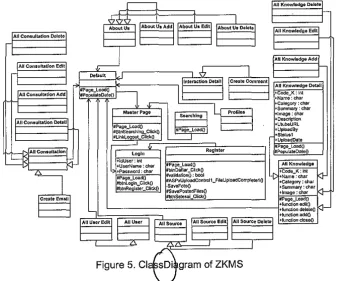
Class Diagram of KMS illustrates the system structure that is defined in terms of classes that could be seen in Figure 5. Class Register has seven methods that are page_load, btnDaftar_click, validation, ASPxUploadContol1_FileUploadComplete1, saveFoto and btnSelesai_Click, Class Registerdirects to class Login which has three attribute that are id User, username and password and which has three methods that are Page_Load, btnLogin_Click and btnRegister_Click. Class Login directs to class Master Page. Class Master Page directs to class Default. Class Default directs to class All Knowledge. Class All Knowledge is a generalization from class All Knowledge Detail, All Knowledge Add, All Knowledge Edit, All Knowledge Delete and other direction.
I I IAll Knowledge Delelel
I
""""""
I I I 'I AboutUs I iAboutUsAddl IAboutUsEdlll iAboutUsDeletel
IAll Knowledge Edit! All Consultation Doletol I
,
,
II I I II ' II ' I
r1 ' I I
'
Nセ@
(AH Knowledge AddiIAH C<>nsultallon Edit I
I
'セ@ I I Default l,J .1, I
I I
·' Interaction Detanl I Create Comment I
1:Poge_Load()
UJ,
I:
II
セセャセZッ[ャセセZ・@Oetall
IAll Consultation Addi #PopulateDate()
' 1 +Nami char
_,----I Soar<:hlng I
セ@
Kc。ャセッイケ@ char Master Page Prolllos I +Summary char +Image
""'
IAll Coneultallon Detail I I +Description
#Page_LoadO +UtubeURL
I #BlnSearchln1.1..Cllck() セp。ァ・⦅lッ。、HI@ I I +UplcadBy
I I #Llnklogout_CllckO _ J +Sta1us1 +UploadDate
セBᄋ@
#Page_Load()_NAii Comultatlonl
""
Register #PcpulateOateOe
"'
v me:char #Page Load() All Knowledge
Password : char j#b1nDailar_Cl1ci<O -( +Code_K: Int
fO-I
"Paga_Load() l#'lalldaUono: bool +Name :char #btnlcg;n_CllckO !iiASPxUplcaclContml1_FileUploadCcmpTete10 +Ca1egory : char #btnRegister_Clici<O Nウ。セ・fッエッo@ +Summary: char
k1-Cs。セ・pッウエ・、fゥャ・ウo@ +Image: char
I Create Email I #blnSelesai_Clici<O #Page_Load()
I I +luncilon edil()
I<!-'
-
+function delete() +function add() I All User Edll I I All User I I All source I \All Source Edit I IAll Source Delete I +function close()I I I I ''
I '' II I
' I
Figure 5. Clegram of ZKMS
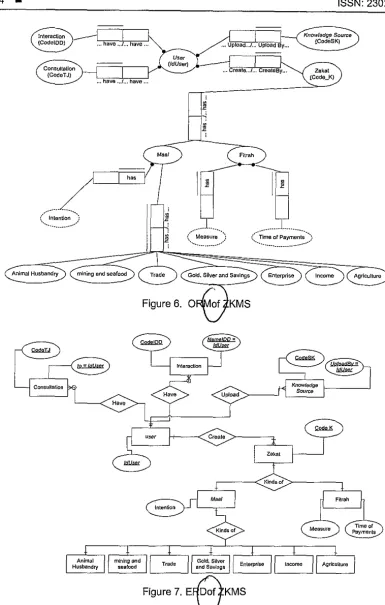
Object Relational Mapping (ORM) [15] is designed to represent the database relational of data storage with object form that could be seen as in Figure 6. Each user attributes upload one or more knowledge source attribute; each knowledge source attributes upload by one user attribute. Each user attributes have one or more interaction; each interaction attributes have one user. Each user attributes have one or more consultation; each consultation attributes have one user. Each user attributes create one or more zakat attribute; each zakat attributes have one user. Each zakat attributes has one maal and fitrah attribute. Fitrah attribute has two values that are measure and time of payment. Maal attribute has intention's value and has one animal husbandry, mining and seafood, trade, gold, silver and savings, enterprise, income and agriculture attribute.
[image:7.599.118.465.314.595.2]8354 •
Interaction
(CodelOD)
Consultation
(CodeTJ)
Animal Husbandry
... have ... / ... h!ive ..
... have ... / .. have ..
""
User
(ldUsel}
Maal
,,, Upload .. ./ ... Upload By ...
... Create ... / ... CreateBy ...
Fitrah
[image:8.605.96.481.63.668.2]mining and seafood Trade Gold, Sliver and Savings
Figure 6. 0 KMS
Zakat
ISSN: 2302-4046
Knowfedg9 Source
(CodfiSK)
Zakat
!Code_KJ
Agriculture
,----CKindsor>---,
Animal
Husbandry min!n>1 and seafood
lnt1:1ntion
Trade
Figure 7. EeKMS
Fitrah
Measure
Income Agriculture Timaor Payments
,.
TELKOMNIKA ISSN: 2302-4046 • 8355
user attributes have one or more consultation that has CodeTJ as primary key and uploadBy
=
ldUser as foreign key; each consultation attributes have by one and only one user attribute. Each user attributes create one or more zakat attributes that have Code_K as primary key. Each zakat attributes has kinds of maal and fitrah attribute. Fitrah attribute has two values that are measure and time of payment. Maal attribute has intention value and has kinds of one animal husbandry, mining and seafood, trade, gold, silver and savings, enterprise, income and agriculture attribute.Verification and validation of KMS have done with interviews and discussion on a design blueprint with experts from BAZNas. Overall design blue print is accordance with what is expected on stage of the knowledge capturing, then next stage is KMS implementation process with using ASP.NET (C#) to be converted into a web.
Implementation of KM System has the navigation functions contains all concepts blueprint that have been designed. Visitors could do registration in the registration navigation. Login navigation is permission process for members, experts and admin. Header navigation is used to search the knowledge if put in a word and would search for words listed on the system. Navigation menu consists of menu of knowledge zakat, consultation with experts, interaction and dialogue between members, knowledge source, profile, about us and user. Navigation of sub-menu consists of the animal husbandry, mining and seafood, trade, gold, silver and savings, enterprise, income, agriculture. Center navigation contains banner "welcome to ZKMS", introduce the KMS system and how manner to create an account, top topic with a question and answer with experts. Navigation of footer consists of the category zakat, tools and shortcut of the system.
KM System has been tested with black box [17) on each of functions that have been tested by the examiner whom be credible with running application system on Google Chrome or Mozilla Firefox, MySQL local web server and Microsoft Visual Studio 2010 which has already installed. Any function that is designed on the blueprint has been tested with black box. Procedures performed by testing functional requirements and non-functional requirements. Specification of testing is: status of one (1) for successful testing and status of zero (0) for testing that did not work. Ultimately testers have stated that each function has run successfully.
Current research is focusing on the development KMS for zakat in BAZNas and continuity of its practices. What was not being measured is, how significant processes are being practiced; how implement the concept of system manage change and rewards structure and how do to post-system evaluation. It is hoped that we could further relate the existence with significance of existence to better understand the culture of knowledge management processes at BAZNas.By doing so, we could further determine which process needs to be improved (if any) or process the administrator normally practice. The results of finding would be useful to cultivate the knowledge sharing for society among BAZNas.
4. Conclusion
The formulation of problem in this research is lack of awareness, satisfaction and muzakki trust. It is caused the lack of knowledge about zakat. Therefore, we have taken a concept of KMS that it would be cultivated and be instilled knowledge, paradigms and awareness in every a Muslim. The objectjyg_of this research is to develop web-based Zakat Knowledge Management System (ZKMS). The KMS development methodology is done with using Knowledge Management System Life Cycle (KMSLC}.The ZKMS was developed using ASP.NET framework, C# programming language and MySQL database management system. The system has ュセ@ that are user, zakat knowledge, questions and answers with experts, interaction between members, about us, profiles and knowledge sources. This system is designed be user friendly to get, know, make, share, store and disseminate actual and contemporary of zaKafKnowledge.
References
[1] Hafidhuddin. Peran Strategis Organisasi Zakat dalam Menguatkan Zakat di Dunia. Jurnal Ekonomi Islam. 2011; 2(1 ),ISSN: 2087-2178.
..
8356 • ISSN: 2302-4046
[3] Ayuniyyah. Factors Affecting Zakat Payment Through Institution Of Amil: Muzaki's Perspectives Analysis (Case Study Of Sadan Amil Zakat Nasional [BAZNas]). Al-infaq Jurnal Ekonomi Islam. 2011; 2(2), ISSN: 2087-2178.
[4] Siswantoro, Nurhayati. Factors Affecting Concern about Zakat as a Tax Deduction in Indonesia. Int. J. Manag. Bus. Res., 2012; 2(4): 293- 312.
[5] Rizal. Pengaruh Tingkat Kepuasan Dan Kepercayaan Muzakki Kepada Lembaga Amil Zakat Terhadap Perilaku Ber Zakat Muzakki. (Master's thesis). Jakarta: Universitas lndonesia.2006. [6] Alotaibi et al., Investigating Factors for Knowledge Sharing Using Web Technologies. ACM. 2013;
978-1-4503-2300-0113109.
[?] Davenport, Prusak. Working Knowledge - How Organisations Manage What They Know. Harvard Business School Press, Boston, Massachusetts.1998.
[8] Gloe!, Berrell. The Dual Paradigm Nature Of Knowledge Management: Implications For Achieving Quality Outcomes In Human Resource Management.Journal of Knowledge Management. 2003; 7(1 ): 78-89.
[9] Rowley. The Wisdom Hierarchy: Representations Of The DIKW Hierarchy. Journal of Information Science. 2007; 33 (2): 163-180, DOI: 10.117710165551506070706.
[10] Tan Cuipinget al., Agricultural Knowledge Grid Construction. TELKOMNIKA Indonesian Journal of Electrical Engineering. 2013; 11(9): 5224-5228.
[11] LvXikuiet al., Construction of Geological Knowledge-based Systems of Railway Route Selection.
TELKOMNIKA Indonesian Journal of Electrical Engineering. 2014; 12(7): 5575-5584.
[12] Awad, Ghaziri. Knowledge Management. Upper Saddle River, NJ: Pearson Prentice Hall. 2010. [13] Novak, Canas. The Theory Underlying Concept Maps and How To Construct and Use Them, Institute
for Human and Machine Cognition. 2006.
[14] Wesley. Unified Modeling Language User Guide, The 2 ed., 2005: 496, ISBN 0321267974.
[15] Halpin. Information Modeling and Relational Databases, The 2nd edition.2008; ISBN: 978-0-12-373568-3.
[16] Chen et al., The Entity-Relationship Model Toward a Unified View of Data. ACM Transactions on Database Systems. 1976; 1 (1 ): 9-36, doi:10.11451320434.320440.
[17] Satzinger. Systems Analysis And Design In A Changing World. Fifth Edition. 2010.
•
Register
•
Search
•
Current
•
Archives
•
Announcements
Home> Archives> Vol 12, No 12
Vol 12, No 12
December 2014
Table of Contents
Study on Smart Grid System Based on System Dynamics
Cui He-Rui, Xu Peng
7979-7986
Improving the Dielectric Properties of High Density Polyethylene by Incorporating Clay-Nano PDF
Filler
Osama Elsayed Gouda, Sohair F. Mahmoud, Ahmed A. El-Gently, Ahmed S. Haiba
A High-accuracy Detection Method Research for Electric Power Harmonic
Jingfang Wang
Improvement of Transient Stability Performance of Captive Power Plant During Islanding
Condition
Utpal Goswami, Tapas Kumar Sengupta, Arabinda Das
HVDC Application for Different Solar PV Technology Combinations in India
Suprava Chakraborty, Pradip Kumar Sadhu, Nitai Pal
7987-7995
7996-8000
8001-8007
Emperical Computation of Solar Radiation and Determination of Regression Coefficients for
Khulna City
8008-8014
Mohammad ArifSobhan Bhuiyan, Abdus Sobhan Bhuiyan, Muhammed Jamshed Alam
Patwary, Subrina Akter, Mohammad Monjur Alam
8015-8021
Guidelines to Establish Secure Structure in Communication Networks used in the Smart Grid PDF
Siamak Rezaei
Single Axis Automatic Solar Tracking System Using Microcontroller
Soumya Das, Pradip Sadhu, Nitai Pal, Suprotim Mukherjee
8022-8027
8028-8032
Prediction the AC Breakdown Voltage in Point/Plane Air Gaps with Barrier Using Design of
Experiments
Abdelghani Rouini, Djillali Mahi, Tahar Seghier
•
Mitigation of SSR Oscillations in Series Compensated Line using LCAP Subsynchronous
Damping Controller
Sanjiv Kumar, Narendra Kumar
. Remote Controlling and Monitoring of Induction Motors Through Internet
Abdiilkadir <;;akir, Hakan <;;alis, Giikhan Turan
Analysis of variable speed chopper fed Brushless Direct Current motor
J eya Selvan Renius, Vinoth Kumar K, Raja Guru, Arnold Fredderics
Modelling of Faulty Three Phase Induction Motor by Field Orientation
M. Jannati, N. R. N. Idris, M.
J.
A.Aziz
New Generation Solar PV Powered Sailing Boat using Boost Chopper
Soumya Das, Pradip Kumar Sadhu, Suprava Chakraborty, Nitai Pal, Gourav Majumdar
Effect of Switching Freguency in DTC Based Switched Reluctance Motor Drive
Srinivas Pratapgiri
An Approach of Power Factor Co1Tection in BLDC Motor Drives Using Cuk Derived
Conve1ters
R. Balamurugan, J. Pearly Catherine
Modeling and Simulation of Grid Interfaced Synchronous Generator with Controller
S. Sridharan, N. Manonmani
8042-8050
8051-8059
8069-8076
8069-8076
8077-8084
8085-8091
8092-8097
8098-8103
A Novel Technigue for Vector Control of Single-Phase Induction Motors Based on Rotor
Field-Oriented Control
Mohammad Jannati, Sajad Abdollahzadeh Anbaran, Nik Rumzi Nik Idris, Mohd Junaidi Abdul
8104-Aziz
8113
A Design and Analysis of Voltage Source Inverters for Renewable Energy Applications
M. Murali, Arulmozhiyal Arulmozhiyal, P Sundaramoorthy
Bidirectional Luo Converter Fed Switched Reluctance Motor
R. Balamurugan, M. Vishvanath
New Research on MEMS Acoustic Vector Sensor Used in gr01md Marker of Pipeline
Mengran Liu, Guojun Zhang, Zeming Jian, Hong Liu, Xiaopeng Song, Wendong Zhang
An Empirical Evaluation of Topologies for Large Scale NoC
Mehdi Baboli, Nasir Shaikh Husin
Design of Fractional Order PID controller for de motor using Genetic Algorithm
Ashu Ahuja, Bhawna Tandon
The Automatic Recognition of Large Ball Valve Sealing Bolt Based on Digital Image
Song Qingjun, Xiao Xingming, Jiang Haiyan, Zhao Xieguang
Step Responses of Tuned Conventional Controller for a Three Tank Liguid Filled System
Kuna! Chakraborty, Rahul Dev Basak, Dipak Kumar Dutta
8114-8119
8120-8125
8126-8132
8133-8139
8140-8151
8152-8160
•
••
RBFNN Variable Structure Controller for MIMO System and Application to Ship Rudder/Fin PDF
Joint Control
Han Yao Zhen, Hairong Xiao
The B+-tree-based Method for Nearest Neighbor Queries in Traffic Simulation Systems
Zhu Song, Zhiguang Qin, Weiwei Deng, Yuping Zhao
8166-8174
Improved Reaching Law Sliding Mode Control Algorithm Design For DC Motor Based on
Kalman Filter
8175-8192
Li Liu
8193-8199
CNC Parametric Optimization for Exercise Equipment Parts Surface Roughness Using TRIZ
Han-Chen Huang, Cheng-I Hou, Tian-Syung Lan
8200-8204
Pitch detection base on EMD and the second spectrum
Jingfang Wang
A Design of Bang-Bang PLL in Low Jitter and Wide Pull-in Range
Xihong Chen, Qiang Liu, Denghua Hu
Chaotic Binary Modulation Excitation Sequences for Multichannel Ultrasonic Ranging
Svstem
Zhenjing Yao, Jingsong Yang
A New Image Encryption Algorithm Based on Two-dimensional Coupled Chaotic Map
Li Tu, Liyuan Jia, Chi Zhang, Saiqiu Guo
Speech Enhancement Research based on Fractional Fourier transform
Jingfang Wang
Optimal Tlueshold of LTE-Femtocell Network Based Bayes-Nash Equilibrium Theory
Hao Chen, Ying Liu, Jianfu Teng
Ultra-Wideband Patch Antenna for K-Band Applications
Umair Rafique, Syed Ahsan Ali
8205-8211
8212-8216
8217-8228
8229-8237
8238-8245
8246-8251
8252-8256
New Topology LNA Architecture using Inductive Drain Feedback Technique for Wireless
Application
Kami! bin Pongot, Othman A.R, Zakaria Z, Suaidi M.K, Hamidon A.H
A Difference-Based Feature Description Method of Image Target
Qiang Gao, Wu Yang, Hongye Yang
8257-8267
8268-8277
Accelerating Computation of DNA Multiple Sequence Alignment in Distributed Environment PDF
Ramdan Satra, Wisnu Ananta Kusuma, Heru Sukoco
8278-8285
Particle Swarm Optimization with a Simulated Binary Crossover Operator
Lei Yang, Caixia Yang, Yu Liu
'
•
Pose Error Analysis Model Based on Binocular Vision for Rigid-Body
Fenglian Niu
Service Cooperation Incentive Mechanism in a Dual-channel Supply Chain under Service
Differentiation
Jun Chen, Ying Yang
8292-8302
8303-8311
Application of Value Assessment Weights in Conservation of Modern Architectural Heritage
Song Gang, Yang Changrning, Hao Chen, Ran Y anping
8312-8318
Study on the Evaluation Abilitv of Personalized Information Service of Higher Vocational
Librarv
XinJuan Zhou, Meiying Nie
Decision Support Dashboard in OpenERP
8319-8325
Laila Eken, Belaid Bouikhalene, Mohamed Fakir
8326-8334
Performance Comparison of Host Identity Protocol and TCP/IP with Firewall against Denial
of Services
Alfan Presekal, Riri Fitri Sari
Computing Simulation of Post-buckling in Functionally Graded Materials - A Review
Elias Randjbaran, Rizal Zahari, Ramin Vaghei
Knowledge Management System for Zakat
Aulia Rahman Nasution, Innan Hennadi, Wisnu Ananta
K.,Irfan Syauqi B.
8335-8343
8344-8348
8349-8356