• Tidak ada hasil yang ditemukan

Investigation on oil palm fiber composite mechanical properties.

N/A
N/A
Protected

Academic year: 2017

Membagikan "Investigation on oil palm fiber composite mechanical properties."

Copied!
24
0
0

Teks penuh

(1)

INVESTIGATION ON OIL PALM FIBER COMPOSITE MECHANICAL PROPERTIES

MUHAMAD SYAFIQ BIN MD NAJIB

(2)

PENGESAHAN PENYELIA

“Saya akui bahawa telah membaca laporan ini dan pada pandangan saya laporan ini adalah memadai dari segi skop dan kualiti untuk tujuan penganugerahan

ijazah Sarjana Muda Kejuruteraan Mekanikal (Struktur dab Bahan).”

Tandatangan: ………..

(3)

SUPERVISOR DECLARATION

“I hereby declare that I have read this thesis and in my opinion this report is sufficient in terms of scope and quality for the award of the degree of Bachelor of

Mechanical Engineering (Structure and Materials)”

Signature : ……….

(4)

INVESTIGATION ON OIL PALM FIBER COMPOSITE MECHANICAL PROPERTIES

MUHAMAD SYAFIQ BIN MD NAJIB

Project submitted in fulfilment of the requirements for Bachelor Degree of Mechanical Engineering (Structure & Materials)

Faculty of Mechanical Engineering Universiti Teknikal Malaysia Melaka

(5)

ii

DECLARATION

“I hereby declare that the work in this report is my own except for summaries and quotations which have bkeen duly acknowledged.”

Signature : ………..

Author : MUHAMAD SYAFIQ BIN MD NAJIB

(6)

iii

Specially dedicated to my beloved father Md Najib Bin Ithnain and beloved mother Norliza Binti Tukimin, brothers and sisters, to all family members, lecturers

(7)

iv

ACKNOWLEDGEMENTS

Alhamdulillah, Thanks to Allah SWT, whom with His willing give me the opportunity to complete this Final Year Project. This final year project report was prepared for Faculty of Mechanical Engineering (FKM), Universiti Teknikal Malaysia Melaka (UTeM), basically for student in final year to complete the undergraduate program that leads to the degree of Bachelor of Mechanical Engineering major in Structure and Materials.

Firstly, I would like to express my deepest thanks to, Dr Sivakumar Dhar Malingam my supervisor who had guided me a lot to finish this final year project.

(8)

vi

ABSTRACT

(9)

v

ABSTRAK

(10)

vii

TABLE OF CONTENT

CHAPTER TITLE PAGE

DECLARATION ii

DEDICATION iii

ACKNOWLEDGEMENT iv

ABSTRAK v

ABSTRACT vi

TABLE OF CONTENT vii

LIST OF TABLES xi

LIST OF FIGURES xiii

LIST OF APPENDICES xvi

CHAPTER I INTRODUCTION 1

1.1 Objectives 5

1.2 Problem Statement 5

1.3 Scope 5

CHAPTER II LITERATURE REVIEW 6

2.1 Composite 6

2.1.1 Polymer Matrix Composite 8

2.2 Matrix 9

2.2.1 Polypropylene (PP) 9 2.2.2 Maleic Anhydride-Polypropylene

(MAPP)

9

2.3 Reinforcement 10

(11)

viii

2.3.2 Oil Palm Empty Fruit Bunch (OPEFB)

11

2.4 Oil Palm Empty Fruit Bunch Treatment 13

2.5 Mechanical Testing 14

2.5.1 Tensile Test 14

2.5.2 Three Point Bend Test 16

2.5.3 Hardness Test 18

CHAPTER III METHODOLOGY 19

3.1 Materials 20

3.1.1 Reinforcement 20

3.1.2 Matrix 20

3.2 Specimen Preparation 22

3.2.1 Fiber Treatment 22 3.2.2 Fiber Chopping 23 3.2.3 Mix Fiber with Matrix 24 3.2.4 Crush into Pallet Size 25 3.2.5 Compress (Hot and Cold Press) 25 3.2.6 Cutting the Palm Fiber Composite 26

3.3 Mechanical Testing 28

3.3.1 Tensile Test 28

3.3.2 Three Point Bend Test 31

3.3.3 Hardness Test 32

CHAPTER IV RESULTS AND DISCUSSION 33

4.1 Introduction 33

4.2 Tensile Test Results 33

4.2.1 Tensile Test Result for PP/OPEFB 0% Composite

34

4.2.2 Tensile Test Result for PP/OPEFB 10% Composite

35

4.2.3 Tensile Test Result for PP/OPEFB 20% Composite

(12)

ix

4.2.4 Tensile Test Result for PP/OPEFB 30% Composite

37

4.2.5 Tensile Test Result for PP/OPEFB 40% Composite

38

4.2.6 Tensile Test Discussion 39

4.3 Flexural Test Result 42

4.3.1 Flexural Test Result for PP/OPEFB 0% Composite

42

4.3.2 Flexural Test Result for PP/OPEFB 10% Composite

43

4.3.3 Flexural Test Result for PP/OPEFB 20% Composite

44

4.3.4 Flexural Test Result for PP/OPEFB 30% Composite

45

4.3.5 Flexural Test Result for PP/OPEFB 40% Composite

46

4.3.6 Flexural Test Discussion 47

4.4 Hardness Test Result 49

4.4.1 Hardness Test Result for PP/OPEFB 0% Composite

49

4.4.2 Hardness Test Result for PP/OPEFB 10% Composite

49

4.4.3 Hardness Test Result for PP/OPEFB 20% Composite

50

4.4.4 Hardness Test Result for PP/OPEFB 30% Composite

50

4.4.5 Hardness Test Result for PP/OPEFB 40% Composite

50

4.4.6 Hardness Test Discussion 51

CHAPTER V CONCLUSION AND RECOMMENDATIONS 53

(13)

x

5.2 Conclusion 53

5.3 Recommendations 54

REFERENCES 55

(14)

xi

LIST OF TABLES

NO. TITLE PAGE

2.1 Properties of Oil Palm Empty Fruit Bunch Fibre (OPEFB) (M.Z.M. Yusoff et. al. 2009)

11

2.2 Standard percentage of fibre length (Hamzah, 2008)

14

3.1 Composition for PP, OPEFB Fiber and MAPP 24 4.1 Ultimate Tensile Stress, Strain and Young Modulus

of PP/OPEFB 0% Composites

34

4.2 Ultimate Tensile Stress, Strain and Young Modulus of PP/OPEFB 10% Composites

35

4.3 Ultimate Tensile Stress, Strain and Young Modulus of PP/OPEFB 20% Composites

36

4.4 Ultimate Tensile Stress, Strain and Young Modulus of PP/OPEFB 30% Composites

37

4.5 Ultimate Tensile Stress, Strain and Young Modulus of PP/OPEFB 40% Composites

38

4.6 Average Value of Ultimate Tensile Stress and Young Modulus for Different Composite Composition

39

4.7 Ultimate Flexural Stress of PP/OPEFB 0% Composites

42

4.8 Ultimate Flexural Stress of PP/OPEFB 10% Composites

43

4.9 Ultimate Flexural Stress of PP/OPEFB 20% Composites

(15)

xii

4.10 Ultimate Flexural Stress of PP/OPEFB 30% Composites

45

4.11 Ultimate Flexural Stress of PP/OPEFB 40% Composites

46

4.12 Average Value of Flexural Strength for Different Composites Composition

47

4.13 Hardness Scale for PP/OPEFB 0% Composite 49 4.14 Hardness Scale for PP/OPEFB 10% Composite 49 4.15 Hardness Scale for PP/OPEFB 20% Composite 50 4.16 Hardness Scale for PP/OPEFB 30% Composite 50 4.17 Hardness Scale for PP/OPEFB 40% Composite 51 4.18 Average of Shore-D Hardness Number of All

Composition Composites

(16)

xiii

LIST OF FIGURES

NO. TITLE PAGE

1.1 Classification of Fiber(http://www.globalspec.com, 2006)

2

2.1 Composite Composition (K.V. Rijswijk et. al. 2001)

7

2.2 Specimen For Tensile Test (M.Z.M. Yusoff et. al. 2010)

14

2.3 Tensile Strength versus Volume Fraction of Chopped Random Fiber Composite (M.Z.M. Yusoff et. al. 2010)

15

2.4 Flexural stress of OPEFB/PF composite (M.Y.M. Zuhri et. al. 2009)

17

2.5 Maximum load for OPEFB/PF composite (M.Y.M. Zuhri et. al. 2009)

17

2.6 Effect of fibre content on the hardness of PF-EFB boards (L.L. Chai et. al. 2009)

18

3.1 Project Methodology Flow Chart 19 3.2 Oil Palm Empty Fruit Bunch Fiber (OPEFB) 20

3.3 Polypropylene (PP) 21

3.4 Maleic Anhydride Polypropylene (MAPP) 21

3.5 Specimen Preparation Flow Chart 22

3.6 Fiber Treatment 23

3.7 Crusher Machine 23

3.8 Haake Internal Mixer 25

3.9 Schematic Diagram of Mold 26

(17)

xiv

3.11 Oil Palm Fiber Composite 27

3.12 Rectangular Shape Specimen 27

3.13 Sample Cutting Machine 27

3.14 Mechanical Testing 28

3.15 Tensile Test Machine (Model: Instron 5585) 29

3.16 Specimen is tested 29

3.17 Ultimate Tensile Stress versus Strain Graph for PP/OPEFB 0% Composites

30

3.18 Three Point Bend Test 31

3.19 Digital Shore Durometer Model 54-762-001 32 4.1 Tensile Stress versus Strain Graph for PP/OPEFB

0% Composites

34

4.2 Tensile Stress versus Strain Graph for PP/OPEFB 10% Composites

35

4.3 Tensile Stress versus Strain Graph for PP/OPEFB 20% Composites

36

4.4 Tensile Stress versus Strain Graph for PP/OPEFB 30% Composites

37

4.5 Tensile Stress versus Strain Graph for PP/OPEFB 40% Composites

38

4.6 Tensile Stress versus Fiber Content Graph of All Composition Composites

40

4.7 Young Modulus versus Fiber Content Graph of All Composition Composites

41

4.8 Flexural Stress versus Strain Graph for PP/OPEFB 0% Composites

42

4.9 Flexural Stress versus Strain Graph for PP/OPEFB 10% Composites

43

4.10 Flexural Stress versus Strain Graph for PP/OPEFB 20% Composites

44

4.11 Flexural Stress versus Strain Graph for PP/OPEFB 30% Composites

45

(18)

xv

40% Composites

4.13 Ultimate Flexural Stress versus Fiber Content Graph of All Composition Composites

48

4.14 Shore-D versus Fiber Content Graph of All Composition Composites

(19)

xvi

LIST OF APPENDICES

APPENDIX TITLE PAGE

A Specimen Before and After Tensile Test (Sample: 30% of fiber content)

62

B Specimen Before and After Flexural Test (Sample: 30% of fiber content)

(20)

1

CHAPTER I

INTRODUCTION

Nowadays, there is a huge public concern for reducing damage to our environment. This project focuses on composites that are created from natural fiber reinforced polymer matrix. Composites are hybrid materials made of polymer resin reinforced by fibers, which combine the high mechanical and physical performance of the fibers and appearance, as well as bond the physical properties of polymers. The composites may result in inconsistent fiber quality and can lead to impact failure. Natural composites have various benefits due to its friendly characteristics that are no skin irritation and lightweight property of the products.

(21)

2

[image:21.595.142.518.135.385.2]

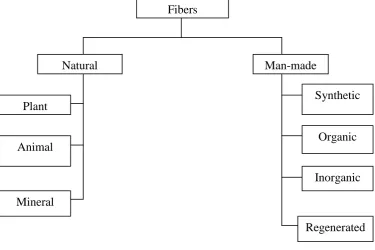
Fibers are classified into natural fibers and man-made fibers.

Figure 1.1: Classification of Fiber

(http://www.globalspec.com/reference/43331/203279/classification-of-fibers, 2006)

Natural fibers are hair-like threads obtained directly from plants, animals, and mineral sources. Botanically, a natural fiber is a collection of cells having long length and negligible diameter. They are obtained as discrete elongated pieces similar to thread.

Natural fibers include those made from animal, mineral and plant sources. Animal fiber generally comprise of animal hair, silk fiber, and avian fiber. Man-made fibers comprise of asbestos, ceramic fibers, and metal fibers. Examples of plant fibers are like seed, leaf and skin fibers.

This research is carried out using oil palm empty fruit bunch (OPEFB) fiber. Oil palm (Elaeis guaineensis) has become the most important economic plantation crop in Malaysia. It is the major source in the production of edible oil which is extracted from fruits palm oil empty fruit bunch (EFB) (A.C. Lua, and J. Guo,

Fibers

Natural Man-made

Plant

Animal

Mineral

Synthetic

Organic

Inorganic

(22)

3

1998). However, palm oil mills produce a large amount of solid wastes. The remainder of the oil palm consists of huge amount of lignocellulosic materials such as oil palm fronds, trunks and empty fruit bunches. The solid wastes contain about 7.0 million tonnes of oil palm trunks, 26.2 million tonnes of oil palm fronds and 23% of EFB per tonne of Fresh Fruit Bunch (FFB) processed in oil palm mill. The fresh oil palm fruit bunch contains about 21% palm oil, 6-7% palm kernel, 14-15% fiber, 6-7% shell, and 23% empty fruit bunch (M.Z.M. Yusoff et al, 2009). Exploiting this kind of waste materials not only maximizes the use of oil palm but also helps to preserve natural resources and maintain ecological balance (D.C.L Teo et al, 2006).

(23)

4

This project uses Polypropylene (PP) as the matrix and Maleic Anhydride Polypropylene (MAPP) as the coupling agent for the composite. Polypropylene is a semi-crystalline polymer that is used extensively due to its unique properties, cost and easy fabrication. Meanwhile, MAPP is an effective functional molecule for the reactive compatibility between PP and OPEFB. MAPP can improve the bonding between PP and OPEFB fibers.

(24)

5

1.1 Objectives

The objective of this project is:

i. To investigate the tensile properties of oil palm fiber composite. ii. To investigate the flexural properties of oil palm fiber composite. iii. To investigate the hardness properties of oil palm fiber composite

1.2 Problem Statement

In recent years, natural fibers have drawn considerable attention as substitutes to the synthetic fibers such as glass and carbon fibers. Natural fiber is also renewable and cheaper so it can be an attractive reinforcement in the making of composites and for its various applications. The synthetic fibers such as glass fiber, rock wool, or asbestos are concern with the possible health effects and it is required high standard practice to take safety precaution when installing or handling fiber glass or rock wool. Therefore, by using natural fiber we can reduce the possible health effect. The possibility of finding use for oil palm fibers in fiber composite will open a new market for what normally considered waste or used in low value products.

1.3 Scope

Oil palm fiber composite with different compositions of polypropylene will be used to study their effects on the mechanical properties.

Gambar

Figure 1.1: Classification of Fiber

Referensi

Dokumen terkait

[r]

Berdasarkan uraian di atas, maka dapat dirumuskan suatu permasalahan yaitu bagaimanakah kualitas fermentasi kulit pisang ( fruitghurt ) dengan pemberian konsentrasi

PENGARUH PENGGUNAAN MODEL PEMBELAJARAN KOOPERATIF TIPE STAD TERHADAP MOTIVASI DAN HASIL BELAJAR SISWA PADA POKOK BAHASAN PENJUMLAHAN DAN PENGURANGAN BILANGAN BULAT DI KELAS VII A

Seperti letak geografis yang strategis karena Desa Situ Ilir mempakan desa kota dan berbatasan dengan desa- desa yang agamis dan memiliki tradisi pengajian dengan

Werimon, Ghozali dan Nazir , 2007, Pengaruh Partisipasi Masyarakat dan Transparansi Kebijakan Publik Terhadap Hubungan Antara Pengetahuan Dewan Tentang Anggaran dengan

Hasil penelitian menunjukkan (1) Tingkat pendidikan formal, tingkatpendidikan non formal, tingkatumur, luaslahangarapan, tingkatkekosmopolitandan lama

Tujuan khususnya adalah: (1) menentukan tingkat pengelolaan sumberdaya ikan di pulau-pulau kecil Kabupaten Bengkalis yang lestari dan optimal, membandingkannya dengan

Hasil percobaan menunjukkan ballwa perlakuan implan LHRH-a 100 ug dan 100 ug,bobot badan'l MT (perlakuan F) memperlihatkan perbedaan nyata pada perkembangan diameter oosit,