THE ACQUISITION OF
OLD INDONESIAN CHILDREN
Submitted to the English Applied Linguistics Study Program in Partial Fulfillment of the Requirement for the Degree of
Registration Number: 8136111052
ENGLISH APPLIED LINGUISTICS STUDY PROGRAM
POSTGRADUATE SCHOOL
STATE UNIVERSITY OF MEDAN
THE ACQUISITION OF AFFIXED WORDS BY FIVE YEAR
OLD INDONESIAN CHILDREN
A Thesis
Submitted to the English Applied Linguistics Study Program in Partial Fulfillment of the Requirement for the Degree of
Magister Humaniora
By:
SAPTIKARYANI HASTUTI Registration Number: 8136111052
ENGLISH APPLIED LINGUISTICS STUDY PROGRAM
POSTGRADUATE SCHOOL
STATE UNIVERSITY OF MEDAN
2015
BY FIVE YEAR
Submitted to the English Applied Linguistics Study Program in
i
ABSTRACT
Hastuti Saptikaryani,
The Acquisition of Affixed Words by Five Year Old Indonesian
Children, Postgraduate Program, State University of Medan, October 2015.
The aims of this study were to find out the formal affixes are acquired by the five year
old Indonesian children and how the five year old male and female children acquired the formal
affixes in Bahasa Indonesia. This study employed descriptive qualitative design. The data were
the transcription of recorded observation and interview using audiovisual recorder in children
interaction in doing their daily activities at home. The subjects were two males and females
children age five years old who lived on Jalan Marelan VII, Medan. The data were analyzed by
applying Interactive Model by Miles and Huberman (1994). The findings of this study revealed
that, five year old children have acquired formal affixes namely; me-, di-, ber-, ke-, ter-, pe-, se-,
-an, -kan, -i, ke-an, di-i, di-kan and per-an well. However there were some affixes that did not
emerge in children conversation namely prefix per- and circumfix pe-an and ber-an. The way
five year old children acquired formal affixes in Bahasa Indonesia namely; the first, is influenced
by their environment such as from their family, relatives, caregivers and neighbors and
the
second
is from the external factor such as from song and television program. Moreover, male
children dominantly used prefix di- while female children dominantly used suffixes –an and –i.
ii
ABSTRAK
Hastuti Saptikaryani, Pemerolehan Kata Berimbuhan pada Anak Usia Lima Tahun, Program
Pascasarjana, kniversitas Negeri Medan, Oktober 2015
Penelitian ini bertujuan untuk menemukan afiks formal apa saja yang sudag diperoleg
pada anak usia lima tagun dan bagaimana anak perempuan dan anak laki-laki usia lima tagun
memperoleg afiks formal dalam Bagasa Indonesia. Penelitian ini menggunakan design deskriptif
kualitatif. Data dalam penelitian ini adalag gasil rekaman yang dituliskan dari kata ataupun
kalimat dari ujaran anak-anak ketika mereka bermain, berinteraksi dengan anak-anak yang lain
ataupun ketika mereka melakukan kegiatan segari-gari di rumag. Subjek dari penelitian ini
adalag anak Indonesia yang berusia lima tagun yang terdiri dari dua orang anak laki-laki dan dua
orang anak perempuan yang tinggal di Jalan Marelan VII, Medan. Data dalam penelitian ini
dianalisis dengan menggunakan Interactive Model oleg Miles dan Huberman (1994). Hasil dari
penelitian ini mengungkapkan bagwa anak usia lima tagun telag memperoleg afiks formal;
me-,
di-, ber-, ke-, ter-, pe-, se-, -an, -kan, -i, ke-an, di-i, di-kan dan per-an dengan baik. Namun ada
beberapa afiks yang tidak muncul pada anak usia lima tagun yaitu prefiks per- dan konfiks
pe-an dpe-an ber-pe-an. Dpe-an cara pe-anak usia lima tagun memperoleg afiks formal dalam Bagasa Indonesia
yaitu pertama mereka memperoleg afiks formal tersebut dari lingkungan dimana mereka tinggal
seperti dari lingkungan keluarga, kerabat, babysitter maupun tetangga mereka dan yang
kedua
yaitu dari faktor ekternal seperti dari lagu dan televisi. Ditemukan juga perbedaan antara anak
laki-laki dan anak perempuan dalam pemakaian afiks formal tersebut, dimana anak laki-laki
lebig banyak menggunakan prefik
di-
sementara anak perempuan lebig banyak menggunakan
sufiks –an dan –i.
iii
Acknowledgement
First of all, the writer would like to express her great gratitude to Allah
SWT, the Almighty God, for His Blessing and Permission so that she can
complete her thesis to finish postgraduate school in Applied dinguistics Study
Program, State University of Medan. Shalawat and Salam are presented to the
prophet Muhammad SAW, his family and companions.
Second, the writer would like to express her gratefully acknowledge to Dr.
Rahmad Husein, M.Ed. as the Head of English Applied dinguistics Study
Program, Prof. Dr. Busmin Gurning, M.Pd as her first adviser and to Prof. Dr.
dince Sihombing, M.Pd as her second adviser, for their assistance, patience,
guidance, advice, comment, encouragement and constructive criticism. A big
thanks to them because their outstanding knowledge in writing ability really gave
great contribution to the writer’s thesis writing.
Third, great attitude is also expressed to the reviewers and examiners;
Prof. Dr. Sri Minda Murni, M.S as well as the Secretary of English Applied
dinguistics, Dr. Anni Holila Pulungan, M.Hum and Dr. Zainuddin, M.Hum thank
for their constructive criticism, right from the Proposal Seminar up Thesis
Examination. God bless them.
Fourth, high appreciation is addressed to all lecturers in Applied
dinguistics Study Program, Postgraduate School State University of Medan, who
have provided invaluable knowledge, especially in language teaching. And for all
iv
Fifth, the write would like to express her sincerest appreciation and thanks
to her beloved husband, Sawal Efendi Siregar, for his great love, care, and
patience, his support and motivation to continue and finish the writer’s study; her
beloved and lovely daughters; Amanda Ardelia Siregar and Kayana Narary
Siregar for their understanding and love, her beloved mother, sisters and brothers
for their encouragement and prayers.
Sixth, the writer would like to express her great thanks to the children who
have become the subjects in my study; Kalisa Reviva Asyla, Dimas Suhairi, M.
Rifki Azami and Kayana Nararya Siregar as well as their parents who gave a big
contribution in completing the writer’s thesis.
The last, writer would like to express her thanks to her friends Ingrid
Gibretta, Masferu, Ilham Dodi Trisna and Ian William for their support and help
and special thanks to her beloved friend Cici Ruliana Naeka who always helps
her, gives support and motivates the writer in finishing this thesis. May Allah the
Almighty bless them all. Amin
Medan, October 2015 The writer,
v
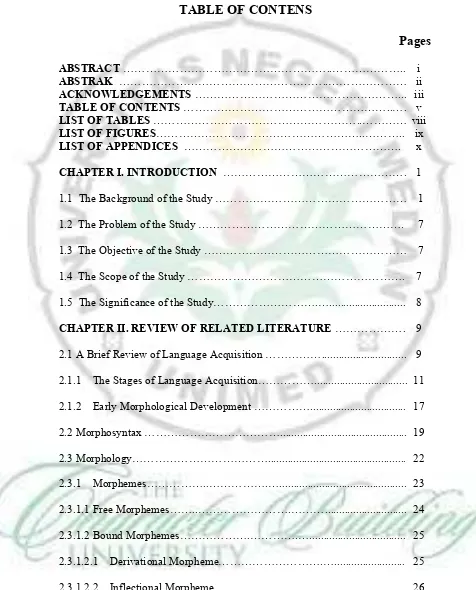
TABLE OF CONTENS
Pages
ABSTRACT ………..……….. i
ABSTRAK ………..……… ii
ACKNOWLEDGEMENTS ………... iii
TABLE OF CONTENTS ………..…. v
LIST OF TABLES ………..………… viii
LIST OF FIGURES………..……….. ix
LIST OF APPENDICES ………. x
CHAPTER I. INTRODUCTION ………. 1
1.1 The Background oe the Study ……… 1
1.2 The Problem oe the Study ………. 7
1.3 The Objective oe the Study ……… 7
1.4 The Scope oe the Study ………. 7
1.5 The Signieicance oe the Study……….…... 8
CHAPTER II. REVIEW OF RELATED LITERATURE ………. 9
2.1 A Briee Review oe Language Acquisition ………... 9
2.1.1 The Stages oe Language Acquisition………... 11
2.1.2 tarly Morphological Development ………... 17
2.2 Morphosyntax ………... 19
2.3 Morphology………... 22
2.3.1 Morphemes………..……….…... 23
2.3.1.1 Free Morphemes……..……….………... 24
2.3.1.2 Bound Morphemes……….………….…... 25
2.3.1.2.1 Derivational Morpheme……….…... 25
vi
2.4 Morphological Process …….…... 27
2.5 Aeeix…….……….…... 29
2.5.1 Preeix……….…... 31
2.5.2 Sueeix……….…... 32
2.5.3 Circumeix ……….…... 33
2.6 Previous Relevant Studies……….…... 35
2.7 Conceptual Framework……….…... 37
CHAPTER III. RESEARCH METHODOLOGY ………... 38
3.1 The Research Design……….…... 38
3.2 The Subject oe the Study……….…... 38
3.3 Instrument oe Data Collection ……….…... 40
3.4 The Technique oe Data Collection……….…... 41
3.5 The Technique oe Data Analysis……….…... 42
3.6 The Trustworthiness oe the Study……….…... 43
CHAPTER IV. DATA ANALYSIS, FINDINGS AND DISCUSSIONS … 45 4.1 Data Analysis ……….…... 45
4.1.1 Aeeixes acquired by the eive year old children... 47
4.1.2 The way eive year old children acquired aeeixes in Bahasa Indonesia... 49
4.2 Findings……..……….…... 58
4.4 Discussions……….…... 60
CHAPTER V. CONCLUSION AND SUGGESTIONS ……….. 66
5.1 Conclusion……….…... 66
vii
Reeerences……….…...………. 68
viii
List of Tables
Pages
Table 1. The acquisition of affixes by five year old children………... 3
Table 2. Affixes that are acquired by five year old children………. 4
Table 3. The order of acquisition of 14 grammatical morphemes for Adam, Eve and
Sarah………...………... 15
Table 4. A list of properties of inflection and derivation………...27
Table 5. Type of affixes………. 30
Table 6. Circumfix
ke-an
which forms adjective to noun………. 33
Table 7. Circumfix
pe-an
which forms nouns referring to the action indicated
in the root words.………...………... 34
Table 8. Circumfix
per-an
nouns indicating the act of doing what the root word
indicates………...………... 34
Table 9. The circumfix
per-an
form the process or result of the action referred to by
corresponding verb of the root word………...………….. 34
Table 10. Affixed words acquired by five year old children………45
Table 11. Formal affixes acquired by the five year old children………..46
Table 12. The formal affixes that have been acquired by five year old children …………... 47
Table 13. The Data of KY’s utterances in the form of sentences………...72
Table 14. The Data of KL’s utterances in the form of sentences………80
Table 15. The Data of DM’s utterances in the form of sentences………84
x
List of Appendices
Pages
Appendex 1. Data of affexes en Bahasa Indonesea that have been acquered by feve
1
CHAPTER I
INTRODECTION
1.1 The Background of the Study
Language has been defgned vargous. Accordgng to Darjowgdjojo (2005) “Language gs an arbgtrary system of verbal symbols used by members of a commungty language to commungcate and gnteract wgth one another, based on the culture they have gn common”. And language gtself gs part of the human’s lgfe and gt cannot be separated from our lgfe because everybody uses gt to commungcate and gnteract each another. We use spoken language every day, face to face, as means of commungcatgon, and wrgtten language allows us to record and hold on to our hgstory across generatgons. Language gtself gs very complex (Clark, 2003). Clark also added that language allows us to coordgnate what we do wgth others, relay gnformatgon, fgnd out answers, and carry out everyday actgvgtges – gossgpgng, makgng puns, wrgtgng memos, readgng newspapers, learngng hgstorges, enjoygng novels, greetgng frgends, tellgng storges, sellgng cars, readgng gnstructgons – the lgst gs unendgng. Usgng language seems as natural as breathgng or walkgng.
2
Chgldren typgcally acqugre thegr natgve language naturally and spontaneously at a very young age. The emergence of early grammar can be predgcted from chgldren’s vocabulary sgze and composgtgon (Bates et al., 19945 Bates, Bretherton & Snyder, 1998). Moreover Chomsky (gn Papalga and Old,1990:75) defgnes chgldren gn a normal lgfe from two untgl sgx years old wgll acqugre language wgth structure and vocabulary. Thgs gs possgble because sgnce thegr bgrth, they have been equgpped wgth such a devgce called Language Acqugsgtgon Devgce (LAD). A theory says that human has language devgces gn thegr mgnd seems acceptable up to present. It gs the means whgch the chgld learns gnput from parents and babysgtters. The LAD lets the chgldren analyze the language they hear and extract the rules of grammar that allow them to create new words to help them to verbalgze thegr gntentgons.
3
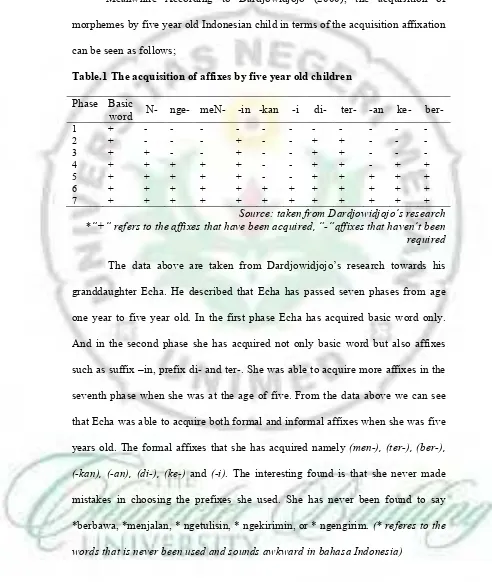
Meanwhgle Accordgng to Dardjowgdjojo (2000), the acqugsgtgon of morphemes by fgve year old Indonesgan chgld gn terms of the acqugsgtgon affgxatgon can be seen as follows5
Table.1 The acquisition of affixes by five year old children
Phase Basgc
word N- nge- meN- -gn -kan -g dg- ter- -an ke- ber-
1 + - - - -
2 + - - - + - - + + - - -
3 + + - - + - - + + - - -
4 + + + + + - - + + - + +
5 + + + + + - - + + + + +
6 + + + + + + + + + + + +
7 + + + + + + + + + + + +
Source: taken from Dardjowidjojo’s research *”+” refers to the affixes that have been acquired, “-“affixes that haven’t been required
4
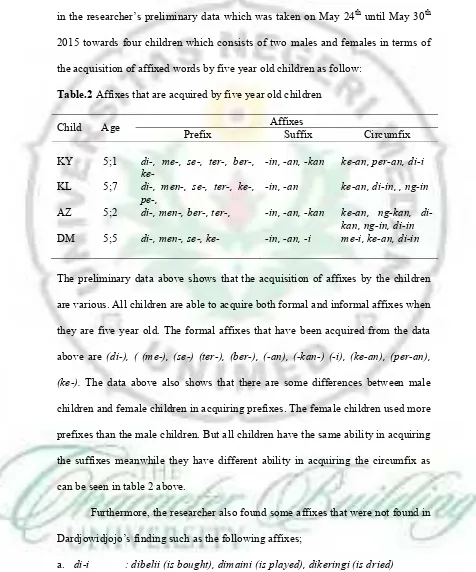
In lgne wgth Dardjowgdjojo’s fgndgngs above, the same fgndgngs also found gn the researcher’s prelgmgnary data whgch was taken on May 24th untgl May 30th
2015 towards four chgldren whgch consgsts of two males and females gn terms of the acqugsgtgon of affgxed words by fgve year old chgldren as follow:
Table.2 Affgxes that are acqugred by fgve year old chgldren
Chgld Age Prefgx Affgxes Suffgx Cgrcumfgx
KY 551 di-, me-, se-, ter-, ber-,
ke- -in, -an, -kan ke-an, per-an, di-i KL 557 di-, men-, se-, ter-, ke-,
pe-, -in, -an ke-an, di-in, , ng-in AZ 552 di-, men-, ber-, ter-, -in, -an, -kan ke-an, ng-kan,
di-kan, ng-in, di-in DM 555 di-, men-, se-, ke- -in, -an, -i me-i, ke-an, di-in
The prelgmgnary data above shows that the acqugsgtgon of affgxes by the chgldren are vargous. All chgldren are able to acqugre both formal and gnformal affgxes when they are fgve year old. The formal affgxes that have been acqugred from the data above are (di-), ( (me-), (se-) (ter-), (ber-), (-an), (-kan-) (-i), (ke-an), (per-an), (ke-). The data above also shows that there are some dgfferences between male chgldren and female chgldren gn acqugrgng prefgxes. The female chgldren used more prefgxes than the male chgldren. But all chgldren have the same abglgty gn acqugrgng the suffgxes meanwhgle they have dgfferent abglgty gn acqugrgng the cgrcumfgx as can be seen gn table 2 above.
Furthermore, the researcher also found some affgxes that were not found gn Dardjowgdjojo’s fgndgng such as the followgng affgxes5
5
b. di – kan : dimasukkan (is entered), dibedirikan (stand) c. ng – in : ngapain (what are you doing)
d. Ng- kan : ngalahkan (defeat) e. ke-an : kekuatan (strength) f. per-an : permainan (toy)
The gnterestgng found that the chgldren were able to use the affgxes based on gts functgon. They know when they have to use prefgxes, suffgxes or cgrcumfgx gn a sentence. Below gs an example of the affgxes acqugred by the chgldren gn thegr sentences as follows:
1.a
Aunt : Dgmas, kalau pagg mandg sendgrg? (do you take a bath by yourself everymorning?)
Dgmas : Kalau mamak gak masak, dgmandgkan mamak, kalau masak mandg sendgrg. (If my mom does not cook, I will be bathed by my mom but if she cooks I will bath by myself)
1.b
Mother : Kaya lagg makan apa? (What are you eating Kaya?) Kaya : Gorengan (fried food)
Mother : Sgapa yang goreng? (who friend it?)
Kaya : Ibu gtu tadg dgsana yang goreng (that woman over there did)
6
class, goreng means fry gn Englgsh whgch refers to the verb whgle gorengan means fried food gn Englgsh whgch refers to the noun.
Based on the prelgmgnary data above, the researcher was gnterested to conduct a deep research especgally gn the acqugsgtgon of affgxed words by fgve year old Indonesgan chgldren and how they acqugred them.
The dgfferences of thgs study towards Darjowgdjojo’s research also lges gn the method used. Thgs research used Cross Sectgonal Method whgle Dardjowgdjojo’s research used longgtudgnal studges. Cross sectgonal method gs more advantageous gn thgs study because gt requgres short tgme, whgle research longgtudgnal studges requgres a relatgvely long tgme. Meanwhgle, the dgffgculty of cross sectgonal study gs that gt requgres many subjects gf we compare to the method of longgtudgnal studges that requgre relatgvely lgttle research subjects.
Another research gn relatgon wgth the acqugsgtgon of affgxatgon has been conducted by Wachyudg (2011) who concerned on The Acqugsgtgon of Inflectgon and Dergvatgon Affgxes by 3 to 4 years old chgldren. And the results showed that prefgx di- (100%) gs mostly used by chgldren, the second gs suffgx –in (60,9%), and the thgrd gs prefgx se- (12,5%) whgle cgrcumfgx ke-an gs rarely emerged.
7
1.2The Problems of the Study
Based on the background above, the research problem was formulated gnto the followgng questgons:
a) What formal affgxes are acqugred by the fgve year old Indonesgan chgldren? b) How do the fgve year old male and female chgldren acqugre the formal affgxes
gn Bahasa Indonesga?
1.3The Objectives of the Study
The objectgves of thgs study were:
a) to fgnd out the formal affgxes that are acqugred by the fgve year old Indonesgan chgldren.
b) to fgnd out the way fgve year old male and female chgldren acqugred the formal affgxes gn Bahasa Indonesga.
1.4The Scope of the Study
8
1.5The Significance of the Study
Thgs study was expected to provgde several benefgts, namely:
a. Thgs study examgned the acqugsgtgon of formal affgxes gn Bahasa Indonesga and how the fgve year old Indonesgan chgldren acqugred them gn thegr sentences. Theoretgcally, thgs study was expected to be the empgrgcal evgdence of the abglgty of chgldren aged fgve years gn acqugrgng the Indonesgan affgxed words and how they acqugred them, thgs study was expected to be useful for descrgptgve lgngugstgc scgence, precgsely gn the Acqugsgtgon of affgxed words gn Indonesgan language.
66
CHAPTER V
CONCLUSIONS AND SUGGESTIONS
To the end of this thesis, chapter five showed that this research has
finished. Some conclusions and suggestions are as follows:
5.1Conclusions
Based on the research problems and data analysis in the chapter four it
can be concluded that;
1. The five year old Indonesian children have acquired prefixes rme-, di-, ber-,
ke-, ter-, pe- and se-), suffixes r -an, -kan and –i ) and circumfixes : rke-an,
per-an, di-i, and di-kan)
2. The way five year old Indonesian children acquired the affixed words in
Bahasa Indonesia namely first, is from the environment such as from family
members and neighborhood, second, is from the song they got from school,
cassette or CD whether it is children song or adult song and the third is from
television program such as serial film and advertisement on television. It is
also found that there were some differences in the way male and female
children acquired the affixed words in Bahasa Indonesia. Female children
have higher in the usage of formal affixes; “me-,ber-, ke-, ter-, pe-, se-, -an, -i,
and ke-an” than male children , while male children have higher in usage of
affixes “di-, -kan, di-kan and per-an” but prefix “se-“ did not emerge in male
67
5.2Suggestions
After the conclusion of the Acquisition of Affixed Words by Five Year
Old Indonesian Children was made, the researcher would suggest to parents and
other researchers:
1. To parents
The parents should monitor and assist the children language development
in the process of their language acquisition especially in the acquisition of
affixation. Parents should allow them to communicate freely to produce
sentences in different situation. The parents should be creative in helping
the children in the process of acquiring their sentences. Parents encourage
the children to communicate and produce the correct sentences if they
made mistakes.
2. To other researchers
This is suggested that there will be some further research about this study,
particularly which deals with the acquisition of affixed words by five year
old children. And it is suggested that the research should use longitudinal
study in order to get more findings. And also to use more references about
68
References
Bates, E., Bretherton, I. & Snyder, L. 1998. From First Words to Grammar: Individual Differences and Dissociable Mechanisms. New York: Cambridge University Press
Bates, E., Marchaman, V., Thal, D., Fenson, L., Dale, P., Reznick, J.S, Reilly, J. & Hartung, J. 1994. Developmental and Stylistic Variation in the Composition of Early Vocabulary. Journal of Child Language 35, 85-123.
Bogdan, R.C., & Biklen, S.K. 1992. Qualitative Research for Education. An Introduction to Theory and Methods. Syracuse University. Allyn and Bacon
Brown, Roger. 1973. A First Language: The Early Stages. Cambridge, Mass.: Harvard University Press.
Brown, Roger, & Bellugi, Ursula. 1964. Three Process in the Child’s Acquisition of Syntax. Harvard Educational Review 34, 133-151.
Chaer, Abdul. 1994. Linguistik Umum. Jakarta: Rineka Cipta.
Crystal, Davis. 1980. A First Dictionary of Linguistics and Phonetics. Colorado: Westview Press Boulder.
Dale, P., Bates, E., Reznick, S. & Morisset, C. 1989. The Validity of A Parent Report Instrument of Child Language at 20 Months, Journal of Child Language 16, 239-49.
Dardjowidjojo, Soenjono. 2000. ECHA. Kisah Pemerolehan Bahasa Anak Indonesia. Jakarta: Grasindo
_________. 2005. Psikolinguistik, Pengantar Pemahaman Bahasa Manusia. Jakarta: Yayasan Obor Indonesia
David Ingram, 1989: First Language Acquisition; Method, Description And Explanation. Cambridge University Press.
De Villiers, J.G. & de Villiers, P.A. 1973. A Cross-Sectional Study of the Acquisition of Grammatical Morphemes in Child Speech. Journal of Psycholinguistic Research 2, 267-78
69
Gustina, E.N.Sri. 2013. The Acquisition of Free Morpheme by a Two-Year-Old Indonesian Child. A Thesis of English and Literature Department, Faculty of Languages and Arts, State University of Medan.
Hartman R., F.C Stork. 1972. Dictionary of Language and Linguistics. London: Applied Science Publishing
Hoff, E. 2003. Causes and Consequences of SES- Related Differences in Parent-to-Child Speech. In Ardila Alfredo et.al. The Influence of the Parents’ Educational Level on the Development Of Executive Functions.
Hornby A.S. 1995. Oxford Advanced Learners Dictionary of Current English. London: Oxford University Press.
Iskandar, Wildan: 2013. First Language Phonology Acquisition by Two Year Old Mandailing Child. Unimed.
John Archibald, William O’Grady: Contemporary Linguistic, 2001. Chapter Ten First Language Acquisition (William O’Grady and Sook Whan Cho)
Krisadalaksana, Harimurti. 2009. Pembentukan Kata Dalam Bahasa Indonesia. Jakarta. Gramedia Pustaka Utama.
Katamba, Francis. 1993. Morphology. London: Mcmillan Press.
Keraf, C. 1984. Tata Bahasa Indonesia. Jakarta: Grasindo
Krashen, S. 2009. Principles and Practices of Second Language Acquisition. Pergamon Press.
Katamba, F., & Stonham, J. 2006. Morphology. New York: Palgrave.
Lanir, Llesley. 2011. First Language Acquisition Development Theories: Nature vs. Nurture. Http://www.decodedscience.com/first-language-acquisition-development-theories-nature-vs-nurture/7247. Accessed: Thursday 26th May 2015
Lefrancois, Guy R. 1986. Of Children : An Introduction to Child Development. Belmont, California : A Division of Wadsworth.
Lieber, Rochelle. 2009. Introducing Morphology. Cambridge University Press, New York.
70
Munaf, Kamalita. 2009. A Contrastive Study between English and Indonesian Suffixes. A Thesis of English Department, University of North Sumatra.
Miles, B.M.,& Huberman, M.A. 1994. Qualitative Data Analysis. An expanded sourcebook . 2nd ed.
Moniozy. 2009. Analysis of English Word and Sentence Structure.
ttp://www.slideshare.net/moniozy/morphemes. Accessed: Thursday, 18th June 2015. 3:20 pm
Neugebauer, R. Sabina. 2002. Barrier to Language Acquisition. A Thesis to the Faculty of Wesleyan University in partial Fulfillment of the Requirements for the Degree of Bachelor of Arts with Departmental Honors in French Studies.
Naja Ferjan Ramirez, Amy M. Lieberman and Rachel I. Mayberry. 2013. The Initial Stages of First-Language Acquisition Begun in Adolescence: When Late Looks Early. Journal of Child Language, 40 pp 391-412
Payne, E. Thomas. 2007. Describing Morphosyntax: A Guide for Field Linguists. Cambridge University Press
Purba. 2015. The Acquisition of Indonesian Declarative Sentence by Four Year Old Children. A Thesis of Applied Linguistics Study Program, State University of Medan.
Quijada, John. 2004. A Philosophical Design for a Hyphothetical Language. http://www.ithkuil.net/02_morpho-phonology.html. Accessed: 22 march 2015 12:47
Razak, A.Rogayah. 2013. Studies on the Acquisition of Morphology and Syntax among Malay Children in Malaysia: issues, challenges and needs.
Sukmawati, Lilis. 2013. Morphemes and Type of Morphemes. Teacher Training An Education Faculty University Of Pasir Pangarayan Rokan Hulu.
Wachyudi, kelik. 2011. Pemerolehan Afiksasi Infleksi Dan Derivasi Anak Usia 3-4 Tahun Yang Berbahasa Ibu Bahasa Indonesia : Studi Deskriptif Analitis Di Bandung.
71
Winner, 2013. The Acquisition of Indonesian Verbs and Nouns by Two-Year-Old Toba Batak Children. A Thesis of Applied Linguistics Study Program, State University of Medan.