INTERNATIONAL TOURISTS’ MOTIVATIONS AND REVISIT INTENTION TO
INDONESIA
Dr. Erna Andajani Siti Rahayu, S.E., M.M. Fitri Novika W., S.Si., M.MT. Adi Prasetyo Tedjakusuma, B.Bus., M.Com
University of Surabaya, Faculty of Business and Economics, Management Department
ABSTRACT
Traveling to another country is always a trend in the tourism industry. In fact, tourists often revisit the countries they have visited before. The current trend of foreign tourists to visit and revisit Indonesia increases. It is important to know the motivation of foreign tourists to visit Indonesia. This study aims to determine the relationship between motivation, satisfaction and revisit intention of foreign tourists in visiting Indonesia. The results showed the motivation is interrelated with satisfaction and satisfaction becomes an important factor that drives revisit intention of foreign tourists in visiting Indonesia.
Keywords: motivation, satisfaction, revisit intention
1. Introduction
The tourism industry is considered one of the largest and fastest growing industries in
the world (Ninemeier and Perdue, 2005; Cooper and Hall, 2008). As a worldwide
occurrence, it forms a very important part of the service sector that strongly
influencing the economy (Ninemeier and Perdue, 2008; Kay, 2003; Koc, 2004; Vuuren
and Slabbert, 2011).
The World Travel and Tourism Organization (WTTC) trends demonstrates that the travel and
tourism is the growing industry which generates 9.8% of global GDP (2015) and travel in the
South East Asia leads the world in the expansion (WTTC, 2013). Culture tourism has also
become the greatest growing segment of tourism (WTO, 2001). Contribution to total world
exports amounted to US$ 7.58 trillion and foreign exchange earnings of tourism sector grew
25.1%. Tourism opens broad employment opportunities that represent one of eleven jobs in
the tourism sector. Compared to other sectors, tourism development is the easiest to create
preserve the environment (pro-environment). As the world tourism shows very positive
prospect, then it is used as a reference in setting the national tourism targets. The President of
the Republic of Indonesia is targeting the tourism sector to be more than doubled for the next
5 years (2019), i.e. contribute to national GDP of 8%, generate income of Rp. 240 trillion,
create jobs of 13 million people, increase the number of foreign tourists to 20 million and the
movement of domestic tourists to 275 million, as well as Indonesia tourism competitiveness
index to be ranked 30 in the world. (Sirisack, et al., 2014, and Widianto, 2016).
The tourism sector has a very important role to support the economy of Indonesia. Kemenpar
also sets macro and micro targets. The indicator of macro target includes a contribution to
National GDP, foreign exchange and labor. In 2017, tourism is targeted to contribute 13% to
the national GDP. Foreign exchange is targeted to increase from Rp. 172 trillion to Rp. 200
trillion. Meanwhile, the number of labor is targeted to increase from 11.8 million to be
accounted for 12 million jobs. For the micro target, Kemenpar set the Tourism
Competitiveness Index 2017 is ranked 40 in the world (Widianto, 2016).
The target to be achieved from the development of tourism include the contribution to GDP
growth from 4.2% in 2014 to 8% in 2019; the increased number of foreign tourists visiting
Indonesia from 9 million people in 2014 to 20 million people in 2019; and foreign exchange
income from this sector rose from Rp. 120 trillion in 2014 to Rp. 240 trillion in 2019.
Another objective is an increase in local businesses of the tourism industry and the increasing
number of certified local workforce. (http://presidenri.go.id.).
The importance of tourism in the world economy increases the number of research on travel
motivation. According to Frederick and Adongo (2015), travel motivation is one of the most
researched themes in the tourism literature. This is seen in the light of theoretical
advancements by scholars, such as Maslow (1943), Gray (1970), Dann (1977, 1981) and
Crompton (1979). In recent times, phenomenal growth in research of this theme has also
increased (Jayarman, Lin, Guat and Ong, 2010; Agyeiwaah, 2013; Otoo, 2013; Dayour,
2013). Literature posits that people travel because they are pushed in making travel decisions
by psychological forces which are innate and pulled by the destination attributes (Crompton,
1979; Prayag and Ryan, 2010). Therefore, travel satisfaction with travel experiences, based
on these push and pull forces, contributes to revisit intention (Pratminingsih, Lipuringtyas
According to Vuuren and Slabbert (2011), for the tourism industry to maintain or
improve its current status it is dependent on tourists ‗travel decisions which are reflected
in travel behavior. Papatheodorou (2006) stated that destination choice has always been an
important aspect in tourism literature and there are various factors influencing travel
decisions. These factors constitute of culture, travel motivations, finances and previous
experiences, to name a few (Ankomah, Crompton and Baker, 1996). Cooper and Hall (2008)
state that tourism is subject to a collection of influences and factors that determine its
relative distribution. Travel motivations form an integral part of travel behavior and has been
widely researched and applied in tourism marketing strategies. The need to see the
unseen and know the unknown drives people to travel to new places and motivates
them to visit new destinations (Venkatesh, 2006).
The condition of tourism in Indonesia experienced significant growth in 2016. Some factors
that affect, among others: intensive promotional campaigns by the Ministry of Tourism to
various countries worldwide as well as the promotion that is done in every tourist attraction
and destinations in the country. The campaign timing also considers the season, for example,
the campaign before the winter season coming in order to attract potential tourists looking for
the country that is not too hot for their holiday season and the events that they want to visit
(Rahmah, 2016).
According to Liên (2010), tourism is a favorite leisure activity. The motivation which causes
someone to choose certain activities and a destination for vacation is an interesting issue,
which allows for a better understanding of people‘s behavior in the area of leisure spending.
The reasons behind why people choose a destination over another have been the topic of
many researchers and are important considerations for both planners and managers of tourism
industry. Motivation is the driving force which compels an individual to take action
(Schiffman and Kanuk, 2004). This implies that motivation moves a person to do something
(Ryan and Deci, 2000). Motivations are thus the basis of all behavior (Fodness, 1994),
including traveling.
To develop tourism in Indonesia, it is important to know the motivation of foreign tourists
visiting Indonesia. The understanding of the traveler motivations will enable Indonesia to
develop good, appropriate and interesting tourism strategies in attracting foreign tourists to
foreign tourists visiting Indonesia or not. This research was conducted in order to understand
the motivation of foreign tourists visiting Indonesia, the satisfaction of tourists after visiting
Indonesia and whether they want to come back to Indonesia.
2. Literature Review 2.1. Motivation
Motivation is a strong impulse from within the individual to perform an action (Schiffman
and Kanuk, 2007). A strong motive to urge individual to act in order to satisfy his needs. The
motivation of each individual is different from one another which signifies the diverse
individual needs. Schiffman and Kanuk (2007) explain also that people who understand the
needs or desires tend to strive to meet the needs or desires and denial on the things that are
troubling. People behave based on motives that is inside a person. In the context of tourism,
Chang and Huang (2014) revealed that the tourism research focuses on the reasons of people
travelling. The reasons of people travelling are still hot and essential issues in tourism
research. Dayour (2013) in Dayour and Adongo (2015) stated that push motives may explain
the desire of tourists to travel tours, while pull motives explain areas of choice tourist
destination with a wide range of its pleasant.
This research uses a variety of motives from Dayour and Adongo (2015), including: novelty
seeking, cultural experience, adventure tourism, social contact, escape, relaxation and
attraction. Novelty seeking is the main reason of tourists visiting tourist destination. Tourists
visit is due to the curiosity towards a tourist destination. The context is different from the
familiarity that leads to little or no experience to a tourist destination. On the motivation of
the cultural experience (Mansfeld, 1992 in Dayour and Adongo, 2015), the reason of tourists
visit is to enjoy cultural diversity. Travelers interested in participating and learning about
local cultures (ritual, the values embraced, music and dances typical of the region).
Adventure tourism shows the tourists visit motivation to experience exciting activity (i.e.
adventure) like the outdoors, wilderness etc. Social contact can be defined as a social
interaction such as friendship (Dayour and Adongo, 2015). In the activities of sightseeing,
tourists can get acquainted and communicate with fellow travelers or residents in the territory
of the tourist areas. This social interaction gives more friends and makes them feeling
comfortable. On the motive of escape, according to Kim and Ritchie (2012) in Dayour and
of tourist shows their intention to getaway from daily activities. The meaning of relaxation is
almost similar to escape motive, while destination's attraction motive represents pull motive.
The motives of tourists to visit tourist destination is due to the interesting tourist destination.
Tourist attraction can be sourced such as event/festival area, local culinary, views, flora and
fauna, artifacts and etc.
2.2 Satisfaction and Revisit Intention
Satisfaction is something very common research discussed in marketing. Satisfaction is a
comparison between the expectations and the fact that consumer will receive in the form
goods or services. Should the fact is as expected, the consumers will be satisfied and vice
versa. Furthermore, should the reality exceed the expectations of consumers then consumers
will be very satisfied (delighted). Basically, the satisfaction is an evaluation process of the
consumer against the goods or services received. In the context of tourist satisfaction, it is
defined as the level of positive feelings that arises from experiencing the tourist destination
(F. Meng and M. Uysal, 2008). The satisfaction of tourists is caused by the two main
dimensions (Yoon and Uysal, 2005). Firstly, tourists have their own expectations before
going to tourist destinations. The second dimension, tourists will compare the travel and
service process with their previous expectations. In the end, tourist will do the evaluation as
the formation of tourist satisfaction.
Khung and Ha (2014) reveal that the intention is the core of destination loyalty.
Understanding the revisit intention drives the tourist to revisit the same tourist destination.
Pratminingsih et al. (2014) convey the concept of revisit intention comes from the behavioral
intention. Behavioral intention is the behavior of repeating the previous joyful experience.
The tourists‘ interest to revisit certain tourist destination (i.e. repeat visitor) gave a positive impact on the destination itself. The tourist destination earns more revenues and reduces costs
and promotion. The cost of tourist destination promotion is borne by the repeat visitor.
In the research of Yoon and Uysal (2005), they state push and pull motives affect the
satisfaction of tourists. This statement implies that the importance of knowing and
understanding the motivations of tourists resulted in the satisfaction of tourists. Yoon and
Uysal (2005) also added that a satisfied tourist creates destination loyalty. One way to
measure loyalty is by assessing tourist‘s interest to repeat the process or recurring purchases.
Pratminingsih et al. (2006) showed that motivation is not only useful to describe behaviors of
tourists but can also be used for predicting revisit intention.
3. Methods
This study uses primary data collected by distributing questionnaires to foreign tourists
visiting Indonesia in the past year. The respondents were asked their opinions regarding the
motivation to visit Indonesia. There are several different reasons that motivate the arrival of
foreign tourists to Indonesia. The questionnaire consists of 4 parts where the first part related
to demographics of respondents including gender, age, marital status, education level,
religion, occupation and nationality. The second part asked about seven (7) related
motivational dimensions of foreign tourist visiting Indonesia, the third part is about the
foreign traveler satisfaction after visiting Indonesia, while the fourth part related to the revisit
intention as a desire to come back to Indonesia in the days to come. A 5-point Likert scale
was used to scale the data in which 1 means strongly disagree with the given statement and 5
means strongly agree to the given statement. The questionnaire was distributed via online and
also sent directly to foreign tourists who visited Indonesia.
The collected data was 100 which then processed by firstly testing the validity and reliability
of the measuring instrument used. Validity testing was done by looking at the correlation of
each indicator of the average value of each dimension while reliability testing was done by
looking at the value of Cronbach's alpha coefficient. After the questionnaire was tested and
the test result indicates valid and reliable then continued by distributing questionnaires to the
amount of data is considered sufficient. By using the Statistical Product for Service Solutions
software (SPSS, version 16), the confirmatory factor analysis was conducted to see if the
seven dimensions of foreign tourist motivation can be used to explain the motivational
variable of traveling to Indonesia. Then the multiple linear regression method is used to view
and examine the effect of each motivational dimension to visit Indonesia on tourist
satisfaction after visiting Indonesia. And the last testing uses simple linear regression model
to see and test the effect of tourist satisfaction to revisit intentions.
4. Results
4.1. Background Characteristics of Respondents
It was found that almost the same proportion of males (46%) and females (54%)
unmarried while fewer (12%) were married. Also about 64% of tourists were between the
ages of 20-29, 24% of them were between the ages of 30-39 and 12% were under 20 years of
age. With regard to educational qualification, 54% of them were bachelor, while 21% had
master and 17% were diploma. About 48% of them said they Christians, 15% were Atheist
and 14% were Catholic and only 10% said they were Moslems. As many as 59% of
respondents were students, 20% were professionals and 17% were self employee. When
viewed from nationality, 20% came from Singapore and 9% Australia while the rest came
various countries from Europe, Asia and Australia continents.
4.2. Tourist Motivations for Travelling to Indonesia
The study sought to examine the motivations of tourists to visit Indonesia. Table 1 shows the
actual mean score and standard deviations on items under each component.
Table 1.
2 I visit Indonesia because of the desire to explore destinations I have not previously visited
3 I visit Indonesia because I want to experience unfamiliar destination
4.41 0.5819 0.717
4 I visit Indonesia to do something challenging 4.08 0.9736 0.658
Component Score 4.33 0.3961 1.370 4.567
D Social Contact
1 I visit Indonesia to make friends with people who are exciting and unexpected
4.20 0.6200 0.704
2 I visit Indonesia to interact with other tourists as it is exciting 2 I visit Indonesia because I want to relieve stress
and tension
1 I visit Indonesia because I like local cuisines 4.53 0.5691 0.894 2 I visit Indonesia because I like cultural artifacts 4.75 0.3275 0.629 3 I visit Indonesia because I like cultural events 6 I visit Indonesia because I like the slave markets
and history
3.8 0.88 0.779
7 I visit Indonesia because I like to visit religious sites
dimensions of Destination's Attractions which shows the arrival of foreign tourists to
Indonesia because they like cultural artifacts then mountainous and cultural events such as
festivals, music and dance. The next motivational dimension that encourages foreign tourists
foreign tourists love the new things that had not been seen in the country of origin, such as
traditional sports like bull-races, a variety of traditional games, traditional procession, and
carnival with an appearance typical of the region, incorporating music and dance area.
Average perception of satisfaction of foreign tourists after the visit to Indonesia is 4.64 with
standard deviation is 0.2904. Moreover, the average perception of foreign tourists revisit
intention after the visit to Indonesia is 4.66 with standard deviation is 0.3244.
After the Exploratory Factor Analysis (EFA) against 31 indicators meets the
condition, then further analysis is conducted. The results of factor analysis show that there are
7 components to build foreign traveler motivation with a total of 68.592% variance. With
factor 1 is Novelty with Eigenvalue equal to 13.341 (44.471%), Factor 2 is Culture with
Eigenvalue equal to 1.437 (4.786%), the third factor is the Adventure with Eigenvalue equal
to 1.370 (4.567%) and then factor 4 is Social Contact with Eigenvalue equal 1.194 (3.980%).
Factor 5 is Escape premises Eigenvalue equal to 1.115 (3.716%), factor 6 is Relaxation with
Eigenvalue equal to 1.1 (3.666%) and the seventh factor is the Destination‘s Attractions with
Eigenvalue equal to 1.02 (3.406%). The seven factors are the dimensions of forming the
motivation variable of foreign tourists visiting Indonesia.
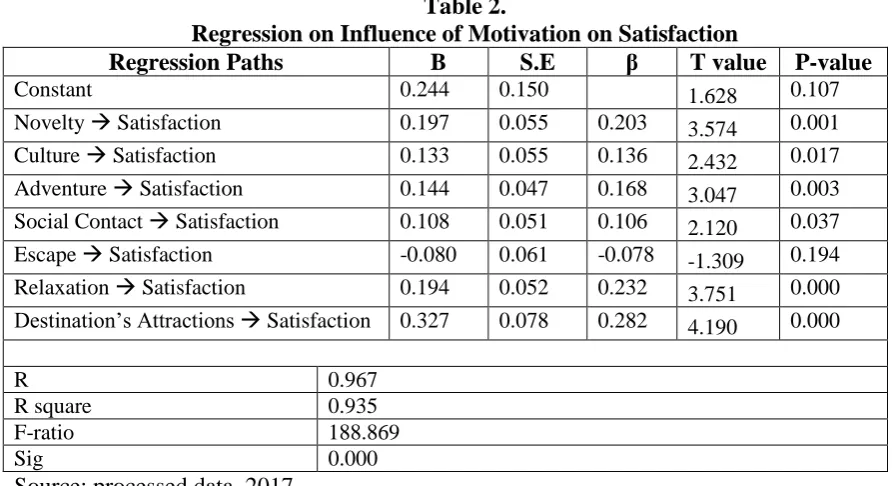
4.3. Prediction of International Tourist’s Overall Satisfaction in Indonesia Table 2.
Regression on Influence of Motivation on Satisfaction
Regression Paths B S.E β T value P-value
Constant 0.244 0.150 1.628 0.107
Novelty Satisfaction 0.197 0.055 0.203 3.574 0.001
Culture Satisfaction 0.133 0.055 0.136 2.432 0.017
Adventure Satisfaction 0.144 0.047 0.168 3.047 0.003
Social Contact Satisfaction 0.108 0.051 0.106 2.120 0.037
Escape Satisfaction -0.080 0.061 -0.078 -1.309 0.194 Relaxation Satisfaction 0.194 0.052 0.232 3.751 0.000 Destination‘s Attractions Satisfaction 0.327 0.078 0.282 4.190 0.000
R 0.967
R square 0.935
F-ratio 188.869
Sig 0.000
Source: processed data, 2017
Regression testing on 6 dimensions of Novelty, Culture, Adventure, Social Contact,
However, the testing on escape dimension shows there is no affect tourist satisfaction. The
regression model has a correlation value of 0.967, with a determination coefficient of 0.953
and significant at overall testing model (F ratio 188.869 with sig 0.000)
4.4. Influence of Satisfaction on Revisit Intention
Table 3.
Regression on Influence of Satisfaction on Revisit Intentions
Regression Paths B S.E β T value P-value
Constant 1.118 0.354 3.163 0.002
Satisfaction Revisit Intention 0.759 0.076 0.712 10.025 0.000
R 0.712
R square 0.506
F-ratio 100.491
Sig 0.000
Source: processed data, 2017
Regression testing to see the effect of foreign tourist satisfaction after visiting Indonesia on a
desire to revisit Indonesia showed significant correlation which is supported in both overall
testing model (F ratio: 100 491 with sig 0.000) and also partial model with a value t of 10.
025 (P value 0.000)
5. Discussion
The findings of this study showed that Novelty, Culture, Adventure, Social Contact,
Relaxation and Destination's Attractions are the driving forces of foreign tourist visiting
Indonesia. This is supported by Dayour and Adongo study (2015) which states that culture,
destination‘s attractions, social contact and adventure-novelty are important factors that attract foreign tourists to visit certain country. Motivation of foreign tourists visiting
Indonesia is very diverse. During a visit to Indonesia, tourists may enjoy a lot of destinations
with various attractions (pull motives that stated Dayour (2013) in Dayour and Adongo
(2015). At present, Indonesia offers new tourist destinations and attractions through
promotion in various countries intensively. The regions in Indonesia began to explore the
existing potential and offer many new destinations. Cultural diversity in various regions in
Indonesia is delivered in exciting new travel packages, such as dances, customs, batik and
others. Many destinations also offer exciting adventure experiences by utilizing natural
various activities like surfing, batik drawing, dancing and others. Among the various
motivations of foreign tourists visiting Indonesia, some of the dominant factors are the desire
to explore tourist destinations in Indonesia, interact with various ethnics, experience various
lifestyle and learn various cultural artifacts.
After enjoying various tourist destinations and attractions in Indonesia, foreign tourists may
feel satisfied. Many of them stay long enough in Indonesia and even reside in Indonesia.
Tourist satisfaction is influenced by six dimensions, namely novelty, culture, adventure,
social contact, relaxation and destination attraction. Tourist motivations of visiting Indonesia
are vacation, pleasure, enjoying the culture and adventure. The results of this study support
the Yoon and Uysal (2005). The escape dimension does not affect tourist satisfaction which
indicates that foreign tourists visiting Indonesia not just to avoid boredom and routine activity
in their country.
Numerous tourist destinations and exciting tourist attractions drive the foreign tourist to
revisit Indonesia. Some destinations in Indonesia are favorite destination for foreign tourists.
In addition, certain destination such as Bali is a ―dream‖ destination for foreign tourists. Very
big land area of Indonesia with a wide range of tourist destinations make single visit is not
enough to explore the destinations which makes tourists repeat their visits, both visiting the
same destination or exploring other new destinations they have never visited before.
6. Conclusions and Implications
Based on the findings of this study, it can be concluded that there is correlation between
foreign tourist satisfactions with revisit intention to Indonesia. Foreign tourist satisfaction
highly depends on the motivation of the foreign tourists. The study found that the motivation
of foreign tourists visiting Indonesia is triggered more by push motives such as novelty,
culture, adventure, social contact and relaxation. In this study, it is also found that the escape
motive does not affect the foreign tourist satisfaction. The destination's attractions dimension
was also found significant in foreign tourist satisfaction when visiting Indonesia.
This paper also practically concludes that foreign tourist satisfaction is important to
build the revisit intention of foreign tourists to Indonesia. The satisfaction occurs in the
travelling process of the tourists in Indonesia. The important thing needs to be executed is to
improve the tourist attraction in Indonesia. Government and entrepreneurs engaged in the
tourists who visited Indonesia can indirectly be a means of promoting Indonesia which would
be very beneficial for the Indonesian government and tourism businesses in Indonesia.
7. Limitations and Future Research
This study has limitations on the number of respondents. The number of respondents was
limited to describe the motivation of foreign tourists visiting Indonesia. The respondents were
foreign tourists (foreigners) who visited Indonesia with travelling as their purpose of visiting
Indonesia.
In future research, customer loyalty variable may be added. Commonly, satisfied customer
tends to be a loyal customer. The loyalty will drive foreign tourists to visit Indonesian more
than once. Future research may compare revisit intention and customer loyalty as a result of
customer satisfaction. It is interesting to know how big the loyalty of foreign tourists to
Indonesia is.
References
Dayour, Frederick and Adongo, Charles Atanga. 2015 . Why They Go There: International
Tourists‘ Motivations and Revisit Intention to Northern Ghana. American Journal of Tourism Management 2015, 4(1): 7-17 DOI: 10.5923/j.tourism.20150401.02
F. Meng and M. Uysal. 2008. Effects of gender differences on perceptions of destination attributes, motivations, and travel values: An examination of a nature-based resort destination. Journal of Sustainable Tourism, vol. 16, pp. 445-466.
Huang, Songshan (Sam) and Hsu, Cathy H. C. Hsu. 2009. Effects of Travel Motivation, Past Experience, Perceived Constraint, and Attitude on Revisit Intention. Journal of Travel Research Volume 48 Number 1. http://jtr.sagepub.com hosted at http://online.sagepub.com
Kenneth F , Lan-Lan Chang and Huang, Backman Yu Chih Huang . 2014. Creative tourism:
a preliminary examination of creative tourists‘ motivation, experience, perceived value and revisit intention. International Journal of Culture, Tourism and Hospitality Research, Vol. 8 Iss 4 pp. 401 – 419. http://dx.doi.org/10.1108/IJCTHR-04-2014-0032.
Khung, Mai Ngoc and Ha, Huynh Thi Thu. 2014. The Influences of Push and Pull Factors on
the International Leisure Tourists‘ Return Intention to Ho Chi Minh City, Vietnam —
A Mediation Analysis of Destination Satisfaction. International Journal of Trade, Economics and Finance, Vol. 5, No. 6, December 2014
Liên, Phan Thị Kim, (2010), Tourist Motivation and Activities A Case Study of Nha Trang, Vietnam, Master Thesis in Fisheries and Aquaculture Management and Economics (30 ECTS), The Norwegian College of Fishery Science University of Tromso, Norway and Nha Trang University, Vietnam, May 2010
Pratminingsih, Sri Astuti; Rudatin, Christina Lipuringtyas and Rimenta, Tetty. 2014. Roles of Motivation and Destination Image in Predicting Tourist Revisit Intention: A Case of Bandung – Indonesia. International Journal of Innovation, Management and Technology, Vol. 5, No. 1, February 2014.
Rahmah, Ghoida, Juli 2016, Jumlah Wisman ke Indonesia Cetak Rekor Tertinggi,
https://m.tempo.co/read/news/2016/09/01/090800814/juli-2016-jumlah-wisman-ke-indonesia-cetak-rekor-tertinggi, Kamis, 1 September 2016, 15: 21 WIB, diunduh 31 Januari 2017, 11.00 WIB
Schiffman, Leon G., and Kanuk, Leslie Lazar. 2007. Consumer Behavior. Perace Education, Inc., Upper SaddleRiver, New Jersey.
Sirisack, Dalivanh, Sithixay Xayavong, Saykham Phongsavath, and Niddavone Vongsanga, The Characteristics and Motivations of Foreign Tourists Who Visit Luang Prabang Province, International Journal of Business and Social Science Vol. 5, No. 9; August 2014.
Šimková, Eva and Jindřich Holzner, Motivation of Tourism Participants, Procedia - Social and Behavioral Sciences 159 ( 2014 ) 660 – 664
Vuuren, C. Van, and Elmarie Slabbert, 2011, Travel Motivations And Behaviour Of Tourists To A South African Resort, Book Of Proceedings Vol. I – International Conference On Tourism and Management Studies – Algarve 2011
Widianto, Satrio, (2016), 2017, Wisatawan Asing ke Indonesia Ditargetkan 15 Juta, http://www.pikiran-rakyat.com/wisata/2016/12/07/2017-wisatawan-asing-ke-indonesia-ditergetkan-15-juta-387169, 7 Desember, 2016 - 20:19, diunduh tanggal 29 Januari 2017, jam 20.00
Yoon, Yooshik and Uysal, Muzaffer. 2005. An examination of the effects of motivation and satisfaction on destination loyalty: a structural model . Tourism Management 26 (2005) 45–56.
________,Menggerakkan Ekonomi Rakyat melalui Sektor Pariwisata,