A Peer Reviewed International Journal of Asian Academic Research Associates
AARJMD
ASIAN ACADEMIC RESEARCH
JOURNAL OF MULTIDISCIPLINARY
ABUNDANCE AND DISTRIBUTION PATTERN OF EARTHWORM IN PEATLAND PLANTED WITH DIFFERENT AGE OF OIL PALM PLANTATION IN DISTRICT OF
SELUMA, BENGKULU PROVINCE
DARMI*; D. BUDIANTA**; SABARUDDIN***; M.R. RIDHO****
*Doctorate Student in the Environmental Sciences, Graduate Program of Sriwijaya University **Faculty Members of Doctorate Program in the Environmental Science, Graduate Program of Sriwijaya
University
***Faculty Members of Doctorate Program in the Environmental Science, Graduate Program of Sriwijaya University.
****Faculty Members of Doctorate Program in the Environmental Science, Graduate Program of Sriwijaya University
Abstract
Peat land conversion to be the oil palm plantation affects on the ecosystem changing from peatland
forest to monoculture of oil palms, thus inducing alteration of soil physical, chemical and biological
characteristic. Biological properties of soil getting its impact is earthworm. Those soil animals are an
important role in improving soil fertility. This study aimed to analyze the abundance and distribution of
earthworm in peat land with different age of oil palm growth (2 years, 10 years, 15 years, 19 years and
23 years). The results showed that only one species of earthworm was found that is Pontoscolex
corethrurus (Oligochaeta : Glossoscolecidae) in stand of oil palm age of 2 years , 19 years and 23 years.
At the location study periodically inundated known from the measurement of groundwater table depth
during the study, there were not found earthworms (at stand age of 10 and 15 years). Earthworm
population density of P. corethrurus tended to increase with enhancing the stand age of oil palms (at
stand age of 2, 19 and 23 years), whereas their distribution pattern based on analysis of the Morisita index
was a clustered pattern. The clustered pattern of earthworm in young age oil palm stands is stronger than
at locations of palm stands of old age.
1.Introduction
Efforts to preserve the existence of flora and fauna in peatland under oil palm plantation is
one of the important factors in supporting the sustainability of farming systems, as stated in the
Regulation of the Minister of Agriculture of Indonesia no. 19 of 2011 on Guidelines for
Sustainable Oil Palm Plantations in Indonesia. One group of animals that have a role in the
balance of peatland ecosystem is earthworm. Lee 10); Gajalaksmi and Abbasi 9) stated that
earthworms as a component in soil ecosystems contribute to improving soil fertility. Through
their activities, these animals can improve soil physical and chemical properties. Earthworms
consume organic materials and can enrich soil nutrients through their manure production. Study
of Samaranayake and Wijekoon 22) showed that the content of N and C of Pontoscolex
corethrurus earthworm manure was significantly higher than in the surrounding soil.As well as,
pH of earthworm manure (6.6 to 7) is closer to neutral than the surrounding soil (5.8 to 6.8).
Many researchers claimed that earthworms are potential as bio-indicator of soil quality 11, 17, 21)
Based on the ecological function, earthworm is divided into three groups: epigeic, endogeic
and anecic which known as Bouche's classification system. Epigeic earthworm with a small
size, darker color, living in litter layers and consume litter (organic material) and rarely consume
soil. Epigeic earthworms are most found in material organic substrate or in animal manure. In
endogeic group, species that live in top soil layer of soil until the depth of 20-30 cm from soil
surface dig a hole in soil and consume soil (geophages) with pale color and size varies. Anecic
worms tend to have larger body sizes, and live in deeper soil layers. They consume organic
material and soil mixture, and rarely appear on surface 1, 10).
Peat lands conversion for agriculture can change the shape of anaerobic forest ecosystem
becomes aerobic shape as a result of decreasing in ground water table level 8). These conditions
provided opportunities for soil fauna to live and breed in peatland 23), including the earthworm
population. Curry and Schmidt 4) stated that peatland that has been reclaimed peat for 20-30
years in Ireland with favorable conditions could support the earthworm population comparable to
the mineral soil fertile in but their species richness was lower (9 species) than in grasslands with
mineral soil (17 species) based on study of Muldowney et al. 16).
Peat land clearance for preparing agricultural drainage network affects on changes in soil
physical and chemical properties of peat 7, 20). Peat land reclamation with different ages has the
of Central Borneo showed that natural peat land has a maturity level of fibric type, whereas
peatlands with reclamation ages of 5 years, 10 years and 15 years, their maturity level are
Sapric. Silvan et al. 23) also stated that the increase in the age of reclaimed peat soil affected on
the lives of soil mesofauna in particular. In general, the density of soil mesofauna (Enchytraidae,
Collembola and Acarina) on peat soil increases correlating with the increases of peat land age
after drained in Ireland forestry. Soil mesofauna density is also significantly positively
correlated with the depth of ground water table in the range of 5-30 cm of the soil surface.
Earthworm study in peatlands are still limited in data and are generally based on different habitat
types 2, 4, 12). Thus, it is needed to study the abundance and distribution of peat land’s
earthworms in oil palm with different strata ages. Determination of differences in stand age strata
of oil palm plantation based on the differences in environmental conditions of biophysics and
micro-climate to soil biota including earthworms.The purposes of this study were to analyze the
abundance of earthworm populations in five locations, and determine the pattern of their
distribution. The results of this study are expected to be input to management of oil palm
plantations on peat lands, both in effort to manage soil fertility and to conserve an important soil
fauna for the sustainability of farming systems on peatlands.
2.Material and Methods
The study was conducted on peat lands in oil palm plantations, District of Seluma,
Bengkulu Province (Southern Sumatra-Indonesia). Peat lands used as the study site consisted of
five stand ages oil palm which were 2 years, 10 years, 15 years, 19 years and 23 years. The
location of oil palm age 2 and 10 years placed in South Seluma Regency in 4o8’56,1”-
4o9’13,1” S and 102o34’24,2-102o34’53,1” E, while three others were located in Air Periukan
Regency (4o0’51” – 4o3’21,2” S and 102o25’42,3”- 102o26’48,3” E). Earthworm sampling at
each study site were carried out systematically consisting of 3 columns and 4 lines, thus each site
has 12 samples. The sampling was conducted in April, May and June 2013 using quadratic
method with size of 25x25x30 cm and using hand sorting methods. Quadrate and hand sorting
method were more efficient for earthworms sampling in peat lands than treated method using
formalin previously 2).
At the same time during the study, there is also measured level of ground water every day
the distance of ground water table to soil surface. It also measured the thickness of the peat, pH,
temperature and soil water content at each location. Quantification of earthworms was done
directly in the field and some earthworm samples taken were brought to laboratory to be
identified using Stephenson’s reference 26).
3.Calculation
Earthworm population data were analyzed by calculating the density and pattern of spread 14,24)
using the following formula:
= square of the number of individuals per plot Id <1 (uniform pattern)
Id =1 (randomized pattern)) Id > 1 (clustered pattern)
Chi square test (X²) for Morisita’s index values using the following formula:
Value of Chi square (X ²) of the count (X²) is compared to the value of X² table with a 95%
confidence interval (α = 0.05) and degrees of freedom (df = n-1). If the value of X² is smaller
than the table value of X ², the results are not significantly different and the means of its
distribution pattern is random.
4.Results and Discussion
Identification result of earthworms with book guide of Stephenson 26) showed that there is
only one species of earthworms found in this location that is Pontoscolex corethrurus
(Oligochaeta: Glossoscolecidae) as seen in Fig. 1. Morphologically, P.corethrurus has
characteristics suchs as body length of 73-95 mm, body diameter of 3.5-4 mm and number of
segments 194-20. Body colors were whitish and slightly browned. Prostomium and first segment
drawn into seta consisted of four pairs with lumbricine type, location of each partner of anterior
seta was adjacent and segment X and XI began to move away, arrangement of ventral seta was
quincuncx and the posterior part was larger. Nefridiofor was on seta c. Klitelum was from
segment XV - XVI to segment XXII or XXIII (8 or 9 segments), klitelum wall on the dorsal was
thick beginning on seta b and had yellowish color.
P. corethrurus are classified as endogeic earthworms (top soil species) having a wide
distribution in tropic condition 10, 18). This worm type also has a high adaptability to fluctuation
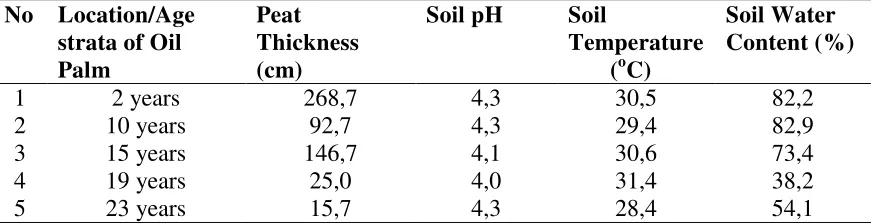
environmental conditions and wide tolerance to soil pH 18). Soil pH measured in the five study
sites ranged from 4.0 up to 4.3 (Table 2). This proves that the worm Pontoscolex corethrurus
Figure 1. Pontoscolex corethrurus earthworms found in the study site
were higly tolerant at acidic pH or low pH. The existence of P. Corethrurus on peat land under
oil palm stands related to the biological characteristics and its ability to adapt. Study results of
corethrurus worms had high adaptability to several types of land use. P.corethrurus almost
always exist in a variety of habitat types (forest habitat, agricultural land, abandoned land and
residential areas) and in general, they have a higher density than other types of earthworms.
4.2. Density of Pontoscolex corethrurus earthworms
The results of this study showed that of the among five locations, earthworm P. corethrurus
were only found in three sites i.e. location of oil palm aged 2 years, 19 years and 23 years
respectively, while the other two sites were never found earthworms during the study (Table 1).
The absence of earthworms on other location of 10 years and 15 years, associated with habitat
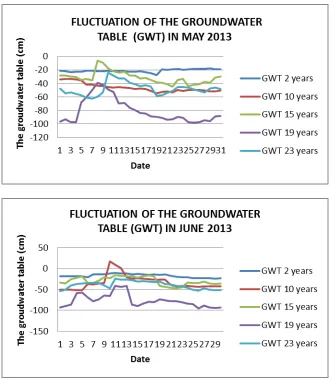
conditions that were known to be periodically flooded, especially in rainy season. Fig. 2 show
that the high water table for 3 months of measurement showed fluctuations. On specific sites of
10 and 15 years, from the recorded observations, the land was ever inundated by stagnant water
at location 10 years by mid-June 2013 (during 3 days) and was in location of 15 years at the
beginning of April 2013 (during 2 days). Flooded conditions (generally anaerobic) causing
earthworms can not live in the location of 10 and 15 years. This is because earthworms need
aerobic conditions for their live. Earthworms were also permanent animal that live in soil and
relatively slow movement 10), so it is difficult to migrate rapidly when the soil in waterlogged
conditions. The results of the study of Emmerling and Strunk 6) showed that earthworms of
species Aporrectodea longa have relatively slow movement and the average of their horizontal
movement ranges 7-8 cm per day. These results highly correlated with movement patterns and
distribution of earthworms, as well as the ability of earthworms in response to changes in the
local climate. Habitat status flooded by waterlog can be inhibit factor for earthworm growth and
life, as a result, in location of oil palm with age of 10 years and 15 years (periodical waterlog),
earthworms were absent.
Table 1. Earthworm Populations Density of P. Corethrurus on Peat lands
Earthworm population density of Pontoscolex corethrurus on three diferrent ages of oil palm
showed variation results. During three months of observation, the highest population density
with value 35 individuals/m2 was found at the age of 23 years, then 23 individuals/m2 on age of
19 years and the lowest with value 13 individuals/m2 was obtained at age 2 years. These results
indicated that there was a trend that, the older age of oil palm, the enlarger density of earthworm
population. This correlated to variation of abiotic factors such as soil temperature and humidity
in three sites (Table 2). In the land of palm stands of old age (23 years), soil temperature (28.4°
C) was lower than those in location of the stand age of 19 years (31° C) and 2 years (30.5° C).
This condition is associated with more dense canopy of the palm trees reducing direct sunlight
penetration to the soil surface. Soil water content at three locations which earthworms exist also
vary. The water content of the soil in palm stands age of 23 years = 54.1%, age of 19 years = 38,
2% and at age of 2 years stand = 82.2%. These results show that, P. corethrurus were quite
tolerant to soil water content in the range of 38.2 to 82.2%, however, these population is higher
in habitats with soil moisture content average of 54.1%.
Tabel 2. Abiotic Factors on Peat lands with Different Age Strata of Oil Palm.
No Location/Age
The depth of peat in study location also vary. The older oil palm plantations tend to have the
peat thickness that is thinner, this was due to the occurrence of subsidence of peat land. The
increasing age also indicated an increase in oil palm age of peat land reclamation, thus it caused
changes in the physical and chemical properties of these soils. Silvan et al. 23) stated that the
increase in age after drained peat lands can improve structure of soil mesofauna community to
Different Age Strata of Oil Palm
4.3.Distribution Pattern of Pontoscolex corethrurus Earthworms
The patterns of distribution of earthworms in this study were analyzed using Morisita index
(Id). ). At the age of 2 years, Morisita index value (Id) is 4.1; at the age of 19 years Id = 2.5 and
at the age of 23 years Id value = 1.5(Table 3). That results showed that distribution of P.
corethrurus at three study locations with Morisita Index >1, were categorized as clustered. To
test the accuration of index value, Chi Quadrat test was used. Results of X2 value in stand age
of 2 years = 12.21; at age of 10 years = 115 and at age of 23 years = 75.48 years. Value of
X2 count > X2 table(p=0.05) in these three sites is 49.77 meaning significantly different from a
random pattern. Thus distribution patterns of earthworm populations tended to be clumped in
three locations.
Table 2. Morisita Index (Id) of P. Corethrurus earthworms on Peat land with Different Strata
Age of Oil Palm.
with increasing stand age of oil palm. This suggests that in the location of young age oil palm
stands, clumped pattern of earthworm distribution is stronger than at locations of palm stands of
old age. Changes in the distribution patterns of earthworms is related to changes in habitat
condition or peat soils with increasing stand age or the age of the land after the oil drained. At
the location of stands of palm age 2 years, the condition of the ground is still unstable and in
some places still found logged stump, while the location of stands of old age (23 years) soil
condition is stable, solid and resemble the mineral soil. In connection with this, Mathieu 13) stated
population density and environmental homogeneity. Test results of Caro et al. 3) showed that
habitat quality is more real influence on the spread of endogeic earthworm. Besides the changes
in the distribution pattern of earthworms can also be associated with better population growth in
line with changes in the peat soil with increasing age of oil palm stands along peat soil still meet
the requirements of live earthworms. Eijsackers 5) also suggests that the spread of earthworms in
a field is determined by the ability of the active movement of earthworms. Period (time) is
directly proportional to the distance spread of the spread of earthworms in a field.
5.Conclusions
Earthworms in peatlands under oil palm in Seluma District of Bengkulu Province consists
of only one type, namely Pontoscolex corethrurus (Oligochaeta : Glossoscolecidae). These
earthworms were found in the location of stands of oil palm age 2 years, 19 years and 23 years
with a population density tending to increase with increasing stand age of oil palms. At the
location periodically inundated (location of stands of palm age 10 years and 15 years), there were
not found earthworms. The distribution of P. corethrurus earthworms in each stratum of palm
stand (age 2 years , 19 years and 23 years) showed a clustered pattern. The clustered pattern of
References
1) Andrade, D.P; G.G. Brown ; M.A. Callaham Jr, 2010. Ecological classification of
Brazilian earthworm: a first attempt using morphological data. Elaetao 4 13 a15 de
outubro, Curitiba, Parana, Brasil. http//:ainfo.cnptia.embrapa.br
2) Baker, G.H. 1983. The distribution, abundance and species associations of earthworm
(Lumbricidae) in a reclaimed peat soil in Ireland. Holarctic Ecology 6: 74-80.
3) Caro, G.; T. Decaens; C. Lecarpentier; J. Mathieu. 2013. Are dispersal behaviours of
earthworm related to their functional group. Soil biology and Biochemistry 58: 181- 187.
4) Curry, J.P. and O. Schmidt. 2006. Long-term establishment of earthworm population in grassland on reclaimed industrial cutaway peatland in Ireland. SUO 57 (3): 65-70.
5) Eijsackers, H. 2011. Earthworm as colonizers af natural and cultivated soil
environments. Applied Soil Ecology Vol. 50: 1-13.
6) Emmerling, C. And H. Strunk. 2012. Active dispersal of the endo-anecic earthworm
Aporrectodea longa (Ude) in an experimental box. Soil Organisms 84 (3): 491-498.
7) Firdaus, M.S., S. Gandaseca and O.H. Ahmed. 2011. Effect of drainage and land clearing
on selected peat soil physical properties of secondary peat swamp forest. Int. J. Phys. Sci.6(23): 5462-5466.
8) Laiho, R. 2008. From a mire ecosystem to a drained peatland forest ecosystem. I:
Korhonen,R. Korpela, R. & Sarkola, S. (eds.). Finland, pp: 152-157. Fisnish Peatland Society, Maahenki Ltd., Helsinki.
9) Gajalakshmi, S. And S.A. Abbasi. 2004. Earthworm and vermicomposting. Indian
Journal of Biotechnology 3: 486-494.
10)Lee, K.E. 1985. Earthworm, their Ecology and Relationships with Soils and Land Use.
Academic Press, London.
11)Maftuah, E; M. Alwi; M. Willis. 2005. Potensi makrofauna tanah sebagai bioindikator
kualitas tanah gambut. Bioscientiae 1; 1-14.
12)Maftuah, E. dan M.A. Susanti. 2009. Komunitas cacing tanah pada beberapa penggunaan
lahan gambut di Kalimantan Tengah. Berita Biologi 9(4): 371-378
13)Mathieu, J.; S. Barot; M. Blouin; G. Caro; T. Decaens; F. Dubs; L. Dupont; P. Jouquet; P.
Nai. 2010. Habitat quality, conspecific density and habitat pre-use affect the dispersal
behaviour of two earthworm species, Porrectodea icterica and Dendrobaena veneta, in
mesocosm experiment. Soil Biology & Biochemistry 42: 2003-2009.
14)Morisita, M. 1959. Measuring of the Dispersion of individuals and analysis of the
distributional patterns. Mem. Fac. Sci. Kyushu., Ser. E (Biol.) 2(4): 215-235.
15)Mudiyarso, D., U. Rosalina, K. Hairiah, L. Muslihat, I.N.N. Suryadiputra dan A.
Jaya.2004. Petunjuk lapangan: Pendugaan cadangan karbo pada lahan gambut. Proyek Climate Change, Forests and Peatlands in Indonesia. Wetlands International-Indonesia Programme dan Wildlife Habitat Canada. Bogor-Indonesia.
16)Muldowney, J., J.P. Curry, J. O’Keeffe, and O. Schmidt. 2003. Relationships between earthworm populations, grassland management and badger densities in County Kilkenny, Ireland. Pedobiologia 47:913-919.
17)Paoletti, M.G., D. Sommaggio, M.R. Favretto. 1998. Earthworms as useful bioindicators
18)Plisko, J.D. 2001. Notes on the occurence of the intruduced earthworm Pontoscolex
corethrurus (Muller,1857) in South Africa (Oligochaeta: Glossoscolecidae). African
Invertebrates Vol. 42: 323-334.
19)Qudratullah, H., T.R. Setyawati; A.R. Yanti. 2013. Keanekaragaman cacing tanah
(Oligochaeta) pada tiga Tipe habitat di Kecamatan Pontianak Kota. Protobiont 2(2): 56-62.
20)Radjagukguk, B. 2000. Perubahan sifat-sifat fisik dan kimia tanah gambut akibat
reklamasi lahan gambut untuk pertanian. Journal Ilmu Tanah dan Lingkungan 2 (1): 1- 15.
21)Rousseau,G. X., P. R. Silva, C. J. R. Carvalho. 2010. Earthworm, ants and other
arthropods as soil health indikators in traditional and no-fire agro-ecosystem from Estern Brazilian Amazonia. Acta Zoológica Mexicana Número Especial 2: 117-134.
22)Samaranayake, JWK. And S. Wijekoon. 2010. Effect of selected earthworms on soil
fertility, plant growth and vermicomposting. Tropical Agricultural Research & Extension 13(2): 33-40.
23)Silvan, N.; R. Laiho; H. Vasander. 2000. Changes in mesofauna abundance in peat soils
drained for forestry. Forest Ecology and Management 133(1): 127-133.
24)Soegianto, A. 1994. Ekologi Kuantitatif: Metoda analasis populasi dan komunitas. Usaha
Nasional Surabaya. Indonesia.
25)Somniyam, P. and P. Suwanwaree.2009. The diversity and distribution of terresterial
earthworm in Sakaerat Enviromental Research Station and Adjacent Areas, Nakon Ratchasima, Thailand . World. Appl. Sci. J., 6(2):221-226.
26)Stephenson, J. 1923. The fauna of British India, including Ceylon and Burma:
Oligochaeta. Taylor and Francis, London.
27)Supriyo, A. and E. Maftu’ah. 2009. Teknologi rehabilitasi lahan gambut bongkor untuk budidaya padi. Jurnal Ilmu Tanah dan Lingkungan 9(1): 115-122.