THE INTERNATIONAL JOINT SEMINAR
& VISIT TO CLEAN AUTHORITY OF TOKYO
Tokyo, Japan 15 – 19 May 2017
Arranged by
Nur Alam Syah
Student ID 120820160064
MASTER OF MANAGEMENT PROGRAM
FACULTY OF ECONOMICS AND BUSINESS
MARKETING ANALYSIS REPORT
Tokyo is Japan’s Capital and the centre of Japanese politics, economy, and culture. Core management institutions, such as head offices of companies, administrative agencies, and foreign corporations, are all concentrated in the metropolitan area. Japan in total has 47 prefectures. Tokyo is one of its prefecture and have 23 cities. Japan is a small, but articulate,
country. They’re advanced in telecommunications, trasportation and waste management.PESTLE analysis of Japan
are as follows.
A. POLITICAL FACTORS
Japan is a monarchy. But the current Emperor, Akihito, has little say in the country’s political developments. He is a figurehead and a symbol of the country. Japan is connected with G8 and ASEAN. They have a rocky relationship with Russia, South Korea, China, and Taiwan. Disputes are related to resources, such as natural gas, oils, and further marine resources.
Political factors relate to
government policies, political conditions and state security conditions. Unstable political and security conditions of the State, can provide a sense of insecurity to all foreign tourists who come to a countries. Japan is a monarchy. But the current Emperor, Akihito, has little say in the country’s political developments. He is a figurehead and a symbol of the country. Based on observations in thefield indicates the Japanese government was very serious to attract foreign tourists. The tax-free policy adopted by the Japanese government very supports the Japanese market.
Policy on system transportation especially at tokyo city is very good. Public transport with in Tokyo is dominated by the world's most extensive urban rail network of clean and efficient surface trains and subways run by a variety of operators, with buses, trams, monorails, and other modes supporting the railway lines. furthermore, high parking taxes make people prefer public transportation rather than personal transportation. all of the poliicy make Tokyo is Comfort of a place to stay
B. ECONOMICAL FACTORS
Economic factors include all factors that affect the purchasing power of the customer and affect the business climate of a countriy. The Japanese economy is strong. In fact, it’s in the top 5 for largest economies in the world. A strong emphasis is placed on its education system and being a contributor to society is a huge part of Japanese culture. best education and good culture prepares them for the working world. Men are expected to join a company and stick with it for most, if not all, of their working career. Women are expected to work until married. economic stabity make stock market is growing at a rapid pace and it is good for business climate of a countriy business climate of a countriy. it can make product is cheaper than other country. Based on observations in the field, the price of a similar product is cheaper in Japan than in Indonesia specially smartphone or Electronic goods.
C. SOCIAL FACTORS
Social factors include all the factors that can affect the needs of the customer and affect the size of the existing market share (Example: level of community education, population growth rate, social environment condition and work environment). Based on observations in the field, The country has 127 million Japanese residents. The couple is expected to have at least one boy who can ‘inherit’ the family’s worth and/or possessions. It’s a patriarchal system. However, birth rates have been low between
monogamous couples over the last couple of years. Regarding religion, Japan is open. Many are Christians, but a few venture into different religions, like Shinto.
D. TECHNOLOGICAL FACTORS
Technological factors include everything that can help in facing business challenges and support the efficiency of the company's business processes. Based on observations in the field, Japan has one of the
most advanced telecommunications systems,
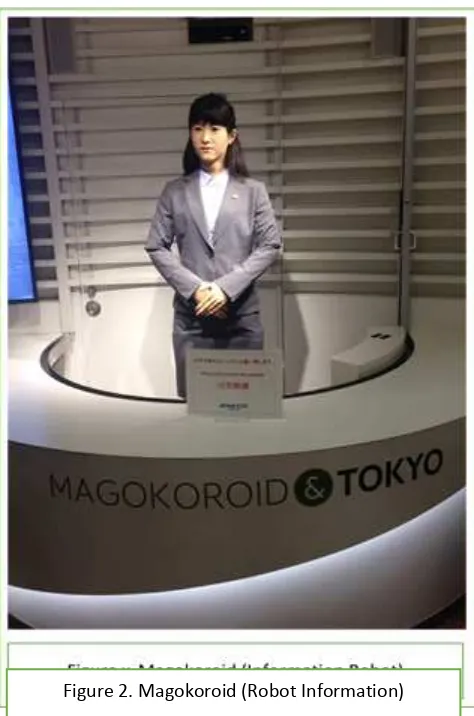
particularly with their mobile devices. Japan have made it possible to connect to wifi virtually anywhere in populated areas. So, instead of texting, the Japanese send emails and pass contact information wirelessly by holding their phones together. In fact, many key facilities in Japan, such as hospitals, airports, and restaurants, use automation systems. They also have stronger robotic development compared to other countries.
E. ENVIRONMENT FACTORS
Environmental factors can be used when doing strategic planning or trying to influence buyer decisions such as geographic location factors. a large population of Japan is concentrated in and around Tokyo. This isn’t a choice, for the most part, because much of the island is overrun by mountain and forest. Because it’s surrounded by water, the land is susceptible to tsunamis and earthquakes. With housing and developments packed closely to accommodate the high population, they’re at risk to colossal damage should a natural disaster hit. To prevent earthquake damage, buildings in japan are designed to withstand earthquakes and the Japanese are very concerned about the environment.
RECOMMENDATION :
In line with the economic growth that occurred in indonesia particulary in Jakarta, as a consequence of its role as a center of government and center of trade in goods and services, population growth has also increased mainly contributed by urbanization. The number of commuters increases the density of traffic in Jakarta. Meanwhile, the variety of transportation modes mixed together in a single lane of traffic in Jakarta, causing traffic jams in almost every street. The fact points out that the application of alternative solutions which is primarily transportation management, have some constraints. it may be said that the most important solution is the political will to encourage the implementation of several alternative solutions. Indonesia must learn Japan transportation management specially in tokyo.
Figure 3. Toilet For Child
Figure 4. Restoran Halal Food CROSS-CULTURAL ANALYSIS REPORT
Cross culture can refer to a company's initiatives to increase understanding of different groups, develop effective communication or marketing efforts to reach out to customers and clients outside its traditional market. Methods of cross culture are intended to strengthen the interaction of people from different backgrounds in the business world and is a vital issue in international business. Understanding consumer behavior for companies that market their products within the borders of a country is quite difficult.
A. Differences in Values, Beliefs and Policies. Japan is a country that is very obedient to the rules and orderly. other than that, Japanese are very concerned with cleanliness. This custom is certainly very different from the habits of the people in the other country. Some of the rules and habits in this country are encountered in this study visit, among others: When we walking on stairs or sidewalks, we have to separate the space so that people can get ahead, In Japan provided various types of bin. You have to sort out the garbage you want to remove. If there is no bin, you should first pocket your garbage and throw it away when you see the bin, The Japanese are always obedient and timely and Instead of smoking, the country has special rules and a special place for smokers. If you want to smoke, you should smoke in a place that has been provided and allowed. If you violate, you also have to pay a fine.
B. Acculturation
Habits of Japanese people are generally a country that is very obedient to the rules and very concerned with cleanliness. So that the international market players must also be able to translate the marketing of its products in accordance with the Japanese people's habits. Related to eating habits, the following are some habits and passions of Japanese people, among
others: Fish Consumption and Love of
C. World Brands
Japan has many product and culture that become worldwide. famous Product from japan are yakult, Hokben, car brand such as toyota and daihatsu and many product more. famous culture from japan are Sumo, ninja, samurai and etc.
RECOMMENDATION:
COMPANY VISIT ANALYSIS REPORT SHIN-KOTO INCINERATION PLANT (TOKYO, JAPAN)
A. Introduction
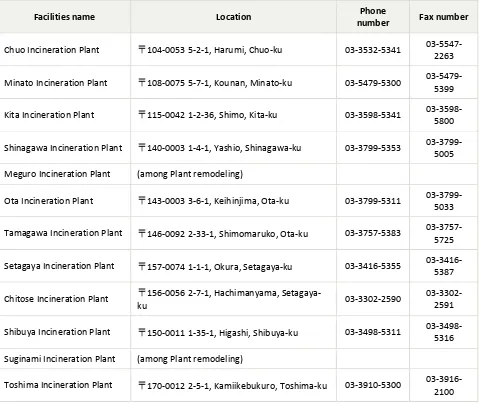
Municipal solid waste management in developed countries encompasses four stages of activities: source separation, collection, recycling, treatment and final disposal. It starts in households, where waste is separately disposed of according to designated categories: glass, paper, plastics, metals and organic waste. In japan especially tokyo have implemetation the best Municipal solid waste. Tokyo is Japan’s Capital and the centre of Japanese politics, economy, and culture. Core management institutions, such as head offices of companies, administrative agencies, and foreign corporations, are all concentrated in the metropolitan area. Japan in total has 47 prefectures. Tokyo is one of its prefecture and have 23 cities. The 23 cities at Tokyo Metropolitan Government has designed an institutional frameworks that the duties of municipal waste management were transferred to 23 cities. Waste management in the 23 cities is performed collaboratively, dividing roles among the respective municipal governments, the Clean Authority of TOKYO, and the Tokyo Metropolitan Government. the List Of Incineration Plants In 23 Cities Of Tokyo as follows:
Figure 5. List Of Incineration Plants In 23 Cities Of Tokyo
Facilities name Location Phone
number Fax number
Chuo Incineration Plant 〒104-0053 5-2-1, Harumi, Chuo-ku 03-3532-5341
03-5547-2263
Minato Incineration Plant 〒108-0075 5-7-1, Kounan, Minato-ku 03-5479-5300
03-5479-5399
Kita Incineration Plant 〒115-0042 1-2-36, Shimo, Kita-ku 03-3598-5341
03-3598-5800
Shinagawa Incineration Plant 〒140-0003 1-4-1, Yashio, Shinagawa-ku 03-3799-5353
03-3799-5005
Meguro Incineration Plant (among Plant remodeling)
Ota Incineration Plant 〒143-0003 3-6-1, Keihinjima, Ota-ku 03-3799-5311
03-3799-5033
Tamagawa Incineration Plant 〒146-0092 2-33-1, Shimomaruko, Ota-ku 03-3757-5383
03-3757-5725
Setagaya Incineration Plant 〒157-0074 1-1-1, Okura, Setagaya-ku 03-3416-5355
03-3416-5387
Chitose Incineration Plant 〒156-0056 2-7-1, Hachimanyama,
Setagaya-ku 03-3302-2590
03-3302-2591
Shibuya Incineration Plant 〒150-0011 1-35-1, Higashi, Shibuya-ku 03-3498-5311
03-3498-5316
Suginami Incineration Plant (among Plant remodeling)
Toshima Incineration Plant 〒170-0012 2-5-1, Kamiikebukuro, Toshima-ku 03-3910-5300
Itabashi Incineration Plant 〒175-0082 9-48-1, Takashimadaira,
Itabashi-ku 03-5945-5341
03-5398-2210
Nerima Incineration Plant 〒177-0032 6-10-11, Yahara, Nerima-ku 03-3995-5311
03-3995-5317
Hikarigaoka Incineration
Plant (among Plant remodeling)
Sumida Incineration Plant 〒131-0042 1-10-23, Higashisumida,
Sumida-ku 03-3613-5311
03-5247-5389
Shin-Koto Incineration Plant 〒136-0081 3-1-1, Yumenoshima, Koutou-ku 03-5569-5341
03-5569-5346
Ariake Incineration Plant 〒135-0063 2-3-10, Ariake, Koutou-ku 03-3529-3751
03-3529-3764
Adachi Incineration Plant 〒121-0812 4-7-1, Nishihokima, Adachi-ku 03-3859-4475
03-3858-5106
Katsushika Incineration Plant 〒125-0032 1-20-1, Mizumoto, Katsushika-ku 03-5660-5389
03-5660-5379
Edogawa Incineration Plant 〒132-0013 2-10, Edogawa, Edogawa-ku 03-3676-4446
03-3676-4547
Other facilities
Facilities name Location Phone number Fax number
Shinagawa Cleaning Facility for Night soil (Night soil relations)
〒140-0003 1-4-11,
Yashio, Shinagawa-ku 03-3799-5361 03-3799-5005
Keihinjima Island Incombustible
It was decided that 23 cities would independently manage its own waste collection and transfer, while management of intermediate processing (incineration, pulverization, etc.) was determined to be handled jointly. This was due to fact of some cities that had no incineration plant within them, and also for the purpose of optimizing the processing efficiency. Each of 23 cities collects waste and transfer and looks after recovery of resources. Whereas Clean Authority of TOKYO looks after Intermediate waste processing of waste, night soil processing etc. And final disposal (landfill) is managed by the Tokyo Metropolitan Government as consigned by 23 cities and the Clean Authority of TOKYO. Shin-Koto Incineration Plant is one of the biggest incenerator in tokyo. The Shin-Koto Incineration Plant property area is 61.000 m2 and incineration capacity is 1.800 ton/day.
Figure 6. Shin Koto Incenerator Plant
Waste management offices in each of the 23 cities collect and transfer waste. Each
while large-sized waste and
business-generated waste are charged. To ensure efficient transfer, transfer methods are determined based on the type of waste. Combustible waste is loaded onto collection vehicles (such as compaction type vehicle) on collection sites, from which it is directly transferred to an incineration plant.
Shin-Koto Incineration Plant was completed in September 1998. It plays an important role of processing combustible waste and recycling energy since the heat generated during the incineration process helps to produce electricity for energy recycling. It has a capacity to process 1,800 ton of waste per day and generates 50000 kW with a steam turbine generator. In addition, the incineration plant is equipped with the state-of-theart air pollution preventive facilities to removes most of the hydrogen chloride contained in exhaust dust sulfur oxides and mercury. It burns combustible waste continuously at high temperature (800-900 deg C) to ensure complete destruction of dioxins, which successfully maintains the emission of dioxins at much lower level than legally stipulated. Although recycle has been stressed by the Tokyo Metropolitan Government as the key to deal with waste problem, incineration has still been playing the main role in handling waste in Tokyo, almost 76% of waste was handled by incineration.
Figure 8. Gerbage truck C. Analysis Shin-Koto Incineration Plant
Combustible waste is incinerated at Shin-Koto Incineration Plant in a safe, stable, and efficient manner. Incineration prevents bacteria, vermin, and foul odor, and maintains a sanitary environment in Tokyo. By incinerating waste, its will waste volume reduce. By recycling a part of bottom ash into cement materials, and by melting it into slag, the amount going to the landfill is further reduced. Emission of hazardous substances within exhaust and wastewater from the incineration plants is controlled and reduced to lower impact on the environment. In an Shin-Koto Incineration Plant, power generation and heat supply are performed using the heat energy of waste incineration. But once improper
waste is brought into an incinerator Combustibles carried into incineration plants sometimes contain waste unsuitable for incineration, such as metals, glass, or oversized waste that exceeds the disposal capacity of the plant. Such improper waste may cause the halt or failure of incinerators, costing a great deal of money and time before recovery. Once the facilities become incapable of accepting waste, waste collection and transfer operations will be interrupted, seriously affecting waste management. To prevent carry-in of improper waste, and to ensure safe and stable plant operation, inspection of incoming waste is reinforced, and awareness-raising activities are undertaken. Special weeks are also set to enhance the above inspection and to perform close observation at platforms in each incineration plant. Overall regular inspection on incoming waste is also conducted at Shin-Koto Incineration Plant..
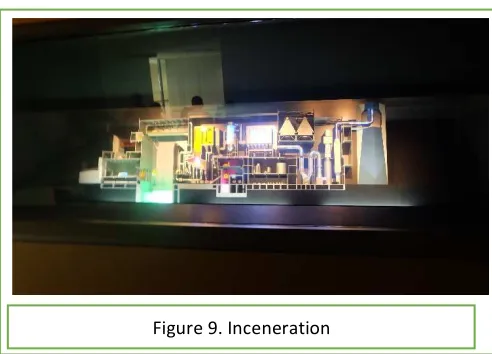
C.1. Facilities in an Incineration Plant Initially when the truck enters the facility, waste truck scale measure the weight of waste. Waste collection trucks dump waste into the bunker. Waste is temporarily stored here until incineration. Some plants even have large vacuums to collect waste through pipes to this chamber. Waste crane is provided in the top of waste bunker, which continuously mixes the waste and sends to the incineration. Forced draught fan is used to send air from the waste bunker to the incineration. The air
Figure 9. Inceneration
such sent has a foul smell. Stoker Furnace is used as Incinerator which is heart of this plant. Incinerator generally burns waste at a high temperature of over 800 degree Celsius. A boiler is attached to the facility which produces steam from heat generated when waste is burned, to be used for heat supply and electric power generation. When something is burned, major two products exhaust gases and ashes are collected. This two things cannot be directly disposed to the atmosphere. Exhaust flue gases from the incineration chamber passes through the cooling tower which cools high-temperature exhaust emitted from the incinerator to around 150 degrees Celsius, for preventing the re-composition of dioxins. Exhaust gases so cooled must be filtered before entering the atmosphere. Bag filter removes soot and dusts, dioxins, mercury, hydrogen chlorides and sulphur oxides from exhaust. Exhaust is cleaned with water and chemicals, for removing mercury, hydrogen chlorides and sulphur oxides. Next comes the Catalyst Reaction Tower where dioxins and nitrogen oxides decomposes in exhaust using catalysts. Through the induced draft fan, exhaust is sent to the stack. Height of stack depends on the local topography and meteorological conditions. Exhaust that is free of hazardous substances or odour is released into the air. Solids and heavy metals in waste water produced from the incineration plant are removed to the limit or below, before wastewater is released to sewer which reaches water reclamation centre where water is reclaimed before mixing it with environment. Heart of this plant is Central Control Room which control and monitors facilities including waste bunker and incinerator. Each facility continuously sends information to a large-scale computer system, and operations across the entire incineration plant can be watched on the monitors. Ash generated from incineration at an incineration Plant is separated into Bottom ash and Fly ash. Bottom ash is cinder discharge from the bottom of incinerator. Fly ash is soot and dust within exhaust that is collected by bag filters, etc. Bottom ash after removing ash to be melted into slag, as well as fly ash after processed with chemicals, are sent to landfill disposal on the New Sea Surface Disposal Site, which has been established and is managed by the Tokyo Metropolitan Government. Because it is extremely difficult to find new landfill disposal sites in the Tokyo Port, a full-scale initiative has been undertaken to recycle the amount of landfill disposal and achieving more efficient use of resources. In the initiative for recycling bottom ash into cement materials, bottom ash that is generated in incineration plants is transferred to private cement factories by freight vehicles/trains, and efficiently used as cement materials. Cement materials include limestone, clay, silica, iron materials, and plaster. Bottom ash is used as substitute for clay. Typically, it is recycled as Portland cement. Portland cement is most common and widely used type of cement that accounts for approx. 70% of cement consumption in Japan. Similarly, when bottom ash is melted at a high temperature of over 1200 degrees Celsius and then rapidly cooled, it turns into slag. As slag, the volume is almost half that of ash. The process of making slag decomposes dioxins within the ash, and traps heavy metals inside, thereby making it safe and efficient for use in construction materials.
C.2. Environmental Measures and Counter
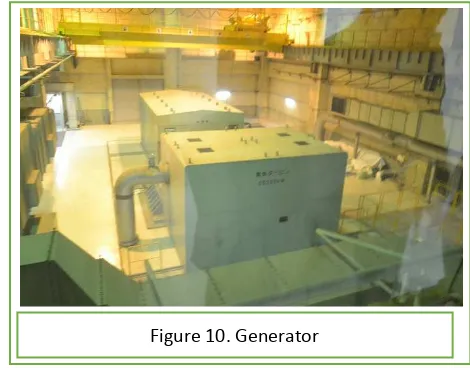
Figure 10. Generator
generally removed by bag filters. Dioxins generation is restricted through control of waste incineration process, and their re-composition is prevented by rapid cooling of exhaust in the cooling tower. Dioxins are also removed by bag filters, and decomposed in the catalyst reaction tower using catalysts. Mercury is removed by adsorption into activated carbon in bag filters, and by liquid chelate in the gas scrubber. Hydrogen chlorides and Sulphur oxides are removed by injecting slaked lime into bag filters, and through a chemical reaction with caustic soda solution in the gas scrubber. Nitrogen oxides are decomposed in the catalyst reaction tower through a reaction with ammonia. Similarly, wastewater is treated in the wastewater treatment facilities to meet the standard value, and released into the sewer. To counter noise and vibration, care is taken for the layout of machinery and soundproof walls and vibration–control equipment are installed. Odour of the plant is mainly from waste bunkers, platforms and waste collection vehicles. Air from inside the waste bunker is sent to the incinerator, where odour is incinerated and decomposed. While the incinerator is off the line, deodorizing devices are used and deodorizing agents are spread. Entrances and exits of platforms are sealed with air curtains and deodorizing agents are spread. Collection Vehicles are washed at washing facility to remove their odour. We have already discussed about bottom ash and fly ash.
C.3. Heat Energy Management
Shin-Koto Incineration Plant use the heat energy generated from waste Incineration beneficially in power generation and in supplying energy. Electricity and hot water produced at Shin-Koto Incineration Plant are used within facilities to operate the plant, thereby reducing electricity purchases and fuel costs. Surplus electricity is sold to power 501,000 GJ of heat was sold and 192.02 million yen was revenue generated.
D. Recomendation