*Corresponding author:
E-mail: [email protected]
Available online at http://medpet.journal.ipb.ac.id/
Meat Characteristic of Crossbred Local Chicken Fed Inulin of Dahlia Tuber and
Lactobacillus
sp.
Z. H. Abdurrahmana,*, Y. B. Pramonob, & N. Suthamab
aDepartment of Animal Science, Faculty of Animal Science, Boyolali University
Jalan Pandanaran No. 405, Boyolali 57313, Indonesia
bFaculty of Animal and Agricultural Sciences, Diponegoro University
Jalan Prof. Soedarto, Tembalang, Semarang, Jawa Tengah, Indonesia (Received 25-05-2016; Reviewed 13-07-2016; Accepted 26-07-2016)
ABSTRACT
This study was conducted to evaluate the meat characteristicof crossbred local chicken fed diet containing both dahlia tuber powder as inulin source and probiotic Lactobacillus sp. The experimental animals were 168 crossbred local chickens which were randomly divided into 6 groups of treatment (4 replications each) when they were 21-d old. A completely randomized design with 2 x 3 factorial
pattern consisted of 2 levels of prebiotic [(0.8% (D1) and 1.2% (D2)] and 3 levels of probiotic [without probiotic (L0), 1.2 mL (L1), and 2.4 mL (L2)] was arranged in the present study. One mL probiotic
(Lactobacillus sp.) was equal to 108 cfu. Results showed that the supplementation of prebiotic and
pro-biotic significantly (P<0.05) affected breast meat color in terms of L* (lightness) and b* (yellowness). The meat fat mass and cholesterol was significantly (P<0.05) decreased by the combination of pre
-biotic and pro-biotic. The hardness of meat was not affected significantly by all treatments. The con -clusion is that breast meat color could be improved, and both meat fat mass and cholesterol content
could be decreased by feeding a combination of 1.2% dahlia tuber powder as inulin source and 1.2
mL probiotic Lactobacillus sp.
Key words: prebiotic inulin, probiotic Lactobacillus sp., meat characteristic, crossbred local chicken
ABSTRAK
Tujuan penelitian ini adalah untuk mengevaluasi karakteristik daging ayam lokal persilang-an ypersilang-ang diberi rpersilang-ansum mengpersilang-andung kombinasi prebiotik inulin dari umbi dahlia dpersilang-an probiotik Lactobacillus sp. Penelitian menggunakan 168 ekor ayam lokal persilangan umur 21 hari yang secara acak ditempatkan pada 6 perlakuan dengan 4 ulangan. Rancangan acak lengkap pola faktorial 2 x
3 diterapkan pada penelitian ini. Penambahan prebiotik sebanyak 0,8% (D1) dan 1,2% (D2) sebagai
faktor pertama, dan penambahan probiotik yaitu tanpa probiotik (L0), probiotik 1,2 mL (L1), dan 2,4 mL (L2) sebagai faktor kedua. Satu mililiter probiotik (Lactobacillus sp.) setara dengan 108 cfu.Hasil
penelitian menunjukkan bahwa penambahan prebiotik dan probiotik pada ransum nyata (P<0,05)
mempengaruhi warna daging dada berdasarkan L* (tingkat kecerahan) dan b* (tingkat kekuningan).
Massa lemak dan kolesterol nyata (P<0,05) menurun akibat penambahan prebiotik dan probiotik. Kekerasan daging tidak nyata dipengaruhi oleh perlakuan. Kesimpulannya adalah bahwa 1,2%
prebiotik dan probiotik 1,2 mL (108 cfu/mL) adalah kombinasi yang paling optimum berdasarkan
perbaikan warna daging dada dan penurunan massa lemak dan kolesterol daging.
Kata kunci: prebiotik inulin, probiotik Lactobacillus sp., karakteristik daging, ayam lokal persilangan
INTRODUCTION
Antibiotic has been used in the poultry industry for period of decade because it can improve the feed
ef-ficiency and performance. However, the use of antibiotic
in animal feed can cause negative effects on consumers.
such as probiotic and/or prebiotic, which is human- and animal-healthy friendly.
Probiotics are ‘live microorganisms’ in sufficient quantities that can affect the digestive microflora
composition and ecosystem so that providing a health
benefit to the host (Hill et al., 2014). Probiotic can
modify microflora in gastrointestinal ecosystem and
help to increase nutrients digestibility (Mountzouris et
al., 2010). The number of Lactobacilli and Bifidobacteria
can be enhanced with prebiotics (Pourabedin & Zhao, 2015). Definition of prebiotic was introduced in 1995
and was updated several times. The scientific commu
-nity has continued to debate concerning what it means to be a prebiotic. Although the absence of a consensus
definition, a principle element is that prebiotic should
improve the health of host or otherwise provide a
ben-eficial physiological effect (Hutkins et al., 2016). Feeding
prebiotic would be more effective when combined with the addition of beneficial bacteria as probiotic because
both are expected to be complementary as a symbiotic
mutualism. Group of organisms known to be potentially
function as probiotic are Lactobacillus sp.
Lactobacillus sp. is a beneficial bacteria commonly used in relation to the improvement of gastrointestinal condition in poultry. The characteristic function of
pro-biotic (Lactobacillus sp.) would be optimal for the change
in gastrointestinal ecosystem to be better when com
-bined with the source of prebiotic. Inulin is a prebiotic
with polyfructans classification which is widely used as
prebiotic and found in dahlia tuber with inulin content
about 15%-20% (Saeed et al., 2015). The balanced
combi-nation of probiotics and prebiotics could be function as
synbiotic (Finamore et al., 2016). The prebiotic can be
se-lectively fermented by a certain probiotic and other
ben-eficial gastrointestinal microbiota into short-chain fatty acids (SFCA), mainly acetate, propionate, and butyrate,
that lowered the luminal pH and decreased pathogenic
bacteria (Pourabedin & Zhao, 2015). However, the
feeding application of both probiotic and prebiotic on
Indonesian crossbred local chicken isstill very rare and
not much studied.
Local chicken is an Indonesian native poultry with plumage color tends to green and red. This local chicken
is presumed the offspring of red jungle fowl (Gallus
gal-lus) and green jungle fowl (Gallus varius). In case of
com-mercial purposes, the productivity of local chicken can
be improved by a system of crossbreeding between male
local chicken andthe female modern chicken. Ma’rifah
et al. (2013) reported that the offspring of crossbreeding system tended to have similar exterior to their uncerstor
(local chicken) and the meat texture was also not much different from that of local chicken at the same age.
Therefore, the aim of the present study was to evaluate
the effect of prebiotic inulin derived from dahlia tuber
powder combined with probiotic using Lactobacillus sp. on color, hardness, fat mass, and cholesterol of
cross-bred local chicken meat.
MATERIALS AND METHODS
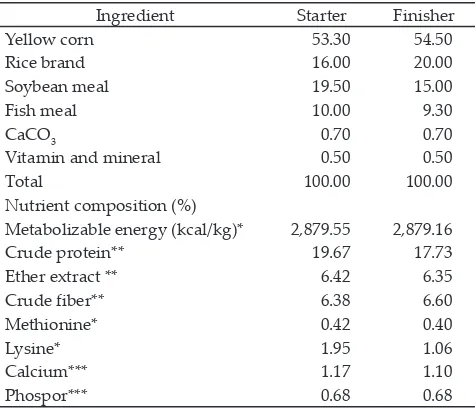
The formulation and nutritional contents of basal diet in the present study was completely similar
to those reported by Abdurrahman et al. (2016) due to the continuation of the study. Diet was formulated
with 19% protein and 2800 kcal/kg for starter period
and 18% and 2800 kcal/kg for finisherperiod. Basal diet
composed of corn, soybean meal, rice bran, fish meal,
CaCO3, mineral, and vitamin (Table 1). The treatments
were 2 levels of dahlia tuber powder combined with three levels of Lactobacillus sp. The experimental animals
were 168 birds of 3-week old crossbred local chicken
with an initial body weight was 164.45±2.97 g raised
in battery cages and provided dietary treatment until 11-week. Chickens were fed at 06:00 am and 04:00 pm every day. A small portion of diet (more or less 30 g)
containing dahlia tuber powder and Lactobacillus sp.
was given at 04:00 pm every afternoon in order to make
sure that both components were consumed totally. The other portion of diets without dahlia tuber powder and Lactobacillus sp. were provided separately to fulfill the amount of daily requirement.
The treatments were 0.8% prebiotic without
pro-biotic (D1L0); 0.8% prepro-biotic combined with 1.2 mL probiotic (D1L1); 0.8% prebiotic combined with 2.4 mL probiotic (D1L2); 1.2% prebiotic without probiotic (D2L0); 1.2% prebiotic combined with 1.2 mL probiotic (D2L1); 1.2% prebiotic combined with 2.4 mL probiotic (D2L2). Prebiotic inulin was derived from dahlia tuber
powder and probiotic was Lactobacillus sp (108 cfu/mL).
Variables observed were color, hardness, fat mass, and cholesterol content of meat.
Samples for meat color and hardness
measure-ments were cutlet of breast and drumstick meat
Table 1. Ingredients and nutrients composition of the experi-mental basal diet1) (%)
1)Same formulation as that of Abdurrahman et al. (2016) due to the con-tinuation of the study.
(skinless). All parts of the skinless carcass meat were
mixed and homogenized for fat mass and cholesterol determinations. The meat color measurements were
carried out using Chroma Meter CR200 (Minolta, Osaka,
Japan). Notation of color was characterized as Hunter
color indexes L* (lightness), a*(redness), and b* (yellow
-ness) according to the method of Zhang et al. (2012). The
meat hardness measurements were started by preparing meat samples cutlet about 1 cm3, which were easily to obtain from the selective parts of breast and drumstick meat. Testing meat texture (hardness) was performed with Lloyd Texture Analyzer TA-XT Plus (England). The hardness value was stated in gram force (gf) according
to Suryanti et al. (2015). Meat fat was analyzed using
Soxhlet Extraction method according to AOAC (2005). Meat fat mass was calculated using formula as follows: [mass of meat fat= % meat fat content x meat mass (g)]. Meat cholesterol was analyzed based on
Leibermann-Burchard method according to Fathullah et al. (2013), using a spectrophotometer at absorbance of 680 nm. Cholesterol content is expressed in mg/g sample.
Experiment was assigned in 2 x 3 factorial pattern
of completely randomized design with 4 replications.
The first factor was 2 levels of prebiotic, namely 0.8% (D1) and 1.2% (D2), whereas the second factor was 3 levels of probiotic, namely none (L0), 1.2 mL (L1), and 2.4 mL (L2). Data analysis was performed using SPSS software (Statistical Package for the Social Sciences, SPSS Inc., USA) subjected to F-test based on analysis of
variance continued to Duncan multiple range test when
the treatment indicated significant effect (P<0.05).
RESULTS
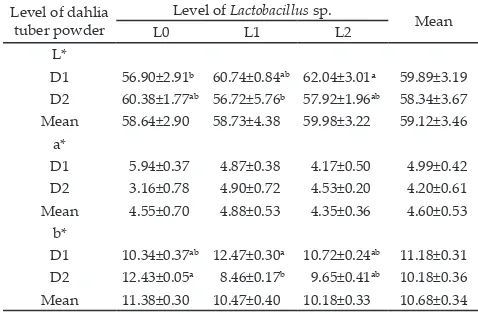
Supplementation of prebiotic combined with
probiotic showed significant effect (P<0.05) on L* (light
-ness) and b* (yellow-ness) (Table 2). The highest L* value
was found due to the combination of prebiotic at 0.8%
and probiotic at 2.4 mL (D1L2) and was significantly different from those of the combination of prebiotic at 0.8% without probiotic (D1L0) and prebiotic at 1.2% combined with probiotic at 1.2 mL (D2L1). The pres
-ent study indicated difference result between breast and drumstick meat colors. The drumstick meat color measurement based on the values of L* (lightness), a* (redness) and b* (yellowness) indicated no significant different due to the supplementation of prebiotic com
-bined with probiotic (Table 3). The supplementation of prebiotic combined with probiotic indicated no signifi
-cant difference on the hardness of either breast or drum
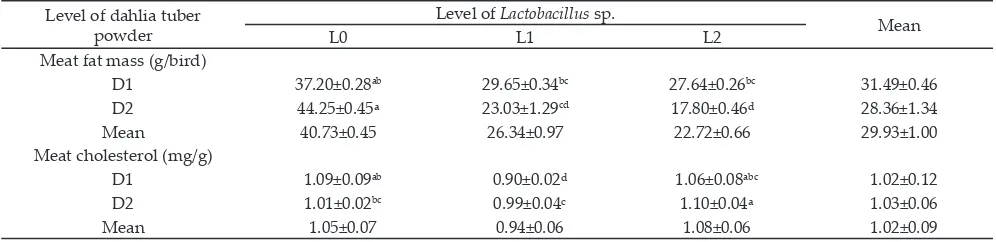
-stick meat (Table 4). However, the different case was found with meat fat mass and meat cholesterol (Table 5) that was affected by the significant interaction (P<0.05)
of supplemental prebiotic and probiotic. The highest meat fat mass was achieved by the combination of 1.2%
prebiotic without probiotic (D2L0) and significantly different to those of all treatment combinations except
for the combination of 0.8% prebiotic without
probi-otic (D1L0). On the other hand, the combination of 1.2% prebiotic and probiotic at 2.4 mL (108 cfu/mL) (D2L2) significantly showed the lowest meat fat mass except for
the treatment of 1.2% prebiotic combined with probiotic
at 1.2 mL (108 cfu/mL) (D2L1).
DISCUSSION
The L* value of breast meat of crossbred local
chicken showed a range from 56.72 to 62.04. Zhu et al.
(2012) reported that the normal L* value of broiler breast
meat was between 48 and 53. In contrast, other studies
(Battula et al., 2008; Sheard et al., 2012; Al-Owaimer et al.,
2014) have shown different results with values that were outside this range. The different value of breast meat
color found in the present study was presumably due to
Level of dahlia
D1 56.90±2.91ᵇ 60.74±0.84ab 62.04±3.01ᵃ 59.89±3.19 D2 60.38±1.77ab 56.72±5.76ᵇ 57.92±1.96ab 58.34±3.67 Mean 58.64±2.90 58.73±4.38 59.98±3.22 59.12±3.46
D1 10.34±0.37ab 12.47±0.30a 10.72±0.24ab 11.18±0.31 D2 12.43±0.05a 8.46±0.17b 9.65±0.41ab 10.18±0.36 Mean 11.38±0.30 10.47±0.40 10.18±0.33 10.68±0.34
Note: Means in the same row and column with different superscript dif-fer significantly (P<0.05). D1=supplementation of prebiotic at 0.8%; D2= supplementation of prebiotic at 1.2%; L0= no supplementa-tion of probiotic; L1= supplementasupplementa-tion of probiotic at 1.2 mL (10⁸ cfu/mL); L2= supplementation of probiotic at 2.4 mL (10⁸ cfu/mL); L*= lightness; a*= redness; b*= yellowness.
Table 2. Breast meat color of crossbred local chicken fed diet
containing prebiotic inulin derived from dahlia tuber powder combined with probiotic Lactobacillus sp.
Note: D1=supplementation of prebiotic at 0.8%; D2= supplementation of prebiotic at 1.2%; L0= no supplementation of probiotic; L1= supplementation of probiotic at 1.2 mL (10⁸ cfu/mL); L2= supple-mentation of probiotic at 2.4 mL (10⁸ cfu/mL); L*= lightness; a*= redness; b*= yellowness.
probiotic strain, source of prebiotic, and chicken strain
or genotype dependent. Feeding broiler with prebiotic
mannanoligosacharides (MOS) and probiotic based on
Lactobacillus acidophillus and casei, and Streptococcus lactis and faecium, and Bifidobacteruim bifidum (Pelicano et al.,
2005; Aristides et al., 2012) indicated no effects, but that
with Bacillus licheniformis (Liu et al., 2012) significantly increased breast meat color. The higher L* value of breastmeat of crossbred local chicken compared to that
of imported breeds was consistence with the finding of
Jaturasitha et al. (2008) that breast meat color of Thai
native chicken was higher than that of Rhode Island Red. Chicken genotype or strain was considered to be
the important factor contributing to the lightness of meat which is much more preferable for the consumers.
Indigenous-blood chickens (crossbred local chicken)
have lower fat and cholesterol contents due to the high-er muscular contraction since their active movement compared to modern breeds. The point of view concern-ing the muscular biochemical process is decribed in the following description.
The increase in L* value was assumed to be related
to myosin activity, a myofibrils protein where ATPase
enzyme production take place. Bowker et al. (2004)
reported that color of muscle depends on the type of
muscle fiber and ATPase activity. White muscle in the
carcass contains many anaerobic white muscle fibers
with high glycogen content, and has a higher ATPase activity. Jao et al. (2007) reported that myosin is a myo
-fibrils protein that responsible to the ATPase enzyme
production. The study of Abdurrahman et al. (2016) showed that the supplementation of inulin derived from dahlia tuber powder as a source of prebiotic combined with Lactobacillus sp. as a probiotic source increased the
protein mass of crossbred kampong chicken meat. In
connection with the previous studies, it can be assumed that the increased meat protein mass of crossbred local
chicken due to the supplementation of prebiotic com
-bined with probiotic followed by the increase in myosin content. Thus, the highest value of lightness breast meat found in D1L2 could be associated with the high-est meat protein mass as it was previously reported by Abdurrahman et al. (2016).
The difference of b* value of the breast meat can
be associated with antioxidant activity, because it can inhibit the oxidation of hemoglobin. Abdurrahman et al. (2016) found that the supplementation of inulin de -rived from dahlia tuber powder as a source of prebiotic combined with Lactobacillus sp. can affect antioxidant
activity in meat. This finding is consistent with a re -search conducted by Jang et al. (2008) that the change in the value of antioxidant activity measured by DPPH can
Table 4. Breast and drumstick meat hardness (gf) of crossbred local chicken fed diet containing prebiotic inulin derived from dahlia
tuber powder combined with probiotic Lactobacillus sp.
Level of dahlia tuber powder
Level of Lactobacillus sp. Mean
L0 L1 L2
Breast meat
D1 1603.87±0.07 1729.41±0.10 1494.73±0.06 1609.34±0.07
D2 1855.56±0.08 2005.25±0.20 1646.14±0.10 1835.65±0.13
Mean 1729.72±0.08 1867.33±0.15 1570.43±0.08 1722.49±0.10
Drumstick meat
D1 1734.63±0.21 2482.61±0.09 1936.34±0.14 2051.19±0.16
D2 1709.44±0.11 1563.30±0.31 1369.72±0.23 1547.49±0.22
Mean 1722.03±0.16 2022.96±0.26 1653.03±0.20 1799.34±0.20
Note: D1=supplementation of prebiotic at 0.8%; D2= supplementation of prebiotic at 1.2%; L0= no supplementation of probiotic; L1= supplementation of probiotic at 1.2 mL (10⁸ cfu/mL); L2= supplementation of probiotic at 2.4 mL (10⁸ cfu/mL); gf= gram-force.
Table 5. Fat mass and cholesterol of meat of crossbred local chicken fed diet containing prebiotic inulin derived from dahlia tuber
powder combined with probiotic Lactobacillus sp.
Note: Means in the same row and column with different superscript differ significantly (P<0.05). D1=supplementation of prebiotic at 0.8%; D2= supple-mentation of prebiotic at 1.2%; L0= no supplesupple-mentation of probiotic; L1= supplesupple-mentation of probiotic at 1.2 mL (10⁸ cfu/mL); L2= supplementa-tion of probiotic at 2.4 mL (10⁸ cfu/mL).
Level of dahlia tuber powder
Level of Lactobacillus sp. Mean
L0 L1 L2
Meat fat mass (g/bird)
D1 37.20±0.28ab 29.65±0.34bc 27.64±0.26bc 31.49±0.46
D2 44.25±0.45ᵃ 23.03±1.29cd 17.80±0.46ᵈ 28.36±1.34
Mean 40.73±0.45 26.34±0.97 22.72±0.66 29.93±1.00
Meat cholesterol (mg/g)
D1 1.09±0.09ab 0.90±0.02ᵈ 1.06±0.08abc 1.02±0.12
D2 1.01±0.02bc 0.99±0.04c 1.10±0.04ᵃ 1.03±0.06
modify the color of meat, although it was indirect based on the value of b*, by reducing the oxidation of hemo-globin and activating mechanisms that modify the dis-tribution of the pigment in animal tissues. The change in b* value in this study can be also related to the dif-ference in meat fat deposition, because meat containing more fat has higher b* value than that containing less
fat. This result was in agreement with Zhou et al (2009)
who showed that the fat content in the breast meat can
modifies the value of b*.
The difference result between breast and drumstick was assumed to be caused by the different structure and movement activities of both muscles. It is well-known that drumstick glycogen content and ATPase activities of drumstick muscle were lower than those of breast muscle. Liu & Xiong (2015) reported that drumstick muscle (red muscle) had lower glycogen content and ATPase activities than breast muscles (white muscle).
Besides meat color, hardness was an important quality indicator which determining the meat selling value to consumers and very often related to the meat
protein content. Troy & Kerry (2010) reported that
hardness was an indicator of consumer preference of acceptance on meat quality. Keeton et al. (2014) found
that the major protein components in meat were con
-nective tissue, myofibril, and sarcoplasm. As it was
reported by Abdurrahman et al. (2016) that meat protein
mass of crossbred kampong chicken was significantly
increased by feed supplemented with dahlia tuber powder combined with Lactobacillus sp. Therefore, the increase in mass of meat proteins should be followed by the increase in collagen, because it was the main protein of connective tissue which responsible for the hardness. However, in the present study, the increase in meat protein mass was not followed by the increase in collagen content, because collagen was assummed to be quite small in the total of meat protein. Although
colla-gen is the major connective tissue protein as reported by Astruc (2014), connective tissue protein comprised only
about 2% of total protein in poultry meat (Keeton et al.,
2014). Therefore, the increase in meat protein mass due to the supplementation of dahlia tuber powder com-bined with Lactobacillus sp. could not affect the concen
-tration of collagen, so that the hardness was not affected significantly by the treatments. Lepetit (2007) reported
that the increase in meat hardness can be explained by the increase in the amount of meat collagen. Similar
to the report of Maiorano et al. (2012) that the increase
in meat hardness is related to the change in collagen concentration.
Modifications of the concentration and strength of
collagen increased with the age of the birds due to the
increase in covalent cross-linking during the growth
and development of poultry muscle (Kong et al., 2008;
Petracci & Cavani, 2012). However, the present result regarding the supplemental effect of prebiotic combined with probiotic did not significantly increase the meat
hardness since the experimental bird used were at the
same age. This finding was in agreement with the report of Brzoska et al. (2010) indicated that dietary probiotic was not related to the hardness of meat.
The decrease in meat fat mass related to the change
in the composition and activity of gut microflora due to
the supplementation of dahlia tuber powder as a source of inulin combined with Lactobacillus sp. This result is in agreement with the report of Krismiyanto et al. (2014)
that the increased lactic acid bacteria (LAB) popula
-tion was due to the feeding effect of inulin derived
from dahlia tuber which can intensely fermented by
endogenous beneficial bacteria. Thus, the drecreased fat
meat content and cholesterol concentration found in the present study can be associated with the increase in bile
salt hydrolase (BSH) enzyme produced by the enhanced
growth of LAB (Fajrih et al., 2014). This biochemical
mechanism will be discussed further in the following paragraph, especially for cholesterol metabolism. The decrease in meat fat mass was consistent with some
previous reports (Al-Lahham et al., 2010; Ooi & Liong,
2010; Weitkunat et al., 2015) that the short chain fatty
acids (acetate, butyrate, propionate) produced by the fermentative effect of lactic acid bacteria on inulin were
assumed to have important contribution. Propionate,
for example, could exert controlling effect on lowering
hepatic lipogenesis, and the inhibition of lipogenesis process related to the decrease in meat fat content.
In addition, the decrease in meat fat mass can also be connected with the ability of probiotic in decreasing the activity of the lipogenic enzymes of acetyl-CoA
car-boxylase which stimulates fatty acid synthesis by pro -ducing statins as inhibitors of the hepatic lipogenesis.
This finding was supported by Yakhkeshi et al. (2012)
that the decrease in acetyl-CoA carboxylase enzyme ac-tivity could decrease the hepatic lipogenesis because the deposition of meat fat was derived from fat synthesis via hepatic lipogenesis. Cavallini et al. (2009) reported that lactic acid bacteria can produce statins, namely a substance as an inhibitors of 3-hydroxy-3-methyl-glu-tarin CoA reductase which is function as regulator en-zyme of fat biosynthesis, cholesterol, and triglycerides. This fat reduction mechanism started when the inhibitor reduced cholesterol in hepatocytes and improved the
performance of high density lipoprotein (HDL) so that it
can reduce the fat content.
The increasing number of lactic acid bacteria (LAB) as described previously can be linked to the mechanism
of cholesterol reduction in meat by bile salt hydrolase
(BSH). Bile salt hydrolase (BSH) can modify conjugated
bile salt into deconjugated bile salt which is less absorb
-able and easily dispose through excreta. Sudha et al.
(2009); Kumar et al. (2013); Rai et al. (2013) suggested
that LAB produced BSH in the duodenum could break
the C-24 amide NaCl down between bile acids and
ami-no acids, and further change it into deconjugated bile
probiotic caused the low number of beneficial bacteria
in the gut, thus the mechanism of cholesterol formation was ocurred in the absence of inhibition mechanism. This condition caused the metabolizable cholesterol
in significant amounts and providing impact on the
high cholesterol in birds given 1.2% prebiotic without
probiotic (D2L0) and also those fed 0.8% prebiotic
without probiotic (D1L0) (Table 5). However, choles
-terol level increased in the treatment of prebiotic either
0.8% or 1.2% combined with 2.4 mL probiotic (D1L2
and D2L2). Similar finding was reported by Daud et al.
(2007) that birds received probiotic and prebiotic either
independently or in combination at low level was not able to reduce meat cholesterol concentration because of
probiotic at that level was unable to produce sufficient
BSH enzyme with its activity to decrease cholesterol
level. It was also likely due to the hepatic synthesis of
endogenous cholesterol is predictably more dominant, while the disposal cholesterol from the body together with bile acids is very slight. On the contrary, intestinal cholesterol absorption increased so that the meat
choles-terol level is also getting high.
CONCLUSION
Dietary supplementation of prebiotic inulin derived from dahlia tuber at 1.2% combined with single probi-otic based on Lactobacillus sp. at 1.2 mL (108 cfu/mL) was
able to improve breast meat color and to decrease both
fat mass and cholesterol of crossbred local chicken meat.
ACKNOWLEDGEMENT
This study was funded by the Goverment of Indonesia through Directorate General of Resource for Science, Technology, and Higher Education Scholarships 2013.
REFERENCES
Abdurrahman, Z. H., Y. B. Pramono, & N. Suthama. 2016.
Feed-ing effect of inulin derived from dahlia tuber combined
with Lactobacillus sp. on meat protein mass of crossbred
kampong chicken. J. Indonesian Trop. Anim. Agric.
41:37-44. http://dx.doi.org/10.14710/jitaa.41.1.37-44
Al-Lahham, S. H., P. P. Maikel, H. Roelofsen, R. J. Vonk, & K. Venema. 2010. Biological effects of propionic acid in
humans; metabolism, potential applications and underly -ing mechanisms. Biochim. Biophys. Acta 1801:1175-1183.
http://dx.doi.org/10.1016/j.bbalip.2010.07.007
Al-Owaimer, A. N., G. M. Suliman, A. H. Alyemni, & A.
M. Abudabos. 2014. Effect of different probiotics on breast quality characteristics of broilers under Salmonella challenge. Ital. J. Anim. Sci. 13:450-454. http://dx.doi.
org/10.4081/ijas.2014.3189
AOAC. 2005. Official Methods of Analysis of AOAC Interna -tional. 18th Ed. Assoc. Official Anal. Chem., Arlington.
Aristides, L. G. A., F. G. Paiao, L. S. Murate, A. Oba, & M. Shimokomaki. 2012. The effects of biotic additives on
growth performance and meat qualities in broiler chick -ens. Int. J. Poult. Sci. 11:599-604. http://dx.doi.org/10.3923/
ijps.2012.599.604
Astruc, T.. 2014. Carcass Composition, Muscle Structure, and
Contraction. In: M. Dikeman & C. Devine (Eds). Encyclo
-pedia of Meat Sciences 2nd Ed. Academic Press, London.
pp. 148-166. http://dx.doi.org/10.1016/B978-0-12-384731-7.00099-4
Badan Standarisasi Nasional. 2006. Pakan anak ayam ras ped
-aging (ayam broiler starter) (Starter broiler feed). Standar Nasional Indonesia (SNI) 01-3930-2006.
Battula, V., M. W. Schilling, Y. Vizzier-Thaxton, J. M. Beh
-rends, J. B. Williams, & T. B. Schmidt. 2008. The effects
of low-atmosphere stunning and deboning time on broiler breast meat quality. Poult. Sci. 87:1202-1210. http://dx.doi. org/10.3382/ps.2007-00454
Bowker, B. C., A. L. Grant, D. R. Swartz, & D. E. Gerrard.
2004. Myosin heavy chain isoforms influence myofibrillar
ATPase activity under simulated postmortem pH, calcium,
and temperature conditions. Meat Sci. 67:139-147. http:// dx.doi.org/10.1016/j.meatsci.2003.09.016
Brzoska, F., M. Pieszka, K. Stecka, W. Migdal, E. Wesierska, M.
Walczycka, K. Krzysztoforski, & O. Michalik-Rutkows -ka. 2010. Effect of Pediococcus spp. in feed instead of
anti-biotic on broiler chicken body weight, mortality, slaughter
traits and meat quality. Ann. Anim. Sci. 10:167–177. Cavallini, D. C., R. Bedani, L. Q. Bomdespacho, R. C.
Vendr-amini, & E. A. Rossi. 2009. Effects of probiotic bacteria,
isoflavones and simvastatin on lipid profile and athero -sclerosis in cholesterol-fed rabbits: a randomized dou-ble-blind study. Lipids Health Dis. 8:1-8. http://dx.doi. org/10.1186/1476-511X-8-1
Daud, M., W. G. Piliang, & I. P. Kompiang. 2007. Persentase
dan kualitas karkas ayam pedaging yang diberi probio
-tik dan prebio-tik dalam ransum. (Carcass percentage and
quality of broilers given ration containing probiotic and
prebiotic). Indonesian J. Anim. Vet. Sci. 12:167-174. (Ab -stract in English).
Fajrih, N., N. Suthama, & V. D. Yunianto. 2014. Body resistance
and productive performance of crossbred local chicken fed inulin of dahlia tubers. Med. Pet. 37:108–144. http://dx.doi.
org/10.5398/medpet.2014.37.2.108
Fathullah., N. Iriyanti, & I. H. Sulistiyawan. 2013. Penggunaan
pakan fungsional dalam ransum terhadap bobot lemak ab
-domen dan kadar kolesterol daging ayam broiler (The use
of functional feed on the weight of abdominal fat and
cho-lesterol level in broiler chicken meat). J. Ilmiah Pet. 1:119-128. (Abstract in English).
Finamore, A., I. Peluso, & M. Serafini. 2016. Synbiotics: A New Strategy to Improve the Immune System from the Gut to
Peripheral Sites. In: R. R. Watson & V. R. Preedy (Eds).
Probiotics, Prebiotics, and Synbiotics: Bioactive Foods in Health Promotion. Academic Press, London. p. 567-574.
http://dx.doi.org/10.1016/B978-0-12-802189-7.00041-1
Hill, C., F. Guarner, G. Reid, G. R. Gibson, D. J. Merenstein, B. Pot, L. Morelli, R. B. Canani, H. J. Flint, S. Salminen, P. C. Calder, & M. E. Sanders. 2014. Expert consensus
docu-ment: The International Scientific Association for probiot -ics and prebiot-ics consensus statement on the scope and appropriate use of the term probiotic. Nat. Rev. Gastro-enterol. Hepatol. 11:506–514. http://dx.doi.org/10.1038/ nrgastro.2014.66
Hutkins, R. W., J. A. Krumbeck, L. B. Bindels, P. D. Cani, G.
Fahey, Y. J. Goh, B. Hamaker, E. C. Martens, D. A Mills,
R. A. Rasta, E. Vaughan, & M. E. Sanders. 2016.
Prebiot-ics: why definition matter. Curr. Opin. Biotechnol. 37:1-7. http://dx.doi.org/10.1016/j.copbio.2015.09.001
Jang, A., X. D. Liu, M. H. Shin, B. D. Lee, S. K. Lee, J. H Lee, & C. Jo. 2008. Antioxidative potential of raw breast meat
from broiler chicks fed a dietary medicinal herb extract
mix. Poult. Sci. 87:2382-2389. http://dx.doi.org/10.3382/ ps.2007-00506
in-duced by high hydrostatic pressure. Food Chem. 101:65-69. http://dx.doi.org/10.1016/j.foodchem.2005.11.051 Jaturasitha, S., T. Srikanchai, M. Kreuzer, & M. Wicke. 2008.
Differences in carcass and meat characteristics between chicken indigenous to northern Thailand (Black-boned and Thai native) and imported extensive breeds (Bresse
and Rhode Island Red). Poult. Sci. 87:160-169. http:// dx.doi.org/10.3382/ps.2006-00398
Keeton, J. T., S. M. Ellerbeck, & M. T. Nunez de Gonzalez.
2014. Chemical and Physical Characteristics Of Meat: Chemical Composition. In: M. Dikeman & C. Devine (Eds). Encyclopedia of Meat Sciences 2nd Ed. Academic Press,
London. p. 235-243. http://dx.doi.org/10.1016/B978-0-12-384731-7.00087-8
Kong, F., J. Tang, M. Lin, & B. Rasco. 2008. Thermal effects on
chicken and salmon muscles: Tenderness, cook loss, area shrinkage, collagen solubility and microstructure.
LWT-food Sci. Tech. 41:1210-1222. http://dx.doi.org/10.1016/j. lwt.2007.07.020
Krismiyanto, L., N. Suthama, & H. I. Wahyuni. 2014. Feeding
effect of inulin derived from Dahlia variabilis tuber on
intes-tinal microbes in starter period of crossbred native chick -ens. J. Indonesian Trop. Anim. Agric. 39:217-233. http://
dx.doi.org/10.14710/jitaa.39.4.217-223
Kumar, R., H. Rajkumar, M. Kumar, S. R. Varikuti, R. Athi-mamula, M. Shujauddin, R. Ramagoni, & N. Kondapalli.
2013. Molecular cloning, characterization and heterolo
-gous expression of bile salt hydrolase (BSH) from Lacto-bacillus fermentum NCDO394. Mol. Biol. Rep. 40:5057-5066. http://dx.doi.org/10.1007/s11033-013-2607-2
Lepetit, J. 2007. A theoretical approach of the relationships
be-tween collagen content, collagen cross-links and meat ten
-derness. Meat Sci. 76:147-159. http://dx.doi.org/10.1016/j.
meatsci.2006.10.027
Liu, X., H. Yan, L. Lv, Q. Xu, C. Yin, K. Zhang, P. Wang, & J. Hu. 2012. Growth performance and meat quality of broiler
chickens supplemented with Bacillus licheniformis in drink -ing water. Asian-Aust. J. Anim. Sci. 25:682-689. http://
dx.doi.org/10.5713/ajas.2011.11334
Liu, C. & Y. L. Xiong. 2015. Oxidation-initiated myosin
subfrag-ment cross-linking and structural instability differences between white and red muscle fiber types. J. Food Sci.
80:288-297. http://dx.doi.org/10.1111/1750-3841.12749 Ma’rifah, B., U. Atmomarsono, & N. Suthama. 2013. Nitrogen
retention and productive performance of crossbred native
chicken due to feeding effect of kayambang (Salvinia mo-lesta). Int. J. Sci. Eng. 5:19-24. http://dx.doi.org/10.12777/
ijse.5.1.19-24
Maiorano, G., A. Sobolewska, D. Cianciullo, K. Walasik, G. Elminowska-Wenda, A. Sławinska, S. Tavaniello, J. Zy -linska, J. Bardowski, & M. Bednarczyk. 2012. Influence of in ovo prebiotic and synbiotic administration on meat
quality of broiler chickens. Poult. Sci. 91:2963-2969. http://
dx.doi.org/10.3382/ps.2012-02208
Mountzouris, K. C., P. Tsitrsikos, I. Palamidi, A. Arvaniti, M.
Mohnl, G. Schatzmayr, & K. Fegeros. 2010. Effects of pro -biotic inclusion levels in broiler nutrition on growth per-formance, nutrient digestibility, plasma
immunoglobu-lins, and cecal microflora composition. Poult. Sci. 89:58-67. http://dx.doi.org/10.3382/ps.2009-00308
National Research Council. 1994. Nutrient Requirements of Poultry. 9th Revised Ed. National Academy Press. Wash
-ington DC.
Ooi, L. G. & M. T. Liong. 2010. Cholesterol-lowering effects of
probiotics and prebiotics: A review of in vivo and in
vi-tro findings. Int. J. Mol. Sci. 11:2499-2522. http://dx.doi. org/10.3390/ijms11062499
Pelicano, E. R. L., P. A. Souza, H. B. A. Souza, A. Oba, M. M. Boiago, N. M. B. L. Zeola, A. M. Scatolini, V. A. Bertanha, & T. M. A. Lima. 2005. Carcass and cut yield and meat qualitative traits of broilers fed diets containing probiotics and prebiotics. Braz. J. Poult. Sci. 7:169-175. http://dx.doi. org/10.1590/s1516-635x2005000300006
Petracci, M. & C. Cavani. 2012. Muscle growth and poultry meat quality issues. Nutr. 4:1-12.
Pourabedin, M. & X. Zhao. 2015. Prebiotics and gut
microbi-ota in chickens. FEMS Microbiol. Lett. 362:fnv122. http://
dx.doi.org/10.1093/femsle/fnv122
Rai, A. K., P. Debetto, & F. D. Sala. 2013. Molecular regula -tion of cholesterol metabolism: HDL-based interven-tion through drugs and diet. Indian J. Exp. Biol. 51:885-894. Saeed, M., I. Yasmin, I. Pasha, M. A. Randhawa, M. I. Khan, M.
A. Shabbir, & W. A. Khan. 2015. Potential application of
inulin in food industry: A review. Pak. J. Food Sci.
25:110-116.
Sheard, P. R., S. I. Hughes, & M. H. Jaspal. 2012. Colour, pH
and weight changes of PSE, normal and DFD breast fillets
from British broilers treated with a phosphate-free, low salt marinade. Br. Poult. Sci. 53:57-65. http://dx.doi.org/10. 1080/00071668.2012.655707
Sudha, M. R., P. Chauhan, K. Dixit, S. Babu, & K. Jamil. 2009. Probiotics as complementary therapy for
hypercholester-olemia. Biol. Med. 1:1-13.
Suryanti, U., V. P. Bintoro, U. Atmomarsono, & Y. B. Pramono.
2015. Physical characteristics of culled magelang duck meat affected by aging and marination in ginger extract.
J. Indonesian Trop. Anim. Agric. 40:107-114. http://dx.doi.
org/10.14710/jitaa.40.2.107-114
Troy, D. J. & J. P. Kerry. 2010. Consumer perception and the
role of science in the meat industry. Meat Sci. 86:214-226. http://dx.doi.org/10.1016/j.meatsci.2010.05.009
Weitkunat, K., S. Schumann, K. J. Petzke, M. Blaut, G. Loh,
& S. Klaus. 2015. Effects of dietary inulin on bacterial
growth, short-chain fatty acid production and hepatic lip -id metabolism in gnotobiotic mice. J. Nut. Biochem. 26:929-937. http://dx.doi.org/10.1016/j.jnutbio.2015.03.010 Yakhkeshi, S., S. Rahimi, & H. R. H. Matin. 2012. Effects of
yarrow (Achillea millefolium L.), antibiotic and probiotic on performance, immune response, serum lipids and micro-bial population of broilers. J. Agr. Sci. Tech. 14:799-810. Zhang, Z. F., T. X. Zhou, X. Ao, & I. H. Kim. 2012. Effects of
β-glucan and Bacillus subtilis on growth performance,
blood profiles, relative organ weight and meat quality in
broilers fed maize-soybean meal based diets. Livest. Sci. 150:419-424. http://dx.doi.org/10.1016/j.livsci.2012.10.003 Zhou, T. X., Y. J. Chen, J. S. Yoo, Y. Huang, J. H. Lee, H. D. Jang,
S. O. Shin, H. J. Kim, J. H. Cho, & I. H. Kim. 2009. Effects
of chitooligosaccharide supplementation on performance, blood characteristics, relative organ weight, and meat
quality in broiler chickens. Poult. Sci. 88:593-600. http://
dx.doi.org/10.3382/ps.2008-00285
Zhu, X. S., X. L. Xu, H. H. Min, & G. H. Zhou. 2012.
Occur-rence and characterization of pale, soft, exudative-like
broiler muscle commercially produced in China. J. In-tegr. Agric. 11:1384-1390.