Emil Olteanu, Ioan Ileană-Dictionaries used in an application of aiding in international commercial correspondence translation
337
DICTIONARIES USED IN AN APPLICATION OF
AIDING IN INTERNATIONAL
COMMERCIAL CORRESPONDENCE TRANSLATION
by
Emil Olteanu, Ioan Ileană
Abstract. An application of aiding in international commercial correspondence translation has needed no end of databases and dictionaries. This paper introduces the application dictionaries and the specific problems.
a. The polyglot dictionary
When a polyglot dictionary is drawn up, problems that do not exist when bilingual dictionaries are drawn up occur. These problems are connected with the existence of synonyms and homonyms. If we start with a word for which we want to find the translation in several languages, the following situation may occur: the word may have several synonyms which do not all have an identical meaning or several series of synonyms may be derived from this - synonyms that are different among them.
An example that can show the complexity of the problem is the word "house". It has several synonyms: residence, home, building, house, family, household, dynasty, marriage etc. Other synonymous series derive from the word "house" and they are represented by the words: Lord's House, pawnshop, madhouse, health establishment, house of culture, brothel. These series have in turn their synonyms.
Every synonym can in turn have homonyms. For instance, the word "house" has the following homonyms:
- building where man lives, household;
- marriage;
- cabinet or iron case for money and valuables.
The word "home", the synonym of the word "house", has, in turn, a lot of homonyms:
- hearth;
- chimney;
- parental roof;
- name given to several institutions with social-cultural character.
The word "residence", the synonym of the word "house", has, in turn, homonyms:
- building;
Emil Olteanu, Ioan Ileană-Dictionaries used in an application of aiding in international commercial correspondence translation
338
The situation becomes more complicated because every synonym and every homonym may have different translations in the other languages.
But this is not enough. The corresponding translations may have in turn different synonyms and homonyms in every language. This may lead to the situation in which a Romanian word may have a correspondent in the other languages, let us say, for instance, in French and German, (but the two words may not have the same meaning.)
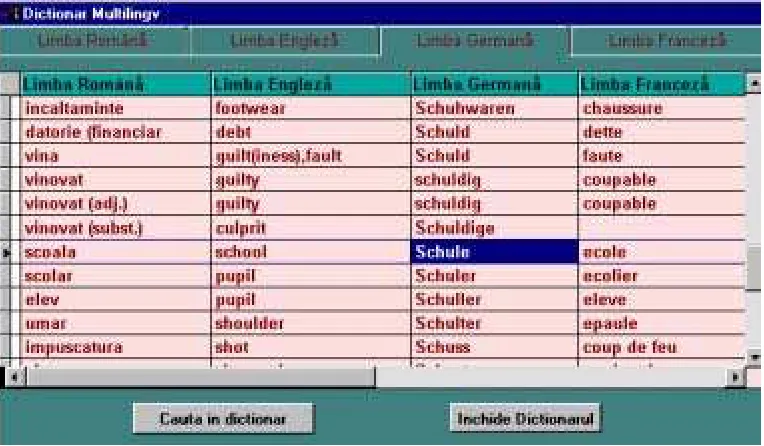
Figure 1. An instance of polyglot dictionary employment for German translation (the word selected is Schule).
Emil Olteanu, Ioan Ileană-Dictionaries used in an application of aiding in international commercial correspondence translation
339
Italian, Danish, Hungarian, Russian, Bulgarian, Yugoslavian, Czech-Slovakian, Polish, Greek and Turkish. This dictionary contains 2070 words for each language.
A polyglot dictionary (produced by the author) in four languages: Romanian, English, German and French has been used in test. This dictionary contains 4*4200 words obtained by consulting several dictionaries, and it is introduced in the computer memory as a database and can be sorted according to each language we want from the four ones above-mentioned.
Figure 2. The dictionaries of phrases.
b. Specialized dictionaries
Emil Olteanu, Ioan Ileană-Dictionaries used in an application of aiding in international commercial correspondence translation
340
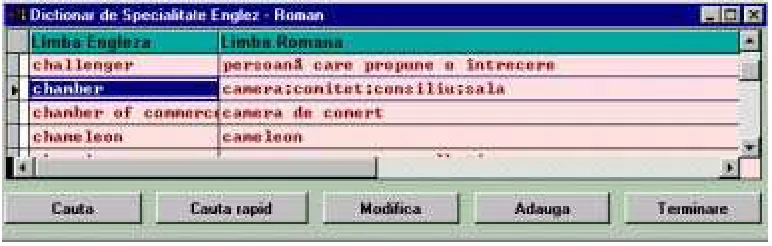
provided for in the test. A bilingual specialized dictionary (English-Romanian) with more than 30.000 terms (items, notions) has been produced in the tested application.
Figure 3. A specialized dictionary
c. Dictionaries of synonyms
A dictionary of synonyms is necessary for a program of assisted correspondence translation because there are situations in which words must be very carefully chosen, as it is well-known that there are words which have close meanings, but not identical ones.
That is why a database with synonyms is necessary for the program of assisted translation. This problem is not at all easy because a dictionary of synonyms should be available for each language from the polyglot dictionary.
References
[1] Bott Edd: Utilizare Microsoft Office 2000, Ed. Teora, 1999, pag. 1-115.
[2] Knuth, D.E. – Arta programării calculatoarelor – vol.1. Algoritmi fundamentali, Editura TEORA, Bucureşti, 1999, pag. 19-25, pag. 27-40, pag. 42-48, pag. 53-80, pag. 86-94, pag. 97-103, pag. 106-129, pag. 231-239.
[3] Lungu, I. ş.c. – BAZE DE DATE. Organizare, proiectare şi implementare – Editura ALL Educaţional, Bucureşti, 1995, pag. 1-22.
[4] Microsoft ®: Curs rapid de Microsoft Office 2000, Ed. Teora,1999.
[5] Miloşescu, M. - Tehnologia informaţiei. Informatică, tehnologii asistate de calculator - Editura TEORA, Bucureşti, 2001, pag. 238-259.
[6] Niţchi, Ş., Racoviţan, D. ş.a.- Bazele prelucrării informaţiilor şi Tehnologie informaţională – Editura Intelvredo, Deva, 1996, pag. 9-78, pag. 111- 132, pag. 225-243, pag. 312-321.