Recent Decisions in
Technologies for
Sustainable Development
Recent Decisions in
Technologies for Sustainable
Development
Selected, peer reviewed papers from the
3
rdInternational Conference on
Sustainable Technology Development
(ICSTD 2014),
October 30-31, 2014, Bali, Indonesia
Edited by
A. Ghurri, N.P.G. Suardana, N. N. Pujianiki,
I. N. Arya Thanaya, A.A. Diah Parami Dewi,
I. N. Budiarsa, I. W. Widhiada,
Copyright2015 Trans Tech Publications Ltd, Switzerland
All rights reserved. No part of the contents of this publication may be reproduced or transmitted in any form or by any means without the written permission of the
publisher.
Trans Tech Publications Ltd Churerstrasse 20
CH-8808 Pfaffikon Switzerland
http://www.ttp.net
Volume 776 of
Applied Mechanics and Materials ISSN print 1660-9336
ISSN cd 1660-9336 ISSN web 1662-7482
Full text available online athttp://www.scientific.net
Distributedworldwide by and in the Americas by
Trans Tech Publications Ltd Trans Tech Publications Inc.
Churerstrasse 20 PO Box 699, May Street
CH-8808 Pfaffikon Enfield, NH 03748
Switzerland USA
Phone: +1 (603) 632-7377
Fax: +41 (44) 922 10 33 Fax: +1 (603) 632-5611
Preface
This volume was selected from papers presented at the 3rd International Conference on Sustainable Technology Development (ICSTD Bali 2014), which have been held in Udayana University Bali during October 30-31, 2014. The conference was organized by Faculty of Engineering, University of Udayana Bali Indonesia. This conference covered wide range of engineering issues toward the achievement of sustainablility.
In order to meet high standard of Applied Mechanics and Materials, the organization committee has made their efforts to do the following things. Firstly, all submitted papers have been reviewed by 2 anonymous expert reviewers, poor quality papers have been rejected after reviewing. Secondly, periodically review meetings have been held around the reviewers about three times for exchanging reviewing suggestions. Finally, the conference organization had several preliminary sessions before the conference. Through efforts of the scientific committee and Editors team, the volume will be the best collected papers.
We would like to thank the Faculty of Engineering, University of Udayana, the member of organizing and scientific committees, and also to TTP publisher.
Table of Contents
Preface
Chapter 1: Technologies of Sustainable Development in Civil
Engineering, Transportation and Urban Planning
Sustainable Development of Concrete Using GGBS: Effect of Curing Temperatures on the Strength Development of Concrete
G. Turu'allo 3
Properties of Sand Sheet Asphalt Mixture Incorporating Waste Plastic
I.N.A. Thanaya, I.G.R. Purbanto and I.G. Wikarga 9 Asphalt Pavement Temperature Profile for Tropical Climate in Indonesia
I.M.A. Ariawan, B.S. Subagio and B.H. Setiadji 17 The Development of Slurry Seal Design with Ordinary Portland Cement Replacement by
Low Calcium Fly Ash
A. Setyawan, D. Sarwono and M.S. Adnan 24
The Structural Properties Assessment of Thin Hot Mixture Asphalt for Pavement Preservation
A. Setyawan, A.H. Mustafa Elshawesh and S. As'ad 30 Mechanical Strength of Hydraulic Binder Made by Blending Type I Portland Cement and
Pozzolan
I.M.A.K. Salain 36
Laboratory Tests on Failure of Retaining Walls Caused by Sinusoidal Load
A.M. Hidayati, R.W. Sri Prabandiyani and I.W. Redana 41 Deformation Behavior of Concrete due to the Influence of the Steel Ring Width Variations
as the External Confinement
E. Safitri, I. Imran, Nuroji and S. Asa'ad 47
Evaluation of High Grade Recycled Coarse Aggregate Concrete Quality Using Non-Destructive Testing Technique
N.N. Kencanawati, J. Fajrin, B. Anshari, Akmaluddin and M. Shigeishi 53 Experimental and Theoretical Investigation of Bolted Bamboo Joints without Void Filled
Material
G.M. Oka, A. Triwiyono, A. Awaludin and S. Siswosukarto 59 The Significant Importance to Measure Road Safety
S.A. Caroline 66
Accessibility to Location of Activities in Denpasar City, Bali-Indonesia
P.A. Suthanaya 74
Travel Time Estimation Based on Spot Speed with Instantaneous and Time Slice Model
A.M.H. Mahmudah, A. Budiarto and S.J. Legowo 80 Port Location Selection Model: Case Study of Tourism Sector in Bali
R.M.N. Budiartha, T. Achmadi and D. Manfaat 87
Determining Passenger Car Equivalent for Motorcycle at Mid-Block of Sesetan Road
I.G.R. Purbanto 95
Readiness Criteria: Indonesias New Initiative to Ensure Sustainable Development Program
A. Merthayasa 101
Conceptual Framework of Bidding Strategy in Order to Improve Construction Project Performance
I.N.Y. Astana, H.A. Rusdi and M.A. Wibowo 108
The Conceptual Framework of Design Change Effects in Some Project Delivery Systems
A.A.G.A. Yana, H.A. Rusdi and M.A. Wibowo 114
An Identification of Construction Project Overheads for Sustainable Cost Management and Controlling Practices (CMCPs)
N.M. Jaya and A. Frederika 121
Risk Analyses for Riau Regional Water Supply Projects (SPAM), Indonesia
b Recent Decisions in Technologies for Sustainable Development
S. Purnawan, I.W. Sukania and L. Widodo
Chapter 2: Materials and Technologies for a Sustainable Development
169
The Property and Applicability to Auto Industry of Natural Fiber Reinforced Composites
R.H. Hu, Z.G. Ma, S. Zheng, C.L. Zheng and A.J. Jiang 179 Fracture Parameters of Short Carbon Fiber Reinforced Polycarbonate Composite
Fabricated by Injection Molding Process
M.G. Hwang, G.H. Kim, H.J. Park, Y.G. Lee, C.M. Yang, J.K. Lim and H.Y. Kang 186 Effect of Polar Extract of Cocoa Peels Inhibitor on Mechanical Properties and
Microstructure of Mild Steel Exposed in Hydrocloric Acid
Gunawarman, Y. Yetri, Emriadi, N. Jamarun, Ken-Cho, M. Nakai and M. Niinomi 193 Hardness Distribution and Effective Case Depth of Low Carbon Steel after Pack
Carburizing Process under Different Carburizer
D.N.K.P. Negara, I.D.M.K. Muku, I.K.G. Sugita, I.M. Astika, I.W. Mustika and D.G.R. Prasetya 201 The Effect of Solidification on Acoustical of Tin Bronze 20Sn Alloy
I.K.G. Sugita and I.G.N. Priambadi 208
Morphological Analyses and Crystalline Structures of Anodic TiO2Thin Film on Ti6Al4V
Alloy Using Phosphate and Calcium Containing Electrolyte under Different Voltage and Calcium Molarity
I.N.G. Antara, K.I.M. Gatot, I.M. Budiana and D.K. Choi 215 Determination of Optimal Clinker Factor in Cement Production by Chemical Grinding
Aids Addition
T. Eryanto and E. Amrina 223
Wear of Carbon Steel (0.65%C) in Rolling-Sliding Contact with Creep Ratio
M. Widiyarta, T.G.T. Nindhia and H. Mudiastrawan 229 Hardness Prediction Based on P-h Curves and Inverse Material Parameters Estimation
I.N. Budiarsa 233
The Influence of Austenisation Temperature and Holding Time on Mechanical Properties, Scale Thickness, and Microstructure in Alloy Steel
A. Aziz, M. Hidayat and I. Hardiyanti 239
Hardness, Density and Porosity of Al/(SiCw+Al2O3p) Composite by Powder Metallurgy
Process without and with Sintering
K. Suarsana and R. Soenoko 246
Development of Fiberglass Woven Roving Composite as an Alternative Material for the Hull of Fishing Boat
Winarto, W. Eddy, R. Liza and H. Syamsul 253
Tensile Strength of Banana Fiber Reinforced Epoxy Composites Materials
A.P. Irawan and I.W. Sukania 260
Green Composites Based on Recycled Plastic Reinforced Local Sisal Fibers
N.P.G. Suardana, N.M. Suaniti and I.P. Lokantara 264 Cement Bonded Sol-Gel TiO2Powder Photocatalysis for Phenol Removal
N. Hafizah and I. Sopyan 271
Modeling Discharge of the Bangga Watershed under Climate Change
I.W. Sutapa, M. Bisri, Rispiningtati and L. Montarcih 133 Water Resources Management of Subak Irrigation System in Bali
I.N. Norken, I.K. Suputra and I.G.N.K. Arsana 139 Study of the Evolution of Sanur Beach Nourishment Project for Beach Enhancement
I.G.B.S. Dharma and S.S. Efendi 145
Numerical Simulation of Breaking Waves in a Wave Group by SPH
N.N. Pujianiki 151
The Study on Bore Piles Foundation of the Reinforced Concrete Arch Bridge Beams of Tukad Pekerisan and Tukad Penet
I.N. Sutarja and I.W. Wayan Redana 157
The Importance of the Physical Boundary Line onBali Coastal Tourist Resorts
A. Rajendra, N. Temple and R. Nicholls 163
I.N.S. Winaya, R.S. Hartati, I.P. Lokantara, I.G. Subawa and I.M.A. Putrawan
Chapter 3: Advanced Decisions in Mechanical Engineering
300
Magnetic Camera and its Applications in Aging Aircraft, Express Train and Pipelines for Green Technology
J.Y. Lee and J.M. Kim 309
Buckling Analysis on Pechiko Field of Fixed Offshore Platform in Makassar Strait
M.Z.M. Alie, Y.R. Palentek and D.G. Sesa 313
Simulation of a Differential-Drive Wheeled Mobile Lego Robot Mindstorms NXT
I.W. Widhiada, C.G.I. Partha and Y.A.P. Wayan Reza 319 Design and Simulation of Five Fingers Gripper for Dexterous Pick-Up Various of
Components
I.W. Widhiada, E. Pitowarno, C.G.I. Partha and Y.A.P. Wayan Reza 325 Tar Balls Collector for Mechanical Recovery in Combating Oil Spill on the Marine
Environment
C.P. Mahandari, M. Yamin and D.S.A. Asandi 331
Three Wheel Bike as Physical Therapy Equipment for Post-Stroke Patient
I.M.L. Batan, Rodika and M. Riva'i 337
Geometric Progression Application in Design Transmission Gear Ratio
A.A.I.A.S. Komaladewi, I.G.A.K. Suriadi and I.K.A. Atmika 343 Role of Risk Management in Effective Maintenance
H.A. Yuniarto and P.F. Paristiawati 349
Redesign Combustion Air Shelter of the Furnace to Improve the Performance in Melting Bronze for Manufacturing Gamelan
I.G.N. Priambadi, I.K.G. Sugita, A.A.I.A.S. Komaladewi, K. Astawa and I.W.B. Adnyana 355 Model of Carbon Dioxide (CO2) Emission from Motorcycle to the Manufactures, Engine
Displacement, Service Life and Travel Speed
A.M. Mulyadi and S. Gunarta 361
Experimental Study of Heat Transfer Characteristics of Condensed Flow on the Vertical Wave Plates
W.H. Piarah and Z. Djafar 371
Forces Analysis on a Spherical Shaped Delivery Valve of Hydram Pump
M. Suarda 377
The Influence of Distance Variation between Rings with Sloping Position on the Cylinder Surface to Drag Coefficient
S.P.G.G. Tista, A. Ghurri and H. Wijaksana 384
Auto PID Tuning of Speed Control of DC Motor Using Particle Swarm Optimization Based on FPGA
H. Tayara, D.J. Lee and K.T. Chong 390
Mobile Robot Motion Planning to Avoid Obstacle Using Modified Ant Colony Optimization
N. Habib, A. Soeprijanto, D. Purwanto and M.H. Purnomo 396 Mobile Robot Motion Control Using Laguerre-Based Model Predictive Control
M. Chipofya, D.J. Lee and K.T. Chong 403
Chapter 4: Application of Alternative Energy and Information
Technologies
Applied Mechanics and Materials Vol. 776 c
Review on Zn-Based Alloys as Potential Biodegradable Medical Devices Materials
M.S. Dambatta, D. Kurniawan, S. Izman, B. Yahaya and H. Hermawan 277 Bone Implant Materials from Eggshell Waste
I. Sopyan 282
Boiling Phenomenon of Tabulate Biomaterial Wick Heat Pipe
W.N. Septiadi and N. Putra 289
Fluidization Characteristic of Sewage Sludge Particles
d Recent Decisions in Technologies for Sustainable Development
Experimental Investigation of Micro-Hydro Waterwheel Models to Determine Optimal Efficiency
L. Jasa, A. Priyadi and M.H. Purnomo 413
Understanding Peak Average Power Ratio in VFFT-OFDM Systems
N.M.A.E.D. Wirastuti 419
Fusing Multiple Inexpensive GPS Heading Data via Fuzzified Ad-Hoc Weighing
F.P. Vista IV, D.J. Lee and K.T. Chong 425
Tree Data Structure Implementation in Android Base System of E-Ulambebantenan
A.A.K.O. Sudana and A.A.G. Brampramana Putra 431 Design and Implementation of Web-Based Geographic Information Systems on Mapping
Hindu s Temple
N. Piarsa and K. Adi Purnawan 437
Improving Biogas Quality through Circulated Water Scrubbing Method
H.S. Tira, Y.A. Padang, Mirmanto and Hendriono 443 Study on Solar Generating Apparatus for Solving Problem of Shadow
J.W. Chang, S.S. Kim, J.K. Lim and J.J. Lee 449 An Experimental Study on the Thickness of Stainless Steel as an Electrode in Alkaline Fuel
Cell
M. Sucipta, I.M. Suardamana, I.K.G. Sugita, M. Suarda and K. Astawa 455 Transient Thermal Efficiency of Natural Hybrid Dryer System on Chimney Height
Variation of Exhaust Moist Air
Applied Mechanics and Materials Vol 776 (2015) pp 355-360 Submitted: 2015-02-19
© (2015) Trans Tech Publications, Switzerland Accepted: 2015-04-10
doi:10.4028/www.scientific.net/AMM.776.355
Redesign combustion air shelter of the furnace to improve the
performance in melting bronze for manufacturing gamelan
I.G.N. Priambadi
1,a, I Ketut Gede Sugita
2,b, AAIA.Sri Komaladewi
3,c,
Ketut Astawa
4,d, I Wayan Bandem Adnyana
5,e1,2,3,4,5Department of Mechanical Engineering Faculty of Engineering Udayana University a[email protected], b[email protected],c[email protected],
d[email protected],e[email protected]5
Keywords:Gamelan, furnace, pollutants, injectors
Abstract. Gamelan Bali is a set of Balinese traditional musical instruments used to accompany a series of cultural and religious ceremonies or performances. The existence of gamelan has been famous to foreign countries. Therefore, gamelan is not only produced for national orders but also for international orders. Almost 75% of gamelan production process is done using traditional method, namely: smelting, forging, grinding (Sruti) to get the basic tone, and assembly. Smelting process uses traditional furnace, where combustion air is blown from the blower through the injector into the combustion chamber of melting furnace. Open model furnace is used so that the heat generated in the combustion of the fuel is not perfect and it consumes more fuel. This condition, of course, impacts on pollutant factors produced in the combustion process and production cost that is relatively high. To minimize that problem, a change in the combustion air shelters form is done. The use of this method in the smelting process is expected to reduce the production cost, especially in fuel use and to reduce pollutants produced in the combustion process. Studies have shown that the application of the above method reduces the fuel consumption up to 20%. The decrease in the fuel consumption due to the fuel (charcoal) is wrapped by more air, thus it makes the fuel combustion process work better.
Introduction
Bronze alloy smelting process in the manufacture of gamelan is an activity that determines the quality of the resulting gamelan. This activity starts by manufacturing a composition consists of copper (Cu) and tin (Sn). Gamelan craftsmen in this study usually make the alloy composition of 80% Cu and 20% Sn. Based on that composition the surface hardness was VHN 29.33 [1]. Bronze material that has been smelted will be printed using an open mold according to the shape of the gamelan instruments that is intended to be made. Wrought aims to condense the microstructure of the bronze material. After the forging process, then the grinding process is performed to obtain the basic tone. In the smelting process many obstacles were faced by artisans, such as smelting process that takes a long time, the high consumption of fuel, and the dust flying in the workplace that is quite disturbing. The research was done by redesigning the air reservoir so that the constraints faced by the artisans can be reduced. Of course, redesign is not done to reduce the mechanical strength of the alloy material that is being melted. This research shows that the melting time did not significantly alter the mechanical properties of the material [2,3].
Research Methodology Form of Furnace Design
356 Recent Decisions in Technologies for Sustainable Development
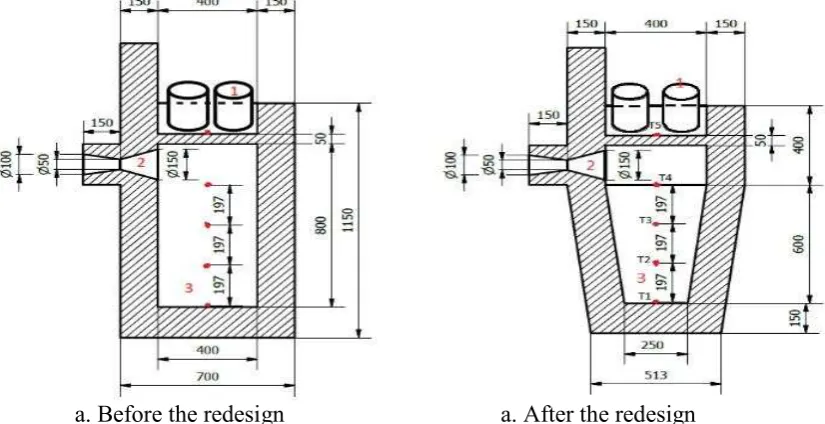
is a shelter of the combustion air that flows through the air blower that is located under the ground surface. The volume of combustion air shelter, a bronze alloy capacity, fuel capacity before and after having the same volume. The fuel is wood charcoal (biomass). The capacity of the alloy bronze bowl is 1.25 kg / bowl, the study used the 6 fruit bowl.
a. Before the redesign a. After the redesign
Figure 1 Shape furnace Specification:
1 = cup holder in the furnace mouth
2 = injector combustion air from the blower 3 = shelter combustion air
Red dots are the placement of the thermocouple probes to measure air temperature in the air storage space. 4 channel thermocouples which were used in this study were equipped with a data acquisition that has the capability of data collection at intervals of 70 milliseconds, the brand National Instrument NI USB-9211 / 9211A. Combustion air flows through the blower with the following specifications :
Table 1. Spesifications Blower
Spesification size Dimention
Merk Elektrical Blower
made in China
The diameter of the output (do)
Data collection was conducted three times in different time and day. The data obtained in the form of temperature data, the capacity of the fuel (biomass) consumption and the resulting production.
Design of air Shelter
Applied Mechanics and Materials Vol. 776 357
Figure 2 Shape of air reservoirs Calculation is done using the following equation:
Vairshelter = V1 V2
V1 = 1 . l
3 1 .t1
V2 = 1 .3 l2 .t2 (1)
so
Vair shelter = 1 [(3 l1.t1) (l2 t2)]
where
l1 = surface area 1 (m2)
l2 = surface area 2 (m2)
t1 = great pyramid height 1 (m)
t2 = small pyramid height 2 (m)
Combustion Air Flow
The air that flows into the combustion chamber follows the ideal gas equation:
p.V =n.R.T (2)
where
p = air pressure (N / m2)
V = volume of air (m3)
n = number of mole gas
R = general gas constan 8314 J/kmol K (0,082 L atm/mol K) T = temperature (K)
358 Recent Decisions in Technologies for Sustainable Development
reduce fuel consumption [4]. Provision of adequate combustion air in the combustion process of fuel can reduce emissions levels [5].
A number of Energy Transfer
Transfer of an amount of energy in the form of heat is caused by the heat of combustion of the fuel in the furnace mouth into the air shelter. This energy transfer occurs by conduction, convection and radiation.
The transfer of energy by conduction
The energy that will flow by conduction through the walls of the furnace which has a high temperature to the wall air shelter is counted with the following equation [6]:
Qcon = K. A(T1 T2) /L
where (3)
Qcon = conduction heat flows from the mouth of the furnace into the air shelter walls made of
refractory bricks (W / m-2K-1)
K = thermal conductivity of refractory bricks (Wm-1K-1) A = area of heat area (m2)
T1- T2 = temperature difference (K)
L = height of the air space shelter, according the location of the thermocouple probe (m) Transfer of a number of energy by convection
The amount of energy transfer by convection occurs on the walls of the shelter space to air is calculated by using the following equation [7]:
Qconv
where=hch A(T1 T2 ) (4)
hch = convection coefficient (W/m2K)
A = area of contact with the walls of the shelter air space (m2)
T1 = temperature at the wall of the shelter room air (K)
T2 = temperature of the air storage space (K)
Transfer the amount of radiation energy
The amount of energy radiation transfer occurs because of the heat that occurred from the mouth of the furnace into the air storage space is calculated with the following equation [8]:
Qrad = ( T)4 (kW) (5)
where
= emission factor for material
= constan Bolzman (5,72.10-5kWm-2K)
T = difference in temperature (K)
Results and Discussion
Applied Mechanics and Materials Vol. 776 359
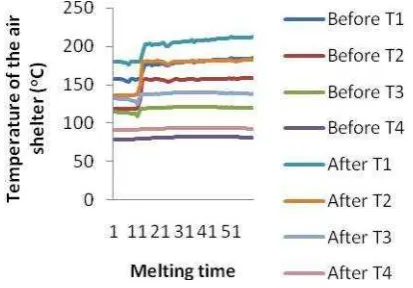
Figure 3 Temperature of the air shelter Figure 4 Melting temperature
Figure 3 shows that the air that is in the air shelter receives a transfer of energy in the form of heat from the furnace during the process of fuel combustion. This condition causes the temperature of the air in the air shelter increased after the redesign. The results of the research that has been conducted in which the temperature rise to give effect to the perfection of the process of fuel burning charcoal. Existing air in the air shelter is functioning to increase the combustion air requirements. Previous research states that the addition of combustion air temperature affects the burning process [9].
Figure 4 shows the melting temperature increases significantly after redesign. This is because the combustion air used in the combustion process already has a high temperature based on Figure 1. Previous studies also suggested that the high temperature of combustion air causes the fuel combustion process more quickly and produces high temperatures [10].
Figure 5 The use of wood charcool Figure 6 Production
Figure 5 shows that the redesign gives significant effect to the reduction of fuel consumption in the combustion process by 20%. This condition has an impact on the effectiveness of the consumption of the fuel in the process melting of bronze alloy. The effectiveness of the fuel consumption in the combustion process will have a significant influence on the thermal efficiency of the furnace used [11].
360 Recent Decisions in Technologies for Sustainable Development
Conclusion
Based on the research that has been done, the redesign of the combustion air shelters provides enough benefit to the performance of the furnace. That performance is significantly measured during the process of fuel combustion that causes higher combustion temperatures. Fuel consumption in the design has shown a decrease to 20%. In addition, smelting process of gamelan production shows an increase.
References
[1] Sugita IKG., Priambadi, IGN dan Kusuma K. 2006. Experimental Study of Mixed Composition Bronze Variations and Variation Charges Against Forging Close Fracture Toughness Properties And Materials Hardness Bronze Gamelan. Research Grant. Study Program of Mechanical Engineering Faculty of Engineering Udayana University. TPSDP-Batch II.
[2] Martano, M.A and Capocchi, J. D. T. 2000. Heat Transfer Coefficient At The Metal Mould Interface In The Unidirectional Solidification Of Cu 8% Sn Alloys, International Journal
Of Heat And Mass Transfer. 43: 2541 2552.
[3] Halvaee, A and Talebi, A. 2001. Effect Of Process Variables An Microstructure And Segregation On Centripugal Casting Of C92200 Alloy. Journal Of Materials Processing
Technology.
[4] Arijit Biswas & Pinakeswar Mahanta. (2013). Design and Experimental Analysis of Furnace for the Production of Bamboo Charcoal. International Journal of Mechanical and Industrial Engineering (IJMIE) ISSN No. 2231-6477, Vol-3, Iss-1.
[5] Abuelnuor A. A. A., Cs . (2013) Review of Numerical Studies on NOX Emission in the
Flameless Combustion. International Journal Applied Mechanics and Materials Vol. 388 (2013) pp 235-240.
[6] Kirk, D. and A.W. Holmes. (1976). The heating of food stuffs in a microwave oven. Jor. of
Food TechnologyVol 30 pp 375-384.
[7] Sunil Gokhale ,Cs. (1991). Simulation of ceramic furnaces using one-dimensional model of heat transfer Part I: Model development and validation .Indian Institute of Technology, New Delhi, India
[8] Duffie, J. A., and W. A. Beckman. (1991). Solar Engineering of Thermal Process, 2nd ed., NewYork, John Wiley.
[9] Jun Li. Cs. (2013). Effects of Flue Gas Internal Recirculation on NOx and Sox Emissions in a Co-Firing Boiler.International Journal of Clean Coal and Energy, 2013, 2, 13-21.
[10] Murrari Mohon Roy and Kenny W. Corscadden. (2012). An experimental study of combustion and emissions of biomass briquettes. International Journal. Applied Energi 99 pp 206 212.