EXPERT MODEL SYSTEM ON ENTREPRENEURSHIP
PERSONALITY
Resmi Darni1, Z. Mawardi Effendi2and Selamat Triono3
Department of Informatic Education, Muhammadiyah University Of Riau, Pekanbaru, Indonesia1 Department of Economic Education, Padang State University, Padang, Indonesia2 Department of Mechanical Engineering, Medan State University, Medan, Indonesia3
ABSTRACT: One of the problems faced by counseling teachers and counseling is their limited knowledge on how to direct students’ interests in accordance with their personalities. Vocational high schools really need counseling program for career and counseling to guide the students’ career match their personalities in order to reduce the number of unemployment who graduated from vocational high schools. Due to this fact, then it requires an expert in psychology or counselor that can direct the students to the right career suitable with their personality based on the result of the test or psychological assessment which have done by the experts in psychology. The high cost of psychological assessment, limited number of psychological experts and very slow result announcement, makes the students have difficulty in having counseling with the experts if they want to decide their chosen career that they want to have in the future. To solve this problem, it needs a system which has an ability like an expert in psychology. This system is equipped with some references knowledge about personality and interest in chosen career by the students in line with the students’ personality. The main purpose of this research is to develop a web-based expert system using basic rules with chaining forward referenced method and PHP language program which meant to help the students in having counseling about their career through online, adaptive, practical, and efficient way. This research is focused on entrepreneurship career interest for students of vocational high school majoring in technological information, using 4D model of research methodology (Define, Design, Develop, and Disseminate). Data analysis used in validating factor is factor analysis with CFA type (Confirmatory Analysis Factor). This research is done on 200 vocational high school students who have studied entrepreneurship. From this research, it is found that there are 5 characters which built entrepreneurship personality namely: Persuader, Creative, Risk taker, Leader and Ambitious which later will become factors in developing CBT-EP program (computer based test for entrepreneurship personality).
Keywords: Personality; Entrepreneurship; Expert System; Structural Equation Modeling; Confirmatory Factor Analysis.
1. INTRODUCTION
Entrepreneurship derived from the word entre-preneur who refers to a figure or a particular human person. Therefore, discussing the issue of entre-preneurship will never escape from talk about the problems of the people and his personality. An entre-preneur must recognize and understand yourself, this will facilitate them to find, define and lead the path of entrepreneurship that suits their personality [1].
Entrepreneurship it has a very important role, entrepreneurship likened as a driving force in the economy nationally and internationally as well as being a symbol of resilient businesses and over-achievers. On this second Millennium era developed countries doing the revolution in the field of entrepreneurship, they develop a business school for entrepreneurship, the creation of characters, develop competence of entrepreneurship that we can look at '21STCentury Competencies', as well as perform the measurement index of sustainable entrepreneur-ship[1]. While in Indonesia have entrepreneurship programs launched by the Government with the
allocation of funds for the activities of the Studium General entrepreneurship, Integrated Work Study Program (PBBT), Student Business Compe-tition and Expo Indonesia Indonesia Student Entrepreneurship (EXPO KMI). The purpose of all this is to find individuals who have the potential in the field of entrepreneurship. However this program alone turned out to be insufficient to locate seeds entrepreneurship potential. It takes a special selection by using the tool (instrument) is the right [2].
Until now, this was enough tools developed to measure the potential of entrepreneurship as KIEA (Kauffman Index Activities Entreprenurial), Entreprise Index SANTANDER, Legatum Prosperity Index, Erasmus, Ivey, IKRM, GEDI and PIKEN. Each of these instruments has different functions, ways of working and goals in discovering the potential for entrepreneurial, business or country entrepreneurship[3].
problems in a specific domain. Expert system is a computer pro-gram that mimics the thought process and expert knowledge in solving a particular problem. expert system is seen as a way of storage of expert knowledge in a particular field in the computer program so that a decision can be rendered in conducting reasoning intelligently. General know-ledge in expert system taken from a human expert in a particular domain and expert system that attempted to emulate the methodology and performance of an expert on the (performance) [4], [5].
Expert system is not only used in the field of medical,and legal only , the expert system can also
be applied in the field of career guidance and coun-seling , for career guidance and councoun-seling also cons-titute an field a large and complex, one of the problems in the field of career guidance and counseling is how do Iprovide recommenda-tions careers at exactly the right person in accordance with his personality. Therefore the solutions offered to solve this problem is to develop a model of expert system that can provide referrals in particular career entrepreneurship for students of vocational high schools.
2. MATERIAL
2.1 Material
There are some preparations that need to be done before building an expert system to measure the personality of entrepreneurship. first determine the indicators and criteria as well as the statement items of the entrepreneurship personality, the criterion indicator and the statement item can be determined based on the literature that suits the personality of entrepreneurship. the next stage do validation with expert personality entrepreneurship. After the entrepreneurial instrument finished in validation by experts, then the stage of building the expert system of entrepreneurship personality began to be implemented. the required equipment and software specifications are Intel Ci3-6006U 2.0GHz, 4GB RAM, 500GB HDD, Intel HD VGA, 21.5 FHD, Wifi, Keyboard & Mouse. Software are needed macromedia dreamweaver, MySQL, WebHosting.
2.2 General Procedure in Instrument Design
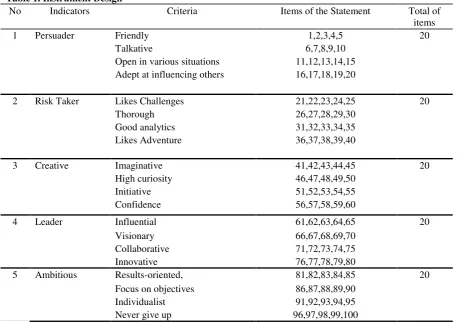
Determine the indicators, criteria and items of the statement to be designed into an entrepreneurship personality instrument.
Table 1. Instrument Design
No Indicators Criteria Items of the Statement Total of
items
1 Persuader Friendly 1,2,3,4,5 20
Talkative 6,7,8,9,10
Open in various situations 11,12,13,14,15 Adept at influencing others 16,17,18,19,20
2 Risk Taker Likes Challenges 21,22,23,24,25 20
Thorough 26,27,28,29,30
Good analytics 31,32,33,34,35
Likes Adventure 36,37,38,39,40
3 Creative Imaginative 41,42,43,44,45 20
High curiosity 46,47,48,49,50
Initiative 51,52,53,54,55
Confidence 56,57,58,59,60
4 Leader Influential 61,62,63,64,65 20
Visionary 66,67,68,69,70
Collaborative 71,72,73,74,75
Innovative 76,77,78,79,80
5 Ambitious Results-oriented, 81,82,83,84,85 20
Focus on objectives 86,87,88,89,90
Individualist 91,92,93,94,95
Total all items 100
2.3 Contruct Validity Intrument
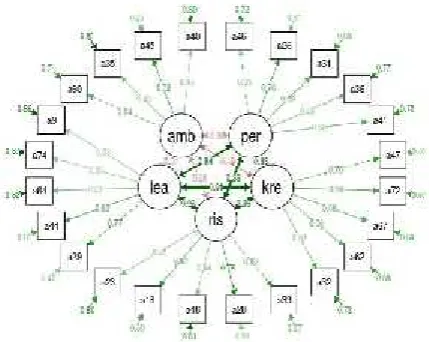
Contracts that have been validated by experts will be re-tested using Structural Equation Modeling (SEM). this can be seen in figure 1
Fig.1 Intrument Validity Useing Structural Equation Modeling (SEM)
2.4 Expert System Design
An expert system is composed of three main modules [6]:
a. Knowledge Acceptance Module (Knowledge Acquisition Mode)
The system resides in the module will receive knowledge from expert. The process of gathering knowledge will used for system development, with the help of knowledge engineer.
b. Consultation Module (Consultation Mode) At the moment the system is in a giving position answer to the problem posed by user, the expert system is in the module consultation.
c. Explanation Module
This module describes the decision-making process by system.
In the expert system there are 2 main components [6]:
a. Knowledge Base
knowledge is the essence of a system experts, namely the form of knowledge representation from experts. The knowledge base is composed of facts and rules.
b. Inference Engine (Inference Engine)
Engine inference serves to guide the process reasoning against a condition, based on the available knowledge base.
Bayes's theorem is a theorem with two different interpretations. In Bayes's interpretation, this theorem states how far the degree of subjective trust should change rationally when there are new clues. In the interpretation frekuentis this theorem explains inverse representation of probability of two events. Bayes probability is one way to overcome the data uncertainty by using Bayes formula is expressed as follows [7].
( | ):The probability of Hk hypothesis if given evidence E.
( | ) : The probability of the emergence of evidence E if Hk hypothesis is known to be true
( ) :Hk hypothesis probability, without looking at any evidence.
n :Jumlah hipotesa yang mungkin
2.4.1 Data Tables of Entrepreneurship Personality
Table2.Indicator of Entrepreneurship Personality matching information entered by users and knowledge base.
Table 3. Criteria of Entrepreneurship Personality Code
criteria
Item Of Criteria Weight
D001 Smile 0.9
D003 Delightful 0.8
D004 Hilarious 0.5
D005 Interesting 0.9
D006 extravagant talk 0.9
D007 interrupting 0.6
D008 likes to be the center of attention
0.5
D009 Adaptable 0.7
D010 Aggressive 0.8
D011 Attention to others 0.8
D012 Kind 0.6
Code criteria
Item Of Criteria Weight
D013 a good listener 0.4
D014 giving advice 0.4
D015 appreciate opinions 0.3 D016 good at seducing
D016
good language skills 0.9D017
good at persuading 0.7D018
interesting when talking 0.6D019
enliven the atmosphere 0.7D020
persistent 0.9D021
Confidence 0.8D022
Brave 0.9D023
Likes outdoor activities 0.5D024
Stubborn 0.4D025
High fighting power 0.8D026
Liked the Count 0.6D027
Have attention and height 0.5D028
Persistent, 0.5D029
Focus 0.8D030
Quiet 0.4D031
Like to solve the problem completely
0.8
D032
Humble 0.4D033
Mathematician 0.8D034
Logical 0.95D035
Has a strong principle 0.81D036
Like freedom 0.95D046
Likes to ask 0.9D047
Pay attention to many things 0.6D048
Learn a lot 0.6D049
Interested in many things 0.5D050
Like to read 0.5D051
good at reading opportunities 0.7D052
be the inspiration of many people
0.6
D053
clever position 0.4D054
has its own style 0.5D055
do not like to be ordered 0.4D056
Not resting on others. 0.45D057
Dare to take a stand and not fear wrong.
0.6
D058
Not afraid to look stupid 0.8D059
Dare to speak, argue and criticize
0.7
D060
Have a good self-control and emotional stable.
0.7
D061
not easy to answer 0.4D062
polite speech 0.6D063
good lifestyle 0.4D064
high response 0.8D065
quickly take action 0.7D066
Keep learning 0.5D067
Service Oriented 0.4D068
Trusting Others 0.5D069
Seeing Life As A Struggle 0.7D070
Always Improving Yourself 0.4D071
loves to work together 0.9D072
appreciate the opinions of others
0.9
D073
appreciate the ability of others 0.8D074
loves to share experiences and knowledge
D081
no matter the small changes 0.8D082
less appreciate the results of hard work of others
0.7
D083
feel success is in the work itself
0.4
D084
like to rush in making decisions
0.5
D085
easily affected 0.4D086
do not like changeD087
do not like criticism 0.8D088
if it fails it will be easy for him to rise up
0.5
D089
strong desire 0.4D090
firmly on the stand 0.9D091
do not like crowds 0.6D092
difficult to work together 0.6D093
difficult to accept change 0.5D094
less friendly 0.5D096
persistent 0.7D097
tough 0.7D098
not cheap received failure 0.5D099
has a high fighting power 0.4D100
optimistic 0.93. METHODS
Fig.2 Research Methods using 4D Model The research method used is 4 D model with 4 stages of development that is (Define, Design, Develop, Disseminate) in the first stage finds literature, materials and tools. the second stage of designing Instruments, determining the weight done by the expert, Rule Base, the third stage of developing the Expert System Model For Entrepreneurship Personality, the last stage of Product socialization to vocational high schools, Implementation of expert model system.
3.1 Product View
Fig. 3 Form registration a. Participant Registration Form
Students must fill in the participants' data. After Charging, then click the save button, then the data will be stored in the database. After registering, the thing done is getting approval from the admin in order to do the next process.
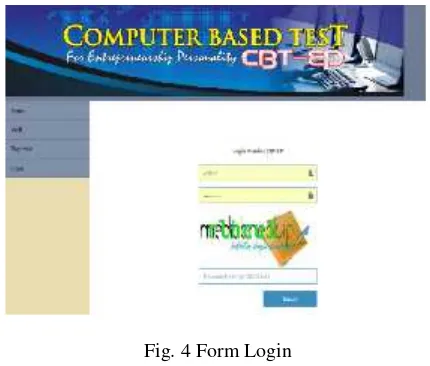
Fig. 4 Form Login b. Form Login
Before doing the test, participants are required to login to be able to do the test
Define
Preparation of Literature, Materials and Tools
Design
Instruments, Probability, Rule Base
Develop
Expert System Model For Entrepreneurship Personality
Disseminate
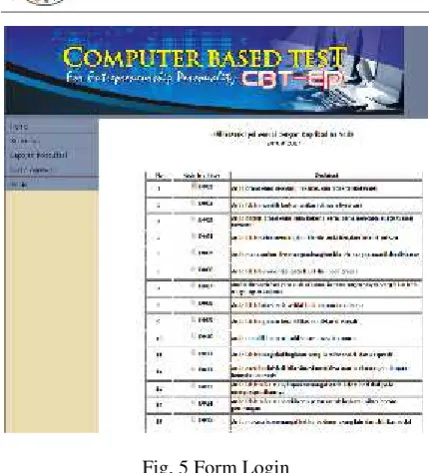
Fig. 5 Form Login c. Entrepreneurship Personality Test Form
Participants are required to fill in the code of participants who have been obtained after the first registration. After the participant code is filled then, will appear the name of participants, gender, selected courses and photos of test participants. In this personality test form comes a statement that has led to assess the personality of the participants towards Entrepreneurship. The answer to the statement given in the form of Likert scale that has the weight of each answer. The right answer according to the personality of Entrepreneurship will get a high score.
4. DISCUSSION
This expert system model has assisted vocational high school students in recognizing their entrepreneurship potential, and assisting students in directing their career to the field of entrepreneurship, besides this model also helps select students who have strong, medium and non-entrepreneurial personality is to facilitate the implementation of training, the efficiency of training costs and the provision of funds PKM more to the right people so that entrepreneurs-entrepreneurs who can potentially utilize the facilities that have been given the government in the right target
5. CONCLUSION
This model can be applied to Vocational High School students especially in the field of technological expertise. This model is a supplement of the existing model in order to be used in providing career referrals for an individual. This model is highly dependent on the readiness of technology, whether hardware (server, personal computer / laptop), Software (Operating system, and
web application) and internet network technology (bandwidth) adequate.
Application of this model is expected to optimize the use of technology resources, human resources and potential possessed by a vocational high school. The application of this model is able to make indirect media consultations that can be done anytime and anywhere without being limited by time and space. Through this model is expected to reduce the unemployment rate, especially for vocational high school graduates.
6. REFERENCES
[1] R. Spinelli, S, Adams, “New Venture Creation,” hal. 130, 2012.
[2] I. Murni dan N. Noviarti, “Penyusunan Indeks Psikometrik Kewirausahaan Perbandingan Mahasiswa Indonesia Dan Malaysia,”J. Ipteks Terap., vol. 8, no. 1, hal. 1–9, 2014.
[3] C. Paper, “Review of Entrepreneurship Indexes Developed to Measure Entrepreneurial Competencies Review Of Entrepreneurship Indexes Developed To Measure Entrepreneurial Competencies E-Index,” no. August, hal. 19–20, 2015.
[4] P. Lucas dan L. van der Gaag, “Principles of Expert Systems,” hal. 426, 1991.
[5] R. Iles, “Building expert systems in prolog,”
Knowledge-Based Syst., vol. 3, no. 2, hal. 122– 123, 1990.
[6] D. L. Poole dan A. K. Mackworth, Artificial Intelligence - Foundations of Computational Agents. 2010.