Haryo Sumowidagdo
▸ Baca selengkapnya: long cross section
(2)Motivation
• A pure third generation decay
which has not been observed with 3σ significance.
t → τ ντb
• Search for new physics in top
quark decay mechanisms.
• In many top quark analyses,
it is assumed that top quark decays predominantly via weak interaction into a W boson and a b quark.
t → W b
proton
antiproton
q
q
g
t
t
l, q
ν
, q’
New physics in top quark decay mechanism
Charged Higgs exist in non-minimal Higgs model (e.g. 2HDM) or beyond standard model physics (e.g. MSSM). Top quark can decay to charged Higgs.
t → H±b → τ ντb
)
β
tan(
1 10
Branching Ratio
0.1
At large tanβ, the charged Higgs decay predominantly into taus.
Figure made with
Experimental Apparatus: Fermilab Tevatron Accelerator
Proton-antiproton collider with center-of-mass
energy 1.96 TeV.
Analysis uses 1.0 fb −1 of recorded data from
Event Preselection
t W+
¯
t W−
q q
b
ν
τ
+
ℓ
−
¯
ν
¯
b
• One isolated electron (muon),
pT > 15(20) GeV, |η| < 1.1(2.0).
Veto second isolated lepton.
• One isolated tau with ET > 10
GeV, appears as narrow jet.
• At least two jets, pT > 20 GeV, |η| < 2.5, leading jet pT > 30 GeV.
• ET/ > 15 GeV, from the presence of
three neutrinos.
• Lepton and tau are expected to have
opposite charge sign.
• Identify b−quark jet to increase
signal to background ratio.
Tau reconstruction and identification: Basics
Tau lifetime ∼ 0.29 ps, ct = 87µm. Decay products of a highly-boosted tau are almost collinear with the tau.
τ
0
R = 0.3
Reconstruction cone
R = 0.5
Isolation cone
π
π
π
π
ν
τ
+
_ _
BR ≈ 35% : τ− → e−νe¯ ντ, µ−νµντ¯
BR ≈ 10% : τ− → π−ντ
BR ≈ 35% : τ− → π−N π0ντ
BR ≈ 15% : τ− → π−π+π−N π0ντ
Leptons from tau decays will be swamped by leptons from W/Z
decays.
Hadronic decay products will
appears as narrow, isolated jets, with charged tracks and
hadronic energy deposition. Neutral pions will appear as
electromagnetic energy
Tau reconstruction and identification: DØ Algorithm
Type 1: one track, w/o EM cluster. Type 2: one track, w/ EM clusters. Type 3: two or more tracks.
Neural networks algorithm is used to identify taus.
1.0)) ≤ τ NN_ ≤ Tau neural network output (all type, 0.5
0.5 0.55 0.6 0.65 0.7 0.75 0.8 0.85 0.9 0.95 1
Number of events
0
700 DATAMultijet
Background Processes and Their Estimation
q'
q
W b
g b
g
l
ν
Fake τ W+jets, use shapes from MC and
normalized to data.
proton
antiproton
q
q
Z0 e +
e–
, µ+, τ+
, µ−, τ−
Z+jets, estimated from MC.
q
q
g
ν l+ W +
c
g
W –
c q
'
q
b
b
Fake τ
Multijet, estimated using MC and data events with same charge sign (SS).
NMultijet = NdataSS − NW+jets likeSS
Preselected sample
2 jets ≥ (GeV),
T
Lepton p
0 20 40 60 80 100 120 140 160
Number of events
0
70 DATAMultijet
W
dilepton non-l
→
Number of events
0
dilepton non-l
→
Leading jet E
0 20 40 60 80 100 120 140 160
Number of events
0
70 DATAMultijet
W
dilepton non-l
→
Number of events
0
70 DATAMultijet W
dilepton non-l
Neural network b−tagging
Average efficiency to tag b-quark in
this analysis is 54 %, with fake rate of 1 %.
Combine information from
b−tagged sample Lepton p
0 20 40 60 80 100 120 140 160
Number of events
0
dilepton non-l
→
Number of events
0
dilepton non-l
→
Leading jet E
0 20 40 60 80 100 120 140 160
Number of events
0
dilepton non-l
→
Number of events
0
dilepton non-l
Elimination of multijet background
Assume that multijet events contribute equally to opposite-charge sign (OS) and same-charge sign (SS) sample.
NdataOS = NtOSt,W,Z,¯ diboson + NMultijetOS
NdataSS = NtSSt,W,Z,¯ diboson + NMultijetSS
Then
NdataOS − NSS
Cross-section extraction
In the individual eτ and µτ channel, the cross-section is extracted using:
σt¯t =
NdataOS − NSS
data − NWOS − NWSS
− NOS
Z − NdibosonOS
ǫOSt¯t − ǫSS t¯t
× L
In the combined measurement over more than one channels, we minimize a negative log-likelihood function based on the Poisson probability to observe a number of events (Njobs) in each individual channel j.
We measure:
dilepton (topological)*
alljets (b-tagged, PRD) 1050 pb–1
6.8 +1.2
–1.1 +0.9
–0.8 pb
410 pb–1
4.5 +2.0
–1.9 +1.4
–1.1 pb
0 2 4 6 8 10 12
D Run II
preliminary*σ (pp →tt) [pb]
March 2008
Cacciari et al., JHEP 0404, 068 (2004) Kidonakis and Vogt, PRD 68, 114014 (2003) mtop = 175 GeV
±0.4
±0.3
(stat) (syst) (lumi)
tau+lepton (b-tagged)* 1050 pb–1
8.3 +2.0
–1.8 +1.4
–1.2 ±0.5 pb
tau+jets (b-tagged)* 350 pb–1
5.1 +4.3
–3.5 +0.7
–0.7±0.3 pb
l+track (b-tagged)* 1050 pb–1
5.1 +1.6
–1.4 +0.9
–0.8 ±0.3 pb
l+jets (from B(t→Wb)/B(t→Wq), PRL)
910 pb–1
8.18 +0.90
–0.84 ±0.50 pb
l+jets (b-tagged and topological, PRL)
910 pb–1
Measurement of σ × BR(tt¯→ ℓ + τ + b¯b)
A simple measure of top quark decay rate to tau lepton.
Assume standard model cross-section for expected top events which are coming from lepton+jets and non-tau dilepton decay modes.
σtt¯× BR(tt¯→ ℓ + τ + b¯b) =
NdataOS − NOS
non−tau t¯t,W,Z,diboson − NMultijet
ǫOStt¯→ℓ+τ+b¯b
At mtop = 175 GeV / σt¯t = 6.8 pb, we measure:
σtt¯× BR(tt¯→ ℓ + τ + b¯b) = 0.19+0−0..0808 (stat)+0−0..0707 (syst) ± 0.01 (lumi) pb.
The standard model expectation is 0.126.
Less statistically significant than the cross-section: low purity of real
taus in the selected sample.
Conclusions from Tevatron analysis
• We measured both the top quark pair production cross-section using
lepton+hadronic tau events, and the σ × BF(t¯t → ℓτ ννb¯b)
σt¯t = 8.3+2−1..80 (stat)+1−1..42 (syst) ± 0.5 (lumi) pb
σt¯t × BR(t¯t → ℓτ ννb¯b) = 0.19+0−0..0808 (stat)−+00..0707 (syst) ± 0.01 (lumi) pb.
• Very exciting and challenging analysis which uses all object
identification: electron, muon, tau, tracks, jets, b−tagging, MET.
• Will be used in a global search for charged Higgs boson in combination
with dilepton and lepton+jets channels: Add sensitivity to tauonic
charged Higgs model. Require orthogonality between pure
dilepton, lepton+tau, and lepton+jets channels.
• Will be published as part of cross-section measurement in the dilepton
Outlook for LHC
• Current efficiency at the Tevatron is about 5 % for pure lepton+tau
events, equivalent to about 10 lepton+tau events per 1 fb−1.
• With 80 million top quark pairs produced per year at the LHC, even at
reconstruction efficiency of 1000 times smaller than at the Tevatron, we can expect to have about 15 lepton+tau events per year.
• The real challenge is the task to develop the algorithm for, and
suppress the background to tau reconstruction at the LHC !
• Tevatron has the advantage of being a well-understood environment,
and can expect to have at least four times as much data used in this analysis. On the path to evidence/discovery.
We hope that we will hear
the answer at Pheno 2009
Table 1: Input variabls to the neural-network b−tagging algorithm.
Variable Description
SV TSL DLS Decay length significance of the secondary vertex
CSIP Comb Weighted combination of the tracks’ impact parameter significance
JLIP Prob Probability that the jet originates from the primary vertex
SV TSL χ2d.o.f. Chi square per degree of freedom of the secondary vertex
SV TL Ntracks Number of tracks used to reconstruct the secondary vertex
SV TSL Mass Mass of the secondary vertex
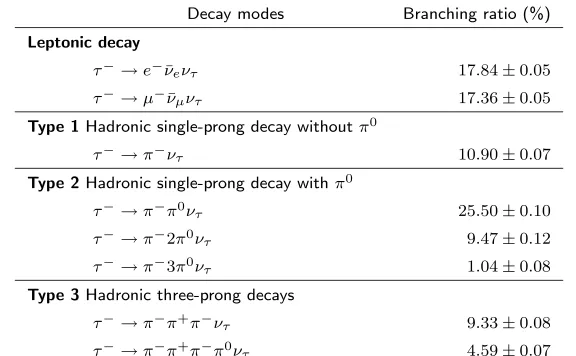
Table 2: Branching ratios (in unit of %) for dominant leptonic and hadronic decay modes of tau, sorted by expected tau type, as stated in Particle Data Book 2006 edition.
Decay modes Branching ratio (%)
Leptonic decay
τ− → e−ν¯eντ 17.84 ± 0.05
τ− → µ−ν¯µντ 17.36 ± 0.05
Type 1 Hadronic single-prong decay without π0
τ− → π−ντ 10.90 ± 0.07
Type 2 Hadronic single-prong decay with π0
τ− → π−π0ντ 25.50 ± 0.10
τ− → π−2π0ντ 9.47 ± 0.12
τ− → π−3π0ντ 1.04 ± 0.08
Type 3 Hadronic three-prong decays
τ− → π−π+π−ντ 9.33 ± 0.08
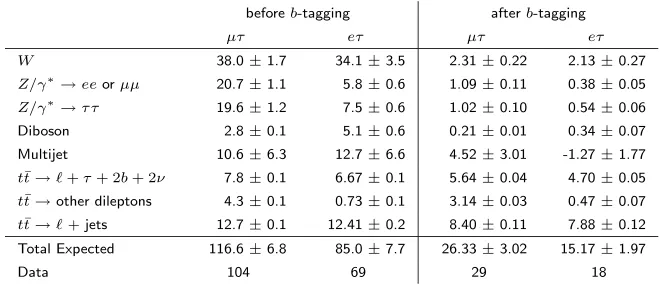
Table 3: Data and predicted numbers of events before and after b-tagging is applied. Standard model cross section and branching ratios are assumed for tt¯ production. Uncertainties are statistical only.
before b-tagging after b-tagging
µτ eτ µτ eτ
W 38.0 ± 1.7 34.1 ± 3.5 2.31 ± 0.22 2.13 ± 0.27
Z/γ∗ → ee or µµ 20.7 ± 1.1 5.8 ± 0.6 1.09 ± 0.11 0.38 ± 0.05
Z/γ∗ → τ τ 19.6 ± 1.2 7.5 ± 0.6 1.02 ± 0.10 0.54 ± 0.06
Diboson 2.8 ± 0.1 5.1 ± 0.6 0.21 ± 0.01 0.34 ± 0.07
Multijet 10.6 ± 6.3 12.7 ± 6.6 4.52 ± 3.01 -1.27 ± 1.77
t¯t → ℓ + τ + 2b + 2ν 7.8 ± 0.1 6.67 ± 0.1 5.64 ± 0.04 4.70 ± 0.05
t¯t → other dileptons 4.3 ± 0.1 0.73 ± 0.1 3.14 ± 0.03 0.47 ± 0.07
t¯t → ℓ + jets 12.7 ± 0.1 12.41 ± 0.2 8.40 ± 0.11 7.88 ± 0.12
Total Expected 116.6 ± 6.8 85.0 ± 7.7 26.33 ± 3.02 15.17 ± 1.97
Table 4: Systematics for the measurement of σtt¯.
µτ eτ combined
∆σ ∆σ ∆σ
Jet energy calibration +0.30 −0.50 +0.33 −0.36 +0.43 −0.35
PV identification +0.36 −0.34 +0.23 −0.37 +0.38 −0.21
Muon identification +0.21 −0.20 – +0.12 −0.12
Electron identification – +0.59 −0.53 +0.25 −0.24
Tau identification +0.16 −0.15 +0.15 −0.15 +0.16 −0.16
Trigger +0.00 −0.00 +0.12 −0.07 +0.14 −0.13
Fakes +0.45 −0.42 +0.59 −0.53 +0.50 −0.49
b-tagging +0.31 −0.34 +0.44 −0.41 +0.45 −0.37
MC normalization +0.18 −0.18 +0.15 −0.15 +0.13 −0.13
Background/MC statistics +1.46 −1.46 +1.19 −1.19 +1.00 −0.91
Other +0.08 −0.08 +0.09 −0.10 +0.19 −0.18
Subtotal +1.76 −1.67 +1.64 −1.59 +1.40 −1.24
Luminosity ±0.49 ±0.52 ±0.51
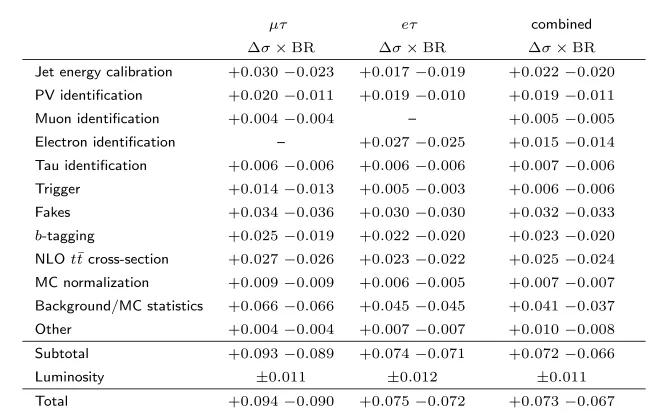
Table 5: Systematics for the measurement of σtt¯× BR.
µτ eτ combined
∆σ × BR ∆σ × BR ∆σ × BR
Jet energy calibration +0.030 −0.023 +0.017 −0.019 +0.022 −0.020
PV identification +0.020 −0.011 +0.019 −0.010 +0.019 −0.011
Muon identification +0.004 −0.004 – +0.005 −0.005
Electron identification – +0.027 −0.025 +0.015 −0.014
Tau identification +0.006 −0.006 +0.006 −0.006 +0.007 −0.006
Trigger +0.014 −0.013 +0.005 −0.003 +0.006 −0.006
Fakes +0.034 −0.036 +0.030 −0.030 +0.032 −0.033
b-tagging +0.025 −0.019 +0.022 −0.020 +0.023 −0.020
NLO t¯t cross-section +0.027 −0.026 +0.023 −0.022 +0.025 −0.024
MC normalization +0.009 −0.009 +0.006 −0.005 +0.007 −0.007
Background/MC statistics +0.066 −0.066 +0.045 −0.045 +0.041 −0.037
Other +0.004 −0.004 +0.007 −0.007 +0.010 −0.008
Subtotal +0.093 −0.089 +0.074 −0.071 +0.072 −0.066
Luminosity ±0.011 ±0.012 ±0.011