How to cite:
Herianto, Kusuma Z, Nihayati E, Prayogo C (2018)The Plant Wisdom of Dayak Ot Danum, Central Kalimantan. J. Trop. Life. Science 8 (2): 130 – 143.
*Corresponding author: Herianto
Faculty of Agriculture, Brawijaya University Jalan Veteran, Malang, Indonesia 65165 E-mail: [email protected]
VOL. 8, NO. 2, pp. 130 – 143, April 2018 Submitted November 2015; Revised December 2017; Accepted January 2017
The Plant Wisdom of Dayak Ot Danum, Central Kalimantan
Herianto *, Zainal Kusuma, Ellis Nihayati, Cahyo Prayogo Faculty of Agriculture, Brawijaya University, Malang Indonesia
ABSTRACT
This research aims to describe plants diversity having local wisdom value for Ot-Danum Dayak people, Tumbang Payang village and Tumbang Kania village, Central Kalimantan. The result reveals that since a long time ago, Ot-Danum Dayak people truly depend on natural resources to meet various daily needs. The vast majority of subsistence and society's income are form forest plants product. Plant diversity can provide food product for society, can produce various plants to be consumed and also produce alternative income sources, such as exploited for food, medicine, fermentation, tonic, cosmetic, building material and etc. However, the existing plant diversity is endangered since deforestation and forest degradation, and even there are many lesser-known species. Therefore, it needs to quickly find the information about the species to conservation effort, given the existing forest resource has a big potential to be developed and cultured to the species through domestication and providing a genetic resource for hybridization and selection.
Keywords: Domestication, subsistence, perception, genetic, culture, conservation INTRODUCTION
Indonesia has a wide variety of ethnic groups living throughout the archipelago from Sabang to Merauke. The tribes in used to be dependent on the natural re-sources to meet the needs of everyday life. Each tribe has different knowledge in the use of plants. The diversity of plants and the related knowledge are ones of
Indone-sia’s cultural richness to keep [1].
Central Kalimantan also has a vast natural biodiver-sity supported by the potential traditional knowledge, characterized by every Dayak ethnic group in Kaliman-tan. Biodiversity is always closely linked to the culture of the local community [1]. One of them is through the utilization of various types of plants used in meeting the daily needs, especially the people who are around the forest area. The diversity of plant species is the basis of sustainable development because it incorporates com-plex experience, skills, and insights by local communi-ties about the surrounding environment [2].
Dayak Ot Danum tribe living in the upstream of Katingan still have beliefs, customs, culture, and empir-ical data related to natural phenomena and the historempir-ical process of environmental change. The environmental
changes in Tumbang Payang and Tumbang Kania vil-lages, due to deforestation and excessive forest degrada-tion, have brought great impact on the surrounding Dayak communities. For example, several types of plants are beginning to extinct due to logging and some have become extinct due to the utilization of biological re-sources and the use of land by human intervention. De-velopment policies that are less concerned about envi-ronmental sustainability also play a role in the species extinction process. These finally lead to the extinction of the traditional and indigenous inheritance [3]. There-fore, efforts to document traditional knowledge along with cultural-based plant conservation efforts for knowledge, conservation, and community welfare must be done.
place of growth, especially in the utilization and use of indigenous plants biodiversity in forest ecosystems. The study is important as it deals with some data on the local culture of Dayak Ot Danum tribe.
MATERIALS AND METHODS Study sites
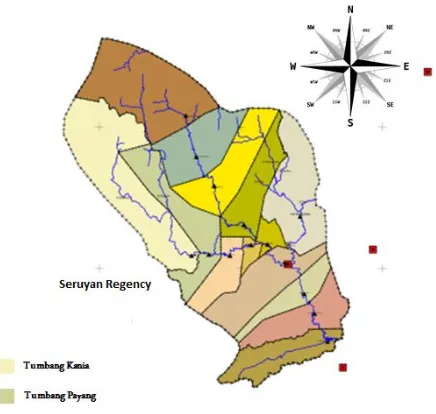
The research was conducted in Tumbang Payang village and Tumbang Kania village, Bukit Santuai Dis-trict of Kotawaringin Timur, Central Kalimantan (Fig-ure 1). Tumbang Payang is the village closest to the cen-ter of PT. Sarpatim, Bai Base Camp (BBC), about 12 km. This village is located on the Kuayan River, the set-tlement is lined north-south. It is located on the left side of the upstream direction, or according to the term used by the local people, it is the kiri mudik of Kuayan River with an area of 105 km2. Administratively, Tumbang
Payang is part of Mentaya Hulu District, Kotawaringin Timur Regency, Central Kalimantan Province. Tum-bang Payang consists of 1 (one) kampung (hamlet)and 4 (four) Rukun Tetangga (neighborhoods). It is geo-graphically located on 01°47’09.0’’– 01°47’17.6’’ south latitude and 112°17’31.9’’ – 112°18’03.6’’ east longitude. Tumbang Kania is located on the upstream of the Kuayan River; the distance from the center of PT. Sarpa-tim, Bai Base Camp (BBC) is about 11 km. Unlike other villages that are located on the kiri mudik, Tumbang Kania Village is located on the right lane of Kuayan River. Administratively, the village of Tumbang Kania is the definitive village that belongs to the administrative area of Tanggang Santuai District, Kota-
waringin Timur Regency, Central Kalimantan Province. The administrative area of Tumbang Kania Village co-vers an area of 164 km2. Based on geographical location,
it lies in position 01°47’16.4’’ – 01°47’21.0’’ south lati-tude and 112°16’00.2’’ – 112°16’.8’’ east longitude.
Data collection technique
A preliminary study was conducted before the main study to find out the profile of Dayak Ot Danum com-munity in Katingan Hulu, i.e. Tumbang Payang village and Tumbang Kania village. Data were collected through focused discussions and interviews with key in-formants. There are 106 family heads in Tumbang Payang and 40 family heads in Tumbang Kania; as many as 40 people were chosen randomly as respondents in this study. To fill out the questionnaires, respondents were assisted by research assistants who guided the pro-cess of answering questionnaires and ensuring that all questions were answered by the respondent. The ques-tionnaire showed a set of questions systematically ar-ranged. Filling questionnaires were conducted, among others, at home, public places, and fields. In any data collection activity that involved the community, the re-searchers began by introducing themselves and telling the intent and purpose of the study. Small talks were made to build good communication between researchers and respondents.
The research used a descriptive method with a qual-itative approach. Data collection was obtained from semi-structured in-depth interviews with small groups or with individuals, then field data were made by obser-vation plot (PCP) with 20 × 100 m size of 5 (five) repli-cations and a snowball sampling system (excluding PCP). The result was made based on the number of spe-cies criterion and its use to explain the existing phenom-enon in the field [4].
RESULTS AND DISCUSSION Characteristics of respondents
Data collection through purposive sampling was
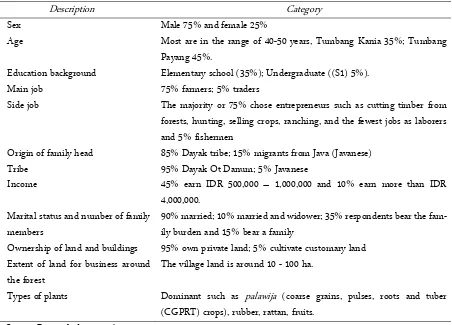
conducted to complement each respondent’s data. The information obtained provided the necessary data input. Through the distribution of questionnaires, characteris-tics of the respondents according to the categories are described in Table 1.
Table 1 describes the data of each respondent in 2 (two) villages, i.e. the data of the questionnaire which shows the most dominant frequency. It shows that peo-ple in their productive age are still dependent on the Figure 1. The Study Sites – Tumbang Payang and Tumbang
surrounding nature, such as forests. The main work is farming (in paddy fields, fields, and gardens).
They usually plant food crops in their paddy fields, while annual plant species planted in the garden. Types of food crops cultivated by the community include rice, corn, yams, beans, and vegetables. Annual types of crops such as coffee, rubber, rattan, and bananas can be found in their gardens. These plants are grown for commercial use. Most communities have rattan gardens harvested each year to earn money used as a means of exchange for purchasing goods not available in the community, as well as for paying tuition fee and health expenses. The side jobs to meet the necessities of life are hunting, gar-dening, livestock raising, and also cutting timber from the forest. Their average monthly net income is in the range of IDR 500,000 – 1,000,000. In order to take ad-vantage of leisure time, the people in the two villages also raise cattle. The livestock products are used to meet the needs of the family, party preparation, and for sale. The most widely raised species of livestock are pigs, as pigs are always used in the ritual or party, such as during rice planting, rice harvesting, wedding ceremonies, as well as funeral. Another animal mostly raised is chicken.
Chickens are served for guests and in other ceremonies to honor the ancestral spirits. The other types of animals currently raised by the community include cattle, ducks, and goats [5].
The most dominant land use patterns are for rubber plantations and the rest are for rattan, fruits, and mixed crops. In recent years, the way the people treat paddy fields has begun to change. In the past, the harvested fields were abandoned until they were ready for the next rice cultivation. Nowadays, these harvested fields are planted with rubber seeds given by the company or in-dividually bought [5, 6].
The Dayak Ot Danum community
Tumbang Payang comes from the word tumbang which means estuary and payang which means trees that grow in the river. The word kania in Tumbang Kania refers to the first person who occupied the village located at the estuary of Kania or Muara Kania.
Both villages adhere to the Kaharingan belief system and have existed since long. Some embrace the beliefs of Islam and Christianity. The kinship system is the patri-lineal system, based on the descendants of the father. Table 1. Characteristics of Respondents in Tumbang Payang and Tumbang Kania
Description Category
Sex Male 75% and female 25%
Age Most are in the range of 40-50 years, Tumbang Kania 35%; Tumbang
Payang 45%.
Education background Elementary school (35%); Undergraduate ((S1) 5%).
Main job 75% farmers; 5% traders
Side job The majority or 75% chose entrepreneurs such as cutting timber from
forests, hunting, selling crops, ranching, and the fewest jobs as laborers and 5% fishermen
Origin of family head 85% Dayak tribe; 15% migrants from Java (Javanese)
Tribe 95% Dayak Ot Danum; 5% Javanese
Income 45% earn IDR 500,000 – 1,000,000 and 10% earn more than IDR
4,000,000. Marital status and number of family
members
90% married; 10% married and widower; 35% respondents bear the fam-ily burden and 15% bear a famfam-ily
Ownership of land and buildings 95% own private land; 5% cultivate customary land Extent of land for business around
the forest
The village land is around 10 - 100 ha.
Types of plants Dominant such as palawija (coarse grains, pulses, roots and tuber (CGPRT) crops), rubber, rattan, fruits.
Tumbang Payang and Kania villagers are forbidden to marry relatives of very close relationships, such as mar-rying a nephew or members of the same bloodline. In terms of the inheritance law, the wealth of the parents is divided equally between girls and boys, especially the fields.
In Tumbang Payang, a leader is chosen based on the age, the eldest among them, or passed down from generation to generation from their parents. The main consideration in customary leadership is the knowledge about the village and the ownership of community land and forest [5]. Tumbang Kania has two systems leader-ship, customary and village. Of the two traditional lead-ers, each has different authorities, although sometimes the two works together to solve the problem or carry out activities in Tumbang Kania. Communities of both vil-lages are always cooperating as happened in the area of West Lombok, West Nusa Tenggara [7], one of which is cooperation in the utilization of forest products called by royong [8].
Customs and cultural sites of Dayak Ot Danum Traditional ceremonies still done in utilizing forest resources and farming activities are chickens cutting during royong followed by putting chicken blood on the rock and then placed on the borders of the fields. The ceremony is intended to make the paddy fields fertile and produce a lot of rice, as well as to get protection from the ancestors. The people of Tumbang Payang still maintain sacred places as cultural sites to keep the sal-vation of life. The examples are big trees believed as the place for the spirits to live—this is the place to ask for fortune and success [5] and the basampuh stone, a stone shaped like a waterfall with slippery rock, believed as the abode of ancestral spirits [5, 9]. Communities have relics of art and traditional heritage such as traditional cere-monies related to the human life cycle. Funeral and its ceremony are highly respected; customary rituals are performed to honor the spirit of the dead. The ceremony is called as tiwah. People also know sandhung, sipun-dhu, and patar to honor the spirits of the deceased fam-ily. The villagers of Tumbang Kania also has a custom-ary ritual called the manyanggar, to pray for successful farming activities throughout the year using traditional tools such as gong, drums, and tengkanung. The tradi-tional dance nganjan for the marriage ceremony and tiwah, with 7 (seven) people as the dancers. In addition, the two villages are also familiar with the birth ceremony called habalas bidan. Traditional ceremonies are also known in some areas such as Dayak Ngaju, Dayak
Kahayan, Dayak Maanyan, Timpah village, Central Ka-limantan [17].
Forest resources
Forest area managed by Tumbang Payang is 9,299 ha and 13,535 ha [5]. The community has been utilizing the areas to meet their subsistence needs as well as com-mercial ones. The forest has fulfilled the needs of the community, both for art, religious, and entertainment purposes, such as wood for construction of houses, fruits, vegetables, and meat for food needs, as well as other natural products. The community is heavily de-pendent on the surrounding environment. Forest prod-ucts utilized by Tumbang Payang villagers are ulin wood, rattan, rubber, and durian. The people of Tum-bang Kania use ulin wood, ulin shingle, rattan, and honey. Ulin wood is utilized by the community for house building materials and some is made for shingles (roofs of houses); yet, the utilization of ulin wood has decreased with the decline of the plant species as the impact of illegal logging activities in the past. Rattan is made into semi-finished or finished goods—it is im-portant to do in order to realize a sustainable and inde-pendent forest village development program. Rubber and honey have been used since long and the activity is adaptive to the local ecological and cultural systems. The patterns of forest product utilization such as rattan and rubber also occur in some areas such as in Malinau, East Kalimantan [8]. The pattern of rubber plantation, i.e. planting rubber crops after intensive cultivation, is a good solution for sustainable use of forest resources [8, 10].
Distribution and utilization of plants by Dayak Ot Da-num
plants form a canopy, followed by a canopy of medium-sized of plants. At the bottom, there is a layer of bush plants. Tumbang Payang, although still dependent on the forest and the surrounding plant species, has an un-even distribution of each species in terms of structure and vegetation, surrounded by rivers and open land due to logging activities and the effects of fire. The funda-mental equations of the two are that both have commod-ities to maintain, harness, and harvest over time such as durian (Durio zibethinus) and mangosteen (Garcinia mangostana). Same plant species are found in the gar-den and home yards such as sarai (Cymbopogon nardus (L.) Rendle) and henda (Curcuma longa). The types of plants that have reached climax are also the same like rubber (Hevea brasiliensis), kuini (Mangifera odorata), as well as for the types of old woody plants, such as ulin (Eusidoxylon zwagerii), tengkawang (Shorea pinanga), sungkai (Peronema canescens) and others.
The utilization of plants by Dayak Ot Danum com-munity in these two villages can improve their standard of living. They have traditional medicinal culture includ-ing the use of medicinal plants since long time ago and have been preserved for generations; they also plant kinds of plants in plantation and home garden.
Utilization of medicinal plants in each region has different ways [11]. The differences can be seen from the traditional ethnic group of Dayak Ot Danum which also has a clearly defined culture, so it is suspected that the perception and conception of the community towards
the plant resources in the environment is different from other places, including the use of plants as traditional medicine. Meanwhile, research conducted in the De-rashe and Kucha in Ethiopia shows that 92% of medic-inal plants there are obtained from natural vegetation, but local people are less likely to grow medicinal plants in yards and home gardens [6, 12, 13].
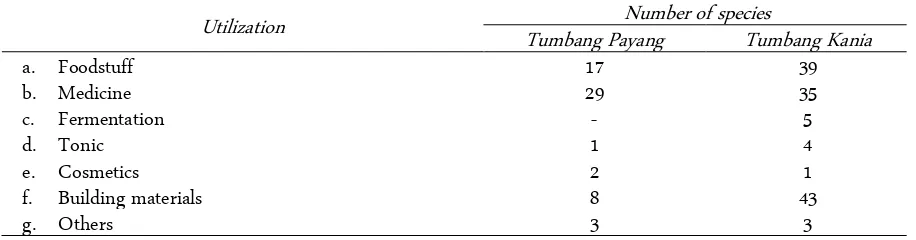
Recapitulation data of plant utilization by Dayak Ot Danum tribe in Tumbang Payang and Tumbang Kania is presented in Table 3. It shows that the number of plant species in Tumbang Kania is higher than that of Payang, although the two villages have similarity in their utilization. The existing biological natural resources have the potential to be developed as foodstuffs, medi-cines, fermentation materials, tonic materials, cosmetic materials, building materials, and other materials.
a. Foodstuff
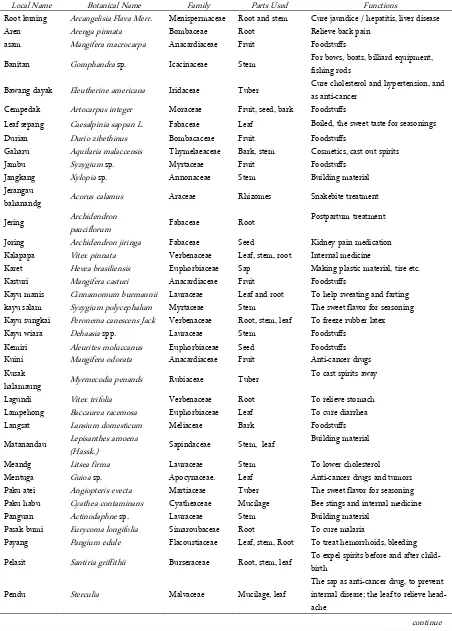
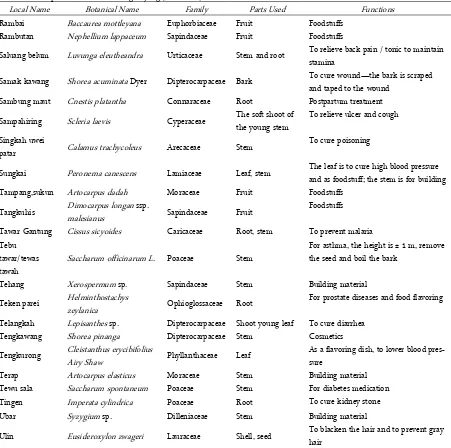
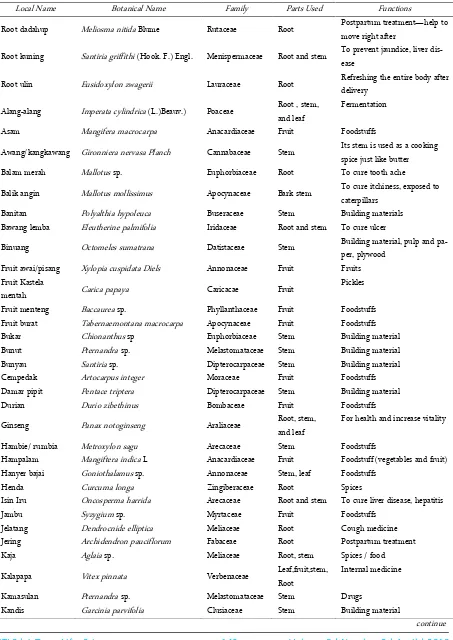
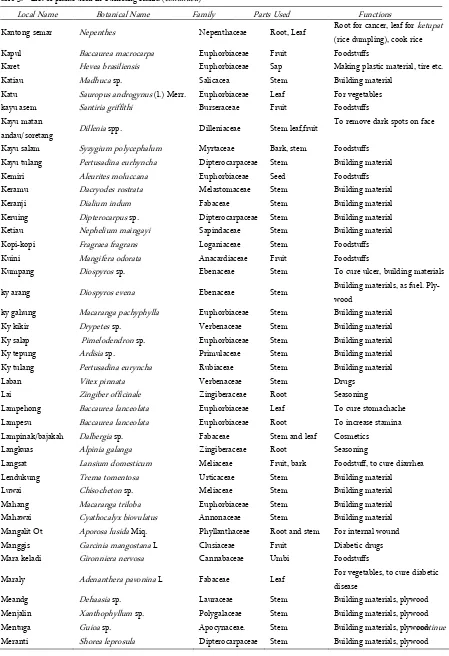
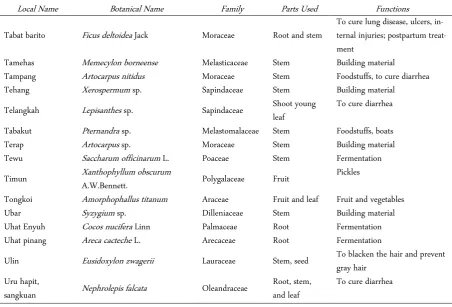
Recorded no less than 56 species of plants are taken from the forest by the community of Ot Danum in two villages used as food (vegetables). The highest potential is in Tumbang Kania, as compared to Tumbang Payang. The big potential in Tumbang Kania is because its struc-ture and vegetation are denser than Tumbang Payang, which is surrounded by many rivers and burnt forest areas. Of the 56 types of plants, 27 species are used as the fruit, while the rest is used for the stems, leaves, seeds, roots, and tubers (Table 4 and 5 appendices). Tabel 2. Recapitulation of plant distribution in 2 (two) villages
Village name Inside the observation site (ha)
Outside the observa-tion site (type)
The number of utilized types The number of individuals The number of types
Tumbang Payang 553 58 35 59
Tumbang Kania 655 139 64 123
Source: Research data, 2016
Table 3. Recapitulation data of plant utilization in 2 (two) villages
Utilization Number of species
Tumbang Payang Tumbang Kania
a. Foodstuff 17 39
b. Medicine 29 35
c. Fermentation - 5
d. Tonic 1 4
e. Cosmetics 2 1
f. Building materials 8 43
g. Others 3 3
These plants are used as a source of carbohydrates, pro-teins, vitamins, fiber, fat, and other compounds. The plant families in Tumbang Payang are Anacardiaceae (3 species), Moraceae (3 species), Euphorbiaceae (2 spe-cies), Myrtaceae (2 spespe-cies), and Sapindaceae (2 species); The plant families found in Tumbang Kania are Araca-ceae (4 species), EuphorbiaAraca-ceae (4 species), Anacardi-aceae (3 species), CannabAnacardi-aceae (3 species), Zingibera-ceae (3 species), AnnonaZingibera-ceae (2 species), MeliaZingibera-ceae (2 species), Moraceae (2 species), and Myrtaceae (2 types). The same potential to be developed in two villages is the one like from seeds by sowing directly on planta-tions or home gardens, or in the nursery mixed with soil and manure such as tamarind (Mangifera macrocarpa), cempedak (Artocarpus integer), durian (D. zibethinus), kasturi (Mangifera asturi), marianandau (Lepisanthes amoena (Hassk.), rambai (Baccaurea mottleyana), ram-butan (Nephellium lappaceum), sungkai (Peronema ca-nescens), tangkuhis (Dimocarpus longan ssp. Malesi-anus), cempedak (A. integer), can be directly eaten for vegetables such as tengkurong (Cleistanthus erycibifo-lius Airy Shaw), kastela (Carica papaya), cucumber (Xanthophyllum obscurum A.W. Bennett.), hambie or rumbia (Metroxylon sagu), singkah potok (Calamus trachycoleus), singkah undus or palm (Elais guinensiss Jacq), derived from cuttings such as rambutan (N. lap-paceum), sungkai (P. canescens). Such foodstuffs are also utilized in Nepal as vegetables cooked with a mix-ture of other ingredients to be consumed to meet daily needs [14].
b. Medicine
In everyday life, Dayak Ot Danum community in two villages still practice traditional medicine. The larg-est potential is in the village of Tumbang Kania as many as 35 types of medicinal plants, which are used to cure various diseases. Traditional medical skills must be con-trolled by people who have expertise in medicines. The community utilizes medicinal plants as an alternative and the first step in treating an illness due to lack of health facilities.
As many as 64 species have been recorded from both villages to cure various diseases (Table 4 and 5 ap-pendices). Dadaup root (Meliosma nitida Blume), ulin root (E. zwagerii), jering (Archidendron pauciflorum), panahan (Barringtonia scortechini King) are used to treat postpartum. The roots are boiled and the boiled water must be taken every morning, day, and night until the illness is healed. Likewise, with other diseases such as liver disease, plants used are akar kuning (Santiria
griffithi (Hook. F.) Engl.), isin iru (Oncosperma harrida), maraly (Adenanthera pavonina L.). The parts of the plants used are roots, stems, barks, leaves, and fruit; they are boiled and the boiled water must be taken every morning, day, and night until the illness is healed. The method of utilization and use of medicinal plant species is similar to the one done in Timpah, Central Kalimantan [15].
In line with the development of modern medicine, traditional medicine needs to be developed, considering the pattern of the community life. The effort to preserve and develop traditional medicine in Indonesia is insepa-rable from the fact that the archipelago is rich in tradi-tional medicinal materials and as anticipation in facing globalization era. Now traditional medicines have been produced under better standard and quality in the form of tablets, capsules or liquid, employing technology like the one done in China [16].
c. Fermentation
Plants used in fermentation in Tumbang Kania as a fermentation come from 5 (five) families such as alang-alang (Imperata cylindrica (L.) Beauv.), sahang (Piper albi Linn), tewu (Saccharum officinarum L.), uhat enyuh (Cocos nucifera, Linn), and uhat pinang (Areca cacteche L.). They are often used as a fermentation ma-terial, food, and cooking spices. These ingredients are usually made with a mixture of other ingredients such as sticky rice to make traditional drinking water called as baram [17]. Meanwhile, rare plant species often used in a fermentation process can also be found in India and Pakistan [15, 18].
d. Tonic
There is only 1 (one) type of plant used as tonic in Tumbang Payang, namely saluang belum (Luvunga eleutheandra); and there are 4 (four) plants used in Tumbang, namely ginseng (Panax notoginseng),
lampe-su (Baccaurea lanceolata), pasak bumi (Eurycoma
longifolia), and saluang belum (L. eleutheandra). These are used for health and to increase energy. They can be taken as they are or mixed with other plants. The form of the mixture consists of the root of saluang belum (L. eleutheandra) and lampesu (B. lanceolata)— they are boiled until and the water is taken three times a day. We can also take only the water of boiled pasak bumi (E. longifolia), either the root or the stem [3, 15].
The people in Tumbang Payang uses gaharu (Aqui
laria malaccensis), tengkawang (S. pinanga) and
lampinak or bajakah (Dalbergia sp.)—these plants are potential. The species can produce mastic, which is highly favored by the people of Middle East, Taiwan, Korea, and Japan, as incense for religious rites, room deodorizer, and as hio. Gaharu oil is very expensive and well-known raw material for cosmetics industry such as perfumes, soaps, lotions, facial cleansers, and medicines for hepatitis, liver, anti-allergic drugs, cough, stomach pain, rheumatism, malaria, tuberculosis, cancer, asthma, tonic, and aromatherapy [8]. Gaharu is used to make soap, deodorant, beauty materials, and ingredients to make offerings of traditional ritual ceremonies of Dayak Ot Danum [3, 14, 18].
f. Building materials
People in Tumbang Payang use 8 species and people in Tumbang Kania use 43 species. In general, commu-nities to the two villages are very dependent on the sur-rounding natural resources. The community has used the forest to fulfill the necessities of life, both for sub-sistence and commercial activities. For community needs such as wood to repair and build houses, such as making beams, rafters, battens, poles, and other benefits as firewood. The types of woody plants used are banitan (Polyalthia hypoleuca), bunyau (Santiria sp.), damar pipit (Pentace triptera), katiau (Madhuca sp.), mahang (Macaranga triloba), mahawai (Cyathocalyx biovulatus), medang (Dehaasia sp.), menjalin (Xanthophyllum sp.), meranti (Shorea leprosula), tehang (Xerospermum sp.), terap (Artocarpus sp.), ubar (Syzygium sp.), and ulin (E. zwagerii). Compared to some similar plantation forest in Kalimantan, the woody plants of the two villages have moderate to the severe complexity and endemic species [20]. Several types of woody plants are endemic to the Kalimantan Island, this type is most widely used as home building materials, and can also be made for paper pulp, veneer, plywood, and materials for roof or shingle made of ulin [19].
CONCLUSION
This study provides empirical evidence of indige-nous varieties of plant species in 2 (two) villages. The results show that the local varieties of plant species are not only a source of food and nutrition for local communities but can also be a means of increasing income if managed sustainably.
The study also highlights the potential species that
can be used in the genetic improvement of plant species. Some plant species can benefit local people not only as food but also as a medicine. Multi-value resources will be threatened by several anthropogenic causes of nature such as land clearing, habitat destruction, burning, log-ging, and invasive species.
Forest resources must be managed for the welfare of the people as well as to conserve species diversity—and the latter is of paramount importance as it can contrib-ute to preserving cultural and genetic diversity. Indige-nous plant diversity should be developed in an effort to conserve community forests with a realistic approach to the two villages, as most of the forests are managed only by certain groups. The study also reveals interesting findings of the types of local plants that can be consid-ered in developing certain types.
ACKNOWLEDGMENT
Our gratitude goes to the Ministry of Research, Technology, and Higher Education, to the Directorate General of Research and Development, and to the Di-rectorate of Research and Community Service that have granted this study for the doctoral dissertation. We also would like to thank LPPM University of Palangka Raya and PT. Sarpatim for providing field facilities and infra-structure especially to Mr. Dodi (the representative in Sampit), Mr. Hani (the manager camp), Mr. Fajar, Mr. Gunawan (planning staff), Mr. Dodi (social staff), the field survey team and PT. Sarpatim tree identifiers, and the community of Tumbang Payang and Tumbang Kania.
REFERENCES
1. Suryadarma IGP (2005) Konsepsi kosmologi dalam pen-gobatan Usada Taru Pramana. Journal of Tropical Ethnobi-ology 2 (1): 65 – 87.
2. World Bank (2013) http://www.worldbank.org/. Accessed: September 2013.
3. Noorcahyati, (2012) Tumbuhan berkhasiat obat etnis asli Kalimantan. Balikpapan, Ministry of Forestry Agency for Forestry Research and Development, Research Institute for Natural Resource Conservation Technology.
4. Sugiyono (2014) Metode penelitian kuantittatif, kualitatif dan kombinasi. Bandung, Alfabeta.
5. Research Institute for Environment and Forestry (RIEF) (2008) Database Desa Tumbang Payang dan Desa Tumbang Kania sosial ekonomi dan budaya di dalam dan sekitar hu-tan. Kota Waringin Timur, PT. Sarpatim.
pia. Journal of Ethnobiology and Ethnomedicine 2: 53. doi: 10.1186/1746-4269-2-53.
7. Jupri A (2015) Upaya konservasi mata air melalui kearifan lokal di Lingsar Lombok Barat Nusa Tenggara Barat. Doc-toral Thesis. Brawijaya University, Management of Natural Resources and Environment.
8. Munawaroh E, Saparita R, Purwanto Y (2011) Ketergan-tungan masyarakat pada hasil hutan non kayu di Malinau, Kalimantan Timur: Suatu analisis etnobotani dan im-plikasinya bagi konservasi hutan. Berkala Penelitian Hayati 7A: 51 – 58.
9. Tjilik Riwut., Nila R, (2007) Kalimantan membangun: Alam dan kebudayaan. Sleman, NR Publishing.
10. Rahu AA, Hidayat K, Ariyadi M, Hakim L (2014) Manage-ment of Kaleka (traditional gardens) in Dayak community in Kapuas, Central Kalimantan. International Journal of Sci-ence and Research 3 (3): 205 – 210.
11. Rifai MA (1998) Pemasakinian etnobotani Indonesia: Suatu keharusan demi peningkatan upaya pemanfaatan, pengem-bangan dan penguasaannya. Prosiding Seminar Nasional Etnobotani III: 5 – 6 May 1998; Denpasar.
12. Ahenkan A, Boon E (2011) Non-Timber Forest Products (NTFPs): Clearing the confusion in semantics. Journal of Human Ecology 33 (1): 1 – 9. doi: 10.1080/09709274. 2011.11906342.
13. Wondimu T, Asfaw Z, Kelbessa E (2007) Ethnobotanical study of medicinal plants around Dheeraa Town, Arsi Zone, Ethiopia. Journal of Ethnopharmacology 112 (1): 152 – 161. doi: 10.1016/j.jep.2007.02.014.
14. Uprety Y, Poudel RC, Shrestha KK et al. (2012) Diversity of use and local knowledge of wild edible plant resources in
Nepal. Journal of Ethnobiology and Ethnomedicine 8: 16. doi: 10.1186/1746-4269-8-16
15. Maikhurri RK, Nautiyal KS, Rao KS, Semwal RL (1998) In-digenous knowledge of medicine plants and wild edible among three tribal subcommunities of the Central Hima-laya, India. Indigenous Knowledge Development Monitor 8 (2): 7 – 13.
16. Liu B, Guo ZY, Bussmann R et al. (2016) Ethnobotanical approaches of traditional medicine studies in Southwest China: A literature review. Journal of of Ethnopharmacology 186 (20): 343 – 350. doi: 10.1016/j.jep.2016.02.040. 17. Setyowati FM, Riswan S, Susiarti S (2005) Etnobotani
masyarakat Dayak Ngaju di daerah Timpah Kalimantan Tengah. Jurnal Teknologi Lingkungan 6 (3): 502 – 510. 18. Khan MPZ, Ahmad M (2015) Traditional preference of Wild
Edible Fruits (WEFs) for digestive disorders (DDs) among the indigenous communities of Swat Valley-Pakistan. Jour-nal of Ethnopharmacology 174 (4): 339 – 354. doi: 10.1016/j.jep.2015.08.024.
19. Adi DS, Risanto L, Damayanti R et al. (2014) 2014. Explo-ration of unutilized fast growing wood species from secondary forest in Central Kalimantan: Study on the fiber characteristic and wood density. Procedia Environmental Sciences 20: 321 – 327. doi: 10.1016/j.proenv.2014.03.040 20. Izuno A, Tanabe AS, Toju H et al. (2016) Structure of
phyl-losphere fungal communities in a tropical dipterocarp plan-tation: A massively parallel next-generation sequencing anal-ysis. Mycoscience 57 (3): 171 – 180. doi: 10.1016/j.myc. 2015.12.005.
Appendix 1.
Table 4. List of plants used in Tumbang Payang
Local Name Botanical Name Family Parts Used Functions
Root kuning Arcangelisia Flava Merr. Menispermaceae Root and stem Cure jaundice / hepatitis, liver disease
Aren Arenga pinnata Bombaceae Root Relieve back pain
asam Mangifera macrocarpa Anacardiaceae Fruit Foodstuffs
Banitan Gomphandra sp. Icacinaceae Stem For bows, boats, billiard equipment, fishing rods
Bawang dayak Eleutherine americana Iridaceae Tuber Cure cholesterol and hypertension, and as anti-cancer
Cempedak Artocarpus integer Moraceae Fruit, seed, bark Foodstuffs
Leaf sepang Caesalpinia sappan L. Fabaceae Leaf Boiled, the sweet taste for seasonings
Durian Durio zibethinus Bombacaceae Fruit Foodstuffs
Gaharu Aquilaria malaccensis Thymelaeaceae Bark, stem Cosmetics, cast out spirits
Jambu Syzygium sp. Myrtaceae Fruit Foodstuffs
Jangkang Xylopia sp. Annonaceae Stem Building material
Jerangau
bahanandg Acorus calamus Araceae Rhizomes Snakebite treatment
Jering Archidendron
pauciflorum Fabaceae Root
Postpartum treatment
Joring Archidendron jiringa Fabaceae Seed Kidney pain medication
Kalapapa Vitex pinnata Verbenaceae Leaf, stem, root Internal medicine
Karet Hevea brasiliensis Euphorbiaceae Sap Making plastic material, tire etc.
Kasturi Mangifera casturi Anacardiaceae Fruit Foodstuffs
Kayu manis Cinnamomum burmannii Lauraceae Leaf and root To help sweating and farting kayu salam Syzygium polycephalum Myrtaceae Stem The sweet flavor for seasoning Kayu sungkai Peronema canescens Jack Verbenaceae Root, stem, leaf To freeze rubber latex
Kayu wiara Dehaasia spp. Lauraceae Stem Foodstuffs
Kemiri Aleurites moluccanus Euphorbiaceae Seed Foodstuffs
Kuini Mangifera odorata Anacardiaceae Fruit Anti-cancer drugs
Kusak
halamaung Myrmecodia penands Rubiaceae Tuber
To cast spirits away
Lagundi Vitex trifolia Verbenaceae Root To relieve stomach
Lampehong Baccaurea racemosa Euphorbiaceae Leaf To cure diarrhea
Langsat Lansium domesticum Meliaceae Bark Foodstuffs
Matanandau Lepisanthes amoena
(Hassk.) Sapindaceae Stem, leaf
Building material
Meandg Litsea firma Lauraceae Stem To lower cholesterol
Mentuga Guioa sp. Apocynaceae. Leaf Anti-cancer drugs and tumors
Paku atei Angiopteris evecta Martiaceae Tuber The sweet flavor for seasoning Paku habu Cyathea contaminans Cyatheaceae Mucilage Bee stings and internal medicine
Panguan Actinodaphne sp. Lauraceae Stem Building material
Pasak bumi Eurycoma longifolia Simaroubaceae Root To cure malaria
Payang Pangium edule Flacourtiaceae Leaf, stem, Root To treat hemorrhoids, bleeding Pelasit Santiria griffithii Burseraceae Root, stem, leaf To expel spirits before and after
child-birth
Pendu Sterculia Malvaceae Mucilage, leaf
The sap as anti-cancer drug, to prevent internal disease; the leaf to relieve head-ache
Table 4. List of plants used in Tumbang Payang (continued)
Local Name Botanical Name Family Parts Used Functions
Rambai Baccaurea mottleyana Euphorbiaceae Fruit Foodstuffs
Rambutan Nephellium lappaceum Sapindaceae Fruit Foodstuffs
Saluang belum Luvunga eleutheandra Urticaceae Stem and root To relieve back pain / tonic to maintain stamina
Samak kawang Shorea acuminata Dyer Dipterocarpaceae Bark To cure wound—the bark is scraped and taped to the wound
Sambung maut Cnestis platantha Connaraceae Root Postpartum treatment Sampahiring Scleria laevis Cyperaceae The soft shoot of
the young stem
To relieve ulcer and cough Singkah uwei
patar Calamus trachycoleus Arecaceae Stem
To cure poisoning
Sungkai Peronema canescens Lamiaceae Leaf, stem The leaf is to cure high blood pressure and as foodstuff; the stem is for building
Tampang,sukun Artocarpus dadah Moraceae Fruit Foodstuffs
Tangkuhis Dimocarpus longan ssp.
malesianus Sapindaceae Fruit
Foodstuffs Tawar Gantung Cissus sicyoides Caricaceae Root, stem To prevent malaria Tebu
tawar/tewas tawah
Saccharum officinarum L. Poaceae Stem
For asthma, the height is ± 1 m, remove the seed and boil the bark
Tehang Xerospermum sp. Sapindaceae Stem Building material
Teken parei Helminthostachys
zeylanica Ophioglossaceae Root
For prostate diseases and food flavoring Telangkah Lepisanthes sp. Dipterocarpaceae Shoot young leaf To cure diarrhea
Tengkawang Shorea pinanga Dipterocarpaceae Stem Cosmetics
Tengkurong Cleistanthus erycibifolius
Airy Shaw Phyllanthaceae Leaf
As a flavoring dish, to lower blood pres-sure
Terap Artocarpus elasticus Moraceae Stem Building material
Tewu sala Saccharum spontaneum Poaceae Stem For diabetes medication
Tingen Imperata cylindrica Poaceae Root To cure kidney stone
Ubar Syzygium sp. Dilleniaceae Stem Building material
Ulin Eusideroxylon zwageri Lauraceae Shell, seed To blacken the hair and to prevent gray hair
Appendix 2
Table 5. List of plants used in Tumbang Kania
Local Name Botanical Name Family Parts Used Functions
Root dadahup Meliosma nitida Blume Rutaceae Root Postpartum treatment—help to move right after
Root kuning Santiria griffithi (Hook. F.) Engl. Menispermaceae Root and stem To prevent jaundice, liver dis-ease
Root ulin Eusidoxylon zwagerii Lauraceae Root Refreshing the entire body after
delivery Alang-alang Imperata cylindrica (L.)Beauv.) Poaceae Root , stem,
and leaf
Fermentation
Asam Mangifera macrocarpa Anacardiaceae Fruit Foodstuffs
Awang/kangkawang Gironniera nervasa Planch Cannabaceae Stem Its stem is used as a cooking spice just like butter
Balam merah Mallotus sp. Euphorbiaceae Root To cure tooth ache
Balik angin Mallotus mollissimus Apocynaceae Bark stem To cure itchiness, exposed to caterpillars
Banitan Polyalthia hypoleuca Buseraceae Stem Building materials
Bawang lemba Eleutherine palmifolia Iridaceae Root and stem To cure ulcer
Binuang Octomeles sumatrana Datistaceae Stem Building material, pulp and
pa-per, plywood Fruit awai/pisang Xylopia cuspidata Diels Annonaceae Fruit Fruits Fruit Kastela
mentah Carica papaya Caricacae Fruit
Pickles
Fruit menteng Baccaurea sp. Phyllanthaceae Fruit Foodstuffs
Fruit burat Tabernaemontana macrocarpa Apocynaceae Fruit Foodstuffs
Bukar Chionanthus sp Euphorbiaceae Stem Building material
Bunut Pternandra sp. Melastomataceae Stem Building material
Bunyau Santiria sp. Dipterocarpaceae Stem Building material
Cempedak Artocarpus integer Moraceae Fruit Foodstuffs
Damar pipit Pentace triptera Dipterocarpaceae Stem Building material
Durian Durio zibethinus Bombaceae Fruit Foodstuffs
Ginseng Panax notoginseng Araliaceae Root, stem,
and leaf
For health and increase vitality
Hambie/ rumbia Metroxylon sagu Arecaceae Stem Foodstuffs
Hampalam Mangiftera indica L Anacardiaceae Fruit Foodstuff (vegetables and fruit)
Hanyer bajai Goniothalamus sp. Annonaceae Stem, leaf Foodstuffs
Henda Curcuma longa Zingiberaceae Root Spices
Isin Iru Oncosperma harrida Arecaceae Root and stem To cure liver disease, hepatitis
Jambu Syzygium sp. Myrtaceae Fruit Foodstuffs
Jelatang Dendrocnide elliptica Meliaceae Root Cough medicine
Jering Archidendron pauciflorum Fabaceae Root Postpartum treatment
Kaja Aglaia sp. Meliaceae Root, stem Spices / food
Kalapapa Vitex pinnata Verbenaceae Leaf,fruit,stem,
Root
Internal medicine
Kamasulan Pternandra sp. Melastomataceae Stem Drugs
Kandis Garcinia parvifolia Clusiaceae Stem Building material
Table 5. List of plants used in Tumbang Kania (continued)
Local Name Botanical Name Family Parts Used Functions
Kantong semar Nepenthes Nepenthaceae Root, Leaf Root for cancer, leaf for ketupat (rice dumpling), cook rice
Kapul Baccaurea macrocarpa Euphorbiaceae Fruit Foodstuffs
Karet Hevea brasiliensis Euphorbiaceae Sap Making plastic material, tire etc.
Katiau Madhuca sp. Salicacea Stem Building material
Katu Sauropus androgynus (l.) Merr. Euphorbiaceae Leaf For vegetables
kayu asem Santiria griffithi Burseraceae Fruit Foodstuffs
Kayu matan
andau/soretang Dillenia spp. Dilleniaceae Stem leaf,fruit
To remove dark spots on face Kayu salam Syzygium polycephalum Myrtaceae Bark, stem Foodstuffs
Kayu tulang Pertusadina eurhyncha Dipterocarpaceae Stem Building material
Kemiri Aleurites moluccana Euphorbiaceae Seed Foodstuffs
Keramu Dacryodes rostrata Melastomaceae Stem Building material
Keranji Dialium indum Fabaceae Stem Building material
Keruing Dipterocarpus sp. Dipterocarpaceae Stem Building material
Ketiau Nephelium maingayi Sapindaceae Stem Building material
Kopi-kopi Fragraea fragrans Loganiaceae Stem Foodstuffs
Kuini Mangifera odorata Anacardiaceae Fruit Foodstuffs
Kumpang Diospyros sp. Ebenaceae Stem To cure ulcer, building materials
ky arang Diospyros evena Ebenaceae Stem Building materials, as fuel.
Ply-wood
ky gahung Macaranga pachyphylla Euphorbiaceae Stem Building material
Ky kikir Drypetes sp. Verbenaceae Stem Building material
Ky salap Pimelodendron sp. Euphorbiaceae Stem Building material
Ky tepung Ardisia sp. Primulaceae Stem Building material
Ky tulang Pertusadina euryncha Rubiaceae Stem Building material
Laban Vitex pinnata Verbenaceae Stem Drugs
Lai Zingiber officinale Zingiberaceae Root Seasoning
Lampehong Baccaurea lanceolata Euphorbiaceae Leaf To cure stomachache
Lampesu Baccaurea lanceolata Euphorbiaceae Root To increase stamina
Lampinak/bajakah Dalbergia sp. Fabaceae Stem and leaf Cosmetics
Langkuas Alpinia galanga Zingiberaceae Root Seasoning
Langsat Lansium domesticum Meliaceae Fruit, bark Foodstuff, to cure diarrhea
Lendukung Trema tomentosa Urticaceae Stem Building material
Luwai Chisocheton sp. Meliaceae Stem Building material
Mahang Macaranga triloba Euphorbiaceae Stem Building material
Mahawai Cyathocalyx biovulatus Annonaceae Stem Building material
Mangalit Ot Aporosa lusida Miq. Phyllanthaceae Root and stem For internal wound
Manggis Garcinia mangostana L Clusiaceae Fruit Diabetic drugs
Mara keladi Gironniera nervosa Cannabaceae Umbi Foodstuffs
Maraly Adenanthera pavonina L Fabaceae Leaf For vegetables, to cure diabetic
disease
Meandg Dehaasia sp. Lauraceae Stem Building materials, plywood
Menjalin Xanthophyllum sp. Polygalaceae Stem Building materials, plywood
Mentuga Guioa sp. Apocynaceae. Stem Building materials, plywood
Meranti Shorea leprosula Dipterocarpaceae Stem Building materials, plywood
Table 5. List of plants used in Tumbang Kania (continued)
Local Name Botanical Name Family Parts Used Functions
Nange Flacourtia rukam Flacourtiaceae Fruit and leaf For vegetables
Nyatoh Palaquium sp. Sapotaceae Stem Building material
Otak uandg Buchanania sessifolia Anacardiaceae Stem, root, leaf To reduce cholesterol level
Pampaning Lihocarpus sp. Fagaceae Stem Building material
Panahan Barringtonia scortechini King Lecythidaceae Root, stem, fruit
Postpartum treatment
Panguan Actinodaphne sp. Lauraceae Stem Building material
Pansalingan Melicope glabra Rutaceae Stem Building material
Pasak bumi Eurycoma longifolia Simaroubaceae Root and stem Add vitality, and prevent dengue fever
Pasir Stemonurus scorpioides Becc. Stemonuraceae Stem Building material
Payang Pangium edule Flacourtiaceae Leaf, stem,
Root
To cure hemorrhoids, bleeding Pelasit Xerospermum sp. Burseraceae Root, stem, leaf To expel spirits before and after
childbirth
Pilang Artocarpus sp. Moraceae Stem Building material
Pisang hutan Musa acuminata Musaceae Fruit and stem For vegetables
Pulai Alstonia scholaris Apocynaceae Stem Building materials, plywood
Puring bahenda Phyllostachys sulphurea Gramineae Root To prevent heart disease
Putat Barringtonia serrata Lecythidaceae Stem Building material
Rambai Baccaurea mottleyana Euphorbiaceae Fruit Foodstuffs
Rambutan Nephellium lappaceum Sapindaceae Fruit Foodstuffs
Rengas Gluta wallichi Anacardiaceae Stem Building material
Sahang Piper albi Linn Piperaceae Fruit Fermentation
Halinjuang Cardilline petiolaris Liliaceae Shoot young leaf
To cure cramp
Saluang belum Luvunga eleutheandra Urticaceae Root and stem To cure waist pain, increase vi-tality
Sarai Cymbopogon nardus (L.)
Rendle Poaceae Stem
Seasoning
Sarang semut Epidendroides Sol Rubiaceae Tuber For cancer, gout, cholesterol, di-abetes
Sawi Tanah Nasturtium montanum Wall. Cruciferae Leaf For vegetables, rheumatism, and gastric pain
Simpur Dillenia sp. Dilleniaceae Stem Building material
Singkah potok Calamus trachycoleus Arecaceae Stem For vegetables
Singkah
undus/sawit Elais guinensiss Jacq Arecaceae Stem
For vegetables
Sirih Piper betle Piperaceae Root and stem Internal wound
Suli Petak/Tanah Leea indica Merr Vitaceae Root, stem,leaf To prevent diabetes Suna Trema cannabina Laur Cannabaceae Root and leaf Seasoning, leaf to eat
Sungkai Peronema canescens Verbenaceae Leaf, stem
Leaf is to cure high blood pres-sure / foodstuff, stem is for building material
Table 5. List of plants used in Tumbang Kania (continued)
Local Name Botanical Name Family Parts Used Functions
Tabat barito Ficus deltoidea Jack Moraceae Root and stem
To cure lung disease, ulcers, in-ternal injuries; postpartum treat-ment
Tamehas Memecylon borneense Melasticaceae Stem Building material
Tampang Artocarpus nitidus Moraceae Stem Foodstuffs, to cure diarrhea
Tehang Xerospermum sp. Sapindaceae Stem Building material
Telangkah Lepisanthes sp. Sapindaceae Shoot young
leaf
To cure diarrhea
Tabakut Pternandra sp. Melastomalaceae Stem Foodstuffs, boats
Terap Artocarpus sp. Moraceae Stem Building material
Tewu Saccharum officinarum L. Poaceae Stem Fermentation
Timun Xanthophyllum obscurum
A.W.Bennett. Polygalaceae Fruit
Pickles
Tongkoi Amorphophallus titanum Araceae Fruit and leaf Fruit and vegetables
Ubar Syzygium sp. Dilleniaceae Stem Building material
Uhat Enyuh Cocos nucifera Linn Palmaceae Root Fermentation
Uhat pinang Areca cacteche L. Arecaceae Root Fermentation
Ulin Eusidoxylon zwagerii Lauraceae Stem, seed To blacken the hair and prevent gray hair
Uru hapit,
sangkuan Nephrolepis falcata Oleandraceae
Root, stem, and leaf
To cure diarrhea