social and humanities
PROCEEDINGS
INTERNATIONAL CONFERENCE
2
nd
SHIELD 2017
52
ndDies Natalis Unila
Organized by:
Supported by:
Postgraduate Program and Institute for Research and Community Services University of Lampung
dev
el
opm
e
social and humanities
PROCEEDINGS
INTERNATIONAL CONFERENCE
2
nd
SHIELD 2017
52
ndDies Natalis Unila
Organized by:
Supported by:
Postgraduate Program and Institute for Research and Community Services University of Lampung
dev
el
opm
e
Bandar Lampung, September 18-20
2017
Editor:
Warsono, Ph.D
Prof. Dr. Sudjarwo, M.S.
Prof. Dr. Muhammad Akib. S.H.M.Hum.
Dr. Ir. Slamet Budi Yuwono, M.S.
Bayu Sujadmiko, Ph.D
Dr. Hasan Hariri
Dr. Vivit Bertoven
Dr. Melya Riniarti
Publisher:
Postgraduate Program University of Lampung
and
Foreword
In this globalization era, advancement in science and technology has led to remarkable gains
in life. However, despite the remarkable gains, many countries particularly Asian countries
face inequalities and uneven progress. Even worse, these countries are facing many problems
such as poverty, terrorism, drug abuse, and other social issues. These problems are complex
and multidimensional. We should give a real contribution to solving these problems. Because
the problems are multidimensional, we need people from cross-disciplinary interests to work
hand in hand with strong commitment, not only to face, but also to change these problems
into opportunities.
Therefore, the Postgraduate Program in collaboration with Institute of Research and
Community Service of University of Lampung provides a place for academicians,
practitioners, policy makers, researchers and professionals from multi-disciplines related to
Social Sciences and Humanities, Economics, Education, Law, and Sustainable Development
(SHIELD) to meet and interact with members inside and outside their own particular
disciplines. All participants are challenged to give their real contribution to helping solve the
real-world problems.
The authors of Proceeding of 2nd SHIELD International Conference come from
academicians, practitioners, policy makers, researchers and professionals from multi-
disciplines related to Social Sciences and Humanities, Economics, Education, Law, and
Sustainable Development.
This conference aims to share information and discuss resent developments and innovations
arising from research in a wide range of disciplines. Through this conference, it is expected
that the research articles can be documented and communicated throughout the countries.
Head of Commite
Welcome Address
Report by the Organizing Committee
Dear
distinguished
guests
and
participants
,
In this globalization era, advancement in science and technology has led to
remarkable gains. However, despite the remarkable gains, many countries
particularly Asian countries face inequalities and uneven progresses. Even
worse, these countries are facing many problems such as poverty, terrorism,
drug abuse, and other social issues. These problems are complex and
multidimensional. We should give a real contribution to solving these problems.
Because the problems are multidimensional, we need people from cross-
disciplinary interests to work hand in hand with strong commitment, not only
to face but also to change these problems into opportunities.
Therefore, the Postgraduate Program in collaboration with Institute of Research
and Community Service of University of Lampung holds The 2
ndSHIELD
Conference as a place for academicians, practitioners, policy makers,
researchers and professionals from multi-disciplines relating to Social Science
and Humanities, Economic, Education, Law, and Sustainable Development
to meet and interact with members inside and outside their own particular
disciplines. All participants are challenged to give their real contribution to
helping solve the real-world problems.
I would like to thank you for your participation and look forward to having
productive discussion among participants.
Sincerely yours,
Remarks by the Rector of the University of
Lampung
The Honorable keynote speakers, committees,
participants, ladies and gentlemen,
It gives me a great pleasure to welcome all of you and chair the Opening
Ceremony this morning to the Second SHIELD International Conference,
jointly organized by Postgraduate Program and Institute for Research and
Public Services, the University of Lampung. We’d like to say how grateful we
are to all the keynote speakers who have accepted our invitation. Also, we are
delighted to have all of participants here to participate and share in the Second
SHIELD International Conference.
Along with an increase in the activity of national development and dynamic
development of the international world due to globalization, then it always
be followed by the emergence of complex social, humanity, economics,
education, law and sustainable development issues. Therefore, the University
of Lampung, which has a vision to be the best 10 among public universities
nationwide, a mission to be a world class research university, and as the third
largest state university (outside Java Island) feels compelled to draw up concepts
and provide solutions to the various issues.
In relation to these issues, practically the University of Lampung through its
Postgraduate Program in collaboration with its Institute Research and Public
Services organizes the Second International
Conference with such disciplines as social sciences, humanities, economics,
education, law and sustainable development. This international conference
presents several keynote speakers who come from leading universities in the
world. These activities are held in Lampung, which is one area that has a
nationally important role, because it is the gateway of Sumatera Island and is
strategically located for the development progress.
life for dissemination of research results in the fields of social sciences,
humanities, economics, education, law and sustainable development. The
participants include practitioners, researchers, academics, students, industrialists
and science observers from various organizations such as industries, state-
owned enterprises, research institutions, government agencies, and public and
private universities.
To expand the horizons of thinking for the participants and to share the
experiences of international researches from world experts, this conference
invites four keynote speakers from four countries who will present their main
papers. These speakers are:
1.
Prof. Dr. Arief
Hidayat, S.H., M.S., Chairman of the
Constitutional Court, Republic of Indonesia
2.
Prof. Ryohei Kada from Shijyonawate Gakuen University,
Japan.
3.
Dr. Fonny Dameaty H. from University of Malaya, Malaysia.
4.
Dr. Jenny H. Panchal from James Cook University, Singapore.
We are honored to have you all the speakers here in this conference, and thank
you for being our keynote speakers in this conference.
Finally, I do hope that this seminar can run well and all participants can
participate actively.
Sincerely yours,
Rector,
TABLE OF CONTENT
Tittle and Writer
Page
COMMODIFICATION OF PAPUAN POVERTY IN TOURISM
MAGAZINE
Amadea Dwi Pradhipta, Udi Rusadi
PAKSI BENAWANG
AT TANGGAMUS :MARRIED RITE,
MARGINALIZED AND LOCAL WISDOM
Bartoven Vivit Nurdin, and Damayanti
A STUDY OF STUDENTS’ READING MOTIVATION FACTORS IN
SECOND LANGUAGE ACQUISITION AT THE THIRD GRADE OF A
SENIOR HIGH SCHOOL IN PANGKALPINANG
Erni Yulianti
THE EFFECT OF THE UNITED STATE PRESIDENTIAL ELECTION
ON JAKARTA ISLAMIC INDEX: EVIDENCE FROM INDONESIA
STOCK EXCHANGE
Hiro Sejati, Erna Listyaningsih and Nur Baiti
PRINCIPLED MATERIALS DEVELOMENT FOR KINDERGARTEN
STUDENTS
Iin Inawati
PRINCIPLED MATERIALS DEVELOMENT FOR KINDERGARTEN
STUDENTS
Jeni Wulandari, Sam’un Jaja Raharja, Heru Nurasa, Herwan Abdul Muhyi
THE IMPLEMENTATION OF DIVERSION IN CHILD CRIMINAL
JUSTICE SYSTEM IN INDONESIA
Nikmah Rosidah, Chaidir Ali
MODELS & PATTERNS OF CLIENTELISM IN LAMPUNG LOCAL
ELECTION
Robi Cahyadi Kurniawan, Utang Suwaryo, Muradi, R.Widya Setiabudi S
POSITIVE PROTECTION: PROTECTING GENETIC RESOURCES
RELATED TO TRADITIONAL KNOWLEDGE IN INDONESIA
Rohaini, Nenny Dwi Ariani
1-14
16-24
25-31
32-39
40-53
54-62
63-71
72-83
THE MODEL OF SMES EMPOWERMENT THROUGH VILLAGE
RULES AS EFFORTS TO IMPROVE THE QUALITY OF PRIMARY
PRODUCT VILLAGE
Yusnani Hasyimzum, Utia Meylina
THE IMPORTANCE OF DEVELOPMENT PLANNING IN LAND
ACQUISITION FOR PUBLIC INTEREST BASED ON LAND
SAVING MODEL REGULATION
Ade Arif Firmansyah, Yos Johan Utama and HS. Tisnanta
REPRESENTATION OF SUBJECT’S IDENTITY IN MIXED
MARRIAGE THROUGH CYBERMEDIA (SEMIOTIC ANALYSIS OF
“NASIB SAYA KAWIN CAMPUR” AND “NIKAH SAMA LOKAL”
VIDEOS ON SACHA STEVENSON’S YOUTUBE ACCOUNT)
Alifia Oktrina Fayardi and Eduard Lukman
LEGAL PROTECTION ON CHILDREN’S RIGHTS FROM BLOOD
RELATIONS MARRIAGE (INCEST) IN THE PERSPECTIVE OF
CONSTITUTIONAL LAW
Amnawaty Hamid, Dina Juliana Anwari, Siti Nurhasanah
REPRESENTATION
OF
SPEECH
POLITENESS
CULTURE
THROUGH SOCIAL MEDIA (SEMIOTIC ANALYSIS OF HATE
SPEECH INDONESIA NETIZEN TOWARD PRESIDENT JOKOWI IN
CYBERSPACE)
Annisa Nur Muslimah Koswara , Eduard Lukman
THE POSITION OF ONLINE DISPUTE RESOLUTION IN THE
POSITIVE LAW OF INDONESIA
Bayu Sujadmiko, Dheka Ermelia Putri and Bismo Jiwo Agung
ENVIRONMENTAL
PROTECTION
IN
ARMED
CONFLICT
ACCORDING TO INTERNATIONAL HUMANITARIAN LAW
Desy Churul Aini, Desia Rakhma Banjarani
THE PREFERENCE OF MULTIPLE REPRESENTATION ON
BIOLOGICAL CONCEPT : IDENTIFICATION AND QUALITY
CONSTRUCTED REPRESENTATION
Dewi Lengkana, Fransisca Tapilow, Ana Ratnawulan
THE CAPACITY DEVELOPMENT POLICY FOR APPARATUS
THROUGH NEW GOVERNMENT PARTNERSHIP COOPERATION
IN LAMPUNG TO OBTAIN OPTIMUM PUBLIC SERVICE
Dian Kagungan, Devi Yulianti
92-101
102-111
112-120
121-126
127-136
137-143
144-152
153-160
THE EFFECTS OF THE PERFORMANCE MEASUREMENT SYSTEM
ON THE MANAGERIAL PERFORMANCE (AN EMPIRICAL STUDY
ON BPR IN BANYUMAS REGENCY, INDONESIA)
Dona Primasari, Abdul Rohman, Fuad
EFFECT OF SERVICE QUALITY ON CUSTOMER SATISFACTION
AND LOYALTY SULTAN ISKANDAR MUDA INTERNATIONAL
AIRPORT ACEH INDONESIA AS THE WORLD’S BEST AIRPORT
FOR HALAL TRAVELLERS
Dorothy Rouly Haratua Pandjaitan
THE CRIMINAL LAW ENFORCEMENT AGAINST CRIMINAL ACTS
BEGAL
BY CHILD OFFENDERS
Eddy Rifai, Heni Siswanto, M. Farid, Anisa Cahaya Pratiwi
CHEMICAL CASTRATED SANCTION ON SEXUAL CRIME
IN
MEANING INSTRUCTIONS IN ENGLISH LANGUAGE TEACHING
AT THE UNIVERSITY OF LAMPUNG
Gede Eka Putrawan, Rafista Deviyanti, Riyan Hidayatullah
STRENGTHENING MODEL CRIMINAL LAW ENFORCEMENT
CRIME SPOLIATION BY THE APPLICATION OF INTEGRAL AND
SCIENTIFIC APPROACHES
Heni Siswanto, Maroni, Fathoni
LEGAL ASPECT OF THE COOPERATION ON TRIPLE HELIX
MODELS IN MITIGATION ANAK KRAKATAU MOUNTAIN
Heryandi
WASTE BANK: THE STRATEGY AND COMMUNITY-BASED
ENVIRONMENTAL GOVERNANCE
Intan Fitri Meutia
THE INFLUENCE OF INFORMATION SYSTEM ON MANAGERIAL
PERFORMANCE : TASK UNCERTAINTY UNCERTAINY TASK AS
MODERATING VARIABLE
Lego Waspodo, Rini Widianingsih, Dona Primasari
CULTURAL HYBRIDIZATION OF KOREAN BEAUTY TREND WITH
HALAL-CERTIFIED
LOCAL
COSMETICS
(ANALYSIS
OF
THE USE OF IMPORTED INPUT AND MANUFACTURING
INDUSTRY PRODUCTIVITY
Lies Maria Hamzah, Dian Fajarini
THE LEGAL POLITICS OF RECALL RIGHT OF POLITICAL PARTIES RELEVANCE WITH THE SYSTEM OF POPULAR SOVEREIGNTY IN DYNAMICS OF THE CONSTITUTION OF INDONESIA
Malicia Evendia, Armen Yasir, and Yulia Neta
STRENGTHENING THE INTEGRITY OF LOCAL LEADERSHIP
AND ITS RELEVANCE TO THE EFFORT TO RUN A DEMOCRATIC
GOVERNMENT
Maulana Mukhlis, Idil Akbar
NONPENAL EFFORT IN ADDRESSING ILLEGAL FISHING IN THE
LAMPUNG PROVINCE
Maya Shafira
REGULATION OF THE COOPERATION LAW INTER-REGIONAL IN
ENVIRONMENTAL MANAGEMENT IN LAMPUNG PROVINCE
Muhammad Akib, FX. Sumarja, Slamet Budi Yuwono, Hieronymus
Soerjatisnanta
HOW FAR IS THE PRECAUTIONARY PRINCIPLE CONSIDERED IN
THE BENEFITS OF GENETICALLY MODIFIED ORGANISMS
WORLD WIDE?
Orima Melati Davey, Ahmad Syofyan , Melly Aida
RESPONSIBILITY TO PROTECT: POSSIBILITY OF
IMPLEMENTATION INTERNATIONAL COMMUNITY TO
PROTECT CIVILIAN
Parulian Yusuf S, Rehulina
THE IMPLEMENTATION OF COORDINATION OF FINANCIAL
SERVICES AUTHORITY AND DEPOSIT INSURANCE AGENCY
(LPS) AND BANK INDONESIA TO THE TROUBLED BANK
Ratna Syamsiar
TRANSGENDER AS A SOCIAL PROBLEM: A FILM ANALYSIS OF
LOVELY MAN
BY TEDDY SOERIAATMADJA
Ria Hasna Shofiyya, Udi Rusadi
TAX DEBT IN THE BANKRUPTCY DISPUTE: INDUSTRIES BADJA
GARUDA INC. V.S. TAX OFFICE OF MEDAN BELAWAN
Rilda Murniati
a,Richmond Cosmas Tobias
267-276
277-287
288-295
296-304
305-311
312-322
32
3
-331
332-338
339-347
SPREADING OF POOR HOUSEHOLD AROUND WAN ABDUL
RACHMAN FOREST PARK AND MANGROVE FOREST IN
SIDODADI VILLAGE (STUDY IN SIDODADI VILLAGE SUB
DISTRICT OF TELUK PANDAN DISTRICT OF PESAWARAN)
Rizki Bahagia Utama, Rommy Qurniati, Arief Darmawan
THE
PROTECTION
OF
INDIGENOUS
PEOPLE’S
CONSTITUTIONAL RIGHTS: CASE OF KASEPUHAN CIPTAGELAR
Rudi Wijaya, Rudy
CLIMATE CHANGE ADAPTATION THROUGH A SHIFT IN
CROPPING AREA ONTO THE UPPER STREAM REGION:
MEASURING COFFEE BEANS RESPONSE IN PHYSICAL QUALITY
Samsul Bakri, Agus Setiawan, Ida Nurhaida
MARINE POLLUTION: INTERNATIONAL LAW PERSPECTIVE
AND SETTLEMENT DISPUTES
Siti Azizah, Safira Salsabila Annisa Musthofa
360-366
367-373
374-383
384-392
LAW PROBLEM ON THE COASTAL VILLAGE
393-397
Siti Khoiriah, Rudi Wijaya
EFFECT OF SELF EFFICIENCY AND TRAINING TO CAREER
DEVELOPMENT IN TEACHER STUDENTS IN THE SUBJECT OF
BEKASI CITY
Suherman, Dede Hamdani, Romlie Ardie
THE ROLE OF CREATING SHARED VALUE (CSV) TO ENFORCE
SOCIAL WELFARE FOR STAKEHOLDER
Sunaryo; I Ketut Dharma, Putra Yoga
DRAMATURGY STUDY ON COMMUNICATIONS BY GAY IN
BANDAR LAMPUNG
Toni Wijaya
THE ETHNIC
IMMIGRANT
LIVING IN SIDOWALUYO VILLAGE,
SIDOMULYO SUBDISTRICT, SOUTH LAMPUNG DISTRICT
Trisnaningsih, Buchori Asyik, Sudjarwo
THE ANALYSIS OF FINANCIAL SERVICES AUTHORITY (FSA) FUNCTION IN THE SUPERVISION OF THE GOOD CORPORATE
GOVERNANCE (GCG) IMPLEMENTATION FOR BANKING
INSTITUTIONS IN INDONESIA
Yulia Hesti, Nenny Dwi Ariani
THE INFLUENCE OF SEGMENTING STRATEGY AND BRAND
POSITIONING
STRATEGY
ON
CONSUMER
PURCHASING
DECISION (STUDY AT SMARTPHONE SAMSUNG IN INDONESIA)
Annisa Nurawalia, Faila Shofa
398-402
403-411
412-418
419-426
427-435
RESOLUTION MODEL ON HORIZONTAL VIOLENCE CONFLICTS
IN LOCAL MULTICULTURAL COMMUNITIES IN LAMPUNG
PROVINCE, INDONESIA
Hartoyo, Abdul Syani
449-455
LIVELIHOODS ASSETS CHANGES OF COMMUNITY FOREST
FARMERS ON PROTECTION FOREST
Hari Kaskoyo, Slamet Budi Yuwono, Christine Wulandari, Rommy Qurniati,
Irwan Sukri Banuwa
456-465
MAPPING THE INDIGENOUS CONFLICT OF INDONESIA: 1945-2017
Budiyono, Meylina U.
IMPLEMENTATION OF SYARI’AH ECONOMIC PRINCIPLES ON
THE MANAGAEMENT OF SYARI’AH MUTUAL FUND
IN INDONESIA
Nunung Rodliyah, Risti Dwi Ramasari
466-474
Commodification of Papuan Poverty in Tourism Magazine
Amadea Dwi Pradhipta, Udi Rusadi
Faculty of Social Scirnce and Political Science, University of Lampung [email protected]
Abstract
Tourism magazines are not different from other types of magazines. They also stand with text, which shaped all forms of language including words and pictures. They are usually equipped with beautiful photojournalism to attract tourists. However, in contrast to their articles in general, there is an article featuring depressing photographs of Papuans who are perfunctory below the poverty line. This research is conducted to analyze the discourse of photojournalism in Manusia Rawa Papua
article on National Geographic Traveler Indonesia magazine. The research was done by doing text analysis using Charles Sanders Peirce's semiotics theory. Based on the signs from the semiotics perspective, the result of this study shows a hidden message that Papuans are still classified as poor. This pathetic condition is then used as a commodification to attract the attention of magazine readers, who come from the upper middle class.
Keywords: commodification, photojournalism, semiotics, tourism magazine;
1. Introduction
Tourism plays an important role in the economic sector. The increase of visit numbers will increase the profit for some types of business in the tourism industry and the employment opportunities in tourist destinations (Wahab, 1997: 13). However, there are three stimuli that usually affect these tourists’ decision to travel; one of them is symbolic stimulus. Symbolic stimulus is the word, sentence, and image that the travel industry propagates for media promotion, such as newspapers, general magazines, and tourism magazines (Ross, 1998: 69). The existence of a symbolic stimulus that can influence the tourists’ visit impacts the media industry; whose stakeholders are competing each other to feature interesting photojournalism.
Basically, tourism magazines are not different from other types of magazines. They also stand
by text. Peter Garrett and Allan Bell in their book, Approaches to Media Discourse, mentioned that
texts are all forms of language, including words, speech, music, images, sound effects, and imagery (1998: 3). But, as a promotion media of tourist destinations, tourism magazines would require photojournalism in order to describe the destination’s condition more clearly to the readers.
However, tourism magazines do not always featuring beautiful photojournalism. One of the
proofs can be seen in the article Manusia Rawa Papua in National Geographic Traveler Indonesia
volume 7 number 7, which was published in July 2015. Contrast to other articles in the same magazine or other tourism magazines, this article shows the depressing photographs of Papuans who are perfunctory under the poverty line. From this article, it is safe to see that communities in Udagaga, Kayobiro, and Adona (UKA) village in Papua fulfill their daily necessities from local in their village.
Yet the fact that the article Manusia Rawa Papua became Editor’s Choice article in National
Geographic Traveler Indonesia volume 7 number 7 makes it more interesting.
National Geographic Traveler Indonesia is a reference for Indonesian readers who like to
travel, both inside and outside the country. The majority of its readers are groups of men and women aged 20-35 years with Socioeconomic Status (SES) A+, A, and B and work as employees or
employers1. This reader group indicates that National Geographic Traveler Indonesia is a magazine
1
that consumed by upper middle class. This fact is also reinforced by the high rate of advertising on
National Geographic Traveler Indonesia as can be seen in the following table.
Table 1. Rate card of National Geographic Traveler Indonesia 2015
Source: http://www.gramediamajalah.com/ratecard/print/6/national-geographic-travel
Media content actually does not reflect events perfectly. It is a representation of a world that has been selected and translated by the media. It is very likely to be used as commodities in commodification practice (Mosco, 2009: 133). Based on this statement, Papuan poverty reflection that is featured in article Manusia Rawa Papua is then suspected of being deliberately commodified in commodification practice. Therefore, the research question that will be discussed in this research is “How the commodification process of poverty occurs in photojournalism in article Manusia Rawa
Papua, based on Charles Sanders Peirce’s semiotics analysis method?”. Regarding this research
question, the purpose of this research is to analyze the commodification process of poverty in article
Manusia Rawa Papua based on the study of meaning of icon, index, and symbol.
Prior to this research, the author have found some previous research on photojournalism studying both non-tourism and tourism magazine, and the commodification of poverty in the mass media. One research that discusses photojournalism is a research entitled “Problems in Photojournalism: realism, the nature of news, and the humanitarian narrative” by John Taylor in 2010. Through this research, Taylor raised three problems that often arise related to the importance of photojournalism in the daily press. The first problem concerns to the compromised nature of photography as a foundation for authentic eye-witness reports. The second problem derives from the poor states of the newspaper industry as a reliable source of public record. Then, the third problem relates to how effective hard-hitting documentary record might be, given that readers are supposed to be quickly bored by images of suffering, unknown strangers. The result suggests that photography is not present as a medium that offers meaning in a transparent way. Then, it also suggests that depressing photos are allowed in the press, as long as it can lead readers to the truth and provide positive knowledges.
Another research that discusses photojournalism in tourism magazine is a research entitled “Analisis Foto Jurnalistik Majalah Travel Xpose (Studi Analisis Semiotika Mengenai Foto Wisata Indonesia dalam Rubrik Domestik Majalah Travel Xpose)” by Dawam Syukron in 2013. This research is conducted to gain the meaning of photojournalism in Travel Xpose magazine. The meaning includes denotation, connotation, and mythology and ideology based on Roland Barthes’ theory. The research was conducted by qualitative approach using semiotics analysis method. The result showed that photos, whether that records incidental events or planned and factually based on the field, had a hidden meaning behind them. The photos are shown to attract public sympathy.
feasible. At the level of representation, editing techniques can make the show more dramatic and moving. At the ideological level, it is clear that this show has a close relationship with capitalist ideology. Poverty is seen as a high-value commodity. Then, the characteristics of audience that tend to accept what they see without seeing what happens behind the text are exploited by the capitalist by designing a product that has the greatest potential to profit as much as possible using the smallest capital.
Based on the aforementioned research studies, the author have not found a study that focuses on researching the commodification of poverty in tourism magazine using photo semiotics analysis method. Thus, the result of this research are expected to complement some previous research on commodification, semiotics, or photojournalism in tourism magazines.
1.1Commodification
Vincent Mosco, in his book entitled The Political Economy of Communication, wrote that commodification is the process of transforming use values into exchange values. Based on Adam Smith’s explanation, the use values and exchange values are two values that can distinguish a product. The use values come from human satisfaction of a particular want or need, while the exchange values is based on what the product produces in exchange (2009: 129). More specifically, Mosco defines commodification as the process of transforming goods and services, including communication, which are valued for what they will bring in the marketplace. Meanwhile, commodities are a form of production that is regulated through the exchange process. Commodities are a special form of product when their production is organized through the exchange process (2009: 156).
Communication is mentioned as a potential arena as a place of commodification. Speaking of communication, Mosco discloses three types of commodification that are important for communication. The first type is commodification of content. This commodity is at the center of the study of the political economy of media and communications. This commodity occurs when the message or content of the communication is treated as a commodity. The second type is the commodification of audiences. In this commodification, the political economy puts some attention on the audience, especially in an attempt to understand the general practice in the way advertisers pay for the size and quality (the trend for consumption) of audiences, magazines, websites, radio, or television programs. The third type is the commodification of labor. Communications workers who are also commodified as wage labor have grown significantly in the media job market (Mosco, 2009: 133- 141).
1.2Market-Driven Journalism
2. Representation
In his book, Representation: Cultural Representations and Signifying Practices, Stuart Hall mentioned that representation is the production of the meaning of concepts in the mind through language. Representation connects concepts and languages that allow humans to refer to things, people, or events in both the real world and the fictional world. According to Hall, representation arises because of the principle of similarity and difference to build relationships between concepts or differentiate them from one another. In order to successfully elicit representation, humans need a common conceptual map. However, the conceptual map also needs to be translated into a common language so that people can connect concepts and ideas with some written words, spoken voices, and meaningful visual images called “signs” (1997: 17-18).
2.1Charles Sanders Peirce’s Semiotics Theory
Something can be called as a sign if it represents something. Charles Sanders Peirce explained, semiotics depart from three main elements called triangle meaning theory. This theory consists of sign, object, and interpretant (Kriyantono, 2006: 263). The object is something referencend by a sign. Then, interpretation is a sign that is in someone’s mind about the object being referred to a sign (Sobur, 2012: 115). These signs are identified by Peirce into 66 different types of signs. Three of them commonly used for studying semiotics are: (1) icon, this sign is designed to represent a reference source through a form of replication, simulation, imitation, or equation, (2) index, this sign representing a reference source by pointing to it (explicitly or implicitly) with other reference sources, (3) symbols, this sign representing the object by agreement in a specific context (Danesi, 2012: 33).
3. Research Methods
This research applies qualitative research. There are three methods that can be used in qualitative research (Baxter, 2004: 348). One of them is social text analysis. Something can be called a social text, as long as it contains symbols and meanings: varies from conversations at home or at work, to photos and movies. Baxter mentioned that the semiotics approach is included in social text analysis (2004: 353).
The source of research data was collected from Manusia Rawa Papua article in National
Geographic Traveler Indonesia volume 7 number 7, published by Kompas Gramedia in July 2015.
The ten pages-article consists of written text and ten photos. The primary data used are the ten photos that featured in the article. But, this research does not ignore the written text to see the photo context. Literature review was also conducted to find out the larger content about poverty in Papua.
After collecting the data, the research continued by identifying the signs of poverty commodification contained in the photo by analyzing the type of signs according to Peirce’s semiotic analysis perspective. All of the photos that featured were analysed one by one by considering three types of signs. Then, the research continued with the overall interpretation of the poverty commodification in Manusia Rawa Papua article. The final step is to draw the conclusion of the interpretation of the signs that has been identified previously and to give criticism of the results that have been obtained.
4. Results and Concluding Discussion
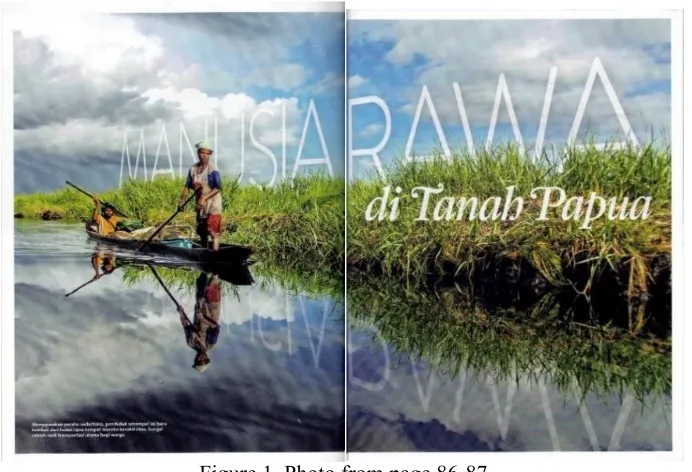
Figure 1. Photo from page 86-87
Table 2. Sign identification of Figure 1
Type of sign Sign Object
Icon Visualization of two Papuans Same with the sign
Index Clothes Simple and shabby
clothes
Index Rowing boat Rowing boat that small
and simple in poor condition
Symbol The title of the article “Manusia Rawa di Tanah
Papua” (Human swamp in the land of Papua)
Written text in the middle of the photo Symbol Photo caption “Menggunakan perahu
sederhana, penduduk setempat ini baru kembali dari hutan rawa tempat mereka beraktivitas. Sungai adalah nadi transportasi utama bagi
warga.” (Using a simple boat, these locals have
just returned from the swamp forest where they do their activity. River is the main transportation route for the residents.)
Written text in the lower left corner of the photo
Overall, this photo of two Papuans was taken to illustrate the daily life of the people living in Papua. The Papuan are depicted as if very primitive with the writing of ‘manusia rawa’ (human swamp). In the photograph, the two Papuans are seen wearing clothes that simple and shabby. In addition, they are seen rowing small simple boat in poor condition to travel from one place to another. Indonesian Team for the Acceleration of Poverty Reduction (Badan Koordinasi Penanggulangan Kemiskinan Republik Indonesia) and Research Institution SMERU (Badan Penelitian SMERU) explained that two examples of poverty problems are the inability to meet basic consumption needs, such as clothes, and lack of access to other basic living needs, such as transportation (Susanto, 2006: 35). This shows that the Papuan still have poverty problems. Judging from the aspect of taking photo, the composition of photo that used to make this photo has a sale value. As described in Digital
Masters: Travel Photography (2008: 69), the composition of this photo is included in the category of
Figure 2. Photo from page 88
Table 3. Sign identification of Figure 2
Overall, this photo of the harbour was taken to illustrate the profession of Papuan that living around Teminabuan Port. The Papuan is shown earning money by doing lower class jobs, such as being a longboat driver or unskilled laborers. Besides that, the activity of loading and unloading cargo seen in the photograph relies solely on hands and a small wooden board. This activity will certainly take a long time if done without the help of high-tech tools. Corruption Eradication Commission (Komisi Pemberantasan Korupsi) explained that one of the characteristics of the poor is not having the ability to conduct productive business activities (Papilaya, 2013: 21). Thus, the Papuan are still classified as poor. Judging from the aspect of taking photo, the composition of photo that used to make this photo has a sale value. As described in Digital Masters: Travel Photography (2008: 72), the composition of this photo is included in the category of Leading lines.
Figure 3. Photo from page 89
Type of sign Sign Object
Icon Visualization of male workers in port Same with the sign
Index Loading and unloading cargo Loading and unloading cargo
with hands and a small wooden board
Symbol Photo caption “Suasana aktivitas di Pelabuhan Teminabuan, Ibukota Kabupaten Sorong Selatan. Pelabuhan ini menjadi titik awal perjalanan panjang menuju Kampung Udagaga, Kayobiro,
dan Adona (UKA).” (Activity atmosphere at
Teminabuan Port, in the capital of South Sorong Regency. This port became the starting point of a long journey to Udagaga, Kayobiro, and Adona (UKA) village.)
Table 4. Sign identification of Figure 3
Type of sign Sign Object
Icon Visualization of a child Same with the sign
Icon Visualization of houses on stilts Same with the sign
Icon Visualization of bridge Same with the sign
Index Crossing the bridge Walking across the bridge
without fear of falling Symbol Photo caption “Mentari menghangatkan Kampung
UKA pagi itu. Di kampung ini, arah bangunan rumah menghadap ke sungai. Semua aktivitas dilakukan di atas rumah panggung dan jembatan yang
menghubungkan satu rumah ke rumah lainnya.” (The
sun warmed up UKA village that morning. In this village, the direction of the house building faces the river. All activities are carried out on stilts and bridges that connect one house to another.)
Written text in the outside the photo
Overall, this photo was taken to illustrate neighbourhood residents in UKA village. Residents live in houses on stilts whose condition looks easily damaged. The materials that used for the walls and roofs of these houses appear to have inferior quality compared to most urban houses. Besides that, residents have to cross the bridge that conditions is also fragile to move from one house to another. The bridge is made using small woods that are unable to withstand heavy loads. However, a child that featured in the photo is not afraid to cross the bridge without adult supervision. The photo shows that situation like that is commonly experienced by children in UKA village. Judging from the aspect of taking photo, the composition of photo that used to make this photo has a sale value. As described in
Digital Masters: Travel Photography (2008: 69), the composition of this photo is included in the
category of One center of interest and a clean background. .
Figure 4. Photo from page 90
Table 5. Sign identification of Figure 4
Type of sign Sign Object
Icon Visualization of photos of former President and Vice President of Indonesia
Same with the sign
Icon Visualization of old electronic equipments Same with the sign
Index House interior House interior that are not
durable, dirty, and messy Symbol Photo caption “Interior rumah warga di Kampung
UKA. Sebuah televisi, aki untuk sumber listrik, dan tak lupa foto Presiden Republik Indonesia
SBY-Boediono yang belum diganti.” (The house interior of a resident in UKA village. A television, battery for power source, and photos of President of the Republic of Indonesia SBY-Boediono that has not been replaced.)
Overall, this photo was taken to illustrate the house interior of Papuans. The condition of the house interior looks very different form the condition of the house interior in most urban areas. This interior uses materials that are not durable, such as bamboo walls and floor woods. The furniture in the house looks dirty and messy. This house also still has the old electronic equipment that is not widely used anymore. Besides that, this house displays photos of former President Susilo Bambang Yudhoyono and Vice President Boediono whose term has expired on October 20, 2014. The backwardness of Papuans in possessing the latest goods can be caused by two reasons, the slow distribution of goods in Papua and the inability of the Papuans to buy expensive goods. Because, Papua is a province located in the easternmost region of Indonesia and difficult to reach by other areas. This is consistent with John Kenneth Galbraith’s explanation that geographical location can be a major cause of poverty (Susanto, 2006: xxv).
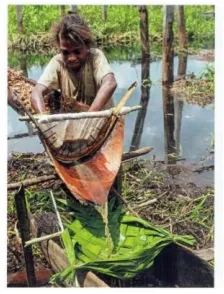
Figure 5. Photo from page 90
Table 6. Sign identification of Figure 5
Overall, this photo of sago processing was taken to illustrate the activities of men and women in UKA village. The women in this village are described having the routine of sago processing using their own hands. Sago processing is done with simple tools, such as bamboo and coconut leaves. In addition, the men in this village are described having a routine to work in swamp forest. The research conducted by Soedarto explains that people in Papua (formerly Irian Jaya) live in subsistence life because of their socioeconomic and cultural environment, as well as their human resource capacity are still very limited (Soeradji, 1998: 333). That research can be said is still relevant to the condition of Papuan today. Judging from the aspect of taking photo, the composition of photo that used to make this photo has a sale value. As described in National Geographic Photography Field Guide: Travel
(2005: 53), the composition of this photo is included in the category of The rule of thirds.
Type of sign Sign Object
Icon Visualization of a woman Same with the sign
Index Clothes Simple and shabby clothes
Index Sago processing Sago processing with simple
tools Symbol Photo caption “Sementara pria bekerja ke hutan
rawa, kaum perempuan mengolah sagu.” (While men
work in swamp forests, women process sago.)
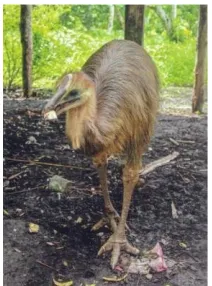
Figure 6. Photo from page 90
Table 7. Sign identification of Figure 6
Overall, this photo of cassowary bird was taken to illustrate the life condition of Papuan who are still very close to nature. In contrast to the condition of residence in the developed region that overrides the existence of nature, Papua is still filled with simple places to live in the midst of nature, without changing the natural conditions. Cassowary bird that featured in the photo is also seen eating food calmly. This bird does not feel disturbed and feel safe as if it was in its natural habitat. However, the bird is mentioned to be a resident’s pet. In fact, as the Encyclopædia Britannica explains, cassowary is the most dangerous bird in the world2. This bird has fierce and aggressive nature, and easy to attack if it feel disturbed. So, cassowary being resident pet can show that knowledge of the Papuan is relatively low. Judging from the aspect of taking photos, the composition of photo that used to make this photo has a sale value. As described in Digital Masters: Travel Photography (2008: 69), the composition of this photo is included in the category of One center of interest and a clean background.
Figure 7. Photo from page 92-93
Table 8. Sign identification of Figure 7
2 6 of the world’s most dangerous birds.
(n.d.). May 7, 2017. https://www.britannica.com/list/6-of-the-worlds- most-dangerous-birds
Type of sign Sign Object
Icon Visualization of cassowary bird Same with the sign
Index Eating food Eating food calmly
Symbol Photo caption ‘Kasuari dijadikan hewan peliharaan
warga.’ (Cassowary is made into resident’s pet.)
Written text in the outside the photo
Type of sign Sign Object
Icon Visualization of a man Same with the sign
brown river
Index River Blackish brown river
Symbol Photo caption “Salah satu rutinitas kaum pria adalah menjaring ikan di sungai. Air sungai dengan
rupa cokelat kehitaman ini bersumber dari rawa.”
(One of the men's routines is catching fish in the river. The river with this blackish brown water is came from the swamp.)
Written text in the outside the photo
Overall, this photo of fish catching was taken to illustrate one of men activities in UKA village. As mentioned in figure 5 analysis, this activity shows that Papuans are still live in subsistence life. Besides that, the fish catching is done in the river whose water is blackish brown. The color of this river water shows that the availability of clean water is still limited in UKA village. National Development Planning Agency of Republic of Indonesia (Badan Perencanaan Pembangunan Nasional) explained that the inability to fulfill basic needs, such as clean water, is one element of poverty (Papilaya, 2013: 21). Thus, Papuan are still classified as poor. Judging from the aspect of taking photo, the composition of photo that used to make this photo has a sale value. As described in
Digital Masters: Travel Photography (2008: 69), the composition of this photo is included in the
category of One center of interest and a clean background.
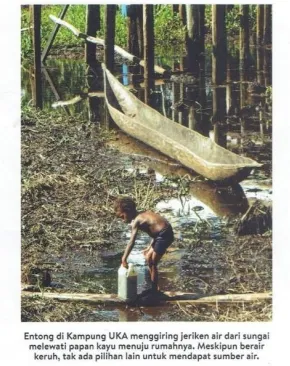
Figure 8. Photo from page 94
Table 9. Sign identification of Figure 8
Type of sign
Sign Object
Icon Visualization of a boy Same with the sign
Index Taking water Taking water that is dark
brown and turbid
Index Water source Water source that came
from the blackish brown river
Symbol Photo caption “Entong di Kampung UKA menggiring jeriken air dari sungai melewati papan kayu menuju rumahnya. Meskipun berair keruh, tak ada pilihan lain
untuk mendapat sumber air.” (Entong in UKA village bring
water jerrycan from the river through a wooden board to his house. Though the water is turbid, there is no other choice to get a water source)
Overall, this photo of a boy named Entong was taken to illustrate the way the Papuan in UKA village get water. Entong mentioned forced to take water from the blackish brown river and turbid because there is no other water source that condition is cleaner. As mentioned in figure 7 analysis, this activity indicates that the availability of clean water is still limited in UKA village. Judging from the aspect of taking photo, the composition of photo that used to make this photo has a sale value. As described in Digital Masters: Travel Photography (2008: 69), the composition of this photo is included in the category of One center of interest and a clean background.
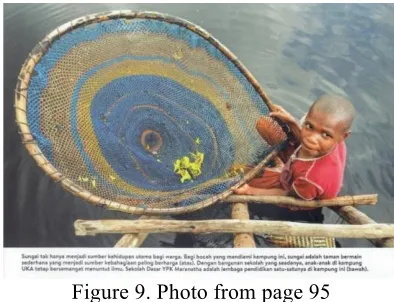
Figure 9. Photo from page 95
Table 10. Sign identification of Figure 9
Overall, this photo of a boy was taken to illustrate the situation of children’s play activity in UKA village. The river that became the main source of life, the main transportation route, the place to fish, and the water source is also a playground for children in UKA village. This is due to the entertainment of children in the village is very limited. In addition, the tools that used to play by the children in the river is very simple, such as nets and leaves. Judging from the aspect of taking photo, the composition of photo that used to make this photo has a sale value. As described in Digital
Masters: Travel Photography (2008: 69), the composition of this photo is included in the category of
One center of interest and a clean background.
Type of sign
Sign Object
Icon Visualization of a boy Same with the sign
Index River The river that
became the main source of life and the playground
Index Playing on the river Playing on the river
as an entertainment Symbol Photo caption “Sungai tak hanya menjadi sumber kehidupan
utama bagi warga. Bagi bocah yang mendiami kampung ini, sungai adalah taman bermain sederhana yang menjadi sumber
kebahagiaan paling berharga.” (The river is not only the main
source of life for the residents. For the boy who lives in this village, the river is a simple playground that becomes the most precious source of happiness.)
Figure 10. Photo from page 95
Table 11. Sign identification of Figure 10
Overall, this photo of classroom was taken to illustrate the educational institution in UKA village. Classroom filled with students shows that Papuan in UKA village is still aware of the importance of education. However, in the photo caption mentioned, YPK Maranatha elementary school in the photo is the only educational institution in UKA village. Besides, this school is in poor condition. Based on education achievement data in 2015-2016 from Ministry of Education and Culture of Republic of Indonesia (Kementerian Pendidikan dan Kebudayaan)3, the achievement rate of junior high school and equivalent in Papua has reached 642.700 and 415.800. Then, the achievement rate of secondary school education and equivalent has reached 484.300 and 376.900. Meanwhile, the achievement rate of junior high school and equivalent in DKI Jakarta has reached 1.080.100 and 958.000. Then, the achievement rate of secondary school education and equivalent has reached 913.600 and 679.100. Thus, many Papuans that still only achieve education up to elementary school and lag far behind other provinces. In fact, as presented by the Indonesian Team for the Acceleration of Poverty Reduction (Badan Koordinasi Penanggulangan Kemiskinan Republik Indonesia) and Research Institution SMERU (Badan Penelitian SMERU), the lack of access to education is one of the poverty problems.
4.1 Commodification of Papuan Poverty in Manusia Rawa Papua Article
According to the authors' interpretation, the photojournalism that examined in this research contain a hidden message that Papuans are still classified as poor. The authors' interpretation is reinforced by data from the Indonesian Central Agency on Statistics (Badan Pusat Statistik) which shows that Papua was the poorest province in Indonesia when the Manusia Rawa Papua article was published. In March 20114, DKI Jakarta became the richest province with the percentage of poor population of 3,75% and Papua became the poorest province with the percentage of poor people
3
Ministry of Education and Culture of Republic of Indonesia (2016, June). Indonesia educational statistics in brief 2015/2016. May 9, 2017. http://publikasi.data.kemdikbud.go.id/uploadDir/isi_AA46E7FA-90A3- 46D9-BDE6-CA6111248E94_.pdf
4
Indonesian Central Agency on Statistics (2011, December 1). Laporan bulanan data sosial ekonomi edisi 19. March 24, 2017. https://www.bps.go.id/website/pdf_publikasi/IP_Desember_2011.pdf
Type of sign Sign Object
Icon Visualization of elementary school students Same with the sign Symbol Photo caption “Dengan bangunan sekolah yang seadanya,
anak-anak di Kampung UKA tetap bersemangat menuntut ilmu. Sekolah Dasar YPK Maranatha adalah lembaga
pendidikan satu-satunya di kampung ini.” (With a simple
school building, children in UKA village still eager to study. YPK Maranatha Elementary School is the only educational institution in this village.)
31,98%. In March 20125, DKI Jakarta became the richest province with the percentage of the poor at 3,69% and Papua became the poorest province with the percentage of poor people 31,11%. In March 20136, DKI Jakarta became the richest province with the poor percentage of 3,55% and Papua became the poorest province with the percentage of poor people 31,13%. In March 20147, DKI Jakarta became the richest province with the percentage of poor people of 3,92% and Papua being the poorest province with the poor percentage of 30,05%. Then in March 20158, DKI Jakarta became the richest province with the percentage of poor people of 3,93% and Papua became the poorest province with the percentage of poor people of 28,17%. From these various data, it can be concluded that during the last five years until the Manusia Rawa Papua article was created, Papua is constantly the poorest province in Indonesia.
Based on the result of research that has been done, the photojournalism in Manusia Rawa
Papua article shown the representation of poverty. Production of the meaning of the concept of
poverty is translated into a common language, which can be seen through the types of signs in Peirce's semiotics perspective. Starting from the icon, the signs are Papuan and cassowary bird. All these residents are shown with simple and shabby clothes or even without clothes and footwear. Cassowary birds also should not be resident’s pet. Then, the index, the signs are objects and various activities of the Papuan. Clothes and home interior indicate that these two things are not a priority for Papuans. In addition, the Papuans’ acitivity are usually carried out without adequate equipment. Next, the symbol, the signs are written text and photo captions. These signs strengthen the conditions of poor Papuans.
As mentioned before, media content is a representation of the world and very likely to be a commodity. The representation of poverty displayed through photojournalism at the same time is used as a commodity to attract the attention of magazine readers, who are mostly from middle to upper class. This phenomenon is in line with Bob Krist's exposure in Digital Masters: Travel Photography
that the desperation of the poor in various countries can attract the attention of tourists and photographers because of the great distance between rich and poor communities (2008: 135). The representation of poverty displayed through the photojournalism is also reinforced by the composition of high-value photographs and photos information that explain the poor condition of Papuan.
The commodification process in photojournalism in Manusia Rawa Papua article takes place when the actual photo has the value to communicate the condition of the Papuan community to the reader transforming into exchange value as it can generate profit in the market. The commodification process investigated in this research belongs to the type of commodification that is important for communication according to Mosco. That type of commodification is the commodification of content because the treated as a commodity.
5. Conclusion
From this research, it can be concluded that the photos in the magazine is able to provide a world representation to magazine readers. The process of displaying representation at the same time can also be a commodification process. Through the signs in Peirce’s semiotics perspective, the result of the analysis in this research indicates that Papuan poverty is turned to be a commodity by the magazine.
Nevertheless, the commodification of Papuan poverty can not only be used for the benefit of the magazine. This commodification can also bring benefit to the Papuan. Therefore, the depressing conditions shown through photojournalism can lead to awareness of readers and even governments, that the Papuan still need a lot of help to improve their living condition.
5
Indonesian Central Agency on Statistics (2012, December 3). Laporan bulanan data sosial ekonomi edisi 31. March 24, 2017. https://www.bps.go.id/website/pdf_publikasi/IP_Desember_2012.pdf
6
Indonesian Central Agency on Statistics (2013, December 2). Laporan bulanan data sosial ekonomi edisi 43. March 24, 2017. https://www.bps.go.id/website/pdf_publikasi/IP_Desember_2013.pdf
7
Indonesian Central Agency on Statistics (2014, December 1). Laporan bulanan data sosial ekonomi edisi 55. March 24, 2017. https://www.bps.go.id/website/pdf_publikasi/IP_Desember_2014.pdf
8
References
Baxter, Leslie A., & Earl Babbie. (2004). The basics of communication research. Toronto, Ontario: Thomson Wadsworth.
Caputo, Robert. (2005). National geographic photography field guide: Travel. Washington D.C.: National Geographic.
Danesi, Marcel. (2012). Pesan, tanda, dan makna: Buku teks dasar mengenai semiotika dan teori
komunikasi (Evi Setyarini dan Lusi Lian Piantari, Trans.). Yogyakarta: Jalasutra.
Hall, Stuart. (1997). Representation: Cultural representations and signifying practices. London, Thousand Oaks, New Delhi: Sage Publications.
Krist, Bob. (2008). Digital masters: Travel photography. New York: Lark Books.
Kriyantono, Rachmat. (2006). Teknis praktis riset komunikasi. Jakarta: Prenada Media Group.
McManus, John H. Market-Driven journalism: Let the citizen beware?. London, Thousand Oaks, New Delhi: Sage Publications.
Mosco, Vincent. (2009). The political economy of communication (2nd ed.). London & New York: Sage.
Muhtadi, Asep Saeful. (1999). Jurnalistik: Pendekatan teori dan praktik. Jakarta: Logos Wacana Ilmu.
Nisa, Anis Haifa K. (2014). Komodifikasi kemiskinan dalam acara televisi (Analisis semiotika John
Fiske mengenai komodifikasi kemiskinan dalam acara “Orang pinggiran”. Bandung:
Universitas Islam Bandung.
Papilaya, Eddy Chiljon. (2013). 7 kiat percepatan pengurangan kemiskinan dan pemiskinan bangsa.
Bogor: IPB Press.
Peter Garrett & Allan Bell. (1998). Approaches to media discourse. New Jersey: Wiley-Blackwell. Ross, Glenn F. (1998). Psikologi pariwisata. (Marianto Samosir, Trans.). Jakarta: Yayasan Obor
Indonesia.
Soeradji, Budi, & Mubyarto. (1998). Gerakan penanggulangan kemiskinan: Laporan penelitian di
daerah-daerah. Yogyakarta: Penerbit Aditya Media.
Sobur, Alex. (2012). Analisis teks media – Suatu pengantar untuk analisis wacana, analisis semiotik,
dan analisis framing. Bandung: PT. Remaja Rosdakarya.
Susanto, Hari. (2006). Dinamika penanggulangan kemiskinan: Tinjauan historis era orde baru. Jakarta: Khanata-Pustaka LP3ES Indonesia.
Syukron, Dawam. (2013). Analisis foto jurnalistik majalah Travel Xpose (Studi analisis semiotika
mengenai foto wisata Indonesia dalam rubrik domestik majalah Travel Xpose). Serang:
Universitas Sultan Ageng Tirtayasa.
Taylor, John. (2000): Problems in photojournalism: Realism, the nature of news and the humanitarian narrative, Journalism Studies, 1:1, 129-143.
Wahab, Salah, L. J. Crampon, & L. M. Rothfield. (1997). Pemasaran pariwisata. (Frans Gromang, Terj.). Jakarta: PT. Pradnya Paramita.
Indonesian Central Agency on Statistics (2011, December 1). Laporan bulanan data sosial ekonomi
edisi 19. March 24, 2017.
https://www.bps.go.id/website/pdf_publikasi/IP_Desember_2011.pdf
Indonesian Central Agency on Statistics (2012, December 3). Laporan bulanan data sosial ekonomi
edisi 31. March 24, 2017.
https://www.bps.go.id/website/pdf_publikasi/IP_Desember_2012.pdf
Indonesian Central Agency on Statistics (2013, December 2). Laporan bulanan data sosial ekonomi
edisi 43. March 24, 2017.
https://www.bps.go.id/website/pdf_publikasi/IP_Desember_2013.pdf
Indonesian Central Agency on Statistics (2014, December 1). Laporan bulanan data sosial ekonomi
edisi 55. March 24, 2017.
Indonesian Central Agency on Statistics (2015, December 7). Laporan bulanan data sosial ekonomi
edisi 67. March 24, 2017. https://www.bps.go.id/website/pdf_publikasi/Laporan-Bulanan-
Data-Sosial-Ekonomi-Desember-2015.pdf
Ministry of Education and Culture of Republic of Indonesia (2016, June). Indonesia educational
statistics in brief 2015/2016. May 9, 2017.
http://publikasi.data.kemdikbud.go.id/uploadDir/isi_AA46E7FA-90A3-46D9-BDE6- CA6111248E94_.pdf
National Geographic Travel 2015 print media rate. (n.d.). August 21, 2017.
http://www.gramediamajalah.com/ratecard/print/6/national-geographic-travel
Pasang Iklan Majalah National Geographic Traveler. (n.d.). August 21, 2017.
https://pusatpemasanganiklan.com/majalah/76-national-geographic-traveler
6 of the world’s most dangerous birds. (n.d.). May 7, 2017. https://www.britannica.com/list/6-of-the-
Paksi Benawang
at Tanggamus :
Married Rite, Marginalized and Local Wisdom
Bartoven Vivit Nurdinª, and Damayantiᵇ
ªSociology Department, FISIP, Universitas Lampung email: [email protected]
ᵇAdministrasi Bisnis Departement, FISIP, Universitas Lampung email : [email protected]
Abstract
This article aims to analyze the married rite, marginalized and local wisdom in the Paksi Benawang of Tanggamus. People of Benawang are a group of indigenous people who are included in the existing Kepaksian Tanggamus people. So far, the paksi Benawang has been marginalized in terms of culture and power. The research used ethnography method, by conducting in-depth interviews and observations. The results show that since regional autonomy, they have begun to do reconstruction, reproduction and even the revitalization of their traditional life, as a response to their marginalization over the years. This is seen in the aspects of the marriage system. The system of marriage has reflected the power delegation. Kepaksian is an institution that is flexible and relative. Adat (custom tradition) is a discussion, dialogue and agreement. This shows that a growing local wisdom is to build harmony in society.