A COMPARATIVE STUDY BETWEEN EXTROVERT AND INTROVERT
LEARNERS I N ACCOMPLISHI NG TEST OF ENGLISH STRUCTURE OF THE
SEVENT SEMESTER STUDENTS AT ENGLISH DEPARTEMENT AT UI N
ALAUDDI N MAKASSAR
VIVIT ROSMAYANTI,S.Pd.I.,M.Pd
STKIP MEGA REZKY MAKASSAR [email protected]
ABSTRACT
This research aimed at comparing the extrovert and introvert learners’ ability in accomplishing test of English Structure at the seventh semester students of Tarbiyah and Teaching Science of English Department at UIN Alauddin Makassar.
This research employed Descriptive Causal Comparative method. This research used purposive sampling technique taking the seventh semester students of Tarbiah and Teaching Science English Department of State Islamic University. The number of population was about 44 students spread in four groups namely PBI 1, PBI 2, PBI 3 and PBI 4, but in this research only 30 students as the sample of the research. The instruments were English structure test and questionnaire.
The data of the students’ achievement and classification were collected by using test and questionnaire. The data obtained through the test were subjected to paired sample t test for dependent sample to see the significant difference in the test.
The findings of the study indicated that the result of test w ere not significantly different. This means that extroversion and introversion are not influenced in learning or accomplishing test of English structure.
Key Words:Extrovert and Introvert Learner
INTRODUCTION 1. Back gr ound
In academic learning, especially in learning the second language, introverts and extroverts ar e commonly found in the classroom. Extroversion and introversion are potentially important factor in the acquisition of a second language. Usually we are prone to think that an extroverted per son as an easy going, like to associate with another and tend to be more active than introverts, while an introverted per son are thought as quiet and reserved.
Learners can be classified into extrovert or introvert by paying attention to their daily attitude. The extrovert students tend to be more active and easy to communicate with others than introvert students. In order to ensur e whether the students are included Extrovert or Introvert, we need to investigate through a set of test. By testing them, will be easy to find whether the extroverts are better or wor se by assessing their speaking ability. For extrovert learners, they need to be confident to speak to others while for extroverts the more they speak and associate with the other, the more comfort they feel, that is why the extroverts ar e always better in speaking (http:/ / w ww.personalitypathways.com/ type_inventory.html).
In this r esearch the w riter is going to find out whether the extroverts are still better in accomplishing structure test as they are better in speaking or even worse. This kind of assessment enables the students to work individually without relying too much on speaking.
Extrovert and introvert students have their own strengths and w eaknesses in learning the second language. For this reason, the writer will find out which character is better in mastering English structure. Introverts and extroverts have a differ ent way in acquire or learn the language and also with the different outcome. We need a deeper research to know the way they learn and the outcome of both extroverts and introverts students especially in accomplishing test of English structur e.
REVIEW OF RELATED LITERATURE 1. Char acter and Per sonality
Some people think that character and personality are same; the only thing that makes it different is its spelling. The in fact, they are totally wrong, character and personality are differ ent from spelling and definition.
According to Kurtus (available in www.ship.edu), character i s a set of behavior traits that define what sort of per son an individual is. It determines whether a person will effectively achieve goals, be forthright in dealing with others and will obey the laws and rules of the group. Although character is r elated to personality, it is not the same thing. Personality is primarily inborn traits, while character consists of learned behavior (Douglas 2007). Both may vary with the situation or circumstances.
2. Per sonality Types
According to Jung's theory (available in ww w.scribd.com) of Psychological Types we are all different in fundamental w ays. One's ability to process different information is limited by their particular type. These types ar e sixteen. People can be either Extroverts or Introverts, depending on the direction of their activity; Thinking, Feeling, Sensing, Intuitive, according to their own infor mation pathways; Judging or Perceiving, depending on the method in which they process r eceived information.
a. Extrover ts vs. Introver ts
Extroverts are dir ected towards the objective world whereas introverts are directed towards the subjective world. The most common differences between extroverts and introverts are shown below:
Table1. Extrover t vs. Intr overt
Extr overts Introver ts
are inter ested in what is
happeningaround them
are open and often talkative
compare their own opinions with
the opinions of others
like action and initiative
easily make new friends or adapt to
a new group
say what they think
are inter ested in new people
easily break unwanted relations
need to have own territory
often appear reserved, quiet
andthoughtful
usually do not have many friends
have difficulties in making
newcontacts
like concentration and quiet
do not like unexpected visits and
therefor e do not make them
work well alone
(Source: w ww.scribd.com)
b.Sensing vs. Intuition
Sensing is an ability to deal with information on the basis of its physical qualities and its affection by other information. Intuition is an ability to deal with the
information on the basis of its hidden potential and its possible existence. The most common differ ences between Sensing and Intuitive types are shown below:
Table2. Sensing vs. Intuition
Sensing types Intuition types
see everyone and sense everything
live in the here and now
quickly adapt to any situation
like pleasures based on physical
sensation
are practical and active
are realistic and self-confident
are mostly in the past or in the future
c. Think ing vs. Feeling
Thinking is an ability to deal with information on the basis of its structur e and its function. Feeling is an ability to deal with information on the basis of its initial
ener getic condition and its interactions. The most common differences betw een Thinking and Feeling type are shown below:
Table3. Thinking vs. Feeling
Thinking types Feeling types
are inter ested
insystems,structures,patterns
expose everything to logical analysis
are relatively cold and unemotional
evaluate things by intellect andright
or w rong
have difficulties talking about
d. Per ceiving vs. Judging
Perceiving types ar e motivated into activity by the changes in a situation. Judging types are motivated into activity by their decisions resulting from the changes in a situation. The most common differ ences between Perceiving and Judging types ar e shown below:
Table4. Per ceiving vs. Judging
Perceiving types Judging types
act impulsively following the
situation
can start many things at once
without finishing them properly
prefer to have freedom from
obligations
are curious and like a fresh look at things
work productivity depends on their
mood
often act without any preparation
do not like to leave unanswered
questions
plan work ahead and tend to finish it
do not like to change their decisions
have relatively stable workability
easily follow rules and discipline
(Source: w ww.scribd.com)
3. Extr oversion and Intr oversion
The terms “extrovert” and “introvert” ar e often used to describe individuals' interpersonal r elations (Kri mgold, 2003).Extroversion is "the act, state, or habit of being predominantly concerned with and obtaining gratification from what i s outside the self" (wikipedia.org). Extroverts tend to enjoy human interactions and to be enthusiastic, talkative, assertive, and gr egarious. They take pleasure in activities that involve large social gatherings, such as parties, community activities, public demonstrations, and business or political groups. Acting, teaching, directing, managing, brokering are fields that favor extroversion. An extroverted person is likely to enjoy time spent with people and find less r ew ard in time spent alone. They enjoy risk-taking and often show leadership abilities. An extrovert is ener gized when around other people. Extroverts tend to "fade" when alone and can easily become bored without other people around. Extroverts tend to think as they speak. When given the chance, an extrovert will talk with someone else rather than sit alone and think.
Table5. The difference of extr over t and intr over t in their point of view
WORD Extrover t's Definition Introver t's Definition
Alone, adj. Lonely. Enjoying some peace and quiet.
Book, n. 1) Doorstop.
2) Paperw eight.
1) Source of comfort.
2) Safe and inexpensive method of traveling, having adventures, and meeting interesting people.
Extr over t, n. A nice, normal, sociable
person. Never surprises you with anything weird.
A boisterous person who may be very nice, but who is somewhat exhausting to spend time with. Usually not too deep, but fun.
Fr ee time, n. A time when you do group
activities. (See Introvert's Definition of work.)
A time when you read without interruption until you're in danger of going blind.
Fr iend, n. Someone who makes sure
that you're never alone.
Someone who understands that you're not rejecting them when you need to be alone.
Good manner s, n. Making sure people aren't
left all by themselves. Filling in any silences in a
conversation.
Not bothering people, unless it's necessary, or they approach you. (Sometimes you can bother people you know well, but make sure they ar en't busy first.)
Intr overt, n. One of those who like to
read. Moody loners. Be car eful not to tick them off; some of them are serial killers.
One who shows a perfectly natural r estraint and caution when meeting new people. One who appreciates solitude. Often, one who enjoys reading and has a philosophical turn of mind.
Reading, v. Chores that a teacher makes
you do when you're a kid.
You have to do it in secret and pretend you don't really do it, or people think you're strange.
To go out, v. Requires at least two people,
and the more the better. Constant chatter, loud music, sports, crowds.
Can be done alone or with others. Enjoyable if there's some point to it; i.e., in order to see a band, a movie, a play, or perhaps to have a stimulating discussion with one or two close friends.
METHOD OF THE RESEARCH A. Resear ch Design
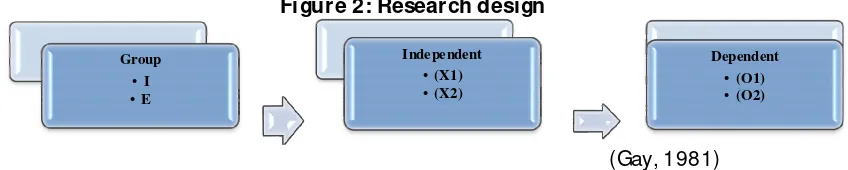
This study is regarded as descriptive causal compar ative research since the main purpose of the study is just to describe the ability of extrovert and introvert learners in accomplishing test of English structure, is ther e any significant differ ence of achievement and is it true that the difference caused by extrovert or introvert personality. The design of the research could be seen clearly through the following figure:
Figure 2: Research design
(Gay, 1981)
B.The scope of the Resear ch
It is important for the researcher to limit this research in four different perspectives by considering the time limit and financial support. In terms of discussion subject, this research is under applied of structure as this is in the area of personality trait and the achievement of proficiency test. By location, this research is applicable only in the English education department of UIN Alauddin Makassar and specified by semester VII in the year of 2014-2015. By method this research is descriptive causal compar ative. By topic, this research focuses on comparing extrovert and introvert learner s in accomplishing test of English structure. The set of test is taken from TOEFL test by considering validity and reliability.
C. Definition of Oper ational Variables 1. Extroversion
Generally, we know an extrovert as the active person and like to associate with others. Some people say that an extrovert must be the talkative one. Carl Jung and Owen give clear definition about Extrovert as the act, state, or habit of being predominantly concerned with and obtaining gr atification from what is outside the self. Extraverts tend to enjoy human interactions and to be enthusiastic, talkative, assertive, and gr egarious. They take pleasure in activities that involve large social gatherings, such as parties, community activities, public demonstrations, and business or political groups.
2 . Intr oversion
We ar e prone to think that an introvert person is the one who looks silent, calm, and like to stay alone in the classroom. Again, Carl Jung and Owen define introvert as the state of or tendency toward being wholly or predominantly concerned with and interested in one's own mental life. Introverts tend to be quiet, low-key, deliberate, and relatively non-engaged in social situations. They take pleasure in solitary activities such as reading, w riting, drawing, watching movies, listening to music, inventing, designing, progr amming and using computers extensively.
3 . English Str uctur e
English structure i s the w ay that the words, phrases, sentences ar e put together or organized into a cor rect form. (Oxford dictionary, 2004) define Structure is the way that the part of something is made, build, or or ganized.
Group
•I
•E
Independent
•(X1)
•(X2)
Dependent
•(O1)
4 . Accomplish
Succeed in doing something r equiring effort and/ or skill to achieve something (Oxford dictionary, 2004). In this research the samples need to accomplish a set of English structure to measure their achievement of English structure. The test consists of 30 items which is taken from structure test of TOEFL.
5 . Char acter
Cobuild dictionary 2005 gives definition of Character as the peculiar quality, or the sum of qualities, by which a person or a thing is distinguished from others; the stamp impressed by nature, education, or habit; that which a person or thing really is; nature; disposition. The other definition of character from Cobuild dictionary 2005 is a unique or extraordinary individuality; a person characterized by peculiar or notable traits; a person who illustrates certain phases of character; as, Randolph was a character; Caesar is a gr eat historical character. Character has close relationship with daily attitude and personality.
6 . Per sonality
Oxford dictionary, 2004 define personality as the quality or featur e of having a strong, interesting and attractive character of the person. Personality means the attitude or something that we have since we were born. It isn’t got by learning or adapting to the environment or other people.
D. Procedure of Collecting Data
The data were collected through the following procedure:
1. Deter mining the subject of the research.
2. Providing the instruments of data collecting such as questionnaire guide and set
of test.
3. Doing observation in the class.
4. Explaining about the research and aim of the research to the respondents.
5. Distributing a set of questionnaire to the respondents to determine whether the
respondents ar e included extroverts or introverts. The questionnaires are completed with the glossary of the difficult words or new vocabularies in the questionnaire, the respondent can also directly ask the researcher about the confusing question they find, the questionnaire takes about 20-30 minute to be answered.
6. Distributing a set of test to the r espondent to measur e their ability in
accomplishing English structure test. It takes about 30-45 minute to answer the test.
7. Analyzing the result of observation, questionnaire and test by using data display.
8. Explaining the result of data descriptively by making conclusion drawing or
verification.
E. Instr uments
Test is used to measure the ability of particular subject of the person or subject of the research. There are many types of tests such as achievement test, projective test, non projective test etc. The test used in this study is achievement test, the test consists of 30 items to detect the student’s ability in mastering English structur e Achievement test measures the current status of individuals which respect to proficiency in given areas of knowledge or skill (Gay, 1981).
F. Technique of Data Analysis
The researcher will use infer ential statistic and descriptive statistic in analyzing the data which are collected through the instruments. Procedures in analyzing the data are as follows:
1. Scor ing the Da ta
Quest ionnai re
Table17. Liker t Scale
Score Category Strongly disagr ee (never)
After obtaining the data from the questionnaire, the data was classified into two groups, namely; extrovert and introvert learner s through the following figure:
Figur e3. Classification of sample
The respondents are classifi ed into strong extrovert, moderate extrovert, combinative, moderate introvert and strong introvert. The respondents with the score above +3 are classified as strong extrovert, the score between +2 and +3 ar e classified as moderate extrovert, the score between +1, 0 and -1 are classified as combinative, the score between -2 and -3 are classifi ed as moder ate introvert and the score below -3 are classified as strong introvert. The lower the score, the stronger the introversion of the respondents while the higher the scor e, the stronger the extroversion of the respondent.
Test
The right answer of each item in the easy level get one (1) point, the moderate level get two (2) points, the difficult level get three (3) points, the very difficult level get four (4) points, while the w rong answer get zero (0) point. The score then compressed in to the scale 10 – 100 with the following classification:
Extrovert score Introvert score ...
The score more than +4
categorized as strong
extrovert
The score between +3 and
+2 categorized as moderate
extrovert
The score between +1, 0 and-1 categorized as
combinative
The score between -2 and -3 categorized as
moderate extrovert
The score less than -4
categorized as strong
Table18 . Score classification of the test
Score Classification Category
81-100 Very High Competent User
61-80 High Modest User
41-60 Moder ate Limited User
21-40 Low Extremely Limited User
0-20 Very Low Inter mittent User
(Source: Huges. 2006)
Statistica l calculation
The data obtained are analyzed using descriptive statistic (mean and standard deviation) and inferential statistic (t-test for non independent sample).
Mean Scor e =
t = test of nonindependent sample
D = Mean of difference
1. The Description of Population and Sample
2. The Introver t Statistic.
The following table presents the fr equencies, percentage, valid percent and cumulative percent of the introvert learners:
Table19. The fr equency and per centage of intr over t
Table 19 shows that the sample with the score 11.11 with cumulative percent 6.7 and valid percent 6.7, the sample with the score 12.50 with cumulative percent 13.3 and valid percent 6.7, the sample with the score 15.28 with cumulative percent 20.0 and valid percent 6.7, the sample with the score 19.44 with cumulative percent 26.7 and valid percent 6.7 and the sample with the score 29.17 with cumulative percent 33.3 and valid percent 6.7 are in frequency 1 with 6.3 percent. While the sample with the score of 30.56 with cumulative percent 46.7, the sample with the score of 36.11 with cumulative percent 60.0 and the sample with the scor e of 37.50 with cumulative percent 73.3 are in frequency 2, 12.5 percent and valid percent 13.3. The sample with the score of 43.06 with cumulative percent 80.0 and the sample with the score of 47.22 with cumulative percent 86.7, sample with the score of 48.61with cumulative percent 93.3, the sample with the score of 50.0 with cumulative percent 100.0 are in frequency 1, 6.3 percent and valid percent 6.7. The frequency of total sample is 15 and total percentage 93.8. The descriptive statistic of Introvert learners could be seen in the following table:
Table20. The descr iptive statistic of intr overt learners.
The total number of introvert learners is 15, the minimum scor e achieved is 50.00 and the minimum score i s 11.11. The total score is 484.73, the mean score is 32.3153 and the standard deviation is 12.85292.
The percentage could be seen in the following chart bar:
Introvert
Frequency Percent Valid Percent CumulativePercent
Descriptive Statistics
15 11.11 50.00 484.73 32.3153 12.85292 15
Introvert Valid N (listwise)
N Minimum Maximum Sum Mean Std. Deviation
3. The Extr overt Statistic.
The following table presents the fr equencies, percentage, valid percent and cumulative percent of the extrovert learners:
Table21. The fr equency and per centage of extr overt
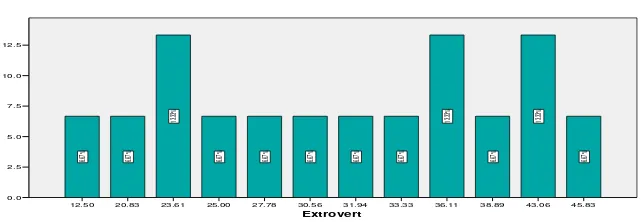
Table 20 shows that the sample with the score 12.50 with cumulative percent 6.7, the sample with the scor e 20.83 with cumulative percent 13.3, the sample with the score 25.0 with cumulative percent 33.3, the sample with the score 27,78 with cumulative percent 40.0, the sample with the score 30.56 with cumulative percent 46.7, the sample with the score of 31.94 with cumulative percent 53.3, the sample with the score of 33.33 with cumulative percent 60.0, the sample with the score of 38.89 with cumulative percent 8.00 and the sample with the scor e 45.83 with cumulative percent 100.0 are in fr equency 1, 6.3 percent and valid percent 6.7. The sample with the score of 23.61 with cumulative percent 26.7, the sample with the score of 36.11 with cumulative percent 73.3, sample with the score of 43.06 with cumulative percent 93.3, the sample with the score of 50.0 with cumulative percent 93.3 are in frequency 2, 12.5 percent and valid percent 13.3. The frequency of total sample is 15 and total percentage 93.8.
The percentage could be seen in the following chart bar:
The descriptive statistic of Extrovert learner s could be seen in the following table:
Table22. The descriptive statistic of extrover t learner s.
Extrovert
15 12.50 45.83 472.22 31.4813 9.37167 15
Extrovert Valid N (listwise)
The total number of introvert learners is 15, the minimum scor e achieved is 45.83 and the minimum score i s 12.50. The total score is 472.22, the mean score is 31.4813 and the standard deviation is 9.37167.
CONCLUSION AND SUGGESTION A. Conclusion
In relation to the research findings and discussion in the previous chapter, the conclusions are presented in the following statements:
1. The hypothesis testing show s that the achievement of introvert and extrovert
learners in accomplishing tests of English structure are not si gnificantly different and it categorized as same. For this reason, it can be conclude that there is no difference between extrovert and introvert in accomplishing test of English structure.
2. Along with the extrovert and introvert achievement which is not si gnificantly
different or categorized as same, it can be conclude that neither extrovert learners nor introvert learners are better in accomplishing test of English structur e, their ability is relatively same.
B. Suggestions
In relation to the subject (English structure) discussed in this thesis and in order to improve the teaching of English structure to the students, the researcher presents some suggestions as follows:
1. The lecturer do not need to pay attention too much to the students’ personality
especially extrover sion and introversion in teaching structure subject. The extroversion or introver sion is not influence the students in learning structure or ability in accomplishing test of English structur e.
2. If it is possible, the lecturers need to design teaching strategy which doesn’t make
introvert learners study under pressure. Both extrovert and introvert learners need to feel comfort in learning in the class.
3. It is not recommended that the students know themselves whether they are
including extrovert or introvert learner s before learning English structure or can be any other subject.
4. Since the achievement of introvert learners are same with extrovert learners in
accomplishing test of English structure, the lecturer must not assess the students by their activeness and under estimate the extr overt learners.
BIBLIOGRAPHY
Ahmadi, Abu. (2003). PsikoloiUmum. Jakarta: Rineka cipta.
Anonymous. (no date). Ext r over sion and Int r over sion. Retrieved January, 14th 2008
from http/ / en.wikipedia.org/ wiki/ extroversion.
Anonymous. (no date). How to go from Ext r over t t o Int r over t People. Retrieved
November 6th 2008 from http:/ / w ww.stevepavlina.com/ blog/ 2005/ 09/
how-to-go-from-introvert-to-extrovert/.
Anonymous. (no date). Per sonalit y Types. Retrieved January 11th from
http:/ / w w w.systemsthinker.com/ interests/ mind/ ptypes.shtml.
Anonymous. (no date). The St r uct ur e of English Language, retrieved January 10th
2009 from http:/ / w ww.teachit.co.uk/ armoore/ lang/ engstruct.htm
Anonymous. (no date). What is Your Myer s Per sonalit y Types? Retrieved January 51th
Arikunto, S. (2008). Dasar -dasar Evaluasi Pendidikan. Edisi revisi, Jakarta: Bumi
Aksara.
Arikunto, S. (2006). Pr osedur Penelit ian, Suatu Pendekat an Pr akt ik. Jakarta: Rineka
Cipta.
Bergin Joseph. (2003). Ext r over t -Int rover t. Retrieved 27th January 2009 from
http:/ / csis.pace.edu/ ~ bergin/ patterns/ introvertExtrovert.html.
Boeree George. (2006). Per onalit y Theor ies. Retrived 17th February 2009 from
http:/ / w w w.ship.edu/ ~ cgboeree/ jung.html
Cowgil Charles. (1997). Car l Jjung. RetrievedFebruary 18th 2009 from
http:/ / w w w.muskingum.edu/ ~ psych/ psycweb/ history/ jung.htm.
Deligne R. Erica. (2004). Ext r over t vs. Int r over t Livi ng Out side the Shell . retrieved 16th
February from
http:/ / w w w.marshallparthenon.com/ new s/ 2004/ 01/ 27/ Life/ Extrovert.Vs.Introv ert-589142.shtml
Douglas, Brown. (2007). Pr inciple and Language Lear ning in Teaching. 5th edition. San
Fransisco: Longman.
Dolliver, Sar ah. (No date). What Ever yone Need t o Know About Int r overt s. Retrieved
January, 14th 2008 from http/ / talentdevelop:com/ introver sion-r.html.
Freeman, Dian Lar sen. (1986). Techniques and Pr inciples in Language Teaching. New
York: oxford university press.
Gay L.R. (1981). Educational Research Compet encies for Analysi s and Applicati on. 2nd
edition; a Bell and Howell Company: London.
Huges Arthur. (2006). Test ing for Language Teacher s. United Kingdom. Cambrige
University Press.
Krimgold Natalya. 2003. Ext r over sion, Int r over sion, and t he Br ai n. Retrived 17th
February 2009 from
http:/ / serendip.brynsmaw r.edu/ biology/ b103/ f03/ w eb1/ nkrimgold.html.
Mawardi, Azhar. (2005). The Abilit y of EFL Learner s in Compr ehending Idioms
Present ed in Linguist ic Cont ext: A study of the seven grade students of English
Department, Muhammadiyah University of Malang. Unpublished Thesis. MUM.
Moleong, J. Lexy. (2008). Met dologi Penelit ian Kualit atif. Bandung: PT Remaja Rosda
Karya.
Munoz, Marry Ellen and friends. (1991). Cliffs TOEFL Pr eparat ion Guide .Singapor e
Narbuko, Cholid. Achmadi, Abu. 2004. Met odology Penelit ian. Jakarta: PT Bumi
Aksara.
Oxford. (2004). Oxford ESL Dict ionar y. New Yor k: Oxford University Press
Reid, Joy M. (1995). Lear ning St yles in t he ESL/ EFL Classroom. United States of
America: Heinle & Heinle Publishers.
Subana dkk. (2005). St st ist ik Pendidikan. Bandung: Pusaka setia.
Trans4mind. (2008). Know Your Own Mind. Retrieved January 8th from
http:/ / w w w.trans4mind.com/ questionnaire/.ww w.scibd.com. (no date).