RELATIONSHIP MARKETING AND CUSTOMER SATISFACTION:
A CONCEPTUAL PERSPECTIVE
Deborah O. Aka
1; Oladele J. Kehinde
2; Olaleke O. Ogunnaike
31,2,3 Department of Business Management, Covenant University P.M.B. 1023, Ota, Ogun State, 234, Nigeria
1[email protected]; 2[email protected]; 3[email protected]
Received: 15th July 2016/ Revised: 8th August 2016/ Accepted: 15th August 2016
How to Cite: Aka, D. O., Kehinde, O. J., & Ogunnaike, O. O. (2016). Relationship Marketing And Customer Satisfaction: A Conceptual Perspective. Binus Business Review, 7(2), 185-190.
http://dx.doi.org/10.21512/bbr.v7i2.1502
ABSTRACT
This article examined the existing body of literature on transaction and relationship marketing. The specific objectives were to develop a conceptual framework to establish the relationship between relationship marketing and customer satisfaction and to examine the components of relationship marketing on the present ever dynamic world of business. The study identified relationship marketing variables and their impact on customer satisfaction. The framework aimed to provide insights into the studies on relationship marketing factors such as trust, commitment, communication, and service quality influence on customer satisfaction. The model provided a basis for empirical studies on the factors of relationship marketing and outcomes of customer satisfaction in developing nations. The study recommends that relationship marketing dimensions such as building customer’s trust, commitment to customers, communication, and service quality should be properly managed and maintained by service providers in Nigeria. This helps in building customer satisfaction and in the long-run customer loyalty.
Keywords: relationship marketing, trust, service quality, communication, customer satisfaction
INTRODUCTION
The contemporary business environment requires that companies shift from transaction marketing which involves the exchange of values between two or more parties to relationship marketing which involves building a long-term satisfying relationship between the parties (i.e. customers, employees, suppliers, distributors, among others.) involved in a transaction. Relationship marketing contrasts with transaction-based marketing strategies, which focus on attracting customers. Relationship marketing focuses on establishing and maintaining a mutually beneficial relationship with existing customers.
Relationship marketing involves creating, maintaining, and enhancing the strong relationship with customers and other stakeholders within and out side ones enterprises (Ibidunni, 2012). According to
Zeithaml and Bitner (2000), relationship marketing is a philosophy of doing business, a strategic orientation that focuses on keeping and improving current customers, rather than acquiring new customers. Also, relationship marketing focuses on building and maintaining a business relationship with the customer rather than focusing on each individual (Rix, 2004). Thus, maintaining long-standing relationships with the customer is the means of staying competitive in the modern business environment.
A number of studies have developed a conceptual framework to examine the relationship between relationship marketing and customer satisfaction. Recent studies have pointed out that there is paucity of the literature with reference to relationship marketing definitions, relational components, and therefore highlight the need to generate empirical evidence on current dimensions of relationship marketing on customer satisfaction among developing nations in Binus Business Review, 7(2), August 2016, 185-190
DOI: 10.21512/bbr.v7i2.1502
general and Nigeria in particular. In the field of marketing, there have been several studies on the role of relationship marketing in organization management.
Some studies have focused on the historical development of relationship marketing in the business world (Shelby, Dennis & Sreedhar, 2006; Ndubisi, 2007; Mazhari, Madahi & Sukati, 2012). Another stream of research is based on surveys and statistics of relationship marketing as a management function (Maxim, 2009; Ogunnaike et al., 2014; Pembi, 2014). Scholars have analyzed the issue of relationship marketing regarding global business implications (Rootman, Tait, & Sharp, 2011). Thus, it becomes imperative to understand how relationship marketing contributes to customer satisfaction in the dynamic world of business. This study, therefore, examines the influence of relationship marketing on customer satisfaction using Nigeria as an example.
In marketing and relationship marketing literature, a number of theories have been discussed. However, in this research work, the theories and models from different authors examined include the commitment-trust theory and leaky bucket theory.
METHODS
This study reviewed relevant literature in the areas of relationship marketing and customer satisfaction with the emphasis in the Nigerian society. Thus, this study adopted the archival method to review the relevant literature as well as the theories that explain relationship marketing and customer satisfaction. Importantly, the archival method is used to identify and analyze relevant data that have been reported, published and stored across the globe.
RESULTS AND DISCUSSIONS
Rauyruen and Miller (2007) defined commitments as an implicit or explicit pledge of relational continuity between exchange partners. In simpler terms, commitment refers to the customer being motivated to stay with an organization. Trust on the other hand refers to one party who is willing to rely on the actions of another and the situation is directed to the future (Markova & Gillespie, 2007). This article is hinged on commitment-trust theory for the purpose of understanding how relationship marketing contributed to customer satisfaction. Morgan and Hunt (1994) commitment-trust theory of relationship marketing stated that the customer’s relationship commitment and trust are positioned as the key mediating variable model of relationship marketing. Kalafatis and Miller (1997) did a replica study and confirmed the position of commitment and trust as key mediating variables of relationship outcomes, although some of the hypothesized paths could not be confirmed. In studying relationship marketing, commitment-trust theory concepts can be used to explain and conceptualize
relationship-marketing paradigms. Relationship relationship-marketing refers to a wide range of ‘relationship variables’ that have developed over the past few decades in product as well as service markets and in consumer as well as business to business sectors.
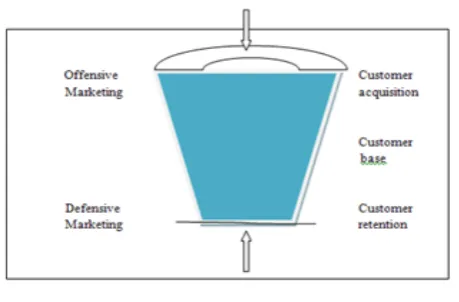
According to ssnstudents.com (2016), the focus of traditional marketing has been on creating new customers. The ‘offensive marketing’ strategy involves acquiring wholly new customers, attempting to attract dissatisfied customers away from customers, particularly in periods of heavy competition. The main thrust of the theory emphasizes the significance of maintaining the clientele while recognizing that acquiring clientele is, of course, the basis for having any customers to keep (Grönroos, 1995). Furthermore, the theory postulates that a company can only succeed in the world of business if the company has restricted the flow of old customer and both a flow of new customers.
Figure 1 Leaky Bucket Theory (Source: Egan, 2011)
ssnpstudents.com (2016) stated that the theory sees relationship marketing as a defensive strategy that has two key approaches, which are firstly, customer acquisition, which is a continuous need in a business for ‘new customers’. Egan (2011) agrees with the fact that a continuous need in business for new customers exists. Thus, any fall in the total number of customers has profitability implications for the marketer, particularly in the service industries where the fixed costs (people) are an important element in the service mix and the highest. Furthermore, in the past, organizations have focused on the customer acquisition process as market growth provided a constant supply of new prospects. Nonetheless, there is always a possibility where the substitutes or new competitors enter the market and divert the flow. Thus, the tendency is that customer acquisition in general terms will become more difficult. Secondly, customer retention which focuses on keeping existing customers happy and satisfied has become one of the major convictions of relationship marketing as seen in Figure 1. The theory has become one of the underpinning convictions of RM that it encourages retention marketing first and acquisition marketing second (Gummesson, 1999).
requires a shift from transaction marketing which involves the exchange of values between two or more parties to relationship marketing which involves building a long-term satisfying relationship between the parties (i.e. customers, employees, suppliers, distributors, among others) involved in a transaction. Relationship marketing contrasts with transaction-based marketing strategies, which focus on attracting customers. Relationship marketing focuses on establishing and maintaining a mutually beneficial relationship with existing customers.
Pembi (2014) said that this focus on individual’s transaction has brought on the much-glorified marketing concept and has propelled companies to move towards a focus on building relationship with customers. Jobber and Fashy (2006) explained that relationship marketing is the process of creating, developing, and enhancing the relationship with customers and other stakeholders. Similarly, Boone and Kurtz (2007) reasoned that relationship marketing refers to the development, growth, maintenance of long-term, cost-effective exchange relationship with individual customers, suppliers, employees, and other partners for mutual benefit. Kotler, Brown, Adam, Burton and Armstrong (2007) also reasoned that “relationship marketing is the process in which the construction, cultivation and strengthening of strong value-laden relationships with customers and other stakeholders occur.”
In today’s globalized business environment, building the relationship with customers and other stakeholders is a crucial factor that helps organizations to improve service quality, profitability and competitive advantage in the modern business environment. From these interjections, relationship marketing simply refers to the process of building and enhancing the long-term relationship with customers and other stakeholders or partners for mutual benefit. Organizations can explore relationship marketing in their marketing activities.
Despite the broad scope, relationship marketing has not lost its core marketing orientation, which involves the application of the marketing philosophy to all parts of the industry. The core of marketing orientation is as followed: (1) The ability of a business owner to appreciate his customer and invest in retaining and satisfying them will go a long way in increasing his income. (2) The ability of a business owner to treat his customers asking and have a special interest in their feelings and affairs will go a long way in helping him to retain them and even attract new ones. (3) Relationship marketing links customer service with quality and marketing. (4) Relationship marketing provides a blueprint of task, processes, tools, behaviors, and leadership actions needed to build a customer community. (5) It helps business owners to identify external service values of their products by understanding customers’ needs.
Scholars presented relationship marketing as the opposite to transaction marketing. In transaction marketing, a customer may repeatedly use the same
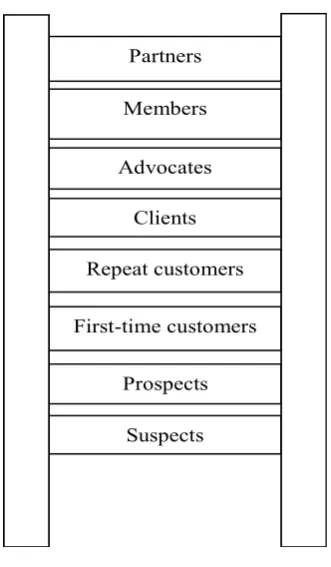
supplier because of high switching costs, but without feeling committed to the supplier (Payne et al., 1995; Gummesson, 2006). In RM relationship building ladder, the lowest step is the contact with a prospect that hopefully turns into a customer who purchases organization products or services. A customer who repeatedly makes purchases move to a higher step of the ladder to become a client and develop a long-term relationship with the business. In the next stage, the client becomes an advocate and finally a strategic partner of the organization.
Transaction marketing has no goal of relationship building. However, transaction marketing is associated with problems relating to the underlying marketing philosophy, structuring of instruments, and the marketing organization (Ayozie, 2012). Furthermore, the marketing philosophy has been centered on the satisfaction of customer needs. However, in an organization’s guidelines or corporate practice, this essential focus on the customer is rarely seen to an adequate degree. Secondly, the structuring of marketing instrument is exclusive in line with the marketing mix. Another criticism is that the marketing department in an organization is the only unit responsible for attending to customers’ needs.
The domain of relationship marketing is very clear, while transactional marketing initiates individual transactions with customers, relationship marketing focuses building and developing customer relationship across all levels of the department.
The need for relationship marketing strategies in organizations cannot be over emphasized. According to Pembi (2014), there are a number of possible relationship marketing strategies to be considered in the development of a relationship plan. They include but not limit the core service strategy, relationship customization, service augmentation, relationship pricing, and the internal market.
Figure 2 Ladder of Relationship Building (Source: Egan, 2011)
Kotler’s model begins with the identification of suspects, individuals or groups who are potential customers of the organization. The climb up the ladder begins when suspects give some implication that they are likely to buy the goods or services on offer, and thus they become prospects. Furthermore, there is a distinction between ‘first time’ and ‘repeat customer’. Thus, with repeat purchase, the customer has the experience to continue the relationship. At this point, the relational marketer seeks to shift from the traditional marketer, whose interest is to close a single sale. Here, the primary task of the relational marketer is to become more skillful at moving customers to higher stages of the relationship building, with each stage representing an improvement in the company’s relationship with the customers. Kotler model suggests that the company is seeking for ways to transform repeat customers into ‘clients.’ The clients refer to the customers with a superior status and some form of psychological attraction or bond between the parties. The further climb to the status of “advocates” means that the customer shifted from being responsive to the firm to becomr actively involved in promoting the firm through word-of-mouth recommendation. ‘Members’ refers to customers with a greater affinity to the organization. The highest stage of relationship building is the partnership level, as the customers become partners of the organization value-creation process.
It is important for the organization to invest in retaining their customers. If customers are satisfied with a firm’s offering, they will become advocates and bring in new businesses from their friends, family, and social networks. To transform suspects into
Repeat customers Partners
Suspects Members
Prospects Advocates
Clients
First-time customers
advocates requires the whole organization’s effort as customers will need to be satisfied each time they come in contact with the organization’s business. Effective communication includes the use of face to face interaction, telephone, emails, social media platforms like Facebook, Twitter, LinkedIn and the Internet to contact with the customers. The world is now a global market where customers will ask for the Twitter or Facebook account before asking for the complimentary cards. It can take a long time for the company to build advocates but only a negative experience with the firm can send advocates down the ladder to prospects.
Customers will always estimate which offer will deliver the most value to them. That is customers are value maximizers and always form an expectation of value and then act on it. If the offer does not meet up with the value expected, then it will affect both satisfaction and re-purchase intention and loyalty. Ibok and Ikoh (2013) believed that customer satisfaction as a measure of how products or services meet or surpassed customer expectations. Thus, customer satisfaction is an overall measure of what customers anticipate and what they eventually receive from service providers regarding service delivery and service quality. It is this type of thinking that made scholars such as Saha and Zhao (2006) to say that, customer satisfaction is a collection of the outcome of perception, evaluation and psychological reactions to the consumption experience with a product or service.
Similarly, Ogunnaike et al., (2014) argued that the best approach to customer retention is to deliver high customer satisfaction that result in strong customer loyalty. Additionally, Kotler (2000) identified five different levels of relating to a customer, namely: (1) the basic level, at this level of relationship, the salesperson simply sells the products to his customers without seeking to get in touch with them on a personal basis; (2) the reactive level focus on the salesperson who sells the product and encourages the customer to get in touch with the organization, with their complaints; (3) the accountable relationship focuses on the sales person who calls the customer especially after purchase to check whether the service delivery or quality meets or exceed their expectations; (4) the proactive level refers to a situation where the sales person gets to know in advance the status of each customer, the potential, the future anticipations of the customers and (5) the partnership level focus on the company working continuously with the customer and with other customers to discover ways to deliver better service to them.
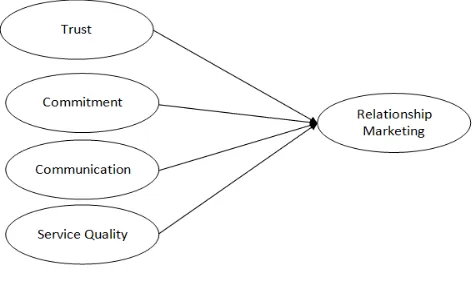
commitment, communication, and service quality as major determinants of relationship marketing.
Figure 3 Major Determinants of Relationship Marketing
The supplier or service providers will fulfill his/ her obligation in the relationship by delivering the promise that would result in positive outcomes and satisfaction and customer trust on the service promise. Commitment is a very important key between the seller and buyer in relationship marketing literature in building and maintaining a long-term profitable, satisfying relationship and image. Relationship marketing favors more individual and personalized communication with customers. It includes the integrated marketing communication efforts which seek to deliver the same promise and image to the perspective of currents customers. For a company to achieve sustainable competitive advantage in the modern business environment, the key lies in delivering high-quality service that will in turn result in satisfied customers.
CONCLUSIONS
Domestic enterprises can explore relationship marketing dimensions such as building customer’s trust, commitment to customers, interpersonal communication and service quality. Secondly, customers tend to stay in business once the owners of enterprises are interested in their welfare by ensuring that good quality products and services are offered to them to meet their respective needs and wants .
The study focused on the trends in relationship marketing and its implication on customer satisfaction among firms in Nigeria. The findings revealed some managerial implications for relationship marketing. Managers can plan their marketing strategies by this study as it identified the significant variables which influence customer satisfaction.
REFERENCES
Ayozie, D. O. (2012). Is relationship marketing an acceptable marketing strategy to be used by Nigerian Commercial banks? Universal Journal of
Management and Social Sciences, 2(1), 17-49 Boone, L. E. & Kurtz, D. L. (2007). Contemporary marketing.
Philadelphia: Harcourt College Publishers.
Egan, J. (2008). Relationship marketing: exploring relational strategies in marketing (4th ed.). London South Bank University.
Egan, J. (2011). Relationship Marketing: Explaining Relational Strategies in Marketing (4th ed.). Harlow, England: Pearson Education Limited.
Grönroos, C. (1995) Relationship marketing: the strategy continuum. Journal of the Academy of Marketing Science, 23(4), 252-254.
Gronroos, C. (2008). Service logic revisited: Who creates value? And who co-creates?. European Business Review, 20(4), 298-314.
Gummesson, E. (1999). Total relationship marketing: rethinking marketing management from 4ps to 30Rs.
Oxford: Butterworth-Heinemann.
Ibidunni, O. S. (2012). Marketing Management: Practical Perspectives. Lagos: Concept Publications.
Ibok, N. I., & Ikoh, I. M. (2013). Determinants of Customer Satisfaction with Internet Banking Services. Journal of Arts and Social Sciences, 14(2), 178-186.
Jobber, D., & Fashy, J. (2006). Foundations of marketing.
New York: The McGraw-Hill Companies.
Kalafatis, S. P. & Miller, H. (1997). A re-examination of the commitment-trust theory, in relationships and networks in international markets, Hans George Gemuden, Thomas Ritter, and Achim Walte, eds, Oxford, UK: Pergamon
Kotler, P. (1997) Marketing: An introduction (2nd ed.). USA, Prentice: McGraw-Hill Companies.
Kotler, P. (2000). Marketing management (Millennium ed.). New Jersey Prentice Hall.
Kotler, P., Brown, L., Adam, S., Burton, S., & Armstrong, G. (2007). Marketing (7th ed.). NSW: Pearson Education Australia.
Markova, I., & Gillespie, A. (2007). Trust and distrust: Sociocultural Perspectives. Information Age Publishing .
Maxim, A. (2009). Relationship marketing: A new paradigm in marketing theory and practice. Retrieved from http://anale.feaa.uaic.ro/anale/resurse/23_M04_ MaximA.pdf
Mazhari, M. Y., Madahi, A., and Sukati, M (2012). The effect of relationship marketing on costumers’ loyalty in iran sanandaj city banks. International Journal of Business and Management, 7(15), 81-87. Moorman, C., Zaltman, G., & Deshpande, R. (1992).
Relationships between providers and users of market Research: The Dynamics of Trust within and between Organizations. Journal of Marketing Research (JMR), 29(3), 314–328.
Morgan, R. & Hunt, S. (1994). The commitment-trust theory of relationship marketing. Journal of Marketing,
58(3).
Ndubisi, N. O. (2007). Relationship marketing and customer loyalty. Mark. Intel. Plan., 25(1), 98- 106.
Telecommunication Service Providers. European Journal of Business and Social Sciences, 3(8), 273-288.
Payne, A., Christopher, M., Clark, M., & Peck, H. (1995) Relationship marketing- key concepts. Relationship marketing for competitive advantage: Winning and keeping customers. Oxford: Butterworth.
Pembi, S. (2014). Relationship Marketing: An approach to customer services, satisfaction and retention in Nigeria. Retrieved January 31, 2016 from http:// www.transcampus.orgjournals; www.ajol.info/ journals//jorind.
Rauyruen, P. & Miller, K. E. (2007). Relationship quality as a predictor of B2B customer loyalty. Journal of Business Research, 60(1), 21-31.
Rix, P. (2004). Marketing: A Practical Approach. North
Ryde, N.S.W.: McGraw-Hill.
Rootman, C., Tait, M., & Sharp, G. (2011). Relationship marketing and customer retention lessons for South African banks. Southern African Business Review,
15(3), 184-206.
Saha, P., & Zhao, Y. (2006). Relationship between online service quality and customer satisfaction: A study of internet banking. Lulea University.
Shelby, D. H., Dennis, B. A., & Sreedhar, M. (2006). The explanatory foundations of relationship marketing theory. Journal of Business & Industrial Marketing, 21(2), 72–87.
Zeithaml, V. A., & Bitner, M. J., (2000). Services marketing: