2
PowerPoint Lectures for
2
PART I INTRODUCTION TO ECONOMICS
A
PART I INTRODUCTION TO ECONOMICS
The Economic
Problem: Scarcity
and Choice
Scarcity, Choice, and Opportunity Cost
Scarcity and Choice in a One-Person Economy
Scarcity and Choice in an Economy of Two or More
The Production Possibility Frontier The Economic Problem
Economic Systems Command Economies Laissez-Faire Economies:
The Free Market
Mixed Systems, Markets, and Governments
Looking Ahead
2
The Economic Problem: Scarcity And Choice
FIGURE 2.1 The Three Basic Questions
A
The Economic Problem: Scarcity And Choice
capital Things that are produced and then used in the production of other goods and services.
factors of production (or factors) The inputs into the process of production. Another term for
2
The Economic Problem: Scarcity And Choice
production The process that transforms scarce resources into useful goods and services.
inputs or resources Anything provided by nature or previous generations that can be used directly or indirectly to satisfy human wants.
A
Scarcity, Choice, And Opportunity Cost
Scarcity and Choice in a One-Person Economy
Nearly all the same basic decisions that
2
What is the difference between a single-person economy and a more complex economy?
a. Most decisions that characterize a complex economy don’t have to be made by an economy with a single person.
b. Most resources that are scarce in a complex economy are usually abundant in a simple economy.
c. In a single-person economy, the concept of opportunity cost does not apply.
d. In a single-person economy, the mechanics of decision
A
What is the difference between a single-person economy and a more complex economy?
a. Most decisions that characterize a complex economy don’t have to be made by an economy with a single person.
b. Most resources that are scarce in a complex economy are usually abundant in a simple economy.
c. In a single-person economy, the concept of opportunity cost does not apply.
d.
d. In a single-person economy, the mechanics of decision In a single-person economy, the mechanics of decision making are simpler than those of a more complex
making are simpler than those of a more complex
economy.
economy.
2
The concepts of constrained choice and scarcity
are central to the discipline of economics.
Opportunity Cost
Scarcity, Choice, And Opportunity Cost
opportunity costs The best alternative that we give up, or forgo, when we make a choice or decision.
A
Using a day at the beach as an example, what is the opportunity cost of leisure?
a. Leisure is free. For example, you don’t have to pay for the benefit of enjoying the sun or relaxing at the beach.
b. Leisure has an opportunity cost only if there is a cost associated with it. For example, entering the beach may require you to pay a fee.
c. The opportunity cost of leisure at the beach is the value of the things that you could have produced during the time you were at the beach. For example, you could have used the time to work and earn some money.
2
Using a day at the beach as an example, what is the opportunity cost of leisure?
a. Leisure is free. For example, you don’t have to pay for the benefit of enjoying the sun or relaxing at the beach.
b. Leisure has an opportunity cost only if there is a cost associated with it. For example, entering the beach may require you to pay a fee.
c.
c. The opportunity cost of leisure at the beach is the value of The opportunity cost of leisure at the beach is the value of the things that you could have produced during the time you
the things that you could have produced during the time you
were at the beach. For example, you could have used the
were at the beach. For example, you could have used the
time to work and earn some money.
time to work and earn some money.
A
Scarcity, Choice, And Opportunity Cost
Scarcity and Choice in a One-Person Economy
The growth of the frozen dinner entrée market in the last 50 years is a good example of the role of opportunity costs in our lives.
Opportunity Cost
2
Specialization, Exchange, and Comparative Advantage
Scarcity, Choice, And Opportunity Cost
theory of comparative advantage Ricardo’s
theory that specialization and free trade will benefit all trading parties, even those that may be
“absolutely” more efficient producers.
A
Scarcity, Choice, And Opportunity Cost
Scarcity and Choice in an Economy of Two or More
FIGURE 2.2 Comparative Advantage
and the Gains from Trade
and (b) shows how much output they could produce in a month, assuming they wanted an equal number of logs and bushels.
Colleen would split her time 50/50, devoting 15 days to each task and achieving total output of 150 logs and 150 bushels of food. Bill would spend 20 days cutting wood and 10 days gathering food.
In this figure, (a) shows the number of logs and bushels of food that Colleen and Bill can produce for every day spent at the task
2
Scarcity, Choice, And Opportunity Cost
absolute advantage A producer has an absolute advantage over another in the production of a
good or service if he or she can produce that product using fewer resources.
comparative advantage A producer has a comparative advantage over another in the production of a good or service if he or she can produce that product at a lower opportunity cost.
Specialization, Exchange, and Comparative Advantage
A
Scarcity, Choice, And Opportunity Cost
FIGURE 2.3a Production Possibilities with No Trade
The figure in (a) shows all of the combinations of logs and bushels of food that Colleen can produce by herself. If she spends all 30 days each month on logs, she produces 300 logs and no food (point A).
If she spends all 30 days on food, she produces 300 bushels of food and no logs (point B).
If she spends 15 days on logs and 15 days on food, she produces 150 of each (point C).
A Graphical Presentation of Comparative Advantage and Gains from Trade
2
Scarcity, Choice, And Opportunity Cost
FIGURE 2.3b Production Possibilities with No Trade
The figure in (b) shows all of the combinations of logs and bushels of food that Bill can produce by himself. If he spends all 30 days each month on logs, he produces 120 logs and no food (point D). If he spends all 30 days on food, he produces 240 bushels of food and no logs (point E).
If he spends 20 days on logs and 10 days on food, he produces 80
A Graphical Presentation of Comparative Advantage and Gains from Trade
A
Scarcity, Choice, And Opportunity Cost
FIGURE 2.4 Colleen and Bill Gain from Trade
By specializing and engaging in trade, Colleen and Bill can move beyond their own production possibilities. If Bill spends all his time producing food, he will produce 240 bushels of food and no logs. If he can trade 140 of his bushels of food to Colleen for 100 logs, he will end up with 100 logs and 100 bushels of food. The figure in (b) shows that he can move from point F to point F'.
2
Scarcity, Choice, And Opportunity Cost
Weighing Present and Expected Future Costs and Benefits
We trade off present and future benefits in small ways all the time.
A
Scarcity, Choice, And Opportunity Cost
Capital Goods and Consumer Goods
consumer goods Goods produced for present consumption.
investment The process of using resources to produce new capital.
2
Scarcity, Choice, And Opportunity Cost
production possibility frontier (ppf) A graph that shows all the combinations of goods and services that can be produced if all of society’s resources are used efficiently.
A
Scarcity, Choice, And Opportunity Cost
All points below and to the left of the curve (the shaded area) represent combinations of capital and consumer goods that are possible for the society given the resources available and existing technology.
Points above and to the right of the curve, such as point G, represent combinations that cannot be reached.
If an economy were to end up at point A on the graph, it would be producing no consumer goods at all; all resources would be used for the production of capital. If an
economy were to end up at point B, it would produce only consumer goods.
2
Scarcity, Choice, And Opportunity Cost
Although an economy may be
operating with full employment of its land, labor, and capital resources, it may still be operating inside its ppf, at a point such as D. The economy could be using those resources inefficiently.
Periods of unemployment also correspond to points inside the ppf, such as point D.
Moving onto the frontier from a point such as D means achieving full employment of resources.
A
Scarcity, Choice, And Opportunity Cost
FIGURE 2.5 Production Possibility
Frontier
The ppf illustrates a number of economic concepts. One of the most important is opportunity cost. The opportunity cost of producing more capital goods is fewer consumer goods.
Moving from E to F, the number of capital goods increases from 550 to 800, but the number of consumer goods decreases from 1,300 to 1,100.
2
Consider the figure below. As this country moves from point D to point B along the production possibility frontier AE,
a. the opportunity cost of building more consumer goods rises. b. the opportunity cost of building more capital goods rises.
c. the opportunity cost is not affected because the curve does not shift. d. the opportunity cost of producing more of either consumer goods or
A
Consider the figure below. As this country moves from point D to point B along the production possibility frontier AE,
a. the opportunity cost of building more consumer goods rises.
b.
b. the opportunity cost of building more capital goods rises. the opportunity cost of building more capital goods rises.
c. the opportunity cost is not affected because the curve does not shift. d. the opportunity cost of producing more of either consumer goods or
2
Scarcity, Choice, And Opportunity Cost
Unemployment
During economic downturns or recessions, industrial plants run at less than their total
capacity. When there is unemployment of labor and capital, we are not producing all that we can.
A
Scarcity, Choice, And Opportunity Cost
Inefficiency
Waste and mismanagement are the results of a firm’s operating below its potential.
Sometimes, inefficiency results from
mismanagement of the economy instead of mismanagement of individual private firms.
2
Scarcity, Choice, And Opportunity Cost
Inefficiency
The Production Possibility Frontier
FIGURE 2.6 Inefficiency from Misallocation of Land in FarmingSociety can end up inside its
ppf at a point such as A by using its resources
inefficiently.
A
Scarcity, Choice, And Opportunity Cost
The Efficient Mix of Output
To be efficient, an economy must produce what people want.
The Production Possibility Frontier
Negative Slope and Opportunity Cost
2
Scarcity, Choice, And Opportunity Cost
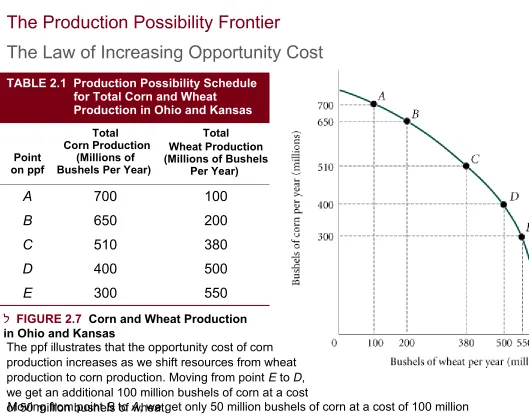
TABLE 2.1 Production Possibility Schedule for Total Corn and Wheat
Production in Ohio and Kansas
Point on ppf
Total Corn Production
(Millions of Bushels Per Year)
Total
Wheat Production (Millions of Bushels
Per Year)
The Law of Increasing Opportunity Cost
The Production Possibility Frontier
FIGURE 2.7 Corn and Wheat Production
in Ohio and Kansas
A
Scarcity, Choice, And Opportunity Cost
Economic Growth
economic growth An increase in the total output of an economy. It occurs when a society acquires new resources or when it learns to produce more using existing resources.
2
Refer to the figure. A 10-ton increase in the production of farm goods
requires a sacrifice of manufactured goods that is:
a. greater between points b and c than between points e and f.
b. greater between points e and f than between points b and c.
c. proportionally the same between any two points.
A
Refer to the figure. A 10-ton increase in the production of farm goods
requires a sacrifice of manufactured goods that is:
a. greater between points b and c than between points e and f.
b.
b. greater between points greater between points ee and and ff
than between points
than between points bb and and cc..
c. proportionally the same between any two points.
2
Scarcity, Choice, And Opportunity Cost
TABLE 2.2 Increasing Productivity in Corn and Wheat Production in the United States, 1935–2007
CORN WHEAT
Yield Per Acre
(Bushels) Labor Hours Per 100 Bushels Yield Per Acre (Bushels) Per 100 Bushels Labor Hours
1935–1939
A
Scarcity, Choice, And Opportunity Cost
FIGURE 2.8 Economic Growth
Shifts the PPF Up and to the Right
Productivity increases have enhanced the ability of the United States to produce both corn and wheat. As Table 2.2 shows, productivity increases were more dramatic for corn than for wheat. Thus, the shifts in the ppf were not parallel.
Note: The ppf also shifts if the amount of land or labor in corn and wheat production changes. Although we emphasize productivity increases here, the actual shifts between years were due in part to land and labor changes.
Economic Growth
2
Scarcity, Choice, And Opportunity Cost
Sources of Growth and the Dilemma of Poor Countries
The Production Possibility Frontier
FIGURE 2.9 Capital Goods and
Growth in Poor and Rich Countries
Rich countries find it easier than poor countries to devote
resources to the production of capital, and the more resources that flow into capital production, the faster the rate of economic growth.
A
Scarcity, Choice, And Opportunity Cost
The Economic Problem
Recall the three basic questions facing all economic systems:
(1) What gets produced?
(2) How is it produced?
(3) Who gets it?
2
command economy An economy in which a
A
Laissez-faire Economies: The Free Market
laissez-faire economy Literally from the French: “allow [them] to do.” An economy in which
individual people and firms pursue their own self-interest without any central direction or regulation.
market The institution through which buyers and sellers interact and engage in exchange.
2
A market exists primarily in what type of economic system? a. A command economy.
b. A laissez-faire economy.
c. A democracy. d. A dictatorship.
A
A market exists primarily in what type of economic system? a. A command economy.
b.
b. AA laissez-faire economy. laissez-faire economy.
c. A democracy. d. A dictatorship.
2
consumer sovereignty The idea that consumers ultimately dictate what will be produced (or not produced) by choosing what to purchase (and what not to purchase).
Consumer Sovereignty
A
free enterprise The freedom of individuals to start and operate private businesses in search of profits.
Individual Production Decisions: Free Enterprise
2
The amount that any one household gets depends on its income and wealth.
Income is the amount that a household earns each year. It comes in a number of forms: wages, salaries, interest, and the like.
Wealth is the amount that households have accumulated out of past income through saving or inheritance.
A
Which of the following problems are typical of a market system?
a. The market system does not always produce what people want at the lowest possible cost.
b. The market system offers rewards (income) that may be unfairly distributed, and some groups may be left out.
c. Periods of unemployment and inflation recur with some regularity. d. All of the above.
2
Which of the following problems are typical of a market system?
a. The market system does not always produce what people want at the lowest possible cost.
b. The market system offers rewards (income) that may be unfairly distributed, and some groups may be left out.
c. Periods of unemployment and inflation recur with some regularity.
d.
d. All of the above.All of the above.
A
In a free market system, the basic economic questions are answered without the help of a central government plan or directives. This is what the “free” in free market means—the system is left to operate on its own with no outside interference. Individuals pursuing their own self-interest will go into business and produce the products and services that people want. Other individuals will decide whether to acquire skills; whether to work; and whether to buy, sell, invest, or save the income that they earn. The basic coordinating mechanism is price.
2
Mixed Systems, Markets, And Governments
The differences between command economies and laissez-faire economies in their pure forms are
A
factors of production (or factors) free enterprise
inputs or resources
investments
laissez-faire economy
marginal rate of transformation (MRT)
market
opportunity cost outputs
production
production possibility frontier (ppf) theory of comparative advantage