Hemophilia
GUIDELINES FOR PARENTS
Indian Academy of Pediatrics (IAP)
Convener: Nita Radhakrishnan
Members: Shruti Kakkar, Swati R Kanakia, Vijay Jaiswal
Reviewer: Bharat Agarwal
34 FAQs on HEMOPHILIA
1. Why is my child getting bruising and bleeding?
2. Our son has been diagnosed with hemophilia.
Nobody on both sides of the family has this disease.
Why did our child still get it?
3. We have not told anyone in the family or friends regarding this illness yet. Should we tell them?
4. What are the common sites of bleeding?
5. How severe is the disease in my child? Will my child be able to lead a normal life?
6. Will this disease last his whole life? Will there be a cure for this illness?
7. How is hemophilia treated?
8. Can you tell us what all we should do at home to prevent bleeding?
9. Will he be able to play with his siblings and friends?
10. Can my child receive all vaccinations? Should I give factor prior to vaccination?
11. How will I cut his nails and hair without the risk of bleeding?
12. My son has just started walking. Should we use kneecaps and helmets to prevent bleeding?
13. Are there any medicines, we should avoid in my
14. I have heard about prophylaxis in hemophilia. When should we start it? Where is it available?
15. He fell while running and hit is head. How do I know if there is internal bleeding? Should I give factor immediately?
16. How will I know if he has bleeding in the joints? What should I do at home when he has a joint bleed?
17. When should I bring my child to the hospital for factor? Should I wait for 2–3 days and see if bleeding subsides before giving factor?
18. Should I store factor at home for emergencies? If so, where should I give him factors in case of emergency?
19. He has cut his tongue while playing. What should I do to reduce bleeding?
20. How should I take care of my child in order to prevent long-term joint damage?
21. He wants to go out and play cricket. I am scared of sending him for risk of bleeding. What should I do?
22. What is RICE/PRICE or POLICE therapy?
23. My 8-year-old son with hemophilia walks with a limp. What should I do to prevent disability in future?
24. Are there any dietary restrictions for my child? Will
25. Can my son with hemophilia go on a school trip?
Should I send factor with him?
26. My wife is a hemophilia carrier and is pregnant. Is it safe for us to have a normal delivery?
27. My wife is a hemophilia carrier and we have just had a baby. How early can we test the baby for hemophilia? What is the possibility of the baby having hemophilia?
28. Can we prevent this disease again in our family?
Should I test my daughters for carrier status?
29. Is the cost of treatment covered by reimbursement or medical insurance?
30. Is treatment available freely for hemophilia in our country?
31. I have observed that factor treatment since last few days has not helped to reduce pain of joint bleeding.
Is it due to inhibitor formation? Why are inhibitors formed?
32. What is FEIBA?
33. Are there new drugs that can reduce the need for frequent injections in hemophilia?
34. What is gene therapy?
Core Group
National Co-ordinator: Deepak Ugra
Member Secretaries: Upendra Kinjawadekar, Samir Dalwai
Members: Apurba Ghosh, CP Bansal, Santosh Soans, Somashekhar Nimbalkar, S Sitaraman
© Indian Academy of Pediatrics
IAP Parent Guideline Committee
Chairpersons:
Piyush Gupta, Bakul Parekh
IAP Co-ordinators:
GV Basavaraja, Harish Kumar Pemde, Purna Kurkure
Hemophilia
68
Hemophilia is a condition where our blood does not clot easily. For blood to clot, we need to have normal platelets and clotting factors in our blood. In hemophilia, the clotting factors VIII or IX are deficient from birth. Children born with hemophilia have increased tendency to bleed either spontaneously or after trauma.
Hemophilia is a genetic disease which is inherited in two-thirds of the cases. In the rest, it is a new mutation, and hence family history may not be there.
Why is my child getting bruising and bleeding?
Our son has been diagnosed with hemophilia. Nobody on both sides of the family has
this disease. Why did our child still get it?
Q1 Q2
4
Hemophilia
Yes. Since it is a chronic condition which will need quite a few lifestyle adjustments, it is better to inform close family members and friends. Also at school entry, school teachers and others who take care of your child such as bus drivers also should be aware that your child has increased tendency to bleed, especially following trauma. Your child may need to be taken care by others when you are not available.
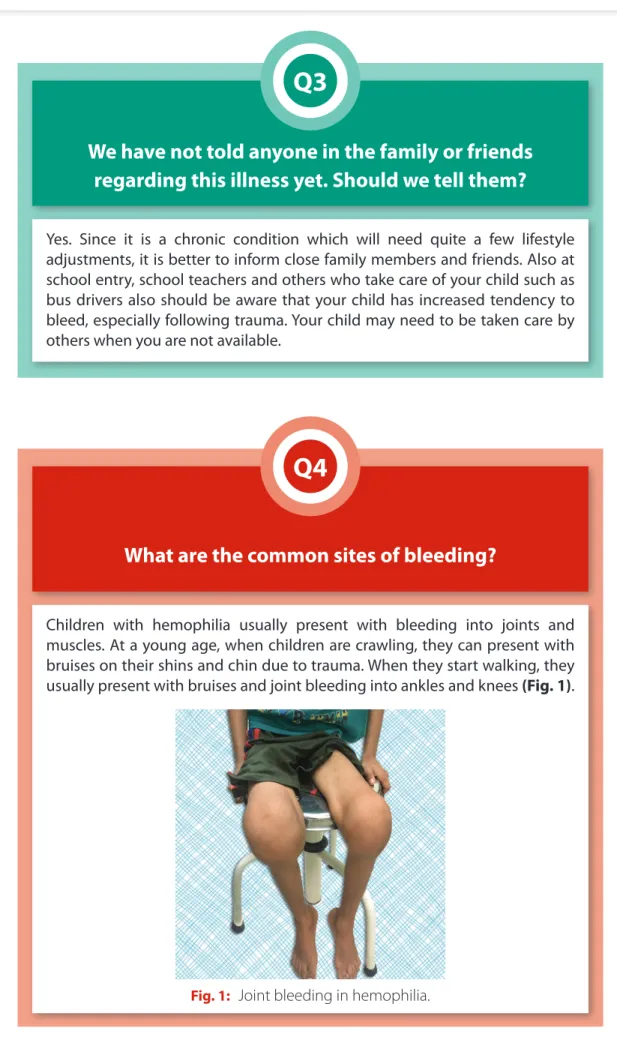
Children with hemophilia usually present with bleeding into joints and muscles. At a young age, when children are crawling, they can present with bruises on their shins and chin due to trauma. When they start walking, they usually present with bruises and joint bleeding into ankles and knees (Fig. 1).
We have not told anyone in the family or friends regarding this illness yet. Should we tell them?
What are the common sites of bleeding?
Q3
Q4
Fig. 1: Joint bleeding in hemophilia.
Hemophilia
Fig. 2: Trauma-related oral bleeding.
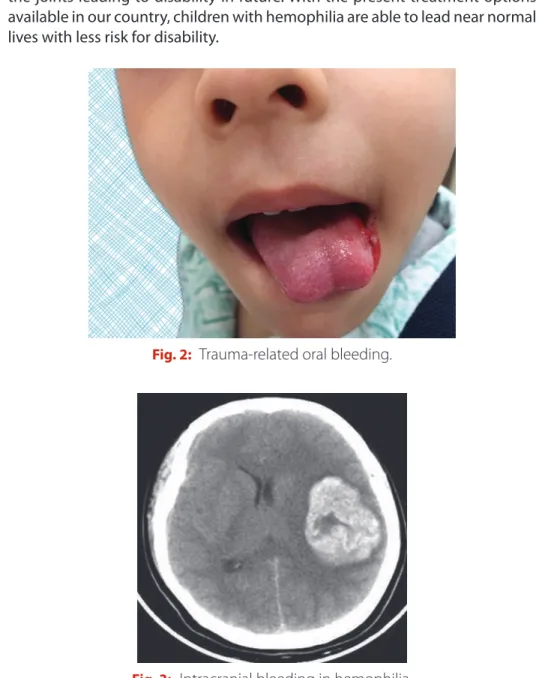
Bleeding could be spontaneous or following any trauma. Usually, they do not have bleeding from nose and mouth, unless there is an injury on the tongue or following tooth fall (Fig. 2). Joint and muscle bleeds account for >80% of bleeding observed. Other sites of bleeding include blood in urine and stools, blood in vomitus, bleeding into the brain (Fig. 3), airway, etc. which are more serious. Child should be brought to the Hemophilia Treatment Center or nearest pediatrician at the earliest suspicion of severe bleeding. Repeated bleeding into joints can result in “target joints” and permanent damage to the joints leading to disability in future. With the present treatment options available in our country, children with hemophilia are able to lead near normal lives with less risk for disability.
Fig. 3: Intracranial bleeding in hemophilia.
6
Hemophilia
Normally the level of factor VIII and IX in human body ranges from 50 to 150%. Hemophilia is graded as severe (factor level <1%), moderate (factor level 1–5%), and mild (factor level 5–40%) disease. In those with mild deficiency, bleeding usually occurs following any major trauma or surgery. Those with moderate deficiency develop bleeding following minor trauma and those with severe deficiency can have spontaneous bleeding. With the current treatment availability, most children are able to lead a near normal life.
Yes. At present, the treatment available for most patients will not cure the disease. Instead, risk of bleeding can be kept under check either preventing or treating bleeding episodes. Gene therapy is the only curative treatment, which is currently under research trials. Once available freely, it will offer the hope of cure.
How severe is the disease in my child?
Will my child be able to lead a normal life?
Will this disease last his whole life?
Will there be a cure for this illness?
Q5
Q6
Hemophilia
Hemophilia is treated with clotting factor concentrates. These clotting factor concentrates replenish the deficient factor in the body and stop bleeding.
These factors can be plasma derived (collected from people with normal factor levels) or recombinant (prepared in research laboratories). They can be given either on-demand, viz. after the bleeding occurs or as replacement (or prophylaxis) in order to prevent bleeding. On-demand treatment is given based on the site of bleeding and weight of the child. In most joint and muscle bleeds, 20–40% factor level is targeted. In more difficult bleeds such as psoas muscle bleed, hip joint bleed or severe bleeding, higher factor level is targeted for a longer period. While receiving on-demand treatment, children would be brought to the hospital as early as possible after bleeding. Prophylaxis, on the other hand, is to prevent bleeding. Small doses of factor concentrates are given two to three times a week to reduce the risk of severe bleeding and muscle/joint bleeds. As the bleed frequency reduces following prophylaxis, children have lesser chance of developing target joints and disability in future.
We usually advise parents to do all that is possible to reduce accidental bleeding. When the baby is very young, get childproofing of your home done by padding sharp corners of tables, chairs, cabinets, and doors. Refrain child from using walkers and staircases till his balance is good. Keep sharp objects such as knives, scissors, and similar objects away from the baby. While going to play, child should be encouraged to stay away from sports, where there is risk of injury to the head. Cycling can be taught with adequate precautions such as helmet and knee and ankle pads. Swimming as well as most indoor games are safe. Caretaker has to be cautious to prevent slipping and falling at home. Babies should not be lifted by their hands or forearms only as this might trigger a pulled elbow and bleeding.
How is hemophilia treated?
Can you tell us what all we should do at home to prevent bleeding?
Q7
Q8
8
Hemophilia
Yes. In the initial few years of life, we encourage parents to supervise and keep children away from sports with risk of trauma to head such as skating, diving, cricket, etc. Children on prophylaxis/replacement factor treatment can engage in sports and physical activities more freely.
In the initial months, care must be taken to prevent trauma. Once the baby grows up, he will understand the risk of bleeding and will cooperate.
Yes. All routine vaccinations are to be given to children with hemophilia.
Factor administration for vaccination is not recommended. Vaccines can be preferably given subcutaneously with 26G needle. Application of ice for 2–3 minutes before and after the injection can reduce the risk of bleeding and pain significantly.
No. There is no need for constant use of kneecaps, braces, or helmets. As discussed earlier, helmets may be used while cycling or playing in the park.
Will he be able to play with his siblings and friends?
How will I cut his nails and hair without the risk of bleeding?
Can my child receive all vaccinations? Should I give factor prior to vaccination?
My son has just started walking. Should we use kneecaps and helmets to
prevent bleeding?
Q9
Q11
Q10
Q12
Hemophilia
Yes. Nonsteroidal anti-inflammatory drugs (NSAIDs) commonly used for fever and pain are to be avoided in children with hemophilia. Inform your pediatrician or doctor pre- scribing medicines that they should not be used. Paracetamol is safe for fever and pain.
The child should be watched for any danger signs for head injury such as vomiting, altered behavior such as excessive cry or reduced activity, inability to move a limb and seizures. As the risk of bleeding can be late, any such symptom in the next 10–14 days should be reported to your treating doctor. In some cases, a dose of factor is usually given immediately. In children who have any of the danger signs, immediate factor administration followed by investigations such as CT scan and further management in an experienced center is advisable.
Are there any medicines, we should avoid in my child
with hemophilia?
He fell while running and hit is head. How do I know if there is internal bleeding? Should I give factor immediately?
Q13
Q15
Prophylaxis is the process of giving factor concentrate 1–3 times in a week in order to reduce the risk of bleeding especially in the joints. When factor is administered at regular intervals, the trough level of factor in the body usually remains above 1%, which makes the child with severe hemophilia behave-like moderate hemophilia, thus reducing the risk of spontaneous bleeding.
Prophylaxis does not prevent all bleeds. It is basically given to reduce the risk of spontaneous joint bleeds, which in-turn reduces target joint formation and long-term disability associated with it. In western and resource plenty countries, the doses recommended are high which encourages a very active lifestyle for the child-like sports. In India, we follow intermediate-to- low dose regimens aiming at reducing joint morbidity in the long term.
I have heard about prophylaxis in hemophilia. When should we start it? Where
is it available?
Q14
10
Hemophilia
Joint bleeds usually present with pain and difficulty in movement of the joints. Unlike superficial bleeds, blue/black discoloration of a bruise is not seen in joint bleeds. Children usually develop painful swelling, which makes joint movement difficult. Young babies may cry while joint is handled and prefer not to move it.
At home, if a joint bleed is expected, the joint should be kept immobile and elevated.
Application of ice/cold compression can help in reducing pain. For upper limb joints, sling can be applied around the neck, and for lower limb joints bed rest is encouraged to prevent movement of the joint. In most bleeds, factor concentrate will be required to stop the bleeding. Early access to factor concentrates can reduce the bleeding and restore joint health at the earliest.
No. For serious (joint and muscle bleeds, mucosal bleeds) and life- threatening bleeds (neck/airway bleeds, bleeding inside the head, and blood in urine) treatment with factor concentrates is vital, and it is best to reach the treatment center at the earliest. If you have access to home therapy, factor treatment should be initiated at the earliest.
In small bruises, small oral bleeds and other superficial bleeds, one can wait and watch and go to a hospital only if bleeding is persisting.
Yes. Most definitely. It is prudent to store few vials of factor at home, in the refrigerator at 2–8°C. As the child grows, self-infusion can be taught so that factor can be administered during an emergency by the child himself.
Till then, one of the parents can be taught how to administer factors or the help of a doctor or nurse nearby can be sought.
Tongue injury can result in troublesome bleeding. In case of bleeding, application of crushed/powdered tablet of tran- examic acid can help reduce bleeding.
Child should be encouraged to sleep on the side to reduce the risk of aspiration of blood. Warm food is discouraged to reduce the risk of bleeding. Factor support is usually needed for few days.
How will I know if he has bleeding in the joints? What should I do at home when he
has a joint bleed?
When should I bring my child to the hospital for factor?
Should I wait for 2–3 days and see if bleeding subsides before
giving factor?
Should I store factor at home for emergencies? If so, where should I give
him factors in case of emergency?
He has cut his tongue while playing. What should I do to
reduce bleeding?
Q16 Q17
Q18 Q19
Hemophilia
The first aid that can be done at home, before factor is given which reduces the chance of bleeding is called RICE or PRICE. RICE stands for Rest, Ice, Compression, and Elevation of the joint whereas P-RICE adds Protection. POLICE is the new terminology introduced in World Federation of Hemophilia 2020 guideline where Protection, Optimal Loading, Ice, Compression, and Elevation is the acronym used. Optimal loading refers to early initiation of physiotherapy to reduce the chance of muscle wasting. These techniques should be learnt under the guidance of experienced doctors from your “Hemophilia Treatment Prophylaxis helps in reducing long-term joint damage. Regular physiotherapy keeps joints and muscles healthy and reduces the risk of bleeding. If prophylaxis is not feasible, early access to episodic treatment should be encouraged to promote early recovery of joint bleeds.
Children with hemophilia can develop limping subsequent to repeated joint bleeds and joint damage. This can be prevented by adhering to a regular treatment program and daily physiotherapy at home.
Children should be encouraged to play in order to promote an active lifestyle.
However, the risk of bleeding in some games such as cricket, hockey, and foot- ball is significant and children should be advised to play sports that are safer. If on prophylaxis, they can participate in most sports activities according to the factor level achieved.
What is RICE/PRICE or POLICE therapy?
How should I take care of my child in order to prevent long-term joint
damage?
My 8-year-old son with hemophilia walks with a limp.
What should I do to prevent disability in future?
He wants to go out and play cricket.
I am scared of sending him for risk of bleeding. What should I do?
Q22 Q20
Q23
Q21
12
Hemophilia
Yes. Delivery can be normal unless your gyne- cologist feels it is not safe for the mother or child due to other reasons.
Yes, carrier status is recommended in sisters of the patient with hemophilia. Prenatal testing is available freely which should be encouraged in all carriers to prevent this disease again in families who already have one affected child.
No. There are no dietary restrictions for children with hemophilia. There are no supplements that reduce bleeding either. However, regular intake of calcium and vitamin supplements can help to improve bone health.
The baby can be tested in the newborn period for hemophilia A. As factor IX is normally also low in newborn babies, it is recommended to wait for few months before testing it to prevent false reports, if the baby is otherwise well. In case of carrier moms, there is 50% risk for boys to develop this disease.
Yes, once older your child can go on school trips. The school teachers who accompany him should be aware of when to inform you and what to do in case of a bleed. Factor concentrates may be sent with him, which can be used in case of an emergency.
My wife is a hemophilia carrier and is pregnant. Is it safe for us to have a
normal delivery?
Can we prevent this disease again in our family? Should I test my daughters for
carrier status?
Are there any dietary restrictions for my child? Will any supplements reduce his
chances of bleeding?
My wife is a hemophilia carrier and we have just had a baby. How
early can we test the baby for hemophilia? What is the possibility
of the baby having hemophilia?
Can my son with hemophilia go on a school trip? Should I send
factor with him?
Q26
Q28 Q24
Q27
Q25
Hemophilia
Some patients with hemophilia can develop what are called inhibitors. Inhibitors are antibodies that can destroy the factor, and thus reduce its efficiency. The development of ET inhibitors is a serious complication of hemophilia. In patients who develop inhibi- tors, further treatment with factor VIII or IX concentrates is not recommended. Instead by- pass ing agents such as factor eight inhibitor bypass activity (FEIBA) or recombinant factor VIIa is used for these patients.
Inhibitors develop as a result of immune response to the factor injections received.
They mostly develop in children with severe hemophilia who have severe mutations, and they run in families. It is not related to the In our country, private medical insurance does not cover most genetic diseases including hemophilia. Employer insurance, however, does cover this disease. Most government sector jobs provide insurance cover for hemophilia.
FEIBA is an acronym for “Factor Eight Inhibitor Bypassing Agent”. This is a drug used in patients of hemophilia A who develop inhibitors.
Yes. Compared to few years back, the availability of factor concentrates has improved dramatically in our country.
Most states provide free factor concent- rates to patients with hemophilia. Treat- ment is available in medical colleges, institutes, and many district hospitals under the government. In addition, hemophilia patient welfare organizations also help patients with provision of factor concentrates either free or at a subsidised rate.
I have observed that factor treatment since last few days has not helped to
reduce pain of joint bleeding. Is it due to inhibitor formation? Why are
inhibitors formed?
Is the cost of treatment covered by reimbursement or medical insurance?
What is FEIBA?
Is treatment available freely for hemophilia in our country?
Q31 Q29
Q32
Q30
14
Hemophilia
Yes. There are many new factor concentrates that have extended half life which reduces the need for frequent doses. Also, currently newer nonfactor treatments are also available that can be administered once in 2–4 weeks, thus reducing the need for frequent injections.
Gene therapy is the only curative treatment available in hemophilia, where the correction of the genetic defect is achieved through insertion of the gene through a viral vector.
It is successful in research trials and will be available for use to patients in our country also in a few years’ time.
We encourage you to have regular conversations with your treatment center and with other parents of hemophilic children.
Their expertise will go a long way in helping you to raise our child.
Refrain from unverified knowledge circulated in social media.