Improving the lives of older persons through
universal social pensions
Thailand
In 2009, Thailand succeeded in expanding pensions for older persons through the implementation of a non-contributory old-age allowance.
Until recently, Thailand’s pension system included several contributory schemes for government officials, private sector employees and informal
economy workers. However, coverage of the latter group was very limited. Overall, only 20 per cent of older persons had access to some level of protection.
In the face of an ageing population and a large informal sector, the country sought new ways to protect older persons without coverage. In 2009, a
non-contributory old-age allowance was introduced and Thailand reached universal coverage soon afterwards.
Main lessons learned
• In a country with a rapidly ageing population, a large informal sector and a relatively high incidence of poverty among older persons, a non-contributory pension can go a long way towards reaching those who do not have access to any social protection in old age.
• Ineffective targeting procedures prevented needy as well as eligible older persons from
receiving a pension. A universal scheme introduced in 2009 resulted in over 5.5 million new beneficiaries by 2013.
• Poverty among the elderly has fallen, which can largely be attributed to increased pension coverage. Increasing and indexing benefits, as well as strengthening the legal
and financial foundations of the scheme, could further strengthen its impacts.
• Even though the benefit levels have increased steadily over time, the pension still does not provide sufficient protection. The non-contributory allowance can be
complemented by additional schemes, such as the recently established National Savings Fund, which strives to provide more comprehensive old-age protection.1
1
As the fund started in 2015, the effectiveness of the scheme cannot yet be assessed.
S
o
cia
l P
ro
te
ct
io
n
in
A
ct
io
n
:
B
u
ild
in
g
S
o
cia
l P
ro
te
ct
io
n
F
lo
o
rs
A
u
g
u
st
20
1
6
1. An ageing population with low pension coverage
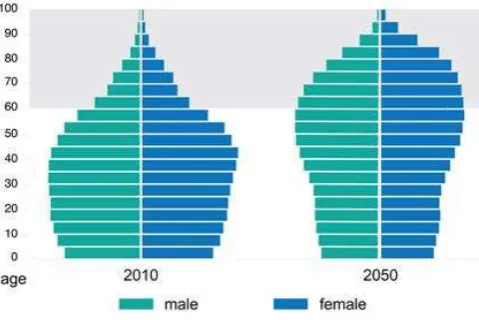
While much of South-East Asia is characterized by relatively youthful populations, Thailand is ageing rapidly. Older persons will make up nearly one-third of the total population by 2050, as seen in figure 1.
Figure 1. Population distribution by age group and sex, 2010 and 2050
Source: UN Population Division (July 2012)
In 2020, the population of persons aged 60 and above is expected to surpass the number of children for the first time in Thailand’s history.2 Yet, until 2009, no more than 20 per cent received any form of old-age pension, often despite decades of hard work.
Thailand’s pension system has continuously
developed over the years and includes various schemes for government officials, private sector employees and informal economy workers. Depending on the number of years of contribution, government officials receive a lump-sum payment or a pension under the Pension for Civil Servants Act,
1951. Furthermore, they can also avail the Government Pension Fund, which provides a lump-sum payment upon retirement.
Depending on the duration of contributions, private sector employees can receive a monthly pension or a lump-sum payment under the Social Security Act, 1990 (section 33). Private sector employees can also
contribute to a provident fund that gives a lump-sum payment upon retirement. Those who were previously insured under section 33 and cease their employment can continue to be insured under
2
Children are defined as persons below 15 years of age.
section 39. The contributions and benefits are based on a reference income of 4,800 Thai baht (THB), which is less than the minimum wage.
Workers in the informal economy can choose to contribute to one of two options under the Social Security Act, section 40. The first option does not
provide any form of retirement benefits, while the second option provides a lump-sum old-age benefit. At the end of 2010, only 84 individuals were insured under section 40 (SSO, 2016).
2. A need for a non-contributory old-age allowance
Previously, there was a large gap in protection for
informal sector workers. Even retirees from the formal sector lacked access to a pension because the contributory scheme was still young and the minimum number of years of contribution was not met. These factors influenced the development of an old-age allowance for “underprivileged elderly” or
persons at least 60 years of age without enough income to meet necessary expenses, or who are unable to work, abandoned or have no caregivers.
The old-age allowance was designed at the national level, but was implemented through local authorities who were responsible for overseeing the scheme, selecting beneficiaries and paying benefits. However,
local authorities differed widely in their interpretation of the national guidelines and application of the eligibility criteria. There was some abuse and leakages in addition to the exclusion of more than 50 per cent of the underprivileged elderly (Suwanrada and Dharmapriya, 2012, p. 158).
When it debuted in 1993, the allowance reached just 20,000 individuals. Reforms to the targeting methodology were made in 1995, 2002 and again in 2005, which resulted in increased representation of elderly advocates and local community members in the local committees in charge of the selection and
disbursement processes. As a result of this and increased budget allocations, the number of beneficiaries went up steadily in the years that followed. Still, many eligible beneficiaries remained outside pension coverage. When the Government dropped ineffective targeting procedures altogether
in 2009, coverage significantly increased.
[image:2.595.44.284.161.321.2]Figure 2. Expansion of the old-age allowance, from 1995 to 2013
Source: ILO, UNDP (2011)
3. A window for universal pensions
In April 2008, Thailand’s government opted to implement the old-age allowance as a universal scheme as one part of its stimulus package to mitigate the global economic crisis and accelerate recovery. All individuals aged 60 and above residing outside of public elderly facilities and without access
to regular pension payments became eligible for the benefit. As a result, coverage expanded remarkably.
Under the universal scheme, the supervision of the allowance is centralized under the Department of Social Development and Welfare with local bodies responsible for registering “residential inhabitants”, a
status required to receive the old-age allowance, and for distributing payments collected in person.
Registration happens once each year. Registrants can either appear in person at their local authority’s office or sign up at a roving mobile registration unit. Payments are then either collected in person at the local authority’s office or deposited directly into a
bank account. Beneficiaries may also designate another individual to receive the benefits for them.
The universal old-age allowance serves as the first and only form of pension for many of those working in the informal economy. It is also a complementary source of income for retirees from the formal sector.
Simultaneously, the Government started to provide a matching contribution under the Social Security Act, section 40. This contributed to increasing
membership of the voluntary social insurance to 2.4 million by the end of 2014.
4. What’s next?
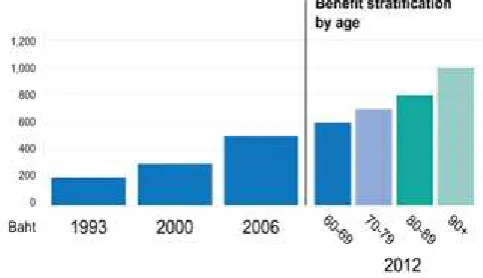
Since its introduction in 1993, the old-age allowance increased steadily from THB200 per month in 1993 to a maximum of THB1,000 in 2012, as seen in figure 3.
[image:3.595.48.287.68.217.2]The adoption of a tiered methodology in 2012 recognizes greater need for income support as people grow older, due to the reduced capacity to work and increased health and long-term care needs.
Figure 3. Evolution of the old-age benefit, 1993-2013
Source: ILO, UNDP (2011)
While the extension of coverage and deepening of benefits has made discernible improvements in the lives of Thailand’s older persons, the pension amount still remains far from the poverty line of THB2,647
per month in 2014 and minimum wage of THB300 per day. Indexation to the consumer price index, a percentage of the minimum wage or other benchmark could help ensure that the scheme provides sufficient income security for older persons.
In 2009, Thailand amended its Elderly Act to include
the universal old-age allowance in national legislation. However, stipulations for setting benefit levels exist only in ministerial decrees, leaving it vulnerable to fiscal and political pressures.
For around 30 million informal economy workers who are not members of the Government Pension Fund or
SSO pension scheme, the Government aims to reduce the income parity gap through the National Savings Fund, which started operations in 2015. Workers can contribute THB50-13,200 per year to receive a monthly pension of up to THB7,000 upon retirement.
[image:3.595.306.548.238.377.2]REFERENCES
Foundation of Thai Gerontology Research and Development Institute. 2015. National
Old Age Pension System Reform (Bangkok).
ILO. 2009. Thailand. Pension reform in times of crisis: A report requested by the
Ministry of Finance (Geneva).
Royal Thai Ministry of Social Development and Human Security. 2010. Amendment of
the 2003 Elderly Act: The Act on Older Persons B.E.2546 (2003A.D.) (Bangkok).
Sakunphanit, T.; Suwanrada, W. 2011. “The 500 Baht Universal Pension Scheme – Thailand”, in Sharing innovative experiences: Successful social protection floor
experiences (New York, ILO and UNDP), pp. 401-415.
Schmitt V.; Sakunphanit T.; Prasitsiriphon O. 2013. Social protection assessment based national dialogue: Towards a nationally defined social protection floor in
Thailand (Bangkok, ILO).
Social Security Office (SSO). 2016. Social Security Fund: Number of Insured Persons
(Article 40): 2007-2016 (Bangkok).
Suwanrada, W.; Dharmapriya, W. 2012. “Development of the old-age allowance system in Thailand: Challenges and policy implications”, in S.W. Handayani and B. Babajanian (eds): Social protection for older persons: Social pension in Asia. (Manila, Asian Development Bank), pp. 153-167.
Wiener, M. 2012. “Thailand’s matching defined contribution programs for the informal sector”, in R. Hinz et al. (eds): Matching contributions for pensions: A review
of international experience (Washington, DC, World Bank), pp. 275-286.
World Bank. 2012. Reducing elderly poverty in Thailand: The role of Thailand’s
pension and social assistance systems (Washington, DC).
Building Social
Protection Floors
Country Note Series
August 2016
This note was produced by James Canonge and Loveleen De of the ILO. It was reviewed by Isabel Ortiz, Valérie Schmitt and Nuno Cunha of the ILO, Usa Khiewrord of HelpAge International and Dr Thaworn Sakulphanit of the Health Insurance System Research Office in Thailand.
The editor of the series is Isabel Ortiz, Director of the Social Protection Department, International Labour Organization (ILO).
For more information, contact: [email protected]
www.social-protection.org
INTERNATIONAL LABOUR OFFICE
4, route des Morillons 1211 Genève 22 Switzerland
Follow us on:
www.facebook.com/SPplatform
www.linkedin.com/company/social-protection-platform www.twitter.com/soc_protection
www.youtube.com/user/ILOTV