• Tidak ada hasil yang ditemukan

Bolivia: Universal pensions for older persons 53696

N/A
N/A
Protected

Academic year: 2017

Membagikan "Bolivia: Universal pensions for older persons 53696"

Copied!
4
0
0

Teks penuh

(1)

Universal pensions for older persons

Plurinational State of Bolivia

Renta Dignidad (“Dignity Pension”): Making the social protection floor a reality for all older people Despite having the lowest GDP per capita on the continent, Bolivia has achieved one of the highest coverage rates in old-age pensions. With the introduction of the non-contributory old-age pension Renta Dignidad in 2007, Bolivia closed coverage gaps and achieved universal coverage.

Renta Dignidad costs around 1 per cent of the country’s GDP and is financed by public revenues generated from taxes on oil and gas production and dividends from a group of state-owned companies.

The impacts of Renta Dignidad on people’s lives are remarkable. For example, the programme led to a reduction in the poverty rate by 14 percentage points at the household level. Renta Dignidad has secured the incomes and consumption of beneficiaries, reduced child labour, and increased school enrolment. In households receiving the benefit, child labour has been halved and school enrolment has reached close to 100 per cent.

Main lessons learned

• Bolivia’s Renta Dignidad programme shows that universal social protection for older persons is achievable, even in developing countries.

• This non-contributory social protection programme has a significant impact on poverty reduction for older persons and other family members living with them; it has reduced poverty by 14 per cent.

• Political will and government commitment are essential. In particular, increasing fiscal space is indispensable to significantly extending old-age pension coverage. Renta Dignidad is financed by revenues from natural hydrocarbon resources.

• Renta Dignidad is administered by the Ministry of Economy and Public Finance but the Bolivian Armed Forces have also played a critical role in achieving higher coverage rates in remote rural areas. There are over 200 payment points installed in military facilities and its mobile units.

• By boosting local demand, stimulating the rural economy, and improving civil registration in rural areas, the universal old-age pension is a driver of growth and development.

S

o

ci

a

l P

ro

te

ct

io

n

in

A

ct

io

n

:

B

u

ild

in

g

S

o

ci

a

l P

ro

te

ct

io

n

F

lo

o

rs

Ju

n

e

20

1

6

(2)

1. What does the system look like?

Renta Dignidad is a universal programme, i.e. there are no conditions or means tests to receive the benefit. Along with the country’s conditional cash transfer programmes, Bono Juancito Pinto (for school children) and the Bono Juana Azurduy (for expectant and new mothers and their infants), Renta Dignidad is another step forward towards creating a national social protection floor.

Key figures

Renta Dignidad reaches 91 per cent of the population over the age of 60.

The monthly benefit amount is 250 bolivianos (BOB) (US$35.9) for beneficiaries without a contributory pension. BOB200 ($28.7) is paid to recipients of the contributory scheme.

Involvement of the armed forces has played a critical role to achieve higher coverage rates in rural areas.

Benefit packages: The monthly benefit amount for retirees who are not part of the contributory pension scheme was raised in 2013 to BOB250 ($35.9) and to BOB200 ($28.7) for those covered by the contributory pension scheme. These amounts represent 38 per cent of the poverty line and 21 per cent of the minimum wage, respectively.

Financing: The scheme’s cost (benefits plus administrative costs) amounts to roughly 1 per cent of GDP. It is financed from two sources: resources derived from a direct tax on hydrocarbons and dividends from nationalized public enterprises that are earmarked to finance the Renta Dignidad. The Government’s revenue from the exploitation and sale of hydrocarbons has increased tremendously. This in turn has brought about a significant increase in fiscal revenues and hence fiscal space for financing social protection.

Legal aspects: Renta Dignidad was established in 2007 by Act No. 3791, replacing the previous social pension scheme known as BONOSOL. The benefit is guaranteed under the Constitution of 2009, which states that “all older persons have the right to a dignified old age, with human quality and warmth.

The State shall provide a lifelong old-age pension in the framework of the integrated social security system, as stipulated by legislation.” Eligible beneficiaries must be at least 60 years of age, be a Bolivian or naturalized citizen, be domiciled in the country, and have a national identity document.

Institutional arrangements for delivery: Renta Dignidad is administered by the Ministry of Economy and Public Finance with cooperation from the military and the national banking system in the delivery of benefits.

The pension is paid on a monthly basis. The payments are made in more than 1,100 payment centres across the entire country, including branches of financial institutions and National Armed Forces payment centres. Involvement of the armed forces has played a critical role in reaching high coverage rates in remote rural areas. There are more than 200 payment points installed in military facilities and its mobile units. All military mobile units are equipped with mobile satellite dishes. The centralized database of beneficiaries can be accessed from any place in the country, allowing beneficiaries to collect their pensions anywhere.

2. How was this major breakthrough achieved?

Consolidation of Renta Dignidad as a universal social pension can be explained by two main factors. First, in the course of privatizing public enterprises in 1995, half of the shares of these companies were sold to foreign investors, while around 48 per cent were granted to Bolivians 21 years of age or older. After the renationalization, the dividends generated by these enterprises were earmarked to finance the Renta Dignidad. Second, in 2006, the Government renationalized the hydrocarbon sector and recovered ownership and control of the country's natural hydrocarbon resources. The allocation of revenues from this sector was renegotiated with an 82 per cent share of revenues going to the State and 18 per cent to private companies. This allowed for the creation of fiscal space for financing social protection.

(3)

Figure 1. Cost of Renta Dignidad in percentage of GDP

Source: APS. Estadísticas 2014.

3. What is the impact on people’s lives?

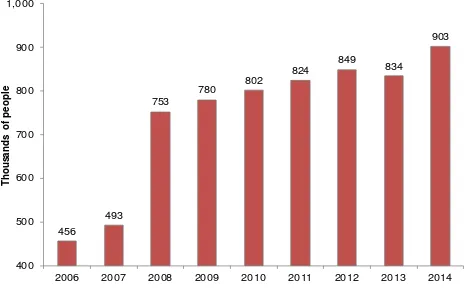
Outcome: Renta Dignidad is the first, and so far only, universal pension programme in Latin America. The effective coverage rate reaches more than 90 per cent of people over the age of 60.

Figure 2. Number of Renta Dignidad beneficiaries

Source: APS. Estadísticas 2014.

Impact on people’s lives: Renta Dignidad led to a reduction in the poverty rate at the household level by 14 percentage points. The pension stabilizes households’ incomes and contributes to boost consumption levels. Positive impacts on child labour and education are also significant. A study conducted by UDAPE (Escobar Loza et al., 2013) shows that children living in households receiving Renta Dignidad benefits are less likely to be working (a reduction of 8.4 percentage points) compared to children in

households that do not benefit from Renta Dignidad. Meanwhile, school enrolment rates were 8 percentage points higher in households receiving the social pension, making the enrolment rate close to 100 per cent for this group.

Impact on the economy: The impact of social pensions on local development and formalization is well known. Before the introduction of the Renta Dignidad, there were many people of all ages without national personal identification (ID) documents in rural areas. The registration campaign conducted by the programme reached members of households of all ages, including working-age people. The growing number of people with personal IDs and the positive impacts of the social pension on local demand for goods and services in rural areas have contributed to the formalization of the rural economy.

4. What’s next?

Bolivia has made significant efforts to universalize its social pension system. The Government is now focusing on improving the administrative and financial governance of the programme, improving the adequacy of benefits, as well as creating complementary linkages with other social protection programmes. Next steps include:

1. overcoming administrative issues to cover the remaining 10 per cent of older persons who are not yet part of Renta Dignidad;

2. maintaining and improving financial governance in order to ensure the sustainability of the programme in the long run;

3. exploring options for increasing the benefit level, which remains modest; and

4. continuing to strengthen the coordination mechanisms with other social protection programmes.

Bolivia’s Renta Dignidad is a successful example of guaranteeing universal social protection for older persons. Such achievements would not have been possible without the strong political will and commitment of the Government to universalize the coverage of social pensions and secure financing sources for universal social protection policies.

1.0

0.9 1.1

1.4

1.3

1.1

1.0 1.0

1.2

0.7 0.8 0.9 1.0 1.1 1.2 1.3 1.4 1.5

2006 2007 2008 2009 2010 2011 2012 2013 2014

P

e

rce

n

tag

e o

f G

D

P

456 493

753 780

802 824

849 834

903

400 500 600 700 800 900 1,000

2006 2007 2008 2009 2010 2011 2012 2013 2014

T

h

o

u

sa

n

d

s

o

f p

e

o

p

le

(4)

REFERENCES

Autoridad de Fiscalización y Control de Pensiones y Seguros. Estadísticas. Available at:

www.aps.gob.bo/estadisticas/Paginas/Renta-Dignidad.aspx.

Durán-Valverde, F.; Pacheco, F. 2012. Fiscal space and the extension of social protection:

Lessons learnt from developing countries (Geneva, ILO). Available at: www.social-protection.org/gimi/gess/RessourcePDF.action?ressource.ressourceId=34168.

Escobar Loza, F.; Martínez Wilde, S.; Mendizábal Córdova, J. 2013. El impacto de la Renta

Dignidad: Política de redistribución del ingreso, consumo y reducción de la pobreza en hogares con personas adultas mayores (La Paz, UDAPE). Available at:

www.udape.gob.bo/evaluaciondeimpacto/12_Documento_Impacto%20Renta%20Dignid ad.pdf.

ILO. 2012. Social Protection Floors Recommendation (No. 202). Available at:

www.ilo.org/dyn/normlex/en/f?p=NORMLEXPUB:12100:0::NO::P12100_ INSTRUMENT_ID:3065524.

—. 2014. World Social Protection Report 2014/2015: Building economic recovery,

inclusive development and social justice (Geneva). Available at: www.social-protection.org/gimi/gess/ShowTheme.action?th.themeId=10.

Ticona Gonzales, M. 2011. “The Dignity Pension (Renta Dignidad): A universal old-age

pension scheme”, in Sharing Innovative experiences, Successful Social Protection Floor

experiences (New York, ILO/UNDP/Global South-South Development Academy).

Available at: www.unicef.org/eapro/innovative_experiences.pdf.

Building Social

Protection Floors

Country Note Series

June 2016

This note was produced by Fabio Durán-Valverde and Tomas Barbero. It was reviewed by Isabel Ortiz and Valérie Schmitt of the ILO.

The editor of the series is Isabel Ortiz, Director of the Social Protection Department,

International Labour Organization (ILO).

For more information, contact: [email protected]

www.social-protection.org

INTERNATIONAL LABOUR OFFICE

4, route des Morillons 1211 Genève 22 Switzerland

Follow us on:

www.facebook.com/SPplatform

www.linkedin.com/company/social-protection-platform www.twitter.com/soc_protection

www.youtube.com/user/ILOTV

Gambar

Figure 1. Cost of Renta Dignidad in percentage of

Referensi

Dokumen terkait

Maka Pokja Jasa Konstruksi 2 (DUA) - ULP Tanjung Jabung Timur mengundang Saudara Direktur/yang mewakili dengan membawa Surat Kuasa yang ditandatangani oleh Direktur dan didampingi

Kegiatan : Uji Kelayakan Sarana Transportasi Guna Keselamatan Penumpang Pekerjaan : Pengadaan Buku Uji dan Plat Uji. Lokasi

Sapon (1.900,00 Ha) untuk memberikan penjelasan kepada peserta lelang tentang adanya pembetulan kesalahan

Laporan Perolehan Dana ZIS ke 31 Lazis Muhammadiyah.. Saldo Laporan

Detection of Dermatophyte between Toes of Medical Students Wearing and not Wearing Socks in Universitas Padjadjaran using Direct..

Mikroprosesor dan komputer memerlukan tempat penyimpanan data dalam biner 1 atau 0, untuk itu diperlukan rangkaian digital yang dapat melakukan tugas tersebut yaitu

Dengan ini kami mengundang perusahaan saudara untuk melakukan klarifikasi dan negosiasi dokumen penawaran pekerjaan penyusunan DED tambak di kabupaten Situbondo pada:. Hari/tanggal

Objek penelitian ini adalah usaha dan hambatan dalam mendapatkan kebutuhan cinta dan kasih sayang pada tokoh Aurelia. Kebutuhan cinta dan