THE ANALYSIS OF READINESS COMPETENCY CERTIFICATION FOR DIPLOMA STUDENTS OF ACCOUNTING DEPARTMENT
IN FACULTY OF ECONOMIC YOGYAKARTA STATE UNIVERSITY BASED ON ACCOUNTING SKILLS CERTIFICATION EXAM (USKAD)
Siswanto
Yogyakarta State University/Universitas Negeri Yogyakarta ([email protected])
Patriani W. Dewanti
Yogyakarta State University/Universitas Negeri Yogyakarta ([email protected])
Merinda N.N. Siregar
Yogyakarta State University/Universitas Negeri Yogyakarta ([email protected])
Wahyu Astri Kurniasari
Yogyakarta State University/Universitas Negeri Yogyakarta ([email protected])
Abstract
This study is aimed to analyze the readiness of Diploma Students (Associate Degree) of Accounting Department in Faculty of Economics Yogyakarta State University to face the certification of competencies based on certification issued by Indonesian Institute of Indonesia Chartered Accountants to deal with the competition in the era of globalization. The subjects of the research were 47 students of Diploma in Accounting Department, Faculty of Economics, Yogyakarta State University who are studying the fifth semester. Data collected in this research were the grade of each course in the List of Students Study Results (DHS) related with the competencies that will be tested in Accounting Skills Certification Exam (USKAD). The variable in this research is the readiness of the students to face the certification of competencies. There are three competencies tested in this research, which are the ability to prepare the financial statements based on accounting financial reporting standards, the ability to prepare and present the financial statements according to accounting cycle, and the ability to analyze financial reports. The research used descriptive statistical analysis to categorize the readiness of the student. The results showed that: (1) 48,9% of the students were categorized as well prepared; 21,3% prepared; 19,1 less prepared; and 10,6% unprepared to deal with the competency test preparing the financial statements; (2) 57,4% of students categorized well prepared; 23,4% prepared; 12,8% less prepared; and 6,4% unprepared to deal with the competency test preparing and presenting the financial statements; and (3) 38,3% of students categorized well prepared; 23,4% prepared; 19,1% less prepared; and 19,1% unprepared to deal with the competency test analyzing financial statements.
The data in the Central Bureau of Statistics (BPS) in 2014 showed that 9,5% of total unemployment in Indonesia are hold theassociate’s degree and bachelor’s degree. A high unemployment rate of college graduates is caused by the gap skills between the graduates’and workers needed by industrial and business world. University graduates are experiencing a dilemma, because the diploma degree can not guarantee to get a job. They should improve their professionalism to face the competition in the world of work. Workers who have competencies may have greater opportunities than the others who do not have. Competencies are become important for graduate students to support them to compete the era of globalization and especially to face the ASEAN Economic Community which implemented in 2015.
Indonesia Government has set up the regulation to support the edcuational system. The Act of The Republic of Indonesia Number 20 Year 2003 mentioned that National Education System consists of content standards, process standards, competency standards, educator standards, facilities and infrastructure standards, management standards, financing standards, and assessment standards of education must be improved as well planned and periodically. Competency standards mean that student graduates must have capabilities in attitude, knowledge and skills. Competency in knowledge must be proven by the certification of comptencies. Certification of competencies are given to graduates who passed the exams. Having the competency certification is giving more added value for graduates in getting a job.
Researcher conducted an interview with Drs. Sururi, MBA., Ak., CA as the Director of Academy of Accounting YKPN on October 21, 2016. He said that Academy of Accounting YKPN has been collaborating with Institute of Indonesia Chartered Accountants since 2013. There are 2 purposes of this certification. Firstly, the purpose is to increase the acceptability of graduates in the world of work. Second, to validate their competencies by competent independent party, named Institute of Indonesia Chartered Accountants. As one of the higher education institution, Diploma of Accounting Department in Faculty of Economics Yogyakarta State University, is expected to create competent graduates in accounting.
II. LITERATURE REVIEW
Competency means capability that represents someone’s qualification both qualitatively and quantitatively. Competency is an important thing especially to some professions, because the competency is something fundamental to the quality of the work. Spencer and Spencer (in Sumedi, 2013) said that competency is “an underlying characteristic of an individual that is casually related it criterion referenced effective and/or superior performance in job or situation”. According to that definition,
competency is the basic characteristic of individual that influeces the effectiveness of the way of thinking and acting as well as establishing a high performance.
Regulation of The Minister of Finance of The Republic of Indonesia Number 045/U/2002 about Core Curriculum of College, Article 1, expressed the definition of competency is a set of intelligent action, the full responsibility of a person as a condition to be considered capable by the community in carrying out tasks in certain occupations. Article 2, paragraph 1 states that the competency of student results a course of study consists of:
a. Main competency b. Supporting competency
c. Others that are specific competency and related to core competency While Article 2, paragraph 2 states that the elements of competency consists of:
a. Basic personality
b. The expertise of knowledge and skill c. Ability to work
d. The attitude and behaviors according to the skills and kmowledge
e. Understanding social rules in accordance with the choice of expertise at work
According to Taxonomi Bloom, sense of competency can be divided into 3 domains and the trainers usually associate those 3 domains with knowledge, skill, and attitude:
a. Cognitive domain emphasizes on knowledge b. Affective domain emphasizes on attitude c. Psychomotor domain emphasizes on skill
a. Communication skills. b. Computer skills.
c. Analytical and intelectual skills.
d. Multi-disciplinary and inter-disciplinary skills. e. Knowledge of global issues.
f. Critical thinking.
Accounting Education Change Commission suggests that accounting education system should prepare graduates become a professional (Institute of Indonesia Chartered Accountants in Arianto and Trimizi, 2013). It requires not only knowledge of accounting and business theory, but also the skills which include intellectual skills, interpersonal and communication skills, and professional orientation. In Indonesia, as a response to the publication of Internal Education Standards by the International Federation of Accountants (IFAC), Institute of Indonesia Chartered Accountants plans to put subjects in addition to accounting to be used as a core curriculum which aims to build soft skills support (especially on personal skills, interpersonal and communication skills, and organizational and business skills) (Institute of Indonesia Chartered Accountants in Arianto and Trimizi, 2013).
Although International Education Standards (IES) is made for public accountant who had to do auditing, it does not mean that everything described and listed on IES is something that should not be shared by all accountants. Accountants are expected to become professionals and to have integrity. Professional accountants are generated through continuous training and education, and refer to the same standards, which one of them is sourced from IES.
From several statements above, it is indicated that there is a way to tighten the accounting students quality. Accounting students are expected to have qualified skills to uphold moral values and code of ethics so it can make a good impression about accounting profession. Government Regulation Number 23/2004 on the National Professional Certification Board describes the job competency certification as a process of granting certificates that carried out systematically and objectively through competency test referring to the national or international standards about job competency.
in Indonesia and earn the trust of the governement to set Financial Accounting Standards. Institute of Indonesia Chartered Accountants also organizes Accounting Skills Certification Exam intended to accounting students and requires basic skills qualification in accounting.
The objectives of these certifications are that students have the ability and expertise in accounting, capable of carrying out operational tasks in accounting, able to analyze financial transactions and apply the knowledge to execute the practice at work. The Accounting Skills Certification Exam participants are required to have a minimum high school degree and registered as an active students majoring accounting at the associate or bachelor degree. The certification is a test to measure the skills of participatns in the following terms:
a. Acknowledge and be able to explain the basic framework of the preparation and presentation of Financial Statements in accordance with Financial Accounting Standards.
b. Identify the transactions that contained in the Financial Statements.
c. Develop and present Financial Statements in accordance with accounting cycle. d. Conduct a basic analysis of Financial Statements.
III. Research Method
A. Population and Sample
The population in this research were the students who are studying in the fifth semester of Diploma in Accounting Department, Faculty of Economics, Yogyakarta State University. Samples are determined by using purposive sampling method. Based on the technique, this research obtained 47 students.
B. Data Collection Technique
According to Sutrisno Hadi (2016), The formula to determine Mi and SDi as follows:
Mi = [ST + SR]: 2 SDi = [ST–SR]: 6 Note:
Mi : The Ideal Mean
SDi : The Ideal Deviation Standard ST : The Highest Ideal Score SR : The Lowest ideal score
The number or value obtained from the formula calculation is categorized into groups as follows:
Well prepared : X > Mi + 1,5 SDi Prepared : Mi < X≤ Mi + 1,5 DSi Less prepared : Mi–1,5 SDi < X≤ Mi Unprepared : < Mi–1,5 SDi
C. Operational Definition and Variable Measurement
Variables investigated in this study are the readiness of students to take the Accounting Basic Skills Exam (USKAD) organized by Institute of Indonesia Accountant (IAI).
1. List of Student Study Results
List of Student Study Results is a list of courses that have been taken by students and approved by the Chairman of the Department of Accounting Education Faculty of Economic Yogyakarta State University. List of Student Study Results is measured by scrutiny of documents each 5th semester student on competency standards that will be tested in USKAD. There are three competencies tested in USKAD, which are capable of preparing the financial statements; preparing and presenting financial statements; and analysing of financial statement.
2. Standard of Competence
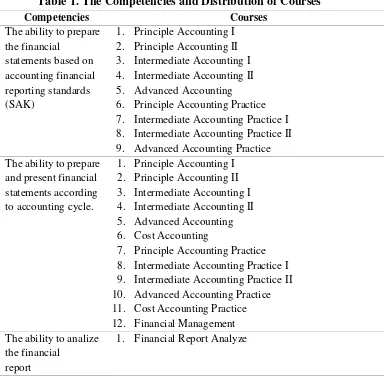
studying the level of education as well. The standard of competence is measured by determining the courses based on the curriculum structure and distribution of subjects that have been set by the Accounting Department in Diploma Programme Faculty of Economics YSU in accordance with USKAD competency standards set by IAI. Standards of competence and distribution of courses that meet are as follows:
Table 1. The Competencies and Distribution of Courses
Competencies Courses
The ability to prepare the financial
statements based on accounting financial reporting standards (SAK)
1. Principle Accounting I 2. Principle Accounting II 3. Intermediate Accounting I 4. Intermediate Accounting II 5. Advanced Accounting 6. Principle Accounting Practice 7. Intermediate Accounting Practice I 8. Intermediate Accounting Practice II 9. Advanced Accounting Practice The ability to prepare
and present financial statements according to accounting cycle.
1. Principle Accounting I 2. Principle Accounting II 3. Intermediate Accounting I 4. Intermediate Accounting II 5. Advanced Accounting 6. Cost Accounting
7. Principle Accounting Practice 8. Intermediate Accounting Practice I 9. Intermediate Accounting Practice II 10. Advanced Accounting Practice 11. Cost Accounting Practice 12. Financial Management The ability to analize
the financial report
1. Financial Report Analyze
V. RESULTS & DISCUSSIONS
The research was conducted by examining the grade of the courses that listed in the list of Student Study Results of each student, which is related with the competencies tested in the Accounting Skills Certification Exam (USKAD). The Measurement of student readiness competency certification was done by calculating the mean values for each competency, and from the average classified in accordance with the assessment categories, categorized as well prepared, prepared, less prepared and unprepared . There are three competencies tested and thirteen related subjects. The discussion on the findings are outlined as follows: 1. The ability to prepare financial statements based on Accounting Financial
Reporting Standards (SAK).
The study showed that a mean of 3.65 with the highest scores (ST) achieved was 4.00 and the lowest score was (SR) 2.96. Determining student competency tendency used the ideal mean (Mi) and the ideal standard deviation (SDi)
Mi = ½ (ST + SR)
= ½ (4,00 + 2,96) = 3,4821 SDi = 1/6 (ST–SR)
= 1/6 (4,00–2,96) = 0,1726
Based on Mi and Sdi the students competencies can be identified in table 2 as follows:
Table 2. The Categorization of Competency to Prepare the Financial Report based on Accounting Financial Reporting Standards
No. Category Span Amount Percentage
1 Well Prepared > 3,74 23 48,9% 2 Prepared 3,48 - 3,74 10 21,3% 3 Less Prepared 3,22 - 3,48 9 19,1%
4 Unprepared < 3,22 5 10,6%
Total 47 100,0%
2. The ability to prepare and present financial statements according to accounting cycle. The research indicates that the mean value was 3,61 which aim the highest score was 4,00 and the lowest score was 2,73. To perceive the students competency tendency, we used mean ideal (Mi) and deviation standard ideal (SDi).
= ½ (4,00 + 2,73) = 3,367 SDi = 1/6 (ST–TR)
= 1/6 (4,00–2,73) = 0,211
Based on Mi and SDi, the competency was indicated by in table 3 as follows:
Table 3. The Categorization of Competency to Prepare and Present Financial Statements According to Accounting Cycle.
No. Category Span Amount Percentage
1 Well Prepared > 3,68 27 57,4%
2 Prepared 3,36 - 3,68 11 23,4%
3 Less Prepared 3,05 - 3,36 6 12,8%
4 Unprepared < 3,05 3 6,4%
Total 47 100,0%
3. The ability to analyze the financial report
The result of the study shows that mean value was 3,29 which are the highest number (ST) for 3,75 and the lowest number (SR) for 2,33
Mi = ½ (ST + SR)
= ½ (3,75 + 2,33) = 3,04 SDi = 1/6 (ST–SR)
= 1/6 (3,75–2,33) = 0,2367
Students ability to analyze the financial report is represented in table 5 as follows:
Table 5. The categorization of competency to analize the financial report
No. Category Span Amount Percentage
1 Well Prepared > 3,39 18 38,3% 2 Prepared 3,04 - 3,39 11 23,4% 3 Less Prepared 2,68 - 3,04 9 19,1%
4 Unprepared < 2,68 9 19,1%
Total 47 100,0%
Based on the research results, it is apparent on each competency that most of the students is considered ready to take the competence test, which are:
1. The ability to prepare the financial report according to the Accounting Financial Reporting Standards (SAK).
This competency standard is to test the students’ understanding of the accounting process consisting of recording the transaction to the process of preparing financial statements in accordance with financial standards as well as an understanding about the posts in the financial statements. Based on the distribution of the subjects in the curriculum structure D3 Accounting Department, there are 7 subjects related to this competence. Based on the results of the study, there are 23 students or 48.9% with a range of > 3.74 categorized as well prepared and 5 students categorized as unprepared or 10.6% with a range of < 3.22. So it can be said that almost 50% of the students already have a good knowledge and ability to prepare financial statements in accordance with GAAP and prepared to follow competency test USKAD competency standards prepare financial statements in accordance with SAK.
2. The ability to prepare and present financial statements according to the accounting cycle.
At this competency standard, in addition to testing the understanding of the financial statements as a standard 1 above, students are also expected to understand the concepts and practices concerning information processing costs as basis for management decision making. Moreover, this competency also tests the understanding of financial management knowledge in companies such as investment funds and capital adequacy of the company.
3. The ability to analyze the financial report
The third competency standard is to measure the students’understanding about how to analyze the financial performance of a company by calculating the ratio of the financial statements. Based on the distribution of curriculum contained in the curriculum structure D3 Accounting Department FE UNY, there are 1 subject related to this competency standards. Based on the results of the study, 18 students or 38.3% with a range of > 3.39 are categorized as well prepared, while the 9 students or 19.1% with a range of < 2.68 are considered as unprepared. The analysis of the data obtained for this competency standards show that less than 50% of students are able to analyze the financial reports and able to perform financial statement analysis. This is in contrast to the standard of competence in prepared financial statements in accordance with GAAP and competency standard of preparing and presenting financial statements in accordance with accounting cycle, which can be said that 50% of the students are prepared to take the standards of competency test.
All in all, the data analysis experienced that most of the student are very prepared in all of the subjects related with the competency standards. However, there are some students categorized as poor but only in few numbers. Thus, it can be concluded that most of the students are considered capable to take the Accounting Skill Certification (USKAD) organized by Indonesian Institute of Indonesia (IAI).
VI. CONCLUSIONS AND RECOMMENDATIONS
A. Conclusions
There are three competencies examined in this study, which are:
1. The ability to prepare the financial report based on Accounting Financial Report Standards (SAK).
In this competeny, the analisis data showed that 23 students or 48,9% categorized as well prepared and ready to tahe the competencies exam , while only 5 students or 10,6% were categorized as unprepared.
The result of the analysis data on this competency were obtained 27 students or 57,4% categorized as well prepared to take the competency test. Homever, 3 student or 6,4%s were categorized as unprepared.
3. The ability to analyze the financial report.
As it can be seen from the data analysis that 18 students or less than 50% of the students were ready to take the competence exam. Meanwhile, students who are considered sufficiently prepared or less prepared are 9 students or 19,1%.
B. Recommendations
1. Two courses is being taken in the fifth semester by the students, which are intermediate accounting 2 practice and advanced accounting practice, therefore the value of the two subjects is not inserted into the data tabulation.
2. The analysis data on standard competency for the ability to analize the financial report showed that the number of the students which are capable to analyze the financial report are less than 50%. Thus, they need more assistance to prepare the competency test.
REFERENCES
Anonim, 2014,Pengangguran terbuka Menurut Pendidikan Tertinggi yang Ditamatkan 2004-2014, dalam tautan www.BPS.go.id
Anonim, 2016,Sekilas BNSP, dalam tautan www.bnps.go.id.
Anonim, 2016,Keuntungan Sertifikasi,dalam tautan www.bnps.go.id.
Anonim, 2016,Masyarakat Ekonomi Asean,dalam tautan www.wikipedia.co.id.
Awayiga, Joseph Y., Joseph M. Onumah, and Mathew Tsamenyi. "Knowledge and skills development of accounting graduates: The perceptions of graduates and employers in Ghana."Accounting Education: an international journal 19.1-2 (2010): 139-158.
Kementrian Pendidikan Nasional.Standar Kompetensi Lulusan Akuntansi,2011.
Hutapea, Parulian, and M. B. A. Nurianna Thoha.Kompetensi plus. Gramedia Pustaka Utama, 2008.
Hadi, Sutisno.Metodologi Riset. Pustaka Pelajar, 2016.
Kavanagh, Marie H., and Lyndal Drennan. "What skills and attributes does an accounting graduate need? Evidence from student perceptions and employer expectations." Accounting & Finance 48.2 (2008): 279-300.
Mohammed, Ehab K.A. “Accounting Knowledge and Skills and the Challenges of A Global Business Environment”, Emerald Insight, Vol 29 Number 7, 2003.
Setyaningsih, Ira. Kompetensi Untuk Menakar Kesiapan Mahasiswa Menghadapi Persaingan Asean Economic Community.,Seminar Nasional IENACO. (2015)