• Tidak ada hasil yang ditemukan

Evaluating an engagement based preferenc

N/A
N/A
Protected

Academic year: 2018

Membagikan "Evaluating an engagement based preferenc"

Copied!
9
0
0

Teks penuh

(1)

See discussions, stats, and author profiles for this publication at:

https://www.researchgate.net/publication/246155161

Evaluating an engagement-based preference

assessment for children with Autism

Article

in

Research in Autism Spectrum Disorders · October 2010

DOI: 10.1016/j.rasd.2009.12.010

CITATIONS

5

READS

189

2 authors:

Some of the authors of this publication are also working on these related projects:

Longtitudinal Study of Australian Students with Autism (LASA)

View project

Deb Keen

Griffith University

61

PUBLICATIONS

714

CITATIONS

SEE PROFILE

Donna Pennell

Queensland University of Technology

17

PUBLICATIONS

270

CITATIONS

SEE PROFILE

All content following this page was uploaded by Deb Keen on 27 May 2014.

(2)

Evaluating an engagement-based preference assessment for children

with Autism

Deb Keen

*

, Donna Pennell

Faculty of Education, Australian Catholic University, 1100 Nudgee Road, Banyo, Queensland, 4014

1. Introduction

Preference can be defined as the subjective liking or disliking of particular objects, people or activities (Kearney & McKnight, 1997). The assessment of preferences for individuals with developmental disabilities is a common practice in the provision of educational and behavioural interventions for this population (Hagopian, Long, & Rush, 2004). For children with autism who often experience low levels of engagement with the physical and social world, identifying and using a child’s interests to increase motivation and participation is an important intervention tool (Keen, 2009).

Individual preferences may be assessed indirectly via caregiver report or directly by presenting stimuli and measuring an individual’s response to those stimuli. Reinforcer testing of the stimuli identified through preference assessments can then be used to determine the reinforcing value of a stimulus as this cannot be determined through a preference assessment alone.

Direct preference assessment procedures can be further categorised into approach-based or engagement-based assessments. In an approach-based preference assessment, single, paired or multiple stimuli (with or without replacement) are presented and data collected on whether or not the individual approaches each stimulus (Fisher et al., 1992). The paired stimulus approach has been shown as one of the most effective approach-based assessment techniques in which paired A R T I C L E I N F O

One method of conducting preference assessments with individuals who have autism involves measuring the time spent by the child engaging with various stimuli. Engagement is generally defined as showing interest in the stimulus but few studies have investigated the potential effects of the quality of engagement with the stimulus on reinforcer effectiveness. In this study, both the duration and quality of engagement were measured for four children with autism aged between 4 and 5 years who participated in a duration-based multiple stimulus with replacement preference assessment. Stimuli were classified into one of the following three categories based on duration and quality of engagement with each stimulus presented: no interest; interest and; active engagement. The relative reinforcing value of stimuli from each category was then investigated. Results showed that the quality of engagement with the stimulus did not predict the relative reinforcer effectiveness of the selected stimuli for any of the participants. For two children, the procedure was effective in differentiating stimuli classified as no interest and those with which the child had engaged, regardless of the quality of that engagement. The utility of an engagement-based preference assessment that also measures quality of engagement with stimuli as a means to guide selection of reinforcers for children with autism is discussed.

ß2010 Elsevier Ltd. All rights reserved.

* Corresponding author. Tel.: +61 7 3623 7531; fax: +61 7 3623 7431. E-mail address:[email protected](D. Keen).

Contents lists available atScienceDirect

Research in Autism Spectrum Disorders

J o u r n a l h o m e p a g e : h t t p : / / e e s . e l s e v i e r . c o m / R A S D / d e f a u l t . a s p

1750-9467/$ – see front matterß2010 Elsevier Ltd. All rights reserved.

(3)

stimuli are presented and data kept on which of the two is selected in each trial (DeLeon & Iwata, 1996). Preferences can then be ranked using this procedure by determining the percentage of trials in which each stimulus was chosen. The resulting preference hierarchy has been found to predict relative reinforcer effectiveness (Piazza, Fisher, Hagopian, Bowman, & Toole, 1996).

Engagement-based preference assessments have been advanced as an alternative to approach-based assessments as they usually take less time to administer, can include activities not easily accommodated in approach-based assessments and may better suit individuals who have difficulty in choosing between two stimuli in a pair-wise presentation (Hagopian, Rush, Lewin, & Long, 2001. In an engagement-based assessment, stimuli are presented and the amount of time the individual engages with the stimulus recorded. This procedure has been used effectively to identify high-preference stimuli that have functioned as reinforcers (DeLeon, Iwata, Conners, & Wallace, 1999). Further differentiation of stimuli ranked as high, middle and low preference has also been tested in a study byHagopian et al. (2001). These researchers investigated the predicative validity of a single stimulus engagement preference assessment with 4 individuals who had developmental disabilities. A stimulus hierarchy was determined for each participant by presenting each stimulus singly for 2 min while recording stimulus engagement. Using this hierarchy, stimuli were categorised as high-, middle-, and low preference. The relative reinforcing effects of stimuli from each category were then assessed. High-preference stimuli were found to produce higher levels of responding than low- and middle-preference stimuli while middle-preference stimuli produced higher levels of responding than low-preference stimuli. This pattern was clear for 3 of the participants in the study. While results for the remaining participant reflected a similar trend, the level of responding for this individual was more variable.

Engagement-based preference assessments such as those described above have generally defined engagement as time spent interacting with a stimulus. Engagement can also be considered to have a qualitative dimension to the interaction. For example,McWilliam and Bailey (1992)defined engagement as the amount of time children spend actively or attentively interacting appropriately with their environment at different levels of competence. For children with autism, the way in which they engage with objects and people can vary considerable. Sautter et al. (2008) investigated the impact of developmental features of toys and preference level on play for 6 children with autism. Toys were categorised as either developmentally oriented or sensory stimulating with the latter being typically used in interventions for, and commonly preferred by, children with autism. They found that highly preferred sensory stimulating toys were associated with more problem behaviour and solitary play while developmentally oriented toys that were moderately preferred produced the most interactive play and fewer problem behaviours. These findings raise interesting questions about the way children interact with toys during engagement-based preference assessments and whether the reinforcing value of a stimulus may vary with the way a child engages with that stimulus.

The aim of the current study was to trial a procedure for assessing child preferences based on quality of engagement with stimuli and to investigate the effects of qualitative aspects of engagement on reinforcer effectiveness. An engagement-based preference assessment was conducted and stimuli were classified into one of three categories based on duration and quality of engagement: no interest; interest; and active engagement. A reinforcer assessment was then conducted to determine if quality of engagement predicted relative reinforcer effectiveness.

2. Study design

2.1. Participants

Three boys and one girl with autism and enrolled in an autism-specific early intervention centre participated. The participants were selected because their teachers reported them to be amongst the most difficult children to engage at the early intervention centre. For this study, diagnoses of participants were confirmed using the Autism Diagnostic Observation Scale (ADOS) (Lord, Rutter, DiLavore, & Risi, 2001) which was administered by a trained assessor. Additional information about the children’s adaptive functioning using the Scales of Independent Behaviour Revised (SIB-R) (Bruininks, Woodcock, Weatherman, & Hill, 1996) and communication skills using the Expressive Vocabulary Test (EVT-2) (Williams, 2007) and Peabody Picture Vocabulary Test (PPVT-4) (Dunn & Dunn, 2007) was gathered (seeTable 1). The children’s ages ranged from 4 years 5 months to 5 years 2 months with a mean of 4 years 9 months. Three of the children (Adrian, Stephen and Mandy) met the cut-off for Autistic Spectrum Disorder on the ADOS and the remaining child (Chris) met the cut-off for Autistic Disorder. All the children scored below the 1st percentile on the SIB-R adaptive behaviour scale except for Mandy who achieved an age equivalent of 3 years 10 months placing her at the 21st percentile. Mandy’s maladaptive behaviour score indicated a need for frequent support while the rest of the children had extensive support needs. Receptive language scores ranged from the 1st to 4th percentile. Expressive language scores were slightly higher and ranged from below the 1st percentile for Adrian to the 14th percentile for Stephen.

2.2. Design

The study consisted of two phases. In Phase 1, a duration-based multiple stimulus with replacement preference assessment adapted from the procedures outlined byDuker, Didden, and Sigafoos (2004)was conducted to categorise items for each child as no interest, interest or active engagement. Phase 2 evaluated the relative reinforcing value of stimuli from each of these categories.

(4)

3. Phase 1 method and results

3.1. Procedure

An initial list of preferred items for each child was generated from information provided by parents and teachers via a questionnaire which asked respondents to identify favourite toys, objects, and activities. Items were then selected for the study if they were (i) developmentally oriented (Sautter, LeBlanc, & Gillett, 2008) or likely to act as a natural scaffold to learning (Ivory & McCollum, 1999); (ii) had multiple components so that reinforcer effectiveness could be later investigated; and (iii) were, where possible, common to a number of participants. Items chosen for each participant are shown inTable 2.

Assessments took place in a small room within the child’s early intervention centre. The room had a play mat on the floor and the six selected items were spaced equally in a circle on the mat in 40 cm30 cm open baskets with some components

displayed in front of the basket. For example, the doll and baby bottle were in front of the basket and other doll accessories like blanket, pillow and clothes were in the basket. Children were brought to the room individually, taken to the centre of the mat, and while gesturing to the items, were instructed to ‘‘play with whatever you want’’. Participants were videotaped for 5 min before being told that play time was finished. The researcher remained stationary behind the camera for each session. To preclude the possibility of a child fixating on only one item across all sessions, if the child played exclusively with only one of the six toys, it was removed for the next 5 min session and then returned to the array in subsequent sessions. This occurred on three occasions and these items are identified inTable 4. Four sessions of 5 min were conducted over 2 or 3 days, with no more than two sessions in any 1 day which were separated by at least 45 min.

3.2. Response measurement and reliability

Videotapes for each session were analysed using continuous recording to determine the amount of time each child spent interacting with the items in the room. The child’s behaviour with each item was coded as ‘no interest’, ‘interest’ or ‘active engagement’ according to the definitions shown inTable 3. More detailed definitions specific to each item were also developed and used for inter-rater reliability (Appendix A).

An independent observer was trained to code the behaviours using the general definitions, specific toy definitions and scoring procedures used by the first observer. Following training, the independent observer coded two sessions for each child

Table 1

Participants age, adaptive behaviour, expressive and receptive communication scores.

Name Age

SS (age equiv.) Percentile SS (age equiv.) Percentile SS (age equiv.) Percentile

Adrian 4:8 42 (2:11) <1 25 (extensive) 56 (<2) <1 64 (2:6) 1

10 pin bowling 10 pin bowling 10 pin bowling 10 pin bowling

Action figures Books Books Trains

Active engagement The child is on the play mat looking at and using a toy productively for at least 5 s. Productive play is using the toy in the way or for the purpose intended.

Interest The child is on the play mat holding, touching or using a toy for at least 5 s in a manner that is inappropriate or unproductive.

(5)

(50%). Sessions were scored for agreement of both occurrences and non-occurrences of active engagement, interest and no interest. Agreement on occurrences ranged from 83% to 100% with a mean of 96% while agreement on non-occurrences ranged from 79% to 94% with a mean of 87%.

3.3. Results

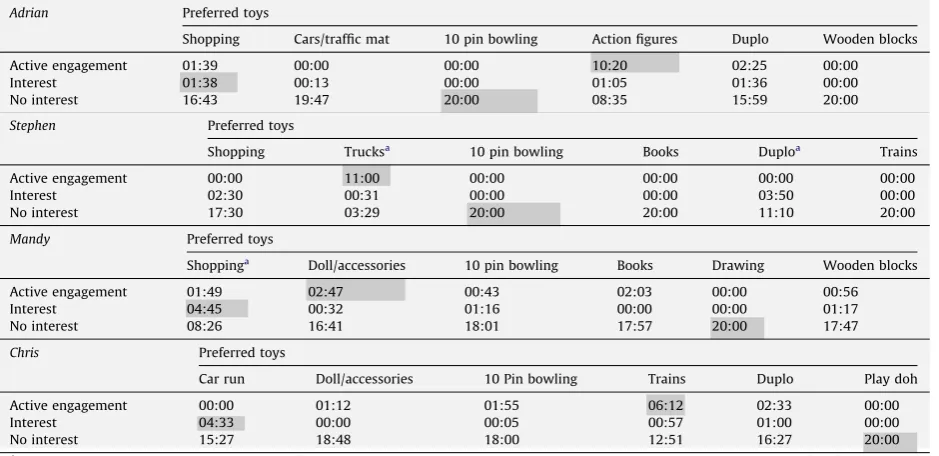
The total amount of time each child spent in active engagement, interest and non-interest per item across all sessions is shown inTable 4. Those items with the most amount of time spent in each of the three categories are shaded and were selected for use in Phase 2 of the study. For example, the amount of time spent by Adrian in active engagement was greatest with action figures and he showed no interest in 10 pin bowls and wooden blocks. The 10 pin bowls was chosen over wooden blocks for Phase 2 because he shared this item in common with Stephen.

4. Phase 2 method and results

4.1. Procedure

Phase 2 employed an ABCBACA single case design (Kennedy, 2005) which enables comparisons to be made across all the conditions. Condition A involved the no interest item, condition B the interest item, and condition C the active engagement item. Sessions were conducted in the same setting as for Phase 1 and all sessions were videotaped for later analysis. At the beginning of the first A condition session, the multiple components of the no interest item were placed inside a clear plastic box with a lid that had a 4 in.6 in. photograph of the item on top. The box allowed the child to see the items but the lid

prevented access to the items unless the child made a request. As the contents could be seen by the child, the photograph was provided primarily for children whose preferred mode of requesting was symbol exchange rather than to indicate the contents of the box per se. On entering the room the child was taken to the play mat and sat facing the researcher with the plastic box between them. The lid was lifted and the child was able to look at but not touch the contents. The lid was then replaced and the child given the photograph with the instruction ‘‘Let me know if you want to play’’. The researcher responded to any attempt to request the item (e.g., vocalising, reaching, touching the box, pointing, or giving the photograph) by giving the child one of the components of the item from the box followed by the instruction ‘‘Let me know if you want more’’. Each item had at least 5 components and in any one session, a maximum of 5 opportunities for requesting contents of the box were provided. The session ceased after 5 requests or 3 min, whichever came first. The requesting task was chosen for the reinforcer assessment as all the children had been observed by the researchers making requests in a variety of contexts at their centre by pointing, reaching or using picture exchange prior to participation in the study. The procedure for the no interest condition was repeated for the other conditions (B and C) and at least 3 sessions were conducted for each condition. The total number of requests made by the child in each session was tallied.

Table 4

Total time spent (min:s) in active engagement, interest and no interest across 45 min observation sessions.

Adrian Preferred toys

Shopping Cars/traffic mat 10 pin bowling Action figures Duplo Wooden blocks

Active engagement 01:39 00:00 00:00 10:20 02:25 00:00

Interest 01:38 00:13 00:00 01:05 01:36 00:00

No interest 16:43 19:47 20:00 08:35 15:59 20:00

Stephen Preferred toys

Shopping Trucksa

10 pin bowling Books Duploa

Trains

Active engagement 00:00 11:00 00:00 00:00 00:00 00:00

Interest 02:30 00:31 00:00 00:00 03:50 00:00

No interest 17:30 03:29 20:00 20:00 11:10 20:00

Mandy Preferred toys

Shoppinga

Doll/accessories 10 pin bowling Books Drawing Wooden blocks

Active engagement 01:49 02:47 00:43 02:03 00:00 00:56

Interest 04:45 00:32 01:16 00:00 00:00 01:17

No interest 08:26 16:41 18:01 17:57 20:00 17:47

Chris Preferred toys

Car run Doll/accessories 10 Pin bowling Trains Duplo Play doh

Active engagement 00:00 01:12 01:55 06:12 02:33 00:00

Interest 04:33 00:00 00:05 00:57 01:00 00:00

No interest 15:27 18:48 18:00 12:51 16:27 20:00

a

This item was removed without replacement for one session because it was played with exclusively on the previous session—therefore for this item the child had access for 3 only of the 45 min sessions.

(6)

4.2. Results

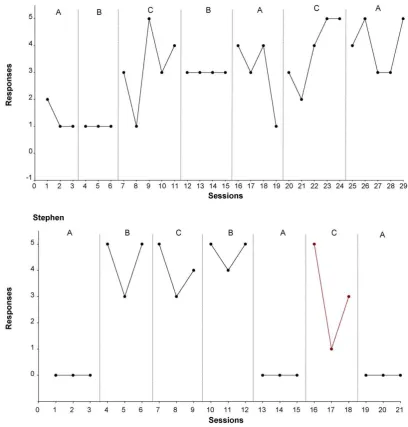
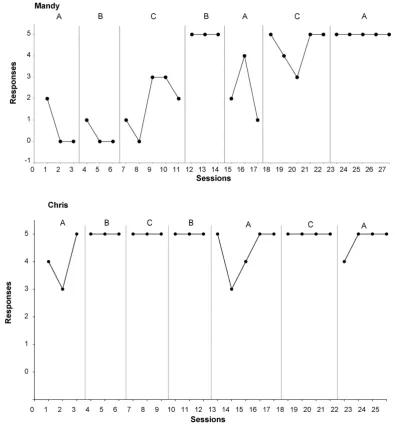
The results for each of the four participants are shown inFigs. 1 and 2. For two of the children, Stephen and Chris, interest items and active engagement items appeared to be equally reinforcing. In the case of Stephen, the number of requests in 11 of the 12 sessions ranged from 3 to 5 requests. However, Stephen made no requests for any of the no interest items during the A condition sessions. Chris made 5 requests, the maximum number possible, for each of his interest and active engagement sessions. In the 12 no interest item sessions, Chris’ response rate ranged from 3 to 5 requests with a mean of 4.42.

The rates of responding for the other 2 children were more variable. There appeared to be a trend in Adrian’s responding during the initial sessions to suggest that items classified as actively engaging may be more reinforcing (mean rate of requesting of 3.2) than either the no interest (mean requests of 1.33) or interest items (mean requests of 1). This was not supported as the sessions continued across the three conditions with the final no interest condition sessions showing a similar rate of responding to the active engagement condition. The mean number of requests for the active engagement condition was slightly higher across all sessions (3.5) than the mean requests for the interest (2.14) and no interest (3) conditions.

There was no discernable pattern in Mandy’s level of requesting for different items with all three conditions eliciting similar and somewhat variable levels of requesting behaviour. There were occasions in each of the conditions when Mandy made no requests and others when she made 5 requests which was the maximum number of responses possible during a session.

(7)

5. Discussion

The engagement-based preference assessment procedure used in this study was effective for two participants and partially effective for a third participant in predicting the relative reinforcer value of no interest items and high interest items. These results are consistent with previous research that has found that high-preference stimuli identified using engagement-based preference assessments produce higher levels of responding than low-preference stimuli (DeLeon et al., 1999; Hagopian et al., 2001). Similar to our findings,Hagopian et al. (2001)found variability in results across administrations during a reinforcer assessment for preferences ranked using a single stimulus engagement preference assessment. One of their participants sometimes allocated more time to lower than to more highly ranked stimuli and a similar finding was evident for Mandy in the current study. For Mandy, the engagement-based preference assessment procedure was ineffective in distinguishing between high and low-preference stimuli. Her response rates in sessions 1–11 were relatively low with higher response rates recorded for sessions 12–27, irrespective of condition. Mandy’s response rates may have reflected an increasing interest in the activity of requesting the contents of the box as the sessions progressed rather than in the contents of the box themselves but it is difficult to draw conclusions without further research. Factors that could be explored in future studies include the number of sessions used in the engagement-based preference assessment, the selection and number of items used and decisions to use replacement or no replacement, and comparison of results with an approach-based preference assessment using a pair-wise presentation.

Figure 2.Requests for items during no interest items (A), items of interest (B) and items of active engagement (C) for Mandy and Chris. D. Keen, D. Pennell / Research in Autism Spectrum Disorders 4 (2010) 645–652

(8)

A key finding from this study was that qualitative aspects of engagement with stimuli for these children did not predict relative reinforcer effectiveness. That is, just showing interest in the stimulus by interacting with it in some way during the preference assessment was to some degree a better predictor of the reinforcing value of the stimulus for the child than the way in which the child interacted with the stimulus.

The selection and use of preferred items is often critical to the behavioural engagement of children with autism because these children have higher levels of non-engagement than their peers (Corsello, 2005; Warren & Kaiser, 1986). When engaged, they are more likely to be engaged with objects than people and it is not unusual for them to have a preference for objects that may lead to repetitive and stereotyped behaviours that distract from or inhibit learning (Bruckner & Yoder, 2007; Morrison & Rosales-Ruiz, 1997). This is particularly so for sensory stimulating items such as toys that have flashing lights and sound effects (Sautter et al., 2008). These items may be used by teachers and parents alike because they are easily identified and appear to be highly reinforcing but there is a risk that these objects can inhibit rather than enhance learning. The engagement-based preference assessment procedures outlined in this study may help to address this problem by differentiating preferred items on the basis of the quality of engagement the child demonstrates while interacting with the items during the assessment. Highly preferred items with which the child is actively engaged during the assessment could be selected for use in place of highly preferred items in which the child shows interest but interacts in a way that is inappropriate, repetitive, or non-productive. For the children in this study, it was possible to identify items in both the interest and active engagement categories that, when tested, appeared to be equally reinforcing even when duration of engagement between the interest and active engagement items for a child differed.

The design of this study provided some preliminary evidence about the possible relationship between the different conditions of no interest, interest and active engagement items for each child. There were, however, only 4 participants in the study and for one child (Mandy), the preference assessment procedure failed to differentiate between no interest items and interest or active engagement items. Further testing of the engagement-based preference assessment procedure used in this study is needed with a larger number of children to determine which children may benefit from this approach. Factors to consider include child characteristics such as chronological and mental age, levels of communication and adaptive behaviour and the type of stimuli used. Previous researchers have, for example, commented on the difficulties associated with providing extended access to food items in an engagement-based preference assessment (Hagopian et al., 2001). This may be one limitation of the procedure trialed in this study.

One area requiring further investigation concerns the overall duration of engagement with stimuli during the preference assessment and how this may have impacted on the results of the reinforcer assessment. None of the children engaged at all during the preference assessment with the no interest item chosen for the reinforcer assessment but the duration of engagement for the other items chosen for the interest and active engagement conditions varied across participants from 1:38 to 11 min. For Adrian and Stephen, the amount of time spent engaged with interest items was relatively low (1:38 and 3:50 min, respectively) compared with their active engagement items (10:20 and 11 min). While it might be predicted from these results that the active engagement items would be more reinforcing because the children spent more time interacting with them during the preference assessment, this was not supported by the reinforcer assessment. This is counter to previous research that found preference rankings based on duration of engagement predicted relative reinforcer effectiveness (Hagopian et al., 2001). It is important to note, however, that the current study used a categorical rather than a ranking approach to select the stimuli used for the interest and active engagement conditions in the reinforcer assessment. Future research could investigate the use of a single stimulus engagement-based preference assessment to measure the quality of engagement. The use of multiple stimuli in the current study required participants to choose between six different items during 5 min sessions. A single stimulus assessment would eliminate the need for choice between items and control for the amount of time the child was exposed to each item.

This study has advanced a methodology for assessing quality of engagement with stimuli via an engagement-based preference assessment that may be used to guide selection of reinforcers for children with autism who may interact with some objects in a way that could impede learning. Results of a reinforcer assessment suggest that the methodology may have some utility but further refinement and testing is required.

Acknowledgement

This research was supported by a grant from the Australian Research Council and the Autism Early Intervention Outcomes Unit (AEIOU). We wish to thank the families and staff of AEIOU for their willing participation and assistance throughout this research.

Appendix A

A.1. Active engagement with specific toys and activities

(9)

Duplo:Connecting blocks together, attempting to connect pieces together, putting drivers in vehicles, playing with pieces that have been connected by the child. Not to be counted if child is investigating a single piece of duplo or using a single piece to drive with or to see how it works.

Cars/mat:Pushing back and forth (i.e., driving them) making driving sounds, crashing. Does not have to be on the car mat to be counted.

Trucks:Loading, dumping, driving, manipulating features of trucks like extension arms, hooks, dumper trays, etc.

Shop play:Sitting in front of items, opening and closing the drawer in order to access or replace money, talking about shopping, e.g., ‘‘How much? $1’’, swiping the credit card, pressing the keys on the number pad, putting grocery items in the shopping basket, scanning grocery items, pretend talking into the microphone. Do not count pressing the scanner button if no grocery item is scanned or if this feature is used for some other purpose (e.g., getting attention, for the noise alone).

10 pin:Standing up pins (child may stand or sit to do this), stepping back to roll ball from standing position. Do not count if child is sitting, or if they knock the pins with their hands or while holding the ball. Do not count ball play only bowling play.

Trains:Assembling track, attempting to assemble track, moving trains on track or floor, putting features on track/train set up (e.g., tree beside track), adding trains together (allow experimentation with magnetic attachment). Do not count putting objects on track if they result in no identified specific pretend play.

Blocks:Standing blocks up, balancing blocks or attempting to, putting one block on top of the other, knocking down blocks which have been assembled. Do not count rummaging for blocks for more than 5 s or holding blocks in the air or laying blocks singly on the mat.

Books:Looking at, pretend reading, opening closing flaps, turning pages, touching feely pages.

Play doh:Using the play doh or its utensils for at least 5 s on the play doh mat. Do not count eating, flicking, or any self-stimulatory uses.

Drawing:Writing with the crayon on the paper, turning the paper in order to have a clean writing space. Do not count choosing colours, taking lids or crayon wrappers on or off, picking up or replacing writing utensils.

Doll:Holding like a baby in arms or on shoulder, moving body parts, putting baby to bed, dressing/undressing, feeding baby, making baby sit or stand, setting up baby’s bed, putting baby to bed, talking to or gesturing to baby.

Car run:Sitting in front of toy, putting cars on ramp, watching them run down, taking cars from bottom of run to top, joining or attempting to join cars to run down together, talking about the features (colour) of cars, driving the cars up the ramp, making blocks with hand or item on car’s run down, releasing stuck cars.

References

Bruckner, C. T., & Yoder, P. (2007). Restricted object use in young children with autism: Definition and construct validity.Autism: The International Journal of Research and Practice, 11, 161–171.

Bruininks, R. H., Woodcock, R. W., Weatherman, R. F., & Hill, B. K. (1996).Scales of independent behavior—Revised. Allen, TX: DLM Teaching Resources. Corsello, C. (2005). Early intervention in autism.Infants and Young Children, 18(2), 74–86.

DeLeon, I. G., & Iwata, B. A. (1996). Evaluation of a multiple-stimulus presentation format for assessing reinforcer preferences.Journal of Applied Behavior Analysis, 29, 519–533.

DeLeon, I. G., Iwata, B. A., Conners, J., & Wallace, M. D. (1999). Examination of ambiguous stimulus preferences with duration-based measures.Journal of Applied Behavior Analysis, 32, 111–114.

Duker, P., Didden, R., & Sigafoos, J. (2004).One-to-one training: Instructional procedures for learners with developmental disabilities. Austin, TX: Pro-ed. Dunn, L. M., & Dunn, D. M. (2007).Peabody picture vocabulary test(4th ed.). Minneapolis, MN: Pearson.

Fisher, W. W., Piazza, C. C., Bowman, L. G., Hagopian, L. P., Owens, J. C., & Slevin, I. (1992). A comparison of two approaches for identifying reinforcers for persons with severe and profound disabilities.Journal of Applied Behavior Analysis, 25, 491–498.

Hagopian, L. P., Long, E. S., & Rush, K. S. (2004). Preference assessment procedures for individuals with developmental disabilities.Behavior Modification, 28, 668– 677.

Hagopian, L. P., Rush, K. S., Lewin, A. B., & Long, E. S. (2001). Evaluating the predictive validity of a single stimulus engagement preference assessment.Journal of Applied Behavior Analysis, 34, 475–485.

Ivory, J. J., & McCollum, J. A. (1999). Effects of social and isolate toys on social play in an inclusive setting.The Journal of Special Education, 32, 238–243. Kearney, C. A., & McKnight, T. (1997). Preference, choice, and persons with disabilities: A synopsis of assessments, interventions, and future directions.Clinical

Psychology Review, 17, 217–238.

Keen, D. (2009). Engagement of children with autism in learning.Australasian Journal of Special Education, 33, 130–140. Kennedy, C. (2005).Single-cased designs for educational research. Boston: Allyn and Bacon.

Lord, C., Rutter, M., DiLavore, P., & Risi, S. (2001).Autism diagnostic observation schedule. Los Angeles: Western Psychological Services.

McWilliam, R. A., & Bailey, D. B. (1992). Promoting engagement and mastery. In D. B. Bailey & M. Wolery (Eds.),Teaching infants and preschoolers with disabilities (2nd ed., pp. 230–255). New York: Macmillan.

Morrison, K., & Rosales-Ruiz, J. (1997). The effect of object preference on task performance and stereotypy in a child with autism.Research in Developmental Disabilities, 18, 127–137.

Piazza, C. C., Fisher, W. W., Hagopian, L. P., Bowman, L. G., & Toole, L. (1996). Using a choice assessment to predict reinforcer effectiveness.Journal of Applied Behavior Analysis, 29, 1–9.

Sautter, R. A., LeBlanc, L. A., & Gillett, J. N. (2008). Using free operant preference assessments to select toys for free play between children with autism and siblings. Research in Autism Spectrum Disorders, 2, 17–27.

Warren, S. F., & Kaiser, A. P. (1986). Incidental teaching: A critical review.Journal of Speech and Hearing Disorders, 51, 292–299. Williams, K. T. (2007).Expressive vocabulary test(2nd ed.). Minneapolis, MN: Pearson.

D. Keen, D. Pennell / Research in Autism Spectrum Disorders 4 (2010) 645–652 652

Gambar

Table 2
Table 4
Fig. 1. Requests for items during no interest items (A), items of interest (B) and items of active engagement (C) for Adrian and Stephen.
Figure 2. Requests for items during no interest items (A), items of interest (B) and items of active engagement (C) for Mandy and Chris.

Referensi

Dokumen terkait

Using data from the 2006 Program for International Student Assessment (PISA), we explored nine aspects of science engagement (science self-efficacy, science self-concept, enjoyment

Table 4.3 The importance level of engagement factors for physicians who worked in private hospitals in Bangkok The importance of engagement factors Mean SD The reputation of the

This study uses the Utrecht Work Engagement Scale UWES dimensions vigor 6 items, dedication 5 items and absorption 6 items developed by Schaufeli & Bakker, Wong and Law Emotional

A total of 387 workers who answered a questionnaire from the work engagement questionnaire scale adapted from the Utrecht Work Engagement Scale UWES which contains 17 items covering

17 Values Engagement in DEA 24 Core Values of DEA 26 Part II: Putting DEA into Practice 35 DEA in Practice: Phases of Assessment 35 DEA in Practice: Tools for Assessment across

https://doi.org/10.20473/mkp.V36I32023.342-355 Physical culture for lifelong healthy participation: Expanding the horizon of individual interest and university engagement in physical

Students’ perception of virtual creative writing in English class No Items Frequency Percentage % EMOTIONAL ENGAGEMENT 1 I enjoyed the creative writing activity 1 8,3 2 The creative

Implementing engagement and wellbeing programs effectively in schools requires increasing intrinsic interest in curriculum, improving professional development for teachers, implementing