Full Terms & Conditions of access and use can be found at
http://www.tandfonline.com/action/journalInformation?journalCode=vjeb20
Download by: [Universitas Maritim Raja Ali Haji] Date: 11 January 2016, At: 19:13
Journal of Education for Business
ISSN: 0883-2323 (Print) 1940-3356 (Online) Journal homepage: http://www.tandfonline.com/loi/vjeb20
Assessing the Flipped Classroom in Operations
Management: A Pilot Study
Anupama Prashar
To cite this article: Anupama Prashar (2015) Assessing the Flipped Classroom in Operations Management: A Pilot Study, Journal of Education for Business, 90:3, 126-138, DOI:
10.1080/08832323.2015.1007904
To link to this article: http://dx.doi.org/10.1080/08832323.2015.1007904
Published online: 23 Feb 2015.
Submit your article to this journal
Article views: 473
View related articles
View Crossmark data
Assessing the Flipped Classroom in Operations
Management: A Pilot Study
Anupama Prashar
Management Development Institute, Gurgaon, India
The author delved into the results of a flipped classroom pilot conducted for an operations management course module. It assessed students’ perception of a flipped learning environment after making them experience it in real time. The classroom environment was construed using a case research approach and students’ perceptions were studied using qualitative and quantitative research methods. The analysis revealed that a flipped classroom scores higher than a conventional, lecture-oriented setup on the following critera: student involvement, task orientation, and innovation. The study corroborated the pedagogical effectiveness of the flipped learning model in promoting collaborative learning for operations management instruction. The findings underline the need to painstakingly structure the learning tasks for the fruition of a flipped classroom exercise.
Keywords: blended learning environment, flipped classroom, inverted classroom, lecture, operations management
Global learning systems are currently in a state of paradigm shift. Recent attempts to blend technology with pedagogics and didactics are changing the rules of the game. Learning is less and less described as a passive process of acquiring knowledge. Its au courant interpretation as an active pro-cess of constructing knowledge is acquiring strengths in various educational and learning forums (Duffy & Cunningham, 1996). Thus, the conventional behaviorist model, which advocates a knowledge transmission view of education (Brown, 2000; Nunan, 1999), is getting into oblivion giving way to a rather modern, transformation view of knowledge based on experimental constructivist model (De Corte, Verschaffel, Entwistle, & Van Merrienboer, 2003; Gerjets & Hesse, 2005).
The successful adoption of information and communica-tion technology (ICT) into a classical classroom has opened new avenues for producing, distributing, and receiving higher education (Bhattacharya & Sharma, 2007; Khan, 2001, 2005). One interesting didactical attempt has been to use technology to introduce new concepts outside the class-room and reinforce learning with effective student
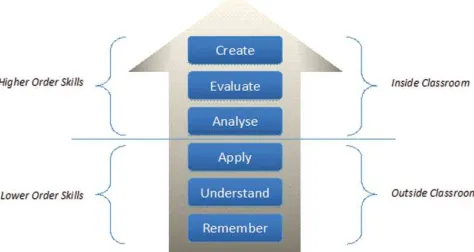
collaboration inside the classroom (Baker, 2000; Collins, De Boer, & Van Der Veen, 2001; Mazur, 2009; Strayer, 2012). Such a restructured classroom is termed a flipped classroom (Bergmann & Sams, 2012) or inverted classroom (Lage, Platt, & Treglia, 2000). For the pioneers of this inverted classroom approach, it was a candid attempt to avoid reteaching lessons to absentees. Nonetheless, their higher education counterparts take this approach to a different para-digm by relating it to Bloom’s revised taxonomy. They state that the emphasis of flipped form of learning is to develop skills that are at higher level of Bloom’s revised taxonomy. This is exercised by promoting collaboration and application of knowledge in the classroom and addressing conceptual understanding outside of it (Krathwohl, 2002).
Benjamin S. Bloom’s (Bloom, Englehart, Furst, Hill, & Krathwohl, 1956) original taxonomy was a revolutionary model intended to present a systematic classification of educational goals and objectives. Bloom et al. further cate-gorized learning into three domains of behavior: cognitive, affective, and psychomotor. This multitiered model has long been a means applied by educators in the evaluation of their course material and testing outcomes (Chyung, 2003; Joyce & Weil, 1996). Anderson and Krathwohl (2001) re-evaluated the original taxonomy and revised its terminol-ogy, structure and emphasis in order to redefine its role in curriculum planning, instructional delivery and assessment. Figure 1 illustrates the Bloom’s revised taxonomy.
Correspondence should be addressed to Anupama Prashar, Manage-ment DevelopManage-ment Institute, DepartManage-ment of Operations & ManageManage-ment Science, Mehruli Road, Sukhrali, Gurgaon 122007, India. E-mail: [email protected]
Color versions of one or more figures in this article are available online at www.tandfonline.com/vjeb.
ISSN: 0883-2323 print / 1940-3356 online DOI: 10.1080/08832323.2015.1007904
Regarding flipped learning, massive research has been done on the use of various active learning strategies for introductory courses in science, statistics, economics and engineering (Bergmann & Sams, 2009; Bonham, Deardorff, & Beichner, 2003; Freeman et al., 2007; Hake, 2008; Lage et al., 2000; Papadapoulos & Roman, 2010). However, an in-depth inquiry of students’ perspectives regarding the real pedagogical value of flipped learning model is still missing (Fredrickson, Reed, & Clifford, 2005; Strayer, 2012).
For business education, the real value of experience-based, active, and solution-oriented learning is pronounced by a number of research studies (Drennan, Kennedy, & Pisarski, 2005; Sheth, 1991). Further, there are evidences of immense pedagogical value offered by ICT-based tools in creating blended learning environment in business edu-cation literature (Arbaugh, Desai, Rau, & Sridhar, 2010; Arenas-Marquez, Machuca, & Medina-Lopez, 2012; Hwang & Arbaugh, 2009; Merrill & Galbraith, 2009). The Association to Advance Collegiate Schools Business (AACSB)—the international accreditation body for busi-ness schools—has also quoted technology as an area of con-text in business courses (AACSB, 2013). Thus, business schools across the world are earnestly attempting to blend information technology with classroom environment to cre-ate a better learning experience (Alavi & Gallupe, 2003).
Furthermore, the value of flipped form of learning for operations management (OM), which aims at equipping students to actively resolve complex real-life business prob-lems, can never be over emphasized. In OM, students are exposed to multiple criteria for making decisions and these criteria are not limited to the use of a single technique or approach. Innovative games, simulations, and interactive learning software have already been used to create blended learning environment for promoting student engagement (Arenas-Marquez et al., 2012; Lewis & Maylor, 2007; Pasin & Giroux, 2011; Tan, Tse, & Chung, 2010; Yazici, 2006). Therefore, there exists a strong case for investigating students’ perception about their effectiveness in OM (Are-nas-Marquez et al., 2012; Yazici, 2006).
In this direction, the study assesses students’ actual and preferred preferences of two different environments (i.e.,
flipped and traditional) for OM instruction. The study involved design of flipped OM module using interactive technologies (wikis, flashcards, and podcasts), its imple-mentation in the researcher’s own classroom, and a formal analysis of how this change influenced students’ perception. The remainder of the article is structured as follows: I briefly review the literature on the design and effectiveness of flipped classroom model for business education; give a description of the design of flipped OM module; and dis-cuss results of the qualitative and quantitative analysis of how students perceive their learning environment. Finally, I present the conclusions and implications.
LITERATURE REVIEW
Arbaugh et al. (2010) looked at the adoption of flipped classroom within management education literature. In the direction, he reviewed the studies on the use of online and blended learning environment in management disciplines. It revealed an uneven, area-wise progress in the discipline. Although the courses on organisation behavior (OB) and strategic management showed most progress, courses on OM, human resources, and international management received little assiduity.
Zabriskie and McNabb (2007) described the develop-ment of a technology-enhanced learning module for delivery of a master of business administration (MBA) managerial accounting course. The authors emphasized that the effective blend of online and classroom component in course delivery hinges around instructor’s own skill and course requirements. As far as the effectiveness of online learning pedagogy in management education and its overall effect on student’s performance is concerned, Lapsley, Kulik, Moody, and Arbaugh (2008) validated the samefor an undergraduate human resource course. On these lines, Klein, Noe, and Wang (2006) observed higher motivational levels for learning, leading to satisfaction, metacognition, and thus, better grades in a blended learning program.
Focusing on OM, Krajewski (1998) stated that the need of involving students actively in the learning process by integration of innovative technologies into OM teaching can never be overemphasized. In another study on OM instruction methodologies used in European MBA pro-grams, Goffin (1998) also highlighted the need for innova-tion in teaching methodology to improve student’s interest in the course.
Another interesting practice in OM is the creative use of games and process models. On one side, Pasin and Giroux (2011) observed that simulation games are effective in developing student’s decision-making abilities for manag-ing complex and dynamic situations. They reinforced Yazici’s (2006) observation on the utility of simulations in testing alternative layouts and labor-allocation strategies in OM training. On the other hand, while reviewing the
FIGURE 1 Bloom’s revised taxonomy. Based on Krathwohl (2002).
breadth and depth of gaming practice in OM education, Lewis and Mayor (2007) noted that the content of OM-related games is dominated by the area of manufacturing planning and control and there is an inherent tendency to produce complex games, which ultimately require informa-tion technology support.
In addition, there are studies on experiences with virtual learning environment and interactive learning for OM instruction. Arenas-Marquez et al. (2012) evaluated effec-tiveness of an interactive software for OM education in an experimental environment. The findings of the experiment showed that the teaching method influenced the student per-ceptions of the course.
There is a large body of literature looking at the effects of flipped classroom or blended learning methods in improving the quality of management education. While one piece of lit-erature shows a positive outlook, the other presents a contrast-ing perspective. For instance, in a study to evaluate the impact of blended leaning for a general accounting course, Lopez-Perez, Perez-Lopez, and Rodrıguez-Ariza (2010) found a positive impact on dropout rates and exam marks. This came in contrast to Terry’s (2007) finding when he com-pared the effectiveness of campus, online, and hybrid instruc-tion in business educainstruc-tion. He found that students enrolled in online courses scored 4% lower on the final exam than cam-pus or hybrid students. However, Brower (2003), in context of a distance delivered OB course, found an enhanced student engagement with the creation of on-line learning communi-ties. While in contrast, another multisemester, multicourse study (Friday, Friday-Stroud, Green, & Hill, 2006) observed no significant difference in student’s performance in online and traditional sections of undergraduate business program. This was further bolstered by Merrill and Galbraith (2010) when they found that student performance in online courses is not significantly different from performance while using other delivery methods. They highlighted a need of further research on order to fully understand the learning outcomes of different course delivery methods.
CASE SETTING
The study was undertaken in fall 2013 my own classroom where I taught an introductory module on OM (each mod-ule worth three credits) in an MBA program at a leading business school in New Delhi, India. For the study, one OM class (class 1) was structured according to flipped class-room format. In class 1, the instructor used online wikis, flashcards, and videos (via engrade.com) to introduce the concepts outside the classroom and used in-class time for engaging activities and in-depth discussions. The other OM class (class 2) in the study was structured according to tra-ditional classroom format using content-driven lectures to introduce the concept of in-class and postclass practice and assignments, and a few case discussions.
Flipped Course Design
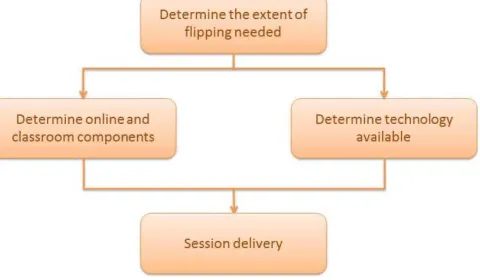
The OM course focuses on the basic concepts, issues, and techniques for efficient and effective management of opera-tions. Topics covered in the course include operations strat-egy, product and service design, process design and analysis, capacity planning, lean production systems, mate-rials and inventory management, quality management and six sigma, project management, and supply chain manage-ment. The diversity in terms of breadth and depth of OM topics demanded blended learning module with a mix of conceptual, framework based, and practice oriented ses-sions. Once the broad course objectives were established, the module was designed using the following steps (Figure 2).
Step 1: Determining Extent of Flipping Needed
Considering the nature of concept and context of the ule, the extent of flip required for each session of the mod-ule was defined in the first step (Zabriskie & McNabb, 2007). A two-dimensional rubric was created for this pur-pose (Appendix A). Thus, three levels of flipping were defined as the following:
Full flip: A full flip session meant complete
introduc-tion to the concept online using lecture podcasts, online quizzes and readings. In a full flip session, emphasis was on building application, analysis, evaluation, and synthesis skills in the classroom while lower order skills were to be developed outside the class.
Partial flip: A partial flip involved using a
combina-tion of online and face-to-face classroom instruccombina-tion. This level is used for providing training on frame-works or models that need to be introduced in the classroom before their analysis and application are emphasized.
Do not flip: This level represented a traditional
class-room teaching format with content-driven lectures (no subject matter was shared outside the classroom).
FIGURE 2. Flipped course design.
This level was suitable for providing training on tools & techniques which requires face-to-face hands-on practice with the instructor.
Table 1 summarizes the rationale for defining the extent of flip for each session.
Step 2: Determine Online and Classroom Components
Next step was to use the rationale defined in Step 1 and establish which portion of the course was best suited for delivery in a traditional classroom environment and which are best with a flipped environment (Zabriskie & McNabb, 2007). A brainstorming session with the other professors teaching in the MBA program was conducted for this pur-pose. The aim was to classify the content for a module on the basis of the extent of opportunity it presents for devel-oping higher order skills. Based on the consensus, the con-tents were classified and a session plan was developed with details of in-class and outside-class activities (Appendix B)
Step 3: Determine Technology Available
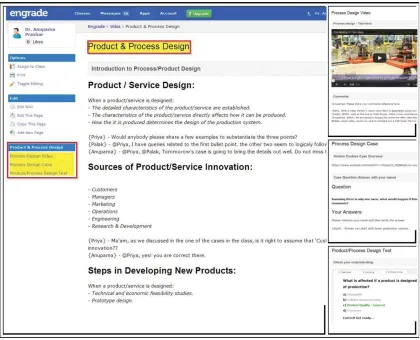
I used Engrade (www.engrade.com), a set of open source web based tools for teachers, which allows sharing real-time content such as wikis, quizzes, videos, and grades with students. To introduce the concepts outside the class-room and engage students before and after the class, a wiki (online session) for each session was created. Figure 3 shows exemplary screen shots of a wiki.
METHODOLOGY
Mixed methods research design was used for assessing students’ actual and preferred preferences of two different environments (i.e., flipped and traditional) for OM instruc-tion. The learning environment under investigation was described using case research method with single case (holistic) design (Eisenhardt, 1989; Yin, 2009). Student perception of their learning environment was recorded using both qualitative and quantitative methods.
A quasiexperimental design was adapted to design the study. After the completion of 18 sessions, students from both classes (classes 1 and 2) responded to two sets—actual and preferred form—the College and University Classroom Environment Inventory (CUCEI; Fraser, 1984). CUCEI was used to assess the learning environment in this study. It follows Moos’s (1979, 2003) seminal framework for describing human social environments. CUCEI measures a students’ perception of learning environment on seven scales: personalization, involvement, student cohesiveness, equity, task orientation, innovation, and individualization. It comprises 49 items, with seven items each belonging to seven scales. Further, qualitative data on students’ percep-tion of classroom environment was collected via focus-group interviews for both the classes at the end of the mod-ule. Table 2 depicts the design of the study.
Participants
Participants of the study were 50 management students of 2013 batch divided into two groups (classes 1 and 2) of 25 each. Participants from both the sections were evenly spread by gender as shown in Table 3.
All the participants were briefed about the objectives of the study.
Data Collection
Quantitative data. After completion of 18 sessions,
CUCEI (actual and preferred version) was administered on all 50 participants. Students responded to each of the 49 CUCEI items on a 4-point Likert-type scale ranging from 1 (strongly agree) to 4 (strongly disagree). For each of the seven scales, an acceptable range of Cronbach’s alpha coef-ficients (ranging from .70 to .90) had been ascertained from previous studies (Fisher & Fraser, 1983; Fraser, 1984; CUCEI appended as Appendix C).
Qualitative data. Qualitative data were collected by
conducting focus group interviews at the end of the module (Marshall & Rossman, 2011). During these interviews, par-ticipants in the two sections reflected on their classroom experiences.
TABLE 1 Instruction Methods
Need for flipping
Need for direct instruction
Low Medium High
Low Short video (theoretical) DO NOT FLIP DO NOT FLIP
Medium PARTIALLY FLIP:
PPT with narration, self-audio/video
FULLY FLIP:
Wiki, flashcards, internal/external videos
PARTIALLY FLIP: PPT, short videos
High FULLY FLIP:
Wiki, flashcards, internal/external videos
FULLY FLIP:
Wiki, flashcards, internal/external videos
PARTIALLY FLIP:
Wiki, flashcards, PPT with narration
Data Analysis
The quantitative survey data was analyzed using
Cronbach’s alpha (reliability) coefficients, discriminant validity measures, t-test and multivariate analysis of vari-ance (MANOVA).
NVivo 10 for Windows (QSR International, Australia) was employed for qualitative data analysis. In NVivo, nodes were defined on the dimensions of learning environ-ment attributes and participants. In the attribute group, four high-level nodes and their subnodes were defined (Appen-dix D). Graphical and cluster analyses were performed on the coded focus group interview transcripts.
RESULTS
Data were analyzed to record students’ perception of their classroom environment. It was observed that the results of qualitative analysis complemented and substantiated those of quantitative analysis. The following sections explain the quantitative and qualitative results.
Quantitative Results
Adequate discriminate validity for the mean correlation between the seven scales was determined, which is pro-duced in Table 4.
TABLE 2 Design of the Study
Classroom Treatment Measure (after 18 sessions)
Class 1 Flipped classroom environment
Students’ perception of their actual and preferred learning environment. Class 2 Traditional classroom
environment
Students’ perception of their actual and preferred learning environment.
FIGURE 3 Wiki on Engrade.
TABLE 3 Participants
Section Girls Boys
1 12 13
2 13 12
Adequate internal consistencies were found for all seven scales for both actual and preferred form of CUCEI (Cronbach’saD.63–.92). Additionally, low values of
corre-lation between scales (ranging from .33 to .46) indicated adequate discriminate validity for each of the CUCEI scales. Furthermore, in order to identify the scales that signifi-cantly affected the CUCEI scores, one-way repeated meas-ures MANOVA was performed (Table 5). For the analysis, actual and preferred responses for each scale paired for each student were used as within-subjects factors and learn-ing environment in the two sections of OM course was used as the between-subjects factor.
Results showed that CUCEI form explained 62.2% and learning environment explained 44.5% of the overall varia-tion in the data. Thepvalue substantiated the statistical sig-nificance of the tests. The interaction effect between the CUCEI form and learning environment explained 35.5% of overall variation in the data. Further, scales that signifi-cantly affected CUCEI scores were identified by analyzing test of between-subjects effects (Table 6).
To measure the students’ perception of their actual learning environment in comparison to perception of their preferred one, independent samplet-tests were performed (Table 7).
The mean scores for each of the CUCEI scale in the actual form were found to be significantly lower than the mean scores of preferred form. This implied that students’ perception of their actual learning environment was not up to their perceived preferred levels.
In order to compare students’ perception of learning environment in flipped classroom (class 1) and lecture classroom (class 2), analysis was carried out for both actual and preferred CUCEI responses (Tables 8 and 9).
Results showed significant difference between student scores in class 1 (flipped classroom) and class 2 (lecture classroom) on the scales of involvement, task orientation, and innovation for actual responses of CUCEI.
The same analysis on preferred CUCEI responses (Table 9) showed difference on the scales of innovation and involvement only (not on task orientation). Thus, flipped classroom was perceived better by the students on its ability to foster innovative thinking and its ability to actively engage students.
TABLE 4
Internal Consistency Reliability and Discriminant Validity of CUCEI Scale
Scale
Cronbach’s alpha coefficient (a)
Mean correlation
Personalization .72 .69 .45 .41
Involvement .70 .67 .46 .40
Student cohesiveness .90 .79 .44 .38
Equity .87 .81 .45 .40
Task orientation .76 .63 .38 .33
Innovation .82 .71 .46 .42
Individualization .77 .67 .33 .34
Note: CUCEI D College and University Classroom Environment Inventory.
TABLE 5
Multivariate Analysis of Variance
Effect HypothesisF df Sig. (p) Multipleh2(effect size) Wiki’sλ(effect size)
CUCEI form (actual or preferred) 10.14 7,40 .001 .622 .355
Learning environment (flipped or lecture) 4.52 7,40 .001 .445 .544
CUCEI form*learning environment 2.75 7,40 .02 .325 .325
Note: CUCEIDCollege and University Classroom Environment Inventory.
TABLE 6
Test for Between-Subjects Effect (CUCEI Scale)
Source Scale df F Sig. (p)
Learning environment Personalization 1 3.40 .065 Involvement 1 11.03 .002** Student cohesion 1 0.25 .599
Equity 1 1.76 .189
Task orientation 1 6.15 .033* Innovation 1 14.47 .001*** Individualization 1 3.59 .065
*
p<.05.**p<.01.***p<.001.
TABLE 7
Difference Between Student Perception of Actual and Preferred Learning Environment
Personalization 4.01 0.76 4.32 0.49 ¡0.51** Involvement 3.21 0.84 3.57 0.93 ¡0.43** Student cohesion 2.98 0.65 3.65 0.64 ¡0.65**
Equity 4.43 0.98 4.90 0.52 ¡0.44*
Task orientation 3.54 0.52 4.42 0.43 ¡0.69** Innovation 2.88 0.43 3.65 0.72 ¡0.54** Individualization 2.32 0.59 3.31 0.51 ¡0.72**
Note: CUCEI D College and University Classroom Environment Inventory.
*
p<.05.**p<.01.
Qualitative Results
To ensure consistency in the analysis, similar learning envi-ronment attributes were defined as nodes in NVivo and observed during qualitative analysis. Figure 4 consolidates the coding reference of each node by each participant.
The graph revealed that class organization (and in partic-ular task orientation and innovation) is the most poppartic-ular feature of learning environment for the participants in both sections.
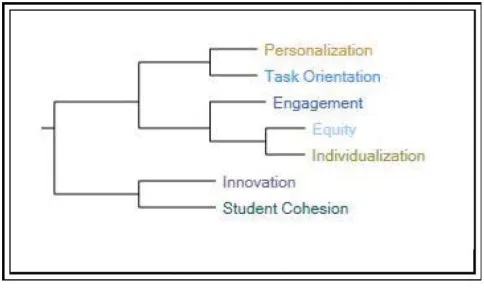
Further, cluster analysis in Figure 5 showed that students’ engagement or involvement (extent to which stu-dents participate actively and attentively in class discus-sions and activities) and individualization (extent to which students are allowed to make decisions in class) were more related to their equity (extent of personal growth) than any other learning environment attribute (Figure 5).
CONCLUSION
There is a pressing need to reform the traditional didactical methods to make learning both enjoyable and effective. In that direction, Bloom’s revised taxonomy emphasizes on collective creation. Further, the flipped classroom approach shifts the lower levels of taxonomy outside the class using interactive technologies, enabling instructors to spend more class time at the upper end of the taxonomy, with tasks that stimulate students to apply, analyze, evaluate, and create (Anderson & Krathwohl, 2001).
The findings highlighted some important implications for business educators in general and OM trainers in partic-ular. First, students in the flipped classroom (class 1) had more issues with the unstructured from of classroom activi-ties and unpredictable homework (low mean score for Task orientation scale and focus group results) than their coun-terparts in traditional lecture-oriented class (class 2). This shows that flipped pedagogical approach may not be appro-priate for introductory classes because students need struc-tured learning tasks to develop interest initially. Once course foundation is built through face-to-face instruction, flipped model could be implemented to facilitate applica-tion of concepts, analysis of practical cases, and synthesis of new problem-solving frameworks through active class-room discussions.
Another finding worth mention is that CUCEI data col-lected for both actual and preferred version from flipped classroom (class 1) indicated high student score on the
TABLE 8
Difference Between Student’s Scores for Actual CUCEI Responses
Scale
Personalization 4.11 0.62 3.66 0.75 ¡1.53 Involvement 3.14 0.56 2.99 0.87 ¡4.12*** Student cohesion 3.01 0.69 2.79 0.59 ¡1.61
Equity 4.15 1.23 4.73 0.76 1.65
Task orientation 3.43 0.54 3.99 0.42 3.01** Innovation 3.16 0.54 2.84 0.42 ¡2.11* Individualization 2.65 0.54 2.32 0.65 ¡1.14
Note: CUCEI D College and University Classroom Environment Inventory.
*
p<.05.**p<.01.***p<.001.
TABLE 9
Difference Between Student’s Scores for Preferred Responses of CUCEI
Personalization 4.45 0.35 4.21 0.43 ¡1.58 Involvement 4.09 0.87 3.23 0.85 ¡2.23* Student cohesion 3.45 0.66 3.70 0.71 0.69
Equity 4.76 0.32 4.82 0.31 0.61
Task orientation 4.32 0.37 4.45 0.65 0.25 Innovation 3.79 0.58 3.09 0.55 ¡3.52*** Individualization 3.45 0.54 3.01 0.45 0.77
Note: CUCEI D College and University Classroom Environment Inventory.
*
p<.05.***p<.001.
FIGURE 4 Most discussed nodes (attributes).
innovation and involvement scales. This indicates that stu-dents in the flipped classroom were more open to associa-tion and valued learning with their partners more than the students in lecture classroom. Additionally, students in the flipped classroom experienced more hands-on activities as compared to their counterparts. This implied that flipped classroom offered more space to students to try out things themselves and thus, make necessary connections with the course content. This is very crucial for teaching courses such as operations management and organizational behav-ior (Krajewski, 1998; Machuca, 2000). This finding con-firms the earlier observation in this field that flipped learning environment promotes the creation of stable and connected learning communities (Strayer, 2012).
On the other hand, the study does also suffer from cer-tain limitations introduced by random selection of partici-pants for the study, observation biases (instructor as researcher) and reluctance in students’ expression due to their fear of disapproval.
Nevertheless, the study provides valuable guidance to educators in designing learning environment for intricate disciplines such as OM. Such areas require pedagogical approaches that not only enable the student to learn the con-cepts but also stimulate their interest both in the discipline as well as its potential as a future career option. Further-more, the study highlighted the indispensability of integrat-ing online and face-to-face components for the success of a flipped classroom model. This should be seen in light of the fact that, even today, the use of technology to support achievement of learning objectives poses a challenge for educators in most disciplines.
REFERENCES
Alavi, M., & Gallupe, R. B. (2003). Using information technology in learn-ing: Case studies in business and management education programs. Academy of Management Learning and Education,2, 139–153. Ammar, S., & Wright, R. (2002). A demonstration of push/pull assembly
line.Informs Transactions on Education,2, 1–8.
Anderson, L. W., & Krathwohl, D. R. (Eds.). (2001).A taxonomy for learn-ing, teaching and assisting: A revision of Bloom’s taxonomy of educa-tion objectives. New York, NY: Longman.
Arbaugh, J. B., Desai, A., Rau, B., & Sridhar, B. S. (2010). A review of research on online and blended learning in the management disciplines: 1994–2009.Organization Management Journal,7, 39–55.
Arenas-Marquez, F. J., Machuca, J. A. D., & Medina-Lopez, C. (2012). Interactive learning in operations management higher education: Soft-ware design and experimental evaluation.International Journal of Oper-ations & Production Management,32, 1395–1426.
Association to Advance of Collegiate Schools of Business (AACSB). (2013).Learning and teaching standards. Retrieved from http://www. aacsb.edu/accreditation/standards/2013-business/learning-and-teaching/ Baker, J. W. (2000).The ‘classroom flip’: Using web course management
tools to become a guide by the side. Paper presented at the 11th interna-tional conference on college teaching and learning, Jacksonville, FL. Bergmann, J., & Sams, A. (2009). Remixing chemistry class: Two
Colo-rado teachers make podcasts of their lectures to free up class time for hands-on activities.Learning & Leading with Technology,36(4), 22–27. Bergmann, J., & Sams, A. (2012).Flip your classroom: Reach every stu-dent in every class every day. Arlington, VA: International Society for Technology in Education. USA.
Bhattacharya, I., & Sharma, K. (2007). India in the knowledge economy— An electronic paradigm.International Journal of Educational Manage-ment,21, 543–568.
Bloom, B. S., Engelhart, M. D., Furst, E. J., Hill, W. H., & Krathwohl, D. R. (1956). Taxonomy of educational objectives: The classification of educational goals. Handbook 1: Cognitive domain. New York, NY: David McKay.
Bonham, S. W., Deardorff, D. L., & Beichner, R. J. (2003). Comparison of student performance using web and paper-based homework in college-level physics.Journal of Research in Science Teaching,40, 1050–1071. Brower, H. H. (2003). On emulating classroom discussion in a
distance-delivered OBHR course: creating an on-line community.Academy of Management Learning & Education,2, 22–36.
Brown, H. (2000).Principles of language learning and teaching(4th ed.). White Plains, NY: Pearson Education.
Chyung, S. Y. (2003). Applying the “congruence” principle of Bloom’s taxonomy to designing online instruction.Quarterly Review of Distance Education,4, 317–323.
Collins, B., De Boer, W., & Van Der Veen, J. (2001). Building on learner contributions: A web-supported pedagogic strategy.Educational Media International,38, 229–240.
De Corte, E., Verschaffel, L., Entwistle, N., & Van Merrienboer, J. (2003). Powerful learning environments: Unraveling basic components and dimensions.Bingley, UK: Emerald Group.
Drennan, J., Kennedy, J., & Pisarski, A. (2005). Factors affecting student attitudes toward flexible online learning in management education.The Journal of Educational Research,98, 331–338.
Duffy, T., & Cunningham, D. (1996). Constructivism: Implications for the design and delivery of instruction. In J. M. Spector, M. D. Merrill, J. van Merrienboer, & M. P. Driscoll (Eds.),Handbook of research for educa-tional telecommunications and technology(pp. 170–198). New York, NY: MacMillan.
Edwards, D. K. (1996). Practical guidelines for lean manufacturing equip-ment.Production and Inventory Management Journal,37, 51–55. Fisher, D. L., & Fraser, B. J. (1983). A comparison of actual and preferred
classroom environment as perceived by science teachers and students. Journal of Research in Science Teaching,20, 55–61.
Fraser, B. J. (1984). Differences between preferred and actual classroom environment as perceived by primary students and teacher.British Jour-nal of EducatioJour-nal Psychology,54, 336–339.
Frederickson, N., Reed, P., & Clifford, V. (2005). Evaluating web-supported learning versus lecture-based teaching: Quantitative and qual-itative perspectives.Higher Education, 50, 645–664.
FIGURE 5 Cluster analysis.
Freeman, S., O’Connor, E., Parks, J. W., Cunningham, M., Hurley, D., Haak, D., . . . Wenderoth, M. P. (2007). Prescribed active learning increases performance in introductory biology.CBE Life Science Educa-tion,6, 132–139.
Friday, E., Friday-Stroud, S. S., Green, A. L., & Hill, A. Y. (2006). A multi-semester comparison of student performance between multiple traditional and online sections of two management courses.Journal of Behavioral and Applied Management, 8(1), 66–81.
Gerjets, P. H., & Hesse, F. W. (2005). When are powerful learning envi-ronments effective? The role of learner activities and of students’ con-ceptions of educational technology. International Journal of Educational Research,41, 445–465.
Goffin, K. (1998). Operations management teaching on European MBA programmes.International Journal of Operations & Production Man-agement,18, 424–451.
Hake, R. (1998). Interactive-engagement versus traditional methods: A six-thousand-student survey of mechanics test data for introductory physics courses.American Journal of Physics,16, 64–74.
Hwang, A., & Arbaugh, J. B. (2009). Seeking feedback in blended learn-ing: Competitive versus cooperative student attitudes and their links to learning outcome.Journal of Computer Assisted Learning,25, 280–293. Joyce, B., & Weil, M. (1996).Models of teaching (5th ed.). Needham
Heights, MA: Allyn & Bacon.
Khan, B. H. (2001). A framework for web-based learning. Englewood Cliffs, NJ: Educational Technology.
Khan, B. H. (2005).Managing. e-learning: Design, delivery, implementa-tion and evaluaimplementa-tion, Hershey, PA: Information Science.
Klein, H. J., Noe, R. A., & Wang, C. (2006). Motivation to learn and course outcomes: The impact of delivery mode, learning goal orientation, and perceived barriers and enablers.Personnel Psychology,59, 665–702. Krajewski, L. (1998). Motivating students in the operations management
class: Challenges for the publishing industry.Production and Opera-tions Management,7, 188–193.
Krathwohl, D. R. (2002). A revision of Bloom’s taxonomy: An overview. Theory Into Practice,41, 212–218.
Lage, M. J., Platt, G. J., & Treglia, M. (2000). Inverting the classroom: A gateway to creating an inclusive learning environment.The Journal of Economic Education,31, 30–43.
Lapsley, R., Kulik, B., Moody, R., & Arbaugh, J. B. (2008). Is identical really identical? An investigation of equivalency theory and online learning.Journal of Educators Online,5(1).
Lewis, M. A., & Maylor, H. R. (2007). Game playing and operations man-agement education. International Journal of Production Economics, 105, 134–149.
Lopez-Perez, M. V., Perez-Lopez, M. C., & Rodrıguez-Ariza, L. (2011). Blended learning in higher education: Students’ perceptions and their relation to outcomes.Computers & Education,56, 818–826.
Machuca, J. A. D. (2000). Transparent-box business simulators: An aid to manage the complexity of organizations. Simulation & Gaming,31, 230–239.
Marshall, C., & Rossman, G. B. (2011).Designing qualitative research (5th ed.). Thousand Oaks, CA: Sage.
Mazur, E. (2009). Farewell, lecture?Science,323, 50–51.
Merrill, G. B., & Galbraith, C. S. (2009). Learning outcomes and instruc-tional delivery method in professional and business related courses: an empirical study controlling for course and instructor differences.Journal of Business and Behavioral Sciences,21(2), 18–38.
Moos, R. H. (1974).The social climate scales: An overview. Palo Alto, CA: Consulting Psychologists Press.
Nunan, D. (1999).Second language teaching & learning. Boston, MA: Heinle & Heinle.
Papadapoulos, C., & Roman, A. S. (2010, October). Implementing an inverted classroom model in engineering statistics: Initial results. Paper presented at the 40th American Society for Engineering Statistics/IEEE Frontiers in Education Conference, Washington, DC.
Pasin, F., & Giroux, H. (2011). The impact of a simulation game on opera-tions management education.Computers & Education,57, 1240–1254. Sheth, N. R. (1991). What is wrong with management education?
Eco-nomic and Political Weekly,26(48), M123–M128.
Strayer, J. F. (2012). How learning in an inverted classroom influences cooperation, innovation and task orientation. Learning Environment Research,15, 171–193.
Tan, K. H., Tse, Y. K., & Chung, P. L. (2010). A plug and play pathway approach for operations management games development.Computers & Education,55, 109–117.
Terry, N. (2007). Assessing instruction modes for master of business administration (MBA) courses.Journal of Education for Business,82, 220–5.
Yazici, H. J. (2004). Student perceptions of collaborative learning in opera-tions management classes. Journal of Education for Business, 80, 110–119.
Yazici, H. J. (2006). Simulation modeling of a facility layout in operations management classes.Simulation and Gaming,37, 73–87.
Yin, R. K. (2009).Case study research: Design and methods, (4th ed., vol. 5). Thousand Oaks, CA: Sage.
Zabriskie, F. H., & McNabb, D. E. (2007). E-hancing the master of busi-ness administration (MBA) managerial accounting course.Journal of Education for Business,82, 226–233.
APPENDIX A: RUBRIC FOR EXTENT OF FLIPPING
Need for Need for face-to-face instruction (lecture)
flipping Low Medium High
Low This means that students like this topic in class, they do not miss this session (irrespective of who teaches it) AND/ OR The topic is very easy to understand AND/OR A lot of Audio-visual content exists related to some of its sub-topics
This means that this concept and MOST of its sub-concepts need greater understanding of some standardized frameworks or process which must be taught in a F2F session in class
This means that this concept and ALL of its sub-concepts need greater understanding of some standardized frameworks or process which must be taught in a F2F session in class
Medium This means that teaching such a topic in a theory class is challenging AND/OR some of the sub-concepts can be better presented with practical videos/ activities AND/OR after class students face many challenges in solving real life issues related to this topic
This means that Many sub-topics in this topic are practical and closer to real life, However, some sub-topics are very theoretical and at the same time important.
This means that some sub-topics in this topic are practical and closer to real life and at the same time highly important for the complete understanding of the topic, However, most sub-topics are very theoretical.
(continued on next page)
(Continued)
Need for Need for face-to-face instruction (lecture)
flipping Low Medium High
High This means that this topic is highly practical, has its most application in day to day life AND/OR most students score very low on questions and projects related to this topic AND/OR teaching such a topic via lecturing style may miss many practical scenarios
This means that almost all the sub-topics in this topic are practical/real life oriented, However there do exist some topics that involve standard theoretical frameworks which must be covered for complete understanding of the topic
This means that many sub-topics in this topic are practical/real life oriented and they make the backbone of the main topic, However there do exist good number of topics that involve standard theoretical frameworks and at the same time are equally important to be covered.
APPENDIX B: FLIPPED CLASSROOM SESSION PLAN
APPEN
DIX
C:
CUCEI
FOR
MS
Actual
Form
136
A.
Pr
eferred
For
m
FLIPPED
CLASSR
OOM
IN
OPERAT
IONS
MANAGE
MENT
EDUCATIO
N
APPENDIX D: QUALITATIVE DATA ANALYSIS (NVIVO)
Attitude Nodes in NVivo 10
Coding Shown for a Piece of Focus Group Transcription