JSChem-ITB-UKM-2007
SOME PHENOLIC COMPOUNDS FROM STEM BARK OF MELINJO
(
GNETUM GNEMON
) AND THEIR ACTIVITY TEST AS
ANTIOXIDANT AND UV-B PROTECTION
Sri Atuna, Retno Arianingruma, Niwa Masatakeb
a Department Chemistry education, Universitas Negeri Yogyakarta, Karangmalang, Depok, Sleman, Yogyakarta, 55281 b
Faculty of Pharmacy, Meijo University, Tempaku, Nagoya, Japan
__________________________________________________________________________________________________________________________
Abstract— Isolation and structure elucidation of three phenolic compounds, namely 3,4-dimethoxychlorogenic acid (1), resveratrol (2), and 3-methoxyresveratrol (3) from stem bark of Melinjo (Gnetum gnemon) had been done. The isolation of those compounds was carried out by chromatographyc method and structure elucidation was performed by interpretation of spectroscopic data, including UV, IR, 1H and 13C NMR 1D and 2D, and FABMS. The result of this study showed that activity each compounds as radical hydroxyl scavenger of 3,4-dimethoxychlorogenic acid (3), resveratrol (2), and 3-methoxyresveratrol (3), with an IC50 523,7; 45,17; and 60,12; g/ml respectively. Each compound showed significant activity as UV-B protection. Activity test as UV-B protection showed that resveratrol and methoxyresveratrol have maximum protections (SPF 8,03 and 12,34 respectively), and 3,4-dimethoxychlorogenic acid has minimum protection (SPF 2,55), each compounds on 50 g/ml.
Key word : melinjo; Gnetum gnemon; natural antioxidant; UV-B protection
____________________________________________________________________________________________________
Introduction
Gnetum gnemon is a species of Gnetaceae which can be found at several places in Indonesia and the local
name is “ melinjo”. The plant ussually can be used as food
source. Several oligostilbenoid compounds had been isolated from some species of Gnetaceae. Oligostilbenoid compound isolated from gnetaceaous plant showed interesting structure and have different characteristic molecular structure than the other oligostilbenoids from Dipterocarpaceae. Therefore, from this research can be found bioactive compounds and can be used as lead compound in pharmaceutical industry[1-8]. In our continuing phytochemical study of the tropical plants occuring in Indonesia, we have examined phenolic constituents of
Gnetum gnemon. This paper will report our first investigation of three phenolic derivatives from stem bark of Gnetum gnemon, namely 3,4-dimethoxychlorogenic acid (1), resveratrol (2), and 3-methoxyresveratrol (3). The structure of this compound based on the analysis spectrum of UV, IR, MS and NMR included ID and 2D NMR.
ITB
PROCEEDING JSChem-ITB-UKM-2007
UKM
O O
HOOC
OH OH
OH
H3CO
OCH3
H
1 2 3
4 5 6
1' 2'
4' 6' 7' 8' 9'
HO OH
OH 1
4 7 8
10 12
2
HO OH
OH 1
4 7 8
10 12
2
OCH3
1
2 3
JSChem-ITB-UKM-2007 2
RESULTS AND DISCUSSION
The isolation was carried out by extraction 9.5 kg dried powdered plant materials with methanol at room temperature for 24 hours (3x). The extract was concentrated at a low pressure, then partision with hexane, chloroform, and ethyl acetate respectively. Fractionated and purification of chloroform fraction (65 g) by repeated chromatography to give two compounds i.e. isolat 1 (40 mg), and isolat 2 (200 mg). Identification these compounds by spectroscophy UV, IR, NMR (1D and 2 D) and FAB MS, concluded that isolat 1 as 3,4-dimethoxychlorogenic acid (1) and isolate 2 as resveratrol (2). A portion of ethyl acetate fraction (40 g) was then subjected to fractionated by VLC (silica gel GF 60 Merk 250 g; : 10 cm, t = 10 cm), using n-hexane, n-hexane-EtOAc, EtOAc, Me2CO, and MeOH of increasing polarity as eluents to give twenty fractions. These fractions were combined to give two major fractions A (4,96 g ) and B (10,4 g ). Fraction B (10,4 g) was repeatedly separated and purified by column
chromatography. From this method we obtained one compound, namely 3-methoxyresveratrol (3) (350 mg). The biological activity as antioxidant was conducted by invitro using Fenton method[9], and activity test as sun protection by invitro with Walters methode[10].
3,4-Dimethoxychlorogenic acid (1) was obtained as a white
powder, UV (MeOH) λmax. 242, 286 and 317 nm, IR (KBr)
υmax. : 3388 ; 2918-2850 ; 1724 ;1598-1514 and 989 cm-1, 1
H and 13C NMR (Me2CO-d6, 600.0 and 150 MHz) see in discussion.
Resveratrol (2) was obtained as a white yellow powder, UV
(MeOH) λmax. 217 and 307 nm, IR (KBr) υmax. : 3276;
1587-1444; 989; 833 cm-1, 1H and 13C NMR (Me2CO-d6, 600.0 and 150 MHz) see in discussion.
3-Methoxyresveratrol (3) was obtained as a white yellow
powder, UV (MeOH) λmax. 229 and 325 nm, IR (KBr)
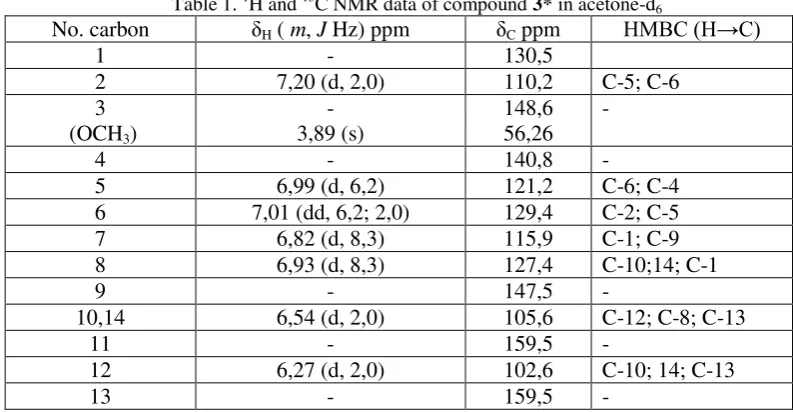
[image:2.595.98.495.325.531.2]υmax. : 3415; 1598-1514; 989cm-1, 1H and 13C NMR (Me2CO-d6, 600.0 and 150 MHz) see in Table 1. FABMS isolat 3 showed molecular ion at m/z 258 [M]+ [C15H14O4].
Table 1. 1H and 13C NMR data of compound 3* in acetone-d6
No. carbon
δ
H(
m
,
J
Hz) ppm
δ
Cppm
HMBC (H→C)
1
-
130,5
2
7,20 (d, 2,0)
110,2
C-5; C-6
3
(OCH
3)
-
3,89 (s)
148,6
56,26
-
4
-
140,8
-
5
6,99 (d, 6,2)
121,2
C-6; C-4
6
7,01 (dd, 6,2; 2,0)
129,4
C-2; C-5
7
6,82 (d, 8,3)
115,9
C-1; C-9
8
6,93 (d, 8,3)
127,4
C-10;14; C-1
9
-
147,5
-
10,14
6,54 (d, 2,0)
105,6
C-12; C-8; C-13
11
-
159,5
-
12
6,27 (d, 2,0)
102,6
C-10; 14; C-13
13
-
159,5
-
a
measured in methanol-d4 at 600 MHz (1H) and 150 MHz (13C) .
From the chloroform extract of stem bark G. gnemon, after separated and repeatedly purification by extensive chromatography resulted two compounds. 3,4-dimethoxychlorogenic acid (1) was obtained as a white powder. Its UV spectrum showed absorption maxima at 242, 286 and 317 nm suggesting the presence of unconjugated phenolic chromophore. The IR spectrum exhibited hydroxyl group (3388 cm-1), 2918-2850 (C-H aliphatic); 1724 (C=O acid); C=C aromatic (1598-1514 cm -1
), 989 (C=C trans olefenic) and monosubtituen benzene (833 cm-1), these spectra characteristic absorptions for supporting 1 to be a phenol derivative. The 1H NMR spectrum of 1 in acetone-d6 exhibited signals in aliphatic and aromatic range. In aromatic range, the 1H NMR spectrum exhibited signals for a set of ABX system at 7,33 (1H, d, J = 1,85 Hz); 7,12 (1H, dd, J = 1,85; 8,0 Hz);
JSChem-ITB-UKM-2007 3 exhibited carbon of siclohexan ring, and 58.0 and 55.0 ppm
exhibited of methoxyl carbon group. Spectrum NMR (1H and 13C) of 1 has similar with chlorogenic acid [11], but isolate 1 has methoxyl group at position 3 and 5 in aromatic ring. Therefore, it may be conclude that 1 is 3,4-dimethoxychlorogenic acid .
Compound 2 was obtained as a white yellow powder, maxima of absorption were observed at 217 and 307 nm in the UV spectrum attributable to the conjugated phenol cromophor.The IR spectrum exhibited hydroxyl group (3276 cm-1), C=C aromatic (1587-1444 cm-1), 989 (trans olefenic), and monosubtituen benzene (833 cm-1).
The 1H NMR spectra showed two sets of AA’BB’ system
of aromatic protons assignable to two independent 4-hydroxyphenyl groups at 6. 7,42 (2H, d, J = 8,5 Hz) ppm and 6,83 (2H, d, J = 8,5 Hz), two sets of meta-coupled aromatic protons at 6,54 (1H, d, J = 2,5 Hz); 6,53 (1H, d, J = 2,5 Hz); and 6,26 (1H, t, J = 2,5; 2,5 Hz) assignable to units 3,5-dihydroxibenzene. They also displayed two signal protons trans coupling at 7,03 (1 H, d, J = 16,0 Hz) and 6,86 (1H, d, J = 16,0 Hz) exhibited of olefenic unit. The 13
C NMR spectrum showed 10 signal carbon which exhibited of 14 carbon atom. Furthermore, 14 signal carbon showed 3 carbon oksiaril at 159,65 (2 C); 158,24 (1C) ppm, 9 carbon metin at 129,09 (1C); 128,75 (2C); 126,86 (1C); 116,43 (2C); 105,64 (2C); 102,68 (1C) ppm; and two carbon quarterner at 140,88 (1C) at 129,95 (1C) ppm. . Spectrum NMR (1H and 13C) of 2 has similar with resveratrol in literature data [2].Therefore, it may be concluded that the 2 is a resveratrol
Compound 3 was obtained as a white yellow powder, maxima of absorption were observed at 229 and 325 nm in the UV spectrum attributable to the conjugated phenol cromophor. The IR spectrum exhibited hydroxyl group (3415 cm-1), C=C aromatic (1598-1514 cm-1), and 989 (trans olefenic). The positive ion FABMS exhibited an [M]+ ion at m/z 258 consistent with a molecular formula C15H14O4 for a resveratrol derivative and supported by the NMR data. 13C NMR spectra showed three signals for oxyaryl carbon at 140,8 (C-4), and 159,5 (C-11; 13). Additionally, the 13C NMR also exhibited one oxyalkyl carbon at 56,26 indicating that C-3 attached with methoxyl fungtional group. The 1H NMR spectrum of 1 in acetone-d6 exhibited signals for of 1,3,4-trisubstitutebenzene at
7,20
(d, 2,0); 6,99 (d, 6,2);
and7,01 (dd, 6,2; 2,0).
The 1HNMR spectrum also showed two sets of meta-coupled aromatic protons signals at 6,54 (2H, d, J = 2,0 Hz) and 6,26 (1H, t, J = 2,0; 2,0 Hz). Additionally, the 1H NMR spectrum exhibited signals for a set of aliphatic proton at δ 6,93 (1 H, d, J = 8,3 Hz) and 6,82 (1H, d, J = 8,3 Hz), characteristic for trans-olefenic proton, and signals
assignable aliphatic protons at δ
3,89 (s) characteristic
for methoxyl proton.
These spectral data indicated thatcompound 3 is 3-methoxy resveratrol (rampotigenetin) (3). The HMQC spectrum supported complete assignment of all proton-bearing carbon signals of compound 3 (Table 1).
Activity test as antioxidant conducted by radical scavenger activity from chloroform and ethyl acetate with Halliwel methode [9], showed at table 2.
Table 2. Data activity test as radical scavenger
No Sample IC50
g/ml
Note 1 Chloroform fraction 214,56 Active 2 Ethyl acetate fraction 1606,41 Less active 3
3,4-Dimetoksichlorogenat acid
523,7 Active
4 Resveratrol 45,17 More active
5 3-Methoxy resveratrol 60,12 More active
5 Vitamin C 83,87 More active
6 BHT 1328,10 Less active
Note : IC50 < 100 g/ml : more active; 100 -1000 g/ml : active; dan 1000-5000 g/ml : less active; > 5000 g/ml : not active
The data showed that the activity as radical hidroxyl scavenger from chloroform and ethyl acetate more lower than vitamin C but more high than BHT. The activity test of isolate 2 and 3 as antioxidant showed high activity. Each compound showed significant activity as UV-B protection. Activity test as UV-B protection showed that resveratrol and methoxyresveratrol have maximum protections (SPF 8,03 and 12,34 respectively), and 3,4-dimethoxychlorogenic acid has minimum protection (SPF 2,55), each compounds on 50 g/ml. Therefore, These results suggest that the compounds from stem bark of
melinjo may be useful as potential sources of natural antioxidants and UV-B protection.
Acknowledgements
This work has been supported by competitive grant XIV(2006-2007), Department General Higher Education, Republic of Indonesia. The authors are grateful to Staff at Laboratorium Biology, UGM for identification of the plant specimen.
References
1. Dai, J.R., Y.F Hallock., J.H. Cardellina , M.R. Boyd (1998), HIV-Inhihibitory and cytotoxic oligostilbenoids isolated from the leaves of Hopea malibato, J. Nat. Prod.,. 61, 351-353
2. Huang Kai-Sheng, Wang Y.H., Li R.L., Lin M., (2000), Five New stilbene dimers from the Lianas of Gnetum hainanense, J. Nat. Prod., 63, 86-89.
3. Ito T., Tanaka T., Ido Y., Nakaya K., Iinuma M., Riswan S., (2000), Stilbenoids isolated from stem bark of Shorea hemsleyana, Chem. Pharm. Bull., 48 (7), 1001-1005. 4. Jang M., Lining Cai, G.O. Udeani, K.V. Slowing, C. F.
JSChem-ITB-UKM-2007 4
(1997), Cancer chemopreventive activity of resveratrol, a natural product derived from Grapes, Science, 275, 218- 220
5. Seo E.K., Chai H. , Constant H.L., Santisuk V.R., Vichai R., Christopher W.W. , Farnsworth N.R., Cordell G.A., Pezzuto J.M., Kinghron A.D. (1999), Resveratrol tetramer from Vatica diospyroides, J. Org. Chem. , 64, 6976-6983
6. Sotheeswaran S., Pasuphaty V. (1993), Distribution of resveratrol oligomers in plants, Phytochemistry, 32 (5), 1083-1092
7. Tanaka T., Ito T., Nakaya K., Linuma M., Riswan S. (2000a ), Oligostilbenoids in the stem bark of Vatica rassak, Phytochemistry, 54, 63-69
8. Tanaka T., Ito T., Nakaya K., Iinuma M., Takashi Y., Naganawa H., Matsuura N., Ubukata M. (2000b),
Vatikanol D, a novel resveratrol hexamer isolated from
Vatica rassak, Tetrahedron Letters, 41, 7929 – 7932 9. Halliwel B, Gutteridge J M C, Aruoma O I. (1987). The
deoxyribose method: a simple test tub assay for determination of rate constans for reaction of hydroxyl radicals. Anal Biochem. 165: 215-219.
10. Walters, C., Keeney A., Wigal C.T., Johnston, C.R, Cornelius R.D., (1997). The spectrophotometric analysis and modelling of sunscreens, Journal of Chem. Ed., 47 (1), 99-102.