ENTREPRENEURSHIP AND THE BIG FIVE PERSONALITY TRAITS: A BEHAVIORAL GENETICS PERSPECTIVE
INTRODUCTION
Why do people become entrepreneurs? Recent research has indicated that some of the variance in who becomes an entrepreneur is accounted for by genetic factors (Nicolaou, Shane, Cherkas, Hunkin and Spector, 2008). Unfortunately, to date research says little about how genetic factors might influence this tendency.
Because we are unlikely to have specific genes for entrepreneurship, the influence of genetic factors on the likelihood of becoming an entrepreneur likely operates through mediating mechanisms. One plausible mechanism is through personality. Empirical research shows that some of the variance in personality traits across people is accounted for by their genetic endowment (Loehlin, 1992; Jang et al., 1996; Plomin et al., 2008). People with different variants of certain genes face different probabilities of developing certain personality traits (Comings et al, 2000; Ebstein et al, 2002). These genetically-influenced personality traits, in turn, affect the odds that a person will become an entrepreneur (Zhao and Seibert, 2006; Rauch and Frese, 2006).
As long as MZ and DZ twins face similar environments to their co-twins, (an assumption we are careful to show is robust), greater cross-trait-cross-twin correlations between the big five and the tendency to be an entrepreneur of MZ twins than of DZ twins would imply that genetic factors contribute to the phenotypic correlation between the two attributes. Because personality traits and occupational choices cannot change an individual’s genetic make-up, greater MZ than DZ cross-trait-cross-twin correlations would indicate that the same genetic factors are the cause of both the tendency to have the personality traits and the tendency to be an entrepreneur. If, on the other hand, the same genetic factors do not influence the big five personality dimensions and entrepreneurship, then there would be no difference in the cross-trait-cross-twin correlations between MZ and DZ twins.
between the big five personality traits and the tendency to become an entrepreneur is of central importance to anyone seeking to be normative about entrepreneurship.
THEORETICAL DEVELOPMENT
A significant portion of the variance in who becomes an entrepreneur is accounted for by genetic factors (Nicolaou, Shane, Cherkas, Hunkin and Spector, 2008). Because we are unlikely to have genes for “entrepreneurship,” the effect of our genes on our tendency to become entrepreneurs is likely to operate through a mediating mechanism. While there are a variety of possible mediating mechanisms, from temperament (Rief and Lesch, 2003) to hormones (Dabbs, 1992) to activity levels (Rutter, 2006), one plausible mechanism is through personality.1
Empirical research shows that a significant portion of the variance in personality traits across people is accounted for by their genetic endowment (Loehlin, 1992; Jang et al., 1996; Plomin et al., 2008). People with different variants of certain genes face different probabilities of developing certain personality traits (Comings et al, 2000; Ebstein et al, 2002). A long line of research shows that these genetically-influenced personality traits, in turn, affect the odds that a person will become an entrepreneur (Knight, 1921; Schumpeter, 1935; McClelland, 1961; Baron, 2007).
The big five model of personality is one of the most comprehensive and parsimonious personality taxonomies (Costa and McCrae, 1992). Although scholars have used somewhat different labels for the five personality traits making up this taxonomy, the five factors are extraversion, openness to experience, agreeableness, conscientiousness and emotional stability (Barrick and Mount, 1991).
The big five model provides a general framework for examining the effects of personality traits on the tendency to become an entrepreneur. Recent meta-analytic evidence has shown that
1
the big five personality traits affect the odds of becoming an entrepreneur (Zhao and Seibert, 2006; Rauch and Frese, 2007).
Empirical research on the big five personality traits also shows that they have a significant genetic component (Comings et al, 2000; Ebstein et al, 2002; Jang et al, 1996), which provides the basis for the development of the hypotheses that follow. We argue that genetic variation affects the development of several neurotransmitters. The genetically-influenced variation in neurotransmitter production, in turn, influences the probability that a person will develop particular personality traits and not others. Finally, those personality traits affect the odds that people will become entrepreneurs. As a result, genetic variation in the odds that people will become entrepreneurs will be observed and a common genetic factor will account for both the development of the personality traits and the tendency to become an entrepreneur. Below we develop specific hypotheses for each of the big five personality traits.
Extraversion
Extraversion is an aspect of personality that includes characteristics such as sociability, talkativeness, assertiveness, and ambition (Barrick and Mount, 1991). It is a valuable trait for entrepreneurs because they need to spend a lot of time interacting with investors, employees, and customers, and have to sell all of them on the value of the business (Shane, 2003).
Behavioral genetics research has shown that the heritability of extraversion ranges from 0.49 (Waller, 1999) to 0.56 (Riemann et al., 1997). Moreover, there is some evidence that the genes that control the development of neurotransmitters, such as dopamine and serotonin, influence the odds of developing the personality trait of extraversion. A particular version of one of the dopamine receptor genes, DRD2, which influences the speed with which dopamine is processed in the brain, is associated with the development of social relationships (Farde and Gustavson, 1997). This may be because the gene variant gives people a stronger physiological reaction to social interaction.
Because genetic factors influence the odds that people will become entrepreneurs (Nicolaou et al., 2008) and that they will be extraverted (Loehlin, 1992), and because extraversion is associated with the tendency to become an entrepreneur, it is possible that part of the covariation between extraversion and the tendency to become an entrepreneur is accounted for by a common genetic factor. This leads to our first hypothesis:
H1: A common genetic factor accounts for some of the covariance between
extraversion and the tendency of people to be entrepreneurs.
Openness to experience
Genetic factors may also account for some of the covariance between openness to experience and entrepreneurship. Openness to experience characterizes someone who is open to novel experiences and ideas and who is imaginative, innovative and reflective (McCrae, 1987; Costa and McCrae, 1992). Such attributes are important for entrepreneurs as they need to explore new ideas and take innovative approaches to the development of products and the organization of businesses (Zhao and Seibert, 2006). Empirical research confirms the positive association between openness to experience and the odds of being an entrepreneur (Zhao and Seibert, 2006).
Research also shows an association between variants of specific genes and openness to experience, most notably the DRD4 gene, which affects the development of dopamine receptors in the brain (Comings et al, 1999). Thus, the development of this personality trait is affected by a person’s genetic endowment.
Because genetic factors influence the odds that people will become entrepreneurs (Nicolaou et al., 2008) and that they will be open to experience (Loehlin, 1992), and because openness to experience is associated with the tendency to become an entrepreneur, it is possible that part of the covariation between openness to experience and the tendency to become an entrepreneur is accounted for by a common genetic factor. This leads to our second hypothesis:
H2: A common genetic factor accounts for some of the covariance between
openness to experience and the tendency of people to be entrepreneurs.
Agreeableness
Genetic factors may account for some of the covariance between agreeableness and entrepreneurship. Agreeableness characterizes someone who is cooperative, trusting, forgiving, tolerant, courteous and soft-hearted (Barrick and Mount, 1991). Agreeable people are less likely to start businesses because people with this trait are less likely to pursue their own self-interest, drive difficult bargains, or use others to achieve their objectives (Zhao and Siebert, 2006). Less agreeable people also are more skeptical than others (Costa and McCrae, 1992) which makes them more likely to have a critical approach to assessing business information (Shane, 2003).
showed that entrepreneurs scored lower than managers on agreeableness (Zhao and Seibert, 2006).
Research has shown that heritability estimates for agreeableness range from 0.33 (Waller, 1999) to 0.42 (Riemann et al., 1997). Researchers also have identified variants of specific genes that are associated with agreeableness, most of which affect neurotransmitters, including DRD4, 5-HTTLPR, 5HT2C, DAT1, SPB, PNMT, GABRAA6, OXYR, CYP19, NMDAR1, and CNRA4 (Comings et al, 1999; 2000; Lesch et al, 1996; Hamer et al, 1999). For instance, the 5HT2C gene, which helps to regulate ACTH, oxytocin and prolactin in the brain, and the 5-HTTLPR gene, which, controls the formation of serotonin transporters, together account for 10 percent of the genetic similarity between people in measures of agreeableness (Jang et al 2001; Greenberg et al, 2000). Thus, the development of the personality trait of agreeableness is affected by a person’s genetic endowment.
Because genetic factors influence the odds that people will become entrepreneurs (Nicolaou et al., 2008) and that they will be agreeable (Loehlin, 1992), and because agreeableness is associated with the tendency to become an entrepreneur, it is possible that part of the covariation between agreeableness and the tendency to become an entrepreneur is accounted for by a common genetic factor. This leads to our third hypothesis:
H3: A common genetic factor accounts for some of the covariance between
agreeableness and the tendency of people to be entrepreneurs.
Conscientiousness
overruns, associated with the venturing process (Locke and Baum, 2007; MacMillan et al., 1985; Timmons, 1989). Empirical research confirms the positive association between conscientiousness and the tendency to be an entrepreneur. A meta-analysis of several studies showed that this was the largest of the big five dimensions on which entrepreneurs and managers differ (Zhao and Siebert, 2006).
Research has shown that conscientiousness has a genetic component to it (Plomin et al., 2008), with heritable estimates ranging from 0.29 (Bergeman et al., 1993) to 0.44 (Jang et al., 1996). Moreover, studies show the association between variants of a number of genes and conscientiousness, including versions of the DRD2, DRD4, CNRA4, ADOR2A, 5-HTTPLR, HTR2C, HTR2A, COMT, VMAT, and 5HT2C genes (Noble et al, 1998; Benjamin et al, 1996; Comings et al 2000; Hamer, 2004; Hamer et al, 1999; Reif and Lesch, 2003; Ebstein et al, 1997, 2002; Plomin and Caspi, 1998).
Because genetic factors influence the odds that people will become entrepreneurs (Nicolaou et al., 2008) and that they will be conscientious (Loehlin, 1992), and because conscientiousness is associated with the tendency to become an entrepreneur, it is possible that part of the covariation between conscientiousness and the tendency to become an entrepreneur is accounted for by a common genetic factor. This leads to our fourth hypothesis:
H4: A common genetic factor accounts for some of the covariance between
agreeableness and the tendency of people to be entrepreneurs.
Emotional stability
significant risks, social isolation, pressure, insecurity, and personal financial difficulties that come from starting their own businesses (Rauch and Freese, 2007). Entrepreneurs cannot worry excessively, and need to be resilient in the face of set backs when building a company (Zhao and Siebert, 2006). Moreover, they need to work in stressful and highly unstructured environments where the separation between family life and work life is often fuzzy.
A variety of studies show that people high on emotional stability are more likely than others to engage in entrepreneurship (Zhao and Seibert, 2006). For instance, one study showed that people who were laid off and went to an outplacement service from which they started a business were more emotionally stable than those who went back to traditional employment through outplacement (Wooten and Folger, 1997). Research even has shown that a child’s score on a measure of anxiety acceptance and hostility – two dimensions of neuroticism – taken at age 11 predicts the odds that the person will be self-employed at age 33 (Blanchflower and Oswald, 1998). Another study showed that people who had founded their own businesses were more emotionally stable as measured by Catell’s 16PF than those who inherited their businesses or had taken them over through marriage (Brandstetter, 1997). And a meta analysis showed that lack of neuroticism, as measured by the 16 personality adjective scale and the 16 personality factor scale, is associated with being an entrepreneur rather than a manager (Zhao and Siebert, 2006).
2003). For instance, a version of the 5HTTLPR gene leads to the production of more of the serotonin transporter than other versions of the gene, thus increasing the degree to which people are neurotic, unassertive, shy and impulsive (Hamer and Copeland, 1999). This gene variant accounts for between three and four percent of the difference between people in neuroticism, and between 7 and 9 percent of their genetic difference in these characteristicsacross a variety of different measures of neuroticism (Lesch et al, 1996).
Other neurotransmitter-related genes also appear to affect neuroticism, including a version of the 5-HT1A gene, the 5HT2C gene, which helps to regulate ACTH, oxytocin and prolactin in the brain, a variant of the gene that governs tyrosine hydroxylase, which affects the nonadrenergic neurotransmitters, CNRA4, ADOR2A, GABRB3, TPH, ADRA2A, DRD4, and COMT (Comings et al, 2000).
Because genetic factors influence the odds that people will become entrepreneurs (Nicolaou et al., 2008) and that they will be emotionally stable (Loehlin, 1992), and because emotional stability is associated with the tendency to become an entrepreneur, it is possible that part of the covariation between emotional stability and the tendency to become an entrepreneur is accounted for by a common genetic factor. This leads to our fifth hypothesis:
H5: A common genetic factor accounts for some of the covariance between
emotional stability and the tendency of people to be entrepreneurs.
METHODOLOGY
the correlations between these different pairs of twins can be used to estimate genetic influence on a variable.
Equal Environments Assumption
DZ twins, on average, face the same environments, and heritability can be estimated conservatively from samples of twins raised together.
Sample
Our sample consists of 3454 twins, comprising 870 pairs of MZ and 857 pairs of same sex DZ pairs from the TwinsUK registry – the national volunteer twin register in the UK – initially recruited through a national media campaign to collect data for medical research on conditions such as osteoarthritis and osteoporosis (www.twinsuk.ac.uk, Spector et al, 1996). All subjects were healthy volunteers with no cognitive or neuropsychological defects, comparable to age-matched singletons (Andrew et al, 2001). The zygosity of the twins was established through a standardized validated questionnaire and, in cases of ambiguity, using multiplex DNA fingerprinting using tandem repeats (Singer et al., 2006).
In 2006, each subject was sent a self-administered mail questionnaire which mainly elicited information on medical conditions. For example, it included questions on osteoporosis, response to pain, dyslexia and exercise details. However, the survey also included some questions about entrepreneurship. Given the focus of the questionnaire, respondents were unaware of the hypotheses of this study when deciding whether or not to respond to the survey.
Measures
Entrepreneurship
The research literature offers several different operationalizations of the phenomenon of entrepreneurship. To obtain convergent validity in our study, we ask the respondents about these different operationalizations and then we sought to create an overall measure of entrepreneurship that is based on these different variables. We asked the respondents about:
we operationalize with the question: “in your working life, how long have you been self employed?”
(ii) Starting a new business (Gartner, 1989; Mesch and Czamanzki, 1997; Delmar and Davidsson, 2000), which we operationalize with the question: “in your working life, how many new businesses have you started?”
(iii)Being an owner-operator of a company (Hull et al., 1980; Ahmed, 1985; Bitler et al., 2005), which we operationalize with the question: “in your working life, how many companies have you been an owner–operator of?”
(iv)Engaging in the firm start-up process (Reynolds et al, 2004; Ruef et al, 2003; Delmar and Shane, 2003), which we operationalize with the question: “in your working life, for how many new business ideas have you taken any actions toward the creation of a new business?”
We factor analyzed the responses and found that they loaded on the same factor. We then combined these different items into a scale, which we found to be reliable; it had a Cronbach’s alpha of 0.80.
Big Five Personality dimensions
We measured the big five personality domains (Extraversion, Agreeableness, Conscientiousness, Emotional Stability, and Openness to Experience) using the TIPI scale (Ten Item Personality Inventory) (Gosling et al., 2003). Prior research has shown the validity and reliability of the scale. It has been translated in 9 languages (e.g. Muck et al., 2007) and has been shown to have slightly increased validity compared to other brief measures of the Big Five Personality dimensions (Furnham, 2008).
We apply multivariate genetics techniques to examine the cross-trait-cross-twin correlations between the big five personality traits and the odds of being an entrepreneur. As long as MZ and DZ twins face similar environments to their co-twins, greater cross-trait-cross-twin correlations between the big five and the tendency to be an entrepreneur of MZ twins than of DZ twins, would imply that genetic factors contribute to the phenotypic correlation between the two variables.
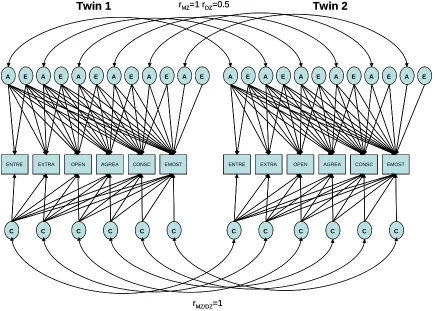
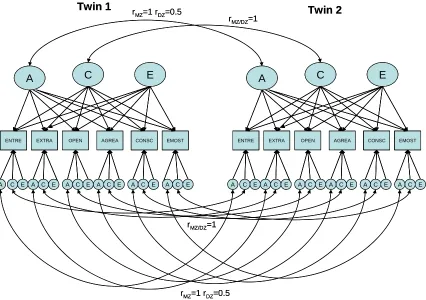
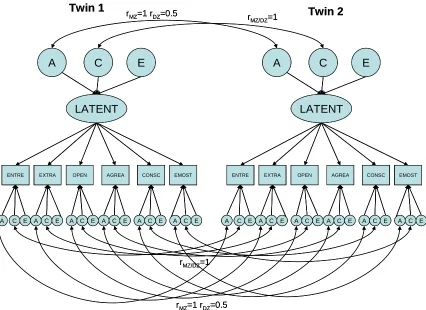
There are three general types of models that can be fit to examine multivariate twin data: Cholesky, Independent Pathway and Common Pathway models. The Cholesky model is the least parsimonious. It assumes that the first latent genetic, unique environmental and common environmental factors load on all observed variables; the second latent genetic, unique environmental and common environmental factors load on all observed variables except for the first; the third latent genetic, unique environmental and common environmental factors load on all variables except the first two, and so on. The independent pathway model assumes general
genetic, common environmental and unique environmental effects, as well as specific genetic, common environmental, and unique environmental effects. The common pathway model is the most parsimonious of the three. It hypothesizes that the general genetic, common environmental and unique environmental effects are mediated through a phenotypic latent variable. Similar to the independent pathway model, this model also assumes that specific genetic, common environmental and unique environmental factors influence each of the observed variables.
comparing the degree of support for various models that is not provided by AIC” (Krueger et al., 2002, p. 418).
(INSERT FIGURES 1, 2 AND 3 ABOUT HERE)
RESULTS
For a common genetic factor to influence the phenotypic variance between the big five personality traits and the tendency to be an entrepreneur, four conditions must hold. First, the personality traits must be heritable. Second, the tendency to be an entrepreneur must be heritable. Third, the personality traits and the tendency to be an entrepreneur must be correlated. Fourth, the genetic factors must account for a substantive portion of the phenotypic correlation between the personality traits and the tendency to be an entrepreneur.
In our sample, we observe substantial heritabilities for all five personality traits. The chi-square test for goodness of fit for the model, the Akaike Information Criterion (Akaike, 1987) and the Root Mean Square Error of Approximation (RMSEA) showed that the best fitting model for each of the big five personality traits included additive genetic and non-shared environmental factors (AE model). The univariate heritabilities for the personality traits of extraversion, openness, agreeableness, conscientiousness and emotional stability were: 0.45, 0.38, 0.32, 0.29 and 0.28 respectively. Thus, we conclude that our sample shows heritability for the big five personality traits.
entrepreneurship examined. Thus, we conclude that our sample shows substantial heritability for entrepreneurship.
We examined the correlations between the big five personality traits and entrepreneurship, which are shown in Table 1. The correlations between entrepreneurship and (i) extraversion, (ii) openness to experience (iii) agreeableness, (iv) conscientiousness and, (v) emotional stability were 0.13 (p<0.01), 0.17 (p<0.01), -0.03, 0.01 and 0.04 (p<0.05) respectively.
Our findings are not consistent with Zhao and Seibert’s (2006) meta analysis, which showed significant effect sizes for all of the big five except extraversion. Our analysis showed significant relationships between entrepreneurship and the big five personality traits of extraversion, openness to experience, and emotional stability.
(INSERT TABLE 1 ABOUT HERE)
that were significantly correlated with entrepreneurship: extraversion, openness to experience, and emotional stability.
If the cross-trait cross-twin correlations are greater for MZ than for DZ twins, then genetic factors contribute to the phenotypic correlation between the two variables. We found greater MZ than DZ cross-trait-cross-twin correlations between both extraversion and entrepreneurship, and between openness to experience and entrepreneurship, indicating that genetic factors influence the correlation between these pairs of variables. However, for emotional stability and entrepreneurship, the cross-trait-cross-twin correlations for MZ twins are not greater than the cross-trait-cross-twin correlations for DZ twins. This means that, while emotional stability is correlated with entrepreneurship, genetic factors do not account for part of this correlation.
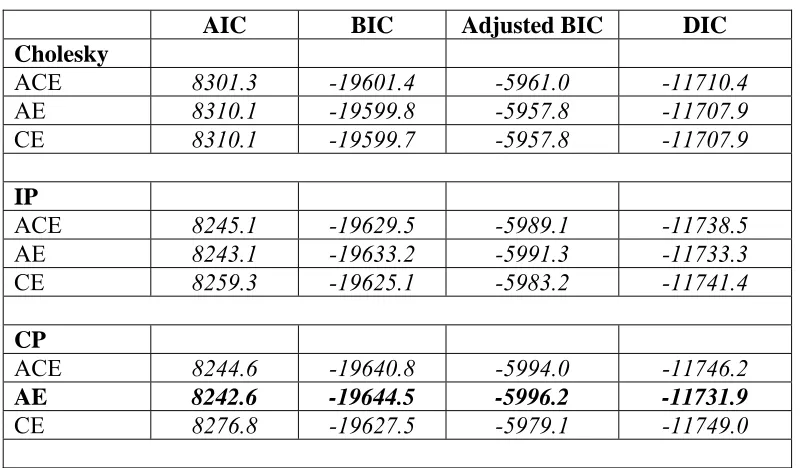
For the personality traits of extraversion and openness to experience, for which the cross-trait-cross-twin correlations indicated a common genetic factor affecting both the personality trait and entrepreneurship, we fitted a Cholesky, an Independent Pathway and a Common Pathway model to the data. The results of the model fitting statistics are shown in Table 2. For each multivariate model, three different models, i.e. ACE, AE and CE models were calculated. Akaike’s Information Criterion, the Bayesian Information Criterion and the Deviance Information Criterion (Neale and Maes, 2002; Spiegelhalter et al., 2002) were used to select the best fitting model. The best fitting model, i.e. the one with the lowest AIC, BIC and DIC scores, was the Common Pathway Model with additive genetic and unique environmental effects (AE model).
(INSERT TABLE 2 ABOUT HERE)
The parameters of this best fitting model are shown in Figure 4. The heritability of entrepreneurship is comprised of specific genetic factors (i.e. genetic factors not shared with extraversion and openness to experience) and common genetic factors that work through a single latent phenotype (and are shared with extraversion and openness to experience). The specific
/ 0.29 + 0.06x0.55). This result shows that most of the genetic predisposition to entrepreneurship is not through genetic factors that influence the big five personality dimensions.
More of the genetic effect on the extraversion and openness to experience covariance comes from common genetic factors. The entrepreneurship-extraversion covariance is 0.075 (√0.06 x √0.31 x 0.55 = 0.075). This implies that 0.58% (0.075/0.13) of the covariance between entrepreneurship and extraversion is accounted for by common genetic factors. The genetic effect on the entrepreneurship - openness to experience covariance is 0.093 (√0.06 x √0.48 x 0.55 = 0.093). This implies that 0.55% (0.093/0.17) of the covariance between entrepreneurship and openness to experience is accounted for by common genetic factors. Nevertheless, the results show that a substantial portion of the genetic variances comes from specific genetic factors.
DISCUSSION
We applied multivariate genetics techniques to a sample of 3454 MZ and same-sex DZ twins from the UK to examine whether genetic factors account for part of the covariance between the big five personality traits and entrepreneurship. We found that both entrepreneurship and the big five are heritable, suggesting that these traits might be the mechanism through which genetic factors influence the tendency of people to be entrepreneurs.
However, we only found limited evidence for this path. We observed significant phenotypic correlations between only three of the big five personality traits and the tendency to engage in entrepreneurship. Even when we looked at specific measures of entrepreneurship as opposed to a composite measure, we failed to find any significant correlations, leading us to conclude that there is no robust relationship between two of the big five personality traits and entrepreneurship.
phenotypic correlation between emotional stability and entrepreneurship showing no evidence of a common genetic factor. Finally, even for those two personality traits for which we found evidence of a common genetic factor, most of the genetic effect on entrepreneurship appears to operate through specific genetic factors.
Our study has several limitations that might account for the limited evidence we found for common genetic effects on the big five personality traits and the tendency to engage in entrepreneurship that we observed. We did not find evidence for the relationship between conscientiousness and entrepreneurship that has been shown in Zhao and Siebert’s (2006) meta-analysis. Therefore, it is possible that our single-study design was insufficient to capture this effect. It is also possible that the TIPI scale that we use to measure the Big 5 is inferior to some of the longer Big 5 personality scales and, therefore, fails to capture the personality traits we seek to measure. Furthermore, our sample of primarily women in the United Kingdom might be inappropriate for capturing the phenomenon of entrepreneurship, given the lower rates of entrepreneurship among women than among men.
However, our results suggest that measurement error does not account for the limited support for our hypotheses. Because we found evidence of the heritability of both the big five personality traits and entrepreneurship, it appears unlikely that our results are artifacts of a sample in which entrepreneurship is less likely to occur or the short instrument we used to measure the big five personality traits. Furthermore, the fact that we found evidence of phenotypic correlations between three of five of the big five personality traits and entrepreneurship, while Zhao and Siebert (2006) found evidence for correlations between four of the big five personality traits and entrepreneurship, combined with the robustness of our correlations to the measures of entrepreneurship used, suggests that inaccurate measures of the personality traits and entrepreneurship are not the explanation for the limited genetic covariation.
Because some scholars believe that conscientiousness has two facets, achievement motivation and dependability, Zhao and Siebert (2006) decomposed the conscientiousness scale into those facets. In so doing, they only found a statistical significant difference between entrepreneurs and managers for achievement motivation. Since, the TIPI scale that we used in our study captures mainly the dependability aspect of conscientiousness (Gosling et al., 2003), our results for conscientiousness are more similar to those that Zhao and Siebert (2006) found in their meta-analysis than appears at first glance.
Because we believe measurement error does not account for our results, we sought to identify the primary mechanism through which genetic factors influence the tendency for people to become entrepreneurs. One possibility is sensation seeking, a personality trait that creates a need for novel experiences (Zuckerman, 1994; Stephenson et al, 2003). People high in sensation seeking are more willing than people low in sensation seeking to take risks to achieve the sensations that they get from doing things new (Lusher et al, 2000), and are less likely to perceive risks (Weber et al, 2002; Rosenbloom, 2003). The willingness to bear the risks associated with starting a business is likely to be affected by sensation seeking because studies have shown that high sensation seekers are more likely than low sensation seekers to engage in a variety of risky activities that are related to starting a business, including taking jobs which involve risk bearing (Rosenbloom, 2003), and bearing personal financial (Wong and Carducci, 1991), and career risk (Zuckerman, 1994).
Following the above argument, we examined the heritability of sensation seeking and the covariation between the tendency to engage in entrepreneurship and sensation seeking, using the sensation seeking scale from the short form of the Zuckerman Kuhlman Personality Questionnaire (ZKPQ-S) (Zuckerman, 2002). 2 Consistent with prior studies, we found a substantial heritability of sensation seeking. Moreover, our analysis of cross-trait-cross-twin correlations indicates that between 31 and 46 percent of the heritability of entrepreneurship was mediated by the psychological trait of sensation seeking.
CONCLUSION
The use of multivariate genetics techniques on a sample of 3454 MZ and same-sex DZ twins from the UK revealed that both entrepreneurship and the big five personality traits are heritable. However, we found that a common genetic factor affected the phenotypic correlations for only two of the big five dimensions: extraversion and openness to experience. No phenotypic correlation was found between conscientiousness or agreeableness and entrepreneurship, and no common genetic factor was found for the phenotypic correlation for emotional stability and entrepreneurship. Moreover, most of the genetic effect for entrepreneurship appears to operate through specific genetic factors rather than genetic factors common with extraversion and openness to experience. Analysis suggests that the personality of sensation seeking is one of the factors through which this genetic effect operates
REFERENCES
Aldrich, H., Kim, P. (2007). A life course perspective on occupational inheritance: Self-employed parents and their children. In M. Ruef, M. Lounsbury (Eds.) Research in the Sociology of Organizations. JAI Press: Amsterdam: Elsevier.
Amit, R., Muller, E., Cockburn, I. (1995). Opportunity costs and entrepreneurial activity. Journal of Business Venturing, 10(2), 95-106.
Baron, R. A. (2004). The cognitive perspective: A valuable tool for answering entrepreneurship’s basic “why” questions. Journal of Business Venturing 19(2) 221-239.
Baron, R. A. (2007). Behavioral and cognitive factors in entrepreneurship. Strategic Entrepreneurship Journal, 1, 167-182.
Barrick, M. R., Mount, M. K. (1991). The Big Five personality dimensions and job performance: A meta-analysis. Personnel Psychology, 44, 1–26.
Benjamin, J., Li, L., Patterson, C., Greenberg, B., Murphy, D., and Hamer, D. 1996.
Population and familial association between the D4 dopamine receptor gene and
measures of sensation seeking. Nature Genetics, 12: 81-84
Benjamin, J., Ebstein, R., and Lesch, K. 1998. Genes for personality traits: Implications
for psychopathology. International Journal of Neuropsychopharmacology, 1:
153-168
Bergman, C. S., Chipuer, H. M., Plomin, R., Pedersen, N. L., McClearn, G. E., Nesselroade, J. R., Costa, P. T., McCrae, R. R. (1993). Genetic and environmental effects on Openness to Experience, Agreeableness, and Conscientiousness: An adoption/twin study. Journal of Personality, 61, 159–179.
Blanchflower, D., and Oswald, A. 1998. What makes an entrepreneur? Journal of Labor
Economics, 16(1): 26-60.
Brandstetter, H. 1997. Becoming an entrepreneur – a question of personality structure?
Carey, G. (2003). Human Genetics for the Social Sciences. Thousand Oaks: Sage Publications. Cohen, J. (1992). A power primer. Psychological Bulletin. 112(1), 155-159.
Comings, D., Gonzalez, N., Wu, S., Gade, R., Muhleman, D., Saucier, G., Johnson, P., Verde, R., Rosenthal, R., Lesieur, H., Rugle, L., Miller, W., MacMurray, J. (1999). Studies of the 48 bp repeat polymorphism of the DRD4 gene in impulsive, compulsive, and addictive behaviors: Tourette syndrome, ADHD, pathological gambling, and substance abuse. American Journal of Medical Genetics, 88: 358-368.
Comings, D., Gade-Andavolu, R., Gonzalez, N., Wu, S., Muhleman, D., Blake, H.,
Mann, M, Dietz, G., Saucier, G., and MacMurray, J. 2000. A multivariate analysis
of 59 candidate genes in personality traits: The temperament and character
inventory. Clinical Genetics, 58: 375-385.
Comings, D., Gonzalez, N., Wu, S., Gade, R., Muhleman, D., Saucier, G., Johnson, P.,
Verde, R., Rosenthal, R., Lesieur, H., Rugle, L., Miller, W., and MacMurray, J.
1999. Studies of the 48 bp repeat polymorphism of the DRD4 gene in impulsive,
compulsive, and addictive behaviors: Tourette syndrome, ADHD, pathological
gambling, and substance abuse. American Journal of Medical Genetics, 88:
358-368.
Costa, P. T., Jr., McCrae, R. R. (1992). Revised NEO Personality Inventory (NEO-PI-R) and NEO Five Factor Inventory NEO-FFI) professional manual. Odessa, FL: PAR
Dabbs, J. 1992. Testosterone and occupational achievement. Social Forces, 70(3):
813-824.
Ebstein, R., Benjamin, J., and Belmaker, R. 2002. Behavioral genetics, genomics, and
Genetics in the Postgenomic Era Washington: American Psychological
Association, 265-388
Ebstein, R., Segman, R., Benjamin, J., Osher, Y., Nemanov, L., and Belmaker, R. 1997.
5HT
2Cserotonin receptor gene polymorphism associated with the human
personality trait of reward dependence: Interaction with dopamine D4 receptor
(D4DR) and dopamine D3 Receptor (D3DR) polymorphisms. American Journal
of Medical Genetics, 74: 65-72.
Farde, L., and Gusavsson, J. 1997. D2 dopamine receptors and personality traits. Nature,
385, February 13: 590.
Furnham, A. (2008). Relationship among four Big Five measures of different length. Psychological Reports, 102, 312-316.
Gaglio, C. M., Katz, J. A. (2001). The psychological basis of opportunity identification: Entrepreneurial alertness. Small Business Economics, 16, (2) 95-111.
Gosling, S. D., Rentfrow, P. J., Swann, W. B., Jr. (2003). A Very Brief Measure of the Big Five Personality Domains. Journal of Research in Personality, 37, 504-528.
Greenberg, B., Li, Q., Lucas, F., Hu, S., Sirota, L., Benjamin, J., Lesch, K., Hamer, D.,
and Murphy, D. 2000. Association between the serotonin transporter promoter
polymorphism and personality traits in a primarily female population sample.
American Journal of Medical Genetics, 96: 202-216.
Hamer, D. 2004. The God Gene, New York: Doubleday; Hamer, D. 2004. The God
Gene, New York: Doubleday.
Hamer, D., Greenberg, B., Sabol, S., and Murphy, D. 1999. Role of the serotonin
transporter gene in temperament and character. Journal of Personality Disorders,
13: 312-328.
Harper, D. 1996. Entrepreneurship and the market process. London: Routledge.
Heinstrom, J. 2003. Five personality dimensions and their influence on information behavior. Information Research, 9(1):
Hettema, J. M., Neale, M .C., Kendler, K. S. (1995). Physical similarity and the equal environment assumption in twin studies of psychiatric disorders. Behavior Genetics, 25, 327-335.
Jaffee, S. R., Price, T. S. (2007). Gene-environment correlations: a review of the evidence and implications for prevention of mental illness. Molecular Psychiatry, 12, 432-442.
Jang, K, W., Livesley, J., Vernon, P. (1996). Heritability of the Big Five Personality Dimensions and Their Facets: A Twin Study. Journal of Personality 63, 577-591.
Jang, K., Livesley, W., Reimann, R., Vernon, P., Hu, S., Angleitner, A., Ando, J., Ono,
Y., and Hamer, D. 2001. Covariance structure of neuroticism and agreeableness:
A twin and molecular genetic analysis of the role of the serotonin transporter
gene. Journal of Personality and Social Psychology, 81(2): 295-304.
John, O. P. (1990). The “big five” factor taxonomy: Dimensions of personality in the natural language and questionnaires. In L. A. Pervin (Ed.), Handbook of Personality (pp. 66– 100). New York: Guilford Press.
Keller, L., Bouchard, T., Arvey, R., Segal, N., and Dawes, R. (1992). Work values: genetic and environmental influences. Journal of Applied Psychology, 77(1), 79-88.
Kendler, K. S., Prescott, C. A. (2006). Genes, Environment and Psychopathology. New York: Guilford Press.
Knight, F. (1921). Risk, uncertainty and profit. Boston, MA: Hart, Schaffner & Marx.
Krueger, R. F., Hicks, B. M., Patrick, C. J., Carlson, S. R., Iacono, W. G., & McGue, M. (2002). Etiologic connections among substance dependence, antisocial behavior, and personality: Modeling the externalizing spectrum. Journal of Abnormal Psychology, 111, 411-424. Kuntsi, J., Eley, T. C., Taylor, A., Hughes, C., Asherson, P., Caspi, A., Moffitt, T. E. (2004).
Co-occurrence of ADHD and low IQ has genetic origins. American Journal of Medical Genetics Part B. 124B, 41-47.
Lesch, K., Bengel, D., Heils, A., Sabol, S., Greenberg, B., Petri, S., Benjamin, J., Muller,
C., Hamer, D., and Murphy, D. 1996. Association of anxiety related trait with a
polymorphism in the serotonin transporter gene regulation region. Science, 274:
1527-1531.
Locke, E., and Baum, R. 2007.Entrepreneurial motivation. In J. Baum, M. Frese and R.
Baron (eds.), The Psychology of Entrepreneurship, Mahwah, NJ: Erlbaum, 41-65
Loehlin, J. C. (1992) Genes and environment in personality development. Newbury Park, CA: Sage Publications Inc.
Loehlin, J., and Martin, N. 2001. Age changes in personality traits and their heritabilities
during the adult years. Evidence from Australian twin registry samples.
Personality and Individual Differences, 30: 1147-1160;
Loehlin, J., McCrae, R., Costa, P., and John, O. 1998. Heritabilities of common and
measure-specific components of the Big Five personality factors. Journal of
Research in Personality, 32: 431-453
McCrae, R. R., Costa, P. T., Jr. (1997). Conceptions and correlates of Openness to Experience. In S. R. Briggs, R. Hogan, & W. H. Jones (Eds.), Handbook of Personality Psychology (pp. 825–847). San Diego: Academic Press.
McMullen, J. S., Shepherd, D. A. (2006). Entrepreneurial action and the role of uncertainty in the theory of the entrepreneur, Academy of Management Review, 31(1), 132–152.
Moffitt, T., Caspi, A., Rutter, M. (2006). Measured gene-environment interactions in psychopathology: Concepts, research strategies, and implications for research, intervention, and public understanding of genetics. Perspectives on Psychological Science, 1, 5-27.
Muck, P. M., Hell, B., Gosling, S. D. (2007). The construct validation of a short five-factor model instrument: A self-peer study on the German adaptation of the Ten-Item Personality Inventory (TIPI-G). European Journal of Psychological Assessment, 23, 166-175.
Neale, M. C., Maes, H. H. M. (2002). Methodology for Genetic Studies of Twins and Families. Dordrecht, Netherlands: Kluwer Academic Publishers.
Nichols, R. C. (1978). Twin studies of ability, personality and interests. Homo, 29, 158–173. Nicolaou, N., Shane, S., Cherkas, L., Hunkin, J., Spector, T. (2008). Is the tendency to engage in
entrepreneurship genetic? Management Science, 54(1), 167-179.
Noble, E., Ozkaragoz, T., Ritchie, T., Zhang, X, Belin, T., and Sparkes, R. 1998. D
2and
D
4dopamine receptor polymorphisms and personality. American Journal of
Medical Genetics, 81: 257-267
Parker, S. C. (2004). The Economics of Self-Employment and Entrepreneurship. Cambridge: Cambridge University Press.
Plomin, R., and Caspi, A. 1998,. DNA and Personality. European Journal of Personality,
Plomin, R., DeFries, J. C., McClearn, G. E., McGuffin, P. (2008). Behavioral Genetics 5th ed. New York: Worth Publishers.
Rauch, A., Frese, M. 2000. Psychological approaches to entrepreneurial success: A general model and an overview of findings. In Cooper, C. L., Robertson, I. T. (eds.) International Review of Industrial and Organizational Psychology 101-142. Chichester: Wiley.
Rauch, A., and Frese, M. 2007. Let’s put the person back into entrepreneurship research:
A meta-analysis on the relationship between business owners personality traits,
business creation, and success. European Journal of Work and Organizational
Psychology, 16(4): 353-385
Reif, A., and Lesch, K. 2003. Towards a molecular architecture of personality.
Behavioral Brain Research, 139: 1-20, p.7.
Reynolds, P., Carter, N., Gartner, W., and Greene, P. (2004). The prevalence of nascent entrepreneurs in the United States: Evidence from the panel study of entrepreneurial dynamics. Small Business Economics, 23, 263-284.
Riemann, R., Angleitner, A., Strelau, J. (1997). Genetic and environmental influence on personality: A study of twins reared together using the self- and peer report NEO-FFI scales. Journal of Personality, 65, 449–475.
Ruef, M., Aldrich, H., Carter, N. (2003). The structure of founding teams: Homophily, strong ties, and isolation among U.S. entrepreneurs. American Sociological Review, 68, 195-222.
Rutter, M. 2006. Genes and Behavior. Oxford: Blackwell; Sherman, D., McGue, M., and
Iacono, W. 1997. Twin concordances for attention deficit hyperactivity disorder:
A comparison of teachers’ and mothers’ reports. American Journal of Psychiatry,
Saudino, K., Gagne, J., Grant, J., Ibatoulina, A., Marytuina, T., and Ravich-Sherbo, I.
1999. Genetic and environmental influences on personality in adult Russian twins.
International Journal of Behavioral Development, 23: 375-389.
Scarr, S. (1992). Developmental theories for 1990s: Development and individual differences. Child Development 63, 1-19.
Scarr, S., Carter-Saltzman, L. (1979). Twin method: Defense of a critical assumption. Behavior Genetics, 9, 527-542.
Shane, S. (2003). A General Theory of Entrepreneurship: The Individual-Opportunity Nexus, Aldershot, UK: Edward Elgar Publishing.
Shane, S., Venkataraman, S. (2000). The promise of entrepreneurship as a field of research. Academy of Management Review, 25, 217-226.
Singer J.J., MacGregor A.J., Cherkas L.F., Spector T.D. (2005). Where did I leave my keys? A twin study of self-reported memory ratings using the multifactorial memory questionnaire. Twin Research Human Genetics, 8(2), 108-12.
Spector, T., Cicuttini, F.,Baker, J., Loughlin, J., Hart D. (1996). Genetic influences on osteoarthritis in women: a twin study. BMJ 312, 940-4.
Spiegelhalter D.J., Best, N.G., Carlin, B.P., van der Linde, A. (2002) Bayesian measures
of model complexity and fit (with discussion), Journal Royal Statistical Society B,
64, 583-640.
Strobel, A., Gutknecht, L., Roth, C., Reif, A., Mossner, R., Zeng, Y., Brocke, B., and
Lesch, K. 2003. Allelic variation in 5-HT1A receptor expression is associated
with anxiety and depression-related personality traits. Journal of Neural
Transmission, 110: 1445-1453
Van Praag, C., and Ophem, H. 1995. Determinants of willingness and opportunity to start as an entrepreneur. Kyklos, 48: 513-540.
Viken, R., Rose, R., Kaprio, J., and Koskenvuo, M. 1994. A developmental genetic
analysis of adult personality: Extraversion and neuroticism from 18 to 59 years of
age. Journal of Personality and Social Psychology, 66(4): 722-730
White, R., Thornhill, S., Hampson, E. (2006). Entrepreneurs and evolutionary biology: The relationship between testosterone and new venture creation. Organizational Behavior and Human Decision Processes, 100, 21-34.
White, R., Thornhill, S., Hampson, E. (2007). A biosocial model of entrepreneurship: the combined effects of nurture and nature. Journal of Organizational Behavior, 28, 451-466.
Winterer, G., and Goldman, D., 2003. Genetics of prefrontal function. Brain Research
Reviews, 43: 13-163.
Yu, T. (2001). Entrepreneurial alertness and discovery. The Review of Austrian Economics, 14(1), 47-63.
Zhao, H.,Seibert, S. (2006). The big five personality dimensions and entrepreneurial status: A meta-analytic review. Journal of Applied Psychology, 91(2): 259-271.
Zuckerman, M. 2005. Psychobiology of Personality, Cambridge, UK: Cambridge
Figure 1: Cholesky Model
rMZ=1 rDZ=0.5
Twin 1 Twin 2
OPEN EXTRA
ENTRE AGREA CONSC EMOST
A E A E A E A E A E A E
C C C C C C
OPEN EXTRA
ENTRE AGREA CONSC EMOST
A E A E A E A E A E A E
C C C C C C
rMZ/DZ=1 rMZ=1 rDZ=0.5
Twin 1 Twin 2
OPEN EXTRA
ENTRE AGREA CONSC EMOST
A E A E A E A E A E A E
C C C C C C
OPEN EXTRA
ENTRE AGREA CONSC EMOST
A E A E A E A E A E A EE
C
C CC CC CC CC CC
OPEN EXTRA
ENTRE AGREA CONSC EMOST
A E A E A E A E A E A E
C C C C C C
OPEN EXTRA
ENTRE AGREA CONSC EMOST
A E A E A E A E A E A EE
C
C CC CC CC CC CC
Figure 2: Independent Pathway Model
rMZ/DZ=1 rMZ=1 rDZ=0.5
Twin 1 Twin 2
rMZ=1 rDZ=0.5 OPEN
EXTRA
ENTRE AGREA CONSC EMOST
A C E
A C E A C E A C E A C E A C E A C E
OPEN EXTRA
ENTRE AGREA CONSC EMOST
A C E
A C E A C E A C E A C E A C E A C E
rMZ/DZ=1
rMZ/DZ=1 rMZ=1 rDZ=0.5
Twin 1 Twin 2
rMZ=1 rDZ=0.5 OPEN
EXTRA
ENTRE AGREA CONSC EMOST
A C E
A C E A C E A C E A C E A C E A C E
OPEN EXTRA
ENTRE AGREA CONSC EMOST
A C E
A C E A C E A C E A C E A C E A C E
OPEN EXTRA
ENTRE AGREA CONSC EMOST
A C E
A C E A C E A C E A C E A C E A C E
OPEN EXTRA
ENTRE AGREA CONSC EMOST
A C E
A C E A C E A C E A C E A C E A C E
Figure 3: Common Pathway Model
rMZ/DZ=1 rMZ=1 rDZ=0.5
Twin 1 Twin 2
rMZ=1 rDZ=0.5
OPEN EXTRA
ENTRE AGREA CONSC EMOST
A C E A C E A C E A C E A C E A C E
LATENT
A C E
OPEN EXTRA
ENTRE AGREA CONSC EMOST
A C E A C E A C E A C E A C E A C E
LATENT
A C E
rMZ/DZ=1
rMZ/DZ=1 rMZ=1 rDZ=0.5
Twin 1 Twin 2
rMZ=1 rDZ=0.5
OPEN EXTRA
ENTRE AGREA CONSC EMOST
A C E A C E A C E A C E A C E A C E
LATENT
A C E
OPEN EXTRA
ENTRE AGREA CONSC EMOST
A C E A C E A C E A C E A C E A C E
LATENT
A C E
OPEN EXTRA
ENTRE AGREA CONSC EMOST
A C E A C E A C E A C E A C E A C E
LATENT
A C E
OPEN EXTRA
ENTRE AGREA CONSC EMOST
A C E A C E A C E A C E A C E A C E
LATENT
A C E
Table 1: Descriptive statistics
Variable
μ
σ
1 2 3 4 5 6
1. Entrepreneurship .44 .77
2. Extraversion 3.55 1.57 .13
3. Openness to Experience 3.24 1.27 .17 .39
4. Agreeableness 2.43 1.12 -.03 -.04 .05
5. Conscientiousness 2.08 1.07 .01 .07 .10 .22
6. Emotional Stability 3.28 1.40 .04 .19 .15 .29 .23
7. Sex .91 .29 .10 .01 -.02 -.11 .00 .08
Table 2: Model fitting statistics for the different multivariate models
AIC BIC
Adjusted
BIC
DIC
Cholesky
ACE
8301.3 -19601.4 -5961.0 -11710.4
AE
8310.1 -19599.8 -5957.8 -11707.9
CE
8310.1 -19599.7 -5957.8 -11707.9
IP
ACE
8245.1 -19629.5 -5989.1 -11738.5
AE
8243.1 -19633.2 -5991.3 -11733.3
CE
8259.3 -19625.1 -5983.2 -11741.4
CP
ACE
8244.6 -19640.8 -5994.0 -11746.2
AE
8242.6 -19644.5 -5996.2 -11731.9
Figure 4: The Parameters of the Best Fitting Model
OPENNESS
A
E
EXTRAVER
A
E
EXPLOIT
A
E
LATENT
A
E
0.55 0.45
0.12 0.28
0.29
0.06 0.31 0.48
0.66 0.41 0.39
OPENNESS
A
E
EXTRAVER
A
E
EXPLOIT
A
E
LATENT
A
E
0.55 0.45
0.12 0.28
0.29
0.06 0.31 0.48